Recognition: unknown
Truthful-in-Expectation Mechanisms for MMS Approximation
Pith reviewed 2026-05-07 10:34 UTC · model grok-4.3
The pith
Randomized truthful-in-expectation mechanisms guarantee agents 1 over log n of their maximin share ex-post for indivisible goods.
A machine-rendered reading of the paper's core claim, the machinery that carries it, and where it could break.
Core claim
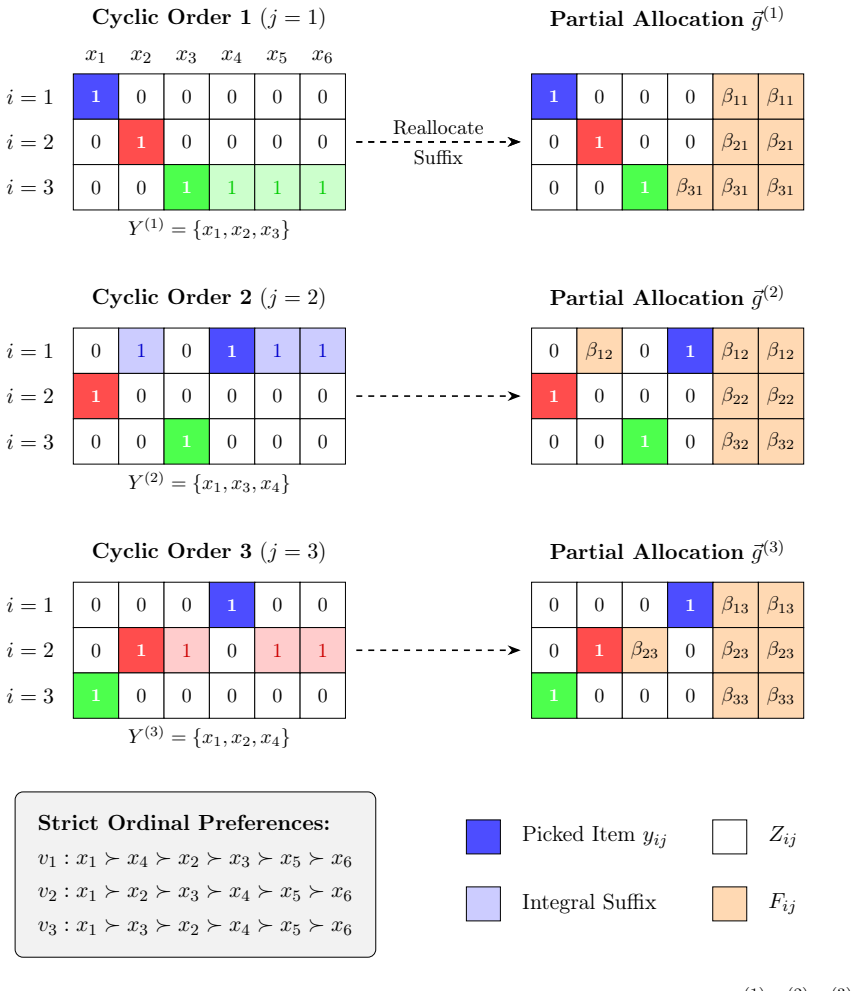
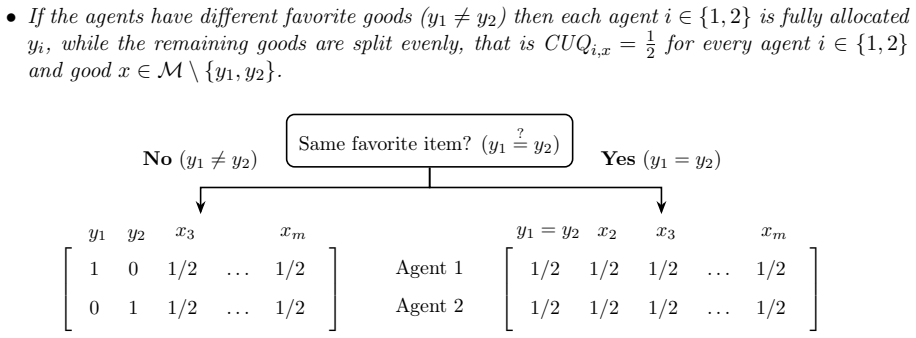
We present an ordinal TIE mechanism that guarantees 1/(H_n + 2)-MMS ex-post, where H_n is the nth harmonic number. This is nearly best possible for ordinal mechanisms, as even non-truthful ordinal allocation algorithms cannot obtain an approximation better than 1/H_n. With just a small amount of additional cardinal information, the ex-post guarantee can be improved to Omega(1/log log n)-MMS at the cost of relaxing the incentive requirement to (1-ε(n))-TIE for negligible ε(n). For two agents, we present a TIE mechanism that is 2/3-MMS ex-post. All mechanisms are ex-ante proportional and polynomial time, and extend to the truncated proportional share.
What carries the argument
Truthful-in-Expectation (TIE) randomized allocation mechanisms that use ordinal rankings or limited cardinal values to approximate the maximin share (MMS) ex-post.
If this is right
- Agents simultaneously receive ex-ante proportionality and the stated ex-post MMS fraction.
- The mechanisms run in polynomial time for arbitrary numbers of agents and goods.
- The same approximation guarantees apply when MMS is replaced by the truncated proportional share, which is always at least as large.
- For two agents the 2/3 guarantee is tight for the truncated proportional share.
Where Pith is reading between the lines
- Relaxing truthfulness to expectation allows bypassing impossibility results known for deterministic truthful mechanisms.
- The improvement from limited cardinal data suggests that hybrid elicitation protocols could be designed for real-world fair division systems.
- The near-optimality of the ordinal bound implies that further gains for many agents will require either more information or stronger relaxations of truthfulness.
Load-bearing premise
Agents have additive valuations and the mechanism can elicit either complete ordinal rankings or a small amount of cardinal value information while preserving the TIE property.
What would settle it
A specific set of additive valuation profiles for n agents in which every TIE mechanism leaves some agent with less than 1/(H_n + 2) of their MMS ex-post would show the ordinal guarantee does not hold.
Figures


read the original abstract
We study fair allocation of indivisible goods among strategic agents with additive valuations. Motivated by impossibility results for deterministic truthful mechanisms, we focus on randomized mechanisms that are \emph{Truthful-in-Expectation (TIE)}. From a fairness perspective, we seek to guarantee every agent a large fraction of their \emph{Maximin Share (MMS)} ex-post. Among other results, Bu~and~Tao~[FOCS 2025] presented a TIE mechanism that guarantees $\frac{1}{n}$-MMS ex-post. First, we present an ordinal TIE mechanism that guarantees $\frac{1}{H_n + 2}$-MMS ex-post, where $H_n$ is the $n$-th harmonic number ($H_n \simeq \ln n$). This is nearly best possible for ordinal mechanisms, as even non-truthful ordinal allocation algorithms cannot obtain an approximation better than $\frac{1}{H_n}$. We then show that with just a small amount of additional cardinal information, the ex-post guarantee can be improved to $\Omega(\frac{1}{\log\log n})$-MMS, at the cost of relaxing the incentive requirement to $(1-\varepsilon(n))$-TIE for negligible $\varepsilon(n)$. Finally, for two agents, we present a TIE mechanism that is $\frac{2}{3}$-MMS ex-post. All our mechanisms are ex-ante proportional (thus also providing ``Best-of-Both-Worlds'' results) and run in polynomial time. Moreover, all our results extend to the truncated proportional share (TPS), which is at least as large as the MMS. Our two-agent $\frac{2}{3}$-TPS result is best possible for the TPS.
Editorial analysis
A structured set of objections, weighed in public.
Referee Report
Summary. The paper studies the design of truthful-in-expectation (TIE) randomized mechanisms for allocating indivisible goods to strategic agents with additive valuations, with the goal of providing strong ex-post maximin share (MMS) guarantees. Building on prior work that achieved 1/n-MMS, it presents an ordinal TIE mechanism with 1/(H_n + 2)-MMS ex-post approximation, where H_n is the nth harmonic number. It further shows that incorporating a small amount of cardinal information allows improving the guarantee to Ω(1/log log n)-MMS while relaxing to (1-ε(n))-TIE for negligible ε(n). For the special case of two agents, a TIE mechanism achieving 2/3-MMS ex-post is given. All mechanisms are ex-ante proportional, run in polynomial time, and the results extend to the truncated proportional share (TPS), with the two-agent 2/3-TPS being optimal.
Significance. Assuming the proofs and constructions are correct, this work is significant as it advances the understanding of incentive-compatible fair allocation mechanisms. The near-optimality of the ordinal result relative to non-strategic bounds is a strong point, as is the demonstration that minimal cardinal elicitation can yield substantial improvements in fairness guarantees. The polynomial-time nature and Best-of-Both-Worlds properties (ex-ante proportionality combined with ex-post MMS) make the mechanisms more applicable. The tightness result for two agents and extension to TPS add to the completeness of the contribution. These results help bridge the gap between theoretical fairness notions and practical mechanism design in multi-agent systems.
major comments (1)
- The near-optimality claim for the ordinal TIE mechanism depends on the fact that non-truthful ordinal algorithms cannot exceed 1/H_n-MMS; a reference to the relevant lower bound result or a short explanation in the introduction would strengthen this assertion.
minor comments (3)
- Define H_n explicitly as the nth harmonic number on first mention for clarity.
- Ensure that the specific form of ε(n) in the (1-ε(n))-TIE relaxation is explicitly stated and analyzed for negligibility in the main body.
- The manuscript would benefit from a table summarizing the approximation guarantees, elicitation requirements, and truthfulness levels for each proposed mechanism.
Simulated Author's Rebuttal
We thank the referee for the positive review, the recognition of the significance of our results, and the recommendation for minor revision. We address the major comment below.
read point-by-point responses
-
Referee: The near-optimality claim for the ordinal TIE mechanism depends on the fact that non-truthful ordinal algorithms cannot exceed 1/H_n-MMS; a reference to the relevant lower bound result or a short explanation in the introduction would strengthen this assertion.
Authors: We agree with the referee that explicitly citing the relevant lower bound would strengthen the near-optimality claim. The statement in the manuscript is based on the known result that no (even non-truthful) ordinal algorithm can guarantee better than 1/H_n-MMS ex-post in the worst case. We will add a short explanation together with a reference to the appropriate lower-bound theorem from the MMS literature in the introduction of the revised version. revision: yes
Circularity Check
No significant circularity
full rationale
The paper's central results consist of explicit mechanism constructions (ordinal TIE for 1/(H_n+2)-MMS, limited-cardinal relaxation to Ω(1/log log n), and two-agent 2/3-MMS/TPS) whose approximation ratios are obtained by direct analysis of the proposed allocation rules under standard additive valuations and the usual MMS definition. These constructions cite Bu and Tao for the baseline 1/n guarantee and reference the known 1/H_n ordinal lower bound for non-truthful algorithms; neither citation is load-bearing for the new upper bounds, nor do any steps rename fitted parameters as predictions or reduce the claimed ratios to self-definitional equations. The ex-ante proportionality and polynomial-time claims follow from the same explicit rules. The derivation chain is therefore self-contained against external benchmarks and does not collapse to its inputs by construction.
Axiom & Free-Parameter Ledger
axioms (2)
- domain assumption Valuations are additive
- standard math MMS and TIE are defined in the usual way
Reference graph
Works this paper leans on
-
[1]
Select any rowu∈Rand any columnv∈C
-
[2]
Sinceu∈Randv∈C, it is guaranteed thatδ >0
Compute the maximum allowed increaseδ= min(su −a u,1−b v). Sinceu∈Randv∈C, it is guaranteed thatδ >0
-
[3]
UpdateB ′ uv ←B ′ uv +δ
-
[4]
Update the running sumsau ←a u +δandb v ←b v +δ. 51
-
[5]
Ifb v = 1, removevfromC
Ifa u =s u, removeufromR. Ifb v = 1, removevfromC. In every iteration of the loop, either a row reaches its target and is removed fromR, or some column reaches its target and is removed fromC(or both). Therefore, the loop terminates after at mostr+citerations. We now show thatBuv ≤B ′ uv ≤1. Because initiallyB∈[0,1] r×c, and our algorithm only adds strict...
-
[6]
x m v1 1 1 3 1 3 1 3 0
Consider the following valuation profile forn= 2agents andm≥4items: 53 x1 x2 x3 x4 x5 . . . x m v1 1 1 3 1 3 1 3 0. . .0 v2 1 2 1 2 1 2 1 2 0. . .0 Note that for both agentsi∈ {1,2}in this profile MMS 2(vi) =TPS 2(vi) =PROP 2(vi) = 1. Consider the induced fractional allocation⃗f=M frac(v1, v2)generated by the mechanism for profile (v1, v2). Separate into ...
-
[7]
Importantly, for every itemeit holds thatv ′ 2(e)≥v 2(e)
= 2 3, andv ′ 2(e2 k) = 2 k for everyk≥3. Importantly, for every itemeit holds thatv ′ 2(e)≥v 2(e). Note that unlike the private valuationv 2, the valuationv ′ 2 is public knowledge, given the reported ordere2 1, . . . , e2 m. The total value of all items underv′ 2 is roughly2 lnm. 54 Extract from each triple ine1 1, . . . , e1 m the highest value item ac...
-
[8]
By construction, it is public knowledge
The hitting set referred to above is the indices inσin which blocks end. By construction, it is public knowledge. Within this hitting set,sis chosen to be the first index by which the sum ofv2 values of items inσis at least 2
-
[9]
As no item hasv ′ 2 value larger than 2 3, andv ′ 2 ≥v 2, thev 2 value of the firstsitems inσis at least 2 3, and at most 4 3, as desired
Reportingscan be done usinglog logm+O(1)bits. As no item hasv ′ 2 value larger than 2 3, andv ′ 2 ≥v 2, thev 2 value of the firstsitems inσis at least 2 3, and at most 4 3, as desired. If we insist on a one-round mechanism, then each agent needs to send in advance, without knowing the order of the other agent over the items, sufficient information that wo...
-
[10]
Further details are omitted. 55
discussion (0)
Sign in with ORCID, Apple, or X to comment. Anyone can read and Pith papers without signing in.