Recognition: unknown
Estimating Decision Uncertainty from Preference Uncertainty: Application to Ground Vehicle Design
Pith reviewed 2026-05-07 09:39 UTC · model grok-4.3
The pith
Uncertainty in designer preferences induces a probability distribution over optimal designs on the Pareto front.
A machine-rendered reading of the paper's core claim, the machinery that carries it, and where it could break.
Core claim
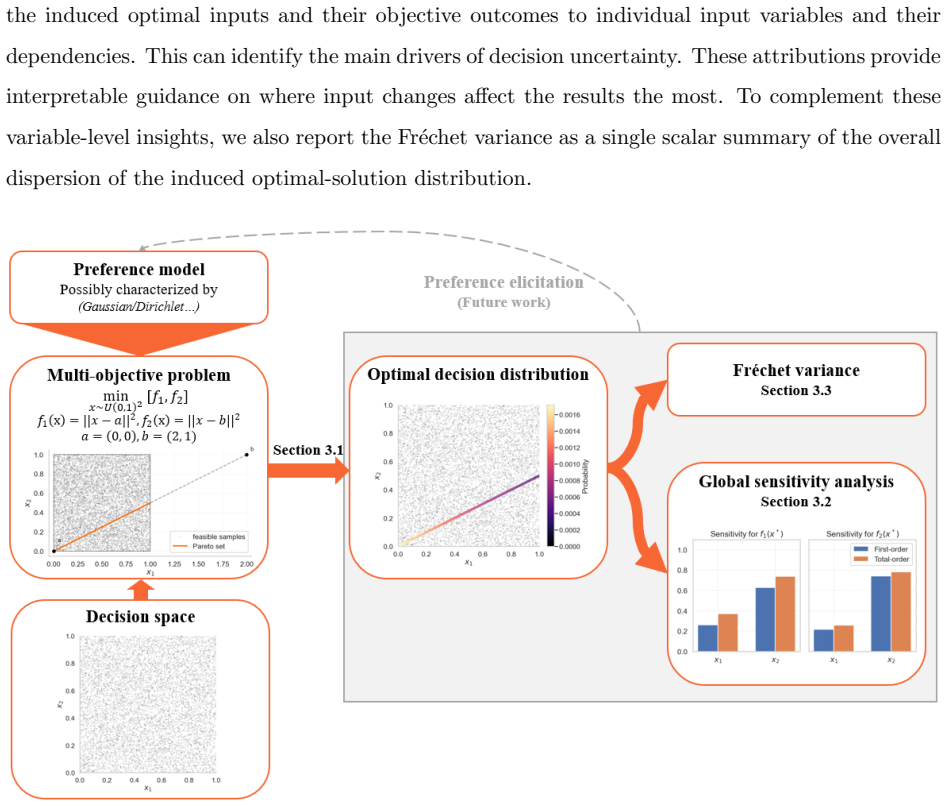
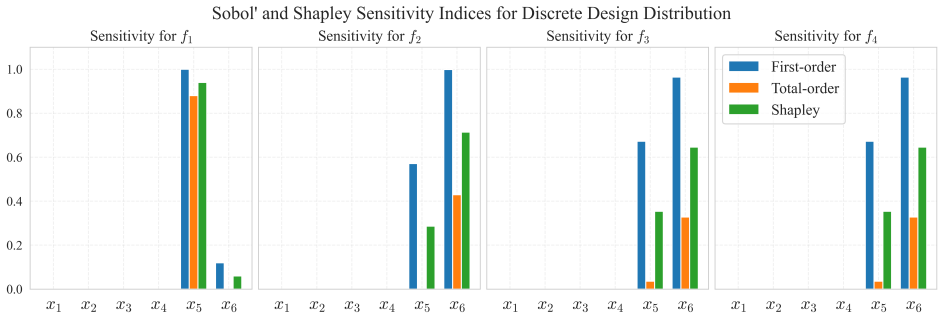
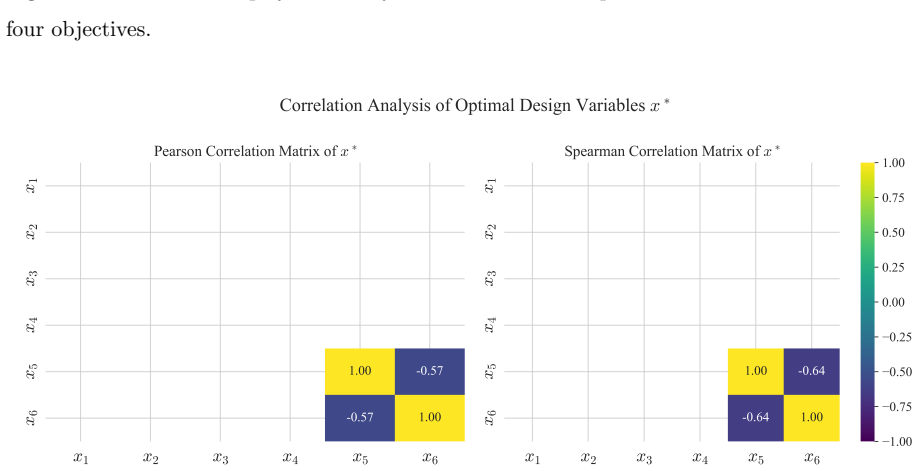
By modeling preference parameters as random variables, the framework derives a probability distribution over the optimal designs selected from the Pareto set by the scalarized utility function. This distribution enables identification of high-probability design regions and supports stability assessment. Global sensitivity analysis decomposes the variability using Sobol' indices and Shapley values to attribute contributions from design variables and dependencies, with Fréchet variance providing a scalar measure of dispersion.
What carries the argument
Induced probability distribution over optimal designs from random preference parameters, analyzed with Sobol' indices, Shapley values, and Fréchet variance.
Load-bearing premise
Designer preferences are completely captured by a scalarized utility function with parameters that can be treated as random variables from a specified distribution.
What would settle it
Empirical sampling of actual designer preferences and comparison of the resulting optimal design frequencies against the model's predicted distribution.
Figures


read the original abstract
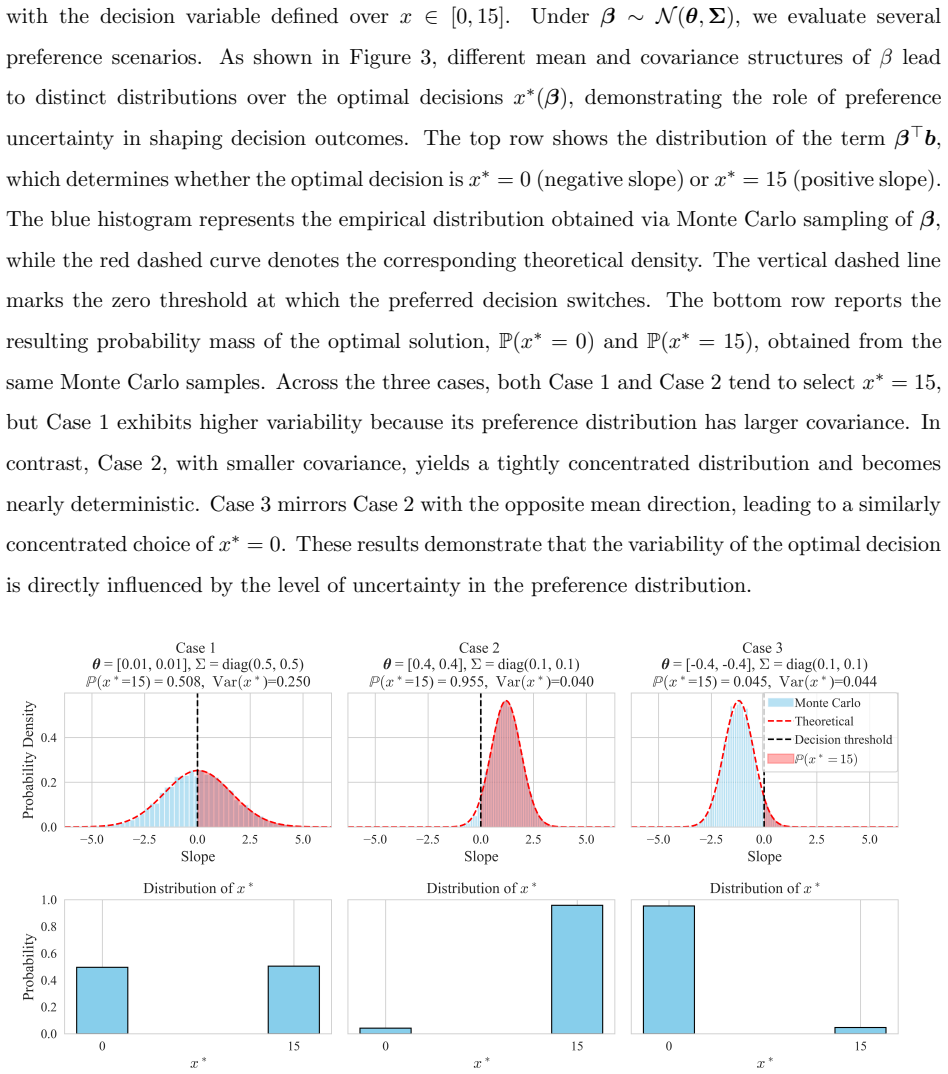
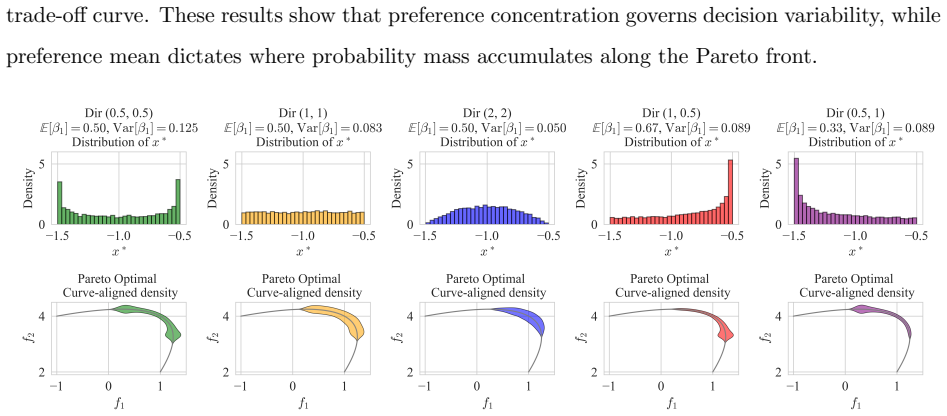
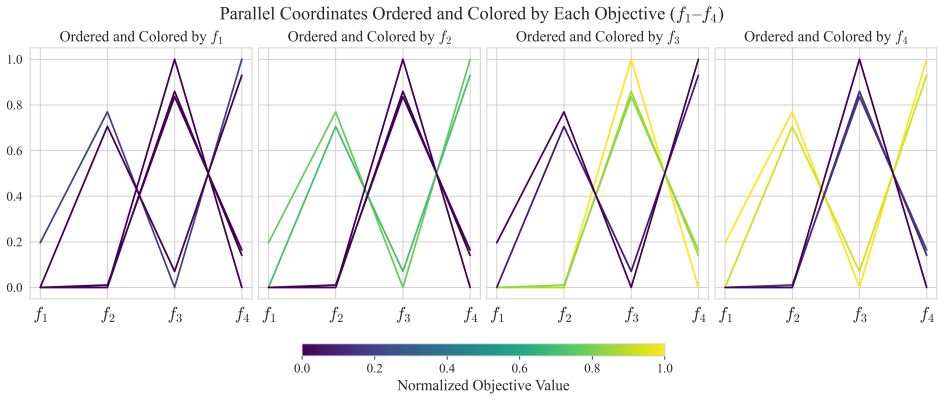
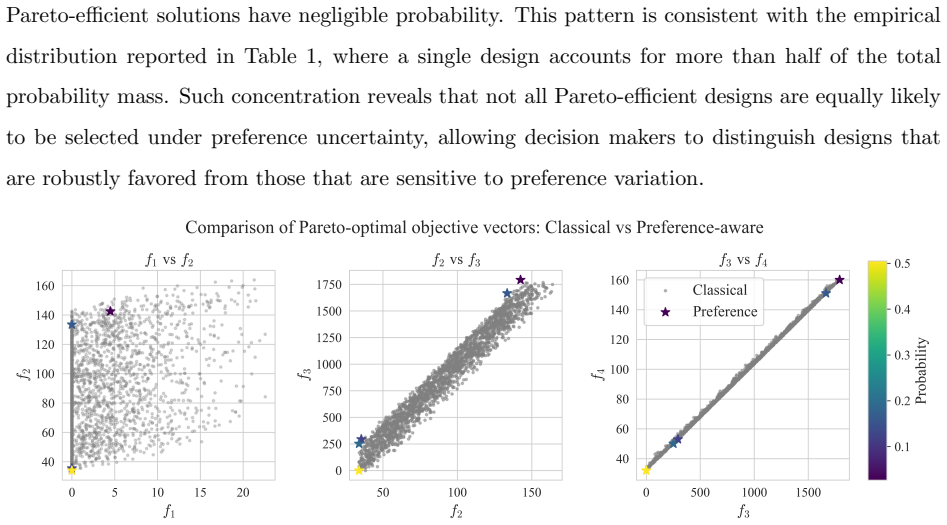
Engineering design problems are often modeled as multi-objective optimization tasks in which a scalarized utility function selects an optimal design from the Pareto set. In practice, preferences are imperfectly known, so uncertainty in the preference model leads to uncertainty in the resulting optimal design. This paper proposes a probabilistic framework that treats preference parameters as random variables and examines how preference uncertainty propagates to decision uncertainty. A random preference vector induces a probability distribution over optimal designs, allowing us to identify which regions of the Pareto front are most likely to be selected and to assess recommendation stability under preference variability. To explain the sources of this variability, we apply variance-based global sensitivity analysis to the induced optimal solutions, using Sobol' indices and Shapley values to quantify the contributions of individual design variables and their dependencies. We further summarize the overall dispersion of the optimal-design distribution using the Fr\'echet variance, which provides a scalar measure of decision stability under a given preference model. Two vehicle design case studies demonstrate how problem structure can lead to discrete versus continuous decision distributions and show how the proposed quantities support preference-aware design analysis.
Editorial analysis
A structured set of objections, weighed in public.
Referee Report
Summary. The manuscript presents a probabilistic framework for multi-objective engineering design in which preference parameters are modeled as random variables. A scalarized utility function then maps each realization to an optimal design on the Pareto front, inducing a probability distribution over designs. This distribution is summarized by the Fréchet variance as a scalar measure of decision stability and is decomposed via variance-based global sensitivity analysis (Sobol' indices and Shapley values) to attribute contributions from individual parameters and their interactions. Two ground-vehicle design case studies are used to illustrate how problem structure produces either discrete or continuous decision distributions and to demonstrate the practical utility of the proposed quantities for preference-aware analysis.
Significance. If the derivations and case-study implementations hold, the work supplies a coherent, tool-based method for quantifying how preference uncertainty translates into decision uncertainty. The combination of pushforward measures with Fréchet variance and global sensitivity indices offers designers a practical way to identify stable Pareto regions and to rank the influence of preference parameters, which is directly relevant to robust vehicle design. The explicit treatment of both discrete and continuous induced distributions is a useful distinction not always emphasized in the literature.
minor comments (3)
- The abstract states that the random preference vector 'induces a probability distribution over optimal designs,' but the manuscript should add a short paragraph (likely in §2 or §3) stating the regularity conditions (e.g., compactness of the design space, continuity of the scalarized objective) that guarantee existence and uniqueness of the optimum for almost every preference draw; without this the induced measure is not rigorously defined.
- In the case-study sections, the specific form of the scalarized utility (e.g., weighted sum, Tchebycheff) and the exact parameterization of the preference distribution should be stated explicitly, together with the numerical method used to solve the resulting optimization problems for each Monte-Carlo draw.
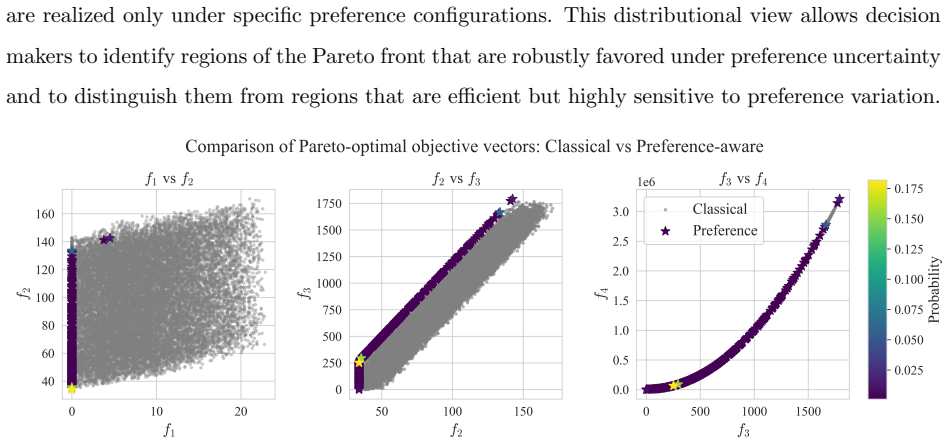
- Figure captions and axis labels for the Pareto-front plots should indicate whether the plotted points are the full Pareto set or only the subset of designs that are optimal for at least one sampled preference vector.
Simulated Author's Rebuttal
We thank the referee for the positive and accurate summary of our manuscript, which correctly identifies the core contribution: a probabilistic framework that propagates preference uncertainty to a distribution over Pareto-optimal designs, summarized by Fréchet variance and decomposed via Sobol' indices and Shapley values. The recommendation for minor revision is noted.
Circularity Check
No significant circularity
full rationale
The central construction is the pushforward of a distribution on preference parameters through the scalarized optimization map, which is a standard measure-theoretic operation once the utility function and Pareto set are given. Quantities such as the induced distribution over designs, Fréchet variance, Sobol' indices, and Shapley values are then computed from that pushforward using well-known sensitivity-analysis definitions; none of these steps reduce by the paper's own equations to a fitted value or to a self-citation whose content is presupposed. The two vehicle-design examples serve only to illustrate the resulting discrete versus continuous distributions and do not supply the definitions or uniqueness claims. The derivation therefore remains self-contained and draws on external, independently verifiable mathematical tools.
Axiom & Free-Parameter Ledger
free parameters (1)
- parameters of the preference distribution
axioms (1)
- domain assumption Multi-objective design problems can be solved by scalarizing preferences into a utility function to select from the Pareto set.
Reference graph
Works this paper leans on
-
[1]
Astudillo, R. and P. Frazier (2020). Multi-attribute bayesian optimization with interactive prefer- ence learning. InInternational Conference on Artificial Intelligence and Statistics, pp. 4496–4507. 26 PMLR. Belakaria, S., A. Deshwal, and J. R. Doppa (2019). Max-value entropy search for multi-objective bayesian optimization.Advances in neural information...
2020
-
[2]
Belakaria, S., A. Deshwal, N. K. Jayakodi, and J. R. Doppa (2020). Uncertainty-aware search framework for multi-objective bayesian optimization. InProceedings of the AAAI Conference on Artificial Intelligence, Volume 34, pp. 10044–10052. Belton, V. and T. Stewart (2012).Multiple criteria decision analysis: an integrated approach. Springer Science & Busine...
-
[3]
Keeney, R. L. and H. Raiffa (1993).Decisions with multiple objectives: preferences and value trade-offs. Cambridge university press. Knowles, J. (2006). Parego: A hybrid algorithm with on-line landscape approximation for expensive multiobjective optimization problems.IEEE transactions on evolutionary computation 10(1), 50–66. Lin, Z. J., R. Astudillo, P. ...
1993
-
[4]
Springer Science & Busi- ness Media. Owen, A. B. and C. Prieur (2017). On shapley value for measuring importance of dependent inputs. SIAM/ASA Journal on Uncertainty Quantification 5(1), 986–1002. Razavi, S., A. Jakeman, A. Saltelli, C. Prieur, B. Iooss, E. Borgonovo, E. Plischke, S. L. Piano, T. Iwanaga, W. Becker, et al. (2021). The future of sensitivit...
2017
discussion (0)
Sign in with ORCID, Apple, or X to comment. Anyone can read and Pith papers without signing in.