Recognition: unknown
Emergence of prethermal time quasicrystalline order in a quasiperiodically driven non-interacting spin chain
Pith reviewed 2026-05-07 08:57 UTC · model grok-4.3
The pith
A disordered non-interacting spin chain develops prethermal time quasicrystalline order under quasiperiodic driving with an irrational frequency ratio.
A machine-rendered reading of the paper's core claim, the machinery that carries it, and where it could break.
Core claim
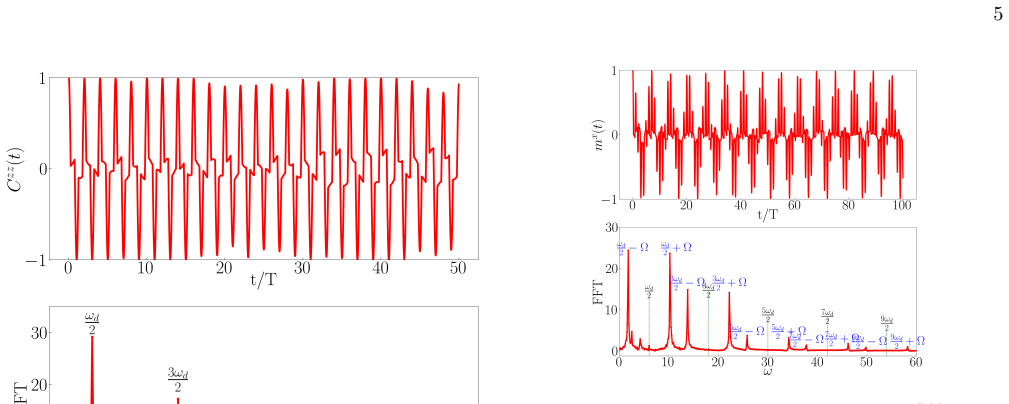
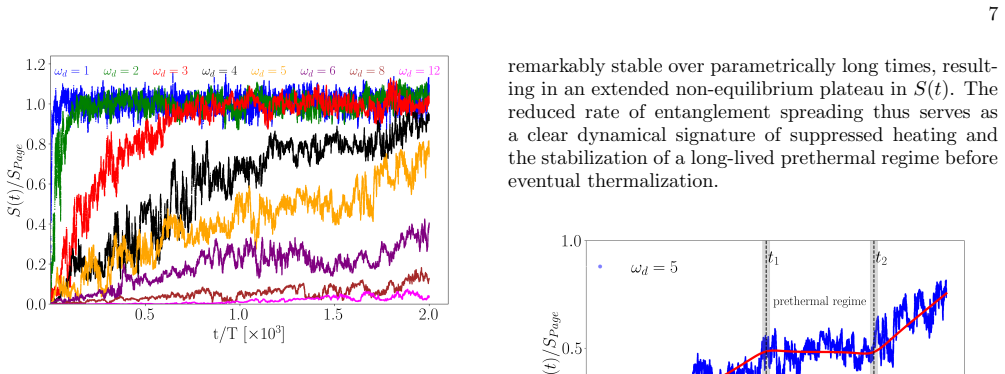
In the high-frequency regime, the quasiperiodically driven non-interacting spin chain exhibits robust spectral peaks at incommensurate frequencies that are not integer multiples of the fundamental drives, signaling quasiperiodic time-translation symmetry breaking. The entanglement entropy displays sublinear power-law growth followed by a prethermal plateau, which indicates suppressed resonant heating arising from an energy scale mismatch. The nonequilibrium lifetime increases rapidly with the driving frequency, and asymmetric disorder distributions enhance collective spin rigidity.
What carries the argument
Quasiperiodic driving with an irrational ratio of the switching frequency to the rotating field frequency, combined with random Ising exchange couplings, that produces multiple incommensurate frequencies and quasiperiodic dynamics beyond standard Floquet theory.
If this is right
- The nonequilibrium lifetime of the order increases rapidly with increasing driving frequency.
- Asymmetric distributions of the Ising couplings induce collective spin rigidity that strengthens resistance to heating.
- The time quasicrystalline phase stays stable against next-nearest-neighbor perturbations and rotational imperfections in the drive.
- This robustness matches that observed in discrete time crystals under periodic driving.
Where Pith is reading between the lines
- Quasiperiodic driving may stabilize similar temporal orders in interacting many-body systems where interactions could further suppress heating.
- Experimental realizations in quantum simulators could measure the incommensurate spectral peaks to confirm the symmetry breaking.
- Energy scale mismatches between drives offer a general strategy to extend prethermal lifetimes in periodically and quasiperiodically driven systems.
- Analogies to spatial quasicrystals suggest that time quasicrystals might exhibit unique topological or transport properties in the prethermal regime.
Load-bearing premise
The irrational ratio between the two driving frequencies and the chosen distribution of disordered couplings will generate stable quasiperiodic dynamics without rapid resonant heating in the high-frequency limit.
What would settle it
Rapid linear growth of the entanglement entropy without an intermediate plateau, or the absence of distinct peaks at incommensurate frequencies in the dynamical structure factor at high frequencies, would indicate that the prethermal time quasicrystalline order does not emerge.
Figures





read the original abstract
We study prethermal time quasicrystalline (TQC) order in a quasiperiodically driven chain of non-interacting spin-1/2 particles. The drive consists of two parts, switched on and off periodically with frequency $\omega_d$: (i) disordered Ising interactions, with exchange couplings chosen from a symmetric interval $[-J/2, J/2]$, allowing random antiferromagnetic or ferromagnetic nearest-neighbor couplings, together with a random transverse field; and (ii) a rotating transverse magnetic field with frequency $\Omega$. The ratio $\omega_d/\Omega$ is chosen to be irrational, producing multiple incommensurate frequencies and yielding quasiperiodic dynamics beyond Floquet theory. Using exact diagonalization, we analyze the time autocorrelation function, dynamical structure factor, and entanglement entropy (EE). In the high-frequency regime, robust spectral peaks at incommensurate frequencies (not integer multiples of the fundamental drives) signal quasiperiodic time-translation symmetry breaking (QTTSB). The EE exhibits sublinear power-law growth followed by a prethermal plateau, indicating suppressed resonant heating due to an energy scale mismatch. The nonequilibrium lifetime increases rapidly with driving frequency. Unlike symmetric disorder sampling, an asymmetric distribution of the Ising exchange couplings induces collective spin rigidity, enhancing the system's resistance to heating. The TQC phase remains stable against next-nearest-neighbor (NNN) exchange perturbations and rotational imperfections, with robustness comparable to discrete time crystals (TCs) under periodic driving. Our results establish this quasiperiodically driven system as a platform for long-lived nonequilibrium temporal order, revealing the interplay of disorder, collective rigidity, and quasiperiodic driving.
Editorial analysis
A structured set of objections, weighed in public.
Referee Report
Summary. The paper studies prethermal time-quasicrystalline (TQC) order in a non-interacting disordered spin-1/2 chain under quasiperiodic driving consisting of periodically switched disordered Ising interactions (with couplings from [-J/2, J/2]) plus a rotating transverse field, with irrational ratio ω_d/Ω. Using exact diagonalization, it reports robust spectral peaks at incommensurate frequencies (signaling quasiperiodic time-translation symmetry breaking, QTTSB) and entanglement entropy showing sublinear power-law growth followed by a prethermal plateau (attributed to energy-scale mismatch suppressing resonant heating). The nonequilibrium lifetime grows with drive frequency; asymmetric disorder induces collective rigidity; the phase is claimed robust to next-nearest-neighbor perturbations and imperfections, comparable to discrete time crystals.
Significance. If the numerical observations of incommensurate peaks and long-lived EE plateaus survive the thermodynamic limit, the work would provide a concrete platform for realizing long-lived nonequilibrium temporal order under quasiperiodic driving, extending discrete time-crystal concepts to incommensurate drives while highlighting the protective roles of disorder asymmetry and energy mismatch. The direct numerical integration approach (no fitted parameters) and reported robustness checks are strengths that could guide experiments in driven spin systems.
major comments (2)
- [Numerical Results section (ED analysis of autocorrelation, structure factor, and EE)] The central claims of QTTSB and a long prethermal plateau rest on ED observations of spectral peaks and EE dynamics, yet the manuscript provides no finite-size scaling, convergence checks with L, or error analysis (e.g., no data showing plateau duration vs. L or peak sharpness in the large-L limit). This is load-bearing for the claim of suppressed resonant heating, as the skeptic correctly notes that free-fermion models can exhibit apparent plateaus from finite-time or localization effects without true prethermalization in the thermodynamic limit.
- [Discussion of prethermal lifetime and energy mismatch] The assertion that an irrational ω_d/Ω ratio plus energy-scale mismatch prevents rapid resonant heating is not supported by any analysis of possible multi-frequency resonances or slow dephasing channels in the free-fermion spectrum; the paper relies solely on observed plateaus without quantifying heating rates or comparing to analytic expectations for the disordered Ising chain.
minor comments (2)
- [Model Hamiltonian] The notation for the two driving frequencies (ω_d and Ω) and the disorder distribution should be standardized and defined explicitly in the model Hamiltonian section to avoid ambiguity when discussing incommensurate frequencies.
- [Figure captions] Figure captions for the dynamical structure factor and EE plots should include the specific system sizes L used and the time window over which the plateau is observed.
Simulated Author's Rebuttal
We thank the referee for their thorough review and constructive feedback on our manuscript. We appreciate the recognition of the numerical strengths and potential significance of the work. Below we provide point-by-point responses to the major comments. We agree that additional analysis will strengthen the claims and have revised the manuscript accordingly.
read point-by-point responses
-
Referee: [Numerical Results section (ED analysis of autocorrelation, structure factor, and EE)] The central claims of QTTSB and a long prethermal plateau rest on ED observations of spectral peaks and EE dynamics, yet the manuscript provides no finite-size scaling, convergence checks with L, or error analysis (e.g., no data showing plateau duration vs. L or peak sharpness in the large-L limit). This is load-bearing for the claim of suppressed resonant heating, as the skeptic correctly notes that free-fermion models can exhibit apparent plateaus from finite-time or localization effects without true prethermalization in the thermodynamic limit.
Authors: We agree that finite-size scaling and convergence checks are important to support the thermodynamic-limit interpretation. The current manuscript reports ED results for accessible system sizes (up to L=16-20 depending on observable) with consistent qualitative features across sizes, but does not include explicit scaling plots. In the revised version we will add a supplementary figure showing the prethermal plateau duration (defined via EE saturation time) versus L, together with the width of the incommensurate spectral peaks as a function of L. For the non-interacting case the single-particle spectrum is exactly diagonalizable, and the observed sublinear EE growth is tied to the mismatch between drive frequencies and the bounded disorder bandwidth; we will include a brief discussion of why finite-time or localization artifacts are unlikely to produce the reported frequency dependence of the lifetime. revision: yes
-
Referee: [Discussion of prethermal lifetime and energy mismatch] The assertion that an irrational ω_d/Ω ratio plus energy-scale mismatch prevents rapid resonant heating is not supported by any analysis of possible multi-frequency resonances or slow dephasing channels in the free-fermion spectrum; the paper relies solely on observed plateaus without quantifying heating rates or comparing to analytic expectations for the disordered Ising chain.
Authors: The manuscript's central evidence is the direct numerical observation that the EE plateau lengthens systematically with increasing drive frequency ω_d while the incommensurate peaks remain sharp. We do not claim a full analytic proof of the absence of all multi-frequency resonances. In the revision we will add a quantitative estimate of the effective heating rate extracted from the late-time slope of the EE (or from the decay of the autocorrelation), and we will compare this rate to the expected scale set by the disorder bandwidth J. A complete enumeration of all possible quasiperiodic resonances in the free-fermion spectrum is technically involved and lies beyond the scope of the present numerical study; we will note this limitation explicitly while emphasizing that the observed frequency dependence and robustness to perturbations already provide strong numerical support for the protective role of the energy mismatch. revision: partial
- A complete analytic classification of all multi-frequency resonances and slow dephasing channels for the quasiperiodically driven disordered Ising chain in the thermodynamic limit.
Circularity Check
No circularity: claims rest on direct numerical integration of the driven Hamiltonian
full rationale
The paper reports spectral peaks and entanglement entropy behavior obtained via exact diagonalization of the time-dependent Schrödinger equation for a non-interacting (free-fermion) spin chain under quasiperiodic driving. No equations or parameters are defined in terms of the reported observables, no fitted quantities are relabeled as predictions, and no load-bearing self-citations reduce the central claims to prior author work by construction. The irrational frequency ratio and energy-scale mismatch are inputs to the simulation, not outputs redefined from the same data. The derivation chain is therefore self-contained against external benchmarks.
Axiom & Free-Parameter Ledger
free parameters (2)
- J (Ising exchange scale)
- ω_d and Ω (driving frequencies)
axioms (1)
- standard math The time evolution is governed by the Schrödinger equation for the explicitly time-dependent Hamiltonian
Reference graph
Works this paper leans on
-
[1]
Dziarmaga, ”Dynamics of a quantum phase transition and relaxation to a steady state”,Advances in Physics 59, 1063–1189 (2010)
J. Dziarmaga, ”Dynamics of a quantum phase transition and relaxation to a steady state”,Advances in Physics 59, 1063–1189 (2010)
2010
-
[2]
Polkovnikov, K
A. Polkovnikov, K. Sengupta, A. Silva, and M. Ven- galattore, ”Colloquium: Nonequilibrium dynamics of closed interacting quantum systems”,Rev. Mod. Phys. 83, 863 (2011)
2011
-
[3]
Dutta, G
A. Dutta, G. Aeppli, B. K. Chakrabarti, U. Divakaran, T. F. Rosenbaum, and D. Sen,Quantum Phase Transi- tions in Transverse Field Spin Models: From Statistical Physics to Quantum Information(Cambridge University Press, 2015)
2015
-
[4]
Chandra, A
A. Chandra, A. Das, and B. Chakrabarti,Quan- tum Quenching, Annealing and Computation(Springer 13 Berlin Heidelberg, 2010)
2010
-
[5]
Bukov, L
M. Bukov, L. D’Alessio, and A. Polkovnikov, ”Univer- sal high-frequency behavior of periodically driven sys- tems: from dynamical stabilization to floquet engineer- ing,”Advances in Physics64, 139 (2015)
2015
-
[6]
D’Alessio and A
L. D’Alessio and A. Polkovnikov, ”Many-body energy localization transition in systems,”Annals of Physics 333, 19 (2013)
2013
-
[7]
From quantum chaos and eigenstate thermalization to statistical mechanics and thermodynamics,
L. D’Alessio, Y. Kafri, A. Polkovnikov, and M. Rigol, “From quantum chaos and eigenstate thermalization to statistical mechanics and thermodynamics,”Advances in Physics65, 239 (2016)
2016
-
[8]
Landau-Zener- St¨ uckelberg interferometry,
S. Shevchenko, S. Ashhab, and F. Nori, “Landau-Zener- St¨ uckelberg interferometry,”Physics Reports492, 1–30 (2010)
2010
-
[9]
Floquet engineering of quan- tum materials,
T. Oka and S. Kitamura, “Floquet engineering of quan- tum materials,”Annual Review of Condensed Matter Physics10, 387–408 (2019)
2019
-
[10]
The magnus expansion and some of its applications,
S. Blanes, F. Casas, J. Oteo, and J. Ros, “The magnus expansion and some of its applications,”Physics Reports 470, 151–238 (2009)
2009
-
[11]
Colloquium: Atomic quantum gases in pe- riodically driven optical lattices,
A. Eckardt, “Colloquium: Atomic quantum gases in pe- riodically driven optical lattices,”Rev. Mod. Phys.89, 011004 (2017)
2017
-
[12]
Analytic approaches to periodically driven closed quantum systems: meth- ods and applications,
A. Sen, D. Sen, and K. Sengupta, “Analytic approaches to periodically driven closed quantum systems: meth- ods and applications,”Journal of Physics: Condensed Matter33, 443003 (2021)
2021
-
[13]
Many-body physics with ultracold gases,
I. Bloch, J. Dalibard, and W. Zwerger, “Many-body physics with ultracold gases,”Rev. Mod. Phys.80, 885 (2008)
2008
-
[14]
Quantum simu- lation of the hubbard model with ultracold fermions in optical lattices,
L. Tarruell and L. Sanchez-Palencia, “Quantum simu- lation of the hubbard model with ultracold fermions in optical lattices,”Comptes Rendus. Physique19, 365– 393 (2018)
2018
-
[15]
Quantum and classical floquet prethermaliza- tion,
W. W. Ho, T. Mori, D. A. Abanin, and E. G. Dalla Torre, “Quantum and classical floquet prethermaliza- tion,”Annals of Physics454, 169297 (2023)
2023
-
[16]
Thermalization and prethermalization in isolated quantum systems: a theoretical overview,
T. Mori, T. N. Ikeda, E. Kaminishi, and M. Ueda, “Thermalization and prethermalization in isolated quantum systems: a theoretical overview,”Journal of Physics B: Atomic, Molecular and Optical Physics51, 112001 (2018)
2018
-
[17]
Emergent symmetries in prethermal phases of periodically driven quantum systems,
T. Banerjee and K. Sengupta, “Emergent symmetries in prethermal phases of periodically driven quantum systems,”Journal of Physics: Condensed Matter37, 133002 (2025)
2025
-
[18]
Zhang, X.-C
Y.-B. Zhang, X.-C. Zhou, B.-Z. Wang, and X.-J. Liu, ”Quantum Many-Body Dynamics for Fermionict-J Model Simulated with Atom Arrays”,Phys. Rev. Lett. 136, 033402 (2026)
2026
-
[19]
Wilczek, ”Quantum time crystals,”Physical Review Letters109, 160401 (2012)
F. Wilczek, ”Quantum time crystals,”Physical Review Letters109, 160401 (2012)
2012
-
[20]
quantum time crystals
P. Bruno, Comment on “quantum time crystals”,Phys. Rev. Lett.,110, 118901 (2013)
2013
-
[21]
Watanabe and M
H. Watanabe and M. Oshikawa, ”Absence of quantum time crystals,”Physical Review Letters114, 251603 (2015)
2015
-
[22]
G. E. Volovik, On the broken time translation symme- try in macroscopic systems: Precessing states and off- diagonal longrange order,JETP Lett.98, 491 (2013)
2013
-
[23]
Bruno, ”Impossibility of spontaneously rotating time- Crystals,”Physical Review Letters111, 070402 (2013)
P. Bruno, ”Impossibility of spontaneously rotating time- Crystals,”Physical Review Letters111, 070402 (2013)
2013
-
[24]
Zhang et al., ”Observation of a discrete time crystal,” Nature543, 217 (2017)
J. Zhang et al., ”Observation of a discrete time crystal,” Nature543, 217 (2017)
2017
-
[25]
Yousefjani, A
R. Yousefjani, A. Carollo, K. Sacha, S. Al-Kuwari, and A. Bayat, Non-Hermitian discrete time crystals,Phys. Rev. B111,165117 (2025)
2025
-
[26]
Yousefjani, K
R. Yousefjani, K. Sacha, and A. Bayat, ”Discrete time crystal phase as a resource for quantum-enhanced sens- ing,”Physical Review B111, 125159 (2025)
2025
-
[27]
Khemani, A
V. Khemani, A. Lazarides, R. Moessner, and S. L. Sondhi, ”Phase structure of driven quantum systems,” Physical Review Letters116, 250401 (2016)
2016
-
[28]
D. V. Else, B. Bauer, and C. Nayak, Floquet time crys- tals,”Physical Review Letters117, 090402 (2016)
2016
-
[29]
Marripour and J
D. Marripour and J. Abouie, ”From time crystals to time quasicrystals: Exploring quasiperiodic phases in transverse field Ising chains,”Physical Review B112, 174307 (2025)
2025
-
[30]
Huang, T
Y. Huang, T. Wang, H. Yin, M. Jiang, Z. Luo, and X. Peng, ”Observation of continuous time crystals and quasi-crystals in spin gases,”Nature Communications 16, 9375 (2025)
2025
-
[31]
V. Khemani, R. Moessner, and S. L. Sondhi, ”A brief history of time crystals,”arXiv:1910.10745(2019)
-
[32]
D. V. Else, C. Monroe, C. Nayak, and N. Y. Yao, Dis- crete time crystals,Annual Review of Condensed Matter Physics11, 467 (2020)
2020
-
[33]
M. P. Zaletel, M. Lukin, C. Monroe, C. Nayak, F. Wilczek, and N. Y. Yao, Colloquium: Quantum and classical discrete time crystals,Reviews of Modern Physics95, 031001 (2023)
2023
-
[34]
Puig, and F
Verdeny, J. Puig, and F. Mintert, Quasi-periodically driven quantum systems,Z. Naturforsch., A: Phys. Sci. 71, 897 (2016)
2016
-
[35]
Sen, and D
Nandy, A. Sen, and D. Sen, Aperiodically Driven In- tegrable Systems and Their Emergent Steady States, Phys. Rev. X7, 031034 (2017)
2017
-
[36]
Kuro´ s, and K
Giergiel, A. Kuro´ s, and K. Sacha, Discrete time qua- sicrystals,Phys. Rev. B99, 220303(R) (2019)
2019
-
[37]
Sinha, and D
Ray, S. Sinha, and D. Sen, Dynamics of quasiperiod- ically driven spin systems,Phys. Rev. E100, 052129 (2019)
2019
-
[38]
Mintert, R
Zhao, F. Mintert, R. Moessner, and J. Knolle, Random Multipolar Driving: Tunably Slow Heating through Spectral Engineering,Phys. Rev. Lett.126, 040601 (2021)
2021
-
[39]
Vidmar, Ergodicity breaking transition in zero dimensions,Phys
J ˇSuntajs and L. Vidmar, Ergodicity breaking transition in zero dimensions,Phys. Rev. Lett.129, 060602 (2022)
2022
-
[40]
Autti, V
S. Autti, V. B. Eltsov, and G. E. Volovik, ”Observa- tion of a time quasicrystal and its transition to a super- fluid time crystal,”Physical Review Letters120, 215301 (2018)
2018
-
[41]
H. Zhao, F. Mintert, and J. Knolle, ”Floquet time spi- rals and stable discrete-time quasicrystals in quasiperi- odically driven quantum many-body systems,”Physical Review B100, 13 (2019)
2019
-
[42]
Wu, ”Quasi time crystal,”arXiv preprint arXiv:2203.01468(2022)
X. Wu, ”Quasi time crystal,”arXiv preprint arXiv:2203.01468(2022)
-
[43]
G. He et al., ”Experimental realization of discrete time quasi-crystals,”arXiv preprint arXiv:2403.17842 (2024)
-
[44]
Mukherjee, A. Sen, D. Sen, and K. Sengupta, Restor- ing coherence via aperiodic drives in a many-body quan- tum system,Phys. Rev. B102, 014301 (2020)
2020
-
[45]
H. Schmid, et al., ”Self-similar phase diagram of the Fibonacci-driven quantum Ising model,” 14 arXiv:2410.18219 (2024)
-
[46]
Peng and G
Y. Peng and G. Refael, ”Time-quasiperiodic topological superconductors with Majorana multiplexing,”Physical Review B98, 220509 (2018)
2018
- [47]
-
[48]
Exotic freezing of response in a quantum many-body system,
A. Das, “Exotic freezing of response in a quantum many-body system,”Phys. Rev. B82, 172402 (2010)
2010
-
[49]
Trans- verse Ising chain under periodic instantaneous quenches: Dynamical many-body freezing and emergence of slow solitary oscillations,
S. Bhattacharyya, A. Das, and S. Dasgupta, “Trans- verse Ising chain under periodic instantaneous quenches: Dynamical many-body freezing and emergence of slow solitary oscillations,”Phys. Rev. B86, 054410 (2012)
2012
-
[50]
Freezing a quantum magnet by repeated quantum in- terference: An experimental realization,
S. S. Hegde, H. Katiyar, T. S. Mahesh, and A. Das, “Freezing a quantum magnet by repeated quantum in- terference: An experimental realization,”Phys. Rev. B 90, 174407 (2014)
2014
-
[51]
Dynamics- induced freezing of strongly correlated ultracold bosons,
S. Mondal, D. Pekker, and K. Sengupta, “Dynamics- induced freezing of strongly correlated ultracold bosons,”EPL (Europhysics Letters)100, 60007 (2012)
2012
-
[52]
Dynami- cal freezing in exactly solvable models of driven chaotic quantum dots,
H. Guo, R. Mukherjee, and D. Chowdhury, “Dynami- cal freezing in exactly solvable models of driven chaotic quantum dots,”Phys. Rev. Lett.134, 184302 (2025)
2025
-
[53]
Dynamic freezing and defect suppression in the tilted one-dimensional Bose- Hubbard model,
U. Divakaran and K. Sengupta, “Dynamic freezing and defect suppression in the tilted one-dimensional Bose- Hubbard model,”Phys. Rev. B90, 184303 (2014)
2014
-
[54]
Complexity and Floquet dynamics: Nonequilibrium Ising phase transitions,
G. Camilo and D. Teixeira, “Complexity and Floquet dynamics: Nonequilibrium Ising phase transitions,” Phys. Rev. B102, 174304 (2020)
2020
-
[55]
Emergent strong zero mode through local Floquet engineering,
B. Mukherjee, R. Melendrez, M. Szyniszewski, H. J. Changlani, and A. Pal, “Emergent strong zero mode through local Floquet engineering,”Phys. Rev. B109, 064303 (2024)
2024
-
[56]
Quantum Rabi dynamics of trapped atoms far in the deep strong coupling regime,
J. Koch, G. R. Hunanyan, T. Ockenfels, E. Rico, E. Solano, and M. Weitz, “Quantum Rabi dynamics of trapped atoms far in the deep strong coupling regime,” Nat. Commun.14, 954 (2023)
2023
-
[57]
Dynam- ical freezing and scar points in strongly driven : Res- onance vs emergent conservation laws,
A. Haldar, D. Sen, R. Moessner, and A. Das, “Dynam- ical freezing and scar points in strongly driven : Res- onance vs emergent conservation laws,”Phys. Rev. X 11, 021008 (2021)
2021
-
[58]
Emergent conservation in the Floquet dynamics of integrable non-Hermitian models,
T. Banerjee and K. Sengupta, “Emergent conservation in the Floquet dynamics of integrable non-Hermitian models,”Phys. Rev. B107, 155117 (2023)
2023
-
[59]
Entanglement tran- sitions in a periodically driven non-Hermitian Ising chain,
T. Banerjee and K. Sengupta, “Entanglement tran- sitions in a periodically driven non-Hermitian Ising chain,”Phys. Rev. B109, 094306 (2024)
2024
-
[60]
Entanglement and corre- lation spreading in non-Hermitian spin chains,
X. Turkeshi and M. Schir´ o, “Entanglement and corre- lation spreading in non-Hermitian spin chains,”Phys. Rev. B107, L020403 (2023)
2023
-
[61]
Counterdiabatic route to entanglement steering and dynamical freez- ing in the Floquet Lipkin-Meshkov-Glick model,
N. Gangopadhay and S. Choudhury, “Counterdiabatic route to entanglement steering and dynamical freez- ing in the Floquet Lipkin-Meshkov-Glick model,”Phys. Rev. Lett.135, 020407 (2025)
2025
-
[62]
Dynamical scar states in driven fracton systems,
S. Pai and M. Pretko, “Dynamical scar states in driven fracton systems,”Phys. Rev. Lett.123, 136401 (2019)
2019
-
[63]
Collapse and revival of quantum many-body scars via Floquet engineering,
B. Mukherjee, S. Nandy, A. Sen, D. Sen, and K. Sen- gupta, “Collapse and revival of quantum many-body scars via Floquet engineering,”Phys. Rev. B101, 245107 (2020)
2020
-
[64]
Exact Flo- quet quantum many-body scars under Rydberg block- ade,
K. Mizuta, K. Takasan, and N. Kawakami, “Exact Flo- quet quantum many-body scars under Rydberg block- ade,”Phys. Rev. Res.2, 033284 (2020)
2020
-
[65]
Yarloo, A
H. Yarloo, A. Emami Kopaei, and A. Langari, ”Ho- mogeneous Floquet time crystal from weak ergodicity breaking,”Physical Review B102, 224309 (2020)
2020
-
[66]
Many-body scar state intrinsic to periodically driven system,
S. Sugiura, T. Kuwahara, and K. Saito, “Many-body scar state intrinsic to periodically driven system,”Phys. Rev. Res.3, L012010 (2021)
2021
-
[67]
Dy- namics of the vacuum state in a periodically driven Ry- dberg chain,
B. Mukherjee, A. Sen, D. Sen, and K. Sengupta, “Dy- namics of the vacuum state in a periodically driven Ry- dberg chain,”Phys. Rev. B102, 075123 (2020)
2020
-
[68]
Discrete time- crystalline order enabled by quantum many-body scars: Entanglement steering via periodic driving,
N. Maskara, A. A. Michailidis, W. W. Ho, D. Bluvstein, S. Choi, M. D. Lukin, and M. Serbyn, “Discrete time- crystalline order enabled by quantum many-body scars: Entanglement steering via periodic driving,”Phys. Rev. Lett.127, 090602 (2021)
2021
-
[69]
Driving quantum many- body scars in the PXP model,
A. Hudomal, J.-Y. Desaules, B. Mukherjee, G.-X. Su, J. C. Halimeh, and Z. Papi´ c, “Driving quantum many- body scars in the PXP model,”Phys. Rev. B106, 104302 (2022)
2022
-
[70]
Discrete time crystals enforced by Floquet- Bloch scars,
B. Huang, T.-H. Leung, D. M. Stamper-Kurn, and W. V. Liu, “Discrete time crystals enforced by Floquet- Bloch scars,”Phys. Rev. Lett.129, 133001 (2022)
2022
-
[71]
D. V. Else, B. Bauer, and C. Nayak, ”Prethermal phases of matter protected by time-translation symme- try,”Physical Review X7, 011026 (2017)
2017
-
[72]
Mallayya, M
K. Mallayya, M. Rigol, and W. De Roeck, ”Prether- malization and thermalization in isolated quantum sys- tems,”Physical Review X9, 021027 (2019)
2019
-
[73]
D. V. Else, W. W. Ho, and P. T. Dumitrescu, Long- lived Interacting Phases of Matter Protected by Multi- ple Time-Translation Symmetries in Quasiperiodically Driven Systems,Phys. Rev. X10, 021032 (2020)
2020
-
[74]
He et al., ”Quasi-Floquet prethermalization in a dis- ordered dipolar spin ensemble in diamond,”Physical Review Letters131, 130401 (2023)
G. He et al., ”Quasi-Floquet prethermalization in a dis- ordered dipolar spin ensemble in diamond,”Physical Review Letters131, 130401 (2023)
2023
-
[75]
S. A. Weidinger and M. Knap, ”Floquet prethermaliza- tion and regimes of heating in a periodically driven, in- teracting quantum system,”Scientific Reports7, 45382 (2017)
2017
-
[76]
Canovi, M
E. Canovi, M. Kollar, and M. Eckstein, ”Strobo- scopic prethermalization in weakly interacting period- ically driven systems,”Physical Review E93, 012130 (2016)
2016
-
[77]
Bukov, S
M. Bukov, S. Gopalakrishnan, M. Knap, and E. Dem- ler, ”Prethermal Floquet steady states and instabili- ties in the periodically driven, weakly interacting Bose- Hubbard model,”Physical Review Letters115, 205301 (2015)
2015
-
[78]
Kyprianidis, F
A. Kyprianidis, F. Machado, W. Morong, P. Becker, K. S. Collins, D. V. Else, ..., and C. Monroe, ”Obser- vation of a prethermal discrete time crystal,”Science 372, 1192–1196 (2021)
2021
-
[79]
Vu and S
D. Vu and S. Das Sarma, ”Dissipative prethermal dis- crete time crystal,”Physical Review Letters130, 130401 (2023)
2023
-
[80]
T. S. Zeng and D. N. Sheng, ”Prethermal time crystals in a one-dimensional periodically driven Floquet sys- tem,”Physical Review B96, 094202 (2017)
2017
discussion (0)
Sign in with ORCID, Apple, or X to comment. Anyone can read and Pith papers without signing in.