Recognition: unknown
Species-Resolved Scaling of Azimuthal Anisotropy: Constraining Attenuation, Collective Expansion, and Hadronic Dynamics in Hydrodynamic Simulations
Pith reviewed 2026-05-07 08:39 UTC · model grok-4.3
The pith
Species-resolved scaling functions for azimuthal anisotropy collapse robustly across momentum, centrality, particle type, and collision energy in hydrodynamic simulations.
A machine-rendered reading of the paper's core claim, the machinery that carries it, and where it could break.
Core claim
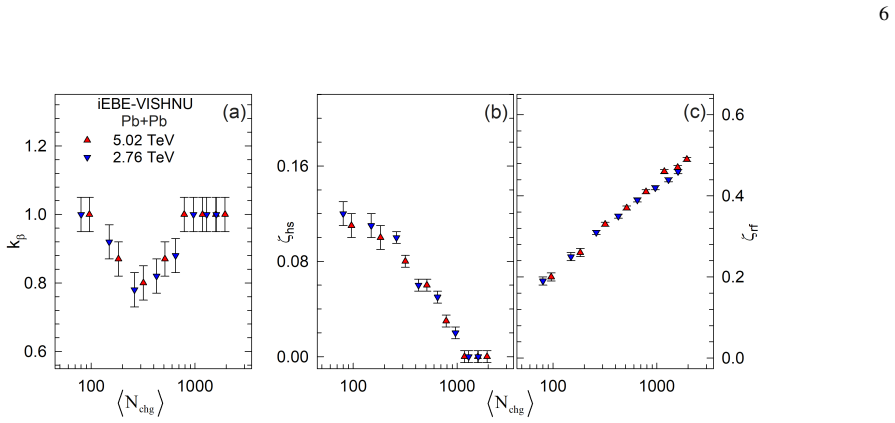
Species-resolved scaling functions constructed from simulated v2 and v3 exhibit a robust collapse across transverse momentum, centrality, particle species, and beam energy. This common scaling structure yields quantitative agreement with data-defined references through an energy-dependent attenuation baseline β0 in central to mid-central collisions and a centrality-dependent modification of the effective attenuation in more peripheral collisions, with only weak dependence on beam energy. The multiplicity dependence of the scaling parameters directly encodes the interplay between EOS-driven collective expansion, finite system lifetime, and hadronic re-scattering.
What carries the argument
Species-resolved azimuthal anisotropy scaling functions, built from v2 and v3, that collapse to a common form modulated by an attenuation baseline β0.
If this is right
- The scaling framework supplies a quantitative, constraint-driven probe of the hydrodynamic response.
- It enables separation of the coupled contributions from collective expansion, attenuation, and hadronic dynamics to the observed anisotropy.
- The multiplicity dependence of the scaling parameters encodes the relative importance of EOS effects, lifetime, and rescattering.
- The weak beam-energy dependence implies that the scaling structure is largely preserved between 2.76 and 5.02 TeV.
Where Pith is reading between the lines
- If the collapse survives in data at other energies or in smaller systems, the same β0 parameterization could be used to extrapolate flow observables without full hydrodynamic runs.
- The scaling may offer a practical way to test whether different hydrodynamic codes produce equivalent underlying flow responses once attenuation and hadronic stages are accounted for.
- A natural extension would be to apply the identical construction to v4 or to identified-particle spectra in pA collisions to check whether the same attenuation baseline holds.
Load-bearing premise
The collapse seen in these particular hydrodynamic simulations reflects a genuine, model-independent property of the underlying response and hadronic dynamics rather than an artifact of the chosen initial conditions or code implementation.
What would settle it
A direct test would be whether the same scaling collapse, with the same β0 values and centrality modifications, appears in measured v2 and v3 data across the same centrality and energy ranges without additional tuning.
Figures


read the original abstract
Species-resolved azimuthal anisotropy scaling functions are constructed from identified particle $v_2$ and $v_3$ obtained from event-by-event iEBE-VISHNU simulations for Pb+Pb collisions at $\sqrt{s_{NN}}=2.76$ and $5.02$~TeV. The scaling functions exhibit a robust collapse across transverse momentum, centrality, particle species, and beam energy, indicating a common and tightly constrained scaling structure. High scaling fidelity yields quantitative agreement with the data-defined reference through an energy-dependent attenuation baseline $\beta_0$ in central to mid-central collisions and a centrality-dependent modification of the effective attenuation in more peripheral collisions, with only a weak dependence on $\sqrt{s_{NN}}$. The multiplicity dependence of the extracted scaling parameters reflects the interplay of EOS-driven collective expansion, finite system lifetime, and hadronic re-scattering. These results demonstrate that the scaling framework provides a quantitative, constraint-driven probe of the hydrodynamic response, enabling the disentanglement and constraint of the coupled contributions to azimuthal anisotropy.
Editorial analysis
A structured set of objections, weighed in public.
Referee Report
Summary. The manuscript constructs species-resolved scaling functions for azimuthal anisotropies v2 and v3 from event-by-event iEBE-VISHNU hydrodynamic simulations of Pb+Pb collisions at √sNN=2.76 and 5.02 TeV. It reports a robust collapse of these functions across transverse momentum, centrality, particle species, and beam energy, and achieves quantitative agreement with a data-defined reference by introducing an energy-dependent attenuation baseline β0 (with centrality-dependent modifications in peripheral collisions), interpreting the multiplicity dependence of the scaling parameters as reflecting the interplay of EOS-driven collective expansion, finite system lifetime, and hadronic rescattering.
Significance. If the observed scaling collapse proves to be a general feature rather than model-specific, the framework could offer a useful quantitative probe for disentangling contributions to azimuthal anisotropy in heavy-ion collisions. The event-by-event simulation approach is a strength for incorporating fluctuations, but the absence of cross-model tests limits the broader implications for constraining hydrodynamic response and hadronic dynamics.
major comments (2)
- [Abstract] Abstract: The claim of a 'robust collapse' and 'quantitative agreement' with data via β0 is central, yet the abstract (and by extension the manuscript) provides no explicit equations defining the scaling functions nor details on how β0 is extracted or whether it is adjusted post-hoc to achieve the reported agreement.
- [Results] Results section: All scaling functions and comparisons are derived exclusively from iEBE-VISHNU without any systematic variations in the equation of state, initial-state model, or hadronic rescattering parameters. This is load-bearing for the central claim of a 'common and tightly constrained scaling structure' because it leaves unresolved whether the collapse is a genuine general feature of the hydrodynamic response or an artifact of the specific implementation.
minor comments (2)
- [Abstract] Abstract: No mention of error bars, statistical uncertainties, or systematic variations in the scaling fidelity or data agreement, which would be needed to assess the robustness of the quantitative match.
- [Methods] The manuscript lacks discussion of alternative scaling constructions or sensitivity to the precise functional form chosen, which would strengthen the interpretation even within the single-model results.
Simulated Author's Rebuttal
We thank the referee for the careful and constructive review. The comments have prompted us to improve the clarity of the abstract and to explicitly discuss the model-specific aspects of our results. We respond to each major comment below and indicate the revisions made.
read point-by-point responses
-
Referee: [Abstract] Abstract: The claim of a 'robust collapse' and 'quantitative agreement' with data via β0 is central, yet the abstract (and by extension the manuscript) provides no explicit equations defining the scaling functions nor details on how β0 is extracted or whether it is adjusted post-hoc to achieve the reported agreement.
Authors: We agree that the abstract would benefit from greater specificity. The species-resolved scaling functions are defined in Section II (Eqs. 1–4) as v_n^{scaled}(p_T) = v_n(p_T) / f(β, p_T, m, species), where the functional form incorporates an energy-dependent attenuation baseline β0. The value of β0 is obtained via a χ² fit to the data-defined reference curve for each centrality class, with the procedure and goodness-of-fit metrics reported in Section III.B; it is not tuned arbitrarily but determined systematically while holding the scaling shape fixed. We have revised the abstract to include a concise statement of the scaling definition and the fitting method for β0, thereby clarifying that the reported agreement follows from this extraction rather than post-hoc adjustment. revision: yes
-
Referee: [Results] Results section: All scaling functions and comparisons are derived exclusively from iEBE-VISHNU without any systematic variations in the equation of state, initial-state model, or hadronic rescattering parameters. This is load-bearing for the central claim of a 'common and tightly constrained scaling structure' because it leaves unresolved whether the collapse is a genuine general feature of the hydrodynamic response or an artifact of the specific implementation.
Authors: We acknowledge that the present study employs a single hydrodynamic framework (iEBE-VISHNU with the s95p-PCE equation of state, AMPT initial conditions, and UrQMD hadronic cascade) and does not perform systematic variations of these ingredients. The observed collapse and the extracted scaling parameters are therefore demonstrated within this specific implementation. To address the concern we have added a dedicated paragraph in the conclusions that (i) states the model dependence of the current results, (ii) notes that the robustness is shown across two collision energies and a wide range of centralities and species, and (iii) outlines how the same scaling analysis can be applied to other models in future work. A full cross-model survey would require substantial additional computational effort and lies beyond the scope of this manuscript, which focuses on establishing the scaling behavior in a state-of-the-art event-by-event simulation that already incorporates fluctuations and a realistic hadronic phase. We have also tempered the language in the results section to refer to a “tightly constrained scaling structure within the iEBE-VISHNU framework.” revision: partial
Circularity Check
No significant circularity detected
full rationale
The paper constructs scaling functions directly from identified-particle v2 and v3 outputs of the iEBE-VISHNU event-by-event hydrodynamic simulations and reports an observed robust collapse across pT, centrality, species, and beam energy. Quantitative agreement with a data-defined reference is then obtained by introducing an adjustable energy-dependent attenuation baseline β0 (plus a centrality-dependent modification). This matching step involves parameter adjustment, but the abstract explicitly frames the agreement as occurring 'through' β0 rather than presenting it as a parameter-free prediction or first-principles derivation. No equations or definitions are shown that reduce the claimed scaling structure or collapse to the inputs by construction, no load-bearing self-citations are invoked to justify uniqueness or ansatz choices, and the data comparison serves as an external benchmark. The derivation chain therefore remains self-contained and does not exhibit the enumerated circularity patterns.
Axiom & Free-Parameter Ledger
free parameters (1)
- β0 =
energy-dependent
axioms (1)
- domain assumption The iEBE-VISHNU event-by-event hydrodynamic plus hadronic-cascade model accurately captures the collective expansion, equation-of-state effects, finite lifetime, and hadronic re-scattering that determine azimuthal anisotropy in Pb+Pb collisions.
Reference graph
Works this paper leans on
-
[1]
A. Bilandzic, R. Snellings, and S. V oloshin, Phys. Rev.C83, 044913 (2011), arXiv:1010.0233 [nucl-ex]
- [2]
-
[3]
D. Teaney and L. Yan, Phys. Rev.C86, 044908 (2012), arXiv:1206.1905 [nucl-th]
-
[4]
J. Adamset al.(STAR), Nucl. Phys. A757, 102 (2005), arXiv:nucl-ex/0501009 [nucl-ex]
-
[5]
K. Adcoxet al.(PHENIX), Nucl. Phys. A757, 184 (2005), arXiv:nucl-ex/0410003 [nucl-ex]
- [7]
- [8]
-
[9]
W. Zhao, H.-j. Xu, and H. Song, Eur. Phys. J. C77, 645 (2017), arXiv:1703.10792 [nucl-th]
-
[10]
Schenke, S
B. Schenke, S. Jeon, and C. Gale, Phys. Rev.C82, 014903 (2010)
2010
-
[11]
B. Schenke, S. Jeon, and C. Gale, Phys. Rev. Lett.106, 042301 (2011), arXiv:1009.3244 [hep-ph]
-
[12]
S. McDonald, C. Shen, F. Fillion-Gourdeau, S. Jeon, and C. Gale, Phys. Rev. C95, 064913 (2017), arXiv:1609.02958 [hep-ph]
-
[13]
M. Bleicheret al., J. Phys. G25, 1859 (1999), arXiv:hep- ph/9909407
-
[14]
S. A. Basset al., Prog. Part. Nucl. Phys.41, 255 (1998), arXiv:nucl-th/9803035
work page Pith review arXiv 1998
-
[15]
J. Weilet al.(SMASH), Phys. Rev. C94, 054905 (2016), arXiv:1606.06642 [nucl-th]
- [16]
- [17]
-
[18]
S. Acharyaet al.(ALICE), Phys. Rev. Lett.136, 032302 (2026), arXiv:2504.04796 [nucl-ex]
-
[19]
G. Aadet al.(ATLAS), Phys. Rev. Lett.136, 032301 (2026), arXiv:2503.24125 [nucl-ex]
- [20]
-
[21]
Zhu (ALICE), PoSICHEP2018, 441 (2019)
Y . Zhu (ALICE), PoSICHEP2018, 441 (2019)
2019
-
[22]
Acharyaet al.(ALICE), JHEP05, 243 (2023), arXiv:2206.04587 [nucl-ex]
S. Acharyaet al.(ALICE), JHEP05, 243 (2023), arXiv:2206.04587 [nucl-ex]
- [23]
-
[24]
Adamet al.(ALICE), JHEP09, 164 (2016), arXiv:1606.06057 [nucl-ex]
J. Adamet al.(ALICE), JHEP09, 164 (2016), arXiv:1606.06057 [nucl-ex]
-
[25]
S. Acharyaet al.(ALICE), Eur. Phys. J. C77, 658 (2017), arXiv:1707.07304 [nucl-ex]
-
[26]
S. Acharyaet al.(ALICE), Phys. Lett. B784, 82 (2018), arXiv:1805.01832 [nucl-ex]
-
[27]
K. Aamodtet al.(ALICE), Phys. Rev. Lett.107, 032301 (2011), arXiv:1105.3865 [nucl-ex]
- [28]
discussion (0)
Sign in with ORCID, Apple, or X to comment. Anyone can read and Pith papers without signing in.