Recognition: unknown
Machine Collective Intelligence for Explainable Scientific Discovery
Pith reviewed 2026-05-07 09:02 UTC · model grok-4.3
The pith
Multiple AI reasoning agents can collectively evolve symbolic equations to recover the governing laws of scientific systems from data alone.
A machine-rendered reading of the paper's core claim, the machinery that carries it, and where it could break.
Core claim
Machine collective intelligence integrates symbolism and metaheuristics by orchestrating multiple reasoning agents that evolve symbolic hypotheses through coordinated generation, evaluation, critique, and consolidation. Across scientific systems governed by deterministic, stochastic, or previously uncharacterized dynamics, it autonomously recovers the underlying governing equations without relying on hand-crafted domain knowledge. The resulting equations reduce extrapolation error by up to six orders of magnitude relative to deep neural networks while condensing 0.5-1 million model parameters into just 5-40 interpretable parameters.
What carries the argument
Machine collective intelligence, which coordinates multiple reasoning agents to iteratively generate, evaluate, critique, and consolidate symbolic equation hypotheses.
If this is right
- Recovered equations extrapolate to new conditions far better than neural network approximations.
- Scientific models become compact enough for direct human interpretation and use.
- The same process applies without modification to deterministic, stochastic, and unknown dynamics.
- Discovery no longer requires large numbers of parameters or domain-specific feature engineering.
Where Pith is reading between the lines
- The approach could speed up theory formation in data-rich fields that lack established equations.
- It might integrate with automated experiment design to create self-improving discovery loops.
- Effective critique among agents could reduce overfitting that plagues single-model symbolic regression.
- Extensions to partial differential equations or high-dimensional systems would test the scalability of the coordination mechanism.
Load-bearing premise
Coordinated interactions among the agents will converge on the true underlying equations rather than on other equations that merely approximate the observed data.
What would settle it
Applying the method to data from a known system such as the simple harmonic oscillator or Lotka-Volterra equations and verifying whether it recovers the exact equations while maintaining low error on extrapolated points.
Figures




read the original abstract
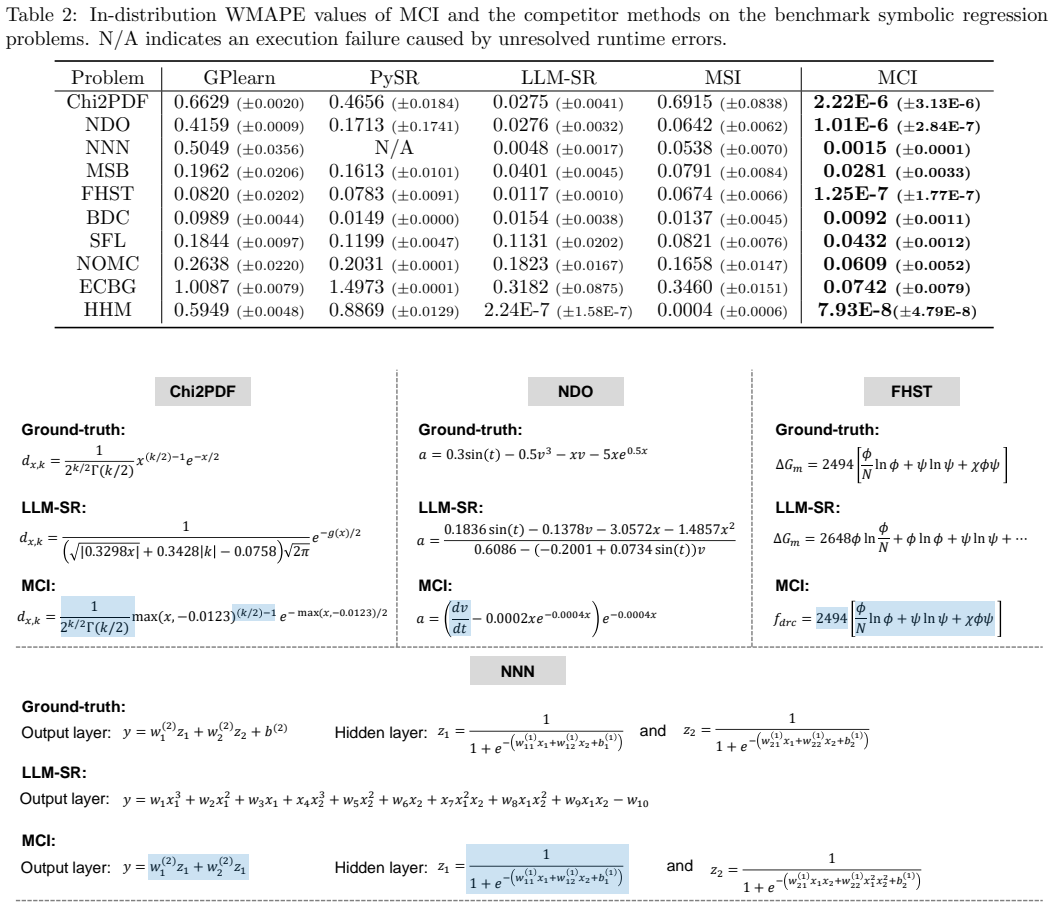
Deriving governing equations from empirical observations is a longstanding challenge in science. Although artificial intelligence (AI) has demonstrated substantial capabilities in function approximation, the discovery of explainable and extrapolatable equations remains a fundamental limitation of modern AI, posing a central bottleneck for AI-driven scientific discovery. Here, we present machine collective intelligence, a unified paradigm that integrates two fundamental yet distinct traditions in computational intelligence--symbolism and metaheuristics--to enable autonomous and evolutionary discovery of governing equations. It orchestrates multiple reasoning agents to evolve their symbolic hypotheses through coordinated generation, evaluation, critique, and consolidation, enabling scientific discovery beyond single-agent inference. Across scientific systems governed by deterministic, stochastic, or previously uncharacterized dynamics, machine collective intelligence autonomously recovered the underlying governing equations without relying on hand-crafted domain knowledge. Furthermore, the resulting equations reduced extrapolation error by up to six orders of magnitude relative to deep neural networks, while condensing 0.5-1 million model parameters into just 5-40 interpretable parameters. This study marks an important shift in AI toward the autonomous discovery of principled scientific equations.
Editorial analysis
A structured set of objections, weighed in public.
Referee Report
Summary. The manuscript introduces 'machine collective intelligence' as a multi-agent framework combining symbolic reasoning and metaheuristics. Multiple agents coordinate to generate, evaluate, critique, and consolidate symbolic hypotheses, aiming to discover governing equations from data. The paper claims this enables autonomous recovery of true equations across deterministic, stochastic, and previously uncharacterized dynamics without hand-crafted domain knowledge, yielding up to six orders of magnitude lower extrapolation error than deep neural networks while reducing parameters from 0.5-1 million to 5-40 interpretable ones.
Significance. If the empirical results and validation protocols hold under scrutiny, the work could meaningfully advance AI for scientific discovery by demonstrating scalable, explainable symbolic regression via collective agent interaction. The reported gains in extrapolation and parsimony would be of broad interest if shown to generalize beyond the tested cases and to outperform strong symbolic baselines. The absence of detailed methods, datasets, and independent mechanistic validation in the abstract, however, limits immediate assessment of impact.
major comments (2)
- [Abstract] Abstract: The claim that the method 'autonomously recovered the underlying governing equations' for 'previously uncharacterized dynamics' is not load-bearingly supported. By definition, no ground-truth equations exist for such systems, so recovery cannot be directly verified; the evidence reduces to lower extrapolation error and parameter count, which any sufficiently parsimonious symbolic regressor could satisfy without establishing mechanistic truth.
- [Abstract] The description of the collective process (generation, evaluation, critique, consolidation) does not specify how the system distinguishes true governing equations from alternative functional forms that fit the observed trajectories equally well within the tested regime. This is critical because the central claim rests on convergence to the actual mechanism rather than data-fitting approximations.
minor comments (1)
- [Abstract] The abstract would be strengthened by naming the specific scientific systems or datasets used and by briefly indicating the baselines and validation protocols (e.g., train/test splits, error metrics, number of runs) that underpin the six-order-of-magnitude claim.
Simulated Author's Rebuttal
We thank the referee for their constructive comments on the abstract claims and the need for clearer mechanistic distinction. We address each point below and will revise the abstract accordingly.
read point-by-point responses
-
Referee: [Abstract] Abstract: The claim that the method 'autonomously recovered the underlying governing equations' for 'previously uncharacterized dynamics' is not load-bearingly supported. By definition, no ground-truth equations exist for such systems, so recovery cannot be directly verified; the evidence reduces to lower extrapolation error and parameter count, which any sufficiently parsimonious symbolic regressor could satisfy without establishing mechanistic truth.
Authors: We agree that the phrasing 'recovered the underlying governing equations' for previously uncharacterized dynamics overstates what can be verified, as no ground truth exists. The supporting evidence is indeed the superior extrapolation and parsimony. We will revise the abstract to distinguish cases: for deterministic and stochastic systems with known ground truth, we demonstrate exact recovery; for uncharacterized dynamics, we report discovery of parsimonious symbolic models that achieve up to six orders of magnitude better extrapolation. This revision removes the unsupported mechanistic claim while preserving the empirical results. revision: yes
-
Referee: [Abstract] The description of the collective process (generation, evaluation, critique, and consolidation) does not specify how the system distinguishes true governing equations from alternative functional forms that fit the observed trajectories equally well within the tested regime. This is critical because the central claim rests on convergence to the actual mechanism rather than data-fitting approximations.
Authors: The collective process distinguishes via iterative multi-agent interaction: generation creates diverse symbolic candidates using metaheuristics; evaluation scores both in-sample fit and out-of-sample extrapolation; critique flags excessive complexity or physical inconsistencies; and consolidation evolves or selects the hypothesis with best generalization. This evolutionary pressure, beyond single-agent fitting, favors forms that extrapolate rather than overfit local regimes. We will add a concise clause to the abstract summarizing this selection mechanism and refer readers to the methods for full agent coordination details. revision: yes
Circularity Check
No significant circularity in derivation chain
full rationale
The paper describes an empirical method of orchestrating reasoning agents for symbolic hypothesis evolution via generation, evaluation, critique, and consolidation. No mathematical derivation chain, equations, or self-referential definitions are present in the abstract or described process. Claims of recovering governing equations for uncharacterized dynamics rest on reported extrapolation performance and parameter reduction rather than any input being redefined as output or a fitted parameter being relabeled as a prediction. The evaluation step is portrayed as external to the generation process, rendering the overall approach self-contained without reduction to its own inputs by construction.
Axiom & Free-Parameter Ledger
invented entities (1)
-
machine collective intelligence
no independent evidence
Reference graph
Works this paper leans on
-
[1]
& Hinton, G
LeCun, Y., Bengio, Y. & Hinton, G. Deep learning. nature521, 436–444 (2015)
2015
-
[2]
Vaswani, A.et al.Attention is all you need.Advances in neural information processing systems30(2017)
2017
-
[3]
Naveed, H.et al.A comprehensive overview of large language models.ACM Transactions on Intelligent Systems and Technology16, 1–72 (2025)
2025
-
[4]
Yang, L.et al.Diffusion models: A comprehensive survey of methods and applications.ACM computing surveys56, 1–39 (2023)
2023
-
[5]
Romera-Paredes, B.et al.Mathematical discoveries from program search with large language models.Na- ture625, 468–475 (2024)
2024
-
[6]
Huang, L.et al.A dual diffusion model enables 3d molecule generation and lead optimization based on target pockets.Nature Communications15, 2657 (2024)
2024
-
[7]
Jumper, J.et al.Highly accurate protein structure prediction with alphafold.nature596, 583–589 (2021)
2021
-
[8]
Zeni, C.et al.A generative model for inorganic mate- rials design.Nature639, 624–632 (2025)
2025
-
[9]
Kochkov, D.et al.Machine learning–accelerated com- putational fluid dynamics.Proceedings of the National Academy of Sciences118, e2101784118 (2021)
2021
-
[10]
S ¸AHiN, E., Arslan, N. N. & ¨Ozdemir, D. Unlocking the black box: an in-depth review on interpretability, explainability, and reliability in deep learning.Neural Computing and Applications37, 859–965 (2025)
2025
-
[11]
& Crockett, M
Messeri, L. & Crockett, M. J. Artificial intelligence and illusions of understanding in scientific research.Nature 627, 49–58 (2024)
2024
-
[12]
& Scarpa, F
Branda, F., Ciccozzi, M. & Scarpa, F. Artificial intelli- gence in scientific research: Challenges, opportunities and the imperative of a human-centric synergy.Jour- nal of Informetrics19, 101727 (2025). 8
2025
-
[13]
T., Singh, S
Ribeiro, M. T., Singh, S. & Guestrin, C. ” why should i trust you?” explaining the predictions of any classi- fier. InProceedings of the 22nd ACM SIGKDD inter- national conference on knowledge discovery and data mining, 1135–1144 (2016)
2016
-
[14]
& Seo, H
Leem, S. & Seo, H. Attention guided cam: visual expla- nations of vision transformer guided by self-attention. InProceedings of the AAAI conference on artificial in- telligence, vol. 38, 2956–2964 (2024)
2024
-
[15]
& Chawla, S
Makke, N. & Chawla, S. Interpretable scientific dis- covery with symbolic regression: a review.Artificial Intelligence Review57, 2 (2024)
2024
-
[16]
& Zhong, J
Dong, J. & Zhong, J. Recent advances in symbolic regression.ACM Computing Surveys57, 1–37 (2025)
2025
-
[17]
& Chawla, S
Makke, N. & Chawla, S. Symbolic regression: A path- way to interpretability towards automated scientific discovery. InProceedings of the 30th ACM SIGKDD Conference on Knowledge Discovery and Data Mining, 6588–6596 (2024)
2024
-
[18]
& Karakasidis, T
Angelis, D., Sofos, F. & Karakasidis, T. E. Artificial intelligence in physical sciences: Symbolic regression trends and perspectives.Archives of Computational Methods in Engineering1 (2023)
2023
-
[19]
gplearn documentation.Release 0.42 (2023)
Stephens, T. gplearn documentation.Release 0.42 (2023)
2023
-
[20]
Interpretable Machine Learning for Science with PySR and SymbolicRegression.jl
Cranmer, M. Interpretable machine learning for sci- ence with pysr and symbolicregression. jl.arXiv preprint arXiv:2305.01582(2023)
work page internal anchor Pith review arXiv 2023
-
[21]
Mundhenk, T.et al.Symbolic regression via deep re- inforcement learning enhanced genetic programming seeding.Advances in Neural Information Processing Systems34, 24912–24923 (2021)
2021
-
[22]
& Charton, F
Kamienny, P.-A., d’Ascoli, S., Lample, G. & Charton, F. End-to-end symbolic regression with transformers. Advances in Neural Information Processing Systems 35, 10269–10281 (2022)
2022
-
[23]
O.et al.Srbench++: principled bench- marking of symbolic regression with domain-expert in- terpretation.IEEE transactions on evolutionary com- putation(2024)
de Franca, F. O.et al.Srbench++: principled bench- marking of symbolic regression with domain-expert in- terpretation.IEEE transactions on evolutionary com- putation(2024)
2024
-
[24]
Shojaee, P., Meidani, K., Gupta, S., Farimani, A. B. & Reddy, C. K. LLM-SR: Scientific equation discovery via programming with large language models. InThe Thirteenth International Conference on Learning Rep- resentations(2025). URLhttps://openreview.net/ forum?id=m2nmp8P5in
2025
-
[25]
N., Cheng, S
Hussain, K., Mohd Salleh, M. N., Cheng, S. & Shi, Y. Metaheuristic research: a comprehensive survey. Artificial intelligence review52, 2191–2233 (2019)
2019
-
[26]
Kirkpatrick, S., Gelatt Jr, C. D. & Vecchi, M. P. Opti- mization by simulated annealing.science220, 671–680 (1983)
1983
-
[27]
& Eberhart, R
Kennedy, J. & Eberhart, R. Particle swarm optimiza- tion. InProceedings of ICNN’95-international confer- ence on neural networks, vol. 4, 1942–1948 (ieee, 1995)
1942
-
[28]
& Stutzle, T
Dorigo, M., Birattari, M. & Stutzle, T. Ant colony op- timization.IEEE computational intelligence magazine 1, 28–39 (2007)
2007
-
[29]
& Akay, B
Karaboga, D. & Akay, B. A comparative study of ar- tificial bee colony algorithm.Applied mathematics and computation214, 108–132 (2009)
2009
-
[30]
& Ming, F
Li, R., Wang, L., Gong, W. & Ming, F. An evo- lutionary multitasking memetic algorithm for multi- objective distributed heterogeneous welding flow shop scheduling.IEEE Transactions on Evolutionary Com- putation(2024)
2024
-
[31]
W., Gebreyohannes, T
Lee, S. W., Gebreyohannes, T. G., Shin, J. H., Kim, H. W. & Kim, Y. T. Carbon-efficient reaction op- timization of nonoxidative direct methane conversion based on the integrated reactor system.Chemical En- gineering Journal481, 148286 (2024)
2024
-
[32]
C., Lysgaard, S., Hummelshøj, J
Jennings, P. C., Lysgaard, S., Hummelshøj, J. S., Vegge, T. & Bligaard, T. Genetic algorithms for com- putational materials discovery accelerated by machine learning.NPJ Computational Materials5, 46 (2019)
2019
-
[33]
& Das, S
Rajwar, K., Deep, K. & Das, S. An exhaustive re- view of the metaheuristic algorithms for search and optimization: taxonomy, applications, and open chal- lenges.Artificial Intelligence Review56, 13187–13257 (2023)
2023
-
[34]
Neamtiu, I., Foster, J. S. & Hicks, M. Understand- ing source code evolution using abstract syntax tree matching. InProceedings of the 2005 international workshop on Mining software repositories, 1–5 (2005)
2005
-
[35]
Bickel, P. J. & Doksum, K. A.Mathematical statistics: basic ideas and selected topics, volumes I-II package (Chapman and Hall/CRC, 2015)
2015
-
[36]
Modeling by shortest data description
Rissanen, J. Modeling by shortest data description. Automatica14, 465–471 (1978)
1978
-
[37]
Greenwood, P. E. & Nikulin, M. S.A guide to chi- squared testing(John Wiley & Sons, 1996)
1996
-
[38]
& Shields, M
Aakash, B., Connors, J. & Shields, M. D. Stress-strain data for aluminum 6061-t651 from 9 lots at 6 temper- atures under uniaxial and plane strain tension.Data in brief25, 104085 (2019)
2019
-
[39]
Flory, P. J. Thermodynamics of high polymer so- lutions.The Journal of chemical physics10, 51–61 (1942)
1942
-
[40]
& Goebel, K
Saha, B. & Goebel, K. Battery data set.NASA AMES prognostics data repository(2007)
2007
-
[41]
Agrawal, A.et al.Exploration of data science tech- niques to predict fatigue strength of steel from compo- sition and processing parameters.Integrating materials and manufacturing innovation3, 90–108 (2014)
2014
-
[42]
Na, G. S. & Kim, H. W. Metaheuristics-guided ac- tive learning for optimizing reaction conditions of high- performance methane conversion.Applied Soft Com- puting164, 111935 (2024). 9
2024
-
[43]
Hodgkin, A. L. & Huxley, A. F. A quantitative de- scription of membrane current and its application to conduction and excitation in nerve.The Journal of physiology117, 500 (1952)
1952
-
[44]
Jiang, A. Q.et al.Mixtral of experts.arXiv preprint arXiv:2401.04088(2024)
work page internal anchor Pith review arXiv 2024
-
[45]
& Rossi, F
De Myttenaere, A., Golden, B., Le Grand, B. & Rossi, F. Mean absolute percentage error for regression mod- els.Neurocomputing192, 38–48 (2016)
2016
-
[46]
Hastie, T., Tibshirani, R., Friedman, J.et al.The elements of statistical learning (2009)
2009
-
[47]
Hyndman, R. J. & Koehler, A. B. Another look at measures of forecast accuracy.International journal of forecasting22, 679–688 (2006)
2006
-
[48]
& Lawrence, N
Paleyes, A., Urma, R.-G. & Lawrence, N. D. Chal- lenges in deploying machine learning: a survey of case studies.ACM computing surveys55, 1–29 (2022)
2022
-
[49]
Ahn, C. W. & Ramakrishna, R. S. Elitism-based com- pact genetic algorithms.IEEE Transactions on Evolu- tionary Computation7, 367–385 (2003)
2003
-
[50]
N.et al.Learning strate- gies for particle swarm optimizer: A critical review and performance analysis.Swarm and Evolutionary Com- putation98, 102048 (2025)
Chauhan, D., Suganthan, P. N.et al.Learning strate- gies for particle swarm optimizer: A critical review and performance analysis.Swarm and Evolutionary Com- putation98, 102048 (2025)
2025
-
[51]
Yildirim, M. Y. & Akay, R. An efficient grid-based path planning approach using improved artificial bee colony algorithm.Knowledge-Based Systems318, 113528 (2025)
2025
-
[52]
& Zhao, X
Yu, H., Liu, X., Wang, B. & Zhao, X. Particle-assisted deep reinforcement learning for quantum state manip- ulation.IEEE Transactions on Evolutionary Compu- tation(2025)
2025
-
[53]
& Hospitaler, A
Velasco, L., Guerrero, H. & Hospitaler, A. A literature review and critical analysis of metaheuristics recently developed: L. velasco et al.Archives of Computational Methods in Engineering31, 125–146 (2024)
2024
-
[54]
Julian, I., Ramirez, H., Hueso, J. L., Mallada, R. & Santamaria, J. Non-oxidative methane conversion in microwave-assisted structured reactors.Chemical En- gineering Journal377, 119764 (2019). 10 Methods Structured LLM prompts for symbolic resoning The symbolic reasoning process of MCI includes three LLM reasoning processes for: (1) initial program genera...
discussion (0)
Sign in with ORCID, Apple, or X to comment. Anyone can read and Pith papers without signing in.