Recognition: unknown
METASYMBO: Multi-Agent Language-Guided Metamaterial Discovery via Symbolic Latent Evolution
Pith reviewed 2026-05-07 08:49 UTC · model grok-4.3
The pith
A multi-agent framework with symbolic latent evolution generates valid metamaterial structures directly from natural language intents.
A machine-rendered reading of the paper's core claim, the machinery that carries it, and where it could break.
Core claim
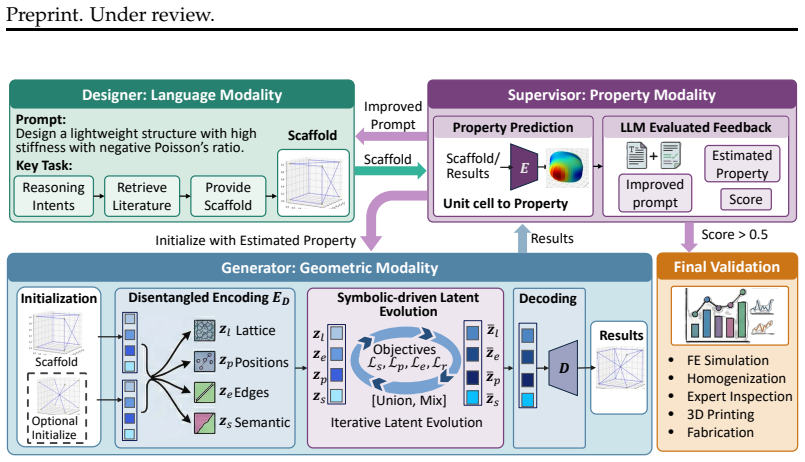
The central discovery is that symbolic-driven latent evolution, applied through a multi-agent system, enables the synthesis of microstructures whose geometry induces targeted behaviors as specified in free-form natural language, without explicit numerical targets, by disentangling latent factors and applying programmable operators for composition and refinement at inference time.
What carries the argument
Symbolic-driven latent evolution: programmable operators applied over disentangled latent factors to compose, modify, and refine candidate microstructures during the discovery process.
If this is right
- Enables starting the design process with qualitative language-based intents instead of numerical property targets.
- Yields microstructures with higher structural validity measured by symmetry and periodicity.
- Provides better alignment with the input language guidance while keeping higher novelty in structures.
- Validates through case studies on auxetic and high-stiffness metamaterials for practical use.
Where Pith is reading between the lines
- The framework could be extended to incorporate real-time simulation feedback for even tighter property control.
- Similar symbolic evolution techniques might apply to generating designs in related fields like photonics or acoustics.
- Disentangling the latent space further could allow users to edit specific aspects of the design post-generation.
Load-bearing premise
The premise that a disentangled latent space combined with symbolic operators can reliably produce physically valid and intent-matching microstructures from language alone, without additional numerical optimization or filtering steps.
What would settle it
Generating a set of structures from language prompts and then performing mechanical testing or high-fidelity simulation to measure if their actual properties match the described behaviors and if the validity improvements persist without post-hoc corrections.
Figures





read the original abstract
Metamaterial discovery seeks microstructured materials whose geometry induces targeted mechanical behavior. Existing inverse-design methods can efficiently generate candidates, but they typically require explicit numerical property targets and are less suitable for early-stage exploration, where researchers often begin with incomplete constraints and qualitative intents expressed in natural language. Large language models can interpret such intents, but they lack geometric awareness and physical property validity. To address this gap, we propose MetaSymbO, a multi-agent framework for language-guided Metamaterial discovery via Symbolic-driven latent evOlution. Specifically, MetaSymbO contains three agents: a Designer that interprets free-form design intents and retrieves a semantically consistent scaffold, a Generator that synthesizes candidate microstructures in a disentangled latent space, and a Supervisor that provides fast property-aware feedback for iterative refinement. To move beyond the limitations of reproducing known samples from literature and training data, we further introduce symbolic-driven latent evolution, which applies programmable operators over disentangled latent factors to compose, modify, and refine structures at inference time. Extensive experiments demonstrate that (i) MetaSymbO improves structural validity by up to 34% in symmetry and nearly 98% in periodicity compared to state-of-the-art baselines; (ii) MetaSymbO achieves about 6-7% higher language-guidance scores while maintaining superior structure novelty compared to advanced reasoning LLMs; (iii) qualitative analyses confirm the effectiveness of symbolic logic operators in enabling programmable semantic alignment; and (iv) realworld case studies on auxetic, high-stiffness metamaterial design further validate its practical capability.
Editorial analysis
A structured set of objections, weighed in public.
Referee Report
Summary. The paper proposes MetaSymbO, a multi-agent framework (Designer, Generator, Supervisor) for language-guided metamaterial discovery. It uses a disentangled latent space combined with symbolic-driven latent evolution via programmable operators to generate microstructures from free-form natural language intents. The central claims are quantitative gains in structural validity (up to 34% symmetry, ~98% periodicity over baselines), 6-7% higher language-guidance scores with maintained novelty, effectiveness of symbolic operators for semantic alignment, and validation via real-world case studies on auxetic and high-stiffness metamaterials.
Significance. If the results hold and the property-aware feedback is grounded in physics, the work could meaningfully advance early-stage metamaterial exploration by allowing qualitative language inputs without requiring explicit numerical targets. The combination of multi-agent LLM reasoning with symbolic operators over disentangled latents offers a potentially generalizable way to improve validity and novelty beyond pure generative models or direct LLM generation. The case studies on auxetic and stiff designs provide a concrete test of practical utility.
major comments (3)
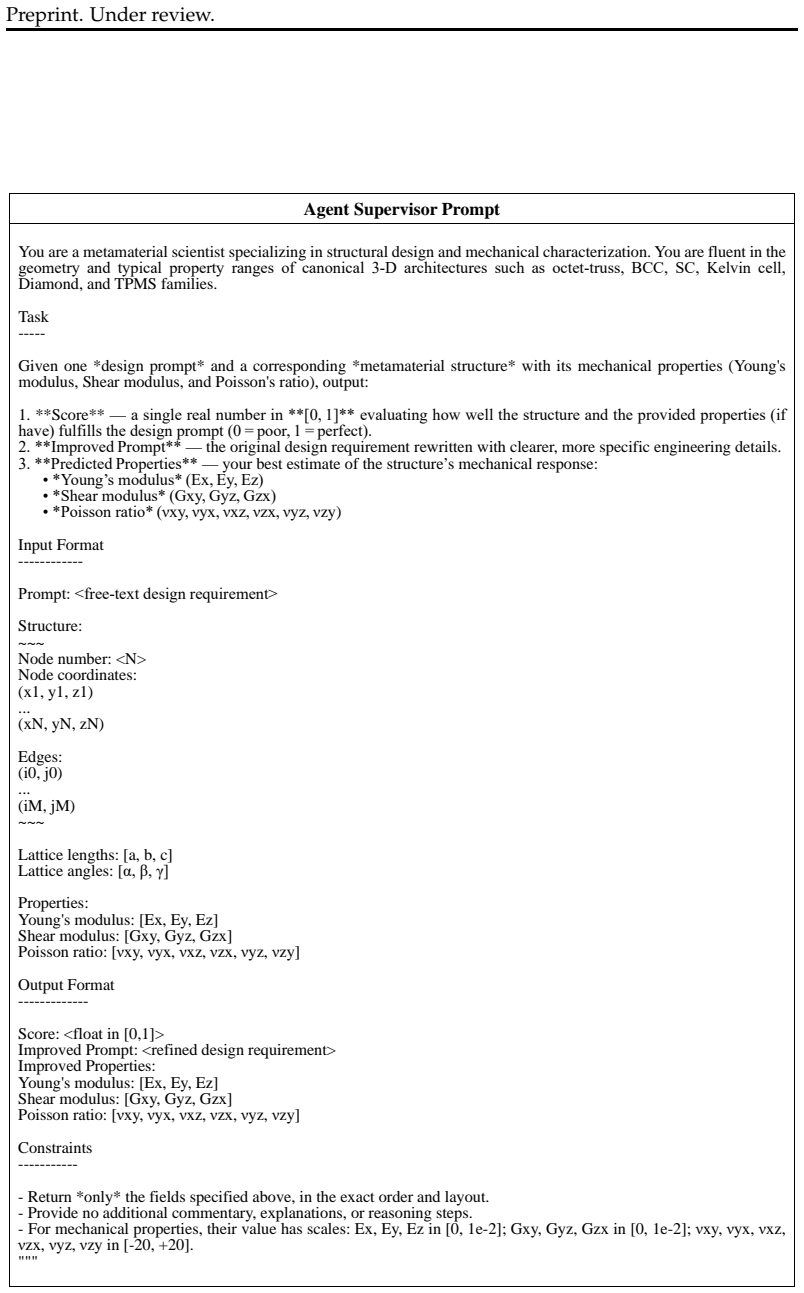
- [Abstract and Supervisor agent section] Abstract (points i and iv) and the Supervisor agent description: the 'fast property-aware feedback' is presented as enabling iterative refinement toward targeted mechanical behaviors (auxeticity, stiffness), yet no derivation, surrogate model, or simulation reference (e.g., FEM, homogenization) is given for how mechanical properties are evaluated. Geometric metrics (symmetry, periodicity) and language scores alone do not establish that the generated structures induce the intended physical responses; this is load-bearing for the central claim that language-guided symbolic evolution produces functionally valid metamaterials.
- [Experiments section] Experiments section (quantitative results): the reported 34% symmetry and 98% periodicity improvements require explicit baseline definitions, training data overlap checks, and statistical error analysis (e.g., standard deviations across multiple runs or seeds). Without these, it is unclear whether gains arise from the symbolic evolution or from differences in how baselines handle language inputs versus the proposed multi-agent setup.
- [Case studies section] Case studies on auxetic and high-stiffness designs: the qualitative validation must include quantitative mechanical property measurements (e.g., Poisson's ratio, effective modulus from simulation) rather than relying solely on visual inspection or language alignment scores. If post-hoc filtering or manual selection is applied, this would undermine the claim of end-to-end language-to-valid-structure generation.
minor comments (2)
- [Methods] The abstract mentions 'disentangled latent space' and 'programmable symbolic operators' without a brief equation or pseudocode example; adding a short formal description in the methods would improve accessibility.
- [Figures and tables] Figure captions and tables should explicitly state the number of samples, random seeds, and exact metric definitions (e.g., how periodicity is quantified) to allow reproduction.
Simulated Author's Rebuttal
We thank the referee for the constructive and detailed feedback. We address each major comment point by point below, clarifying our approach and indicating where the manuscript will be revised for greater rigor and clarity.
read point-by-point responses
-
Referee: [Abstract and Supervisor agent section] Abstract (points i and iv) and the Supervisor agent description: the 'fast property-aware feedback' is presented as enabling iterative refinement toward targeted mechanical behaviors (auxeticity, stiffness), yet no derivation, surrogate model, or simulation reference (e.g., FEM, homogenization) is given for how mechanical properties are evaluated. Geometric metrics (symmetry, periodicity) and language scores alone do not establish that the generated structures induce the intended physical responses; this is load-bearing for the central claim that language-guided symbolic evolution produces functionally valid metamaterials.
Authors: We appreciate this observation. The Supervisor provides fast feedback by combining geometric validity metrics (symmetry and periodicity, which are established proxies for mechanical isotropy and effective properties in metamaterial literature) with language alignment scores. These proxies enable iterative refinement without full physics simulation in the loop. We acknowledge that the manuscript would benefit from explicit references to how these metrics correlate with targeted behaviors such as auxeticity. We will revise the Supervisor section and abstract to include these derivations and literature citations while clarifying that full FEM is reserved for final validation to maintain computational efficiency. revision: partial
-
Referee: [Experiments section] Experiments section (quantitative results): the reported 34% symmetry and 98% periodicity improvements require explicit baseline definitions, training data overlap checks, and statistical error analysis (e.g., standard deviations across multiple runs or seeds). Without these, it is unclear whether gains arise from the symbolic evolution or from differences in how baselines handle language inputs versus the proposed multi-agent setup.
Authors: We agree that these details are essential for reproducibility and to isolate the contribution of symbolic latent evolution. In the revised Experiments section we will explicitly define each baseline (including their language-handling mechanisms), report training-data overlap statistics, and include standard deviations computed across multiple independent runs with different random seeds. revision: yes
-
Referee: [Case studies section] Case studies on auxetic and high-stiffness designs: the qualitative validation must include quantitative mechanical property measurements (e.g., Poisson's ratio, effective modulus from simulation) rather than relying solely on visual inspection or language alignment scores. If post-hoc filtering or manual selection is applied, this would undermine the claim of end-to-end language-to-valid-structure generation.
Authors: We thank the referee for highlighting this requirement. The current case studies use visual inspection and language scores to illustrate practical utility, with no post-hoc filtering or manual selection applied—all structures are direct outputs. To strengthen the claims, we will augment the case-study section with quantitative FEM-derived metrics (Poisson’s ratio for auxetic examples and effective modulus for high-stiffness examples) computed on the generated microstructures. revision: yes
Circularity Check
No significant circularity: framework claims rest on empirical validation rather than self-referential definitions or fitted predictions.
full rationale
The paper describes a multi-agent system (Designer, Generator, Supervisor) plus symbolic operators on a disentangled latent space for language-guided metamaterial generation. No equations, parameter fits, or self-citations are shown that would make the reported gains in symmetry (+34%), periodicity (+98%), or language scores (+6-7%) reduce to the method's own inputs by construction. The central claims are supported by external experimental comparisons to baselines and qualitative case studies on auxetic/high-stiffness designs; these are falsifiable outcomes, not tautologies. The derivation chain is therefore self-contained against external benchmarks, with no load-bearing self-definitional steps, fitted-input predictions, or uniqueness theorems imported from the authors' prior work.
Axiom & Free-Parameter Ledger
axioms (2)
- domain assumption Large language models can interpret free-form design intents and retrieve semantically consistent scaffolds
- domain assumption Disentangled latent space allows independent modification of geometric factors via symbolic operators
invented entities (1)
-
Symbolic-driven latent evolution
no independent evidence
Reference graph
Works this paper leans on
-
[1]
write newline
" write newline "" before.all 'output.state := FUNCTION n.dashify 't := "" t empty not t #1 #1 substring "-" = t #1 #2 substring "--" = not "--" * t #2 global.max substring 't := t #1 #1 substring "-" = "-" * t #2 global.max substring 't := while if t #1 #1 substring * t #2 global.max substring 't := if while FUNCTION format.date year duplicate empty "emp...
-
[2]
Journal of Engineering Materials and Technology, 141 0 (1), January 2019
A 149 line homogenization code for three-dimensional cellular materials written in matlab. Journal of Engineering Materials and Technology, 141 0 (1), January 2019. ISSN 0094-4289. doi:10.1115/1.4040555
-
[3]
How to determine composite material properties using numerical homogenization
Erik Andreassen and Casper Schousboe Andreasen. How to determine composite material properties using numerical homogenization. Computational Materials Science, 83: 0 488--495, 2014. ISSN 0927-0256. doi:https://doi.org/10.1016/j.commatsci.2013.09.006
-
[4]
Sajad Arabnejad and Damiano Pasini. Mechanical properties of lattice materials via asymptotic homogenization and comparison with alternative homogenization methods. International Journal of Mechanical Sciences, 77: 0 249--262, 2013. ISSN 0020-7403. doi:https://doi.org/10.1016/j.ijmecsci.2013.10.003
-
[5]
Inverting the structure--property map of truss metamaterials by deep learning
Jan-Hendrik Bastek, Siddhant Kumar, Bastian Telgen, Rapha \"e l N Glaesener, and Dennis M Kochmann. Inverting the structure--property map of truss metamaterials by deep learning. Proceedings of the National Academy of Sciences, 119 0 (1): 0 e2111505119, 2022
2022
-
[6]
Pattern recognition and machine learning, volume 4
Christopher M Bishop and Nasser M Nasrabadi. Pattern recognition and machine learning, volume 4. Springer, 2006
2006
-
[7]
Customizing graph neural networks using path reweighting
Jianpeng Chen, Yujing Wang, Ming Zeng, Zongyi Xiang, Bitan Hou, Yunhai Tong, Ole J Mengshoel, and Yazhou Ren. Customizing graph neural networks using path reweighting. Information Sciences, 674: 0 120681, 2024 a
2024
-
[8]
Jianpeng Chen, Yawen Ling, Jie Xu, Yazhou Ren, Shudong Huang, Xiaorong Pu, Zhifeng Hao, Philip S. Yu, and Lifang He. Variational graph generator for multiview graph clustering. IEEE Transactions on Neural Networks and Learning Systems, 36 0 (6): 0 11078--11091, 2025 a . doi:10.1109/TNNLS.2024.3524205
-
[9]
Metamatbench: Integrating heterogeneous data, computational tools, and visual interface for metamaterial discovery
Jianpeng Chen, Wangzhi Zhan, Haohui Wang, Zian Jia, Jingru Gan, Junkai Zhang, Jingyuan Qi, Tingwei Chen, Lifu Huang, Muhao Chen, et al. Metamatbench: Integrating heterogeneous data, computational tools, and visual interface for metamaterial discovery. In Proceedings of the 31st ACM SIGKDD Conference on Knowledge Discovery and Data Mining V. 2, pp.\ 5334--...
2025
-
[10]
Smhgc: Homophily-agnostic multi-view heterophilous graph clustering
Jianpeng Chen, Yawen Ling, Yazhou Ren, Shufei Zhang, and Lifang He. Smhgc: Homophily-agnostic multi-view heterophilous graph clustering. Pattern Recognition, pp.\ 113668, 2026
2026
-
[11]
Generative inverse design of metamaterials with functional responses by interpretable learning
Wei Chen, Rachel Sun, Doksoo Lee, Carlos M Portela, and Wei Chen. Generative inverse design of metamaterials with functional responses by interpretable learning. Advanced Intelligent Systems, pp.\ 2400611, 2024 b
2024
-
[12]
Nearest neighbor pattern classification
Thomas Cover and Peter Hart. Nearest neighbor pattern classification. IEEE transactions on information theory, 13 0 (1): 0 21--27, 1967
1967
-
[13]
Inverse design of mechanical metamaterials with target nonlinear response via a neural accelerated evolution strategy
Bolei Deng, Ahmad Zareei, Xiaoxiao Ding, James C Weaver, Chris H Rycroft, and Katia Bertoldi. Inverse design of mechanical metamaterials with target nonlinear response via a neural accelerated evolution strategy. Advanced Materials, 34 0 (41): 0 2206238, 2022
2022
-
[14]
Metamaterials: physics and engineering explorations
Nader Engheta and Richard W Ziolkowski. Metamaterials: physics and engineering explorations. John Wiley & Sons, 2006
2006
-
[15]
Learning with a wasserstein loss
Charlie Frogner, Chiyuan Zhang, Hossein Mobahi, Mauricio Araya, and Tomaso Poggio. Learning with a wasserstein loss. In Advances in Neural Information Processing Systems (NeurIPS), volume 28, pp.\ 2053--2061, 2015
2053
-
[16]
A latent diffusion model for protein structure generation
Cong Fu, Keqiang Yan, Limei Wang, Wing Yee Au, Michael Curtis McThrow, Tao Komikado, Koji Maruhashi, Kanji Uchino, Xiaoning Qian, and Shuiwang Ji. A latent diffusion model for protein structure generation. In Learning on Graphs Conference, pp.\ 29--1. PMLR, 2024
2024
-
[17]
Lawrence Zitnick, and Zachary Ward Ulissi
Nate Gruver, Anuroop Sriram, Andrea Madotto, Andrew Gordon Wilson, C. Lawrence Zitnick, and Zachary Ward Ulissi. Fine-tuned language models generate stable inorganic materials as text. In The Twelfth International Conference on Learning Representations, 2024. URL https://openreview.net/forum?id=vN9fpfqoP1
2024
-
[18]
Deepseek-r1 incentivizes reasoning in llms through reinforcement learning
Daya Guo, Dejian Yang, Haowei Zhang, Junxiao Song, Peiyi Wang, Qihao Zhu, Runxin Xu, Ruoyu Zhang, Shirong Ma, Xiao Bi, et al. Deepseek-r1 incentivizes reasoning in llms through reinforcement learning. Nature, 645 0 (8081): 0 633--638, 2025
2025
-
[19]
Rapid inverse design of metamaterials based on prescribed mechanical behavior through machine learning
Chan Soo Ha, Desheng Yao, Zhenpeng Xu, Chenang Liu, Han Liu, Daniel Elkins, Matthew Kile, Vikram Deshpande, Zhenyu Kong, Mathieu Bauchy, et al. Rapid inverse design of metamaterials based on prescribed mechanical behavior through machine learning. Nature Communications, 14 0 (1): 0 5765, 2023
2023
-
[20]
Forward and inverse design of kirigami via supervised autoencoder
Paul Z Hanakata, Ekin D Cubuk, David K Campbell, and Harold S Park. Forward and inverse design of kirigami via supervised autoencoder. Physical Review Research, 2 0 (4): 0 042006, 2020
2020
-
[21]
Thomas Hayes, Roshan Rao, Halil Akin, Nicholas J Sofroniew, Deniz Oktay, Zeming Lin, Robert Verkuil, Vincent Q Tran, Jonathan Deaton, Marius Wiggert, et al. Simulating 500 million years of evolution with a language model, july 2024. URL https://www. biorxiv. org/content/10.1101/2024.07, 1: 0 v1, 2024
-
[22]
Geoffrey E. Hinton. Training products of experts by minimizing contrastive divergence. Neural Computation, 14 0 (8): 0 1771--1800, 08 2002. ISSN 0899-7667. doi:10.1162/089976602760128018
-
[23]
Aaron Hurst, Adam Lerer, Adam P Goucher, Adam Perelman, Aditya Ramesh, Aidan Clark, AJ Ostrow, Akila Welihinda, Alan Hayes, Alec Radford, et al. Gpt-4o system card. arXiv preprint arXiv:2410.21276, 2024
work page internal anchor Pith review arXiv 2024
-
[24]
Large language model agent as a mechanical designer, 2024
Yayati Jadhav and Amir Barati Farimani. Large language model agent as a mechanical designer, 2024. URL https://arxiv. org/abs/2404.17525, 2024
-
[25]
Engineering lattice metamaterials for extreme property, programmability, and multifunctionality
Zian Jia, Fan Liu, Xihang Jiang, and Lifeng Wang. Engineering lattice metamaterials for extreme property, programmability, and multifunctionality. Journal of Applied Physics, 127 0 (15), 2020
2020
-
[26]
Crystal structure prediction by joint equivariant diffusion on lattices and fractional coordinates
Rui Jiao, Wenbing Huang, Peijia Lin, Jiaqi Han, Pin Chen, Yutong Lu, and Yang Liu. Crystal structure prediction by joint equivariant diffusion on lattices and fractional coordinates. In Workshop on ''Machine Learning for Materials'' ICLR 2023, 2023. URL https://openreview.net/forum?id=VPByphdu24j
2023
-
[27]
Hanxun Jin, Enrui Zhang, Boyu Zhang, Sridhar Krishnaswamy, George Em Karniadakis, and Horacio D Espinosa. Mechanical characterization and inverse design of stochastic architected metamaterials using neural operators. arXiv preprint arXiv:2311.13812, 2023
-
[28]
Identifiability of product of experts models
Manav Kant, Eric Y Ma, Andrei Staicu, Leonard J Schulman, and Spencer Gordon. Identifiability of product of experts models. In Sanjoy Dasgupta, Stephan Mandt, and Yingzhen Li (eds.), Proceedings of The 27th International Conference on Artificial Intelligence and Statistics, volume 238 of Proceedings of Machine Learning Research, pp.\ 4492--4500. PMLR, 02-...
2024
-
[29]
Kingma and Max Welling
Diederik P. Kingma and Max Welling. Auto-encoding variational bayes. In ICLR, 2014
2014
-
[30]
Data-driven design for metamaterials and multiscale systems: a review
Doksoo Lee, Wei Chen, Liwei Wang, Yu-Chin Chan, and Wei Chen. Data-driven design for metamaterials and multiscale systems: a review. Advanced Materials, 36 0 (8): 0 2305254, 2024
2024
-
[31]
Geometry informed tokenization of molecules for language model generation, 2025 a
Xiner Li, Limei Wang, Youzhi Luo, Carl Edwards, Shurui Gui, Yuchao Lin, Heng Ji, and Shuiwang Ji. Geometry informed tokenization of molecules for language model generation, 2025 a . URL https://openreview.net/forum?id=HbZrxBXzks
2025
-
[32]
Large language-geometry model: When LLM meets equivariance
Zongzhao Li, Jiacheng Cen, Bing Su, Tingyang Xu, Yu Rong, Deli Zhao, and Wenbing Huang. Large language-geometry model: When LLM meets equivariance. In Forty-second International Conference on Machine Learning, 2025 b . URL https://openreview.net/forum?id=Qi9rPcdiTY
2025
-
[33]
Equiformer: Equivariant graph attention transformer for 3d atomistic graphs
Yi-Lun Liao and Tess Smidt. Equiformer: Equivariant graph attention transformer for 3d atomistic graphs. In ICLR, 2023
2023
-
[34]
Aixin Liu, Bei Feng, Bing Xue, Bingxuan Wang, Bochao Wu, Chengda Lu, Chenggang Zhao, Chengqi Deng, Chenyu Zhang, Chong Ruan, et al. Deepseek-v3 technical report. arXiv preprint arXiv:2412.19437, 2024
work page internal anchor Pith review arXiv 2024
-
[35]
Spherical message passing for 3d molecular graphs
Yi Liu, Limei Wang, Meng Liu, Yuchao Lin, Xuan Zhang, Bora Oztekin, and Shuiwang Ji. Spherical message passing for 3d molecular graphs. In ICLR, 2022
2022
-
[36]
Exploring the property space of periodic cellular structures based on crystal networks
Thomas S Lumpe and Tino Stankovic. Exploring the property space of periodic cellular structures based on crystal networks. Proceedings of the National Academy of Sciences, 118 0 (7): 0 e2003504118, 2021
2021
-
[37]
Deep learning generative model for crystal structure prediction
Xiaoshan Luo, Zhenyu Wang, Pengyue Gao, Jian Lv, Yanchao Wang, Changfeng Chen, and Yanming Ma. Deep learning generative model for crystal structure prediction. npj Computational Materials, 10 0 (1): 0 254, 2024 a
2024
-
[38]
Towards symmetry-aware generation of periodic materials
Youzhi Luo, Chengkai Liu, and Shuiwang Ji. Towards symmetry-aware generation of periodic materials. NeurIPS, 36, 2024 b
2024
-
[39]
Probabilistic representation and inverse design of metamaterials based on a deep generative model with semi-supervised learning strategy
Wei Ma, Feng Cheng, Yihao Xu, Qinlong Wen, and Yongmin Liu. Probabilistic representation and inverse design of metamaterials based on a deep generative model with semi-supervised learning strategy. Advanced Materials, 31 0 (35): 0 1901111, 2019
2019
-
[40]
Braza, Ryan-Rhys Griffiths, Manvitha Ponnapati, Albert Bou, Jon M Laurent, Ori Kabeli, Geemi Wellawatte, Sam Cox, Samuel G Rodriques, and Andrew White
Siddharth Narayanan, James D. Braza, Ryan-Rhys Griffiths, Manvitha Ponnapati, Albert Bou, Jon M Laurent, Ori Kabeli, Geemi Wellawatte, Sam Cox, Samuel G Rodriques, and Andrew White. Aviary: Training language agents on challenging scientific tasks. In Scaling Self-Improving Foundation Models without Human Supervision, 2025. URL https://openreview.net/forum...
2025
-
[41]
Deep learning for size-agnostic inverse design of random-network 3d printed mechanical metamaterials
Helda Pahlavani, Kostas Tsifoutis-Kazolis, Mauricio C Saldivar, Prerak Mody, Jie Zhou, Mohammad J Mirzaali, and Amir A Zadpoor. Deep learning for size-agnostic inverse design of random-network 3d printed mechanical metamaterials. Advanced Materials, 36 0 (6): 0 2303481, 2024
2024
-
[42]
Optical metamaterials: fundamentals and applications, 2010
Dilip D Paul. Optical metamaterials: fundamentals and applications, 2010
2010
-
[43]
SDXL: Improving Latent Diffusion Models for High-Resolution Image Synthesis
Dustin Podell, Zion English, Kyle Lacey, Andreas Blattmann, Tim Dockhorn, Jonas M \"u ller, Joe Penna, and Robin Rombach. Sdxl: Improving latent diffusion models for high-resolution image synthesis. arXiv preprint arXiv:2307.01952, 2023
work page internal anchor Pith review arXiv 2023
-
[44]
High-resolution image synthesis with latent diffusion models
Robin Rombach, Andreas Blattmann, Dominik Lorenz, Patrick Esser, and Bj \"o rn Ommer. High-resolution image synthesis with latent diffusion models. In Proceedings of the IEEE/CVF conference on computer vision and pattern recognition, pp.\ 10684--10695, 2022
2022
-
[45]
Inverse design of discrete mechanical metamaterials
Henrik Ronellenfitsch, Norbert Stoop, Josephine Yu, Aden Forrow, and J \"o rn Dunkel. Inverse design of discrete mechanical metamaterials. Physical Review Materials, 3 0 (9): 0 095201, 2019
2019
-
[46]
Gemini: A Family of Highly Capable Multimodal Models
Gemini Team. Gemini: A family of highly capable multimodal models, 2025. URL https://arxiv.org/abs/2312.11805
work page internal anchor Pith review arXiv 2025
-
[47]
Machine learning-based prediction and inverse design of 2d metamaterial structures with tunable deformation-dependent poisson's ratio
Jie Tian, Keke Tang, Xianyan Chen, and Xianqiao Wang. Machine learning-based prediction and inverse design of 2d metamaterial structures with tunable deformation-dependent poisson's ratio. Nanoscale, 14 0 (35): 0 12677--12691, 2022
2022
-
[48]
Jie Tian, Martin Taylor Sobczak, Dhanush Patil, Jixin Hou, Lin Pang, Arunachalam Ramanathan, Libin Yang, Xianyan Chen, Yuval Golan, Xiaoming Zhai, et al. A multi-agent framework integrating large language models and generative ai for accelerated metamaterial design. arXiv preprint arXiv:2503.19889, 2025
-
[49]
LLaMA: Open and Efficient Foundation Language Models
Hugo Touvron, Thibaut Lavril, Gautier Izacard, Xavier Martinet, Marie-Anne Lachaux, Timoth \'e e Lacroix, Baptiste Rozi \`e re, Naman Goyal, Eric Hambro, Faisal Azhar, et al. Llama: Open and efficient foundation language models. arXiv preprint arXiv:2302.13971, 2023
work page internal anchor Pith review arXiv 2023
-
[50]
Enhancing geometric representations for molecules with equivariant vector-scalar interactive message passing
Yusong Wang, Tong Wang, Shaoning Li, Xinheng He, Mingyu Li, Zun Wang, Nanning Zheng, Bin Shao, and Tie-Yan Liu. Enhancing geometric representations for molecules with equivariant vector-scalar interactive message passing. Nature Communications, 15 0 (1): 0 313, 2024
2024
-
[51]
Jaakkola
Tian Xie, Xiang Fu, Octavian-Eugen Ganea, Regina Barzilay, and Tommi S. Jaakkola. Crystal diffusion variational autoencoder for periodic material generation. In ICLR, 2022. URL https://openreview.net/forum?id=03RLpj-tc_
2022
-
[52]
An Yang, Baosong Yang, Beichen Zhang, Binyuan Hui, Bo Zheng, Bowen Yu, Chengyuan Li, Dayiheng Liu, Fei Huang, Haoran Wei, Huan Lin, Jian Yang, Jianhong Tu, Jianwei Zhang, Jianxin Yang, Jiaxi Yang, Jingren Zhou, Junyang Lin, Kai Dang, Keming Lu, Keqin Bao, Kexin Yang, Le Yu, Mei Li, Mingfeng Xue, Pei Zhang, Qin Zhu, Rui Men, Runji Lin, Tianhao Li, Tingyu X...
work page internal anchor Pith review arXiv 2024
-
[53]
Cheng Zeng, Zulqarnain Khan, and Nathan L Post. Data-efficient and interpretable inverse materials design using a disentangled variational autoencoder. AI Mater., 2025. doi:https://doi.org/10.55092/aimat20250002
-
[54]
Unimate: A unified model for mechanical metamaterial generation, property prediction, and condition confirmation
Wangzhi Zhan, Jianpeng Chen, Dongqi Fu, and Dawei Zhou. Unimate: A unified model for mechanical metamaterial generation, property prediction, and condition confirmation. In Forty-second International Conference on Machine Learning, 2025. URL https://openreview.net/forum?id=X7uVxeFS9A
2025
-
[55]
Jian Zhao, Robert O. Ritchie, and Jian Xiong. High-performance programmable combinatorial lattice materials. Journal of the Mechanics and Physics of Solids, 206: 0 106351, 2025. ISSN 0022-5096. doi:https://doi.org/10.1016/j.jmps.2025.106351. URL https://www.sciencedirect.com/science/article/pii/S0022509625003254
-
[56]
Unifying the design space and optimizing linear and nonlinear truss metamaterials by generative modeling
Li Zheng, Konstantinos Karapiperis, Siddhant Kumar, and Dennis M Kochmann. Unifying the design space and optimizing linear and nonlinear truss metamaterials by generative modeling. Nature Communications, 14 0 (1): 0 7563, 2023
2023
-
[57]
Bindgpt: A scalable framework for 3d molecular design via language modeling and reinforcement learning
Artem Zholus, Maksim Kuznetsov, Roman Schutski, Rim Shayakhmetov, Daniil Polykovskiy, Sarath Chandar, and Alex Zhavoronkov. Bindgpt: A scalable framework for 3d molecular design via language modeling and reinforcement learning. In Proceedings of the AAAI Conference on Artificial Intelligence, volume 39, pp.\ 26083--26091, 2025
2025
-
[58]
@esa (Ref
\@ifxundefined[1] #1\@undefined \@firstoftwo \@secondoftwo \@ifnum[1] #1 \@firstoftwo \@secondoftwo \@ifx[1] #1 \@firstoftwo \@secondoftwo [2] @ #1 \@temptokena #2 #1 @ \@temptokena \@ifclassloaded agu2001 natbib The agu2001 class already includes natbib coding, so you should not add it explicitly Type <Return> for now, but then later remove the command n...
-
[59]
\@lbibitem[] @bibitem@first@sw\@secondoftwo \@lbibitem[#1]#2 \@extra@b@citeb \@ifundefined br@#2\@extra@b@citeb \@namedef br@#2 \@nameuse br@#2\@extra@b@citeb \@ifundefined b@#2\@extra@b@citeb @num @parse #2 @tmp #1 NAT@b@open@#2 NAT@b@shut@#2 \@ifnum @merge>\@ne @bibitem@first@sw \@firstoftwo \@ifundefined NAT@b*@#2 \@firstoftwo @num @NAT@ctr \@secondoft...
-
[60]
EԥK QAAAOk||ر9 [cƌW_ ew 7# x gC'OVٲe-4`fy. 3f- ]HkՉ ' kyh 4hӱ ]f ,X`>b լY-sn-߿||| 3f85V\\. fc!G_U#G @0x`jʪ:
@open @close @open @close and [1] URL: #1 \@ifundefined chapter * \@mkboth \@ifxundefined @sectionbib * \@mkboth * \@mkboth\@gobbletwo \@ifclassloaded amsart * \@ifclassloaded amsbook * \@ifxundefined @heading @heading NAT@ctr thebibliography [1] @ \@biblabel @NAT@ctr \@bibsetup #1 @NAT@ctr @ @openbib .11em \@plus.33em \@minus.07em 4000 4000 `\.\@m @bibit...
discussion (0)
Sign in with ORCID, Apple, or X to comment. Anyone can read and Pith papers without signing in.