Recognition: unknown
SQuadGen: Generating Simple Quad Layouts via Chart Distance Fields
Pith reviewed 2026-05-07 08:24 UTC · model grok-4.3
The pith
Chart distance fields enable a diffusion model to generate simple quad layouts on 3D shapes.
A machine-rendered reading of the paper's core claim, the machinery that carries it, and where it could break.
Core claim
SQuadGen is a diffusion-based generative framework that leverages Chart Distance Fields to synthesize simple quad layouts on 3D shapes. It addresses the discrete nature of mesh connectivity, which hinders learning, by introducing CDF as a continuous surface-based representation that enables effective learning and synthesis. It also tackles the scarcity of suitable data by defining loop-aware simplicity metrics and constructing a large-scale dataset of high-quality quad layouts recovered from public 3D repositories through a robust quad-recovery pipeline. Extensive evaluations show consistent outperformance on diverse inputs.
What carries the argument
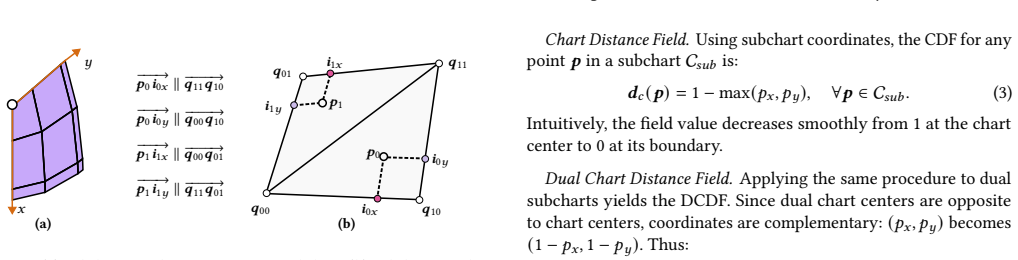
Chart Distance Fields (CDF), a continuous surface-based representation that converts discrete quad mesh connectivity into a learnable field for diffusion-based synthesis.
If this is right
- SQuadGen produces robust and artist-friendly simple quad layouts on a wide range of 3D inputs.
- Generated layouts require less manual cleanup and algorithm tuning than those from prior quad-remeshing techniques.
- The resulting meshes support more efficient editing and modeling workflows in graphics applications.
- High-quality simple quad layouts become available without relying on complex manual design or repeated parameter adjustment.
Where Pith is reading between the lines
- The continuous-field idea could be tested on other discrete structures such as triangle or n-gon layouts in geometry processing.
- Integrating the generator directly into AI-based 3D content pipelines might allow automatic cleanup of newly synthesized models.
- The dataset recovery pipeline could be reused or extended to create training sets for related tasks like mesh segmentation or parameterization.
Load-bearing premise
The Chart Distance Field representation successfully preserves the essential structure of simple quad layouts so the diffusion model can learn to generate them from the recovered dataset.
What would settle it
Testing the trained model on a large set of previously unseen 3D shapes and finding that the output layouts do not achieve higher simplicity scores or require more manual fixes than outputs from existing quad-remeshing methods would show the framework does not deliver the claimed improvement.
Figures









read the original abstract
3D shapes from scanning, reconstruction, or AI-generated content often lack simple quad mesh layouts -- critical for efficient editing and modeling. Existing quad-remeshing techniques typically produce complex layouts with irregular loops, leading to tedious manual cleanup and extensive algorithm tuning. We introduce SQuadGen, a diffusion-based generative framework that leverages Chart Distance Fields (CDF) to synthesize simple quad layouts on 3D shapes. Our approach addresses two key challenges: (1) the discrete nature of mesh connectivity, which hinders learning, and (2) the scarcity of large-scale datasets with simple quad meshes. To overcome the first, we propose CDF, a continuous surface-based representation enabling effective learning and synthesis of quad layouts. To address the second, we define loop-aware simplicity metrics and construct a large-scale dataset of high-quality quad layouts recovered from public 3D repositories through a robust quad-recovery pipeline. Extensive evaluations across diverse 3D inputs show that SQuadGen consistently outperforms existing methods, producing robust, artist-friendly simple quad layouts.
Editorial analysis
A structured set of objections, weighed in public.
Referee Report
Summary. SQuadGen is a diffusion-based generative framework for synthesizing simple quad layouts on 3D meshes. It introduces Chart Distance Fields (CDF) as a continuous surface representation to overcome the discrete nature of mesh connectivity for learning, and constructs a large-scale training dataset of high-quality simple quad meshes recovered from public repositories using a quad-recovery pipeline and newly defined loop-aware simplicity metrics. The paper claims that extensive evaluations on diverse inputs show SQuadGen consistently outperforms existing quad-remeshing methods in producing robust, artist-friendly layouts.
Significance. If validated, the work could meaningfully advance automatic quad meshing in computer graphics by reducing reliance on manual cleanup and parameter tuning for applications in modeling, animation, and fabrication. The CDF representation and the dataset construction pipeline represent potentially reusable contributions to learning on discrete surface structures, building on diffusion models in a geometry-processing context.
major comments (3)
- [§3] §3 (Method, CDF definition): The central claim that CDF converts discrete quad connectivity into a learnable continuous field enabling effective diffusion synthesis lacks supporting ablations. No direct comparisons are provided against alternative encodings (e.g., patch-based connectivity or direct mesh feature vectors) to demonstrate that CDF is necessary for avoiding irregular loops, rather than the gains arising primarily from dataset curation.
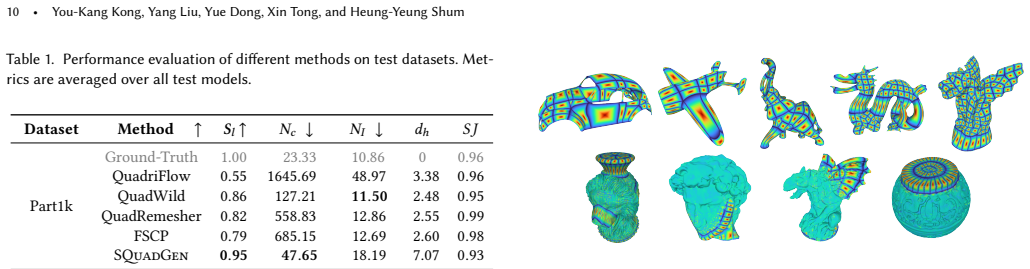
- [§5] §5 (Experiments): The assertion of consistent outperformance is load-bearing for the paper's contribution, yet the evaluation lacks specific quantitative metrics (e.g., loop irregularity scores, average quad count, or Hausdorff distances to ground-truth simple layouts), baseline implementations, statistical significance tests, and analysis of failure cases across the diverse 3D inputs.
- [§4.1] §4.1 (Dataset construction): The loop-aware simplicity metrics are central to recovering and filtering the training data. The manuscript must provide their exact mathematical definitions (e.g., how they quantify irregular loops) and validation evidence that they align with artist preferences or standard simplicity criteria, as poor metric design would undermine the dataset's claimed high quality and the model's generalization.
minor comments (2)
- [§2] The related-work section would benefit from explicit discussion of recent diffusion models applied to geometry processing tasks to better situate the CDF approach.
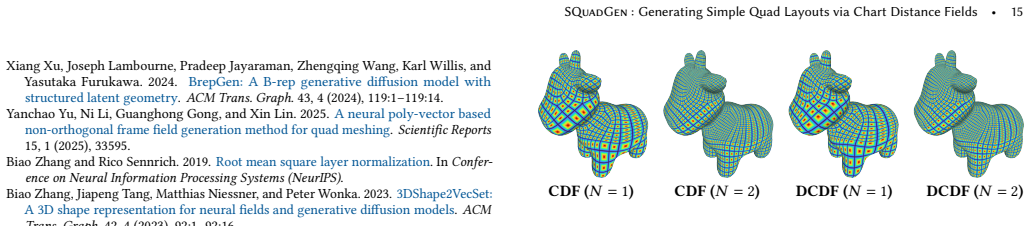
- Figure captions for CDF visualizations and quad-layout results should include annotations or legends clarifying the simplicity improvements (e.g., loop counts) for easier reader interpretation.
Simulated Author's Rebuttal
We thank the referee for the constructive and detailed comments. We address each major point below and will revise the manuscript to incorporate the suggested additions and clarifications.
read point-by-point responses
-
Referee: [§3] §3 (Method, CDF definition): The central claim that CDF converts discrete quad connectivity into a learnable continuous field enabling effective diffusion synthesis lacks supporting ablations. No direct comparisons are provided against alternative encodings (e.g., patch-based connectivity or direct mesh feature vectors) to demonstrate that CDF is necessary for avoiding irregular loops, rather than the gains arising primarily from dataset curation.
Authors: We acknowledge that the manuscript would benefit from explicit ablations on the CDF representation. While the current text motivates CDF as a continuous encoding to enable diffusion on discrete mesh structures, we agree that direct comparisons are needed to isolate its contribution. In the revised version, we will add ablations comparing CDF against patch-based connectivity encodings and direct mesh feature vectors. These will quantify the reduction in irregular loops and show that the gains are not solely from dataset curation. revision: yes
-
Referee: [§5] §5 (Experiments): The assertion of consistent outperformance is load-bearing for the paper's contribution, yet the evaluation lacks specific quantitative metrics (e.g., loop irregularity scores, average quad count, or Hausdorff distances to ground-truth simple layouts), baseline implementations, statistical significance tests, and analysis of failure cases across the diverse 3D inputs.
Authors: We agree that the evaluation would be strengthened by additional quantitative details. In the revised manuscript, we will report loop irregularity scores, average quad counts, and Hausdorff distances to ground-truth simple layouts. We will also specify baseline implementations, include statistical significance tests, and analyze failure cases across diverse inputs such as high-genus shapes and those with intricate features. revision: yes
-
Referee: [§4.1] §4.1 (Dataset construction): The loop-aware simplicity metrics are central to recovering and filtering the training data. The manuscript must provide their exact mathematical definitions (e.g., how they quantify irregular loops) and validation evidence that they align with artist preferences or standard simplicity criteria, as poor metric design would undermine the dataset's claimed high quality and the model's generalization.
Authors: We will add the exact mathematical definitions of the loop-aware simplicity metrics to the revised manuscript, including the formulas used to quantify irregular loops. Additionally, we will include validation evidence, such as comparisons to artist preferences via a small-scale study or alignment with established simplicity criteria in the quad meshing literature, to confirm the metrics' effectiveness in selecting high-quality data. revision: yes
Circularity Check
No circularity: CDF and dataset are independently defined; diffusion training and evaluations are external
full rationale
The paper defines Chart Distance Fields as a new continuous representation to address discrete mesh connectivity, constructs a dataset via explicit loop-aware metrics and a quad-recovery pipeline from public repositories, then trains a standard diffusion model on the CDF representation. The claimed outperformance is measured against external baselines on diverse 3D inputs. No equation or step reduces the generated layouts to a fitted parameter or self-defined quantity by construction. No load-bearing uniqueness theorem or ansatz is imported via self-citation. The derivation chain remains self-contained with independent components and external benchmarks.
Axiom & Free-Parameter Ledger
invented entities (2)
-
Chart Distance Fields (CDF)
no independent evidence
-
Loop-aware simplicity metrics
no independent evidence
Reference graph
Works this paper leans on
-
[1]
In Conference on Neural Information Processing Systems (NeurIPS)
MeshXL: Neural Coordinate field for generative 3D foundation models. In Conference on Neural Information Processing Systems (NeurIPS). Yiwen Chen, Tong He, Di Huang, Weicai Ye, Sijin Chen, Jiaxiang Tang, Xin Chen, Zhon- gang Cai, Lei Yang, Gang Yu, Guosheng Lin, and Chi Zhang. 2025a. MeshAnything: Artist-created mesh generation with autoregressive transfo...
2016
-
[2]
arXiv preprint arXiv:2412.09548 , year=
Spectral surface quadrangulation.ACM Trans. Graph.25, 3 (2006), 1057–1066. Hans-Christian Ebke, Patrick Schmidt, Marcel Campen, and Leif Kobbelt. 2016. Interac- tively controlled quad remeshing of high resolution 3D models.ACM Trans. Graph. 35, 6 (2016), 218:1–218:13. Exoside. 2024.Quad Remesher. https://exoside.com/ Xianzhong Fang, Hujun Bao, Yiying Tong...
-
[3]
Graph.40, 4 (2021), 155:1–155:17
Reliable feature-line driven quad-remeshing.ACM Trans. Graph.40, 4 (2021), 155:1–155:17. Nico Pietroni, Enrico Puppo, Giorgio Marcias, Roberto Scopigno, and Paolo Cignoni
2021
-
[4]
Tracing field-coherent quad layouts.Comput. Graph. Forum35, 7 (2016), 485–496. Cédric Portaneri, Mael Rouxel-Labbé, Michael Hemmer, David Cohen-Steiner, and Pierre Alliez. 2022. Alpha wrapping with an offset.ACM Trans. Graph.41, 4 (2022), 127:1–127:22. Nicolas Ray, Wan Chiu Li, Bruno Lévy, Alla Sheffer, and Pierre Alliez. 2006. Periodic global parameteriz...
2016
discussion (0)
Sign in with ORCID, Apple, or X to comment. Anyone can read and Pith papers without signing in.