Recognition: unknown
Estimating Population Viral Load Contextual Exposure Using GPS-Derived Activity Spaces in Rural South Africa
Pith reviewed 2026-05-07 10:01 UTC · model grok-4.3
The pith
GPS-derived activity spaces enable estimation of contextual exposure to HIV population viral load.
A machine-rendered reading of the paper's core claim, the machinery that carries it, and where it could break.
Core claim
The central claim is that contextual exposure to HIV can be quantified within GPS-derived activity spaces by first estimating population viral load at local grid-cell levels from integrated surveillance and sociodemographic data, then deriving individual activity spaces from GPS trajectories, and finally measuring exposure inside those spaces. This reveals how exposure evolves beyond static homes and supports procedures to flag participants at elevated acquisition risk.
What carries the argument
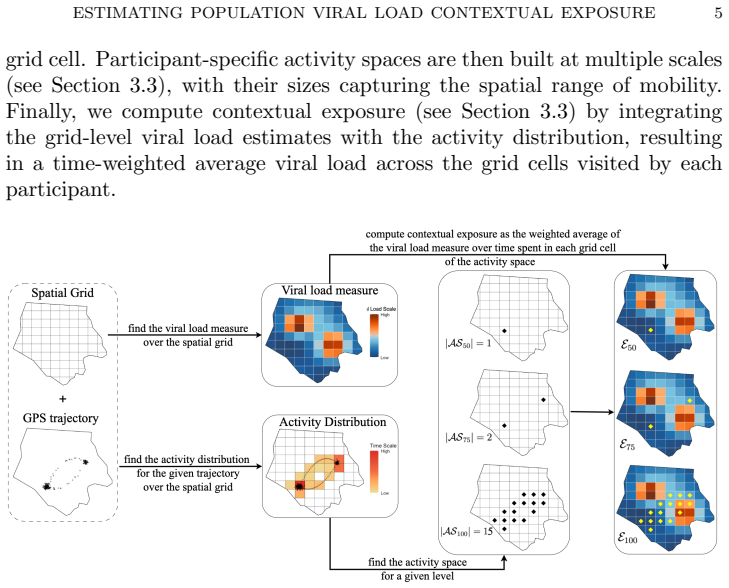
The key machinery is the three-part framework that links grid-cell population viral load estimation, GPS trajectory-based activity space derivation, and contextual exposure quantification.
If this is right
- Participants' sex and age systematically influence the magnitude, configuration, and heterogeneity of mobility patterns.
- Contextual exposure to HIV changes as activity spaces extend beyond residential locations.
- Analytical approaches can identify GPS-tracked participants at elevated risk of HIV acquisition.
- Derived mobility measures allow assessment of how contextual exposure varies with individual characteristics.
Where Pith is reading between the lines
- Extending this to predict actual infection outcomes could test the exposure measure's predictive power.
- Similar GPS-based methods might apply to studying exposure for other pathogens or in urban settings.
- Integrating with other data sources could refine the grid-level viral load estimates over time.
Load-bearing premise
GPS trajectories accurately and sufficiently represent the activity spaces relevant to HIV exposure risk, and the surveillance data provides unbiased estimates of population viral load at the grid-cell level.
What would settle it
The claim would be falsified if individuals with high calculated contextual exposure do not show correspondingly higher rates of HIV acquisition in longitudinal tracking, or if GPS data systematically underrepresents key locations of potential exposure.
Figures


read the original abstract
This article introduces novel methodologies for estimating contextual exposure to HIV population viral load using GPS data. We propose a comprehensive analytical framework comprising (i) local (grid-cell level) estimation of HIV population viral load, (ii) derivation of individual activity spaces from GPS trajectories, and (iii) quantification of contextual exposure to HIV within these activity spaces. We integrate HIV surveillance and sociodemographic survey data with GPS-based mobility data collected in rural KwaZulu-Natal, South Africa, to characterize mobility patterns among young adults aged 20-30 years. Using derived measures of mobility and contextual exposure, we assess whether participants' sex and age systematically influence the magnitude, configuration, and heterogeneity of their mobility patterns. Furthermore, we describe analytical approaches to examine how contextual exposure to HIV evolves as activity spaces extend beyond static residential locations, outlining procedures to identify GPS-tracked participants at elevated risk of HIV acquisition. KEYWORDS: Population viral load exposure; GPS-based mobility analysis; Activity space
Editorial analysis
A structured set of objections, weighed in public.
Referee Report
Summary. The paper proposes a comprehensive analytical framework for estimating contextual HIV exposure using population viral load (PVL) at the grid-cell level, derived from integrated HIV surveillance and sociodemographic surveys, combined with individual activity spaces extracted from GPS trajectories. Applied to young adults aged 20-30 in rural KwaZulu-Natal, South Africa, the work characterizes mobility patterns, examines systematic differences by sex and age in the magnitude and heterogeneity of these patterns, and outlines procedures to track how contextual exposure evolves beyond residential locations and to flag participants at elevated HIV acquisition risk.
Significance. If the integration and quantification steps prove robust, the framework offers a meaningful advance in HIV epidemiology by replacing static residential proxies with dynamic, GPS-informed activity spaces. This could improve risk stratification in mobile rural populations and provide a reusable template for contextual exposure metrics in other infectious disease settings. The explicit linkage of surveillance aggregates to mobility data is a constructive contribution, though its value hinges on addressing the validation gaps noted below.
major comments (3)
- [Methods (grid-cell PVL estimation and data integration)] The grid-cell PVL estimation step (described in the methods for integrating surveillance and survey data) provides no explicit bias correction or sensitivity analysis for spatial sampling, non-response, or coverage gaps in the rural KwaZulu-Natal cohort. Systematic under-sampling of high-mobility or high-risk subgroups would directly attenuate or mis-rank the downstream exposure metrics and sex/age comparisons that form the paper's applied contribution.
- [Results (mobility patterns and exposure quantification)] No validation results, error analysis, or performance metrics are reported for the derived activity spaces, contextual exposure quantifications, or risk-identification procedures. The manuscript describes the three-component framework and its application to GPS trajectories but does not demonstrate robustness against GPS accuracy limitations, trajectory completeness, or misalignment between survey clusters and GPS points.
- [Discussion (risk identification and evolution of exposure)] The claim that activity-space extensions beyond residential locations improve risk identification (outlined in the discussion of evolving contextual exposure) rests on the untested assumption that the GPS-derived spaces accurately capture relevant exposure. Without a baseline comparison to residential-only exposure or any falsification test, the procedures for identifying elevated-risk participants remain speculative.
minor comments (2)
- [Abstract] The abstract is information-dense; separating the general methodological proposal from the specific sex/age mobility findings and risk-identification procedures would improve readability.
- [Methods (activity space derivation)] Notation for the exposure metric and activity-space boundaries should be defined more explicitly when first introduced to aid readers in following the quantification step.
Simulated Author's Rebuttal
We thank the referee for the detailed and constructive review. The comments highlight important areas for strengthening the robustness of our framework. We address each major comment below and commit to revisions that directly respond to the concerns raised.
read point-by-point responses
-
Referee: The grid-cell PVL estimation step (described in the methods for integrating surveillance and survey data) provides no explicit bias correction or sensitivity analysis for spatial sampling, non-response, or coverage gaps in the rural KwaZulu-Natal cohort. Systematic under-sampling of high-mobility or high-risk subgroups would directly attenuate or mis-rank the downstream exposure metrics and sex/age comparisons that form the paper's applied contribution.
Authors: We acknowledge the potential for residual bias in the grid-cell PVL estimates. Our current integration applies inverse probability weighting derived from the surveillance sampling frame to adjust for known selection probabilities. However, we agree that explicit sensitivity analyses for spatial sampling, non-response, and coverage gaps would improve transparency and strengthen the applied comparisons. In the revised manuscript, we will add a dedicated subsection to the Methods describing these analyses (including scenarios for differential non-response by mobility level) and report corresponding results in a new supplementary table showing the stability of exposure metrics and sex/age differences. revision: yes
-
Referee: No validation results, error analysis, or performance metrics are reported for the derived activity spaces, contextual exposure quantifications, or risk-identification procedures. The manuscript describes the three-component framework and its application to GPS trajectories but does not demonstrate robustness against GPS accuracy limitations, trajectory completeness, or misalignment between survey clusters and GPS points.
Authors: The manuscript prioritizes framework development and descriptive application over external validation, as ground-truth exposure data are unavailable. We will nevertheless incorporate internal robustness checks. The revised Results section will include quantitative metrics on GPS trajectory completeness (e.g., percentage of valid location fixes and time gaps), sensitivity analyses varying GPS accuracy thresholds and spatial matching tolerances between survey clusters and GPS points, and error bounds on the derived activity-space and exposure measures. These additions will provide the requested performance information while remaining within the data constraints of the study. revision: yes
-
Referee: The claim that activity-space extensions beyond residential locations improve risk identification (outlined in the discussion of evolving contextual exposure) rests on the untested assumption that the GPS-derived spaces accurately capture relevant exposure. Without a baseline comparison to residential-only exposure or any falsification test, the procedures for identifying elevated-risk participants remain speculative.
Authors: We agree that a direct baseline comparison is needed to support the interpretive claims. Although the manuscript describes how exposure evolves beyond residential locations, it does not present a formal side-by-side quantification. In the revision, we will add a new subsection to the Results that compares contextual exposure metrics (magnitude, heterogeneity, and high-risk flagging) using full GPS-derived activity spaces versus residential-only buffers. We will also include a brief falsification test based on spatially permuted GPS points to assess whether observed differences exceed those expected under random mobility. These changes will ground the risk-identification procedures in explicit evidence. revision: yes
Circularity Check
No circularity: framework integrates external data sources without self-referential reductions
full rationale
The manuscript describes a methodological framework that combines HIV surveillance data, sociodemographic surveys, and GPS trajectories to estimate grid-cell population viral load, derive activity spaces, and quantify contextual exposure. No equations, derivations, or predictions are presented that reduce to fitted parameters by construction, self-citations that bear the central load, or ansatzes smuggled from prior author work. All components rely on external data integration and standard spatial analysis techniques, with no evidence that any output is equivalent to its inputs by definition. The reader's assessment of score 1.0 aligns with the absence of load-bearing internal loops.
Axiom & Free-Parameter Ledger
axioms (2)
- domain assumption GPS trajectories accurately represent participants' activity spaces
- domain assumption HIV surveillance and sociodemographic data can be used to produce reliable grid-cell level population viral load estimates
Reference graph
Works this paper leans on
-
[1]
V. Ain, T. Liegler, J. Kabami, G. Chamie, T. D. Clark, D. Black, E. H. Geng, D. Kwarisiima, J. K. Wong, M. Abdel - Mohsen, N. Sonawane, F. T. Aweeka, H. Thirumurthy, M. L. Petersen, E. D. Charlebois, M. R. Kamya, D. V. Havlir, and SEARCH Collaboration. Assessment of population-based HIV RNA levels in a rural east African setting using a fingerprick-based ...
-
[2]
A. Akullian, A. Vandormael, J. C. Miller, A. Bershteyn, E. Wenger, D. Cuadros, D. Gareta, T. B\" a rnighausen, K. Herbst, and F. Tanser. Large age shifts in HIV -1 incidence patterns in KwaZulu-Natal , South Africa . Proceedings of the National Academy of Sciences of the United States of America, 118 0 (5): 0 e2013164118, 2021. doi:10.1073/pnas.2013164118
-
[3]
Birdthistle, C
I. Birdthistle, C. Tanton, A. Tomita, K. de G raaf, S. B. Schaffnit, F. Tanser, and E. Slaymaker. Recent levels and trends in H I V incidence rates among adolescent girls and young women in ten high-prevalence A frican countries: a systematic review and meta-analysis. Lancet Glob Health, 7: 0 e1521--e1540, 2019
2019
-
[4]
Baggaley, Lu Wang, Benoit Mass \'e , Richard G
Marie-Claude Boily, Rebecca F. Baggaley, Lu Wang, Benoit Mass \'e , Richard G. White, Richard J. Hayes, and Michel Alary. Heterosexual risk of hiv-1 infection per sexual act: Systematic review and meta-analysis of observational studies. The Lancet Infectious Diseases, 9: 0 118--129, 2009
2009
-
[5]
Bulstra, Jan A
Caroline A. Bulstra, Jan A. C. Hontelez, Federica Giardina, Richard Steen, Nico J. D. Nagelkerke, Till B\" a rnighausen, and Sake J. de Vlas. Mapping and characterising areas with high levels of H I V transmission in sub- S aharan A frica: A geospatial analysis of national survey data. PLOS Medicine, 17: 0 1--19, 2020
2020
-
[6]
A. D. Castel, M. Befus, S. Willis, A. Griffin, T. West, S. Hader, and A. E. Greenberg. Use of the community viral load as a population-based biomarker of HIV burden. AIDS, 26: 0 345--353, 2012
2012
-
[7]
Guidance on community viral load: A family of measures, definitions, and method for calculation, 2011
CDC . Guidance on community viral load: A family of measures, definitions, and method for calculation, 2011. CDC guidance document
2011
-
[8]
Myron S. Cohen, Ying Q. Chen, Marybeth McCauley, Theresa Gamble, Mina C. Hosseinipour, Nagalingeswaran Kumarasamy, and et al. Antiretroviral therapy for the prevention of HIV -1 transmission. The New England Journal of Medicine, 375 0 (9): 0 830--839, 2016. doi:10.1056/NEJMoa1600693
-
[9]
Dobra, T
A. Dobra, T. B\" a rnighausen, A. Vandormael, and F. Tanser. Space-time migration patterns and risk of H I V acquisition in rural S outh A frica. AIDS, 31: 0 137--145, 2017
2017
-
[10]
Duncan, Basile Chaix, Seann D
Dustin T. Duncan, Basile Chaix, Seann D. Regan, Su Hyun Park, Cordarian Draper, William C. Goedel, June A. Gipson, Vincent Guilamo-Ramos, Perry N. Halkitis, Russell Brewer, and De M arc A. Hickson. Collecting mobility data with G P S methods to understand the hiv environmental riskscape among young black men who have sex with men: A multi-city feasibility...
2018
-
[11]
Eisinger, Carl W
Robert W. Eisinger, Carl W. Dieffenbach, and Anthony S. Fauci. HIV viral load and transmissibility of hiv infection: undetectable equals untransmittable. Journal of the American Medical Association, 321: 0 451--452, 2019
2019
-
[12]
Gareta, K
D. Gareta, K. Baisley, T. Mngomezulu, T. Smit, T. Khoza, S. Nxumalo, J. Dreyer, S. Dube, N. Majozi, G. Ording- J esperson, E. Ehlers, G. Harling, M. Shahmanesh, M. Siedner, W. Hanekom, and Herbst K. Cohort profile update: A frica C entre D emographic I nformation S ystem ( A C D I S ) and population-based H I V survey. International Journal of Epidemiolog...
2021
-
[13]
W. M. Gesler and M. S. Meade. Locational and population factors in health care-seeking behavior in S avannah, G eorgia. Health Services Research, 23: 0 443--462, 1988
1988
-
[14]
Exploring mobility data for enhancing HIV care engagement in B lack/ A frican A merican and H ispanic/ L atinx individuals: a longitudinal observational study protocol
Maryam Hassani, Cristina De Haro, Lidia Flores, Mohamed Emish, Seungjun Kim, Zeyad Kelani, Dominic Arjuna Ugarte, Lisa Hightow-Weidman, Amanda Castel, Xiaoming Li, Katherine P Theall, and Sean Young. Exploring mobility data for enhancing HIV care engagement in B lack/ A frican A merican and H ispanic/ L atinx individuals: a longitudinal observational stud...
2023
-
[15]
L. F. Johnson, R. E. Dorrington, and T. A. Moultrie. Thembisa version 5.6: a model for evaluating the impact of HIV / AIDS in S outh A frica, 2023. URL https://www.thembisa.org/
2023
-
[16]
The U rgency of N ow: A I D S at a C rossroads: 2024 U N A I D S global A I D S U pdate, 2024
Joint United Nations Programme on H I V / A I D S . The U rgency of N ow: A I D S at a C rossroads: 2024 U N A I D S global A I D S U pdate, 2024. URL https://crossroads.unaids.org/. June 30, 2025
2024
-
[17]
Data on the global H I V epidemic
Joint United Nations Programme on H I V / A I D S . Data on the global H I V epidemic. https://www.unaids.org/en/regionscountries/countries/southafrica, 2026 a . Accessed: 2026-04-26
2026
-
[18]
Saving lives, leaving no one behind
Joint United Nations Programme on H I V / A I D S . Saving lives, leaving no one behind. https://www.unaids.org/en/whoweare/about, 2026 b . Accessed: 2026-04-26
2026
-
[19]
Garg, and R.D
Rashmi Kandwal, P.K. Garg, and R.D. Garg. Health G I S and H I V / A I D S studies: Perspective and retrospective. Journal of Biomedical Informatics, 42: 0 748--755, 2009
2009
-
[20]
M. K. Kitenge, G. Fatti, I. Eshun-Wilson, O. Aluko, and P. Nyasulu. Prevalence and trends of advanced HIV disease among antiretroviral therapy-naive and antiretroviral therapy-experienced patients in S outh A frica between 2010--2021: a systematic review and meta-analysis. BMC Infectious Diseases, 23: 0 549, 2023
2010
-
[21]
M.-P. Kwan. The uncertain geographic context problem. Annals of the Association of American Geographers, 102: 0 958--968, 2012
2012
-
[22]
Hirsch, Jacqueline Kerr, Marta M
Oriol Marquet, Jana A. Hirsch, Jacqueline Kerr, Marta M. Jankowska, Jonathan Mitchell, Jaime E. Hart, Francine Laden, J. Aaron Hipp, and Peter James. G P S -based activity space exposure to greenness and walkability is associated with increased accelerometer-based physical activity. Environment International, 165: 0 107317, 2022
2022
-
[23]
Mathenjwa, E
T. Mathenjwa, E. Okango, K. H. Tram, M. Inghels, D. Cuadros, H. Y. Kim, F. Walsh, T. B\" a rnighausen, A. Dobra, and F. Tanser. Leveraging smartphone mobility data to understand H I V risk among rural S outh A frican young adults: a pilot study. JMIR mHealth and uHealth, 13: 0 e67519, 2025
2025
-
[24]
William C. Miller, Kimberly A. Powers, M. Kumi Smith, and Myron S. Cohen. Community viral load as a measure for assessment of hiv treatment as prevention. The Lancet Infectious Diseases, 13 0 (5): 0 459--464, 2013. doi:10.1016/S1473-3099(12)70314-6
-
[25]
Paediatric and adolescent HIV viral load testing in South Africa : insights and outcomes
National Institute for Communicable Diseases in South Africa. Paediatric and adolescent HIV viral load testing in South Africa : insights and outcomes. NICD Bulletin, 18: 0 16--23, 2020
2020
-
[26]
E. F. Okonji, B. Van Wyk, F. C. Mukumbang, and G. D. Hughes. Determinants of viral suppression among adolescents on antiretroviral treatment in ehlanzeni district, South Africa : a cross-sectional analysis. AIDS Research and Therapy, 18: 0 66, 2021
2021
-
[27]
M. Otto, E. Okango, P. Mee, A. Dobra, K. H. Tram, D. Gareta, W. Otambo, R. Moyo, T. Sereo, N. Blose, N. S. Letoao, L. Mupanguri, H. Mwambi, K. Herbst, and F. Tanser. Trends in population H I V viral suppression: a longitudinal analysis. AIDS (London, England), 39 0 (8): 0 1088--1092, 2025
2025
-
[28]
Quinn, Maria J
Thomas C. Quinn, Maria J. Wawer, Nelson Sewankambo, David Serwadda, Chuanjun Li, Fred Wabwire-Mangen, Mary O. Meehan, Tom Lutalo, and Ronald H. Gray. Viral load and heterosexual transmission of human immunodeficiency virus type 1. The New England Journal of Medicine, 342 0 (13): 0 921--929, 2000 a . Rakai Project Study Group
2000
-
[29]
Thomas C. Quinn, Maria J. Wawer, Nelson Sewankambo, David Serwadda, Chun-Yi Li, Fred Wabwire-Mangen, Mary O. Meehan, Tom Lutalo, and Ronald H. Gray. Viral load and heterosexual transmission of human immunodeficiency virus type 1. The New England Journal of Medicine, 342 0 (13): 0 921--929, 2000 b . doi:10.1056/NEJM200003303421303
-
[30]
A. J. Rodger, V. Cambiano, T. Bruun, P. Vernazza, S. Collins, O. Degen, G. M. Corbelli, V. Estrada, A. M. Geretti, A. Beloukas, D. Raben, P. Coll, A. Antinori, N. Nwokolo, A. Rieger, J. M. Prins, A. Blaxhult, R. Weber, A. Van Eeden, N. H. Brockmeyer, A. Clarke, J. Del Romero Guerrero, F. Raffi, J. R. Bogner, G. Wandeler, J. Gerstoft, F. Guti \'e rrez, K. ...
-
[31]
S. S. Solomon, S. H. Mehta, A. M. McFall, A. K. Srikrishnan, S. Saravanan, O. Laeyendecker, P. Balakrishnan, D. D. Celentano, S. Solomon, and G. M. Lucas. Community viral load, antiretroviral therapy coverage, and HIV incidence in India : A cross-sectional, comparative study. The Lancet HIV, 3: 0 e183--e190, 2016
2016
-
[32]
Tanser, V
F. Tanser, V. Hosegood, T. B\" a rnighausen, K. Herbst, M. Nyirenda, W. Muhwava, C. Newell, J. Viljoen, T. Mutevedzi, and M. L. Newell. Cohort profile: A frica C entre D emographic I nformation S ystem ( A C D I S ) and population-based H I V survey. International Journal of Epidemiology, 37: 0 956--962, 2008
2008
-
[33]
Tanser, T
F. Tanser, T. B\" a rnighausen, G. S. Cooke, and M.-L. Newell. Localized spatial clustering of H I V infections in a widely disseminated rural S outh A frican epidemic. International Journal of Epidemiology, 38: 0 1008--1016, 2009
2009
-
[34]
Tanser, T
F. Tanser, T. B\" a rnighausen, E. Grapsa, J. Zaidi, and M. L. Newell. High coverage of ART associated with decline in risk of HIV acquisition in rural KwaZulu-Natal , S outh A frica. Science, 339: 0 966--971, 2013
2013
-
[35]
Phillips, Tulio de Oliveira, Andrew Tomita, Till B\'' a rnighausen, and Deenan Pillay
Frank Tanser, Alain Vandormael, Diego Cuadros, Andrew N. Phillips, Tulio de Oliveira, Andrew Tomita, Till B\'' a rnighausen, and Deenan Pillay. Effect of population viral load on prospective hiv incidence in a hyperendemic rural african community. Science Translational Medicine, 9 0 (420): 0 eaam8012, 2017. doi:10.1126/scitranslmed.aam8012. URL https://ww...
-
[36]
Vandormael, T
A. Vandormael, T. B\" a rnighausen, J. Herbeck, A. Tomita, A. Phillips, D. Pillay, T. de Oliveira, and F. Tanser. Longitudinal trends in the prevalence of detectable HIV viremia: Population-based evidence from rural KwaZulu-Natal , south africa. Clinical Infectious Diseases, 66 0 (8): 0 1254--1260, 2018
2018
-
[37]
Viljoen, S
J. Viljoen, S. Gampini, S. Danaviah, D. Val\' e a, S. Pillay, D. Kania, N. M\' e da, M. L. Newell, P. Van de Perre, F. Rouet, and World Health Organization/ANRS 1289 Kesho Bora Study Group. Dried blood spot HIV -1 RNA quantification using open real-time systems in South Africa and Burkina Faso . Journal of Acquired Immune Deficiency Syndromes, 55 0 (3): 0...
2010
-
[38]
L. A. Waller and C. A. Gotway. Applied Spatial Statistics for Public Health Data, volume 368. John Wiley & Sons, 2004
2004
-
[39]
D. P. Wilson, M. G. Law, A. E. Grulich, D. A. Cooper, and J. M. Kaldor. Relation between hiv viral load and infectiousness: A model-based analysis. The Lancet, 372: 0 314--320, 2008
2008
-
[40]
E.B. Wong, S. Olivier, R. Gunda, O. Koole, A. Surujdeen, D. Gareta, D. Munatsi, T. H. Modise, J. Dreyer, S. Nxumalo, T. K. Smit, G. Ording- J espersen, I. B. Mpofana, K. Khan, Z. E. L. Sikhosana, S. Moodley, Y. J. Shen, T. Khoza, N. Mhlongo, S. Bucibo, K. Nyamande, K. J. Baisley, D. Cuadros, F. Tanser, A. D. Grant, K. Herbst, J. Seeley, W. A. Hanekom, T. ...
2021
discussion (0)
Sign in with ORCID, Apple, or X to comment. Anyone can read and Pith papers without signing in.