Recognition: unknown
Bibliometric Mapping of AI-Supported Social Presence in Online Learning Environments: Trends, Collaboration, and Thematic Directions
Pith reviewed 2026-05-07 09:26 UTC · model grok-4.3
The pith
Research on AI-supported social presence in online learning has risen since 2020, led by the US and Brazil, yet international collaboration stays limited and ethical questions on trust remain underexplored.
A machine-rendered reading of the paper's core claim, the machinery that carries it, and where it could break.
Core claim
Analysis of 59 Scopus-indexed open-access studies shows an upward publication trend beginning in 2020. Dominant research foci include engagement, AI tools, instructional design, and ethical issues. The United States and Brazil contribute the most papers, while international collaboration remains limited. Ethical concerns around trust and fairness appear as emerging topics but receive little deep treatment. The study concludes that future work should emphasize ethical integration, wider interdisciplinary ties, and learner-centered AI designs.
What carries the argument
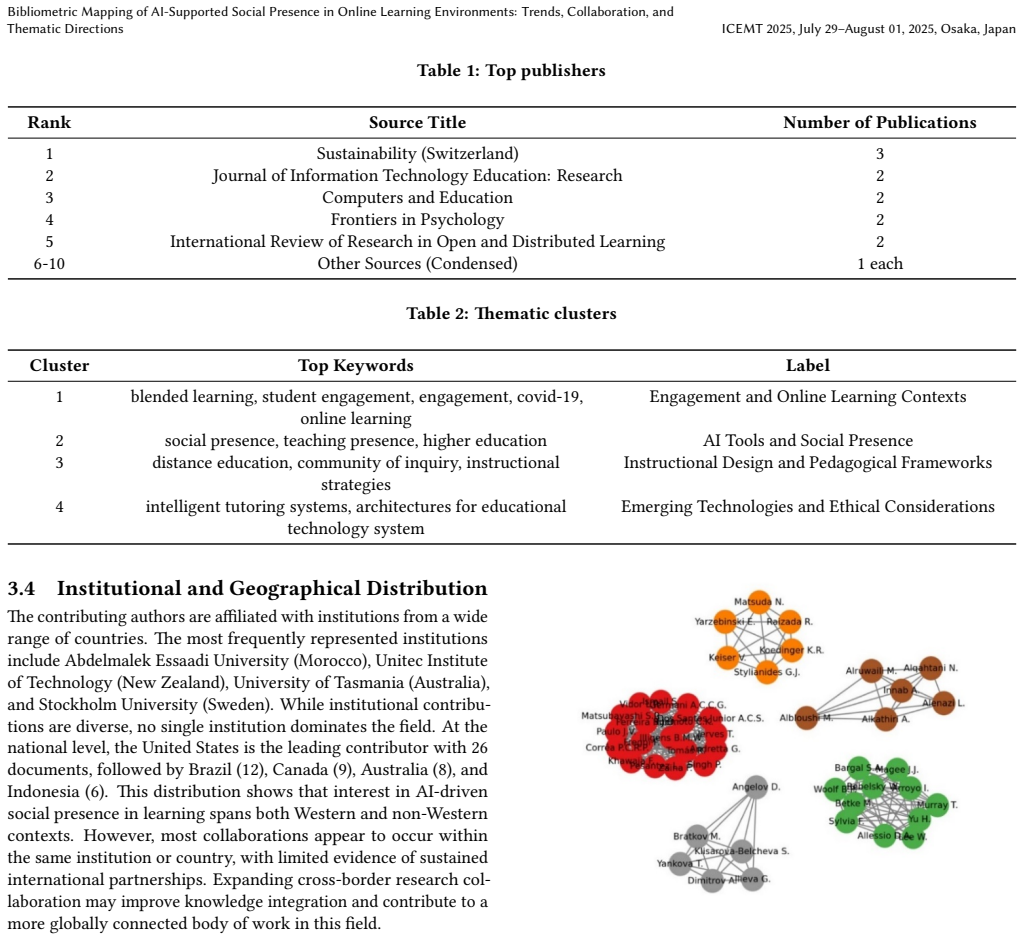
Bibliometric mapping performed with Python tools on citation networks, co-authorship graphs, institutional output, and keyword co-occurrence clusters drawn from 59 Scopus papers.
If this is right
- Future studies will likely prioritize ethical safeguards for trust and fairness when deploying AI in online settings.
- Greater international co-authorship is needed to move the field beyond national clusters.
- Instructional designers should integrate learner-centered AI features more systematically to sustain engagement.
- Policy and funding bodies can target the currently thin ethical and cross-border research areas.
Where Pith is reading between the lines
- If open-access restrictions shape the sample, including paywalled papers might alter the picture of collaboration strength.
- The identified themes suggest room for new empirical work that directly tests AI interventions for social presence rather than mapping them.
- Limited collaboration could be addressed by creating shared datasets or joint projects across the leading countries.
- As online learning scales, the underexplored ethics topics may become bottlenecks for widespread adoption.
Load-bearing premise
The 59 open-access empirical studies retrieved from Scopus are sufficient to represent the overall development, influence, and collaboration patterns across the entire field of AI-supported social presence research.
What would settle it
Locating a substantial body of relevant studies from other databases or published before 2020 that show different leading countries, higher international collaboration rates, or mature ethical analysis would undermine the reported trends and gaps.
Figures

read the original abstract
This study examines the development, influence, and collaboration patterns in AI-supported social presence research within online learning environments. Utilizing 59 open-access empirical studies from Scopus, the study applies citation analysis, co-authorship mapping, institutional analysis, and keyword clustering using Python-based bibliometric tools. Findings reveal an upward trend in publications since 2020, with research focusing on engagement, AI tools, instructional design, and ethical issues. While countries such as the United States and Brazil are leading contributors, international collaboration remains limited. Ethical concerns related to trust and fairness are emerging but underexplored. The study highlights the importance of ethical integration, interdisciplinary collaboration, and learner-centered AI applications in education.
Editorial analysis
A structured set of objections, weighed in public.
Referee Report
Summary. The paper conducts a bibliometric analysis of 59 open-access empirical studies retrieved from Scopus on AI-supported social presence in online learning environments. It applies citation analysis, co-authorship mapping, institutional analysis, and keyword clustering via Python tools to identify trends, collaboration patterns, and themes. Key claims include an upward publication trend since 2020, research emphasis on engagement, AI tools, instructional design, and ethics, leadership by the United States and Brazil, limited international collaboration, and emerging but underexplored ethical concerns around trust and fairness.
Significance. If the sample proves representative, the mapping could usefully highlight growth areas and gaps for researchers in AI-enhanced education, particularly the call for ethical integration and interdisciplinary work. The application of standard bibliometric techniques on a focused corpus is a modest contribution, but the absence of reproducibility details and sensitivity checks limits its reliability as a field overview.
major comments (3)
- [Methods] The methods description provides no explicit Scopus search string, date range, inclusion/exclusion criteria, or justification for restricting to open-access empirical studies only. This omission directly undermines replicability and the validity of all downstream claims about publication trends, country leadership, and thematic clusters derived from the 59 papers.
- [Results and Discussion] The central claims of upward trend since 2020, US/Brazil dominance, limited international collaboration, and underexplored ethics rest on this single-database, open-access filter without any sensitivity analysis or comparison to the full Scopus corpus. The skeptic note correctly identifies this representativeness assumption as load-bearing and untested, risking systematic bias in observed patterns.
- [Thematic Analysis] Keyword clustering and thematic interpretation (engagement, AI tools, ethics) are presented without validation steps such as inter-rater checks or cross-referencing against non-open-access literature, weakening the assertion that ethical issues are 'emerging but underexplored.'
minor comments (2)
- [Methods] The abstract and results would benefit from clearer reporting of exact Python libraries and parameters used for co-authorship and keyword networks to aid reproducibility.
- [Figures] Figure captions for bibliometric maps should explicitly state the number of nodes/edges and clustering algorithm to improve interpretability.
Simulated Author's Rebuttal
We thank the referee for the constructive and detailed comments, which have prompted important improvements to the transparency and robustness of our bibliometric analysis. We have revised the manuscript to address the concerns about replicability, representativeness, and validation of themes. Our responses to each major comment are provided below.
read point-by-point responses
-
Referee: [Methods] The methods description provides no explicit Scopus search string, date range, inclusion/exclusion criteria, or justification for restricting to open-access empirical studies only. This omission directly undermines replicability and the validity of all downstream claims about publication trends, country leadership, and thematic clusters derived from the 59 papers.
Authors: We agree that the original Methods section was insufficiently detailed for replicability. In the revised manuscript we have inserted the exact Scopus search string, the date range of the search, the full list of inclusion criteria (open-access empirical studies focused on AI-supported social presence in online learning environments), and the exclusion criteria (non-empirical works, non-English papers, and studies outside the defined scope). We also added a justification for the open-access restriction: it ensures all source material is publicly verifiable and aligns with the goal of mapping accessible research for the education community. A PRISMA-style flow diagram documenting the retrieval and screening process has been included. revision: yes
-
Referee: [Results and Discussion] The central claims of upward trend since 2020, US/Brazil dominance, limited international collaboration, and underexplored ethics rest on this single-database, open-access filter without any sensitivity analysis or comparison to the full Scopus corpus. The skeptic note correctly identifies this representativeness assumption as load-bearing and untested, risking systematic bias in observed patterns.
Authors: We acknowledge that restricting the corpus to open-access records from a single database introduces potential bias and that the representativeness of the 59-paper sample was not previously tested. In the revision we have added an expanded Limitations subsection that explicitly discusses these constraints and their possible effects on the reported trends, country rankings, and collaboration patterns. Although a complete sensitivity analysis against the full (including paywalled) Scopus corpus is not feasible within the present study, we have contextualized our findings against two recent broader reviews of AI in education. The original claims are now qualified with appropriate caveats regarding the open-access focus. revision: partial
-
Referee: [Thematic Analysis] Keyword clustering and thematic interpretation (engagement, AI tools, ethics) are presented without validation steps such as inter-rater checks or cross-referencing against non-open-access literature, weakening the assertion that ethical issues are 'emerging but underexplored.'
Authors: We have strengthened the Thematic Analysis section by documenting the exact parameters of the Python-based keyword clustering procedure and by adding an inter-rater validation step: two authors independently reviewed and labeled the resulting clusters, resolving disagreements through discussion. We also performed a limited cross-check by examining abstracts of non-open-access papers returned by the same Scopus query. These steps corroborate that ethical dimensions such as trust and fairness receive comparatively little attention. The manuscript language has been revised from “emerging but underexplored” to “emerging and still limited,” with an explicit call for future work. revision: yes
Circularity Check
No circularity in descriptive bibliometric analysis
full rationale
The paper conducts a standard bibliometric analysis by retrieving 59 open-access empirical studies from the external Scopus database and applying citation analysis, co-authorship mapping, institutional analysis, and keyword clustering via Python tools. All reported findings (upward trend since 2020, focus areas, country leadership, limited collaboration, emerging ethics themes) are direct descriptive summaries of this external dataset with no equations, derivations, predictions, or first-principles results. No steps reduce by construction to the paper's own inputs, self-definitions, fitted parameters renamed as predictions, or load-bearing self-citations; the work is self-contained as an empirical description of the chosen sample.
Axiom & Free-Parameter Ledger
axioms (1)
- domain assumption Scopus database plus open-access filter yields a sufficiently complete and unbiased set of empirical studies on AI-supported social presence
Reference graph
Works this paper leans on
-
[1]
Aljawharah M Aldosari, Saad M Alramthi, and Hala F Eid. 2022. Improving social presence in online higher education: Using live virtual classroom to con- front learning challenges during COVID-19 pandemic. Front. Psychol. 13, (2022). Retrieved from 10.3389/fpsyg.2022.994403
-
[2]
Rex Bringula, Roman Paulo Baet, Ralph Lawrence Garcia, Franchesca Mari, Jan Carlo Ramos, Hanna Sophia Sarmiento, and Edmon Torres. 2024. Factors Contributing to the Negative Online Learning Academic Self-Concept of College Students. In Proceedings of the 32ndInternational Conference on Computers in Education, 2024. 1–6. Retrieved from https://library.apsc...
2024
-
[3]
Manuel B Garcia. 2023. Fostering an Innovation Culture in the Education Sector: A Scoping Review and Bibliometric Analysis of Hackathon Research. Innov. High. Educ. (2023). https://doi.org/10.1007/s10755-023-09651-y
-
[4]
Garcia, Clievenze Karl Quejado, Clark Raven B
Manuel B. Garcia, Clievenze Karl Quejado, Clark Raven B. Maranan, Owen N. Ualat, Rossana T. Adao, Ari Happonen, Ramazan Yilmaz, and Aras Bozkurt. 2024. Social Relationship Development in the Metaverse: The Roles of Embodiment, Immersion, and the Moderating Effect of Copresence. In TENCON 2024 - 2024 IEEE Region 10 Conference (TENCON) , 2024. Singapore, 15...
-
[5]
Philip Hallinger and Jasna Kovačević. 2023. Applying bibliometric review meth- ods in education: rationale, definitions, analytical techniques, and illustrations. In Robert J Tierney, Fazal Rizvi and Kadriye B T - International Encyclope- dia of Education (Fourth Edition) Ercikan (eds.). Elsevier, Oxford, 546–556. https://doi.org/10.1016/B978-0-12-818630-...
-
[6]
Yungwei Hao. 2016. Chapter 12 - Investigating Students’ Feelings and Their Perspectives Toward Web 2.0 Technologies in a Teacher Education Course. In Emotions and Technology, Sharon Y Tettegah and Martin B T - Emotions Gartmeier Technology, Design, and Learning (eds.). Academic Press, San Diego, 239–271. https://doi.org/10.1016/B978-0-12-801856-9.00012-8
-
[7]
Carol Johnson. 2017. Teaching music online: Changing pedagogical approach when moving to the online environment. London Rev. Educ. 15, 3 (2017), 439–456. Retrieved from https://files.eric.ed.gov/fulltext/EJ1163219.pdf
2017
-
[8]
A Kaur, A Mustafa, L Mehta, and A Dhall. 2018. Prediction and Localization of Student Engagement in the Wild. In 2018 Digital Image Computing: Techniques and Applications (DICTA), 2018. 1–8. https://doi.org/10.1109/DICTA.2018.8615851
-
[9]
Jia Miao and Li Ma. 2022. Students’ online interaction, self-regulation, and learn- ing engagement in higher education: The importance of social presence to online learning. Front. Psychol. 13, (2022). Retrieved from 10.3389/fpsyg.2022.815220
-
[10]
Lynette Nagel and Theuns G Kotzé. 2010. Supersizing e-learning: What a CoI survey reveals about teaching presence in a large online class. Internet High. Educ. 13, 1 (2010), 45–51. https://doi.org/10.1016/j.iheduc.2009.12.001
-
[11]
Elise Schurink. 2019. The role of perceived social presence in online shopping: The effects of chatbot appearance on perceived social presence, satisfaction and purchase intention. University of Twente. Retrieved from https://essay.utwente. nl/77361/1/Schurink_MA_BMS.pdf
2019
-
[12]
Emma J Stodel, Terrie Lynn Thompson, and Colla J MacDonald. 2006. Learners’ Perspectives on what is Missing from Online Learning: Interpretations through the Community of Inquiry Framework. Int. Rev. Res. Open Distrib. Learn. 7, 3 SE-Research Articles (December 2006). https://doi.org/10.19173/irrodl.v7i3.325
-
[13]
Murat Turk, Benjamin C Heddy, and Robert W Danielson. 2022. Teaching and social presences supporting basic needs satisfaction in online learning environ- ments: How can presences and basic needs happily meet online? Comput. Educ. 180, (2022), 104432. https://doi.org/10.1016/j.compedu.2022.104432
-
[14]
Qiaosi Wang, Ida Camacho, Shan Jing, and Ashok K Goel. 2022. Understanding the Design Space of AI-Mediated Social Interaction in Online Learning: Challenges and Opportunities. Proc. ACM Hum.-Comput. Interact. 6, CSCW1 (April 2022). https://doi.org/10.1145/3512977
-
[15]
Okan Yeti̇şensoy and Hıdır Karaduman. 2024. The effect of AI-powered chatbots in social studies education. Educ. Inf. Technol. 29, 13 (2024), 17035–17069. https: //doi.org/10.1007/s10639-024-12485-6 227
discussion (0)
Sign in with ORCID, Apple, or X to comment. Anyone can read and Pith papers without signing in.