Recognition: unknown
Hyperspectral Image Classification via Efficient Global Spectral Supertoken Clustering
Pith reviewed 2026-05-07 10:00 UTC · model grok-4.3
The pith
DSCC decouples clustering from classification to produce boundary-aligned predictions from spectral supertokens in hyperspectral images.
A machine-rendered reading of the paper's core claim, the machinery that carries it, and where it could break.
Core claim
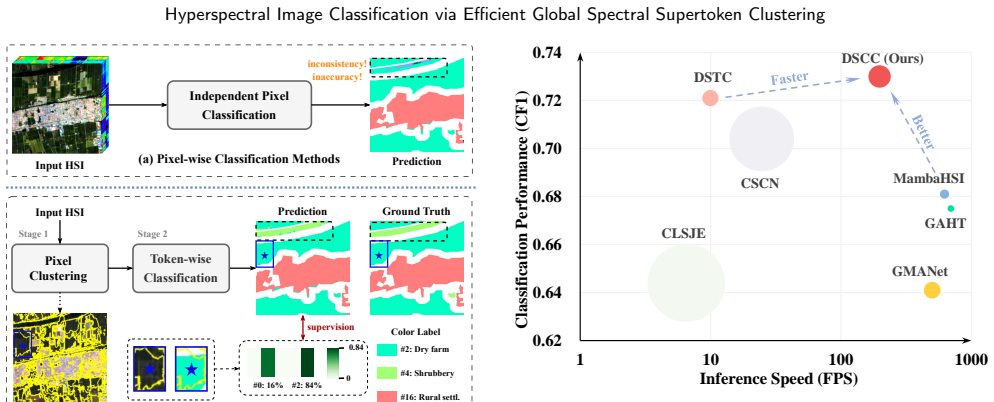
DSCC is an end-to-end framework that explicitly decouples clustering from classification. It groups spectrally similar and spatially proximate pixels into boundary-preserving spectral supertokens by computing an image-level multi-criteria feature distance, applying locality-aware assignment regularization, and selecting centers via density-isolation. Token-level prediction then uses a soft-label scheme that records class proportions within each supertoken. This design guarantees region-level, boundary-aligned classification outputs while handling mixed compositions and delivering a favorable accuracy-efficiency trade-off.
What carries the argument
The spectral supertoken, a cluster of spectrally similar and spatially proximate pixels carrying soft class-proportion labels, which shifts classification from pixel-wise to token-level and thereby enforces regional consistency.
Where Pith is reading between the lines
- The token-level soft-label scheme could be adapted to standard semantic segmentation tasks where pixels often straddle class boundaries.
- Density-isolation center selection might generalize to other clustering-based image partitioning problems that suffer from scale variation.
- The explicit decoupling of stages offers a template for improving spatial coherence in video or multi-temporal remote-sensing classification pipelines.
- Real-time remote-sensing systems could incorporate the dual-stage design to reduce per-frame compute while preserving edge accuracy.
Load-bearing premise
The multi-criteria feature distance plus locality-aware assignment regularization will reliably produce boundary-preserving supertokens whose soft-label proportions accurately reflect mixed land-cover content without introducing new classification errors.
What would settle it
Quantitative boundary-alignment evaluation or visual inspection on the WHU-OHS dataset showing that a substantial fraction of supertoken edges cross verified land-cover transitions, which would increase per-pixel classification errors relative to pixel-wise baselines.
Figures


read the original abstract
Hyperspectral image classification demands spatially coherent predictions and precise boundary delineation. Yet prevailing superpixel-based methods face an inherent contradiction: clustering aggregates similar pixels into regions, but the subsequent classifier operates pixel-wise, undermining regional consistency. Consequently, existing approaches do not guarantee region-level, boundary-aligned classification. To address this limitation, we propose the Dual-stage Spectrum-Constrained Clustering-based Classifier (DSCC), an end-to-end framework that explicitly decouples clustering from classification by first grouping spectral similar and spatially proximate pixels into spectral supertokens and then performing token-level prediction. At its core, DSCC computes an image-level multi-criteria feature distance between pixels and centers, followed by a locality-aware assignment regularization, enabling the generation of boundary-preserving spectral supertokens. A density-isolation based center selection further yields representative, well-separated centers, reducing redundancy and improving robustness to scale variation. To accommodate mixed land-cover compositions within each token, we introduce a soft-label scheme that encodes class proportions and improves robustness for mixed-class tokens. DSCC attains a CF1 of 0.728 at 197.75 FPS on the WHU-OHS dataset, offering a superior accuracy-efficiency trade-off compared with state-of-the-art methods. Extensive experiments further validate the effectiveness and generality of the proposed dual-stage paradigm for hyperspectral image classification. The source code is available at https://github.com/laprf/DSCC.
Editorial analysis
A structured set of objections, weighed in public.
Referee Report
Summary. The manuscript proposes the Dual-stage Spectrum-Constrained Clustering-based Classifier (DSCC) for hyperspectral image classification. It decouples clustering from classification by first forming boundary-preserving spectral supertokens via an image-level multi-criteria feature distance, locality-aware assignment regularization, and density-isolation center selection, then performing token-level prediction with a soft-label scheme that encodes class proportions for mixed land-cover pixels. The central empirical claim is a CF1 of 0.728 at 197.75 FPS on the WHU-OHS dataset, with a superior accuracy-efficiency trade-off versus state-of-the-art methods, supported by ablation studies on each component and direct comparisons under consistent protocols.
Significance. If the reported performance holds, the work is significant because it resolves the regional-consistency contradiction inherent in prior superpixel pipelines by enforcing an explicit dual-stage separation and soft-label encoding. The efficiency (nearly 200 FPS) and open-source code are practical strengths that could influence real-time remote-sensing applications. The ablations and reproducible implementation provide a solid basis for follow-on research.
minor comments (3)
- [Abstract] Abstract: The performance figures (CF1 and FPS) are stated without reference to hardware platform or batch size; while the full experimental section supplies these details, a brief qualifier in the abstract would improve immediate readability.
- [§2] §2: The contrast between spectral supertokens and conventional superpixels is conceptually clear, yet a short quantitative comparison (e.g., average token size or boundary F-score) in the related-work discussion would sharpen the novelty statement.
- [§4.2] §4.2: The density-isolation center selection is described algorithmically, but the sensitivity of the isolation threshold to image resolution is not tabulated; adding a one-line sensitivity plot would strengthen the robustness claim.
Simulated Author's Rebuttal
We thank the referee for the positive review, the recognition of the dual-stage paradigm's resolution of regional-consistency issues, and the recommendation to accept. We appreciate the note on practical strengths and reproducibility.
Circularity Check
No significant circularity; empirical performance claim
full rationale
The paper proposes an algorithmic framework (DSCC) with multi-criteria distance, locality-aware regularization, density-isolation center selection, and soft-label encoding, then reports empirical results (CF1 0.728 at 197.75 FPS on WHU-OHS) plus ablations and comparisons. No equations, fitted parameters, or predictions are defined in terms of themselves; the central claim is a measured trade-off under consistent protocols rather than a self-referential derivation. Self-citations, if present, are not load-bearing for any uniqueness theorem or ansatz that would force the result.
Axiom & Free-Parameter Ledger
invented entities (1)
-
spectral supertokens
no independent evidence
Reference graph
Works this paper leans on
-
[1]
Acosta,I.C.C.,Khodadadzadeh,M.,Tusa,L.,Ghamisi,P.,Gloaguen, R., 2019. A machine learning framework for drill-core mineral mapping using hyperspectral and high-resolution mineralogical data fusion. IEEE Journal of Selected Topics in Applied Earth Observa- tions and Remote Sensing 12, 4829–4842. doi:10.1109/JSTARS.2019. 2924292
-
[2]
Bai, H., Xu, T., Chen, H., Liu, P., Li, J., 2024. Content-driven magnitude-derivative spectrum complementary learning for hyper- spectral image classification. IEEE Transactions on Geoscience and Remote Sensing 62, 1–14. doi:10.1109/TGRS.2024.3435079
-
[4]
Bhadra, S., Sagan, V., Sarkar, S., Braud, M., Mockler, T.C., Eveland, A.L., 2024. Prosail-net: A transfer learning-based dual stream neural network to estimate leaf chlorophyll and leaf angle of crops from uav hyperspectralimages. ISPRSJournalofPhotogrammetryandRemote Sensing 210, 1–24. doi:https://doi.org/10.1016/j.isprsjprs.2024. 02.020
-
[6]
Neural clustering based visual representation learning, in: CVPR, pp
Chen, G., Li, X., Yang, Y., Wang, W., 2024. Neural clustering based visual representation learning, in: CVPR, pp. 5714–5725
2024
-
[7]
Bridging3-d and2-dconvolutionforhyperspectralimageswithcross-dimensional spectral attention
Chen,H.,Xu,T.,Liu,P.,Bai,H.,Bian,Z.,Li,J.,2025a. Bridging3-d and2-dconvolutionforhyperspectralimageswithcross-dimensional spectral attention. IEEE Journal of Selected Topics in Applied Earth Observations and Remote Sensing 19, 2497–2510. doi:10.1109/ JSTARS.2025.3608249
-
[8]
Chen, Y., Jiang, H., Li, C., Jia, X., Ghamisi, P., 2016. Deep feature extraction and classification of hyperspectral images based on con- volutional neural networks. IEEE Transactions on Geoscience and Remote Sensing 54, 6232–6251. doi:10.1109/TGRS.2016.2584107
-
[9]
Sit: Scale-interaction transformer for hyperspectral image classification
Chen, Z., Kumar Roy, S., Gao, H., Ding, Y., Zhang, B., 2025b. Sit: Scale-interaction transformer for hyperspectral image classification. IEEE Transactions on Geoscience and Remote Sensing 63, 1–17. doi:10.1109/TGRS.2025.3598290
-
[10]
R-pred:Two-stagemotion prediction via tube-query attention-based trajectory refinement, in: ProceedingsoftheIEEE/CVFInternationalConferenceonComputer Vision (ICCV), pp
Choi,S.,Kim,J.,Yun,J.,Choi,J.W.,2023. R-pred:Two-stagemotion prediction via tube-query attention-based trajectory refinement, in: ProceedingsoftheIEEE/CVFInternationalConferenceonComputer Vision (ICCV), pp. 8525–8535
2023
-
[11]
An image is worth 16x16 words: Transformers for image recognition at scale, in: ICLR
Dosovitskiy,A.,Beyer,L.,Kolesnikov,A.,Weissenborn,D.,Zhai,X., Unterthiner, T., Dehghani, M., Minderer, M., Heigold, G., Gelly, S., Uszkoreit, J., Houlsby, N., 2021. An image is worth 16x16 words: Transformers for image recognition at scale, in: ICLR
2021
-
[12]
Simple hardware-efficient long convolutions for sequencemodeling, in: Proceedings of International Conference on Machine Learning, pp
Fu, D.Y., Epstein, E.L., Nguyen, E., Thomas, A.W., Zhang, M., Dao, T., Rudra, A., Re, C., 2023. Simple hardware-efficient long convolutions for sequencemodeling, in: Proceedings of International Conference on Machine Learning, pp. 10373–10391
2023
-
[13]
Mamba: Linear-time sequence modeling with selective state spaces
Gu, A., Dao, T., 2024. Mamba: Linear-time sequence modeling with selective state spaces
2024
-
[14]
Han, Z., Yang, J., Gao, L., Zeng, Z., Zhang, B., Chanussot, J.,
-
[15]
IEEETransactionsonGeoscienceandRemoteSensing 63, 1–14
Subpixel spectral variability network for hyperspectral image classification. IEEETransactionsonGeoscienceandRemoteSensing 63, 1–14. doi:10.1109/TGRS.2025.3535749
-
[16]
Hong, D., Han, Z., Yao, J., Gao, L., Zhang, B., Plaza, A., Chanussot, J., 2022. Spectralformer: Rethinking hyperspectral image classifica- tionwithtransformers.IEEETransactionsonGeoscienceandRemote Sensing 60, 1–15. doi:10.1109/TGRS.2021.3130716
-
[17]
Deep diversity-enhanced feature representation of hyperspectral images
Hou, J., Zhu, Z., Hou, J., Liu, H., Zeng, H., Meng, D., 2024. Deep diversity-enhanced feature representation of hyperspectral images. IEEE Transactions on Pattern Analysis and Machine Intelligence 46, 8123–8138. doi:10.1109/TPAMI.2024.3399753
-
[18]
Super- pixel sampling networks, in: ECCV
Jampani, V., Sun, D., Liu, M.Y., Yang, M.H., Kautz, J., 2018. Super- pixel sampling networks, in: ECCV
2018
-
[19]
Whu-ohs: A benchmark dataset for large-scale hersepctral image classification
Li, J., Huang, X., Tu, L., 2022. Whu-ohs: A benchmark dataset for large-scale hersepctral image classification. International Journal of Applied Earth Observation and Geoinformation 113, 103022
2022
-
[20]
Li, M., Liu, Y., Xue, G., Huang, Y., Yang, G., 2023. Exploring the relationship between center and neighborhoods: Central vector ori- ented self-similarity network for hyperspectral image classification. IEEETransactionsonCircuitsandSystemsforVideoTechnology33, 1979–1993. doi:10.1109/TCSVT.2022.3218284
-
[21]
Mambahsi: Spatial–spectral mamba for hyperspectral image classification
Li, Y., Luo, Y., Zhang, L., Wang, Z., Du, B., 2024. Mambahsi: Spatial–spectral mamba for hyperspectral image classification. IEEE Transactions on Geoscience and Remote Sensing 62, 1–16. doi:10. Peifu Liu, et al:Preprint submitted to ElsevierPage 13 of 14 Hyperspectral Image Classification via Efficient Global Spectral Supertoken Clustering 1109/TGRS.2024.3430985
-
[22]
Dual-stage hyperspectralimageclassificationmodelwithspectralsupertoken,in: ECCV, pp
Liu, P., Xu, T., Wang, J., Chen, H., Bai, H., Li, J., 2025a. Dual-stage hyperspectralimageclassificationmodelwithspectralsupertoken,in: ECCV, pp. 368–386
-
[23]
Hypermamba: A spectral-spatial adaptive mamba for hyperspectral image classifi- cation
Liu, Q., Yue, J., Fang, Y., Xia, S., Fang, L., 2024. Hypermamba: A spectral-spatial adaptive mamba for hyperspectral image classifi- cation. IEEE Transactions on Geoscience and Remote Sensing 62, 1–14. doi:10.1109/TGRS.2024.3482473
-
[24]
Liu, S., Fu, C., Duan, Y., Wang, X., Luo, F., 2025b. Spatial–spectral enhancement and fusion network for hyperspectral image classifica- tionwithfewlabeledsamples. IEEETransactionsonGeoscienceand Remote Sensing 63, 1–14. doi:10.1109/TGRS.2024.3523578
-
[25]
Grouped multi-attention network for hyperspectral image spectral-spatial classification
Lu, T., Liu, M., Fu, W., Kang, X., 2023. Grouped multi-attention network for hyperspectral image spectral-spatial classification. IEEE Transactions on Geoscience and Remote Sensing 61, 1–12. doi:10. 1109/TGRS.2023.3263851
-
[26]
Image as set of points, in: ICLR
Ma, X., Zhou, Y., Wang, H., Qin, C., Sun, B., Liu, C., Fu, Y., 2023. Image as set of points, in: ICLR
2023
-
[27]
Mei,S.,Song,C.,Ma,M.,Xu,F.,2022. Hyperspectralimageclassifi- cationusinggroup-awarehierarchicaltransformer.IEEETransactions onGeoscienceandRemoteSensing60,1–14. doi:10.1109/TGRS.2022. 3207933
-
[28]
Nartey, O.T., Sarpong, K., Addo, D., Rao, Y., Qin, Z., 2023. Picovs: Pixel-level with covariance pooling feature and superpixel-level fea- ture fusion for hyperspectral image classification. IEEE Transactions onGeoscienceandRemoteSensing61,1–20. doi:10.1109/TGRS.2023. 3322641
-
[29]
Hyperloopnet: Hyperspectral image classification using multiscale self-looping convolutional networks
Pande, S., Banerjee, B., 2022. Hyperloopnet: Hyperspectral image classification using multiscale self-looping convolutional networks. ISPRS Journal of Photogrammetry and Remote Sensing 183, 422–
2022
-
[30]
doi:https://doi.org/10.1016/j.isprsjprs.2021.11.021
-
[31]
Hsod-bit-v2: A challenging benchmark for hyperspectral salient object detection
Qiu, Y., Bai, S., Xu, T., Liu, P., Qin, H., Li, J., 2025. Hsod-bit-v2: A challenging benchmark for hyperspectral salient object detection. Proceedings of the AAAI Conference on Artificial Intelligence 39, 6630–6638
2025
-
[32]
Faster r-cnn: Towards real-time object detection with region proposal networks
Ren, S., He, K., Girshick, R., Sun, J., 2017. Faster r-cnn: Towards real-time object detection with region proposal networks. IEEE TransactionsonPatternAnalysisandMachineIntelligence39,1137–
2017
-
[33]
doi:10.1109/TPAMI.2016.2577031
-
[34]
Spectral–spatial morphological attention transformer for hyperspec- tral image classification
Roy, S.K., Deria, A., Shah, C., Haut, J.M., Du, Q., Plaza, A., 2023. Spectral–spatial morphological attention transformer for hyperspec- tral image classification. IEEE Transactions on Geoscience and Remote Sensing 61, 1–15. doi:10.1109/TGRS.2023.3242346
-
[35]
Remote sensing monitoring of multi-scale watersheds impermeability for urban hy- drological evaluation
Shao, Z., Fu, H., Li, D., Altan, O., Cheng, T., 2019. Remote sensing monitoring of multi-scale watersheds impermeability for urban hy- drological evaluation. Remote Sensing of Environment 232, 111338
2019
-
[36]
Sheng, J., Zhou, J., Wang, J., Ye, P., Fan, J., 2025. Dualmamba: A lightweight spectral–spatial mamba-convolution network for hyper- spectral image classification. IEEE Transactions on Geoscience and Remote Sensing 63, 1–15. doi:10.1109/TGRS.2024.3516817
-
[37]
Hyperspectral image classification using a superpixel–pixel–subpixel multilevel network
Tu, B., Ren, Q., Li, Q., He, W., He, W., 2023. Hyperspectral image classification using a superpixel–pixel–subpixel multilevel network. IEEE Transactions on Instrumentation and Measurement 72, 1–16. doi:10.1109/TIM.2023.3271713
-
[38]
Dual-stage construction of probability for hyperspectral image classification
Tu, B., Wang, J., Zhao, G., Zhang, X., Zhang, G., 2019. Dual-stage construction of probability for hyperspectral image classification. IEEE Geoscience and Remote Sensing Letters 17, 889–893
2019
-
[39]
Attentionisallyouneed,in: NIPS
Vaswani,A.,Shazeer,N.,Parmar,N.,Uszkoreit,J.,Jones,L.,Gomez, A.N.,Kaiser,L.u.,Polosukhin,I.,2017. Attentionisallyouneed,in: NIPS
2017
-
[40]
Wan, L., Zhang, J., Xu, Y., Huang, Y., Zhou, W., Jiang, L., He, Y., Cen,H.,2021. Prosdm:Applicabilityofprospectmodelcoupledwith spectralderivativesandsimilaritymetricstoretrieveleafbiochemical traitsfrombidirectionalreflectance. RemoteSensingofEnvironment 267, 112761. doi:https://doi.org/10.1016/j.rse.2021.112761
-
[41]
Retrieval-Augmented Embodied Agents
Wang, G., Guo, Y., Xu, Z., Kankanhalli, M., 2024a. Bilateral adaptation for human-object interaction detection with occlusion- robustness, in: 2024 IEEE/CVF Conference on Computer Vision and Pattern Recognition (CVPR), pp. 27970–27980. doi:10.1109/ CVPR52733.2024.02642
-
[42]
S2mamba: A spatial–spectral state space model for hyperspectral image classi- fication
Wang, G., Zhang, X., Peng, Z., Zhang, T., Jiao, L., 2025. S2mamba: A spatial–spectral state space model for hyperspectral image classi- fication. IEEE Transactions on Geoscience and Remote Sensing 63, 1–13. doi:10.1109/TGRS.2025.3530993
-
[43]
Wang, Y., Huang, D., Ye, W., Zhang, G., Ouyang, W., He, T., 2024b. Neurodin: A two-stage framework for high- fidelity neural surface reconstruction, in: Globerson, A., Mackey, L., Belgrave, D., Fan, A., Paquet, U., Tomczak, J., Zhang, C. (Eds.), Advances in Neural Information Processing Systems, Curran Associates, Inc.. pp. 103168–103197. URL: https://pro...
-
[44]
1955–1964
Wang,Y.C.,Wang,C.Y.,Lai,S.H.,2022.Disentangledrepresentation withdual-stagefeaturelearningforfaceanti-spoofing,in:WACV,pp. 1955–1964
2022
-
[45]
From center to surrounding: An interactivelearningframeworkforhyperspectralimageclassification
Yang, J., Du, B., Zhang, L., 2023. From center to surrounding: An interactivelearningframeworkforhyperspectralimageclassification. ISPRS Journal of Photogrammetry and Remote Sensing 197, 145–
2023
-
[46]
doi:https://doi.org/10.1016/j.isprsjprs.2023.01.024
-
[47]
Yu, D., Li, Q., Wang, X., Xu, C., Zhou, Y., 2022. A cross-level spectral–spatial joint encode learning framework for imbalanced hy- perspectral image classification. IEEE Transactions on Geoscience and Remote Sensing 60, 1–17. doi:10.1109/TGRS.2022.3203980
-
[48]
Tcformer: Visual recognition via token clustering transformer
Zeng, W., Jin, S., Xu, L., Liu, W., Qian, C., Ouyang, W., Luo, P., Wang, X., 2024. Tcformer: Visual recognition via token clustering transformer. IEEE Transactions on Pattern Analysis and Machine Intelligence 46, 9521–9535. doi:10.1109/TPAMI.2024.3425768
-
[49]
Zhang, Q., Dong, Y., Zheng, Y., Yu, H., Song, M., Zhang, L., Yuan, Q.,2024a. Three-dimensionspatial–spectralattentiontransformerfor hyperspectralimagedenoising.IEEETransactionsonGeoscienceand Remote Sensing 62, 1–13. doi:10.1109/TGRS.2024.3458174
-
[50]
Cooperated spectrallow-ranknessprioranddeepspatialpriorforhsiunsupervised denoising
Zhang,Q.,Yuan,Q.,Song,M.,Yu,H.,Zhang,L.,2022a. Cooperated spectrallow-ranknessprioranddeepspatialpriorforhsiunsupervised denoising. IEEE Transactions on Image Processing 31, 6356–6368. doi:10.1109/TIP.2022.3211471
-
[51]
Hyperspectral image denoising: From model-driven, data- driven,tomodel-data-driven
Zhang, Q., Zheng, Y., Yuan, Q., Song, M., Yu, H., Xiao, Y., 2024b. Hyperspectral image denoising: From model-driven, data- driven,tomodel-data-driven. IEEETransactionsonNeuralNetworks and Learning Systems 35, 13143–13163. doi:10.1109/TNNLS.2023. 3278866
-
[52]
Spectral–spatial self-attention networks for hyperspectral image classification
Zhang, X., Sun, G., Jia, X., Wu, L., Zhang, A., Ren, J., Fu, H., Yao, Y., 2022b. Spectral–spatial self-attention networks for hyperspectral image classification. IEEE Transactions on Geoscience and Remote Sensing 60, 1–15. doi:10.1109/TGRS.2021.3102143
-
[53]
Zhao, C., Zhu, W., Feng, S., 2022. Superpixel guided deformable convolution network for hyperspectral image classification. IEEE Transactions on Image Processing 31, 3838–3851. doi:10.1109/TIP. 2022.3176537
work page doi:10.1109/tip 2022
-
[54]
Zheng,Z.,Zhong,Y.,Ma,A.,Zhang,L.,2020. Fpga:Fastpatch-free global learning framework for fully end-to-end hyperspectral image classification. IEEETransactionsonGeoscienceandRemoteSensing 58, 5612–5626. doi:10.1109/TGRS.2020.2967821
-
[55]
Zhong, Y., Hu, X., Luo, C., Wang, X., Zhao, J., Zhang, L., 2020. Whu-hi: Uav-borne hyperspectral with high spatial resolution (h2) benchmarkdatasetsandclassifierforprecisecropidentificationbased on deep convolutional neural network with crf. Remote Sensing of Environment 250, 112012. doi:https://doi.org/10.1016/j.rse.2020. 112012
-
[56]
Zhong, Z., Li, Y., Ma, L., Li, J., Zheng, W.S., 2022. Spectral–spatial transformer network for hyperspectral image classification: A fac- torized architecture search framework. IEEE Transactions on Geo- science and Remote Sensing 60, 1–15. doi:10.1109/TGRS.2021. 3115699. Peifu Liu, et al:Preprint submitted to ElsevierPage 14 of 14
discussion (0)
Sign in with ORCID, Apple, or X to comment. Anyone can read and Pith papers without signing in.