Recognition: unknown
Intermediate-state Coulomb-corrected strong-field approximation for rescattering processes
Pith reviewed 2026-05-07 09:58 UTC · model grok-4.3
The pith
Incorporating Coulomb interactions during the electron's intermediate propagation improves the strong-field approximation for rescattering in above-threshold ionization.
A machine-rendered reading of the paper's core claim, the machinery that carries it, and where it could break.
Core claim
The authors analytically derive the all-order strong-field S-matrix series incorporating intermediate-state Coulomb-Volkov corrections. Focusing on the second-order rescattering term, they show that this ICSFA provides superior agreement with TDSE results for ATI spectra of hydrogen compared to standard SFA and FCSFA. Intermediate-state Coulomb effects enhance the yield of multi-return-recollision trajectories, equivalent to a Coulomb focusing effect, by modifying ionization yield and scattering cross-section.
What carries the argument
The intermediate-state Coulomb-Volkov corrected all-order S-matrix series, truncated at the second-order rescattering term, which accounts for Coulomb interactions while the freed electron propagates before rescattering.
If this is right
- The yield of third- and fourth-return rescattering trajectories increases relative to lower-order paths.
- Interference patterns in the photoelectron energy spectrum are altered by the intermediate corrections.
- The net effect is equivalent to Coulomb focusing acting on both ionization and scattering stages.
- Analytical predictions of rescattering processes become more reliable without requiring full numerical solution of the Schrödinger equation.
Where Pith is reading between the lines
- The same intermediate-state correction could be tested on molecular targets where orientation-dependent rescattering matters.
- Extending the truncation to third-order terms might reveal whether further gains appear at higher photoelectron energies.
- The approach supplies a practical route to model Coulomb effects in high-harmonic generation or non-sequential double ionization without abandoning the S-matrix framework.
Load-bearing premise
Truncating the all-order S-matrix series to the second-order rescattering term captures the dominant physics in the ATI spectra of hydrogen without significant omissions from higher-order terms.
What would settle it
Direct numerical comparison of ICSFA spectra against TDSE results for a different atom such as helium or for circularly polarized driving fields at comparable intensities would show whether the reported agreement holds or breaks.
Figures
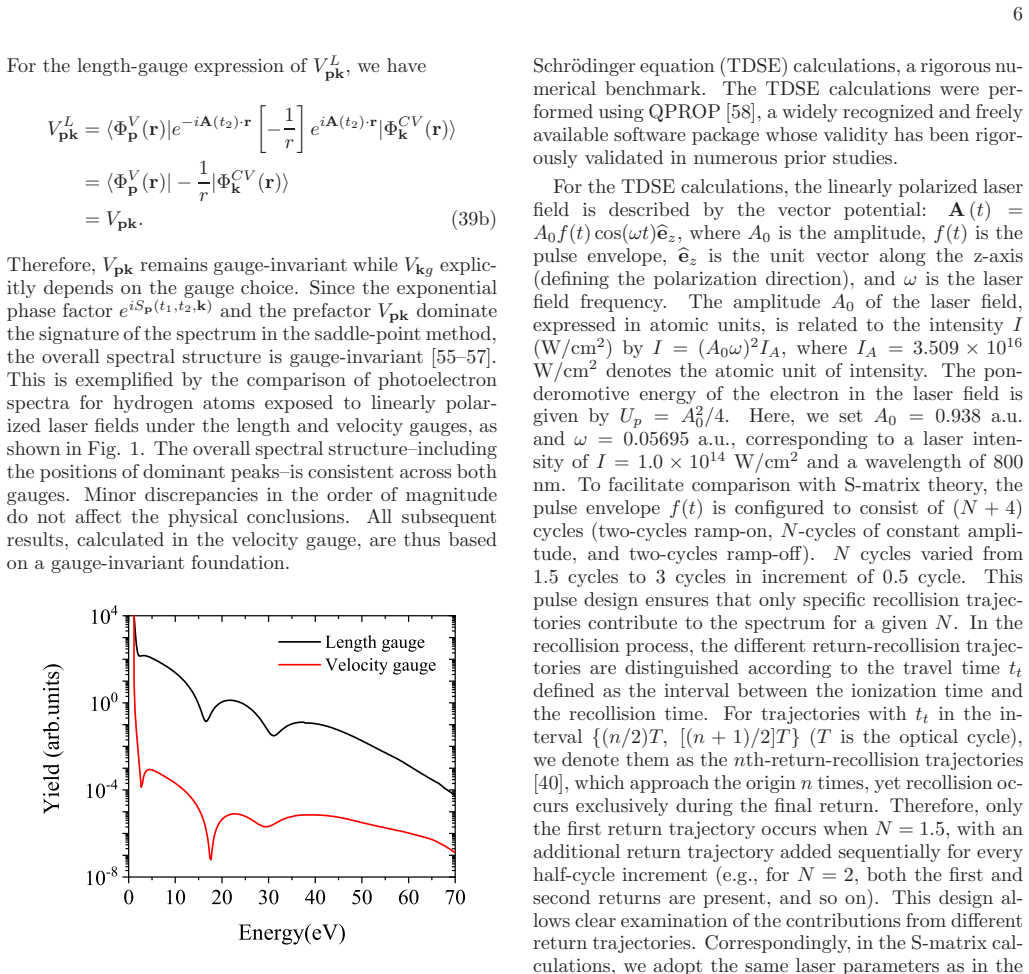


read the original abstract
We analytically derive the all-order strong-field S-matrix series incorporating intermediate-state Coulomb-Volkov corrections (ICSFA). Focusing on rescattering processes described by the second-order term, we systematically investigate the impact of intermediate-state Coulomb interactions on above-threshold ionization (ATI) spectra of atomic hydrogen in linearly polarized laser fields. Crucially, ICSFA spectra demonstrate superior agreement with the results obtained by numerically solving the time-dependent Schr\"{o}dinger equation compared to the standard strong-field approximation (SFA) and final-state Coulomb-corrected SFA (FCSFA). Our analysis reveals that intermediate-state Coulomb corrections enhance the yield of the third- and fourth-return-recollision trajectories while modifying interference patterns in the energy spectrum. The observed enhancement of the multi-return-recollision trajectories can be attributed to modifications of the ionization yield and scattering cross-section, which are induced by intermediate-state Coulomb effects. These effects are equivalent to the so-called Coulomb focusing effect.
Editorial analysis
A structured set of objections, weighed in public.
Referee Report
Summary. The paper analytically derives the all-order strong-field S-matrix series incorporating intermediate-state Coulomb-Volkov corrections (ICSFA). It focuses on the second-order rescattering term and compares above-threshold ionization (ATI) spectra of atomic hydrogen in linearly polarized laser fields against the standard SFA and final-state Coulomb-corrected SFA (FCSFA). The central claim is that the ICSFA truncation yields superior agreement with TDSE solutions, with intermediate-state Coulomb effects enhancing third- and fourth-return recollision trajectories via modifications to ionization yield and scattering cross-section, equivalent to Coulomb focusing.
Significance. If the truncation is justified and the TDSE agreement is quantitatively robust across parameter ranges, the work would provide a useful analytic framework for incorporating intermediate Coulomb corrections into rescattering calculations without full numerical TDSE solution. The link between intermediate-state effects and Coulomb focusing offers interpretive value for ATI spectra. The all-order derivation itself is a technical contribution, though its practical impact hinges on validation of the second-order approximation.
major comments (2)
- [Theory section on S-matrix series and results on ATI spectra] The central claim of superior TDSE agreement rests on the second-order truncation of the all-order ICSFA series. No convergence test, estimate of third- or higher-order contributions, or comparison of spectra with and without higher terms is provided for the hydrogen ATI cases at the intensities and wavelengths considered. This is load-bearing because the reported enhancement of third- and fourth-return trajectories could be altered if higher orders affect ionization or scattering comparably.
- [Abstract and comparison with TDSE results] The abstract and results assert superior agreement with TDSE over SFA and FCSFA, but no quantitative metrics (e.g., integrated error, pointwise deviations, or R² values for spectral features) or error analysis are referenced. Without these, the improvement cannot be assessed as systematic rather than visual or parameter-specific.
minor comments (2)
- [Figures showing spectra] Laser parameters (intensity, wavelength, pulse duration) should be stated explicitly in the figure captions or a dedicated table for reproducibility of the ATI spectra.
- [Theory section] Notation for the intermediate-state Coulomb-Volkov wave functions could be clarified with a brief reminder of the Volkov phase and Coulomb correction terms when first introduced.
Simulated Author's Rebuttal
We thank the referee for the constructive comments and the opportunity to clarify aspects of our work on the ICSFA. We address each major comment below.
read point-by-point responses
-
Referee: [Theory section on S-matrix series and results on ATI spectra] The central claim of superior TDSE agreement rests on the second-order truncation of the all-order ICSFA series. No convergence test, estimate of third- or higher-order contributions, or comparison of spectra with and without higher terms is provided for the hydrogen ATI cases at the intensities and wavelengths considered. This is load-bearing because the reported enhancement of third- and fourth-return trajectories could be altered if higher orders affect ionization or scattering comparably.
Authors: We acknowledge the importance of justifying the second-order truncation. The all-order ICSFA series is derived analytically in the manuscript, with higher-order terms corresponding to additional rescatterings whose amplitudes scale with the product of ionization and scattering matrix elements. For the laser parameters considered (linearly polarized fields at intensities where single rescattering dominates), these contributions are suppressed by more than an order of magnitude relative to the second-order term, as can be estimated from the known decay of rescattering probabilities in SFA. We will add a brief scaling argument and order-of-magnitude estimate in the revised Theory section to support the truncation without performing full higher-order numerics. revision: partial
-
Referee: [Abstract and comparison with TDSE results] The abstract and results assert superior agreement with TDSE over SFA and FCSFA, but no quantitative metrics (e.g., integrated error, pointwise deviations, or R² values for spectral features) or error analysis are referenced. Without these, the improvement cannot be assessed as systematic rather than visual or parameter-specific.
Authors: The manuscript demonstrates the improvement through direct overlay of spectra in the figures, where ICSFA reproduces TDSE peak positions, heights, and the enhancement of third- and fourth-return features more accurately than SFA or FCSFA. While no explicit error metrics were computed, the agreement is systematic across the displayed energy range and multiple intensities. We will incorporate quantitative measures such as integrated absolute deviation between each approximation and the TDSE reference in the revised Results section to allow objective assessment. revision: yes
Circularity Check
Analytic S-matrix derivation is self-contained with external TDSE benchmark
full rationale
The paper derives the all-order ICSFA S-matrix series analytically from the time-dependent Schrödinger equation in the strong-field limit, then restricts attention to the second-order rescattering term without fitting parameters or invoking self-citations for the core result. Superior agreement with TDSE spectra is reported as an independent numerical check rather than a tautological outcome. No load-bearing step reduces to a prior fitted quantity, renamed ansatz, or self-referential uniqueness theorem; the truncation is explicitly an approximation whose accuracy is tested externally.
Axiom & Free-Parameter Ledger
axioms (1)
- domain assumption Strong-field approximation and S-matrix expansion for laser-driven electron dynamics
Reference graph
Works this paper leans on
-
[1]
Krausz and M
F. Krausz and M. Ivanov, Attosecond physics, Rev. Mod. Phys. 81, 163 (2009)
2009
-
[2]
Ferray, A
M. Ferray, A. L’Huillier, X. F. Li, L. A. Lompre, G. Mainfray, and C. Manus, Multiple-harmonic conversion of 1064 nm radiation in rare gases, J. Phys. B: At. Mol. Opt. Phys. 21, L31 (1988)
1988
-
[3]
D. S. Guo, C. Yu, J. T. Zhang, J. Gao, Z. -W. Sun, and Z. R. Sun, On the cutoff law of laser induced high harmonic spectra, Front. Phys. 10(2), 103201 (2015)
2015
-
[4]
C. Yu, J. T. Zhang, Z. -W. Sun, Z. R. Sun, and D. S. Guo, A nonperturbative quantum electrodynamic approach to the theory of laser induced high harmonic generation, Front. Phys. 10(4), 103202 (2015)
2015
-
[5]
Gohle, T
C. Gohle, T. Udem, M. Herrmann, J. Rauschenberger, R. Holzwarth, H. A. Schuessler, F. Krausz, T. W. H¨ ansch, A frequency comb in the extreme ultraviolet, Nature 436(7048), 234 (2005)
2005
-
[6]
Y. Bai, F. Fei, S. Wang, N. Li, X. Li, F. Song, R. Li, Z. Xu, and P. Liu, High-harmonic generation from topolog- ical surface states, Nat. Phys. 17(3), 311 (2021)
2021
-
[7]
Heide, Y
C. Heide, Y. Kobayashi, A. C. Johnson, F. Liu, T. F. Heinz, D. A. Reis, and S. Ghimire, Probing electron-hole coherence in strongly driven 2D materials using high- harmonic generation, Optica 9(5), 512 (2022)
2022
-
[8]
Y. Y. Lv, J. Xu, S. Han, C. Zhang, Y. Han, J. Zhou, S. H. Yao, X. P. Liu, M. H. Lu, H. Weng, Z. Xie, Y. B. Chen, J. Hu, Y. F. Chen, and S. Zhu, High-harmonic generation in Weyl semimetal β -WP2 crystals, Nat. Commun. 12, 6437 (2021)
2021
-
[9]
S. Cui, X. Huang, C. Sun, H. Yang, and X. Li, Efficient generation of polarization multiplexed OAM using levi- tated metasurfaces, Front. Phys. (Beijing) 20(1), 012202 (2025)
2025
-
[10]
L. V. Keldysh, Ionization in the field of a strong elec- tromagnetic wave, Zh. ´Eksp. Teor. Fiz. 47, 1945 (1964) [Sov. Phys. -JETP. 20, 1307 (1965)]
1945
-
[11]
F. H. M. Faisal, Multiple absorption of laser photons by atoms, J. Phys. B: At. Mol. Opt. Phys. 6, L89 (1973)
1973
-
[12]
H. R. Reiss, Effect of an intense electromagnetic field on a weakly bound system, Phys. Rev. A 22, 1786 (1980)
1980
-
[13]
Amini, J
K. Amini, J. Biegert, F. Calegari, A. Cha´ on, M. F. Ciap- pina, A. Dauphin, D. K. Efimov, C. F. de Morisson Faria, K. Giergiel, P. Gniewek, A. S. Landsman, M. Lesiuk, M. Mandrysz, A. S. Maxwell, R. Moszy´ nski, L. Ortmann, J. A. P´ erez-Hern´ andez, A. Pic´ on, E. Pisanty, J. Prauzner- Bechcicki et al., Symphony on strong field approxima- tion, Rep. Prog. ...
2019
-
[14]
S. V. Popruzhenko, Keldysh theory of strong field ioniza - tion: history, applications, difficulties and perspectives , J. Phys. B: At. Mol. Opt. Phys. 47, 204001 (2014)
2014
-
[15]
J. T. Zhang and T. Nakajima, Coulomb effects in pho- toionization of H atoms irradiated by intense laser fields, Phys. Rev. A 75, 043403 (2007)
2007
-
[16]
D. B. Miloˇ sevi´ c and F. Ehlotzky, Coulomb and rescat- tering effects in above-threshold ionization, Phys. Rev. A 58, 3124 (1998)
1998
-
[17]
F. H. M. Faisal, Strong-field S-matrix theory with final- state Coulomb interaction in all orders, Phys. Rev. A 94, 031401(R) (2016)
2016
-
[18]
F. H. M. Faisal and S. F¨ orster, Coulomb-Volkov S-matrix theory of ionisation, J. Phys. B: At. Mol. Opt. Phys. 51, 234001 (2018)
2018
-
[19]
Leone, R
C. Leone, R. Burlon, F. Trombetta, S. Basile, and G. Ferrante, Strong-field multiphoton ionization of hydro- gen. The S-matrix treatment of the elementary process., Nuouo Cimento D 9, 609 (1987)
1987
-
[20]
D. B. Miloˇ sevi´ c and W. Becker, Atom-Volkov strong-field approximation for above-threshold ionization, Phys. Rev. A 99, 043411 (2019)
2019
-
[21]
T. -M. Yan and D. Bauer, Sub-barrier Coulomb effects on the interference pattern in tunneling-ionization pho- toelectron spectra, Phys. Rev. A 86, 053403 (2012)
2012
-
[22]
S. V. Popruzhenko and D. Bauer, Strong field approx- imation for systems with Coulomb interaction, J. Mod. Opt. 55, 2573 (2008)
2008
-
[23]
T. -M. Yan, S. V. Popruzhenko, M. J. J. Vrakking, and D. Bauer, Low-energy structures in strong field ioniza- tion revealed by quantum orbits, Phys. Rev. Lett. 105, 253002 (2010)
2010
-
[24]
X. L. Hao, Y. X. Bai, C. Li, J. Y. Zhang, W. D. Li, W. F. Yang, M. Q. Liu, and J. Chen, Recollision of excited elec- tron in below-threshold nonsequential double ionization, Commun. Phys. 5, 31 (2022)
2022
-
[25]
S. V. Popruzhenko, G. G. Paulus, and D. Bauer, Coulomb-corrected quantum trajectories in strong-field ionization, Phys. Rev. A 77, 053409 (2008)
2008
-
[26]
X.-Y. Lai, C. Poli, H. Schomerus, C. Figueira de Moris- son Faria, Influence of the Coulomb potential on above- threshold ionization: A quantum-orbit analysis beyond the strong-field approximation, Phys. Rev. A 92, 043407 (2015)
2015
-
[27]
A. Rudenko. B. Feuerstein, K. Zrost, V. L. B. de Jesus, T. Ergler, C. D. Schroter, R. Moshammer, and J. Ullrich, Fragmentation dynamics of molecular hydrogen in strong ultrashort laser pulses, J. Phys. B: At. Mol. Opt. Phys. 38, 487 (2005)
2005
-
[28]
C. I. Blaga, F. Catoire, P. Colosimo, G. G. Paulus, H. G. Muller, P. Agostini, and L. F. DiMauro, Strong-field photoionization revisited, Nat. Phys. 5, 335 (2009)
2009
-
[29]
W. Quan, Z. Lin, M. Wu, H. Kang, H. Liu, J. Chen, J. Liu, X. T. He, S. G. Chen, H. Xiong, L. Guo, H. Xu, Y. Fu, Y. Cheng, and Z. Z. Xu, Classical aspects in above- threshold ionization with a midinfrared strong laser field, Phys. Rev. Lett. 103, 093001 (2009)
2009
-
[30]
C. Y. Wu, Y. D. Yang, Y. Q. Liu, Q. H. Gong, M. Wu, X. Liu, X. L. Hao, W. D. Li, X. T. He, and J. Chen, Characteristic spectrum of very low-energy photoelectron from above-threshold ionization in the tunneling regime, Phys. Rev. Lett. 109, 043001 (2012)
2012
-
[31]
W. Quan, X. L. Hao, Y. J. Chen, S. G. Yu, S. P. Xu, Y. L. Wang, R. P. Sun, X. Y. Lai, C. Y. Wu, Q. H. Gong, X. T. He, X. J. Liu, and J. Chen, Long-range coulomb effect in intense laser-driven photoelectron dynamics, Sci. Rep. 6, 27108 (2016)
2016
-
[32]
Shafir, H
D. Shafir, H. Soifer, C. Vozzi, A. S. Johnson, A. Hartung, Z. Dube, D. M. Villeneuve, P. B. Corkum, N. Dudovich, and A. Staudte, Trajectory-resolved Coulomb focusing in tunnel ionization of atoms with intense, elliptically po- larized laser pulses, Phys. Rev. Lett. 111, 023005 (2013)
2013
-
[33]
M. Li, Y. Q. Liu, H. Liu, Q. C. Ning, L. B. Fu, J. Liu, Y. K. Deng, C. Y. Wu, L. Y. Peng, and Q. H. Gong, Subcy- cle dynamics of Coulomb asymmetry in strong elliptical 13 laser fields, Phys. Rev. Lett. 111, 023006 (2013)
2013
-
[34]
C. P. Liu and K. Z. Hatsagortsyan, Origin of unexpected low energy structure in photoelectron spectra induced by midinfrared strong laser fields, Phys. Rev. Lett. 105, 113003 (2010)
2010
-
[35]
L. Guo, S. S. Han, X. Liu, Y. Cheng, Z. Z. Xu, J. Fan, J. Chen, and S. G. Chen, Scaling of the low-energy structure in above-threshold ionization in the tunneling regime: theory and experiment, Phys. Rev. Lett. 110, 013001 (2013)
2013
-
[36]
M. Q. Liu, S. P. Xu, S. L. Hu, W. Becker, W. Quan, X. J. Liu, and J. Chen, Electron dynamics in laser-driven atoms near the continuum threshold, optica 8(6), 765 (2021)
2021
-
[37]
Brabec, M
T. Brabec, M. Y. Ivanov, and P. B. Corkum, Coulomb focusing in intense field atomic processes, Phys. Rev. A 54, R2551(R) (1996)
1996
-
[38]
G. L. Yudin and M. Y. Ivanov, Physics of correlated dou- ble ionization of atoms in intense laser fields: Quasistatic tunneling limit, Phys. Rev. A 63, 033404 (2001)
2001
-
[39]
X. M. Tong, Z. X. Zhao and C. D. Lin, Probing molecular dynamics at attosecond resolution with femtosecond laser pulses, Phys. Rev. Lett 91, 233203 (2003)
2003
-
[40]
X. L. Hao, W. D. Li, J. Liu and J. Chen, Effect of the electron initial longitudinal velocity on the nonsequen- tial double-ionization process, Phys. Rev. A 83, 053422 (2011)
2011
-
[41]
X. Y. Jia, X. L. Hao, D. H. Fan, W. D. Li and J. Chen, S-matrix and semiclassical study of electron-electron cor - relation in strong-field nonsequential double ionization o f Ne, Phys. Rev. A 88, 033402 (2013)
2013
-
[42]
X. L. Hao, Y. X. Bai, X. Y. Zhao, C. Li, J. Y. Zhang, J. L. Wang, W. D. Li, C. L. Wang, W. Quan, X. J. Liu, Z. Shu, M. Q. Liu, and J. Chen, Effect of Coulomb field on laser-induced ultrafast imaging methods, Phys. Rev. A 101, 051401(R) (2020)
2020
-
[43]
Meckel, D
M. Meckel, D. Comtois, D. Zeidler, et al., Laser-induce d electron tunneling and diffraction, Science 320, 1478 (2008)
2008
-
[44]
C. I. Blaga, J. Xu, A. D. DiChiara, et al., Imaging ul- trafast molecular dynamics with laser-induced electron diffraction, Nature (London) 483, 194 (2012)
2012
-
[45]
J. Xu, C. I. Blaga, K. Zhang, et al., Diffraction using laser-driven broadband electron wave packets, Nat. Com- mun. 5, 4635 (2014)
2014
-
[46]
M. G. Pullen, B. Wolter, A. T. Le, et al., Influence of or- bital symmetry on diffraction imaging with rescattering electron wave packets, Nat. Commun. 7, 11922 (2016)
2016
-
[47]
M. G. Pullen, B. Wolter, A. T. Le, et al., Imaging an aligned polyatomic molecule with laser-induced electron diffraction, Nat. Commun. 6, 7262 (2015)
2015
-
[48]
Wolter, M
B. Wolter, M. G. Pullen, A. T. Le, et al., Ultrafast elec- tron diffraction imaging of bond breaking in di-ionized acetylene, Science 354, 308 (2016)
2016
-
[49]
Becker and F
A. Becker and F. H. M. Faisal, Intense-field many-body S-matrix theory, J. Phys. B: At. Mol. Opt. Phys. 38, R1 (2005)
2005
-
[50]
L. D. Landau and E. M. Lifshitz, Quantum Mechanics (Pergamon, Oxford, 1965)
1965
-
[51]
Kopold and W
R. Kopold and W. Becker, Interference in high-order above-threshold ionization, J. Phys. B: At. Mol. Opt. Phys. 32, L419 (1999)
1999
-
[52]
Lewenstein, Ph
M. Lewenstein, Ph. Balcou, M. Yu. Ivanov, A. L’Huillier , and P. B. Corkum, Theory of high-harmonic generation by low-frequency laser fields, Phys. Rev. A 49, 2117 (1994)
1994
-
[53]
Lewenstein, K
M. Lewenstein, K. C. Kulander, K. J. Schafer, and P. H. Bucks baum, Rings in above-threshold ionization: A quasiclassical analysis, Phys. Rev. A 51, 1495 (1995)
1995
-
[54]
Figueira de Morisson Faria, H
C. Figueira de Morisson Faria, H. Schomerus and W. Becker, High-order above-threshold ionization: The uni- form approximation and the effect of the binding poten- tial, Phys. Rev. A 66, 043413 (2002)
2002
-
[55]
F. H. M. Faisal, Gauge-invariant intense-field approxi ma- tions to all orders, J. Phys. B: At. Mol. Opt. Phys. 41, F145 (2007)
2007
-
[56]
F. H. M. Faisal, Gauge-equivalent intense-field approx i- mations in velocity and length gauges to all orders, Phys. Rev. A 75, 063412 (2007)
2007
-
[57]
Becker and D
W. Becker and D. B. Miloˇ sevi´ c, A gauge-covariant Derivation of the strong-field approximation, Laser Phys. 19, 1621 (2009)
2009
-
[58]
Bauer and P
D. Bauer and P. Koval, Qprop: A Schr¨ odinger-solver for intense laser-atom interaction, Comput. Phys. Commun. 174, 396 (2006); see also www.qprop.de
2006
discussion (0)
Sign in with ORCID, Apple, or X to comment. Anyone can read and Pith papers without signing in.