Recognition: 2 theorem links
· Lean TheoremMAAS-SFRThelper: An Integrated ESAPI Plugin for Structure Generation, Optimization, and Evaluation of Spatially Fractionated Radiation Therapy
Pith reviewed 2026-05-13 07:59 UTC · model grok-4.3
The pith
MAAS-SFRThelper integrates sphere lattice generation, geometric optimization, and peak-valley evaluation into one ESAPI workflow inside the Eclipse treatment planning system.
A machine-rendered reading of the paper's core claim, the machinery that carries it, and where it could break.
Core claim
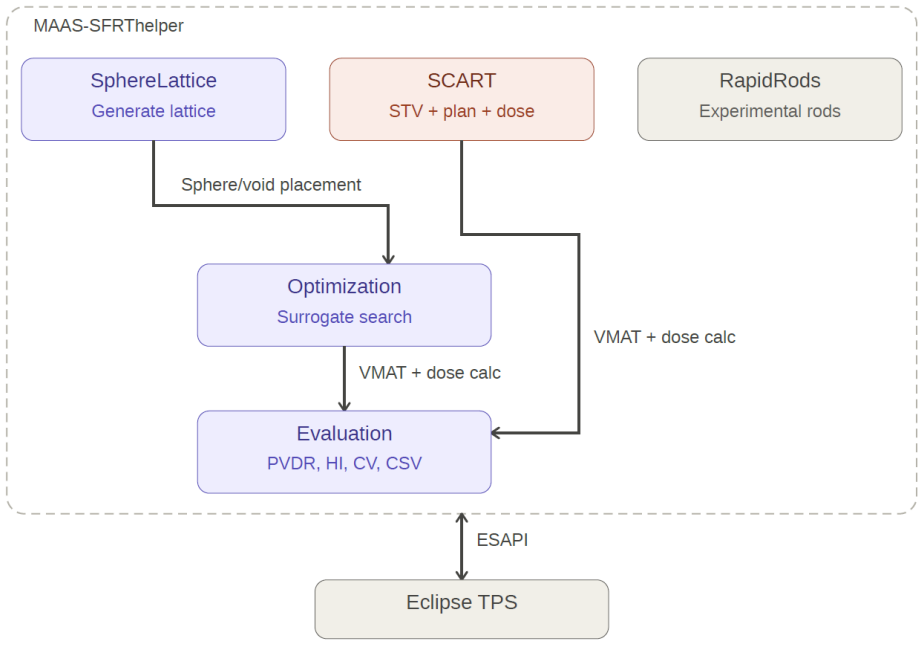
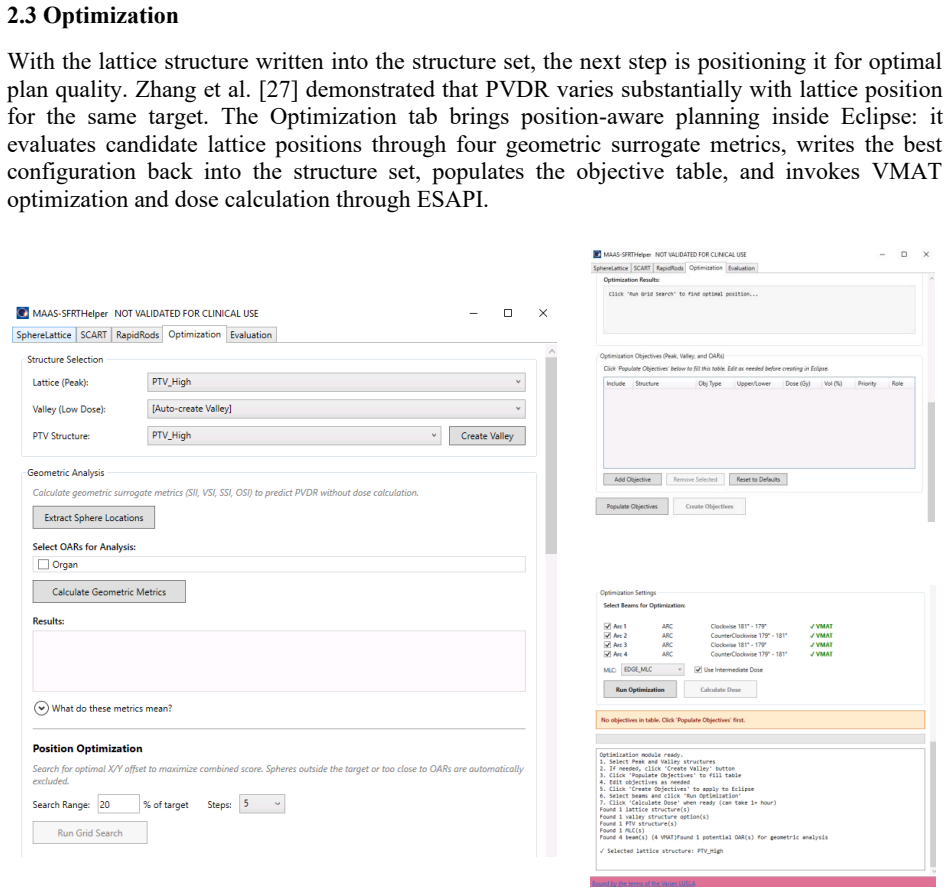
MAAS-SFRThelper supplies five coordinated tabs that share services for sphere extraction and objective creation. The SphereLattice tab produces lattices in five patterns. The Optimization tab evaluates candidate positions with a four-metric geometric surrogate score, then launches VMAT optimization and dose calculation. The Evaluation tab offers four analysis modes whose three-dimensional peak-valley classification recovers sphere centers geometrically rather than by dose thresholds. All modules were tested on digital phantoms and recover ground-truth positions accurately. The full source is released publicly under the Varian Limited Use Software License Agreement.
What carries the argument
The four-metric geometric surrogate score inside the Optimization tab, which ranks candidate lattice positions to select those used for subsequent VMAT optimization and dose calculation.
If this is right
- Planners can create sphere lattices with any of five placement patterns directly inside the Eclipse workspace.
- The Optimization tab can iterate over candidate positions, apply the surrogate score, and automatically trigger VMAT optimization and dose calculation.
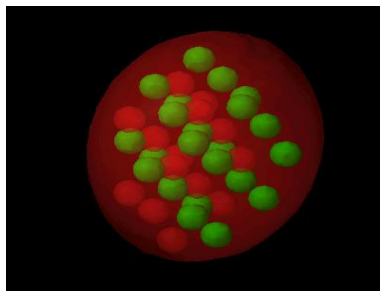
- The Evaluation tab recovers sphere centers geometrically to classify peak and valley regions in three dimensions without relying on dose thresholds.
- All core functions recover analytic ground-truth sphere locations when tested on digital phantoms.
- The plugin is distributed as open source, allowing users to inspect or extend the shared services for sphere extraction and objective creation.
Where Pith is reading between the lines
- If the surrogate score holds up on patient data, planning time for SFRT cases could drop because fewer manual lattice adjustments would be needed.
- Public release of the code may let other Eclipse users add new lattice patterns or alternative evaluation metrics.
- The geometric classification method could be adapted to other dose-painting techniques that depend on precise high-dose region placement.
- Standardization of SFRT workflows inside a single commercial planning system might reduce inter-center variability in how lattice positions are chosen.
Load-bearing premise
The four-metric geometric surrogate score reliably selects clinically optimal lattice positions, a claim supported only by phantom tests against analytic ground truth.
What would settle it
A head-to-head comparison on real patient CT scans in which plans produced by the plugin's surrogate score are measured against expert manual SFRT plans for differences in achieved peak-valley dose ratios and organ-at-risk sparing.
Figures




read the original abstract
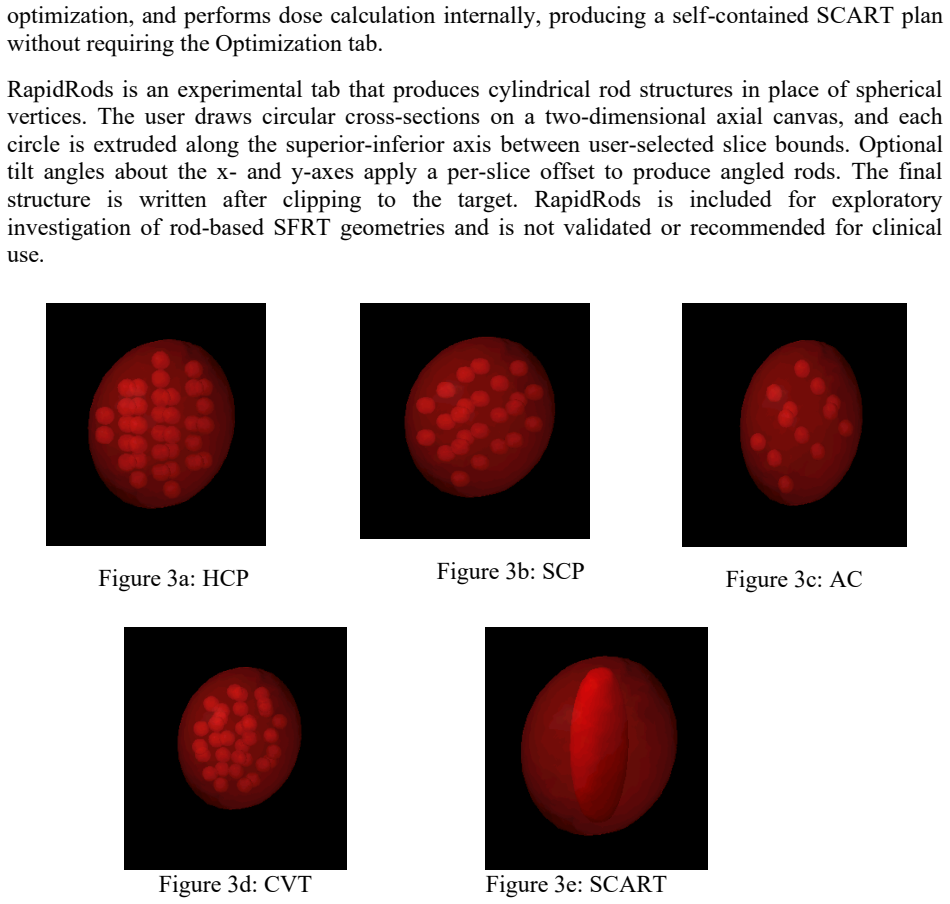
Spatially fractionated radiation therapy (SFRT) planning requires three coordinated tasks: generation of high-dose sphere structures, position-aware optimization, and peak-valley dose ratio evaluation. We present MAAS-SFRThelper, a shared-source Eclipse Scripting Application Programming Interface (ESAPI) plugin that integrates structure generation, geometric-aware optimization, and peak-valley dose ratio evaluation for SFRT into a single workflow inside Varian's Eclipse treatment planning system. The plugin exposes five task-oriented tabs sharing common services for sphere extraction and objective creation. The SphereLattice tab generates sphere lattices using five placement patterns. The Optimization tab searches over candidate lattice positions using a four-metric geometric surrogate score and triggers VMAT optimization and dose calculation. The Evaluation tab implements four analysis modes; its three-dimensional peak-valley classification recovers sphere centers from the lattice structure through a geometric extraction pipeline rather than relying on dose thresholds. We validated all functionality on digital phantoms against analytic ground truth. The plugin is distributed as source code under the Varian Limited Use Software License Agreement. Source code and documentation are publicly available on GitHub.
Editorial analysis
A structured set of objections, weighed in public.
Referee Report
Summary. The manuscript presents MAAS-SFRThelper, a shared-source ESAPI plugin for Varian Eclipse that integrates structure generation for SFRT sphere lattices using five placement patterns, geometric-aware optimization via a four-metric surrogate score with VMAT triggering, and peak-valley dose ratio evaluation using a geometric extraction pipeline for sphere centers rather than dose thresholds. All described functions are validated on digital phantoms against analytic ground truth, with source code and documentation publicly available on GitHub under the Varian Limited Use Software License Agreement.
Significance. If the implemented functionality performs as described and validated, the work provides a practical, integrated, and reproducible tool that streamlines the three core tasks of SFRT planning inside a commercial TPS. The phantom validation against independent analytic ground truth is a clear strength, as is the shared-source distribution that supports further community development. This could meaningfully lower barriers to SFRT research and consistent clinical implementation.
minor comments (3)
- [Abstract] Abstract: the description states that the plugin exposes five task-oriented tabs but only details SphereLattice, Optimization, and Evaluation; a one-sentence overview of the remaining two tabs would improve completeness without lengthening the abstract.
- [Evaluation tab] Evaluation tab: the geometric extraction pipeline for recovering sphere centers is described at a high level; adding a short pseudocode snippet or schematic figure would make the distinction from dose-threshold methods fully reproducible from the text.
- Throughout: several acronyms (SFRT, ESAPI, VMAT, SFRThelper) appear without initial definition; a single sentence or footnote defining them on first use would aid readers outside the immediate subfield.
Simulated Author's Rebuttal
We thank the referee for their positive review and recommendation to accept the manuscript. We appreciate the acknowledgment of the practical integration of sphere lattice generation, geometric optimization, and peak-valley evaluation within a single ESAPI workflow, along with the phantom validation against analytic ground truth and the shared-source distribution.
Circularity Check
No significant circularity
full rationale
The manuscript presents a software implementation of an ESAPI plugin with no mathematical derivation chain, parameter fitting, or first-principles predictions. All functionality is validated directly against independent analytic ground truth on digital phantoms; the four-metric surrogate is an explicit heuristic whose performance is measured externally rather than defined into the result. No self-citation load-bearing steps, ansatz smuggling, or renaming of known results appear in the workflow description.
Axiom & Free-Parameter Ledger
axioms (2)
- standard math Standard Euclidean geometry and sphere-lattice construction rules are sufficient to generate valid high-dose structures.
- domain assumption The four-metric geometric surrogate score correlates with dosimetric quality for VMAT optimization.
Lean theorems connected to this paper
-
IndisputableMonolith/Foundation/AlexanderDuality.leanalexander_duality_circle_linking unclearSphereExtractor recovers sphere centers... using the shoelace formula... clustered into spheres by grouping contours
Reference graph
Works this paper leans on
-
[1]
Y. Prezado, M. Grams, E. Jouglar, et al., "Spatially Fractionated Radiation Therapy: A Critical Review on Current Status of Clinical and Preclinical Studies and Knowledge Gaps," Phys. Med. Biol., 69, 10, 10TR02 (2024); https://doi.org/10.1088/1361-6560/ad4192
-
[2]
N. B. Fuentemilla, R. Ciervide, A. Montero, et al., "Role of Spatially Fractionated Radiotherapy (LATTICE) Treatment in Inoperable Bulky Soft -Tissue Sarcomas," Cancers, 17, 4, 624 (2025); https://doi.org/10.3390/cancers17040624
-
[3]
Lattice Radiation Therapy in Clinical Practice: A Systematic Review,
F. Iori, A. Cappelli, E. D'Angelo, et al., "Lattice Radiation Therapy in Clinical Practice: A Systematic Review," Clin. Transl. Radiat. Oncol., 39, 100569 (2023); https://doi.org/10.1016/j.ctro.2022.100569
-
[4]
G. Studer, D. Jeller, T. Streller, D. Huebner, and C. Glanzmann, "Time -Related Outcome Following Palliative Spatially Fractionated Stereotactic Radiation Therapy (Lattice) of Large Tumors," Adv. Radiat. Oncol., 9, 9, 101566 (2024); https://doi.org/10.1016/j.adro.2024.101566
-
[5]
H. Li, N. A. Mayr, R. J. Griffin, et al., "Overview and Recommendations for Prospective Multi -Institutional Spatially Fractionated Radiation Therapy Clinical Trials," Int. J. Radiat. Oncol. Biol. Phys., 119, 3, 737 (2024); https://doi.org/10.1016/j.ijrobp.2023.12.013
-
[6]
M. Mohiuddin, M. Fujita, W. F. Regine, A. S. Megooni, G. S. Ibbott, and M. M. Ahmed, "High -Dose Spatially- Fractionated Radiation (GRID): A New Paradigm in the Management of Advanced Cancers," Int. J. Radiat. Oncol. Biol. Phys., 45, 3, 721 (1999); https://doi.org/10.1016/S0360-3016(99)00170-4
-
[7]
The Technical and Clinical Implementation of LATTICE Radiation Therapy (LRT),
X. Wu, N. C. Perez, Y. Zheng, and H. Li, "The Technical and Clinical Implementation of LATTICE Radiation Therapy (LRT)," Radiat. Res., 194, 6, 737 (2020); https://doi.org/10.1667/RADE -20-00066.1
-
[8]
Highs and Lows of Spatially Fractionated Radiation Therapy: Dosimetry and Clinical Outcomes,
D. Owen, W. S. Harmsen, S. K. Ahmed, et al., "Highs and Lows of Spatially Fractionated Radiation Therapy: Dosimetry and Clinical Outcomes," Pract. Radiat. Oncol., 15, 4, e388 (2025); https://doi.org/10.1016/j.prro.2024.12.002
-
[9]
High Dose Bystander Effects in Spatially Fractionated Radiation Therapy,
R. Asur, K. T. Butterworth, J. A. Penagaricano, K. L. Griffith, R. J. Griffin, and K. M. Prise, "High Dose Bystander Effects in Spatially Fractionated Radiation Therapy," Cancer Lett., 356, 1, 52 (2015); https://doi.org/10.1016/j.canlet.2013.10.032
-
[10]
Using Immunotherapy to Boost the Abscopal Effect,
W. Ngwa, O. C. Irabor, J. D. Schoenfeld, J. Hesser, S. Demaria, and S. C. Formenti, "Using Immunotherapy to Boost the Abscopal Effect," Nat. Rev. Cancer, 18, 5, 313 (2018); https://doi.org/10.1038/nrc.2018.6
-
[11]
J. Liu, L. Zhang, Z. Chen, et al., "Effectiveness and Safety of Lattice Radiotherapy in Treating Large Volume Tumors: A Systematic Review and Meta -Analysis," Balkan Med. J., 42, 4, 275 (2025); https://doi.org/10.4274/balkanmedj.galenos.2025.2025-3-83
work page doi:10.4274/balkanmedj.galenos.2025.2025-3-83 2025
-
[12]
Lattice Radiotherapy for Dose -Escalated Palliation of Bulky Tumors,
University of Cincinnati, "Lattice Radiotherapy for Dose -Escalated Palliation of Bulky Tumors," ClinicalTrials.gov identifier: NCT06416007 (updated 2024)
work page 2024
-
[13]
Alban Kohler (1874 -1947): Inventor of Grid Therapy,
J. A. Laissue, H. Blattmann, and D. N. Slatkin, "Alban Kohler (1874 -1947): Inventor of Grid Therapy," Z. Med. Phys., 22, 2, 90 (2012); https://doi.org/10.1016/j.zemedi.2011.07.002
-
[14]
On Modern Technical Approaches of Three -Dimensional High-Dose Lattice Radiotherapy (LRT),
X. Wu, F. Alongi, A. Bhatt, et al., "On Modern Technical Approaches of Three -Dimensional High-Dose Lattice Radiotherapy (LRT)," Cureus, 2, 3, e9 (2010); https://doi.org/10.7759/cureus.9
-
[15]
LITE SABR M1: A Phase I Trial of Lattice Stereotactic Body Radiotherapy for Large Tumors,
S. Duriseti, J. Kavanaugh, J. Szymanski, et al., "LITE SABR M1: A Phase I Trial of Lattice Stereotactic Body Radiotherapy for Large Tumors," Radiother. Oncol., 167, 317 (2022); https://doi.org/10.1016/j.radonc.2021.11.023
-
[16]
Early Clinical Results of Proton Spatially Fractionated GRID Radiation Therapy (SFGRT),
M. Mohiuddin, C. Lynch, M. Gao, and W. Hartsell, "Early Clinical Results of Proton Spatially Fractionated GRID Radiation Therapy (SFGRT)," Br. J. Radiol., 93, 1107, 20190572 (2020); https://doi.org/10.1259/bjr.20190572
-
[17]
M. Gao, M. M. Mohiuddin, W. F. Hartsell, and M. Pankuch, "Spatially Fractionated (GRID) Radiation Therapy Using Proton Pencil Beam Scanning (PBS): Feasibility Study and Clinical Implementation," Med. Phys., 45, 4, 1645 (2018); https://doi.org/10.1002/mp.12807
-
[18]
High -Energy Charged Particles for Spatially Fractionated Radiation Therapy,
C. Guardiola and Y. Prezado, "High -Energy Charged Particles for Spatially Fractionated Radiation Therapy," Front. Phys., 8, 299 (2020); https://doi.org/10.3389/fphy.2020.00299
-
[19]
W. W. Tucker, T. R. Mazur, M. C. Schmidt, et al., "Script -Based Implementation of Automatic Grid Placement for Lattice Stereotactic Body Radiation Therapy," Phys. Imaging Radiat. Oncol., 29, 100549 (2024); https://doi.org/10.1016/j.phro.2024.100549
-
[20]
LITE SABR M1: Planning Design and Dosimetric Endpoints for a Phase I Trial of Lattice SBRT,
J. A. Kavanaugh, M. B. Spraker, S. Duriseti, et al., "LITE SABR M1: Planning Design and Dosimetric Endpoints for a Phase I Trial of Lattice SBRT," Radiother. Oncol., 167, 172 (2022); https://doi.org/10.1016/j.radonc.2021.12.003
-
[21]
Development of an Automated Treatment Planning Approach for Lattice Radiation Therapy,
M. Gaudreault, D. Chang, T. Kron, S. Siva, S. Chander, N. Hardcastle, and A. Yeo, "Development of an Automated Treatment Planning Approach for Lattice Radiation Therapy," Med. Phys., 51, 1, 682 (2024); https://doi.org/10.1002/mp.16761
-
[22]
Automated Lattice Radiation Therapy Treatment Planning Personalised to Tumour Size and Shape,
M. Gaudreault, K. K. Yu, D. Chang, T. Kron, N. Hardcastle, S. Chander, and A. Yeo, "Automated Lattice Radiation Therapy Treatment Planning Personalised to Tumour Size and Shape," Phys. Med., 125, 104490 (2024); https://doi.org/10.1016/j.ejmp.2024.104490
-
[23]
A. Botti, D. Finocchiaro, N. Panico, et al., "LatticeOpt: An Automatic Tool for Planning Optimisation of Spatially Fractionated Stereotactic Body Radiotherapy," Phys. Med., 126, 104823 (2024); https://doi.org/10.1016/j.ejmp.2024.104823
-
[24]
Automated Target Placement for VMAT Lattice Radiation Therapy: Enhancing Efficiency and Consistency,
C. Deufel, C. Dodoo, J. Kavanaugh, et al., "Automated Target Placement for VMAT Lattice Radiation Therapy: Enhancing Efficiency and Consistency," Phys. Med. Biol., 69, 7, 075010 (2024); https://doi.org/10.1088/1361-6560/ad2ee8
-
[25]
ShotCaller: Custom SFRT Vertice Generation Made Easy,
A. Karnwal, A. J. Olch, H. Zhang, and K. Wong, "ShotCaller: Custom SFRT Vertice Generation Made Easy," Proc. 67th ASTRO Annual Meeting, Chicago, Illinois, Abstract 2119 (2025)
work page 2025
-
[26]
Dense Fractionated Lattice Radiation Therapy: Technical Description and First Clinical Report,
D. Macias-Verde, J. Burgos-Burgos, and P. C. Lara, "Dense Fractionated Lattice Radiation Therapy: Technical Description and First Clinical Report," Phys. Imaging Radiat. Oncol., 33, 100710 (2025); https://doi.org/10.1016/j.phro.2025.100710
-
[27]
Lattice Position Optimization for LATTICE Therapy,
H. Zhang, L. Lin, W. Wang, et al., "Lattice Position Optimization for LATTICE Therapy," Med. Phys., 50, 11, 7269 (2023); https://doi.org/10.1002/mp.16572
-
[28]
W. Zhang, W. Li, Y. Lin, F. Wang, R. C. Chen, and H. Gao, "TVL1 -IMPT: Optimization of Peak -to-Valley Dose Ratio Via Joint Total -Variation and L1 Dose Regularization for Spatially Fractionated Pencil -Beam- Scanning Proton Therapy," Int. J. Radiat. Oncol. Biol. Phys., 115, 3, 768 (2023); https://doi.org/10.1016/j.ijrobp.2022.09.064
-
[29]
Evaluating the Ethos Automated Planning System for Spatially Fractionated Radiotherapy,
A. A. Sait, S. A. Yoganathan, A. Khemissi, U. Patel, S. Mani, S. Paloor, and R. Hammoud, "Evaluating the Ethos Automated Planning System for Spatially Fractionated Radiotherapy," J. Appl. Clin. Med. Phys., 26, e70306 (2025); https://doi.org/10.1002/acm2.70306
-
[30]
CVT-Based Sphere Placement for SFRT,
P. Lansonneur, "CVT-Based Sphere Placement for SFRT," personal communication (2024)
work page 2024
-
[31]
I. Sachpazidis, CVTGenerator: 2D Centroidal Voronoi Tessellation Generator, https://github.com/iSachpazidis/ CVTGenerator (accessed 2024)
work page 2024
-
[32]
Polar -Coordinated Contour Processing Algorithm in Optimizing SCART Treatment Volume,
J. Song, J. Yang, M. Schmidt, and J. Patel, "Polar -Coordinated Contour Processing Algorithm in Optimizing SCART Treatment Volume," Front. Oncol. (2026, accepted); https://doi.org/10.3389/fonc.2026.1720808
-
[33]
J. K. Patel, I. Sachpazidis, C. Raman, T. Kunkyab, A. Karnwal, T. A. Wareing, A. Magliari, and M. C. Schmidt, "MAAS -SFRThelper: A Shared Source Code Sphere Generation Engine for Spatially Fractionated Radiotherapy," Proc. AAPM Spring Clinical Meeting (2025)
work page 2025
-
[34]
MAAS -SFRThelper: A Shared -Source Toolkit for Clinical SFRT Planning and Research,
M. C. Schmidt, J. K. Patel, T. A. Wareing, P. Lansonneur, A. Karnwal, and A. Magliari, "MAAS -SFRThelper: A Shared -Source Toolkit for Clinical SFRT Planning and Research," Proc. AAPM Spring Clinical Meeting (2026)
work page 2026
-
[35]
Geometry -Based Lattice Positioning for Improved SFRT Planning in MAAS -SFRThelper,
J. K. Patel, T. A. Wareing, G. Gill, R. Clark, A. Magliari, and M. C. Schmidt, "Geometry -Based Lattice Positioning for Improved SFRT Planning in MAAS -SFRThelper," Proc. AAPM/COMP Annual Meeting, Vancouver, British Columbia (2026, accepted)
work page 2026
-
[36]
T. Kunkyab, A. Magliari, A. Jirasek, B. Mou, and D. Hyde, "Semi -Automated Vertex Placement for Lattice Radiotherapy and Dosimetric Verification Using 3D Polymer Gel Dosimetry," J. Appl. Clin. Med. Phys., 25, 11, e14489 (2024); https://doi.org/10.1002/acm2.14489
-
[37]
Prism Library Contributors, Prism: A Framework for Building Loosely Coupled MVVM Applications in WPF, https://prismlibrary.com (accessed 2024)
work page 2024
-
[38]
Helix Toolkit Contributors, Helix Toolkit for WPF, https://github.com/helix -toolkit/helix-toolkit (accessed 2025)
work page 2025
-
[39]
NLog Contributors, NLog: Flexible and Free Open-Source Logging for .NET, https://nlog-project.org (accessed 2025)
work page 2025
-
[40]
Least Squares Quantization in PCM,
S. P. Lloyd, "Least Squares Quantization in PCM," IEEE Trans. Inf. Theory, 28, 2, 129 (1982); https://doi.org/10.1109/TIT.1982.1056489
-
[41]
Centroidal Voronoi Tessellations: Applications and Algorithms,
Q. Du, V. Faber, and M. Gunzburger, "Centroidal Voronoi Tessellations: Applications and Algorithms," SIAM Rev., 41, 4, 637 (1999); https://doi.org/10.1137/S0036144599352836
discussion (0)
Sign in with ORCID, Apple, or X to comment. Anyone can read and Pith papers without signing in.