Recognition: unknown
Indication of gamma-Ray Quasi-periodicity in GB6 J1037+5711 from Multi-technique Timing Analysis
Pith reviewed 2026-05-07 09:52 UTC · model grok-4.3
The pith
Gamma-ray observations reveal a 478-day quasi-periodic oscillation in the blazar GB6 J1037+5711.
A machine-rendered reading of the paper's core claim, the machinery that carries it, and where it could break.
Core claim
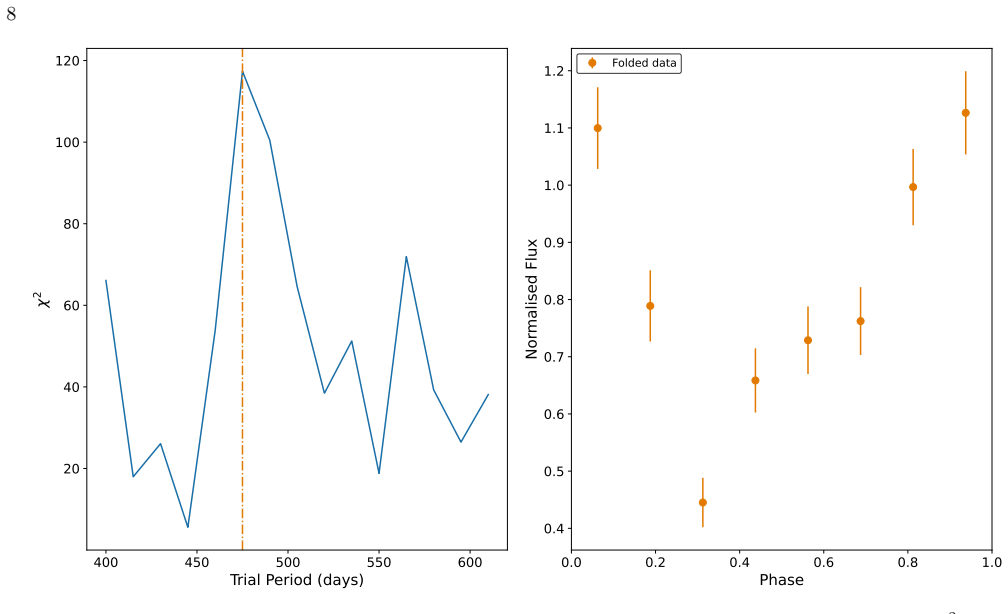
The indication of a ~478 day QPO in the gamma-ray emission of GB6 J1037+5711 is reported, with the LSP showing a signal at 478.74 ± 17.55 days above 99.99% confidence, independently confirmed by WWZ at 474.72 ± 27.24 days (99.7% significance), REDFIT at 481.67 ± 35.41 days (99% confidence), and epoch-folding analysis. The small differences across methods arise from their distinct mathematical frameworks and sensitivity functions.
What carries the argument
Multi-technique timing analysis on the monthly binned Fermi-LAT light curve, combining Lomb-Scargle periodogram, weighted wavelet Z-transform, first-order autoregressive red-noise modeling, and epoch-folding.
If this is right
- The ~478 day period remains consistent across four distinct timing techniques despite their different sensitivities to noise and sampling.
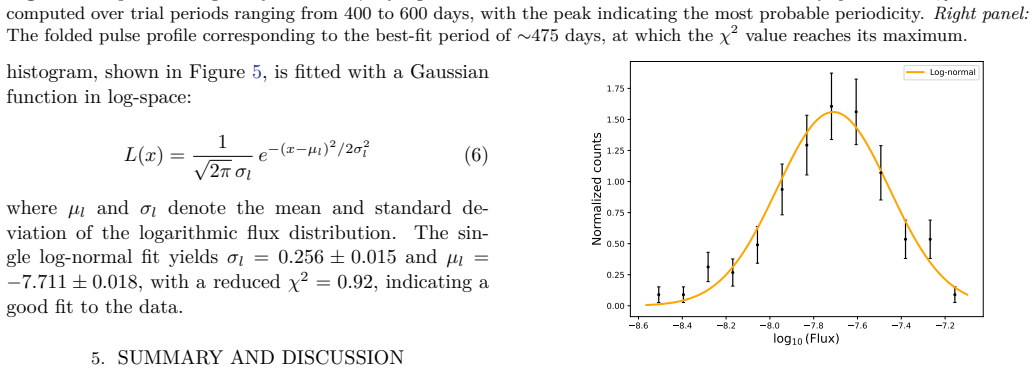
- The long-term flux distribution is better described by a lognormal than Gaussian profile, pointing to multiplicative variability.
- The QPO may be linked to orbital dynamics in a supermassive binary black hole system, Lense-Thirring precession, or disk-jet instabilities amplified by beaming.
- Epoch-folding independently confirms the modulation timescale found by the frequency-domain methods.
Where Pith is reading between the lines
- If the periodicity holds in future data, it could constrain the orbital separation or precession period in a potential binary black hole system.
- The finding motivates similar multi-method searches for long-term QPOs in the gamma-ray light curves of other bright blazars.
- A confirmed deterministic component would require jet emission models to incorporate periodic modulation alongside stochastic turbulence.
- Multi-wavelength follow-up could test whether the same period appears in radio or optical bands, linking the gamma-ray signal to the jet base.
Load-bearing premise
The detected periodic signal is astrophysical rather than an artifact of red-noise processes, uneven sampling, or multiple-trial statistics, and the Monte Carlo simulations fully capture the null distribution.
What would settle it
Continued Fermi-LAT monitoring over the next several years that either recovers the same periodicity with consistent phase or shows no significant signal at the expected frequency.
Figures


read the original abstract
We report the indication of a long-term quasi-periodic oscillation (QPO) in the $\gamma$-ray emission of the BL Lac object 4FGL J1037.7+5711 (GB6 J1037+5711) using more than 17 years of monthly binned Fermi-LAT observations. Since blazar $\gamma$-ray variability is typically dominated by stochastic red-noise processes from turbulent jet activity and accretion fluctuations, we applied multiple independent timing techniques to test periodic modulation. These include the Lomb--Scargle periodogram (LSP), weighted wavelet $Z$-transform (WWZ), first-order autoregressive red-noise modeling (REDFIT), and epoch-folding analysis. The LSP reveals a significant periodic signal at $478.74 \pm 17.55$ days, exceeding the $99.99\%$ confidence level from Monte Carlo simulations. The WWZ analysis independently recovers a comparable period of $474.72 \pm 27.24$ days at $99.7\%$ significance, while the REDFIT analysis identifies a similar periodic feature at $481.67 \pm 35.41$ days above the $99\%$ confidence level. The epoch-folding analysis further confirms the same modulation timescale. The small differences in period estimates across methods are expected given the distinct mathematical frameworks and sensitivity functions. The long-term flux distribution of the source is better described by a lognormal profile than a Gaussian, suggesting that the underlying variability arises from multiplicative processes. The indication of a $\sim$478 day QPO, independently confirmed across all four timing techniques, may be associated with the orbital dynamics of a supermassive binary black hole system driving Newtonian jet precession or periodic Doppler-factor modulation, Lense--Thirring precession of the inner accretion disk around a rapidly spinning SMBH, or accretion-driven instabilities at the disk--jet interface amplified through relativistic beaming.
Editorial analysis
A structured set of objections, weighed in public.
Referee Report
Summary. The manuscript reports an indication of a ~478-day quasi-periodic oscillation (QPO) in the gamma-ray light curve of the BL Lac object GB6 J1037+5711 (4FGL J1037.7+5711) from >17 years of monthly-binned Fermi-LAT data. Four independent timing methods—Lomb-Scargle periodogram (LSP), weighted wavelet Z-transform (WWZ), REDFIT, and epoch-folding—recover consistent periods (478.74 ± 17.55 d, 474.72 ± 27.24 d, 481.67 ± 35.41 d) with quoted significances of 99.99%, 99.7%, and 99% derived from Monte Carlo simulations. The long-term flux distribution is shown to be better fit by a lognormal than Gaussian profile, and possible physical origins (SMBH binary orbital dynamics, Lense-Thirring precession, or disk-jet instabilities) are discussed.
Significance. If the Monte Carlo null simulations are demonstrated to faithfully reproduce the observed red-noise PSD, variance, lognormal statistics, and exact sampling window, the result would be noteworthy because confirmed QPOs in blazar gamma-ray light curves remain rare and could constrain jet-launching or central-engine physics. The multi-method consistency and explicit lognormal characterization are positive features that increase robustness relative to single-technique claims.
major comments (2)
- [Methods section describing LSP, WWZ, REDFIT, and associated Monte Carlo simulations] The Monte Carlo simulations used to assign the 99.99% confidence level to the LSP peak at 478.74 days (and the corresponding levels in WWZ and REDFIT) are described only at a high level. The manuscript must specify the exact red-noise model (PSD slope, normalization, presence/absence of breaks), how the simulations incorporate the empirical variance and lognormal flux distribution, and how the precise monthly sampling window and gaps of the 17-year Fermi-LAT dataset are reproduced. Without these details it is impossible to verify that the tail probabilities correctly reflect the false-positive rate for the dominant multiplicative stochastic processes in blazar light curves.
- [Abstract and results sections on significance] The abstract and results sections report significances without stating whether (and how) the period search accounts for the number of independent frequencies tested or for the use of four separate techniques. Because the central claim rests on the quoted confidence levels, an explicit statement of the trial-correction procedure (or demonstration that it is unnecessary) is required.
minor comments (3)
- The uncertainties on the recovered periods (e.g., ±17.55 d) should be accompanied by a brief description of how they were obtained (e.g., from the width of the peak or from bootstrap/MC realizations).
- A summary table listing the period, uncertainty, and significance returned by each of the four methods would improve readability and allow direct comparison.
- The manuscript should cite the specific references for the REDFIT implementation and for the lognormal flux-distribution test employed.
Simulated Author's Rebuttal
We thank the referee for the positive evaluation of our multi-technique timing analysis and for the constructive comments that help strengthen the manuscript. We have revised the paper to address the major concerns regarding the Monte Carlo simulation details and the handling of multiple testing in significance estimates. Below we respond to each comment point by point.
read point-by-point responses
-
Referee: The Monte Carlo simulations used to assign the 99.99% confidence level to the LSP peak at 478.74 days (and the corresponding levels in WWZ and REDFIT) are described only at a high level. The manuscript must specify the exact red-noise model (PSD slope, normalization, presence/absence of breaks), how the simulations incorporate the empirical variance and lognormal flux distribution, and how the precise monthly sampling window and gaps of the 17-year Fermi-LAT dataset are reproduced. Without these details it is impossible to verify that the tail probabilities correctly reflect the false-positive rate for the dominant multiplicative stochastic processes in blazar light curves.
Authors: We agree that a more explicit description of the Monte Carlo procedure is necessary for full reproducibility and verification. In the revised Methods section we now specify that the simulations employ the Emmanoulopoulos et al. (2013) algorithm to generate light curves that preserve both the observed power-law PSD (fitted slope β ≈ −1.7 with no break in the probed frequency range) and the lognormal flux distribution. The simulated time series are normalized to the empirical variance and then resampled onto the exact monthly binning and gap structure of the 17-year Fermi-LAT dataset. We have added the fitted PSD parameters, the number of realizations (10^5), and a supplementary figure comparing the average simulated PSD to the observed one. These additions directly address the concern about faithfully reproducing the red-noise and multiplicative statistics. revision: yes
-
Referee: The abstract and results sections report significances without stating whether (and how) the period search accounts for the number of independent frequencies tested or for the use of four separate techniques. Because the central claim rests on the quoted confidence levels, an explicit statement of the trial-correction procedure (or demonstration that it is unnecessary) is required.
Authors: We appreciate the referee drawing attention to the multiple-testing issue. In the revised manuscript we clarify that the Monte Carlo significance for each individual method (LSP, WWZ, REDFIT) is computed from the distribution of the maximum peak value across the entire searched frequency range in each simulated light curve; this procedure automatically incorporates the look-elsewhere effect for the number of independent frequencies. We have added an explicit statement in the Results section noting that no further Bonferroni-style correction is applied across the four techniques, because the reported significances are method-specific and the close agreement of the recovered periods (within uncertainties) provides independent corroboration rather than an additional trial factor. The abstract has been updated to reflect this clarification. revision: yes
Circularity Check
No significant circularity in empirical timing analysis
full rationale
The paper applies standard, externally established timing methods (LSP, WWZ, REDFIT, epoch-folding) directly to the Fermi-LAT light curve and assesses significance via Monte Carlo simulations drawn from a red-noise null model. No step derives a result from fitted parameters that presuppose the periodicity, no self-citation chain supports the central claim, and no mathematical reduction equates the reported periods or confidence levels to the input data by construction. The analysis remains data-driven and falsifiable against external benchmarks.
Axiom & Free-Parameter Ledger
axioms (2)
- domain assumption Blazar gamma-ray variability is dominated by stochastic red-noise processes that can be modeled as a first-order autoregressive process.
- domain assumption The monthly binning and sampling of Fermi-LAT data do not introduce spurious periodicities that survive the multi-method cross-check.
Reference graph
Works this paper leans on
-
[1]
Abazajian, K. N., Adelman-McCarthy, J. K., Agüeros, M. A., et al. 2009, ApJS, 182, 543, doi: 10.1088/0067-0049/182/2/543
-
[2]
A., Ackermann, M., Agudo, I., et al
Abdo, A. A., Ackermann, M., Agudo, I., et al. 2010, ApJ, 716, 30, doi: 10.1088/0004-637X/716/1/30
-
[3]
2015, ApJL, 813, L41, doi: 10.1088/2041-8205/813/2/L41
Ackermann, M., Ajello, M., Albert, A., et al. 2015, ApJL, 813, L41, doi: 10.1088/2041-8205/813/2/L41
-
[4]
2024, ApJ, 977, 111, doi: 10.3847/1538-4357/ad8ddb
Akbar, S., Shah, Z., Misra, R., & Iqbal, N. 2024, ApJ, 977, 111, doi: 10.3847/1538-4357/ad8ddb
-
[5]
Angel, J. R. P., & Stockman, H. S. 1980, ARA&A, 18, 321, doi: 10.1146/annurev.aa.18.090180.001541
-
[6]
Atwood, W. B., Abdo, A. A., Ackermann, M., et al. 2009, ApJ, 697, 1071, doi: 10.1088/0004-637X/697/2/1071
-
[7]
Baluev, R. V. 2008, MNRAS, 385, 1279, doi: 10.1111/j.1365-2966.2008.12689.x
-
[8]
2019, MNRAS, 487, 3990, doi: 10.1093/mnras/stz1482
Bhatta, G. 2019, MNRAS, 487, 3990, doi: 10.1093/mnras/stz1482
-
[9]
2020, The Astrophysical Journal, 891, 120
Bhatta, G., & Dhital, N. 2020, The Astrophysical Journal, 891, 120
2020
-
[10]
2016, The Astrophysical Journal, 832, 47
Bhatta, G., Zola, S., Ostrowski, M., et al. 2016, The Astrophysical Journal, 832, 47
2016
-
[11]
1992, A&A, 255, 59
Camenzind, M., & Krockenberger, M. 1992, A&A, 255, 59
1992
-
[12]
1985, Nature, 314, 146, doi: 10.1038/314146a0
Carrasco, L., Dultzin-Hacyan, D., & Cruz-Gonzalez, I. 1985, Nature, 314, 146, doi: 10.1038/314146a0
-
[13]
2024, A&A, 689, A35, doi: 10.1051/0004-6361/202347593
Chen, Z.-H., & Jiang, Y. 2024, A&A, 689, A35, doi: 10.1051/0004-6361/202347593
-
[14]
Davies, S. R. 1990, MNRAS, 244, 93 —. 1991, MNRAS, 251, 64P, doi: 10.1093/mnras/251.1.64P
-
[15]
2013, Monthly Notices of the Royal Astronomical Society, 433, 907
Emmanoulopoulos, D., McHardy, I., & Papadakis, I. 2013, Monthly Notices of the Royal Astronomical Society, 433, 907
2013
-
[16]
2015, A&A, 576, A122, doi: 10.1051/0004-6361/201424644
Esposito, V., Walter, R., Jean, P., et al. 2015, A&A, 576, A122, doi: 10.1051/0004-6361/201424644
-
[17]
Foschini, L., Lister, M. L., Andernach, H., et al. 2022, Universe, 8, 587, doi: 10.3390/universe8110587
-
[18]
1996, Astronomical Journal v
Foster, G. 1996, Astronomical Journal v. 112, p. 1709-1729, 112, 1709
1996
-
[19]
2022, ApJ, 931, 168, doi: 10.3847/1538-4357/ac6c8c
Gong, Y., Zhou, L., Yuan, M., et al. 2022, ApJ, 931, 168, doi: 10.3847/1538-4357/ac6c8c
-
[20]
2024, The Astrophysical Journal, 976, 51
Gong, Y., Gao, Q., Li, X., et al. 2024, The Astrophysical Journal, 976, 51
2024
-
[21]
C., Srivastava, A., & Wiita, P
Gupta, A. C., Srivastava, A., & Wiita, P. J. 2008, The Astrophysical Journal, 690, 216
2008
-
[22]
Gupta, A. C., Tripathi, A., Wiita, P. J., et al. 2019, MNRAS, 484, 5785, doi: 10.1093/mnras/stz395
-
[23]
2017, AJ, 154, 42, doi: 10.3847/1538-3881/aa799a —
Hong, S., Xiong, D., & Bai, J. 2017, AJ, 154, 42, doi: 10.3847/1538-3881/aa799a —. 2018, AJ, 155, 31, doi: 10.3847/1538-3881/aa9d89
-
[24]
2013, Research in Astronomy and Astrophysics, 13, 705, doi: 10.1088/1674-4527/13/6/010 11
Huang, C.-Y., Wang, D.-X., Wang, J.-Z., & Wang, Z.-Y. 2013, Research in Astronomy and Astrophysics, 13, 705, doi: 10.1088/1674-4527/13/6/010 11
-
[25]
Iyida, E. U., Odo, F. C., Chukwude, A. E., & Ubachukwu, A. A. 2022, NewA, 90, 101666, doi: 10.1016/j.newast.2021.101666
-
[26]
2023, MNRAS, 518, 2675, doi: 10.1093/mnras/stac3167
Kasai, E., Goldoni, P., Pita, S., et al. 2023, MNRAS, 518, 2675, doi: 10.1093/mnras/stac3167
-
[27]
2019, Monthly Notices of the Royal Astronomical Society, 491, 1934, doi: 10.1093/mnras/stz3108
Khatoon, R., Shah, Z., Misra, R., & Gogoi, R. 2019, Monthly Notices of the Royal Astronomical Society, 491, 1934, doi: 10.1093/mnras/stz3108
-
[28]
A quasi-periodic oscillation in the blazar J1359+4011
King, O. G., Hovatta, T., Max-Moerbeck, W., et al. 2013, MNRAS, 436, L114, doi: 10.1093/mnrasl/slt125
-
[29]
2006, Mem
Komossa, S. 2006, Mem. Soc. Astron. It., 77, 733
2006
-
[30]
1996, A&AS, 117, 197
Larsson, S. 1996, A&AS, 117, 197
1996
-
[31]
Leahy, D. A., Elsner, R. F., & Weisskopf, M. C. 1983, ApJ, 272, 256, doi: 10.1086/161288
-
[32]
Formation of precessing jets by tilted black hole discs in 3D general relativistic MHD simulations
Liska, M., Hesp, C., Tchekhovskoy, A., et al. 2018, MNRAS, 474, L81, doi: 10.1093/mnrasl/slx174
-
[33]
Lomb, N. R. 1976, Astrophysics and space science, 39, 447
1976
-
[34]
2025, MNRAS, 539, 2185, doi: 10.1093/mnras/staf620
Malik, Z., Akbar, S., Shah, Z., et al. 2025, MNRAS, 539, 2185, doi: 10.1093/mnras/staf620
-
[35]
2015, ApJ, 805, 91, doi: 10.1088/0004-637X/805/2/91
Mohan, P., & Mangalam, A. 2015, ApJ, 805, 91, doi: 10.1088/0004-637X/805/2/91
-
[36]
A., Becerra González, J., et al
Otero-Santos, J., Acosta-Pulido, J. A., Becerra González, J., et al. 2020, MNRAS, 492, 5524, doi: 10.1093/mnras/staa134
-
[37]
2020, MNRAS, 497, 94, doi: 10.1093/mnras/staa1840
Paiano, S., Falomo, R., Treves, A., & Scarpa, R. 2020, MNRAS, 497, 94, doi: 10.1093/mnras/staa1840
-
[38]
Prokhorov, D. A., & Moraghan, A. 2017, MNRAS, 471, 3036, doi: 10.1093/mnras/stx1742
-
[39]
Pshirkov, M., & Kovankin, A. 2026, Journal of High Energy Astrophysics, 50, 100492, doi: https://doi.org/10.1016/j.jheap.2025.100492
-
[40]
Raiteri, C. M., Villata, M., Aller, H. D., et al. 2001, A&A, 377, 396, doi: 10.1051/0004-6361:20011112
-
[41]
2021a, MNRAS, 506, 3791, doi: 10.1093/mnras/stab1739 —
Ren, G.-W., Ding, N., Zhang, X., et al. 2021a, MNRAS, 506, 3791, doi: 10.1093/mnras/stab1739 —. 2021b, MNRAS, 506, 3791, doi: 10.1093/mnras/stab1739
-
[42]
2021c, Research in Astronomy and Astrophysics, 21, 075, doi: 10.1088/1674-4527/21/3/075
Ren, G.-W., Zhang, H.-J., Zhang, X., et al. 2021c, Research in Astronomy and Astrophysics, 21, 075, doi: 10.1088/1674-4527/21/3/075
-
[43]
Rieger, F. M. 2004, The Astrophysical Journal, 615, L5
2004
-
[44]
Rieger, F. M. 2007, Astrophysics and Space Science, 309, 271, doi: 10.1007/s10509-007-9467-y
-
[45]
Transient quasi-periodic oscillations at γ-rays in the TeV blazar PKS 1510-089
Roy, A., Sarkar, A., Chatterjee, A., et al. 2022, MNRAS, 510, 3641, doi: 10.1093/mnras/stab3701
-
[46]
QUASI-PERIODICITIES AT YEAR-LIKE TIMESCALES IN BLAZARS
Sandrinelli, A., Covino, S., Dotti, M., & Treves, A. 2016, AJ, 151, 54, doi: 10.3847/0004-6256/151/3/54
-
[47]
Wiita, P. J. 2020, A&A, 642, A129, doi: 10.1051/0004-6361/202038052
-
[48]
Scargle, J. D. 1982, Astrophysical Journal, Part 1, vol. 263, Dec. 15, 1982, p. 835-853., 263, 835
1982
-
[49]
2002, Computers & Geosciences, 28, 421
Schulz, M., & Mudelsee, M. 2002, Computers & Geosciences, 28, 421
2002
-
[50]
2018, Research in Astronomy and Astrophysics, 18, 141
Shah, Z., Mankuzhiyil, N., Sinha, A., et al. 2018, Research in Astronomy and Astrophysics, 18, 141
2018
-
[51]
Bose, D. 2024, MNRAS, 527, 2672, doi: 10.1093/mnras/stad3399
-
[52]
Byrd, G. G. 1988, ApJ, 325, 628, doi: 10.1086/166033
-
[53]
Sinha, A., Khatoon, R., Misra, R., et al. 2018, Monthly Notices of the Royal Astronomical Society: Letters, 480, L116, doi: 10.1093/mnrasl/sly136
-
[54]
2018, The Astrophysical Journal, 854, 11
Tavani, M., Cavaliere, A., Munar-Adrover, P., & Argan, A. 2018, The Astrophysical Journal, 854, 11
2018
-
[55]
Urry, C. M., & Padovani, P. 1995, PASP, 107, 803, doi: 10.1086/133630
work page internal anchor Pith review doi:10.1086/133630 1995
-
[56]
2005, Monthly Notices of the Royal Astronomical Society, 359, 345
Uttley, P., McHardy, I., & Vaughan, S. 2005, Monthly Notices of the Royal Astronomical Society, 359, 345
2005
-
[57]
Uttley, P., & McHardy, I. M. 2001, Monthly Notices of the Royal Astronomical Society, 323, L26, doi: 10.1046/j.1365-8711.2001.04496.x
-
[58]
1985, Nature, 314, 148, doi: 10.1038/314148a0
Valtaoja, E., Lehto, H., Teerikorpi, P., et al. 1985, Nature, 314, 148, doi: 10.1038/314148a0
-
[59]
Valtonen, M. J., Lehto, H. J., Sillanpää, A., et al. 2006, ApJ, 646, 36, doi: 10.1086/504884
-
[60]
Valtonen, M. J., Lehto, H. J., Nilsson, K., et al. 2008, Nature, 452, 851, doi: 10.1038/nature06896
-
[61]
VanderPlas, J. T. 2018, The Astrophysical Journal Supplement Series, 236, 16
2018
-
[62]
1999, Astronomy and Astrophysics, v
Villata, M., & Raiteri, C. 1999, Astronomy and Astrophysics, v. 347, p. 30-36 (1999), 347, 30
1999
-
[63]
2018, The Astronomer’s Telegram, 11806, 1
Weisgarber, T., & HA WC Collaboration. 2018, The Astronomer’s Telegram, 11806, 1
2018
-
[64]
2017, in International Cosmic Ray Conference, Vol
Wood, M., Caputo, R., Charles, E., et al. 2017, in International Cosmic Ray Conference, Vol. 301, 35th International Cosmic Ray Conference (ICRC2017), 824, doi: 10.22323/1.301.0824
-
[65]
2017, ApJS, 229, 21, doi: 10.3847/1538-4365/aa64d2
Xiong, D., Bai, J., Zhang, H., et al. 2017, ApJS, 229, 21, doi: 10.3847/1538-4365/aa64d2
-
[66]
2014, Research in Astronomy and Astrophysics, 14, 933, doi: 10.1088/1674-4527/14/8/004
Zhang, B.-K., Zhao, X.-Y., Wang, C.-X., & Dai, B.-Z. 2014, Research in Astronomy and Astrophysics, 14, 933, doi: 10.1088/1674-4527/14/8/004
-
[67]
2023, PASP, 135, 064102, doi: 10.1088/1538-3873/acdf1f
Zhang, H., Wu, F., & Dai, B. 2023, PASP, 135, 064102, doi: 10.1088/1538-3873/acdf1f
-
[68]
2021, ApJ, 919, 58, doi: 10.3847/1538-4357/ac0cf0
Zhang, H., Yan, D., Zhang, P., Yang, S., & Zhang, L. 2021, ApJ, 919, 58, doi: 10.3847/1538-4357/ac0cf0
-
[69]
2017, ApJ, 835, 260, doi: 10.3847/1538-4357/835/2/260 12
Zhang, P.-f., Yan, D.-h., Liao, N.-h., & Wang, J.-c. 2017, ApJ, 835, 260, doi: 10.3847/1538-4357/835/2/260 12
-
[70]
A 34.5 day quasi-periodic oscillation in γ-ray emission from the blazar PKS 2247–131
Zhou, J., Wang, Z., Chen, L., et al. 2018, Nature Communications, 9, 4599, doi: 10.1038/s41467-018-07103-2
discussion (0)
Sign in with ORCID, Apple, or X to comment. Anyone can read and Pith papers without signing in.