Recognition: unknown
The Critical Mass in Galaxy Evolution
Pith reviewed 2026-05-07 08:17 UTC · model grok-4.3
The pith
A redshift-independent critical mass around 10^{12.5} solar masses arises when stable hot gas halos form and suppress cool gas inflows, slowing star formation relative to total mass growth.
A machine-rendered reading of the paper's core claim, the machinery that carries it, and where it could break.
Core claim
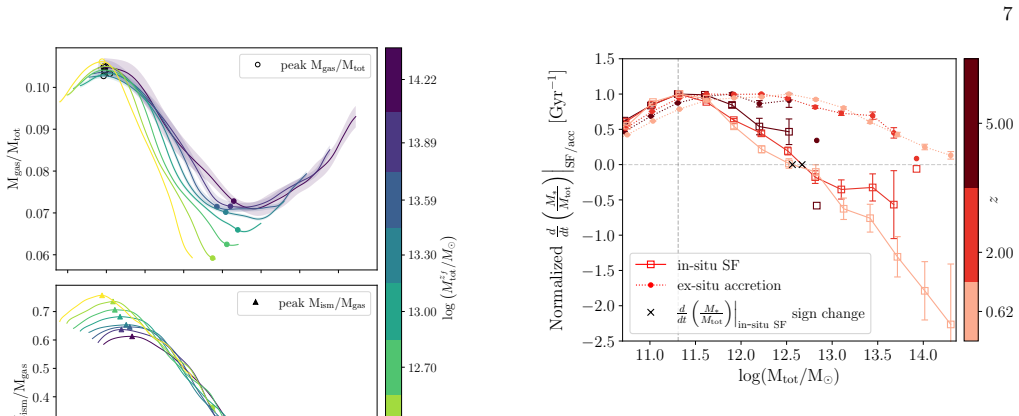
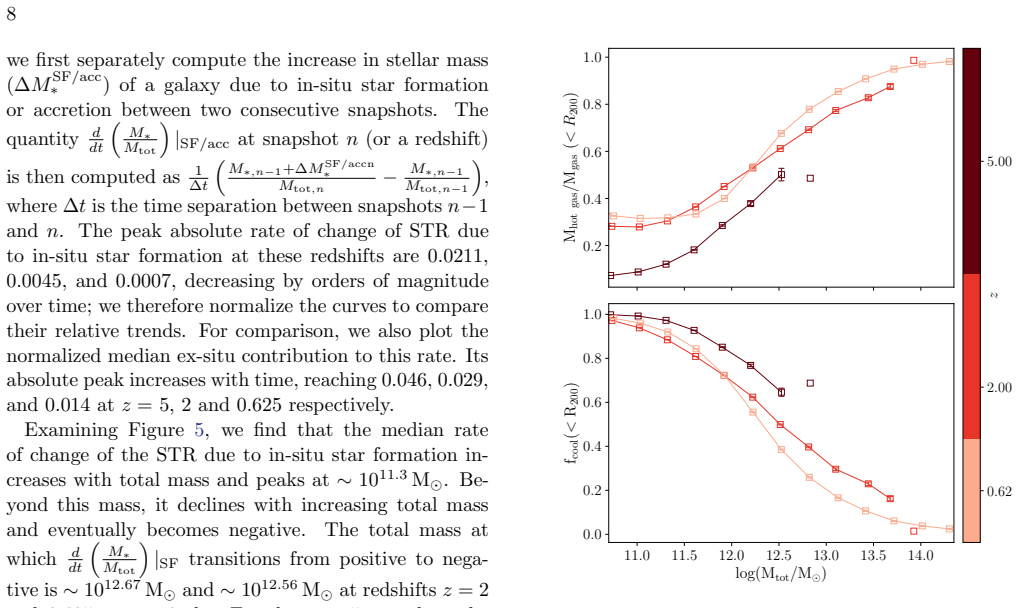
At M_tot approximately 10^{12.5} solar masses, a dynamically stable hot gas halo develops that suppresses cool gas inflow. This reduces in-situ star formation efficiency so that total mass growth outpaces stellar mass growth. The hot gas reservoir therefore increases while stellar mass growth slows, producing upturns in M_gas/M_tot and M_bar/M_tot together with a downturn in M_*/M_bar that drives the observed turnover in the stellar-to-total mass ratio. The same critical mass appears independent of redshift. A secondary transition occurs near 10^{11} solar masses where the baryon retention fraction reaches its maximum.
What carries the argument
The dynamically stable hot gas halo that forms at the critical mass and suppresses cool gas accretion, thereby lowering in-situ star formation efficiency.
If this is right
- M_tot growth exceeds in-situ M_* growth once the hot halo forms.
- The hot gas reservoir grows while stellar mass growth slows.
- Upturns appear in both M_gas/M_tot and M_bar/M_tot.
- A downturn in M_*/M_bar produces the stellar-to-total mass ratio turnover.
- Gas retention fraction peaks at a secondary critical mass near 10^{11} solar masses.
Where Pith is reading between the lines
- The redshift-independent threshold points to a gravitational potential depth that could unify quenching mechanisms across cosmic time.
- Measurements of circumgalactic medium temperature and kinematics around galaxies at this mass could directly confirm the stable hot halo.
- Varying feedback prescriptions in simulations would shift the exact location of the critical mass and thereby calibrate subgrid models.
- The same halo-stability criterion might predict a corresponding break in the efficiency of AGN feedback or in the morphology of the circumgalactic medium.
Load-bearing premise
The simulation accurately reproduces the formation and stability of hot gas halos and the resulting cutoff of cool gas inflows at the identified mass scale without dominant numerical or subgrid effects that would move the threshold.
What would settle it
Direct observations or higher-resolution simulations showing that cool gas continues to accrete efficiently onto galaxies near 10^{12.5} solar masses, with no corresponding downturn in the stellar-to-baryon mass ratio, would falsify the mechanism.
Figures




read the original abstract
We investigate the physical origin of critical mass, a threshold where many galaxy properties and scaling relations undergo fundamental transitions, using the Horizon Run 5 simulation. Focusing on massive ($M_{\rm tot} \geq 10^{12}{\rm M_\odot}$) central galaxies, we examine the mass-dependent turnover of the stellar-to-total mass ratio (STR) and the physical processes driving it. We decompose STR into the stellar-to-baryon mass ratio ($M_*/M_{\rm bar}$) and baryon retention fraction ($M_{\rm bar}/M_{\rm tot}$) to examine galaxies' ability to retain baryons and convert them into stars. We find that STR evolution is dominated by variation in $M_*/M_{\rm bar}$, which changes by over a factor of three, peaking within a narrow range of $M_{\rm tot} \sim 10^{12.4\text{--}12.7}{\rm M_\odot}$ independent of redshift, while $M_{\rm bar}/M_{\rm tot}$ varies by at most 30%. A redshift-independent critical mass at $M_{\rm tot} \sim 10^{12.5}{\rm M_\odot}$ ($M_* \sim 10^{10.7}{\rm M_\odot}$) arises from the changing nature of gas accretion. At this scale, a dynamically stable hot gas halo develops that suppresses cool gas inflow, reducing in-situ star formation efficiency such that $M_{\rm tot}$ growth exceeds in-situ $M_{*}$ growth. Consequently, the hot gas reservoir grows while $M_{*}$ growth slows, producing upturns in $M_{\rm gas}/M_{\rm tot}$ and $M_{\rm bar}/M_{\rm tot}$ and a downturn in $M_{*}/M_{\rm bar}$ that ultimately drives the STR turnover. We also identify a secondary critical mass at $M_{\rm tot} \approx 10^{11}{\rm M_\odot}$ (or $M_{*} \approx 10^{9\text{--}9.5}{\rm M_\odot}$) where gas retention fraction peaks, above which increasing hot gas fraction gradually suppresses in-situ star formation efficiency.
Editorial analysis
A structured set of objections, weighed in public.
Referee Report
Summary. The paper analyzes central galaxies with M_tot >= 10^12 M_sun in the Horizon Run 5 simulation to identify the physical driver of a critical mass scale. It decomposes the stellar-to-total mass ratio (STR) into the stellar-to-baryon ratio (M*/M_bar) and baryon retention fraction (M_bar/M_tot), finding that STR evolution is dominated by a factor-of-three variation in M*/M_bar that peaks at a redshift-independent M_tot ~ 10^{12.4-12.7} M_sun. The authors attribute the associated downturn in M*/M_bar to the formation of a dynamically stable hot gas halo that suppresses cool inflows, thereby lowering in-situ star-formation efficiency while M_tot continues to grow; this produces upturns in M_gas/M_tot and M_bar/M_tot. A secondary critical mass near 10^11 M_sun is also reported where gas retention peaks.
Significance. If the central claim is robust, the work supplies a concrete, simulation-derived mechanism for the well-known transition in galaxy scaling relations around 10^{12.5} M_sun, directly linking the turnover to the shift from cold-mode to hot-mode accretion and the stability of virialized halos. The decomposition into retention and conversion efficiencies is a useful diagnostic that could be applied to other simulations or observations. The redshift-independent location of the primary critical mass, derived empirically rather than by construction, strengthens its potential utility as a benchmark for semi-analytic models and hydrodynamical codes.
major comments (3)
- [§3] §3 (results on mass-dependent trends): the location of the critical mass is reported as the narrow interval 10^{12.4-12.7} M_sun where M*/M_bar peaks, yet no quantitative procedure (binning scheme, derivative threshold, or bootstrap significance test) is described for identifying this interval or for confirming its redshift independence. Without these details the claimed precision and universality cannot be evaluated.
- [§4.2] §4.2 (discussion of hot-halo mechanism): the assertion that a 'dynamically stable hot gas halo develops that suppresses cool gas inflow' is central to the causal explanation, but the text provides neither radial inflow-rate profiles, t_cool/t_ff distributions, nor radial-velocity histograms at the quoted mass scale. These diagnostics are required to demonstrate that the suppression is resolved and not an artifact of the subgrid cooling or AGN feedback implementation.
- [Methods] Methods and §5 (simulation robustness): all results are obtained from a single run of Horizon Run 5. No resolution-convergence tests, variations in subgrid parameters, or cross-code comparisons are presented for the 10^{12}-10^{13} M_sun regime where hot-halo stability is known to be numerically sensitive. This omission leaves open the possibility that the reported critical mass shifts by several tenths of a dex under different numerics.
minor comments (3)
- [§1] The abstract and §1 introduce STR without an explicit equation; adding M_*/M_tot = (M_*/M_bar) × (M_bar/M_tot) early would improve readability.
- [Figures] Figures displaying M*/M_bar versus M_tot (presumably Figs. 3-5) should include bootstrap or jackknife error bands on the binned medians and on the location of the turnover to allow readers to judge the statistical significance of the redshift-independent claim.
- [§4.3] The secondary critical mass at ~10^{11} M_sun is mentioned only briefly; a short dedicated paragraph or table entry would clarify whether it is identified by the same decomposition procedure.
Simulated Author's Rebuttal
We thank the referee for their constructive and detailed report, which highlights important areas for clarification and strengthening. We address each major comment below, indicating revisions where appropriate. Our responses focus on improving the manuscript's transparency and robustness without altering the core findings.
read point-by-point responses
-
Referee: §3 (results on mass-dependent trends): the location of the critical mass is reported as the narrow interval 10^{12.4-12.7} M_sun where M*/M_bar peaks, yet no quantitative procedure (binning scheme, derivative threshold, or bootstrap significance test) is described for identifying this interval or for confirming its redshift independence. Without these details the claimed precision and universality cannot be evaluated.
Authors: We agree that explicit details on the identification procedure will improve reproducibility. The interval was identified from the binned M*/M_bar–M_tot relations (0.1 dex logarithmic bins) as the contiguous range containing the peak value at each redshift. In the revised manuscript we will add a description of the binning scheme, define the interval quantitatively as the mass range where M*/M_bar remains within 10% of its maximum, and include bootstrap-resampled uncertainties on the peak location. A new table will tabulate the peak mass and its 1σ uncertainty at z = 0, 0.5, 1, and 2, confirming consistency within uncertainties and thereby supporting the claimed redshift independence. revision: yes
-
Referee: §4.2 (discussion of hot-halo mechanism): the assertion that a 'dynamically stable hot gas halo develops that suppresses cool gas inflow' is central to the causal explanation, but the text provides neither radial inflow-rate profiles, t_cool/t_ff distributions, nor radial-velocity histograms at the quoted mass scale. These diagnostics are required to demonstrate that the suppression is resolved and not an artifact of the subgrid cooling or AGN feedback implementation.
Authors: We acknowledge that direct kinematic and thermodynamic diagnostics would provide stronger causal evidence. The Horizon Run 5 snapshot outputs available for the full sample do not contain the particle-level time series required for inflow-rate profiles or t_cool/t_ff maps. In revision we will add radial profiles of gas temperature, density, and specific entropy for a representative subsample of galaxies at the critical mass, which illustrate the emergence of a stable hot atmosphere. We will also expand the discussion to reference analytic expectations for the cold-to-hot accretion transition and note consistency with trends reported in other simulations, while explicitly stating the limitations of the available data products. revision: partial
-
Referee: Methods and §5 (simulation robustness): all results are obtained from a single run of Horizon Run 5. No resolution-convergence tests, variations in subgrid parameters, or cross-code comparisons are presented for the 10^{12}-10^{13} M_sun regime where hot-halo stability is known to be numerically sensitive. This omission leaves open the possibility that the reported critical mass shifts by several tenths of a dex under different numerics.
Authors: We recognize the value of numerical robustness checks. Horizon Run 5 is a single, fixed-resolution, large-volume run; performing additional simulations with varied resolution or subgrid physics is computationally prohibitive within the scope of this study. In the revised Methods section we will detail the relevant resolution and subgrid parameters for the 10^{12}–10^{13} M_sun range. In §5 we will add a dedicated paragraph discussing potential numerical sensitivities, citing prior convergence tests from the Horizon Run series and noting that the reported critical mass is consistent with independent results from IllustrisTNG and EAGLE at similar masses. revision: partial
- Full resolution-convergence tests, subgrid parameter variations, and new cross-code comparisons for the 10^{12}–10^{13} M_sun regime cannot be performed, as they would require additional large-volume simulations beyond the resources available for this work.
Circularity Check
No significant circularity; critical mass identified empirically from simulation measurements
full rationale
The paper measures the turnover in stellar-to-total mass ratio (STR) and its decomposition into M*/M_bar and M_bar/M_tot directly from Horizon Run 5 simulation outputs for central galaxies above 10^12 M_⊙. The redshift-independent critical mass at M_tot ∼ 10^{12.5} M_⊙ is located where M*/M_bar peaks and declines, with the physical mechanism (stable hot halo suppressing cool inflows) inferred from the same simulation's gas temperature, accretion, and halo stability diagnostics. No fitted parameter is renamed as a prediction, no load-bearing step reduces to a self-citation or self-defined ansatz, and the central claim does not rely on uniqueness theorems imported from prior author work. The derivation remains self-contained against the simulation data without circular reduction to inputs.
Axiom & Free-Parameter Ledger
free parameters (1)
- Critical mass location =
~10^{12.5} M_⊙
axioms (2)
- domain assumption Horizon Run 5 accurately reproduces the transition from cold-mode to hot-mode gas accretion and the stability of hot gas halos at the relevant mass scale.
- domain assumption The decomposition STR = (M_*/M_bar) × (M_bar/M_tot) cleanly separates baryon retention from star-formation efficiency without significant cross-talk from other processes.
Reference graph
Works this paper leans on
-
[1]
Astropy Collaboration, Robitaille, T. P., Tollerud, E. J., et al. 2013, A&A, 558, A33, doi: 10.1051/0004-6361/201322068 Astropy Collaboration, Price-Whelan, A. M., Sip˝ ocz, B. M., et al. 2018, AJ, 156, 123, doi: 10.3847/1538-3881/aabc4f
-
[2]
K., Glazebrook K., Brinkmann J., Ivezi \'c Z ., Lupton R
Baldry, I. K., Glazebrook, K., Brinkmann, J., et al. 2004, ApJ, 600, 681, doi: 10.1086/380092
-
[3]
Behroozi, P. S., Wechsler, R. H., & Conroy, C. 2013, ApJ, 770, 57, doi: 10.1088/0004-637X/770/1/57
-
[4]
A., Lu, Y., Benson, A., Katsianis, A., & Barraza, M
Blanc, G. A., Lu, Y., Benson, A., Katsianis, A., & Barraza, M. 2019, ApJ, 877, 6, doi: 10.3847/1538-4357/ab16ec
-
[5]
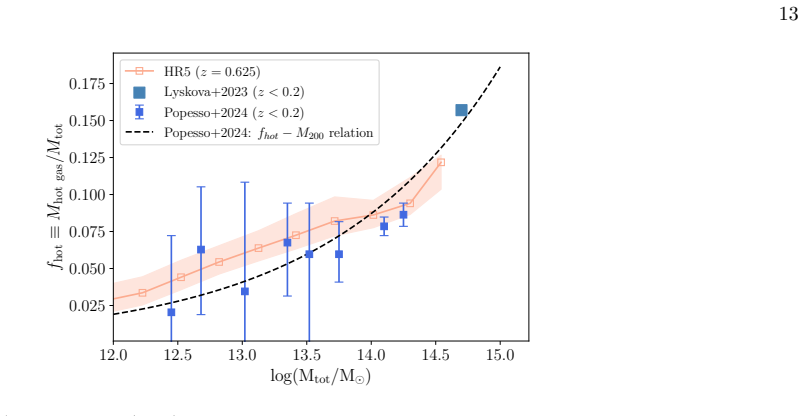
Booth, C. M., & Schaye, J. 2010, MNRAS, 405, L1, doi: 10.1111/j.1745-3933.2010.00832.x 13 12.0 12.5 13.0 13.5 14.0 14.5 15.0 log(Mtot/M⊙) 0.025 0.050 0.075 0.100 0.125 0.150 0.175 fhot ≡ Mhot gas /Mtot HR5 ( z = 0.625) Lyskova+2023 (z < 0.2) Popesso+2024 ( z < 0.2) Popesso+2024: fhot − M200 relation Figure 9.Hot gas fraction (f hot ≡M hot gas/Mtot) as a f...
-
[6]
2012, MNRAS, 420, 1825, doi: 10.1111/j.1365-2966.2011.19805.x
Booth, C. M., & Schaye, J. 2011, MNRAS, 413, 1158, doi: 10.1111/j.1365-2966.2011.18203.x
-
[7]
2024, MNRAS, 531, 84, doi: 10.1093/mnras/stae1122
Boubel, P., Colless, M., Said, K., & Staveley-Smith, L. 2024, MNRAS, 531, 84, doi: 10.1093/mnras/stae1122
-
[8]
Choi, Y.-Y., Park, C., & Vogeley, M. S. 2007, ApJ, 658, 884, doi: 10.1086/511060
-
[9]
Correa, C. A., Schaye, J., Wyithe, J. S. B., et al. 2018, MNRAS, 473, 538, doi: 10.1093/mnras/stx2332
-
[10]
2024, , 684, A75, 10.1051/0004-6361/202346698
Curti, M., Maiolino, R., Curtis-Lake, E., et al. 2024, A&A, 684, A75, doi: 10.1051/0004-6361/202346698
-
[11]
Davies, L. J. M., Robotham, A. S. G., Lagos, C. d. P., et al. 2019, MNRAS, 483, 5444, doi: 10.1093/mnras/sty3393
-
[12]
Dekel, A., & Birnboim, Y. 2006, Monthly Notices of the Royal Astronomical Society, 368, 2–20, doi: 10.1111/j.1365-2966.2006.10145.x
-
[13]
Origin of the Golden Mass of Galaxies and Black Holes
Dekel, A., Lapiner, S., & Dubois, Y. 2019, https://arxiv.org/abs/1904.08431
work page Pith review arXiv 2019
-
[14]
Dubois, Y., Peirani, S., Pichon, C., et al. 2016, MNRAS, 463, 3948, doi: 10.1093/mnras/stw2265
-
[15]
2015, MNRAS, 452, 1502, doi:10.1093/mnras/stv1416
Dubois, Y., Volonteri, M., Silk, J., et al. 2015, MNRAS, 452, 1502, doi: 10.1093/mnras/stv1416
-
[16]
2022, The Astrophysical Journal, 927, 204, doi: 10.3847/1538-4357/ac51ca
Enia, A., Talia, M., Pozzi, F., et al. 2022, The Astrophysical Journal, 927, 204, doi: 10.3847/1538-4357/ac51ca
-
[17]
2013, MNRAS, 432, 23, doi: 10.1093/mnras/stt308
Gruppioni, C., Pozzi, F., Rodighiero, G., et al. 2013, MNRAS, 432, 23, doi: 10.1093/mnras/stt308
-
[18]
The nature, luminosity function, and star formation history of dusty galaxies up to z ≃ 6
Gruppioni, C., B´ ethermin, M., Loiacono, F., et al. 2020, A&A, 643, A8, doi: 10.1051/0004-6361/202038487
-
[19]
Habouzit, M., Volonteri, M., & Dubois, Y. 2017, MNRAS, 468, 3935, doi: 10.1093/mnras/stx666
-
[20]
2012, MNRAS, 420, 1825, doi: 10.1111/j.1365-2966.2011.19805.x
Hahn, O., & Abel, T. 2011, MNRAS, 415, 2101, doi: 10.1111/j.1365-2966.2011.18820.x
-
[21]
Hong, S. E., Park, C., Mishra, P. K., et al. 2024, ApJ, 977, 183, doi: 10.3847/1538-4357/ad9276
-
[22]
Hopkins, A. M. 2004, ApJ, 615, 209, doi: 10.1086/424032
-
[23]
P., Giovanelli, R., & Brinchmann, J
Huang, S., Haynes, M. P., Giovanelli, R., & Brinchmann, J. 2012, ApJ, 756, 113, doi: 10.1088/0004-637X/756/2/113
-
[24]
Hunter, J. D. 2007, Computing in Science & Engineering, 9, 90, doi: 10.1109/MCSE.2007.55
-
[25]
Jeong, D., Hwang, H. S., Chung, H., & Yoon, Y. 2025, ApJ, 982, 11, doi: 10.3847/1538-4357/adb1be
-
[26]
2003, MNRAS, 339, 937, doi: 10.1046/j.1365-8711.2003.06241.x G¨ otberg, Y., de Mink, S
Kauffmann, G., Heckman, T. M., White, S. D. M., et al. 2003, MNRAS, 341, 33, doi: 10.1046/j.1365-8711.2003.06291.x
-
[27]
Kawinwanichakij, L., Silverman, J. D., Ding, X., et al. 2021, ApJ, 921, 38, doi: 10.3847/1538-4357/ac1f21
-
[28]
, archivePrefix = "arXiv", eprint =
Kelvin, L. S., Driver, S. P., Robotham, A. S. G., et al. 2014, MNRAS, 444, 1647, doi: 10.1093/mnras/stu1507
-
[29]
Kendall, M. G., & Stuart, A. 1977, The Advanced Theory of Statistics, Vol. 1: Distribution Theory, 4th edn. (London: Charles Griffin & Company) Kereˇ s, D., Katz, N., Weinberg, D. H., & Dav´ e, R. 2005, MNRAS, 363, 2, doi: 10.1111/j.1365-2966.2005.09451.x
-
[30]
2006, The Astrophysical Journal, 639, 600–616, doi: 10.1086/499761
Kim, J., & Park, C. 2006, The Astrophysical Journal, 639, 600–616, doi: 10.1086/499761
-
[31]
2023, ApJ, 951, 137, doi: 10.3847/1538-4357/acd251
Kim, J., Lee, J., Laigle, C., et al. 2023, ApJ, 951, 137, doi: 10.3847/1538-4357/acd251
-
[32]
Kravtsov, A. V., Vikhlinin, A. A., & Meshcheryakov, A. V. 2018, Astronomy Letters, 44, 8, doi: 10.1134/S1063773717120015
-
[33]
2021, MNRAS, 505, 172, doi: 10.1093/mnras/stab1205
Lapiner, S., Dekel, A., & Dubois, Y. 2021, MNRAS, 505, 172, doi: 10.1093/mnras/stab1205
-
[34]
Lapiner, S., Dekel, A., Freundlich, J., et al. 2023, MNRAS, 522, 4515, doi: 10.1093/mnras/stad1263 14 Lara-L´ opez, M. A., Hopkins, A. M., L´ opez-S´ anchez, A. R., et al. 2013, Monthly Notices of the Royal Astronomical Society, 434, 451–470, doi: 10.1093/mnras/stt1031 Le Bail, A., Daddi, E., Elbaz, D., et al. 2024, A&A, 688, A53, doi: 10.1051/0004-6361/202347465
-
[35]
Lee, J., Shin, J., Snaith, O. N., et al. 2021, ApJ, 908, 11, doi: 10.3847/1538-4357/abd08b
-
[36]
Lee, J. H., Park, C., Hwang, H. S., & Kwon, M. 2024, ApJ, 966, 113, doi: 10.3847/1538-4357/ad3448
-
[37]
Lewis, A., Challinor, A., & Lasenby, A. 2000, ApJ, 538, 473, doi: 10.1086/309179
-
[38]
Lucie-Smith, L., Peiris, H. V., Pontzen, A., et al. 2025, PhRvD, 112, 063541, doi: 10.1103/vh8n-9cr2
-
[39]
Lyskova, N., Churazov, E., Khabibullin, I. I., et al. 2023, MNRAS, 525, 898, doi: 10.1093/mnras/stad2305
-
[40]
Madau, P., & Dickinson, M. 2014, ARA&A, 52, 415, doi: 10.1146/annurev-astro-081811-125615
work page Pith review doi:10.1146/annurev-astro-081811-125615 2014
-
[41]
1998, ApJ, 498, 106, doi: 10.1086/305523
Madau, P., Pozzetti, L., & Dickinson, M. 1998, ApJ, 498, 106, doi: 10.1086/305523
-
[42]
2023, A&A, 678, A83, doi: 10.1051/0004-6361/202347052 M´ erida, R
Magnelli, B., G´ omez-Guijarro, C., Elbaz, D., et al. 2023, A&A, 678, A83, doi: 10.1051/0004-6361/202347052 M´ erida, R. M., Sawicki, M., Iyer, K. G., et al. 2025, arXiv e-prints, arXiv:2509.22871, doi: 10.48550/arXiv.2509.22871
-
[43]
Mishra, P. K., Rana, D., & More, S. 2023, MNRAS, 526, 2403, doi: 10.1093/mnras/stad2914
-
[44]
Mowla, L., Wel, A. v. d., Dokkum, P. v., & Miller, T. B. 2019, The Astrophysical Journal Letters, 872, L13, doi: 10.3847/2041-8213/ab0379
-
[45]
2017, A&A, 602, A5, doi: 10.1051/0004-6361/201629436
Novak, M., Smolˇ ci´ c, V., Delhaize, J., et al. 2017, A&A, 602, A5, doi: 10.1051/0004-6361/201629436
-
[46]
Ocvirk, P., Pichon, C., & Teyssier, R. 2008, MNRAS, 390, 1326, doi: 10.1111/j.1365-2966.2008.13763.x
-
[47]
Paquereau, L., Laigle, C., McCracken, H. J., et al. 2025, A&A, 702, A163, doi: 10.1051/0004-6361/202553828
-
[48]
Blanton, M. R. 2007, The Astrophysical Journal, 658, 898–916, doi: 10.1086/511059
-
[49]
2009, ApJ, 691, 1828, doi: 10.1088/0004-637X/691/2/1828
Park, C., & Choi, Y.-Y. 2009, ApJ, 691, 1828, doi: 10.1088/0004-637X/691/2/1828
-
[50]
Park, C., Gott, III, J. R., & Choi, Y.-Y. 2008, ApJ, 674, 784, doi: 10.1086/524192
-
[51]
2022, The Astrophysical Journal, 937, 15, doi: 10.3847/1538-4357/ac85b5 Planck Collaboration, Ade, P
Park, C., Lee, J., Kim, J., et al. 2022, The Astrophysical Journal, 937, 15, doi: 10.3847/1538-4357/ac85b5 Planck Collaboration, Ade, P. A. R., Aghanim, N., et al. 2016, A&A, 594, A13, doi: 10.1051/0004-6361/201525830
-
[52]
2024, arXiv e-prints, arXiv:2411.16555, doi: 10.48550/arXiv.2411.16555
Popesso, P., Biviano, A., Marini, I., et al. 2024, arXiv e-prints, arXiv:2411.16555, doi: 10.48550/arXiv.2411.16555
-
[53]
Raptis, M., Rudie, G. C., Trainor, R. F., et al. 2025, arXiv e-prints, arXiv:2512.00162, doi: 10.48550/arXiv.2512.00162
-
[54]
Reines, A. E., & Volonteri, M. 2015, ApJ, 813, 82, doi: 10.1088/0004-637X/813/2/82
-
[55]
Roy, N., Napolitano, N. R., La Barbera, F., et al. 2018, MNRAS, 480, 1057, doi: 10.1093/mnras/sty1917
-
[56]
2003, MNRAS, 339, 937, doi: 10.1046/j.1365-8711.2003.06241.x G¨ otberg, Y., de Mink, S
Shen, S., Mo, H. J., White, S. D. M., et al. 2003, MNRAS, 343, 978, doi: 10.1046/j.1365-8711.2003.06740.x
-
[57]
2025, A&A, 695, A20, doi: 10.1051/0004-6361/202452570
Shuntov, M., Ilbert, O., Toft, S., et al. 2025, A&A, 695, A20, doi: 10.1051/0004-6361/202452570
-
[58]
Sutherland, R. S., & Dopita, M. A. 1993, ApJS, 88, 253, doi: 10.1086/191823
-
[59]
Teyssier, R. 2002, A&A, 385, 337, doi: 10.1051/0004-6361:20011817
-
[60]
Tortora, C., Busillo, V., Napolitano, N. R., et al. 2025, arXiv e-prints, arXiv:2502.13589, doi: 10.48550/arXiv.2502.13589
-
[61]
Tremonti, C. A., Heckman, T. M., Kauffmann, G., et al. 2004, ApJ, 613, 898, doi: 10.1086/423264
-
[62]
2024, arXiv e-prints, arXiv:2409.15909, doi: 10.48550/arXiv.2409.15909 van der Wel, A
Tsukui, T., Wisnioski, E., Bland-Hawthorn, J., & Freeman, K. 2024, arXiv e-prints, arXiv:2409.15909, doi: 10.48550/arXiv.2409.15909 van der Wel, A. 2008, ApJL, 675, L13, doi: 10.1086/529432
-
[63]
Wechsler, R. H., & Tinker, J. L. 2018, Annual Review of Astronomy and Astrophysics, 56, 435–487, doi: 10.1146/annurev-astro-081817-051756
work page Pith review doi:10.1146/annurev-astro-081817-051756 2018
-
[64]
Wetzel, A. R., Tinker, J. L., Conroy, C., & van den Bosch, F. C. 2013, MNRAS, 432, 336, doi: 10.1093/mnras/stt469
-
[65]
2021, The Astrophysical Journal, 922, 249, doi: 10.3847/1538-4357/ac2302
Yoon, Y., Park, C., Chung, H., & Zhang, K. 2021, The Astrophysical Journal, 922, 249, doi: 10.3847/1538-4357/ac2302
discussion (0)
Sign in with ORCID, Apple, or X to comment. Anyone can read and Pith papers without signing in.