Recognition: unknown
Empire Amplifier: Uncovering and Contesting the Prioritization of Colonial Content on Platforms Through Community-Informed Algorithmic Auditing
Pith reviewed 2026-05-07 08:53 UTC · model grok-4.3
The pith
YouTube recommends non-Kyrgyz content to Kyrgyz children even when they signal preference for Kyrgyz videos.
A machine-rendered reading of the paper's core claim, the machinery that carries it, and where it could break.
Core claim
The central finding is that YouTube's recommendation algorithm primarily delivers non-Kyrgyz, especially Russian, videos to profiles representing Kyrgyz children, even when those profiles have been tuned to favor Kyrgyz content. This pattern is read as reinforcing offline colonial language ideologies rather than supporting the revitalization of Indigenous linguistic heritage.
What carries the argument
Community-informed algorithmic audit that deploys simulated user profiles signaling Kyrgyz preferences to quantify language prioritization in YouTube recommendations.
If this is right
- Platform recommendations can reinforce Kyrgyz children's offline uptake of colonial language ideologies.
- End-user tactics such as cross-generational device sharing can measurably reduce the share of Russian-language recommendations.
- Algorithms may amplify colonial influence on Indigenous communities instead of aiding cultural preservation.
- Researchers should examine how recommendation systems can reimpose power structures that decolonial work has sought to undo.
Where Pith is reading between the lines
- The same audit approach could be applied to other platforms and other Indigenous languages facing similar colonial pressures.
- If the pattern holds across real user data, platforms may need explicit design choices that actively boost minority-language content when users signal preference.
- Family-level practices like device sharing point to hybrid technical and social strategies for mitigating algorithmic effects on language transmission.
Load-bearing premise
Simulated profiles that signal Kyrgyz preferences accurately mirror the recommendation behavior real Kyrgyz children encounter, and any observed tilt toward Russian content stems specifically from colonial linguistic influence rather than differences in content availability or popularity.
What would settle it
Collecting recommendation logs from actual Kyrgyz children who have set Kyrgyz-language preferences and finding that the system consistently surfaces Kyrgyz content at rates comparable to or higher than Russian content would undermine the claim of systematic prioritization.
Figures






read the original abstract
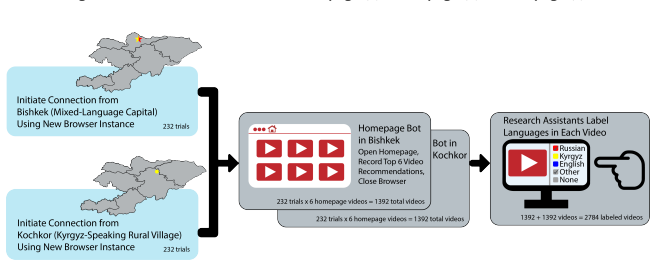
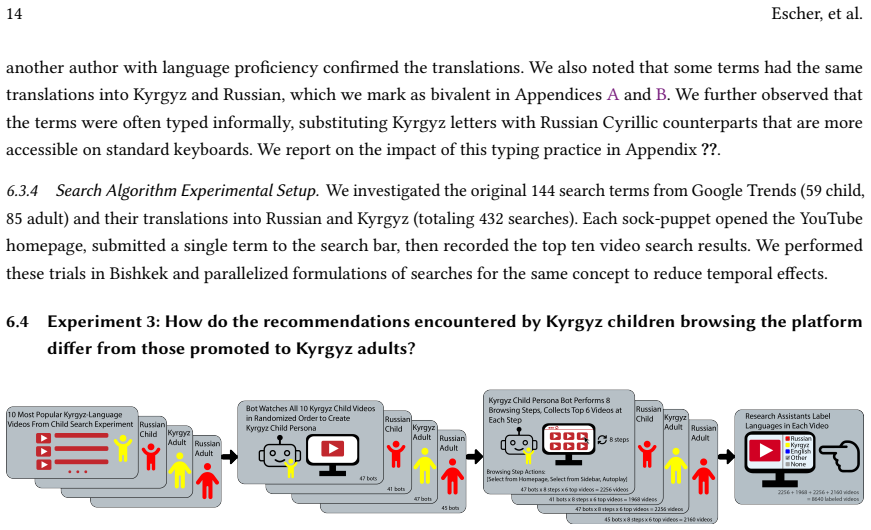
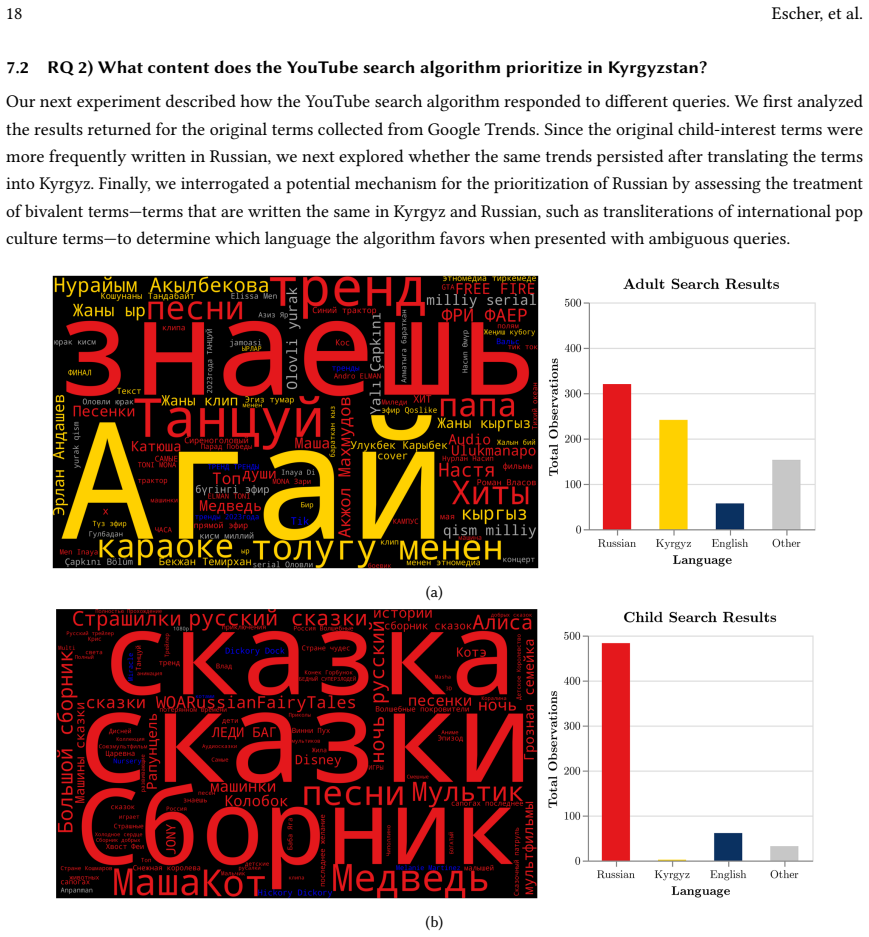
Though online platforms claim to amplify Indigenous voices, Indigenous communities are worried that these systems are instead eroding their language and culture. We conduct a community-informed algorithmic audit to explore whether online platforms sustain or endanger Indigenous cultural practice. First, we review ethnographic research pertaining to the cultural anxieties of a specific Indigenous community, as Indigenous peoples are not a monolith. We consider concerns from Kyrgyz communities who believe that platforms are expanding Russia's linguistic influence and threatening their language. Next, we construct and conduct an algorithmic audit in conversation with the community. Our audit investigates deep-seated fears among Kyrgyz caregivers that YouTube encourages their children to speak Russian instead of Kyrgyz, their heritage language. We measure how the YouTube recommendation algorithm prioritizes content across Indigenous and non-Indigenous languages for child users. Our results validate caregiver concerns, as we find that YouTube primarily recommends non-Kyrgyz content to Kyrgyz children, even when children signal clear preferences for Kyrgyz content. Thus, platform recommendations reinforce Kyrgyz children's offline uptake of colonial language ideologies. Finally, we evaluate strategies to align platform behavior with Indigenous values. We identify effective end-user practices for reducing the proportion of Russian-language YouTube recommendations, like cross-generational device sharing. Overall, our work uncovers how platforms can amplify colonial influence, rather than revitalizing Indigenous cultural heritage. We encourage researchers to consider how algorithmic systems can reimpose oppressive power structures that decolonial efforts have sought to dismantle.
Editorial analysis
A structured set of objections, weighed in public.
Referee Report
Summary. The paper conducts a community-informed algorithmic audit of YouTube's recommendation system for Kyrgyz children. Drawing on ethnographic concerns from Kyrgyz caregivers about platform-driven shift toward Russian-language content, the authors construct simulated user profiles that signal preference for Kyrgyz content and measure the proportion of non-Kyrgyz (primarily Russian) recommendations returned. They report that YouTube continues to prioritize non-Kyrgyz content even under these conditions, interpret this as reinforcement of colonial language ideologies, and evaluate user-level mitigation strategies such as cross-generational device sharing.
Significance. If the audit design successfully isolates algorithmic prioritization from supply-side factors, the work would provide concrete empirical grounding for Indigenous community concerns about platform effects on language maintenance. The community-engaged framing and evaluation of concrete end-user practices are strengths that could inform both platform accountability research and practical interventions in smaller-language contexts.
major comments (2)
- [Methods / Audit Design] The central empirical claim—that recommendations prioritize non-Kyrgyz content 'even when children signal clear preferences for Kyrgyz content'—requires controls that isolate algorithmic behavior from differences in content availability, upload volume, popularity, or engagement metrics between Kyrgyz and Russian children's videos. The abstract and methods description provide no details on corpus size, a no-preference baseline condition, or normalization by video supply; without these, the observed pattern could reflect supply imbalances rather than the claimed algorithmic reinforcement of colonial ideologies.
- [Results and Interpretation] The interpretive step from observed recommendation distributions to 'reinforce Kyrgyz children's offline uptake of colonial language ideologies' is not supported by the reported data. The audit measures only in-platform recommendations; no evidence is presented linking these recommendations to actual language uptake, caregiver reports of child behavior, or longitudinal outcomes.
minor comments (2)
- [Results] The paper would benefit from explicit reporting of sample sizes for simulated profiles, number of recommendation queries per profile, and any statistical tests or confidence intervals around the reported proportions of non-Kyrgyz content.
- [Methods] Clarify how 'signaling clear preferences for Kyrgyz content' was operationalized in the simulated profiles (e.g., watch history, search queries, or likes) and whether these signals were validated against real user behavior.
Simulated Author's Rebuttal
We thank the referee for their constructive and detailed feedback on our community-informed algorithmic audit of YouTube recommendations for Kyrgyz children. The comments highlight important areas for clarification regarding audit controls and interpretive scope. We address each major comment below and indicate planned revisions.
read point-by-point responses
-
Referee: The central empirical claim—that recommendations prioritize non-Kyrgyz content 'even when children signal clear preferences for Kyrgyz content'—requires controls that isolate algorithmic behavior from differences in content availability, upload volume, popularity, or engagement metrics between Kyrgyz and Russian children's videos. The abstract and methods description provide no details on corpus size, a no-preference baseline condition, or normalization by video supply; without these, the observed pattern could reflect supply imbalances rather than the claimed algorithmic reinforcement of colonial ideologies.
Authors: We agree that the manuscript requires expanded methodological detail to better isolate algorithmic prioritization from supply-side factors. In the revised version, we will add the total corpus size of Kyrgyz- and Russian-language children's videos sampled, explicitly describe the no-preference baseline condition used for comparison, and detail normalization procedures that account for differences in upload volume, popularity, and engagement metrics. These additions will allow readers to assess whether the observed recommendation patterns reflect algorithmic behavior beyond content availability imbalances. revision: yes
-
Referee: The interpretive step from observed recommendation distributions to 'reinforce Kyrgyz children's offline uptake of colonial language ideologies' is not supported by the reported data. The audit measures only in-platform recommendations; no evidence is presented linking these recommendations to actual language uptake, caregiver reports of child behavior, or longitudinal outcomes.
Authors: The current interpretation is anchored in the ethnographic context from Kyrgyz caregivers, who directly connect platform recommendations to concerns about language shift. However, we recognize that the audit itself provides no direct data on offline uptake, behavioral changes, or longitudinal outcomes. We will revise the discussion and conclusion sections to frame the results more precisely as validating community concerns about potential reinforcement of colonial language ideologies, while explicitly stating the lack of direct linkage to offline behavior as a limitation and proposing future longitudinal work to address this gap. revision: partial
- Direct empirical evidence linking in-platform recommendations to actual offline language uptake, child behavior changes, or longitudinal outcomes, as the study design is an algorithmic audit rather than a behavioral or longitudinal investigation.
Circularity Check
No significant circularity in empirical audit methodology
full rationale
The paper conducts a community-informed algorithmic audit measuring YouTube recommendation outputs for simulated Kyrgyz child profiles that signal language preferences. The central finding—that non-Kyrgyz content is primarily recommended even with Kyrgyz preference signals—is presented as a direct empirical observation rather than a derivation, prediction, or first-principles result. No equations, fitted parameters renamed as predictions, self-definitional constructs, or load-bearing self-citations appear in the abstract or described chain. The study is self-contained as an observational measurement with independent content from the audit execution itself, satisfying the default expectation of no circularity for empirical work.
Axiom & Free-Parameter Ledger
axioms (2)
- domain assumption Kyrgyz communities hold documented cultural anxieties about platform-driven shift toward Russian language use
- domain assumption Simulated user interactions can reliably surface recommendation prioritization patterns relevant to real children
Reference graph
Works this paper leans on
-
[1]
Sergey Abashin and Elena Srapyan. 2023. Decolonization frees from some dependencies, but often brings others. https://therussiaprogram.org/ on_decolonization_01182024/
2023
-
[2]
José Abdelnour Nocera, Torkil Clemmensen, Judy van Biljon, Jan H Kroeze, Xiangang Qin, and Leonardo Parra-Agudelo. 2024. Towards a Research Agenda for Geopolitical Tensions in HCI. 23 pages. doi:10.1093/iwc/iwae024
-
[3]
Amina A. Abdu, Irene V. Pasquetto, and Abigail Z. Jacobs. 2023. An Empirical Analysis of Racial Categories in the Algorithmic Fairness Literature. InProceedings of the 2023 ACM Conference on Fairness, Accountability, and Transparency(Chicago, IL, USA)(FAccT ’23). Association for Computing 28 Escher, et al. Machinery, New York, NY, USA, 1324–1333. doi:10.1...
-
[4]
Deena Abul-Fottouh, Melodie Yunju Song, and Anatoliy Gruzd. 2020. Examining algorithmic biases in YouTube’s recommendations of vaccine videos.International Journal of Medical Informatics140 (2020), 104175. doi:10.1016/j.ijmedinf.2020.104175
-
[5]
Nuha Albadi, Maram Kurdi, and Shivakant Mishra. 2022. Deradicalizing YouTube: Characterization, Detection, and Personalization of Religiously Intolerant Arabic Videos.Proc. ACM Hum.-Comput. Interact.6, CSCW2, Article 505 (Nov 2022), 25 pages. doi:10.1145/3555618
-
[6]
Syed Mustafa Ali. 2016. A brief introduction to decolonial computing.XRDS22, 4 (Jun 2016), 16–21. doi:10.1145/2930886
-
[7]
Adriana Alvarado Garcia, Juan F. Maestre, Manuhuia Barcham, Marilyn Iriarte, Marisol Wong-Villacres, Oscar A Lemus, Palak Dudani, Pedro Reynolds-Cuéllar, Ruotong Wang, and Teresa Cerratto Pargman. 2021. Decolonial Pathways: Our Manifesto for a Decolonizing Agenda in HCI Research and Design. InExtended Abstracts of the 2021 CHI Conference on Human Factors ...
-
[8]
2023.Decolonial Discourse in Kyrgyzstan: Language as a Tool of National Identity Building
Aidana Alybaeva. 2023.Decolonial Discourse in Kyrgyzstan: Language as a Tool of National Identity Building. Master’s thesis. American University of Central Asia
2023
-
[9]
Emilie Maria Nybo Arendttorp, Kasper Rodil, Heike Winschiers-Theophilus, and Christof Magoath. 2022. Overcoming Legacy Bias: Re-Designing Gesture Interactions in Virtual Reality With a San Community in Namibia. InProceedings of the 2022 CHI Conference on Human Factors in Computing Systems(New Orleans, LA, USA)(CHI ’22). Association for Computing Machinery...
-
[10]
Joshua Asplund, Motahhare Eslami, Hari Sundaram, Christian Sandvig, and Karrie Karahalios. 2020. Auditing Race and Gender Discrimination in Online Housing Markets.Proceedings of the International AAAI Conference on Web and Social Media14, 1 (May 2020), 24–35. doi:10.1609/icwsm. v14i1.7276
-
[11]
Jack Bandy. 2021. Problematic Machine Behavior: A Systematic Literature Review of Algorithm Audits.Proc. ACM Hum.-Comput. Interact.5, CSCW1, Article 74 (Apr 2021), 34 pages. doi:10.1145/3449148
-
[12]
Teanna Barrett, Chinasa T. Okolo, B. Biira, Eman Sherif, Amy Zhang, and Leilani Battle. 2025. African Data Ethics: A Discursive Framework for Black Decolonial AI. InProceedings of the 2025 ACM Conference on Fairness, Accountability, and Transparency (FAccT ’25). Association for Computing Machinery, New York, NY, USA, 334–349. doi:10.1145/3715275.3732023
-
[13]
Alex Beutel, Paul Covington, Sagar Jain, Can Xu, Jia Li, Vince Gatto, and Ed H. Chi. 2018. Latent Cross: Making Use of Context in Recurrent Recommender Systems. InProceedings of the Eleventh ACM International Conference on Web Search and Data Mining(Marina Del Rey, CA, USA) (WSDM ’18). Association for Computing Machinery, New York, NY, USA, 46–54. doi:10....
-
[14]
Social Blade. 2024. Top 100 Most Viewed YouTube Channels (sorted by Video Views). Retrieved Dec 3, 2024 from https://socialblade.com/youtube/ top/100/mostviewed
2024
-
[15]
Geoffrey Bowker and Susan Leigh Star. 1999. Sorting things out.Classification and its consequences4 (1999)
1999
-
[16]
Sharad Chari and Katherine Verdery. 2009. Thinking between the Posts: Postcolonialism, Postsocialism, and Ethnography after the Cold War. Comparative Studies in Society and History51, 1 (2009), 6–34. doi:10.1017/S0010417509000024
-
[17]
My Culture, My People, My Hometown
Si Chen, Xinyue Chen, Zhicong Lu, and Yun Huang. 2023. "My Culture, My People, My Hometown": Chinese Ethnic Minorities Seeking Cultural Sustainability by Video Blogging.Proc. ACM Hum.-Comput. Interact.7, CSCW1, Article 76 (April 2023), 30 pages. doi:10.1145/3579509
-
[18]
Donavyn Coffey. 2021. M¯aori are Trying to Save their Language from Big Tech.Wired(April 2021). https://www.wired.com/story/maori-language- tech/
2021
-
[19]
Terje Colbjørnsen. 2018. My Algorithm: User Perceptions of Algorithmic Recommendations in Cultural Contexts. InHuman-Machine Communica- tion: Rethinking Communication, Technology, and Ourselves, Andrea Guzman (Ed.). Peter Lang, 167–183
2018
-
[20]
Paul Covington, Jay Adams, and Emre Sargin. 2016. Deep Neural Networks for YouTube Recommendations. InProceedings of the 10th ACM Conference on Recommender Systems(Boston, Massachusetts, USA)(RecSys ’16). Association for Computing Machinery, New York, NY, USA, 191–198. doi:10.1145/2959100.2959190
-
[21]
YouTube Creators. 2024. Promotions on YouTube: Set Up & Manage Ad Campaigns for your Content.YouTube(Sept 2024). https://www.youtube. com/watch?v=zbVejKnOxlQ
2024
-
[22]
Aimé Césaire, Robin D. G. Kelley, and Joan Pinkham. 2001.Discourse on Colonialism. Monthly Review Press
2001
-
[23]
Merrion Dale, Prafulla Basumatary, Javid Iqbal, Rex Khullar, and Maaz Shaikh. 2022. Case study of using Facebook groups to connect community users to archived CoRSAL content.Language Documentation & Conservation16 (2022), 399–416
2022
-
[24]
Dipto Das, Shion Guha, Jed R. Brubaker, and Bryan Semaan. 2024. The “Colonial Impulse" of Natural Language Processing: An Audit of Bengali Sentiment Analysis Tools and Their Identity-based Biases. InProceedings of the CHI Conference on Human Factors in Computing Systems(Honolulu, HI, USA)(CHI ’24). Association for Computing Machinery, New York, NY, USA, A...
-
[25]
Dipto Das, Carsten Østerlund, and Bryan Semaan. 2021. "Jol" or "Pani"?: How Does Governance Shape a Platform’s Identity?Proc. ACM Hum.-Comput. Interact.5, CSCW2, Article 473 (Oct. 2021), 25 pages. doi:10.1145/3479860
-
[26]
2018.Talking Indian: Identity and language revitalization in the Chickasaw renaissance
Jenny L Davis. 2018.Talking Indian: Identity and language revitalization in the Chickasaw renaissance. University of Arizona Press
2018
-
[27]
Fabio de Almeida and Sónia Rafael. 2024. Bias by Default.: Neocolonial Visual Vocabularies in AI Image Generating Design Practices.. InExtended Abstracts of the 2024 CHI Conference on Human Factors in Computing Systems (CHI EA ’24). Association for Computing Machinery, New York, NY, USA, Article 549, 8 pages. doi:10.1145/3613905.3644053 Empire Amplifier 29
-
[28]
2009.Языковая политика и языковая ситуация в Кыргызстане[Language politics and the language situation in Kyrgyzstan]
Zamira Derbisheva. 2009.Языковая политика и языковая ситуация в Кыргызстане[Language politics and the language situation in Kyrgyzstan]. Russian Language Journal59 (2009), 49–58
2009
-
[29]
Bryan Dosono and Bryan Semaan. 2020. Decolonizing Tactics as Collective Resilience: Identity Work of AAPI Communities on Reddit.Proc. ACM Hum.-Comput. Interact.4, CSCW1, Article 69 (May 2020), 20 pages. doi:10.1145/3392881
-
[30]
Paul Dourish and Scott D. Mainwaring. 2012. Ubicomp’s colonial impulse. InProceedings of the 2012 ACM Conference on Ubiquitous Computing (Pittsburgh, Pennsylvania)(UbiComp ’12). Association for Computing Machinery, New York, NY, USA, 133–142. doi:10.1145/2370216.2370238
-
[31]
Theodora Dryer. 2023. Settler Computing: Water Algorithms and the Equitable Apportionment Doctrine on the Colorado River, 1950–1990.Osiris 38, 1 (2023), 265–285
2023
-
[32]
2021.Ethnologue: Languages of the World
David M Eberhard, Gary Francis Simons, and Charles D Fenning. 2021.Ethnologue: Languages of the World. SIL International
2021
-
[33]
Maria C. Eriksson and Anna Johansson. 2017. Tracking Gendered Streams.Culture Unbound9, 2 (Oct. 2017), 163–183. doi:10.3384/cu.2000.1525. 1792163
-
[34]
Nel Escher and Nikola Banovic. 2020. Exposing Error in Poverty Management Technology: A Method for Auditing Government Benefits Screening Tools.Proc. ACM Hum.-Comput. Interact.4, CSCW1, Article 64 (May 2020), 20 pages. doi:10.1145/3392874
- [35]
-
[36]
2007.Black Skin, White Masks
Franz Fanon and Richard Philcox (trans.). 2007.Black Skin, White Masks. Grove Press, New York
2007
-
[37]
Andres Ferraro, Gustavo Ferreira, Fernando Diaz, and Georgina Born. 2024. Measuring Commonality in Recommendation of Cultural Content to Strengthen Cultural Citizenship.ACM Trans. Recomm. Syst.2, 1, Article 10 (March 2024), 32 pages. doi:10.1145/3643138
-
[38]
1991.Language Planning and National Development: The Uzbek Experience
William Fierman. 1991.Language Planning and National Development: The Uzbek Experience. Mouton De Gruyter
1991
-
[39]
Joshua A Fishman. 1991. Reversing Language Shift: Theoretical and Empirical Foundations of Assistance to Threatened Languages.Multilingual Matters(1991)
1991
-
[40]
Francesco Vigneri Francesca Ieracitano and Francesca Comunello. 2024. ‘I’m not bad, I’m just. . . drawn that way’: media and algorithmic systems logics in the Italian Google Images construction of (cr)immigrants’ communities.Information, Communication & Society27, 2 (2024), 386–405. doi:10.1080/1369118X.2023.2205928
-
[41]
Fatima Gaw. 2022. Algorithmic logics and the construction of cultural taste of the Netflix Recommender System.Media, Culture & Society44, 4 (2022), 706–725. doi:10.1177/01634437211053767
-
[42]
2021.Nested nationalism: Making and unmaking nations in the Soviet Caucasus
Krista A Goff. 2021.Nested nationalism: Making and unmaking nations in the Soviet Caucasus. Cornell University Press
2021
-
[43]
Elizabeth Gómez, David Contreras, Maria Salamo, and Ludovico Boratto. 2024. Bringing Equity to Coarse and Fine-Grained Provider Groups in Recommender Systems. InProceedings of the 32nd ACM Conference on User Modeling, Adaptation and Personalization(Cagliari, Italy)(UMAP ’24). Association for Computing Machinery, New York, NY, USA, 18–23. doi:10.1145/36270...
-
[44]
Elizabeth Gómez, Carlos Shui Zhang, Ludovico Boratto, Maria Salamó, and Mirko Marras. 2021. The Winner Takes it All: Geographic Imbalance and Provider (Un)fairness in Educational Recommender Systems. InProceedings of the 44th International ACM SIGIR Conference on Research and Development in Information Retrieval(Virtual Event, Canada)(SIGIR ’21). Associat...
-
[45]
Cristos Goodrow. 2021. On YouTube’s Recommendation System.YouTube Official Blog(Sept 2021). https://blog.youtube/inside-youtube/on- youtubes-recommendation-system/
2021
-
[46]
Sysyn (eds.)
Andrea Graziosi and Frank E. Sysyn (eds.). 2022.Genocide: The Power and Problems of a Concept. McGill-Queen’s University Press
2022
-
[47]
2003.Language Policy in the Soviet Union
Lenore Grenoble. 2003.Language Policy in the Soviet Union. Kluwer Academic Publishers
2003
-
[48]
2005.Saving Languages: An Introduction to Language Revitalization
Lenore A Grenoble and Lindsay J Whaley. 2005.Saving Languages: An Introduction to Language Revitalization. Cambridge University Press
2005
-
[49]
Carlos Guerrero Millan, Bettina Nissen, and Larissa Pschetz. 2024. Cosmovision Of Data: An Indigenous Approach to Technologies for Self- Determination. InProceedings of the CHI Conference on Human Factors in Computing Systems(Honolulu, HI, USA)(CHI ’24). Association for Computing Machinery, New York, NY, USA, Article 617, 13 pages. doi:10.1145/3613904.3642598
-
[50]
Aniko Hannak, Piotr Sapiezynski, Arash Molavi Kakhki, Balachander Krishnamurthy, David Lazer, Alan Mislove, and Christo Wilson. 2013. Measuring personalization of web search. InProceedings of the 22nd International Conference on World Wide Web(Rio de Janeiro, Brazil)(WWW ’13). Association for Computing Machinery, New York, NY, USA, 527–538. doi:10.1145/24...
-
[51]
Anikó Hannák, Claudia Wagner, David Garcia, Alan Mislove, Markus Strohmaier, and Christo Wilson. 2017. Bias in Online Freelance Marketplaces: Evidence from TaskRabbit and Fiverr. InProceedings of the 2017 ACM Conference on Computer Supported Cooperative Work and Social Computing (Portland, Oregon, USA)(CSCW ’17). Association for Computing Machinery, New Y...
- [52]
-
[53]
Muhammad Haroon, Magdalena Wojcieszak, Anshuman Chhabra, Xin Liu, Prasant Mohapatra, and Zubair Shafiq. 2023. Auditing YouTube’s recommendation system for ideologically congenial, extreme, and problematic recommendations.Proceedings of the National Academy of Sciences 120, 50 (2023)
2023
-
[54]
Heine, and Ara Norenzayan
Joseph Henrich, Steven J. Heine, and Ara Norenzayan. 2010. Most people are not WEIRD.Nature466 (2010), 29–29
2010
-
[55]
Joseph Henrich, Steven J. Heine, and Ara Norenzayan. 2010. The weirdest people in the world?Behavioral and Brain Sciences33, 2–3 (2010), 61–83. doi:10.1017/S0140525X0999152X 30 Escher, et al
-
[56]
Hendrik Heuer, Hendrik Hoch, Andreas Breiter, and Yannis Theocharis. 2021. Auditing the Biases Enacted by YouTube for Political Topics in Germany. InProceedings of Mensch Und Computer 2021(Ingolstadt, Germany)(MuC ’21). Association for Computing Machinery, New York, NY, USA, 456–468. doi:10.1145/3473856.3473864
-
[57]
Francine Hirsch. 2000. Toward an Empire of Nations: Border-Making and the Formation of Soviet National Identities.The Russian Review59, 2 (Apr 2000), 201–226. doi:10.1111/0036-0341.00117
-
[58]
Eugene Huskey. 1995. The Politics of Language in Kyrgyzstan.Nationalities Papers23, 3 (1995), 549–572
1995
-
[59]
Eslam Hussein, Prerna Juneja, and Tanushree Mitra. 2020. Measuring Misinformation in Video Search Platforms: An Audit Study on YouTube. Proc. ACM Hum.-Comput. Interact.4, CSCW1, Article 48 (May 2020), 27 pages. doi:10.1145/3392854
-
[60]
Alexa Internet Inc. 2022.Top Sites in Kyrgyzstan. https://web.archive.org/web/20220430193524/http://www.alexa.com/topsites/countries/KG
-
[61]
Snap Inc. 2025. Our commitment to belonging at Snap.Belonging at Snap(May 2025). https://belonging.snap.com/
2025
-
[62]
Lilly Irani, Janet Vertesi, Paul Dourish, Kavita Philip, and Rebecca E. Grinter. 2010. Postcolonial computing: a lens on design and development. InProceedings of the SIGCHI Conference on Human Factors in Computing Systems(Atlanta, Georgia, USA)(CHI ’10). Association for Computing Machinery, New York, NY, USA, 1311–1320. doi:10.1145/1753326.1753522
-
[63]
Seung-Pyo Jun, Hyoung Sun Yoo, and San Choi. 2018. Ten years of research change using Google Trends: From the perspective of big data utilizations and applications.Technological Forecasting and Social Change130 (2018), 69–87. doi:10.1016/j.techfore.2017.11.009
-
[64]
Prerna Juneja, Md Momen Bhuiyan, and Tanushree Mitra. 2023. Assessing enactment of content regulation policies: A post hoc crowd-sourced audit of election misinformation on YouTube. InProceedings of the 2023 CHI Conference on Human Factors in Computing Systems(Hamburg, Germany)(CHI ’23). Association for Computing Machinery, New York, NY, USA, Article 545,...
-
[65]
Botakoz Kassymbekova. 2023. How Western scholars overlooked Russian imperialism.Al Jazeera(24 Jan 2023). https://www.aljazeera.com/ opinions/2023/1/24/how-western-scholars-overlooked-russian-imperialism
2023
-
[66]
Botakoz Kassymbekova and Erica Marat. 2022. Time to Question Russia’s Imperial Innocence.PONARS Eurasia771 (2022)
2022
-
[67]
Matthew Kay, Cynthia Matuszek, and Sean A. Munson. 2015. Unequal Representation and Gender Stereotypes in Image Search Results for Occupations. InProceedings of the 33rd Annual ACM Conference on Human Factors in Computing Systems(Seoul, Republic of Korea)(CHI ’15). Association for Computing Machinery, New York, NY, USA, 3819–3828. doi:10.1145/2702123.2702520
-
[68]
Webb Keane. 2003. Semiotics and the social analysis of material things.Language & communication23, 3-4 (2003), 409–425
2003
-
[69]
1990.Language Planning in the Soviet Union
Michael Kirkwood. 1990.Language Planning in the Soviet Union. St. Martin’s Press
1990
-
[70]
2005.Language Attitudes Towards Kyrgyz and Russian: Discourse, Education and Policy in Post-Soviet Kyrgyzstan
Britta Korth. 2005.Language Attitudes Towards Kyrgyz and Russian: Discourse, Education and Policy in Post-Soviet Kyrgyzstan. Peter Lang
2005
-
[71]
Lindah Kotut and D. Scott McCrickard. 2022. Winds of Change: Seeking, Preserving, and Retelling Indigenous Knowledge Through Self-Organized Online Communities. InProceedings of the 2022 CHI Conference on Human Factors in Computing Systems(New Orleans, LA, USA)(CHI ’22). Association for Computing Machinery, New York, NY, USA, Article 257, 15 pages. doi:10....
-
[72]
Marlene Laruelle and Dylan Royce. 2020. No Great Game: Central Asia’s Public Opinions on Russia, China, and the US.Kennan Cable56 (Aug 2020)
2020
-
[73]
Shaimaa Lazem, Danilo Giglitto, Makuochi Samuel Nkwo, Hafeni Mthoko, Jessica Upani, and Anicia Peters. 2022. Challenges and Paradoxes in Decolonising HCI: A Critical Discussion.Comput. Supported Coop. Work31, 2 (June 2022), 159–196. doi:10.1007/s10606-021-09398-0
-
[74]
Erwan Le Merrer, Gilles Trédan, and Ali Yesilkanat. 2023. Modeling rabbit-holes on YouTube.Social Network Analysis and Mining13, 1, Article 100 (2023), 16 pages
2023
-
[75]
Mark Ledwich, Anna Zaitsev, and Anton Laukemper. 2022. Radical bubbles on YouTube? Revisiting algorithmic extremism with personalised recommendations.First Monday27, 12 (Dec. 2022). doi:10.5210/fm.v27i12.12552
-
[76]
Sebastian Linxen, Christian Sturm, Florian Brühlmann, Vincent Cassau, Klaus Opwis, and Katharina Reinecke. 2021. How WEIRD is CHI?. In Proceedings of the 2021 CHI Conference on Human Factors in Computing Systems(Yokohama, Japan)(CHI ’21). Association for Computing Machinery, New York, NY, USA, Article 143, 14 pages. doi:10.1145/3411764.3445488
-
[77]
2021.The New Patriarchs of Digital Capitalism: Celebrity Tech Founders and Networks of Power
Ben Little and Alison Winch. 2021.The New Patriarchs of Digital Capitalism: Celebrity Tech Founders and Networks of Power. Routledge
2021
-
[78]
2020.Parenting for a Digital Future: How Hopes and Fears about Technology Shape Children’s Lives
Sonia Livingstone and Alicia Blum-Ross. 2020.Parenting for a Digital Future: How Hopes and Fears about Technology Shape Children’s Lives. Oxford University Press, USA
2020
-
[79]
Joycelyn Longdon, Michelle Westerlaken, Alan F Blackwell, Jennifer Gabrys, Benjamin Ossom, Adham Ashton-Butt, and Emmanuel Acheampong
-
[80]
Justice-oriented Design Listening: Participatory Ecoacoustics with a Ghanaian Forest Community. InProceedings of the CHI Conference on Human Factors in Computing Systems(Honolulu, HI, USA)(CHI ’24). Association for Computing Machinery, New York, NY, USA, Article 560, 12 pages. doi:10.1145/3613904.3643044
discussion (0)
Sign in with ORCID, Apple, or X to comment. Anyone can read and Pith papers without signing in.