Recognition: unknown
X-Ray Spectral Variability of the TeV HBL Blazar PG 1553+113 with XMM-Newton
Pith reviewed 2026-05-07 08:18 UTC · model grok-4.3
The pith
X-ray spectra of the TeV blazar PG 1553+113 are mostly better described by log-parabola models than power-laws.
A machine-rendered reading of the paper's core claim, the machinery that carries it, and where it could break.
Core claim
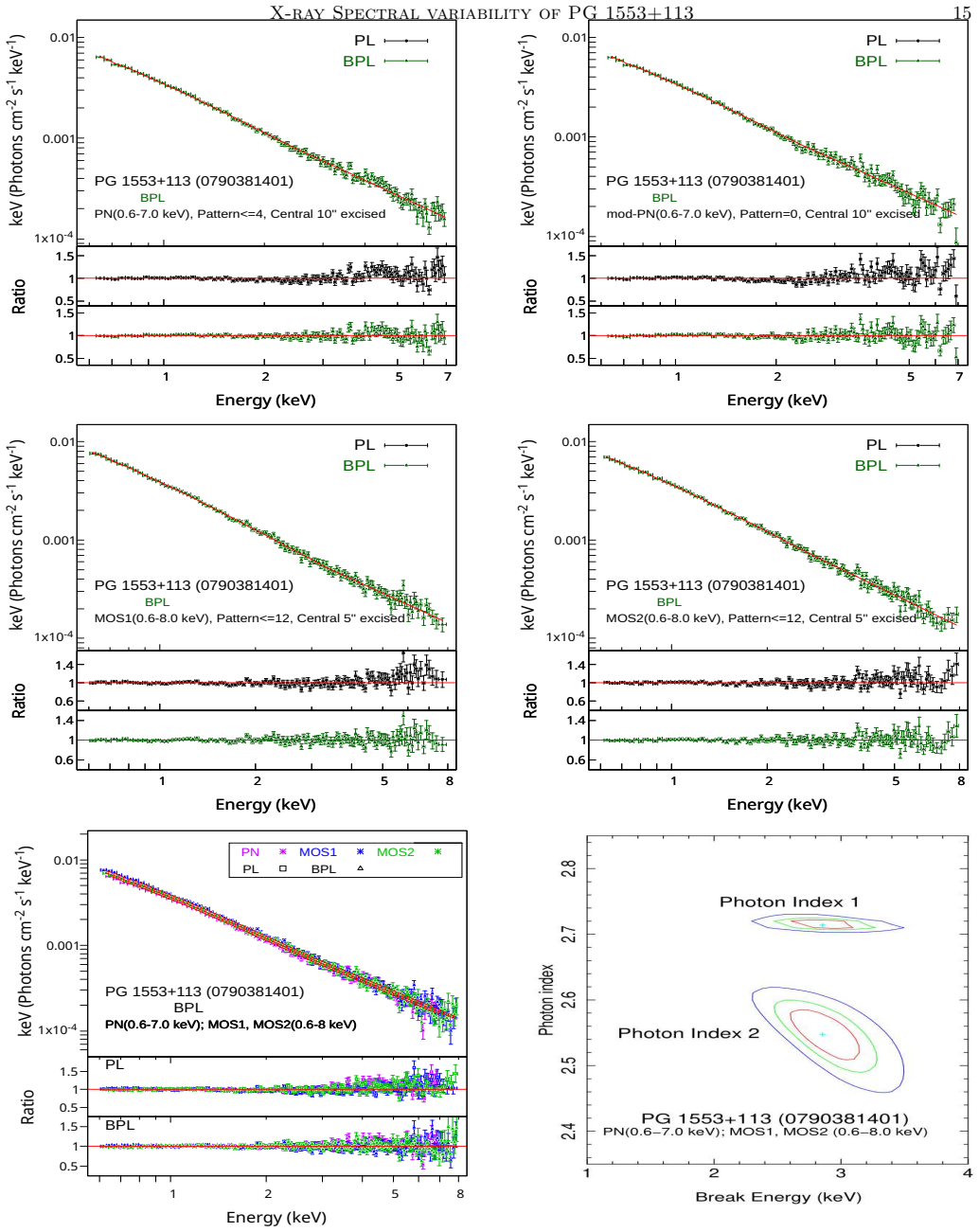
Fitting the 0.6-7.0 keV EPIC-PN spectra with absorbed log-parabola models yields alpha values from 2.13 to 2.80 and beta from 0.04 to 0.18 for 14 observations, while 15 are adequately described by power-laws with photon index 2.53 to 2.69. Joint fits with optical monitor data reveal synchrotron peak frequencies in the range 4.59 to 48.61 eV. Two observations show clear additional inverse Compton components. The authors conclude that the observed spectral evolution arises from variations in particle acceleration or cooling conditions within the jet.
What carries the argument
Log-parabola spectral model applied to EPIC-PN X-ray data to extract curvature and place the synchrotron peak frequency.
If this is right
- The electron energy distribution in the jet is frequently curved rather than a pure power-law.
- The synchrotron peak energy can shift by nearly an order of magnitude, altering the source's contribution to the broadband spectral energy distribution.
- Inverse Compton emission occasionally extends into the X-ray band.
- Spectral changes occur on multi-year timescales, consistent with evolving jet conditions.
Where Pith is reading between the lines
- The measured range of beta values can be compared against predictions from stochastic acceleration models to constrain the turbulence spectrum in the jet.
- Simultaneous TeV gamma-ray observations could test whether X-ray curvature changes precede or follow high-energy flares.
- The long baseline of data offers a way to check if the same acceleration mechanism operates across different flux states.
Load-bearing premise
That the statistical preference for log-parabola over power-law models reliably traces physical changes in particle acceleration or cooling without extra emission components or unaccounted data systematics.
What would settle it
An observation in which a power-law model is statistically preferred at a flux level previously described by a log-parabola, or a measured synchrotron peak energy that falls outside 4.59-48.61 eV while the source remains in a comparable state.
Figures

read the original abstract
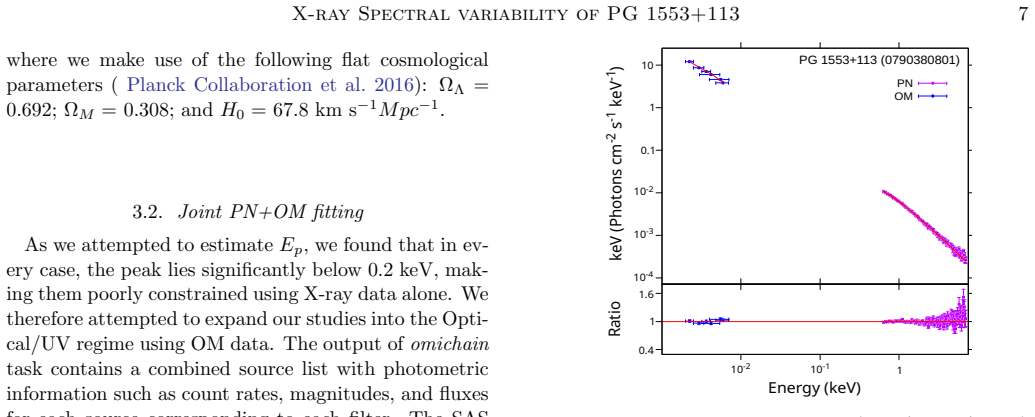
We present an extensive X-ray spectral variability study of the TeV photon-emitting high-energy-peaked BL Lacertae object PG 1553+113, using the data from EPIC-PN camera of XMM-Newton, which observed the source during its operational period from Sep 2001 to Nov 2024. X-ray spectra in this energy range, $0.6-7.0$ keV, were fitted with absorbed Power-law (PL) and absorbed Log-Parabola (LP) models. We found with 99$\%$ confidence that 14 of them were fit well by LP models having parameters in the range $\alpha\simeq2.13-2.80$, and $\beta\simeq0.04-0.18$, one spectrum favours a LP model with $\beta<0$, while simple PL models with $\Gamma\simeq2.53-2.69$ were sufficient to describe the X-ray spectra of the remaining 15. Two of these 30 observations showed strong signatures of an additional inverse Compton component, while one showed weaker indications. On fitting joint Optical Monitor and EPIC-PN data with LP models, we found synchrotron peaks in the energy range of $\nu_s\simeq4.59-48.61$ eV. This indicates that the spectral evolution is probably caused by variations in particle acceleration or cooling conditions within the jet.
Editorial analysis
A structured set of objections, weighed in public.
Referee Report
Summary. The manuscript analyzes 30 XMM-Newton EPIC-PN observations of the TeV HBL blazar PG 1553+113 (2001–2024). Spectra in the 0.6–7 keV band are fitted with absorbed power-law (PL) and log-parabola (LP) models. LP models are preferred at 99% confidence in 14 epochs (α ≈ 2.13–2.80, β ≈ 0.04–0.18), with one additional LP fit showing β < 0; PL models (Γ ≈ 2.53–2.69) suffice for the remaining 15. Two epochs show signatures of an inverse-Compton component. Joint OM+PN LP fits yield synchrotron peak energies ν_s spanning 4.59–48.61 eV. The authors conclude that the spectral evolution is probably caused by variations in particle acceleration or cooling conditions within the jet.
Significance. If the model selections and peak locations are robust, the work provides a useful archive of X-ray spectral parameters and synchrotron-peak estimates for a well-studied high-energy-peaked BL Lac over two decades. Such observational catalogs can inform statistical studies of blazar variability and serve as input for jet-emission modeling. The physical interpretation offered, however, remains tentative because the analysis is purely phenomenological.
major comments (2)
- [Abstract / Conclusion] Abstract and concluding section: The statement that the observed spectral evolution 'indicates' or 'is probably caused by' variations in particle acceleration or cooling conditions is not supported by the analysis. The LP model is phenomenological and can be produced by several mechanisms (energy-dependent acceleration, stochastic processes, or multi-zone emission). No leptonic forward modeling, parameter-degeneracy tests (e.g., varying Doppler factor or magnetic-field strength while holding acceleration/cooling fixed), or comparison against alternative scenarios are presented. This interpretive claim is load-bearing for the paper’s central conclusion.
- [Data reduction and spectral fitting] Data-analysis section: The manuscript does not specify the background-subtraction procedure, pile-up checks for EPIC-PN, the exact statistical test and threshold (F-test, likelihood-ratio, AIC, etc.) used to establish the 99% confidence preference for LP over PL, or how systematic uncertainties in the soft X-ray band are propagated. These details are required to assess the reliability of the reported model preferences and the derived ν_s range.
minor comments (2)
- [Results] A summary table listing all 30 epochs with best-fit parameters, χ²/dof, null-hypothesis probabilities, and the model-comparison statistic would improve clarity and allow readers to assess the fits directly.
- [Abstract / Results] The ν_s values are quoted without uncertainties or corresponding frequencies in Hz; adding these would aid comparison with the broader blazar literature.
Simulated Author's Rebuttal
We thank the referee for their constructive and detailed comments, which have helped us identify areas where the manuscript can be strengthened. We address each major comment below and outline the revisions we will make.
read point-by-point responses
-
Referee: [Abstract / Conclusion] Abstract and concluding section: The statement that the observed spectral evolution 'indicates' or 'is probably caused by' variations in particle acceleration or cooling conditions is not supported by the analysis. The LP model is phenomenological and can be produced by several mechanisms (energy-dependent acceleration, stochastic processes, or multi-zone emission). No leptonic forward modeling, parameter-degeneracy tests (e.g., varying Doppler factor or magnetic-field strength while holding acceleration/cooling fixed), or comparison against alternative scenarios are presented. This interpretive claim is load-bearing for the paper’s central conclusion.
Authors: We agree that the log-parabola model is phenomenological and that multiple mechanisms (including stochastic acceleration, energy-dependent processes, or multi-zone emission) can produce the observed curvature. Our original wording was intended to offer a plausible physical interpretation consistent with the observed changes in spectral parameters across the 23-year baseline, which is a common framing in the blazar literature for LP fits. However, we acknowledge that without dedicated leptonic modeling or degeneracy tests, the claim is too definitive. In the revised manuscript we will replace 'indicates' and 'is probably caused by' with 'is consistent with' in both the abstract and conclusion. We will also add a short paragraph noting the range of possible mechanisms and stating that distinguishing among them would require multi-wavelength forward modeling that lies beyond the scope of this purely observational study. revision: yes
-
Referee: [Data reduction and spectral fitting] Data-analysis section: The manuscript does not specify the background-subtraction procedure, pile-up checks for EPIC-PN, the exact statistical test and threshold (F-test, likelihood-ratio, AIC, etc.) used to establish the 99% confidence preference for LP over PL, or how systematic uncertainties in the soft X-ray band are propagated. These details are required to assess the reliability of the reported model preferences and the derived ν_s range.
Authors: We thank the referee for identifying these omissions. In the revised data-reduction and spectral-fitting section we will explicitly describe: (i) background subtraction performed with the SAS task evselect using source-free annular regions on the same CCD; (ii) pile-up assessment via the epatplot task for every EPIC-PN observation, confirming that no significant pile-up was present; (iii) the use of the F-test to compare nested PL and LP models, with the LP model adopted only when the null-hypothesis probability fell below 0.01 (corresponding to >99 % confidence); and (iv) the treatment of systematic uncertainties, where the hydrogen column was fixed to the Galactic value from the HI4PI survey and soft-band residuals were verified to be consistent with statistical errors alone, with no additional systematic floor applied because calibration uncertainties were sub-dominant to the statistical uncertainties in the 0.6–7 keV band. revision: yes
Circularity Check
No circularity in observational spectral fitting and interpretation
full rationale
The paper conducts standard absorbed PL and LP model fits to 30 XMM-Newton EPIC-PN spectra (0.6-7 keV), reports parameter ranges for the 14 LP-preferred epochs and 15 PL epochs, notes IC signatures in two cases, and derives synchrotron peak energies from joint OM+PN LP fits. The concluding statement is a qualitative interpretive inference linking observed spectral evolution to possible jet physics variations, without any equations, predictions, or derivations that reduce by construction to the fitted parameters themselves. No self-citations, ansatzes, uniqueness theorems, or renamings of known results appear as load-bearing steps. This is a purely data-driven phenomenological analysis with no mathematical chain that could exhibit circularity.
Axiom & Free-Parameter Ledger
free parameters (4)
- alpha =
2.13-2.80
- beta =
0.04-0.18
- Gamma =
2.53-2.69
- nu_s =
4.59-48.61 eV
axioms (2)
- domain assumption Absorbed power-law and log-parabola models are sufficient and appropriate descriptions of the 0.6-7 keV spectra of this high-energy-peaked BL Lac object
- domain assumption The synchrotron component dominates the X-ray band and its peak can be located by joint optical-X-ray fitting
Reference graph
Works this paper leans on
-
[1]
A., Ackermann, M., Agudo, I., et al
Abdo, A. A., Ackermann, M., Agudo, I., et al. 2010, ApJ, 716, 30, doi: 10.1088/0004-637X/716/1/30
-
[2]
Abdollahi, S., Baldini, L., Barbiellini, G., et al. 2024, ApJ, 976, 203, doi: 10.3847/1538-4357/ad64c5
-
[3]
2015, ApJL, 813, L41, doi: 10.1088/2041-8205/813/2/L41
Ackermann, M., Ajello, M., Albert, A., et al. 2015, ApJL, 813, L41, doi: 10.1088/2041-8205/813/2/L41 Aleksi´ c, J., Alvarez, E. A., Antonelli, L. A., et al. 2012, ApJ, 748, 46, doi: 10.1088/0004-637X/748/1/46 Aleksi´ c, J., Ansoldi, S., Antonelli, L. A., et al. 2015, MNRAS, 450, 4399, doi: 10.1093/mnras/stv811
-
[4]
Arnaud, K. A. 1996, in Astronomical Society of the Pacific Conference Series, Vol. 101, Astronomical Data Analysis Software and Systems V, ed. G. H. Jacoby & J. Barnes, 17
1996
-
[5]
Begelman, M. C., Blandford, R. D., & Rees, M. J. 1980, Nature, 287, 307, doi: 10.1038/287307a0
-
[6]
Bhagwan, J., Gupta, A. C., Papadakis, I. E., & Wiita, P. J. 2014, MNRAS, 444, 3647, doi: 10.1093/mnras/stu1703
-
[7]
Blandford, R. D., & Levinson, A. 1995, ApJ, 441, 79, doi: 10.1086/175338
-
[8]
Bloom, S. D., & Marscher, A. P. 1996, ApJ, 461, 657, doi: 10.1086/177092
-
[9]
1992, A&A, 255, 59
Camenzind, M., & Krockenberger, M. 1992, A&A, 255, 59
1992
-
[10]
Carter, J. A., & Read, A. M. 2007, A&A, 464, 1155, doi: 10.1051/0004-6361:20065882
-
[11]
Helical jets and the misalignment distribution for core-dominated radio sources
Conway, J. E., & Murphy, D. W. 1993, ApJ, 411, 89, doi: 10.1086/172809
-
[12]
2012, The Astronomer’s Telegram, 3977, 1
Cortina, J. 2012, The Astronomer’s Telegram, 3977, 1
2012
-
[13]
Devanand, P. U., Gupta, A. C., Jithesh, V., & Wiita, P. J. 2022, ApJ, 939, 80, doi: 10.3847/1538-4357/ac9064
-
[14]
2025, ApJS, 278, 20, doi: 10.3847/1538-4365/adc10d
Gupta, A. 2025, ApJS, 278, 20, doi: 10.3847/1538-4365/adc10d
-
[15]
Diplas, A., & Savage, B. D. 1994, ApJ, 427, 274, doi: 10.1086/174139 Dorigo Jones, J., Johnson, S. D., Muzahid, S., et al. 2021, Monthly Notices of the Royal Astronomical Society, 509, 4330, doi: 10.1093/mnras/stab3331
-
[16]
1990, PASP, 102, 1120, doi: 10.1086/132740
Falomo, R., & Treves, A. 1990, PASP, 102, 1120, doi: 10.1086/132740
-
[17]
2004, ARA&A, 42, 317, doi: 10.1146/annurev.astro.42.053102.134031
Fender, R., & Belloni, T. 2004, ARA&A, 42, 317, doi: 10.1146/annurev.astro.42.053102.134031
-
[18]
Fossati, G., Buckley, J. H., Bond, I. H., et al. 2008, ApJ, 677, 906, doi: 10.1086/527311
-
[19]
Fragile, P. C., & Meier, D. L. 2009, ApJ, 693, 771, doi: 10.1088/0004-637X/693/1/771
-
[20]
J., et al
Gabriel, C., Denby, M., Fyfe, D. J., et al. 2004, in Astronomical Society of the Pacific Conference Series, Vol. 314, Astronomical Data Analysis Software and Systems (ADASS) XIII, ed. F. Ochsenbein, M. G. Allen, & D. Egret, 759
2004
-
[21]
2002, in Blazar Astrophysics with BeppoSAX and Other Observatories, ed
Giommi, P., Capalbi, M., Fiocchi, M., et al. 2002, in Blazar Astrophysics with BeppoSAX and Other Observatories, ed. P. Giommi, E. Massaro, & G. Palumbo, 63, doi: 10.48550/arXiv.astro-ph/0209596
-
[22]
2005, A&A, 434, 385, doi: 10.1051/0004-6361:20041789
Giommi, P., Piranomonte, S., Perri, M., & Padovani, P. 2005, A&A, 434, 385, doi: 10.1051/0004-6361:20041789
-
[23]
Green, R. F., Schmidt, M., & Liebert, J. 1986, ApJS, 61, 305, doi: 10.1086/191115 HI4PI Collaboration, Ben Bekhti, N., Fl¨ oer, L., et al. 2016, A&A, 594, A116, doi: 10.1051/0004-6361/201629178
-
[24]
Huang, S., Yin, H., Hu, S., et al. 2021, ApJ, 922, 222, doi: 10.3847/1538-4357/ac2d98
-
[25]
Ingram, A., Done, C., & Fragile, P. C. 2009, Monthly Notices of the Royal Astronomical Society: Letters, 397, L101, doi: 10.1111/j.1745-3933.2009.00693.x
-
[26]
K., Sahayanathan, S., Misra, R., Ravikumar, C
Jagan, S. K., Sahayanathan, S., Misra, R., Ravikumar, C. D., & Jeena, K. 2018, MNRAS, 478, L105, doi: 10.1093/mnrasl/sly086
-
[27]
Jethwa, P., Saxton, R., Guainazzi, M., Rodriguez-Pascual, P., & Stuhlinger, M. 2015, A&A, 581, A104, doi: 10.1051/0004-6361/201425579
-
[28]
Johnson, S. D., Mulchaey, J. S., Chen, H.-W., et al. 2019, ApJL, 884, L31, doi: 10.3847/2041-8213/ab479a
-
[29]
W., Rudnick, L., & Landau, R
Jones, T. W., Rudnick, L., & Landau, R. 1986, in IN: Continuum emission in active galactic nuclei; Proceedings of the Workshop, ed. M. L. Sitko, 122–133
1986
-
[30]
2016, MNRAS, 457, 704, doi: 10.1093/mnras/stv3004
Kapanadze, B., Romano, P., Vercellone, S., et al. 2016, MNRAS, 457, 704, doi: 10.1093/mnras/stv3004
-
[31]
2020, ApJS, 247, 27, doi: 10.3847/1538-4365/ab6322
Kapanadze, B., Gurchumelia, A., Dorner, D., et al. 2020, ApJS, 247, 27, doi: 10.3847/1538-4365/ab6322
-
[32]
2012, A&A, 537, A112, doi: 10.1051/0004-6361/201116886
Eckart, A. 2012, A&A, 537, A112, doi: 10.1051/0004-6361/201116886
-
[33]
Krennrich, F., Biller, S. D., Bond, I. H., et al. 1999, ApJ, 511, 149, doi: 10.1086/306677
-
[34]
Landau, R., Golisch, B., Jones, T. J., et al. 1986, ApJ, 308, 78, doi: 10.1086/164480
-
[35]
P., Vaughan, S., Pounds, K., & Reeves, J
Lobban, A. P., Vaughan, S., Pounds, K., & Reeves, J. N. 2016, MNRAS, 457, 38, doi: 10.1093/mnras/stv2896 MAGIC Collaboration, Abe, H., Abe, S., et al. 2024, MNRAS, 529, 3894, doi: 10.1093/mnras/stae649
-
[36]
Mannheim, K., & Biermann, P. L. 1992, A&A, 253, L21
1992
-
[37]
Mason, K. O., Breeveld, A., Much, R., et al. 2001, A&A, 365, L36, doi: 10.1051/0004-6361:20000044 32Devanand 2026 et al
-
[38]
2004, A&A, 413, 489, doi: 10.1051/0004-6361:20031558
Massaro, E., Perri, M., Giommi, P., & Nesci, R. 2004, A&A, 413, 489, doi: 10.1051/0004-6361:20031558
-
[39]
2008, A&A, 478, 395, doi: 10.1051/0004-6361:20078639
Giommi, P. 2008, A&A, 478, 395, doi: 10.1051/0004-6361:20078639
-
[40]
Mastichiadis, A., & Kirk, J. G. 2002, PASA, 19, 138, doi: 10.1071/AS01108
-
[41]
Middei, R., Perri, M., Puccetti, S., et al. 2023, ApJL, 953, L28, doi: 10.3847/2041-8213/acec3e NASA High Energy Astrophysics Science Archive Research Center (HEASARC). 2014, HEAsoft: Unified Release of FTOOLS and XANADU,, Astrophysics Source Code Library, record ascl:1408.004 http://ascl.net/1408.004
-
[42]
2018, Nature, 558, 406, doi: 10.1038/s41586-018-0204-1
Nicastro, F., Kaastra, J., Krongold, Y., et al. 2018, Nature, 558, 406, doi: 10.1038/s41586-018-0204-1
-
[43]
Peebles, P. J. E. 1993, Principles of Physical Cosmology (Princeton Univsersity Press), doi: 10.1515/9780691206721
-
[44]
2007, A&A, 462, 889, doi: 10.1051/0004-6361:20066063
Perri, M., Maselli, A., Giommi, P., et al. 2007, A&A, 462, 889, doi: 10.1051/0004-6361:20066063
-
[45]
Peters, P. C. 1964, Physical Review, 136, 1224, doi: 10.1103/PhysRev.136.B1224
-
[46]
Piner, B. G., & Edwards, P. G. 2014, ApJ, 797, 25, doi: 10.1088/0004-637X/797/1/25 Planck Collaboration, Ade, P. A. R., Aghanim, N., et al. 2016, A&A, 594, A13, doi: 10.1051/0004-6361/201525830
-
[47]
Raiteri, C. M., Stamerra, A., Villata, M., et al. 2015, MNRAS, 454, 353, doi: 10.1093/mnras/stv1884
-
[48]
An analysis of its flux and polarization variability
Raiteri, C. M., Nicastro, F., Stamerra, A., et al. 2017, MNRAS, 466, 3762, doi: 10.1093/mnras/stw3333
-
[49]
2008, ApJ, 682, 775, doi: 10.1086/589641
Dorner, D. 2008, ApJ, 682, 775, doi: 10.1086/589641
-
[50]
E., Chajet, L., Abraham, Z., & Fan, J
Romero, G. E., Chajet, L., Abraham, Z., & Fan, J. H. 2000, A&A, 360, 57
2000
-
[51]
Schlafly, E. F., & Finkbeiner, D. P. 2011, ApJ, 737, 103, doi: 10.1088/0004-637X/737/2/103
-
[52]
Sesana, A., & Khan, F. M. 2015, Monthly Notices of the Royal Astronomical Society: Letters, 454, L66, doi: 10.1093/mnrasl/slv131
-
[53]
2003, MNRAS, 339, 937, doi: 10.1046/j.1365-8711.2003.06241.x G¨ otberg, Y., de Mink, S
Stirling, A. M., Cawthorne, T. V., Stevens, J. A., et al. 2003, Monthly Notices of the Royal Astronomical Society, 341, 405, doi: 10.1046/j.1365-8711.2003.06448.x
-
[54]
doi:10.1051/0004-6361/200810865 , archiveprefix =
Tosti, G. 2009, A&A, 501, 879, doi: 10.1051/0004-6361/200810865
-
[55]
doi:10.1051/0004-6361:20066723 , archiveprefix =
Tramacere, A., Massaro, F., & Cavaliere, A. 2007, A&A, 466, 521, doi: 10.1051/0004-6361:20066723
-
[56]
Urry, C. M., & Padovani, P. 1995, PASP, 107, 803, doi: 10.1086/133630
work page internal anchor Pith review doi:10.1086/133630 1995
-
[57]
M., Sillanpaa, A., & Takalo, L
Vlahakis, N., & Tsinganos, K. 1998, Monthly Notices of the Royal Astronomical Society, 298, 777, doi: 10.1046/j.1365-8711.1998.01660.x
-
[58]
2019, ApJ, 885, 8, doi: 10.3847/1538-4357/ab4416
Wang, Y., Zhu, S., Xue, Y., et al. 2019, ApJ, 885, 8, doi: 10.3847/1538-4357/ab4416
-
[59]
Wani, K., Gaur, H., & Patil, M. K. 2023, ApJ, 951, 94, doi: 10.3847/1538-4357/acd186
-
[60]
Wani, K. A., & Gaur, H. 2020, Galaxies, 8, 59, doi: 10.3390/galaxies8030059
-
[61]
Wilkins, D. C. 1972, PhRvD, 5, 814, doi: 10.1103/PhysRevD.5.814
-
[62]
On the Absorption of X-rays in the Interstellar Medium
Wilms, J., Allen, A., & McCray, R. 2000, ApJ, 542, 914, doi: 10.1086/317016
-
[63]
Xu, Y., Garc´ ıa, J. A., Walton, D. J., et al. 2021, ApJ, 913, 13, doi: 10.3847/1538-4357/abf430
-
[64]
Zhang, Y. H. 2008, ApJ, 682, 789, doi: 10.1086/589493
discussion (0)
Sign in with ORCID, Apple, or X to comment. Anyone can read and Pith papers without signing in.