Recognition: unknown
Detection of optical quasi-periodic oscillation in the blazar 3C 454.3
Pith reviewed 2026-05-07 08:10 UTC · model grok-4.3
The pith
Optical observations reveal a 433-day quasi-periodic oscillation persisting for 9.5 years in blazar 3C 454.3
A machine-rendered reading of the paper's core claim, the machinery that carries it, and where it could break.
Core claim
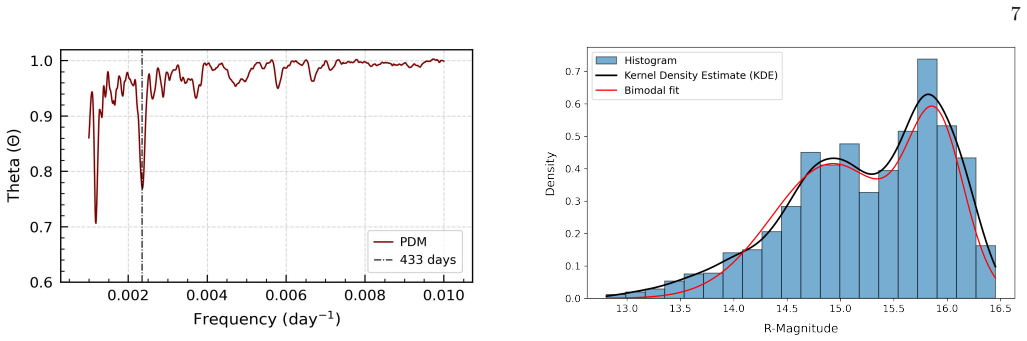
We detected a QPO of ∼ 433 days using Lomb-Scargle periodogram, which lasted from MJD 54980--58450 as detected by the weighted wavelet Z-transform technique, making it one of the most persistent QPOs ever detected in the optical regime. We detected this signal at a global significance of 2.53σ across all methodologies. To explain the observed QPO, we have considered both models focused on the accretion disk around the super-massive black hole (SMBH), and those based purely on jet emissions. Plausible jet-based models involve a shock moving down the jet in a helical magnetic field, whereas the SMBH models could involve Lense-Thirring effect-induced jet precession or dual jets in a binary SMBH
What carries the argument
Lomb-Scargle periodogram combined with weighted wavelet Z-transform and phase dispersion minimization, plus a novel technique to rule out spurious signals from annual seasonal observing gaps.
If this is right
- The QPO could be produced by a shock moving along the jet in a helical magnetic field.
- Lense-Thirring precession of the jet or a binary supermassive black hole system could also generate the observed periodicity.
- The long duration of the signal implies it is a stable feature that can be tracked in future data to test disk versus jet origin models.
- The consistency across three independent analysis methods reduces the chance that the detection is due to random noise.
Where Pith is reading between the lines
- If the period is confirmed, it could help estimate the mass or spin of the central black hole in this blazar.
- The gap-handling method could be applied to other blazar light curves to search for additional long-lived QPOs.
- Repeated detections in independent datasets would strengthen the case that such oscillations trace real physical processes rather than sampling artifacts.
Load-bearing premise
The novel method for distinguishing genuine QPOs from spurious signals due to annual seasonal gaps works as intended, and a global significance of 2.53 sigma is high enough to support a real detection despite the red noise typical of blazar variability.
What would settle it
Additional optical monitoring of 3C 454.3 over the next several years that shows the 433-day cycle does not continue or recur at the expected phases after MJD 58450 would indicate the reported signal was not a persistent physical QPO.
Figures



read the original abstract
We analyzed 19 years of $R$-band data of the blazar 3C 454.3 from the Whole Earth Blazar Telescope (WEBT) archive, along with new data from its members and from public archives such as those provided by the Small and Moderate Aperture Research Telescope System (SMARTS) and the Steward Observatory projects to search for quasi-periodic oscillations (QPOs). We detected a QPO of $\sim$ 433 days using Lomb-Scargle periodogram, which lasted from MJD 54980--58450 as detected by the weighted wavelet Z-transform technique, making it one of the most persistent QPOs ever detected in the optical regime. The phase dispersion minimization technique was also performed to further validate this QPO claim. We detected this signal at a global significance of $2.53\sigma$ across all methodologies. To explain the observed QPO, we have considered both models focused on the accretion disk around the super-massive black hole (SMBH), and those based purely on jet emissions. Plausible jet-based models involve a shock moving down the jet in a helical magnetic field, whereas the SMBH models could involve Lense-Thirring effect-induced jet precession or dual jets in a binary SMBH system. We introduce a novel approach to distinguish genuine QPOs from spurious signals arising from annual seasonal gaps, a common limitation of ground-based observations.
Editorial analysis
A structured set of objections, weighed in public.
Referee Report
Summary. The manuscript analyzes 19 years of R-band optical photometry of the blazar 3C 454.3 from WEBT, SMARTS, and Steward Observatory archives. It reports detection of a ~433-day QPO via Lomb-Scargle periodogram, with persistence over MJD 54980–58450 confirmed by weighted wavelet Z-transform (WWZ) and cross-validated by phase dispersion minimization (PDM). A global significance of 2.53σ is quoted across methods, a novel procedure is introduced to separate genuine signals from annual-gap aliases, and both jet-precession and binary-SMBH interpretations are discussed.
Significance. A robust detection of an optical QPO persisting for ~8 cycles would be a notable result for blazar variability studies, offering constraints on jet or disk precession models. The multi-technique approach and long temporal baseline are positive features. However, the marginal 2.53σ global significance combined with the absence of published validation tests for the novel gap-handling method substantially limits the strength of the claim.
major comments (3)
- [Results] The global significance of 2.53σ is marginal for a firm detection claim in red-noise-dominated blazar light curves. The manuscript must detail the Monte Carlo procedure used to derive this value, including the number of realizations, the exact PSD model fitted to the data, and whether the simulations preserve the observed sampling window and annual gaps (Results section on significance estimation).
- [Methods] The novel gap-correction technique is presented as essential to the detection, yet no signal-injection and recovery tests are shown to quantify its false-alarm rate or completeness. Without such tests, the quoted 2.53σ cannot be taken at face value (Methods section describing the novel approach).
- [Results] The WWZ analysis claims persistence from MJD 54980 to 58450 (~8 cycles), but no quantitative coherence metric (e.g., quality factor or time-frequency localization width) is provided to support the statement that this is “one of the most persistent QPOs ever detected” (WWZ results subsection).
minor comments (3)
- [Abstract] The abstract states the signal was “detected at a global significance of 2.53σ across all methodologies” but does not specify how the three independent techniques (Lomb-Scargle, WWZ, PDM) are combined into a single significance figure.
- [Figures] Figure captions for the periodogram and WWZ map should explicitly state the significance contours used and whether the gap-correction procedure has been applied to the displayed data.
- [Discussion] A brief comparison of the derived 433-day period with previously reported optical or radio QPOs in 3C 454.3 or similar FSRQs would strengthen the discussion.
Simulated Author's Rebuttal
We thank the referee for the careful reading of our manuscript and the constructive comments. We address each major comment below and indicate the revisions that will be incorporated into the next version of the paper.
read point-by-point responses
-
Referee: [Results] The global significance of 2.53σ is marginal for a firm detection claim in red-noise-dominated blazar light curves. The manuscript must detail the Monte Carlo procedure used to derive this value, including the number of realizations, the exact PSD model fitted to the data, and whether the simulations preserve the observed sampling window and annual gaps (Results section on significance estimation).
Authors: We agree that the Monte Carlo procedure requires a more explicit description to allow readers to evaluate the global significance. The manuscript currently states that Monte Carlo simulations were used to assess significance across methods while preserving the sampling properties, but we will expand the relevant subsection in the revised Results section to specify the number of realizations performed, the precise red-noise PSD model fitted to the data, and explicit confirmation that each realization incorporates the actual observation times and annual gaps. This will clarify how the 2.53σ value was obtained without altering the reported significance. revision: yes
-
Referee: [Methods] The novel gap-correction technique is presented as essential to the detection, yet no signal-injection and recovery tests are shown to quantify its false-alarm rate or completeness. Without such tests, the quoted 2.53σ cannot be taken at face value (Methods section describing the novel approach).
Authors: We acknowledge that quantitative validation of the novel gap-correction procedure would strengthen the result. The current manuscript introduces the method as a way to distinguish genuine periodic signals from annual-gap aliases and applies it to the data, but does not include injection-recovery tests. We will add a dedicated subsection in the revised Methods section describing signal-injection experiments performed on simulated light curves that match the observed sampling and gaps. These tests will report the recovered false-alarm rate and completeness as a function of signal strength, thereby providing direct support for the quoted global significance. revision: yes
-
Referee: [Results] The WWZ analysis claims persistence from MJD 54980 to 58450 (~8 cycles), but no quantitative coherence metric (e.g., quality factor or time-frequency localization width) is provided to support the statement that this is “one of the most persistent QPOs ever detected” (WWZ results subsection).
Authors: We agree that a quantitative metric would better support the persistence claim. The manuscript identifies the interval MJD 54980–58450 from the WWZ map and notes the long duration relative to other reported optical QPOs, but does not supply a numerical coherence measure. In the revised WWZ results subsection we will add the quality factor Q = period / frequency width measured from the time-frequency localization in the WWZ map, together with a brief comparison to literature values, to substantiate the statement of persistence. revision: yes
Circularity Check
No circularity: pure observational periodogram analysis on archival data.
full rationale
The paper applies standard statistical tools (Lomb-Scargle periodogram, weighted wavelet Z-transform, phase dispersion minimization) directly to 19 years of R-band light-curve data to search for periodicity. The claimed ~433-day QPO and its 2.53σ global significance are outputs of these data-driven tests, not quantities fitted or defined in terms of themselves. The novel gap-handling procedure is introduced as an additional data-processing step to mitigate seasonal aliases; it does not enter any self-referential derivation or prediction loop. No accretion-disk or jet models are fitted to the data in a manner that would make a subsequent prediction equivalent to the input by construction. No load-bearing self-citations or uniqueness theorems are invoked. The derivation chain is therefore self-contained against external benchmarks and contains no circular steps.
Axiom & Free-Parameter Ledger
axioms (1)
- domain assumption The light curve variability can be analyzed with standard Fourier-based and wavelet methods assuming the noise properties allow detection of periodic signals above the significance threshold.
Reference graph
Works this paper leans on
-
[1]
2007, Encyclopedia of measurement and statistics, 3, 2007
Abdi, H., et al. 2007, Encyclopedia of measurement and statistics, 3, 2007
2007
-
[2]
A., Ackermann, M., Ajello, M., et al
Abdo, A. A., Ackermann, M., Ajello, M., et al. 2009, ApJ, 699, 817, doi: 10.1088/0004-637X/699/1/817 —. 2010, ApJ, 722, 520, doi: 10.1088/0004-637X/722/1/520
-
[3]
2010, ApJ, 721, 1383, doi: 10.1088/0004-637X/721/2/1383
Ackermann, M., Ajello, M., Baldini, L., et al. 2010, ApJ, 721, 1383, doi: 10.1088/0004-637X/721/2/1383
-
[4]
2015, ApJL, 813, L41, doi: 10.1088/2041-8205/813/2/L41
Ackermann, M., Ajello, M., Albert, A., et al. 2015, ApJL, 813, L41, doi: 10.1088/2041-8205/813/2/L41
-
[5]
2014, MNRAS, 445, L16, doi: 10.1093/mnrasl/slu127
Middleton, M. 2014, MNRAS, 445, L16, doi: 10.1093/mnrasl/slu127
-
[6]
Alston, W. N., Parker, M. L., Markeviˇ ci¯ ut˙ e, J., et al. 2015, MNRAS, 449, 467, doi: 10.1093/mnras/stv351 Astropy Collaboration, Price-Whelan, A. M., Lim, P. L., et al. 2022, ApJ, 935, 167, doi: 10.3847/1538-4357/ac7c74
-
[7]
2017, ApJ, 847, 7, doi: 10.3847/1538-4357/aa86ed —
Bhatta, G. 2017, ApJ, 847, 7, doi: 10.3847/1538-4357/aa86ed —. 2019, MNRAS, 487, 3990, doi: 10.1093/mnras/stz1482
-
[8]
Bhatta, G., & Dhital, N. 2020, ApJ, 891, 120, doi: 10.3847/1538-4357/ab7455
-
[9]
Bonning, E. W., Bailyn, C., Urry, C. M., et al. 2009, ApJL, 697, L81, doi: 10.1088/0004-637X/697/2/L81
-
[10]
V., Melchior, A.-L., & Zolotukhin, I
Ghirlanda, G. 2011, MNRAS, 410, 368, doi: 10.1111/j.1365-2966.2010.17450.x
-
[11]
2013, MNRAS, 428, 280, doi: 10.1093/mnras/sts014
Caproni, A., Abraham, Z., & Monteiro, H. 2013, MNRAS, 428, 280, doi: 10.1093/mnras/sts014
-
[12]
Helical jets and the misalignment distribution for core-dominated radio sources
Conway, J. E., & Murphy, D. W. 1993, ApJ, 411, 89, doi: 10.1086/172809
-
[13]
P., et al
Czesla, S., Schr¨ oter, S., Schneider, C. P., et al. 2019, PyA: Python astronomy-related packages. http://ascl.net/1906.010
2019
-
[14]
Dey, L., Valtonen, M. J., Gopakumar, A., et al. 2018, ApJ, 866, 11, doi: 10.3847/1538-4357/aadd95
-
[15]
Dogra, K., Gupta, A. C., Raiteri, C. M., et al. 2025, ApJS, 276, 1, doi: 10.3847/1538-4365/ad8e3d
-
[16]
Emmanoulopoulos, D., McHardy, I. M., & Papadakis, I. E. 2013, MNRAS, 433, 907, doi: 10.1093/mnras/stt764
-
[17]
Fan, J. H., Kurtanidze, S. O., Liu, Y., et al. 2021, ApJS, 253, 10, doi: 10.3847/1538-4365/abd32d
-
[18]
Foreman-Mackey, D., Hogg, D. W., Lang, D., & Goodman, J. 2013, PASP, 125, 306, doi: 10.1086/670067
-
[19]
1996, AJ, 112, 1709, doi: 10.1086/118137
Foster, G. 1996, AJ, 112, 1709, doi: 10.1086/118137
-
[20]
2006, A&A, 445, L1, doi: 10.1051/0004-6361:200500213
Fuhrmann, L., Cucchiara, A., Marchili, N., et al. 2006, A&A, 445, L1, doi: 10.1051/0004-6361:200500213
-
[21]
2016, in Revista Mexicana de Astronomia y Astrofisica Conference Series, Vol
Gazeas, K. 2016, in Revista Mexicana de Astronomia y Astrofisica Conference Series, Vol. 48, Revista Mexicana de Astronomia y Astrofisica Conference Series, 22–23
2016
-
[22]
Gazeas, K. 2019, Galaxies, 7, 58, doi: 10.3390/galaxies7020058 Gierli´ nski, M., Middleton, M., Ward, M., & Done, C. 2008, Nature, 455, 369, doi: 10.1038/nature07277
-
[23]
Giommi, P., Blustin, A. J., Capalbi, M., et al. 2006, A&A, 456, 911, doi: 10.1051/0004-6361:20064874
-
[24]
Gupta, A. C., Srivastava, A. K., & Wiita, P. J. 2009, ApJ, 690, 216, doi: 10.1088/0004-637X/690/1/216
-
[25]
Gupta, A. C., Tripathi, A., Wiita, P. J., et al. 2018, A&A, 616, L6, doi: 10.1051/0004-6361/201833629 —. 2019, MNRAS, 484, 5785, doi: 10.1093/mnras/stz395
-
[26]
Gupta, A. C., Mangalam, A., Wiita, P. J., et al. 2017, MNRAS, 472, 788, doi: 10.1093/mnras/stx2072
-
[27]
Gupta, A. C., Kushwaha, P., Valtonen, M. J., et al. 2023, ApJL, 957, L11, doi: 10.3847/2041-8213/acfd2e
-
[28]
1989, ApJS, 69, 1, doi: 10.1086/191307
Hewitt, A., & Burbidge, G. 1989, ApJS, 69, 1, doi: 10.1086/191307
-
[29]
M., Sesana, A., Sandrinelli, A., et al
Holgado, A. M., Sesana, A., Sandrinelli, A., et al. 2018, MNRAS, 481, L74, doi: 10.1093/mnrasl/sly158
-
[30]
Hughes, P. A., Aller, H. D., & Aller, M. F. 1985, ApJ, 298, 301, doi: 10.1086/163611
-
[31]
Jorstad, S. G., Marscher, A. P., Larionov, V. M., et al. 2010, ApJ, 715, 362, doi: 10.1088/0004-637X/715/1/362
-
[32]
, year = 2022, month = sep, volume =
Jorstad, S. G., Marscher, A. P., Raiteri, C. M., et al. 2022, Nature, 609, 265, doi: 10.1038/s41586-022-05038-9
-
[33]
2023, lcsim: Light curve simulation code, Astrophysics Source Code Library, record ascl:2310.002
Kiehlmann, S. 2023, lcsim: Light curve simulation code, Astrophysics Source Code Library, record ascl:2310.002. http://ascl.net/2310.002
2023
-
[34]
2023, wwz: Weighted wavelet z-transform code, Astrophysics Source Code Library, record ascl:2310.003
Kiehlmann, S., Max-Moerbeck, W., & King, O. 2023, wwz: Weighted wavelet z-transform code, Astrophysics Source Code Library, record ascl:2310.003. http://ascl.net/2310.003
2023
-
[35]
Kiehlmann, S., de la Parra, P. V., Sullivan, A. G., et al. 2025, ApJ, 985, 59, doi: 10.3847/1538-4357/adc567
-
[36]
A quasi-periodic oscillation in the blazar J1359+4011
King, O. G., Hovatta, T., Max-Moerbeck, W., et al. 2013, MNRAS, 436, L114, doi: 10.1093/mnrasl/slt125
-
[37]
Kishore, S., Gupta, A. C., & Wiita, P. J. 2023, ApJ, 943, 53, doi: 10.3847/1538-4357/aca809
-
[38]
Lachowicz, P., Gupta, A. C., Gaur, H., & Wiita, P. J. 2009, A&A, 506, L17, doi: 10.1051/0004-6361/200913161
-
[39]
Lehto, H. J., & Valtonen, M. J. 1996, ApJ, 460, 207, doi: 10.1086/176962
-
[40]
Formation of precessing jets by tilted black hole discs in 3D general relativistic MHD simulations
Liska, M., Hesp, C., Tchekhovskoy, A., et al. 2018, MNRAS, 474, L81, doi: 10.1093/mnrasl/slx174
-
[41]
Liu, Y., Jiang, D. R., & Gu, M. F. 2006, ApJ, 637, 669, doi: 10.1086/498639
-
[42]
Lomb, N. R. 1976, Ap&SS, 39, 447, doi: 10.1007/BF00648343 16
-
[43]
P., Gear, W
Marscher, A. P., Gear, W. K., & Travis, J. P. 1992, in Variability of Blazars, ed. E. Valtaoja & M. Valtonen, 85
1992
-
[44]
, year = 2008, month = apr, volume =
Marscher, A. P., Jorstad, S. G., D’Arcangelo, F. D., et al. 2008, Nature, 452, 966, doi: 10.1038/nature06895
-
[45]
Mashhoon, B., Hehl, F. W., & Theiss, D. S. 1984, General Relativity and Gravitation, 16, 711, doi: 10.1007/BF00762913
-
[46]
Mason, K. O. 2004, MNRAS, 348, 783, doi: 10.1111/j.1365-2966.2004.07376.x
-
[47]
2015, MNRAS, 452, 2004, doi: 10.1093/mnras/stv1412
Mohan, P., Agarwal, A., Mangalam, A., et al. 2015, MNRAS, 452, 2004, doi: 10.1093/mnras/stv1412
-
[48]
Nalewajko, K., Gupta, A. C., Liao, M., et al. 2019, A&A, 631, A4, doi: 10.1051/0004-6361/201935904 O’Neill, S., Kiehlmann, S., Readhead, A. C. S., et al. 2022, ApJL, 926, L35, doi: 10.3847/2041-8213/ac504b
-
[49]
Otero-Santos, J., Raiteri, C. M., Acosta-Pulido, J. A., et al. 2024, A&A, 686, A228, doi: 10.1051/0004-6361/202449647
-
[50]
Pan, H.-W., Yuan, W., Yao, S., et al. 2016, ApJL, 819, L19, doi: 10.3847/2041-8205/819/2/L19 Pe˜ nil, P., Torres-Alb` a, N., Rico, A., et al. 2025, MNRAS, doi: 10.1093/mnras/staf1842 Pe˜ nil, P., Dom´ ınguez, A., Buson, S., et al. 2020, ApJ, 896, 134, doi: 10.3847/1538-4357/ab910d
-
[51]
Peters, P. C. 1964, PhD thesis, California Institute of Technology
1964
-
[52]
Raiteri, C. M., Villata, M., Larionov, V. M., et al. 2007, A&A, 473, 819, doi: 10.1051/0004-6361:20078289 —. 2008, A&A, 491, 755, doi: 10.1051/0004-6361:200810869
-
[53]
Raiteri, C. M., Stamerra, A., Villata, M., et al. 2015, MNRAS, 454, 353, doi: 10.1093/mnras/stv1884
-
[54]
Remillard, R. A., & McClintock, J. E. 2006, ARA&A, 44, 49, doi: 10.1146/annurev.astro.44.051905.092532
-
[55]
Rieger, F. M. 2004, ApJL, 615, L5, doi: 10.1086/426018
-
[56]
E., Chajet, L., Abraham, Z., & Fan, J
Romero, G. E., Chajet, L., Abraham, Z., & Fan, J. H. 2000, A&A, 360, 57
2000
-
[57]
Transient quasi-periodic oscillations at γ-rays in the TeV blazar PKS 1510-089
Roy, A., Sarkar, A., Chatterjee, A., et al. 2022a, MNRAS, 510, 3641, doi: 10.1093/mnras/stab3701
-
[58]
Roy, A., Chitnis, V. R., Gupta, A. C., et al. 2022b, MNRAS, 513, 5238, doi: 10.1093/mnras/stac1287
-
[59]
QUASI-PERIODICITIES AT YEAR-LIKE TIMESCALES IN BLAZARS
Sandrinelli, A., Covino, S., Dotti, M., & Treves, A. 2016, AJ, 151, 54, doi: 10.3847/0004-6256/151/3/54
-
[60]
2018, A&A, 615, A118, doi: 10.1051/0004-6361/201732550
Sandrinelli, A., Covino, S., Treves, A., et al. 2018, A&A, 615, A118, doi: 10.1051/0004-6361/201732550
-
[61]
Sarkar, A., Gupta, A. C., Chitnis, V. R., & Wiita, P. J. 2021, MNRAS, 501, 50, doi: 10.1093/mnras/staa3211
-
[62]
Wiita, P. J. 2020, A&A, 642, A129, doi: 10.1051/0004-6361/202038052
-
[63]
Sarkar, A., Chitnis, V. R., Gupta, A. C., et al. 2019, ApJ, 887, 185, doi: 10.3847/1538-4357/ab5281
-
[64]
2014, ApJ, 784, 141, doi: 10.1088/0004-637X/784/2/141
Sasada, M., Uemura, M., Fukazawa, Y., et al. 2014, ApJ, 784, 141, doi: 10.1088/0004-637X/784/2/141
-
[65]
2012, MNRAS, 423, 600, doi: 10.1111/j.1365-2966.2012.20901.x
Sbarrato, T., Ghisellini, G., Maraschi, L., & Colpi, M. 2012, MNRAS, 421, 1764, doi: 10.1111/j.1365-2966.2012.20442.x
-
[66]
Scargle, J. D. 1982, ApJ, 263, 835, doi: 10.1086/160554
-
[67]
Balonek, T. J. 1988, ApJL, 326, L39, doi: 10.1086/185119
-
[68]
Stella, L., & Vietri, M. 1998, ApJL, 492, L59, doi: 10.1086/311075
-
[69]
Stellingwerf, R. F. 1978, ApJ, 224, 953, doi: 10.1086/156444
-
[70]
1995, A&A, 300, 707
Timmer, J., & K¨ onig, M. 1995, A&A, 300, 707
1995
-
[71]
Tripathi, A., Gupta, A. C., Aller, M. F., et al. 2021, MNRAS, 501, 5997, doi: 10.1093/mnras/stab058
-
[72]
Tripathi, A., Smith, K. L., Wiita, P. J., & Wagoner, R. V. 2024a, MNRAS, 527, 9132, doi: 10.1093/mnras/stad3744
-
[73]
Tripathi, A., Gupta, A. C., Smith, K. L., et al. 2024b, ApJ, 977, 166, doi: 10.3847/1538-4357/ad90e3
-
[74]
Urry, C. M., & Padovani, P. 1995, PASP, 107, 803, doi: 10.1086/133630
work page internal anchor Pith review doi:10.1086/133630 1995
-
[75]
2008, A&A, 477, 407, doi: 10.1051/0004-6361:20066399
Valtonen, M., Kidger, M., Lehto, H., & Poyner, G. 2008, A&A, 477, 407, doi: 10.1051/0004-6361:20066399
-
[76]
Valtonen, M. J. 2024, RNAAS, 8, 11, doi: 10.3847/2515-5172/ad8d5e
-
[77]
Valtonen, M. J., Zola, S., Gupta, A. C., et al. 2024, ApJL, 968, 8, doi: 10.3847/2041-8213/ad4d9b,(PaperIV)
-
[78]
VanderPlas, J. T. 2018, ApJS, 236, 16, doi: 10.3847/1538-4365/aab766
-
[79]
Vaughan, S., Uttley, P., Markowitz, A. G., et al. 2016, MNRAS, 461, 3145, doi: 10.1093/mnras/stw1412
-
[80]
2010, ApJ, 712, 405, doi: 10.1088/0004-637X/712/1/405
Vercellone, S., D’Ammando, F., Vittorini, V., et al. 2010, ApJ, 712, 405, doi: 10.1088/0004-637X/712/1/405
discussion (0)
Sign in with ORCID, Apple, or X to comment. Anyone can read and Pith papers without signing in.