Recognition: unknown
Finding Strongly Lensed Supernovae from Blended Light Curves
Pith reviewed 2026-05-07 09:58 UTC · model grok-4.3
The pith
A photometry-only method fits blended supernova light curves as two time-shifted components to flag strongly lensed candidates with under 1 percent false positives.
A machine-rendered reading of the paper's core claim, the machinery that carries it, and where it could break.
Core claim
By treating the observed flux as the sum of two time-shifted supernova light curves and performing Bayesian inference to constrain the time delay and flux ratio, the framework selects objects whose apparent delays are long enough to be consistent with strong lensing while most ordinary supernovae do not mimic this behavior at high thresholds.
What carries the argument
The two-component superposition model for blended flux, with Bayesian estimation of relative scaling and time delay Δt.
If this is right
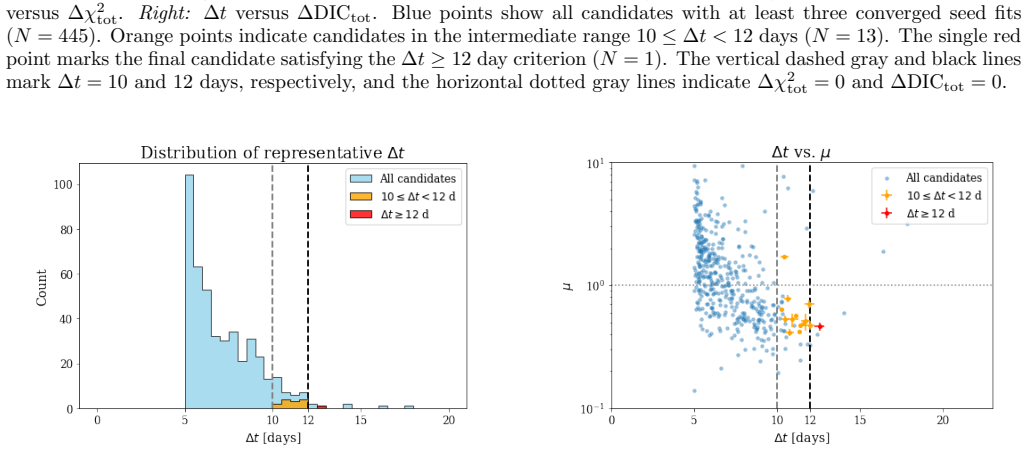
- A conservative Δt ≥ 12 days threshold yields a false positive fraction of 0.22 percent in the 445-object validation set.
- Relaxing to Δt ≥ 10 days raises the fraction to 3.15 percent while still limiting contamination.
- The method requires only photometry and needs no specific lens model or host-galaxy assumptions.
- It supplies a short list of candidates for targeted follow-up to confirm lensing.
Where Pith is reading between the lines
- The same fitting procedure could be run on the full LSST alert stream to pre-select lensed-supernova candidates for spectroscopy or high-resolution imaging.
- Adding color or multi-band information to the two-component model might further reduce contamination without losing the photometry-only character.
- The framework may generalize to other classes of transients that can appear blended, such as strongly lensed core-collapse supernovae or tidal disruption events.
Load-bearing premise
Ordinary non-lensed Type Ia supernovae light curves do not produce fitted time delays above the chosen threshold at a rate much higher than seen in the validation sample.
What would settle it
A substantially larger sample of spectroscopically confirmed non-lensed supernovae in which the fraction exceeding the 12-day delay threshold is many times higher than 1/445.
Figures



read the original abstract
We present a model-independent, photometry-only framework for identifying strongly lensed supernovae when multiple images are unresolved and blended into a single point source. Building on the simulation-based methodology of Bag et al. (2021), we apply this approach to real Zwicky Transient Facility (ZTF) data using a validation sample of spectroscopically confirmed Type Ia supernovae. The method models the observed flux as a superposition of two time-shifted components, and Bayesian inference is used to estimate the relative scaling and time delay. Applying this framework to 445 well-converged supernovae, we find that only a single object satisfies the selection criteria when adopting a conservative threshold of $\Delta t \ge 12$ days, corresponding to a false positive fraction of $1/445 \approx 0.22\%$. A laxer threshold of $\Delta t \ge 10$ days yields fourteen objects, for a false positive fraction of $3.15\%$. The method provides a scalable and model-independent first-stage filter for identifying lens-like candidates in large time-domain surveys such as the Rubin Observatory's Legacy Survey of Space and Time (LSST).
Editorial analysis
A structured set of objections, weighed in public.
Referee Report
Summary. The manuscript presents a model-independent, photometry-only framework for identifying strongly lensed supernovae from unresolved blended light curves. It models the observed flux as a superposition of two time-shifted components and uses Bayesian inference to estimate the relative scaling and time delay Δt. The method is applied to a validation sample of spectroscopically confirmed Type Ia supernovae from ZTF data; among 445 well-converged objects, only one satisfies the conservative selection threshold Δt ≥ 12 days (false-positive fraction 1/445 ≈ 0.22%), while a laxer threshold of Δt ≥ 10 days yields 14 objects (3.15%). The approach is proposed as a scalable first-stage filter for large surveys such as LSST.
Significance. If the reported false-positive rates hold under operational conditions, the framework provides a practical, simulation-informed tool for pre-selecting lensed-supernova candidates in high-volume time-domain data streams without requiring lens modeling or spectroscopy at the initial stage. The use of real ZTF observations and explicit numerical false-positive fractions on a validation sample strengthens its potential utility for LSST-era searches.
major comments (2)
- [Abstract] Abstract: The false-positive fraction is stated as 1/445 ≈ 0.22% for Δt ≥ 12 days using only the 445 well-converged supernovae as the denominator. When the method is deployed as a first-stage filter on an unfiltered survey stream, the relevant rate is instead (number of normal SNe that both converge and exceed the threshold) / (total normal SNe input). Without the total count before the convergence cut or the convergence rate, it is impossible to determine whether the quoted fraction over- or under-states the practical false-positive rate.
- [Abstract] Abstract and results section: The central claim relies on the assumption that ordinary non-lensed Type Ia supernovae do not produce fitted time delays above the chosen threshold at a rate substantially higher than observed in the validation sample, and that the two-component superposition model captures the dominant behavior of blended lensed events. No explicit quantification of convergence diagnostics, priors on the time delay and scaling parameters, or tests against alternative variability sources is provided to support this assumption.
minor comments (1)
- The manuscript would benefit from a table or explicit statement of the total number of supernovae initially processed, the fraction that converged, and the priors and sampling settings used in the Bayesian inference.
Simulated Author's Rebuttal
We thank the referee for their thorough review and constructive feedback on our manuscript. We have carefully considered the comments and made revisions to address the concerns raised regarding the presentation of the false-positive rate and supporting details for our assumptions. Our point-by-point responses are provided below.
read point-by-point responses
-
Referee: [Abstract] Abstract: The false-positive fraction is stated as 1/445 ≈ 0.22% for Δt ≥ 12 days using only the 445 well-converged supernovae as the denominator. When the method is deployed as a first-stage filter on an unfiltered survey stream, the relevant rate is instead (number of normal SNe that both converge and exceed the threshold) / (total normal SNe input). Without the total count before the convergence cut or the convergence rate, it is impossible to determine whether the quoted fraction over- or under-states the practical false-positive rate.
Authors: We agree that the false-positive rate quoted in the abstract is conditional upon successful convergence of the Bayesian fit. The referee correctly notes that the operationally relevant rate for a survey filter is the unconditional rate over the full input sample of normal supernovae. In the revised manuscript, we now report the total number of ZTF Type Ia supernovae considered in our validation sample prior to the convergence selection, as well as the resulting convergence fraction. This information allows the unconditional false-positive fraction to be calculated directly and we have updated both the abstract and the results section to present this context clearly. We believe this addresses the concern without altering the core findings. revision: yes
-
Referee: [Abstract] Abstract and results section: The central claim relies on the assumption that ordinary non-lensed Type Ia supernovae do not produce fitted time delays above the chosen threshold at a rate substantially higher than observed in the validation sample, and that the two-component superposition model captures the dominant behavior of blended lensed events. No explicit quantification of convergence diagnostics, priors on the time delay and scaling parameters, or tests against alternative variability sources is provided to support this assumption.
Authors: The methods section of the manuscript describes the Bayesian inference procedure used to fit the two-component model. To provide the explicit quantification requested, we have revised the text to include details on the convergence diagnostics employed and the priors used in the Bayesian analysis. We have also added a discussion of alternative sources of variability, noting that the validation on real, spectroscopically confirmed supernovae already incorporates a variety of observational effects, and the low rate of high-delay fits empirically supports the robustness of the threshold. These revisions strengthen the justification for the central assumption. revision: yes
Circularity Check
No significant circularity; empirical count on external validation sample is self-contained
full rationale
The paper's central result is an empirical false-positive fraction obtained by applying Bayesian inference to fit a two-component superposition model directly to real ZTF light curves of 445 spectroscopically confirmed Type Ia supernovae, then counting how many exceed a fixed Δt threshold. This count is a straightforward application to independent data and does not reduce to the inputs by construction, nor does it rely on self-citation chains, fitted parameters renamed as predictions, or ansatzes smuggled via prior work. The method builds on Bag et al. (2021) only for the simulation-based framework, but the reported rate uses real observations without tautological normalization or redefinition of the threshold from the same fits.
Axiom & Free-Parameter Ledger
free parameters (1)
- time-delay threshold
axioms (1)
- domain assumption Observed flux equals the sum of two time-shifted but otherwise identical supernova light curves plus noise.
Forward citations
Cited by 1 Pith paper
-
HOLISMOKES XXI: Detecting strongly lensed type Ia supernovae from time series of multi-band LSST-like imaging data -- Part II
A convLSTM classifier identifies lensed SNe Ia in simulated LSST-like time series, reaching ~60% true-positive rate at O(10^{-4}) false-positive rate by the seventh epoch even after adding realistic PSF variations and...
Reference graph
Works this paper leans on
-
[1]
introduced a Bayesian model in which lensed super- novae are treated as the superposition of two time delayed and magnified copies of a smooth intrinsic light curve
-
[2]
Finding Strongly Lensed Supernovae from Blended Light Curves
extended this with freeform deviations from the Hsiao supernova Ia spectral template [23] for time delay modeling. This was successfully extended to shorter time delays and lowerS/Nwith deep learning in [24]. How- ever, these studies primarily relied on simulated data, and their performance on real photometric data remains untested. Recent observational a...
work page internal anchor Pith review Pith/arXiv arXiv 2026
-
[3]
A measured time delay satisfying ∆t≥12 days, a regime in which false positive rates are expected to be negligible based on previous simulation re- sults [1]
-
[4]
Improvement of the lensed model fit in both bands, quantified by negative differences in the data-only chi-square statistic ∆χ2 g <0,∆χ 2 r <0, where ∆χ 2 is computed from the likelihood term only and does not include prior contributions
-
[5]
Preference for the lensed model under the deviance information criterion (DIC), ∆DICtot <0, where the DIC provides a Bayesian measure of model quality that balances goodness-of-fit and ef- fective model complexity
-
[6]
We emphasize that the ∆t≥12 day criterion is cho- sen to ensure a high-purity sample with negligible false positives
Posterior consistency of the inferred lensing param- eters, requiring P(∆t≥12 days)≥0.95 and P(1/3≤µ≤3)≥0.95, which corresponds to relative magnifications of order unity typical of unresolved galaxy-scale lensing config- urations, and helps suppress solutions associated with poorly constrained or degenerate fits that would other- wise increase the number ...
- [7]
-
[8]
Gravitationally lensed quasars and supernovae in future wide-field optical imaging surveys
M. Oguri and P. J. Marshall, Gravitationally lensed quasars and supernovae in future wide-field optical imag- ing surveys, Mon. Not. Roy. Astron. Soc.405, 2579 (2010), arXiv:1001.2037 [astro-ph.CO]
work page Pith review arXiv 2010
-
[9]
Refsdal, On the possibility of determining Hubble’s pa- rameter and the masses of galaxies from the gravitational lens effect, MNRAS128, 307 (1964)
S. Refsdal, On the possibility of determining Hubble’s pa- rameter and the masses of galaxies from the gravitational lens effect, MNRAS128, 307 (1964)
1964
- [10]
- [11]
- [12]
-
[13]
T. Treu and P. J. Marshall, Time Delay Cosmography, Astron. Astrophys. Rev.24, 11 (2016), arXiv:1605.05333 [astro-ph.CO]
- [14]
-
[15]
Measuring the value of the Hubble constant "\`a la Refsdal"
C. Grilloet al., Measuring the Value of the Hubble Constant ”` a la Refsdal”, Astrophys. J.860, 94 (2018), 12 (a) #2 ZTF19abdqapq, unlensed (b) #2 ZTF19abdqapq, lensed (c) #3 ZTF20aayxkqy, unlensed (d) #3 ZTF20aayxkqy, lensed (e) #4 ZTF19aavidqf, unlensed (f) #4 ZTF19aavidqf, lensed (g) #5 ZTF20aaiaaoi, unlensed (h) #5 ZTF20aaiaaoi, lensed FIG. 5: Represe...
work page Pith review arXiv 2018
-
[16]
P. L. Kellyet al., Multiple Images of a Highly Magni- fied Supernova Formed by an Early-Type Cluster Galaxy Lens, Science347, 1123 (2015), arXiv:1411.6009 [astro- ph.CO]
work page Pith review arXiv 2015
-
[17]
iPTF16geu: A multiply imaged, gravitationally lensed type Ia supernova
A. Goobaret al., iPTF16geu: A multiply imaged, grav- itationally lensed type Ia supernova, Science356, 291 (2017), arXiv:1611.00014 [astro-ph.CO]
work page Pith review arXiv 2017
-
[18]
T. Petrushevska, R. Amanullah, M. Bulla, M. Kromer, R. Ferretti, A. Goobar, and S. Papadogiannakis, Testing for redshift evolution of Type Ia supernovae using the strongly lensed PS1-10afx atz= 1.4, Astron. Astrophys. 603, A136 (2017), arXiv:1706.03770 [astro-ph.HE]
-
[19]
M. Pascaleet al., SN H0pe: The First Measurement of H 0 from a Multiply Imaged Type Ia Supernova, Discovered by JWST, Astrophys. J.979, 13 (2025), arXiv:2403.18902 [astro-ph.CO]
-
[20]
R. M. Quimby, M. Oguri, A. More, S. More, T. J. Moriya, M. C. Werner, M. Tanaka, G. Folatelli, M. C. Bersten, and K. Nomoto (XXX), Detection of the Gravitational Lens Magnifying a Type Ia Supernova, Science344, 396 (2014), arXiv:1404.6014 [astro-ph.CO]
work page Pith review arXiv 2014
- [21]
- [22]
-
[23]
2022, arXiv e-prints, arXiv:2211.00656
A. Goobaret al., Uncovering a population of gravita- tional lens galaxies with magnified standard candle SN Zwicky, Nature Astron.7, 1098 (2023), [Erratum: Nature Astron. 7, 1137–1137 (2023)], arXiv:2211.00656 [astro- ph.CO]
-
[24]
E. C. Bellmet al., The Zwicky Transient Facility: System Overview, Performance, and First Results, PASP131, 018002 (2019), arXiv:1902.01932 [astro-ph.IM]
work page Pith review arXiv 2019
- [25]
-
[26]
LSST Science Collaboration, P. A. Abell,et al., LSST Science Book, Version 2.0, arXiv e-prints , arXiv:0912.0201 (2009), arXiv:0912.0201 [astro-ph.IM]
work page Pith review arXiv 2009
-
[27]
D. A. Goldstein, P. E. Nugent, D. N. Kasen, and T. E. Collett, Precise Time Delays from Strongly Gravita- tionally Lensed Type Ia Supernovae with Chromati- cally Microlensed Images, Astrophys. J.855, 22 (2018), arXiv:1708.00003 [astro-ph.CO]
work page Pith review arXiv 2018
-
[28]
M. Denissenya, S. Bag, A. G. Kim, E. V. Linder, and A. Shafieloo, Out of one, many: distinguishing time de- lays from lensed supernovae, Mon. Not. Roy. Astron. Soc. 511, 1210 (2022), arXiv:2109.13282 [astro-ph.CO]
- [29]
-
[30]
M. Denissenya and E. V. Linder, Deep learning unre- solved lensed light curves, Mon. Not. Roy. Astron. Soc. 515, 977 (2022), arXiv:2202.11903 [astro-ph.IM]
- [31]
- [32]
- [33]
-
[34]
A. Townsendet al., Candidate strongly lensed type Ia supernovae in the Zwicky Transient Facility archive, As- tron. Astrophys.694, A146 (2025), arXiv:2405.18589 [astro-ph.HE]
-
[35]
E. Khalouei, A. Shafieloo, A. G. Kim, R. E. Keeley, W. Sheu, G. S. H. Paek, M. Im, X. Huang, and H. M. Lee, Detection of unresolved strongly lensed supernovae with the 7-Dimensional Telescope, Astron. Astrophys.698, A266 (2025), arXiv:2501.12525 [astro-ph.HE]
-
[36]
A. Shafieloo, Crossing Statistic: Bayesian interpretation, model selection and resolving dark energy parametriza- tion problem, JCAP05, 024 (2012), arXiv:1202.4808 [astro-ph.CO]
-
[37]
M. Rigaultet al., ZTF SN Ia DR2: Overview, Astron. Astrophys.694, A1 (2025), arXiv:2409.04346 [astro- ph.CO]
-
[38]
F. J. Masciet al., The Zwicky Transient Facility: Data 17 Processing, Products, and Archive, PASP131, 018003 (2019), arXiv:1902.01872 [astro-ph.IM]
work page internal anchor Pith review arXiv 2019
-
[39]
Smoothing Supernova Data to Reconstruct the Expansion History of the Universe and its Age
A. Shafieloo, U. Alam, V. Sahni, and A. A. Starobinsky, Smoothing Supernova Data to Reconstruct the Expan- sion History of the Universe and its Age, Mon. Not. Roy. Astron. Soc.366, 1081 (2006), arXiv:astro-ph/0505329
work page Pith review arXiv 2006
-
[40]
A. Shafieloo, Model Independent Reconstruction of the Expansion History of the Universe and the Properties of Dark Energy, Mon. Not. Roy. Astron. Soc.380, 1573 (2007), arXiv:astro-ph/0703034
-
[41]
A. Shafieloo and C. Clarkson, Model independent tests of the standard cosmological model, Phys. Rev. D81, 083537 (2010), arXiv:0911.4858 [astro-ph.CO]
-
[42]
A. Aghamousa and A. Shafieloo, Fast and Reliable Time Delay Estimation of Strong Lens Systems Using the Smoothing and Cross-correlation Methods, Astrophys. J. 804, 39 (2015), arXiv:1410.8122 [astro-ph.CO]
-
[43]
A. Shafieloo, T. Clifton, and P. G. Ferreira, The Cross- ing Statistic: Dealing with Unknown Errors in the Dis- persion of Type Ia Supernovae, JCAP08, 017 (2011), arXiv:1006.2141 [astro-ph.CO]
-
[44]
A. Shafieloo, Crossing Statistic: Reconstructing the Ex- pansion History of the Universe, JCAP08, 002 (2012), arXiv:1204.1109 [astro-ph.CO]
- [45]
-
[46]
Carpenter, A
B. Carpenter, A. Gelman, M. D. Hoffman, D. Lee, B. Goodrich, M. Betancourt, M. Brubaker, J. Guo, P. Li, and A. Riddell, Stan: A probabilistic programming lan- guage, Journal of Statistical Software76, 1–32 (2017)
2017
-
[47]
Gelman and D
A. Gelman and D. B. Rubin, Inference from Iterative Simulation Using Multiple Sequences, Statistical Science 7, 457 (1992)
1992
discussion (0)
Sign in with ORCID, Apple, or X to comment. Anyone can read and Pith papers without signing in.