Recognition: unknown
A stochastic agent-based extension of the GSM2 model for particle therapy: cell-cycle dynamics, dose-rate dependence, and fractionation effects
Pith reviewed 2026-05-07 06:53 UTC · model grok-4.3
The pith
A stochastic agent-based extension of GSM2 reproduces dose-rate and LET-dependent cell survival in particle therapy through explicit coupling of damage and repair without empirical corrections.
A machine-rendered reading of the paper's core claim, the machinery that carries it, and where it could break.
Core claim
By representing each cell in a 3D tumor spheroid as an agent governed by a continuous-time Markov chain with GSM2-derived rates for DNA lesions, cell-cycle phase, and oxygenation, and by resolving all competing stochastic events (damage induction from particle tracks, repair, misrepair, cycle progression, proliferation, and migration) via a next-event event-driven algorithm, the framework shows that dose-rate dependence of cell survival, its attenuation at high linear energy transfer, and the inverse dose-rate effect in split-dose irradiation emerge naturally from the explicit coupling of particle arrivals with damage accumulation and repair kinetics, without any empirical correction factors
What carries the argument
The continuous-time Markov chain for each cell agent's internal state (DNA lesion counts, cell-cycle phase, oxygenation level) with transition rates taken from GSM2, implemented via a next-event simulation algorithm that resolves competing stochastic processes in a spatially resolved three-dimensional tumor spheroid geometry.
If this is right
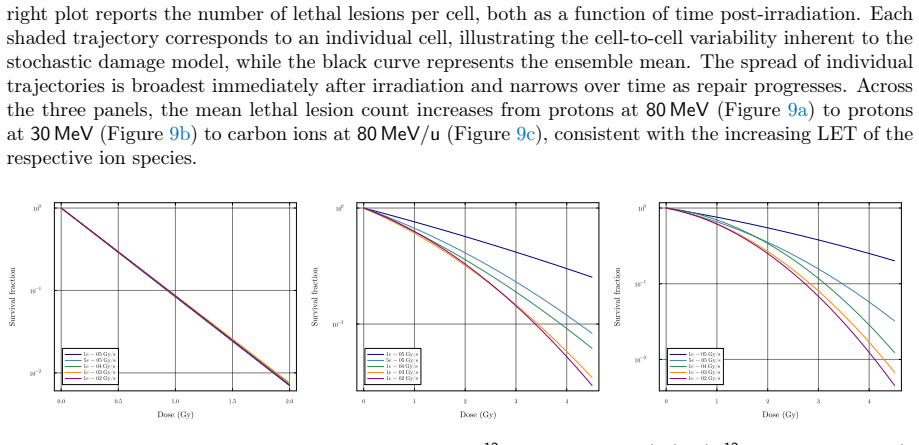
- Cell survival depends on dose rate over four orders of magnitude because of the explicit balance between stochastic damage induction and repair kinetics.
- Dose-rate dependence weakens at high LET because the model produces more complex, less repairable lesions from carbon ions than from protons.
- An inverse dose-rate effect appears in split-dose irradiation as a direct result of cell-cycle progression and repair occurring between fractions.
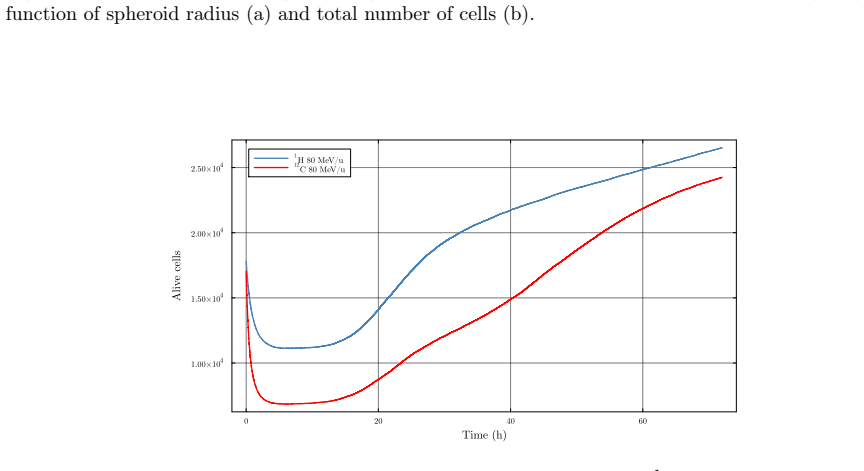
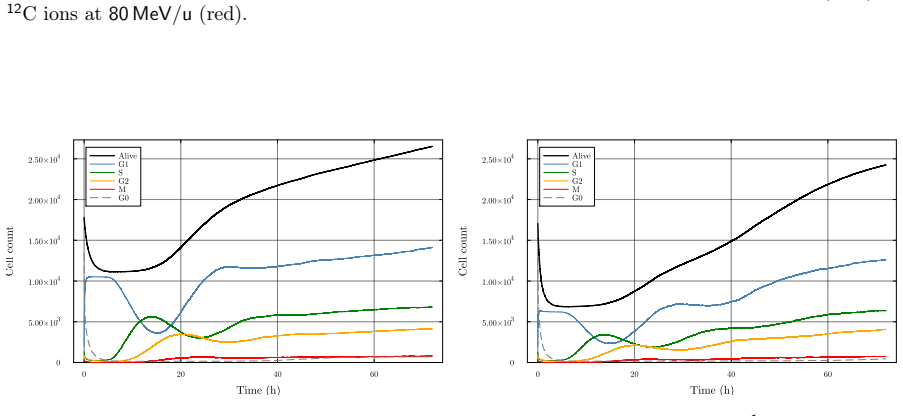
- Spatiotemporal maps of cell-cycle phase composition and spheroid volume growth can be generated for 1H and 12C ions at different energies and dose rates.
- The next-event algorithm scales efficiently to large cell populations while retaining full single-cell resolution.
Where Pith is reading between the lines
- The same explicit coupling could be used to explore how varying oxygenation gradients inside spheroids alter overall response without introducing new parameters.
- Adding explicit spatial interactions between neighboring agents would allow the framework to test bystander or abscopal effects that current non-interacting simulations omit.
- Running the model on clinical beam time structures could identify fractionation schedules that exploit the inverse dose-rate effect for therapeutic gain.
- Comparison of predicted versus measured survival in additional cell lines would test how portable the GSM2-derived rates are beyond the spheroid systems studied here.
Load-bearing premise
The parameters and transition rates of the underlying GSM2 model accurately capture the stochastic processes of radiation damage induction, repair, misrepair, and cell-cycle progression for the cell types and irradiation conditions considered in the simulations.
What would settle it
Direct comparison of simulated cell survival curves and cell-cycle phase distributions against experimental data for proton or carbon ion irradiation of tumor spheroids at varying dose rates and split-dose intervals; mismatch at conditions where repair kinetics or cell-cycle progression dominate would falsify the claim that the trends emerge without correction factors.
Figures






read the original abstract
Accurately linking microscopic energy deposition from ionizing radiation to emergent biological outcomes remains a central challenge in radiobiological modelling, particularly when stochastic damage induction, cell-cycle dynamics, and spatial organisation within irradiated tissues must be treated explicitly and consistently across scales. To address this, we introduce a stochastic agent-based radiobiological modelling framework for simulating biological response to particle irradiation, developed as an explicit single-cell extension of the Generalized Stochastic Microdosimetric Model (GSM2). Each cell is represented as an autonomous agent whose internal state, including DNA lesion counts, cell-cycle phase, and oxygenation level, evolves according to a continuous-time Markov chain driven by GSM2 transition rates. Radiation-induced damage induction, repair, misrepair, cell-cycle progression, proliferation, and migration are treated as competing stochastic events resolved through a next-event, event-driven algorithm, which provides computationally efficient scaling with system size while preserving full single-cell resolution. The framework is applied to three-dimensional tumour spheroids irradiated with 1H and 12C ions across a range of energies and dose rates. We characterise the spatiotemporal evolution of cell-cycle phase composition and spheroid volume following irradiation, and examine the dependence of cell survival on dose rate over four orders of magnitude. Several empirically established trends in biological response, including the dose-rate dependence of cell survival, its attenuation at high LET, and the inverse dose rate effect in split-dose irradiation, emerge from the model through the explicit coupling of particle arrivals, damage accumulation, and repair kinetics, without recourse to empirical correction factors as typically done.
Editorial analysis
A structured set of objections, weighed in public.
Referee Report
Summary. The manuscript introduces a stochastic agent-based extension of the GSM2 model for particle therapy simulations in 3D tumor spheroids. Individual cells are modeled as autonomous agents whose internal states (DNA lesion counts, cell-cycle phase, oxygenation) evolve via a continuous-time Markov chain using transition rates from the original GSM2. Radiation damage induction, repair, misrepair, proliferation, and migration are treated as competing stochastic events in a next-event algorithm. The framework is applied to 1H and 12C ion irradiation across energies and four orders of magnitude in dose rate, characterizing cell-cycle composition, spheroid volume evolution, and cell survival. The central claim is that dose-rate dependence of survival, its attenuation at high LET, and the inverse dose-rate effect in split-dose irradiation emerge mechanistically from explicit coupling of particle arrivals, damage accumulation, and repair kinetics without empirical correction factors.
Significance. If the central claim holds after validation, the work offers a mechanistic, scale-bridging framework for radiobiological modeling in particle therapy that avoids ad-hoc empirical corrections common in other approaches. The explicit stochastic treatment of single-cell dynamics and spatial organization in spheroids is a notable strength, with potential to improve predictions for dose-rate and fractionation effects. However, the significance is currently limited by the absence of quantitative validation details and sensitivity analysis for parameter transferability, which are needed to confirm that observed trends arise independently rather than from inherited inputs.
major comments (3)
- [Model description (GSM2 extension and CTMC rates)] Model description section (GSM2 extension and CTMC rates): The transition rates governing damage induction, repair, misrepair, cell-cycle progression, proliferation, and migration are adopted directly from the prior GSM2 model with no reported re-derivation, sensitivity analysis, or re-calibration for the specific 3D spheroid cell types, 1H/12C energies, or dose-rate range. This is load-bearing for the abstract claim that trends 'emerge ... without recourse to empirical correction factors,' because the rates may embed empirical dependencies from GSM2's original calibration to other cell lines or conditions, undermining the independence of the new coupling and agent rules.
- [Results on dose-rate dependence and LET attenuation] Results on dose-rate dependence and LET attenuation: The survival curves and their dose-rate dependence (four orders of magnitude) and attenuation at high LET are presented as emergent, but the manuscript provides no quantitative comparisons to experimental survival data for the same spheroid system, no error metrics, and no sensitivity tests on rate variations. Without these, it is not possible to assess whether the trends are robustly reproduced or how strongly they support the mechanistic claim over parameter inheritance.
- [Fractionation and inverse dose-rate effect section] Fractionation and inverse dose-rate effect section: The simulation of split-dose irradiation and emergence of the inverse dose-rate effect is described at a high level, but lacks specific details on the event-driven algorithm implementation (e.g., how inter-dose timing interacts with repair kinetics in the Markov chain) or supporting figures showing time-resolved lesion counts and competing event rates that produce the effect. This detail is needed to evaluate the mechanistic explanation.
minor comments (2)
- [Abstract and introduction] The abstract and introduction could more explicitly state the cell line or spheroid model used in the simulations to allow readers to assess transferability.
- [Figures] Figures showing survival curves and cell-cycle distributions should include clear legends distinguishing model predictions from any reference data and report the number of simulated cells or realizations for statistical reliability.
Simulated Author's Rebuttal
We thank the referee for their constructive and detailed comments, which have identified important areas for improving the clarity, transparency, and support for the mechanistic claims in our manuscript. We address each major comment below and outline the revisions we will make.
read point-by-point responses
-
Referee: Model description section (GSM2 extension and CTMC rates): The transition rates governing damage induction, repair, misrepair, cell-cycle progression, proliferation, and migration are adopted directly from the prior GSM2 model with no reported re-derivation, sensitivity analysis, or re-calibration for the specific 3D spheroid cell types, 1H/12C energies, or dose-rate range. This is load-bearing for the abstract claim that trends 'emerge ... without recourse to empirical correction factors,' because the rates may embed empirical dependencies from GSM2's original calibration to other cell lines or conditions, undermining the independence of the new coupling and agent rules.
Authors: The transition rates are indeed taken from the established GSM2 framework, which itself is grounded in radiobiological mechanisms calibrated to a broad set of cell-line data. The central advance of the present work is the stochastic agent-based extension that treats damage induction, repair, and other processes as competing events within an explicit 3D spatial context, allowing dose-rate and fractionation effects to arise directly from the timing of particle arrivals and repair kinetics. To address the concern about parameter transparency and potential inherited dependencies, we will add a dedicated subsection in the Model Description that tabulates each rate, its GSM2 source reference, and the original calibration conditions. We will also perform and report a sensitivity analysis in which key rates are varied within their documented uncertainties to demonstrate that the qualitative trends in survival, dose-rate dependence, and LET attenuation are robust features of the coupling rules rather than fine-tuned values. revision: yes
-
Referee: Results on dose-rate dependence and LET attenuation: The survival curves and their dose-rate dependence (four orders of magnitude) and attenuation at high LET are presented as emergent, but the manuscript provides no quantitative comparisons to experimental survival data for the same spheroid system, no error metrics, and no sensitivity tests on rate variations. Without these, it is not possible to assess whether the trends are robustly reproduced or how strongly they support the mechanistic claim over parameter inheritance.
Authors: The manuscript currently emphasizes the mechanistic emergence of established radiobiological trends through direct simulation rather than quantitative fitting to new experimental datasets. The simulated dose-rate and LET dependencies reproduce the direction and functional form of trends reported in the particle-therapy literature. In the revised version we will add quantitative comparisons to published survival data for proton- and carbon-ion-irradiated spheroids of comparable size and cell type, together with error metrics (RMSE and, where appropriate, chi-squared values). We will also include the results of the sensitivity analysis on rate parameters mentioned above, thereby providing a direct assessment of robustness independent of any single parameter set. revision: yes
-
Referee: Fractionation and inverse dose-rate effect section: The simulation of split-dose irradiation and emergence of the inverse dose-rate effect is described at a high level, but lacks specific details on the event-driven algorithm implementation (e.g., how inter-dose timing interacts with repair kinetics in the Markov chain) or supporting figures showing time-resolved lesion counts and competing event rates that produce the effect. This detail is needed to evaluate the mechanistic explanation.
Authors: We agree that a more explicit description of the algorithmic implementation is required to substantiate the mechanistic account. We will expand the Methods section with a step-by-step account of the next-event algorithm, including the precise manner in which the continuous-time Markov chain is advanced across inter-fraction intervals and how repair, misrepair, and other competing transitions are sampled during those intervals. In addition, we will include supplementary figures that display the time-resolved evolution of mean lesion counts per cell, the instantaneous rates of repair versus other events, and the cumulative probability of competing processes throughout the split-dose protocol, thereby illustrating how incomplete repair between fractions produces the inverse dose-rate effect. revision: yes
Circularity Check
Dose-rate and fractionation trends 'emerge' from GSM2 transition rates imported without re-calibration or independent validation for spheroids
specific steps
-
fitted input called prediction
[Abstract]
"Each cell is represented as an autonomous agent whose internal state, including DNA lesion counts, cell-cycle phase, and oxygenation level, evolves according to a continuous-time Markov chain driven by GSM2 transition rates. ... Several empirically established trends in biological response, including the dose-rate dependence of cell survival, its attenuation at high LET, and the inverse dose rate effect in split-dose irradiation, emerge from the model through the explicit coupling of particle arrivals, damage accumulation, and repair kinetics, without recourse to empirical correction factors."
The trends are presented as emerging from the new explicit coupling and agent rules. However, all competing stochastic events (damage induction, repair, misrepair, cell-cycle progression, proliferation, migration) are governed by the GSM2 transition rates imported unchanged. If those rates were previously fitted to match experimental cell survival or repair kinetics (standard practice for continuous-time Markov chain radiobiology models), then dose-rate dependence and fractionation effects are statistically forced by the input rates rather than independently predicted by the extension. The 'without empirical correction factors' phrasing highlights the absence of ad-hoc terms but does not address that the core rates themselves carry the empirical calibration from the prior GSM2 work.
full rationale
The paper's strongest claim is that dose-rate dependence, LET attenuation, and inverse dose-rate effects in split-dose irradiation arise mechanistically from explicit coupling of particle arrivals, damage accumulation, and repair kinetics in the agent-based extension, without empirical correction factors. However, the continuous-time Markov chain is driven by GSM2 transition rates for damage induction, repair, misrepair, cell-cycle progression, proliferation, and migration, taken directly from the prior model. The abstract and framework description provide no re-derivation, sensitivity analysis, or direct comparison to experimental survival/cell-cycle data for the same 3D spheroid system and 1H/12C conditions. If GSM2 rates embed fits to other cell lines or conditions (as is standard for such Markov models), the observed trends inherit those empirical dependencies rather than constituting independent emergence. This matches the 'fitted input called prediction' pattern: parameters calibrated elsewhere are used to reproduce closely related quantities and presented as mechanistic prediction. No self-definitional equations or renaming of known results, but the load-bearing premise reduces to the transferability of prior rates. Central claim still has new spatial/agent content, so not full reduction to input (score 6, not 8-10).
Axiom & Free-Parameter Ledger
free parameters (1)
- GSM2 transition rates
axioms (2)
- domain assumption Individual cells can be represented as autonomous agents whose states evolve according to a continuous-time Markov chain.
- domain assumption Radiation-induced damage, repair, and cell-cycle progression can be treated as competing stochastic events resolved by a next-event algorithm.
Reference graph
Works this paper leans on
-
[1]
(2015).Molecular Biology of the Cell
[Alberts et al., 2015] Alberts, B., Johnson, A., Lewis, J., Morgan, D., Raff, M., Roberts, K., and Walter, P. (2015).Molecular Biology of the Cell. Garland Science, New York, 6 edition. Chapter 17: The Cell Cycle. [Barnett et al., 2009] Barnett, G. C., West, C. M., Dunning, A. M., Elliott, R. M., Coles, C. E., Pharoah, P. D., and Burnet, N. G. (2009). Nor...
2015
-
[2]
A., Francis, Z., Guatelli, S., Ivanchenko, V
[Bernal et al., 2015] Bernal, M.A., Bordage, M.-C., Brown, J.M.C., Davídková, M., Delage, E., ElBitar, Z., Enger, S. A., Francis, Z., Guatelli, S., Ivanchenko, V. N., Karamitros, M., Kyriakou, I., Maigne, L., Meylan, S., Murakami, K., Okada, S., Payno, H., Perrot, Y., Petrovic, I., Pham, Q. T., Ristic-Fira, A., Sasaki, T., Štěpán, V., Tran, H. N., Villagr...
-
[3]
[Helm and Fournier, 2023] Helm, A
Philadelphia. [Helm and Fournier, 2023] Helm, A. and Fournier, C. (2023). High-let charged particles: Radiobiology and application for new approaches in radiotherapy.Strahlentherapie und Onkologie, 199:1225–1241. [Inaniwa and Kanematsu, 2018] Inaniwa, T. and Kanematsu, N. (2018). Adaptation of stochastic mi- crodosimetric kinetic model for charged-particl...
2023
-
[4]
[Lea and Catcheside, 1942] Lea, D. E. and Catcheside, D. G. (1942). The mechanism of the induction by radiation of chromosome aberrations in tradescantia.Journal of Genetics, 44:216–245. [McMahon, 2018] McMahon, S. J. (2018). The linear quadratic model: usage, interpretation and chal- lenges.Physics in Medicine & Biology, 64(1):01TR01. [Missiaggia et al.,...
1942
discussion (0)
Sign in with ORCID, Apple, or X to comment. Anyone can read and Pith papers without signing in.