Recognition: unknown
MSR:Hybrid Field Modeling for CT-MRI Rigid-Deformable Registration of the Cervical Spine with an Annotated Dataset
Pith reviewed 2026-05-07 07:05 UTC · model grok-4.3
The pith
A hybrid registration framework fuses per-vertebra rigid alignments with a gated Mamba-Swin deformable model to improve CT-MRI matching of the cervical spine.
A machine-rendered reading of the paper's core claim, the machinery that carries it, and where it could break.
Core claim
MSR achieves hybrid field modeling for CT-MRI rigid-deformable registration of the cervical spine by first performing independent local rigid alignment of individual vertebrae and then using an MSL block to generate a deformable field that integrates Mamba-based global modeling with Swin Transformer-based local modeling via adaptive gating. The rigid and deformable deformation fields are fused to produce a hybrid field that better preserves local anatomical consistency in this anatomically complex region.
What carries the argument
The MSL block that adaptively gates Mamba-based global modeling with Swin Transformer-based local modeling, together with the fusion of rigid and deformable deformation fields into a hybrid field.
Load-bearing premise
That the proposed MSL block and subsequent rigid-deformable fusion will produce deformation fields that are both more accurate and more anatomically plausible than existing rigid-only or deformable-only methods for cervical spine CT-MRI pairs.
What would settle it
A direct comparison on the released R-D-Reg dataset showing that the hybrid method does not improve target registration error or anatomical plausibility metrics over the best existing rigid or deformable baseline methods.
Figures


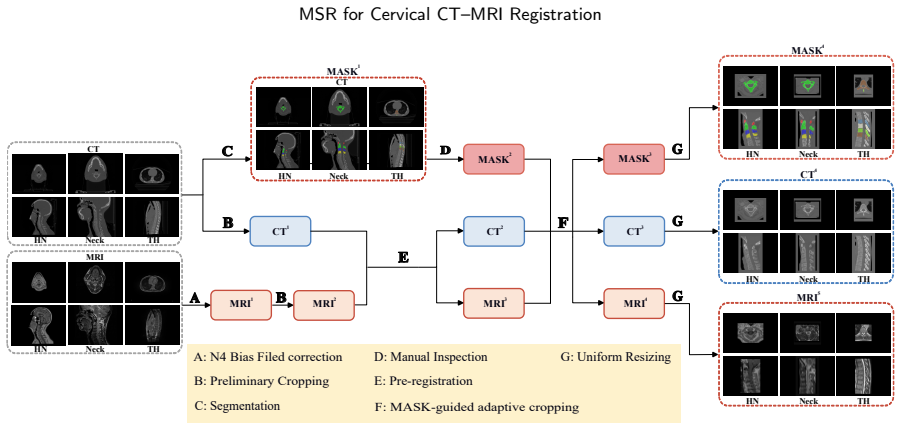


read the original abstract
Accurate CT-MRI registration of the cervical spine is essential for preoperative planning because this region is anatomically complex,highly variable,and vulnerable to injury of the vertebral arteries and spinal cord. However,cervical CT-MRI registration remains underexplored,particularly for rigid-deformable hybrid modeling,and the lack of high-quality annotated multimodal data further limits progress. To address these challenges, we construct and release a comprehensively annotated CT-MRI dataset, R-D-Reg, and propose MSR, a rigid-deformable hybrid registration framework for complex joint structures. Specifically, MSR includes a rigid registration module for independent local rigid alignment of individual vertebrae and a deformable registration module with an MSL block that combines Mamba-based global modeling and Swin Transformer-based local modeling through adaptive gating. The rigid and deformable deformation fields are then fused to generate a hybrid field that better preserves local anatomical consistency. The code and dataset are publicly available at https://github.com/ssc1230609-spec/MSR-registration.
Editorial analysis
A structured set of objections, weighed in public.
Referee Report
Summary. The manuscript claims to address the underexplored problem of CT-MRI rigid-deformable registration for the cervical spine by releasing the annotated R-D-Reg dataset and introducing the MSR framework. MSR features a rigid module for per-vertebra alignment, a deformable module with an MSL block integrating Mamba global and Swin local modeling via adaptive gating, and fusion of the deformation fields into a hybrid field that purportedly better preserves local anatomical consistency.
Significance. Should the quantitative evaluations confirm improved registration accuracy and anatomical fidelity, the work would contribute to medical image registration by providing both data and a hybrid modeling approach tailored to bony structures with soft tissue variability. The public availability of the dataset and code strengthens its potential impact in the field.
major comments (2)
- [Abstract] The abstract provides no quantitative results, baseline comparisons, ablation studies, or error metrics to support the assertion that the hybrid field improves consistency. The central claim cannot be evaluated from the description alone.
- [MSR framework (fusion step)] The fusion of independent per-vertebra rigid fields with the global deformable field is not accompanied by any described mechanism, such as mask-based blending or rigidity-preserving regularization, to ensure the resulting field remains rigid within each vertebra. Without this, the deformable component may introduce non-rigid deformations inside bony anatomy, violating the physical constraint that bones do not deform and potentially affecting clinical safety near the spinal cord.
minor comments (2)
- [Abstract] Typographical errors: missing spaces after commas, e.g., 'complex,highly variable,and vulnerable'.
- [Abstract] The 'MSL block' acronym is not expanded; provide its full form or definition.
Simulated Author's Rebuttal
We thank the referee for the constructive comments on our manuscript regarding CT-MRI registration for the cervical spine. We appreciate the recognition of the dataset and framework's potential impact. We provide point-by-point responses to the major comments below.
read point-by-point responses
-
Referee: [Abstract] The abstract provides no quantitative results, baseline comparisons, ablation studies, or error metrics to support the assertion that the hybrid field improves consistency. The central claim cannot be evaluated from the description alone.
Authors: We agree with the referee that the abstract should be more informative. In the revised version, we will update the abstract to include quantitative results, such as the main registration error metrics, baseline comparisons, and key findings from ablation studies on the hybrid modeling approach. This will enable readers to better evaluate the central claims. revision: yes
-
Referee: [MSR framework (fusion step)] The fusion of independent per-vertebra rigid fields with the global deformable field is not accompanied by any described mechanism, such as mask-based blending or rigidity-preserving regularization, to ensure the resulting field remains rigid within each vertebra. Without this, the deformable component may introduce non-rigid deformations inside bony anatomy, violating the physical constraint that bones do not deform and potentially affecting clinical safety near the spinal cord.
Authors: This comment highlights an important aspect of our method that needs clarification. The current manuscript briefly mentions the fusion but does not detail the mechanism. We will revise the description of the fusion step to explicitly include the blending strategy using vertebral masks and any regularization terms that enforce rigidity within the bony structures. This will ensure the hybrid field respects the non-deformable nature of bones and maintains safety considerations. revision: yes
Circularity Check
No circularity: novel hybrid registration constructed from independent components
full rationale
The paper introduces a new annotated dataset (R-D-Reg) and a new MSR framework whose core steps are: (1) per-vertebra rigid alignment, (2) a deformable module whose MSL block is defined as the combination of Mamba global modeling and Swin Transformer local modeling via adaptive gating, and (3) fusion of the two resulting fields. None of these steps is shown to reduce, by equation or by self-citation, to a re-expression of the target quantity. No fitted parameter is relabeled as a prediction, no uniqueness theorem is imported from prior author work, and no ansatz is smuggled via citation. The claim that the fused hybrid field “better preserves local anatomical consistency” is presented as an empirical outcome of the new architecture rather than a definitional identity. The derivation chain is therefore self-contained and does not exhibit any of the enumerated circular patterns.
Axiom & Free-Parameter Ledger
axioms (1)
- domain assumption Hybrid rigid-deformable fusion via the MSL block preserves local anatomical consistency better than rigid-only or deformable-only registration for cervical spine CT-MRI pairs.
Reference graph
Works this paper leans on
-
[1]
Mamba: Linear-Time Sequence Modeling with Selective State Spaces
Mairnet: weakly supervised anatomy-aware multimodal artic- ulated image registration network. International Journal of Computer Assisted Radiology and Surgery 19, 507–517. Garg, P., 2024. Bone microarchitectural, cellular and transcriptomic changesinasimulationmodelofmicrogravityandevaluationofasolu- blefactorlikelytocounterboneandmusclelossinhindlimbunlo...
work page internal anchor Pith review arXiv 2024
-
[2]
10012–10022
Swin transformer: Hierarchical vision transformer using shifted windows,in: Proceedingsof theIEEE/CVFinternational conferenceon computer vision, pp. 10012–10022. Luong, D.V., Rueckert, D., Rustem, B., 2011. Incorporating hard con- straintsinto non-rigidregistrationvianonlinear programming,in:Med- ical Imaging 2011: Image Processing, SPIE. pp. 298–308. Ngu...
2011
-
[3]
Medical physics 52, e17981
Synthrad2025 grand challenge dataset: Generating synthetic cts for radiotherapy from head to abdomen. Medical physics 52, e17981. Wang, Y., Guo, T., Yuan, W., Shu, S., Meng, C., Bai, X., 2025. Mamba- based deformable medical image registration with an annotated brain mr-ct dataset. Computerized Medical Imaging and Graphics 123, 102566. Wasserthal, J., Bre...
2025
discussion (0)
Sign in with ORCID, Apple, or X to comment. Anyone can read and Pith papers without signing in.