Recognition: unknown
Mechanistic driven TCP and NTCP modeling for particle therapy accounting for a broad range of physical irradiation parameters and tissue environmental conditions
Pith reviewed 2026-05-07 06:39 UTC · model grok-4.3
The pith
Extending the GSM2 model to cell populations enables mechanistic prediction of TCP and NTCP in particle therapy accounting for physical and environmental parameters.
A machine-rendered reading of the paper's core claim, the machinery that carries it, and where it could break.
Core claim
The authors extend the biological stage of the GSM2 model, which tracks DNA lesion evolution in a cell nucleus via microdosimetric principles, to larger scales involving cell populations. This single-cell resolution framework accounts for energy deposition variations and tissue heterogeneities, enabling predictions of side effects in healthy tissues and tumor responses under different radiation qualities and fractionation schemes.
What carries the argument
The extended GSM2 model applied to cell populations with defined geometric and functional architecture, which simulates stochastic radiation damage from microdosimetry to macroscopic tissue responses.
If this is right
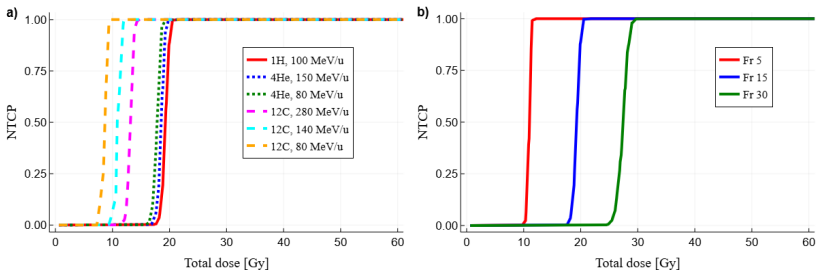
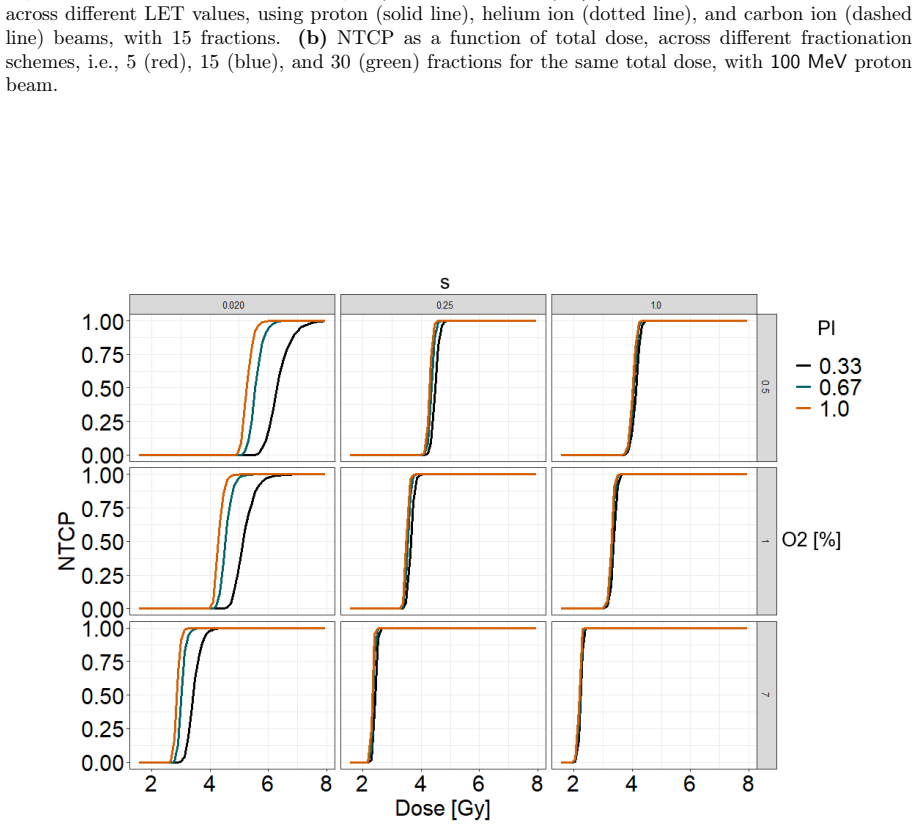
- The model reveals the interplay between radiation quality (type, energy, LET) and tissue environmental conditions in inducing side effects.
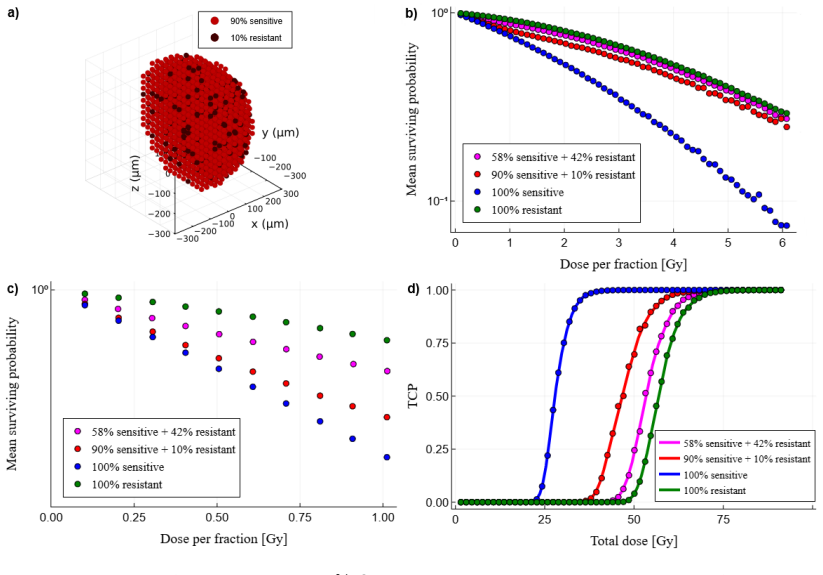
- It allows for the inclusion of biochemical heterogeneities in predicting tumor response.
- Different fractionation schemes can be evaluated for their impact on both TCP and NTCP.
- Organ volume effects and cell type distributions are explicitly considered in the calculations.
Where Pith is reading between the lines
- This approach might enable more precise personalization of particle therapy plans based on individual patient tissue characteristics.
- It could facilitate better comparisons between different particle beams, such as protons and heavier ions, in clinical settings.
- The model provides a foundation for integrating additional biological factors like repair kinetics across tissue scales.
- Validation against clinical data could lead to refined treatment planning systems.
Load-bearing premise
The stochastic microdosimetric principles at the cell nucleus can be accurately scaled to macroscopic tissue organizations with the assumed geometric and functional cell population architecture representing real tissues.
What would settle it
Direct comparison of the model's predicted TCP and NTCP values with observed clinical outcomes for patients treated with particle therapy under varying conditions, such as different LET values or oxygenation levels.
Figures




read the original abstract
In conventional radiotherapy, the probability of controlling tumor growth is quantified using Tumor Control Probability (TCP) models. Instead, the probability of experiencing a side effect after the irradiation of healthy tissues and organs is typically assessed using the concept of Normal Tissue Complication Probability (NTCP), an additional crucial metric for evaluating and comparing treatment plans. This work is dedicated to the development, implementation, and application of a general mechanistic model to describe the effects of particle therapy (PT) on different tissue organizations beyond Poissonian assumptions, extending the Generalized Stochastic Microdosimetric Model (GSM2), i.e., a stochastic radiobiological model that describes the time evolution of DNA lesions in a cell nucleus according to microdosimetric principles, to the study of macroscopic biological systems. Specifically, we extend the biological stage of radiation damage of the GSM2 model to larger spatial and temporal scales, involving cell populations with a specific geometric and functional architecture. The model's single-cell resolution allows it to account for energy deposition and tissue heterogeneity, considering different organ volume effects, cell type distributions, and oxygen gradients for different radiation qualities of the beam, that is, type, energy, and LET of radiation, and various fractionation schemes. We show the interplay between physical and environmental parameters on the induction of side effects on healthy tissues, for different radiation qualities and fractionation schemes, and we highlight the impact of biochemical heterogeneities in the target environment, for tumor response.
Editorial analysis
A structured set of objections, weighed in public.
Referee Report
Summary. The manuscript develops a mechanistic model for Tumor Control Probability (TCP) and Normal Tissue Complication Probability (NTCP) in particle therapy by extending the Generalized Stochastic Microdosimetric Model (GSM2) from single-nucleus lesion kinetics to cell populations with explicit geometric and functional architectures. The extension incorporates tissue heterogeneity, organ volume effects, cell-type distributions, oxygen gradients, radiation quality (type, energy, LET), and fractionation schemes, with the goal of demonstrating parameter interplay on healthy-tissue side effects and tumor response beyond Poissonian assumptions.
Significance. If the aggregation from single-cell stochastic outcomes to organ-level probabilities can be shown to preserve microdosimetric fidelity without effective averaging or new free parameters, the work would offer a substantive advance over conventional LQ-based TCP/NTCP models by enabling mechanistic predictions that explicitly resolve energy deposition, hypoxia, and architectural heterogeneity across particle beams. The approach builds directly on the cited GSM2 framework and targets a clinically relevant gap in particle-therapy planning.
major comments (3)
- [Model Extension] The central extension of GSM2 lesion kinetics to tissue-scale cell populations (described in the model-development section) lacks an explicit derivation or numerical scheme for propagating stochastic single-cell outcomes into macroscopic TCP/NTCP while retaining spatial correlations in energy deposition. Without this, it is unclear whether the claimed single-cell resolution collapses to conventional averaging when cell architectures and oxygen gradients are imposed.
- [Results / Validation] No quantitative validation is reported against experimental or clinical data on volume effects, hypoxia-induced radioresistance, or fractionation response for different LET values. The manuscript must demonstrate that the chosen geometric and functional architectures reproduce known tissue-level phenomena without additional free parameters; otherwise the mechanistic advantage over existing models remains unproven.
- [Discussion] The assumption that microdosimetric stochastic principles at the nucleus level extend to macroscopic tissue organizations without significant loss of fidelity is load-bearing for the entire claim. The paper should include a sensitivity analysis on architecture choices and an explicit check that oxygen-gradient and cell-type heterogeneity effects emerge from the single-cell rules rather than being imposed externally.
minor comments (2)
- [Abstract] The abstract states that the model 'shows the interplay' between parameters but provides no quantitative highlights or key numerical outcomes; adding one or two concrete findings would improve reader assessment.
- [Notation / Figures] Ensure uniform definition and consistent use of acronyms (GSM2, LET, TCP, NTCP) on first appearance in the main text and figure captions.
Simulated Author's Rebuttal
We thank the referee for the detailed and constructive comments on our manuscript. We provide point-by-point responses to the major comments and describe the revisions planned for the next version of the paper.
read point-by-point responses
-
Referee: [Model Extension] The central extension of GSM2 lesion kinetics to tissue-scale cell populations (described in the model-development section) lacks an explicit derivation or numerical scheme for propagating stochastic single-cell outcomes into macroscopic TCP/NTCP while retaining spatial correlations in energy deposition. Without this, it is unclear whether the claimed single-cell resolution collapses to conventional averaging when cell architectures and oxygen gradients are imposed.
Authors: We agree that an explicit derivation would strengthen the presentation. In the revised manuscript, the model-development section will be expanded with a step-by-step mathematical derivation showing how single-cell stochastic lesion outcomes from GSM2 are aggregated to tissue-level TCP/NTCP. The scheme preserves spatial correlations by sampling microdosimetric events within the explicit geometric cell architectures and oxygen gradient fields; population-level probabilities are obtained by Monte Carlo integration over the organ volume using only the original GSM2 parameters and literature-based cell-type responses, without new free parameters. Pseudocode and a flowchart of the numerical implementation will be added to demonstrate that the single-cell resolution is retained rather than reduced to averaging. revision: yes
-
Referee: [Results / Validation] No quantitative validation is reported against experimental or clinical data on volume effects, hypoxia-induced radioresistance, or fractionation response for different LET values. The manuscript must demonstrate that the chosen geometric and functional architectures reproduce known tissue-level phenomena without additional free parameters; otherwise the mechanistic advantage over existing models remains unproven.
Authors: The current work centers on model development and simulation-based exploration of parameter interplay. We acknowledge the importance of validation. In revision we will add quantitative comparisons in the results section to established literature benchmarks for volume effects (e.g., NTCP scaling with irradiated volume) and hypoxia/LET-dependent radioresistance, using the model to reproduce reported trends without introducing new parameters. These additions will illustrate the mechanistic advantage. Direct fitting to new clinical datasets lies outside the scope of this modeling study and is noted as future work. revision: partial
-
Referee: [Discussion] The assumption that microdosimetric stochastic principles at the nucleus level extend to macroscopic tissue organizations without significant loss of fidelity is load-bearing for the entire claim. The paper should include a sensitivity analysis on architecture choices and an explicit check that oxygen-gradient and cell-type heterogeneity effects emerge from the single-cell rules rather than being imposed externally.
Authors: We will revise the discussion to include a sensitivity analysis on architectural parameters (cell packing density, oxygen gradient steepness, and cell-type fractions). By comparing TCP/NTCP predictions for homogeneous versus heterogeneous configurations, we will show that the effects of oxygen gradients and cell-type distributions arise directly from applying the GSM2 single-cell lesion kinetics rules across the spatially distributed populations, rather than being externally imposed. This analysis will be presented with quantitative metrics to confirm emergence from the microdosimetric foundation. revision: yes
Circularity Check
GSM2 extension adds independent tissue-scale architecture and aggregation rules; self-citation to base model is not load-bearing
full rationale
The paper starts from the established GSM2 stochastic microdosimetric model at the single-nucleus level and extends it by introducing explicit geometric and functional cell-population architectures, cell-type distributions, oxygen gradients, and volume-effect handling to compute macroscopic TCP/NTCP. These additions constitute new structural assumptions and aggregation steps that are not defined in terms of the final TCP/NTCP outputs themselves. No equations in the abstract or described derivation reduce by construction to fitted parameters or prior outputs. Self-citations to GSM2 supply the microscopic lesion kinetics but do not carry the load-bearing claim about tissue-scale fidelity; the central extension remains independently falsifiable against experimental data under varying LET, fractionation, and hypoxia. This yields only minor self-citation without circular reduction of the main result.
Axiom & Free-Parameter Ledger
Reference graph
Works this paper leans on
-
[1]
S. Webb, A. E. Nahum, A model for calculating tumour control probability in radiotherapy including the effects of inhomogeneous distributions of dose and clonogenic cell density, Physics in medicine & biology 38 (6) (1993) 653.doi:10.1088/0031-9155/38/6/001
-
[2]
Källman, A
P. Källman, A. Ågren, A. Brahme, Tumour and normal tissue responses to fractionated non-uniform dose delivery, International journal of radiation biology 62 (2) (1992) 249–262
1992
-
[3]
A. Niemierko, M. Goitein, Implementation of a model for estimating tumor control probability for an inhomogeneously irradiated tumor, Radiotherapy and Oncology 29 (2) (1993) 140–147.doi:https: //doi.org/10.1016/0167-8140(93)90239-5
-
[4]
De Ruysscher, G
D. De Ruysscher, G. Niedermann, N. G. Burnet, S. Siva, A. W. Lee, F. Hegi-Johnson, Radiother- apy toxicity, Nature reviews Disease primers 5 (1) (2019) 13.doi:https://doi.org/10.1038/ s41572-019-0064-5
2019
-
[5]
D. E. Citrin, R. D. Timmerman, Effects of radiotherapy in normal tissue, New England Journal of Medicine 394 (10) (2026) 996–1009.doi:10.1056/NEJMra2506017
-
[7]
S. Bidanta, K. Börner, B. W. Herr Ii, E. M. Quardokus, M. Nagy, K. S. Gustilo, R. Bajema, E. Maier, R. Molontay, G. M. Weber, Functional tissue units in the human reference atlas, Nature Communications 16 (1) (2025) 1526.doi:https://doi.org/10.1038/s41467-024-54591-6
-
[8]
M. Scholz, Dose response of biological systems to low- and high-let radiation, in: Microdosimetric response of physical and biological systems to low- and high-LET radiations, Elsevier, 2006, pp. 1–73.doi:https://doi.org/10.1016/B978-044451643-5/50013-7
-
[9]
H. R. Withers, J. M. Taylor, B. Maciejewski, Treatment volume and tissue tolerance, International Journal of Radiation Oncology* Biology* Physics 14 (4) (1988) 751–759.doi:https://doi.org/ 10.1016/0360-3016(88)90098-3
-
[10]
M. Battestini, M. Schwarz, M. Krämer, E. Scifoni, Including volume effects in biological treatment plan optimization for carbon ion therapy: Generalized equivalent uniform dose-based objective in trip98, Frontiers in Oncology 12 (2022) 555.doi:https://doi.org/10.3389/fonc.2022.826414
-
[11]
Niemierko, A generalized concept of equivalent uniform dose (eud), Medical Physics 26 (6) (1999) 1100
A. Niemierko, A generalized concept of equivalent uniform dose (eud), Medical Physics 26 (6) (1999) 1100
1999
-
[12]
B. Emami, J. Lyman, A. Brown, L. Cola, M. Goitein, J. Munzenrider, B. Shank, L. Solin, M. Wesson, Tolerance of normal tissue to therapeutic irradiation, International Journal of Radiation Oncology* Biology* Physics 21 (1) (1991) 109–122.doi:https://doi.org/10.1016/0360-3016(91)90171-Y
-
[13]
C. Burman, G. Kutcher, B. Emami, M. Goitein, Fitting of normal tissue tolerance data to an analytic function, International Journal of Radiation Oncology* Biology* Physics 21 (1) (1991) 123–135. doi:https://doi.org/10.1016/0360-3016(91)90172-Z
-
[14]
G. Fellin, C. Fiorino, T. Rancati, V. Vavassori, M. Baccolini, C. Bianchi, E. Cagna, P. Gabriele, F. Mauro, L. Menegotti, et al., Clinical and dosimetric predictors of late rectal toxicity after con- formal radiation for localized prostate cancer: results of a large multicenter observational study, Radiotherapy and Oncology 93 (2) (2009) 197–202.doi:https...
-
[15]
G. J. Kutcher, C. Burman, Calculation of complication probability factors for non-uniform nor- mal tissue irradiation: the effective volume method, International Journal of Radiation Oncology - Biology - Physics 16 (1989) 1623–1630.doi:https://doi.org/10.1016/0360-3016(89)90972-3
-
[16]
Zaider, B
M. Zaider, B. H. H. Rossi, M. Zaider, Microdosimetry and its Applications, Springer, 1996
1996
-
[17]
V. E. Bellinzona, F. Cordoni, M. Missiaggia, F. Tommasino, E. Scifoni, C. La Tessa, A. Attili, Linking microdosimetric measurements to biological effectiveness in ion beam therapy: A review of theoretical aspects of mkm and other models, Frontiers in Physics 8 (2021).doi:https://doi.org/ 10.3389/fphy.2020.578492. 22
-
[18]
Y. Kase, T. Kanai, N. Matsufuji, Y. Furusawa, T. Elsässer, M. Scholz, Biophysical calculation of cell survival probabilities using amorphous track structure models for heavy-ion irradiation, Physics in Medicine & Biology 53 (1) (2007) 37.doi:10.1088/0031-9155/53/1/003
-
[19]
Pfuhl, T
T. Pfuhl, T. Friedrich, M. Scholz, Comprehensive comparison of local effect model iv predictions with the particle irradiation data ensemble, Medical Physics 49 (1) (2022) 714–726
2022
-
[20]
M. Scholz, Effects of ion radiation on cells and tissues, Radiation effects on polymers for biological use (2003) 95–155doi:https://doi.org/10.1007/3-540-45668-6_4
-
[21]
F. Cordoni, M. Missiaggia, A. Attili, S. Welford, E. Scifoni, C. La Tessa, Generalized stochastic microdosimetric model: The main formulation, Physical Review E 103 (1) (2021) 012412.doi: 10.1103/PhysRevE.103.012412
-
[22]
F. G. Cordoni, M. Missiaggia, E. Scifoni, C. La Tessa, Cell survival computation via the generalized stochastic microdosimetric model (gsm2); part i: The theoretical framework, Radiation Research 197 (3) (2022) 218–232.doi:https://doi.org/10.1667/RADE-21-00098.1
-
[23]
F. G. Cordoni, M. Missiaggia, C. La Tessa, E. Scifoni, Multiple levels of stochasticity accounted for in different radiation biophysical models: from physics to biology, International Journal of Radiation Biology (2022) 1–16doi:https://doi.org/10.1080/09553002.2023.2146230
-
[24]
Missiaggia, G
M. Missiaggia, G. Cartechini, E. Scifoni, M. Rovituso, F. Tommasino, E. Verroi, M. Durante, C. La Tessa, Microdosimetric measurements as a tool to assess potential in-field and out-of-field toxicity regions in proton therapy, Physics in Medicine & Biology 65 (24) (2020) 245024
2020
-
[25]
Missiaggia, E
M. Missiaggia, E. Pierobon, M. Castelluzzo, A. Perinelli, F. Cordoni, M. Centis Vignali, G. Borghi, E. Bellinzona, E. Scifoni, F. Tommasino, et al., A novel hybrid microdosimeter for radiation field characterization based on the tissue equivalent proportional counter detector and low gain avalanche detectors tracker: a feasibility study, Frontiers in Phys...
2021
-
[26]
Missiaggia, G
M. Missiaggia, G. Cartechini, F. Tommasino, E. Scifoni, C. La Tessa, Investigation of in-field and out-of-field radiation quality with microdosimetry and its impact on relative biological effectiveness in proton therapy, International Journal of Radiation Oncology* Biology* Physics 115 (5) (2023) 1269–1282
2023
-
[27]
G. Bordieri, M. Missiaggia, G. Cartechini, M. Battestini, L. Bronk, F. Guan, D. R. Grosshans, P. Rai, E. Scifoni, C. La Tessa, G. Lattanzi, F. G. Cordoni, Validation of the generalized stochastic microdosimetric model (gsm2) over a broad range of let and particle beam type: a unique model for accurate description of (therapy relevant) radiation qualities,...
-
[28]
M. Battestini, M. Missiaggia, A. Attili, F. Tommasino, C. La Tessa, F. G. Cordoni, E. Scifoni, Across the stages: a multiscale extension of the generalized stochastic microdosimetric model (ms-gsm2) to include the ultra-high dose rate, Frontiers in Physics 11 (2023).doi:10.3389/fphy.2023.1274064. URLhttps://www.frontiersin.org/articles/10.3389/fphy.2023.1274064
-
[29]
Battestini, M
M. Battestini, M. Missiaggia, S. Bolzoni, F. G. Cordoni, E. Scifoni, A multiscale radiation biophys- ical stochastic model describing the cell survival response at ultra-high dose rate under different oxygenations and radiation qualities, Radiotherapy and Oncology (2025)
2025
-
[31]
Bordieri, M
G. Bordieri, M. Missiaggia, G. Lattanzi, C. Villagrasa, Y. Perrot, F. G. Cordoni, Integrating nano- and micrometer-scale energy deposition models for mechanistic prediction of radiation-induced dna damage and cell survival, Computers in Biology and Medicine 199 (2025) 111330
2025
-
[32]
J. Kiefer, H. Straaten, A model of ion track structure based on classical collision dynamics (radiobi- ology application), Physics in Medicine & Biology 31 (11) (1986) 1201.doi:10.1088/0031-9155/ 31/11/002. 23
-
[33]
Chatterjee, H
A. Chatterjee, H. Schaefer, Microdosimetric structure of heavy ion tracks in tissue, Radiation and environmental biophysics 13 (3) (1976) 215–227
1976
-
[34]
rep., International Commission on Radiation Units and Measurements (2016)
ICRU, Icru report 90: Key data for ionizing-radiation dosimetry: Measurement standards and ap- plications, Tech. rep., International Commission on Radiation Units and Measurements (2016)
2016
-
[35]
Kundrát, W
P. Kundrát, W. Friedland, J. Becker, M. Eidemüller, A. Ottolenghi, G. Baiocco, Analytical formu- las representing track-structure simulations on dna damage induced by protons and light ions at radiotherapy-relevant energies, Scientific Reports 10 (1) (2020) 15775
2020
-
[36]
M. Missiaggia, F. G. Cordoni, E. Scifoni, C. L. Tessa, Cell Survival Computation via the Generalized Stochastic Microdosimetric Model (GSM2); Part II: Numerical Results, Radiation Research 201 (2) (2024) 104–114.doi:10.1667/RADE-22-00025.1.S1. URLhttps://doi.org/10.1667/RADE-22-00025.1.S1
-
[37]
E. R. Epp, H. Weiss, B. Djordjevic, A. Santomasso, The radiosensitivity of cultured mammalian cells exposed to single high intensity pulses of electrons in various concentrations of oxygen, Radiation research 52 (2) (1972) 324–332.doi:https://doi.org/10.2307/3573572
-
[38]
E. Scifoni, W. Tinganelli, W. K. Weyrather, M. Durante, A. Maier, M. Krämer, Including oxygen enhancement ratio in ion beam treatment planning: model implementation and experimental verifi- cation, Physics in Medicine & Biology 58 (11) (2013) 3871.doi:10.1088/0031-9155/58/11/3871. URLhttps://dx.doi.org/10.1088/0031-9155/58/11/3871
-
[39]
Bidanta, K
S. Bidanta, K. Börner, B. W. Herr, M. Nagy, K. S. Gustilo, R. Bajema, L. Maier, R. Molontay, G. Weber, et al., Functional tissue units in the human reference atlas, bioRxiv (2023)
2023
-
[40]
Niemierko, M
A. Niemierko, M. Goitein, Modeling of normal tissue response to radiation: the critical volume model, International Journal of Radiation Oncology* Biology* Physics 25 (1) (1993) 135–145
1993
-
[41]
A. Cometto, G. Russo, F. Bourhaleb, F. M. Milian, S. Giordanengo, F. Marchetto, R. Cirio, A. Attili, Direct evaluation of radiobiological parameters from clinical data in the case of ion beam therapy: An alternative approach to the relative biological effectiveness, Phys. Med. Biol. 59 (23) (2014) 7393–7417.doi:10.1088/0031-9155/59/23/7393
-
[42]
J. Bezanson, A. Edelman, S. Karpinski, V. B. Shah, Julia: A fresh approach to numerical computing, SIAM review 59 (1) (2017) 65–98.doi:https://doi.org/10.1137/141000671
-
[43]
W. K. Sinclair, Cyclic x-ray responses in mammalian cells in vitro, Radiation research 33 (3) (1968) 620–643
1968
-
[44]
F. G. Cordoni, On the emergence of the deviation from a poisson law in stochastic mathematical models for radiation-induced dna damage: A system size expansion, Entropy 25 (9) (2023) 1322
2023
-
[45]
M. Saager, P. Peschke, S. Brons, J. Debus, C. P. Karger, Determination of the proton rbe in the rat spinal cord: Is there an increase towards the end of the spread-out bragg peak?, Radiotherapy and Oncology 128 (1) (2018) 115–120.doi:https://doi.org/10.1016/j.radonc.2018.03.002. URLhttps://www.sciencedirect.com/science/article/pii/S0167814018301348
-
[46]
L. Hintz, C. Glowa, M. Saager, R. Euler-Lange, P. Peschke, S. Brons, R. Grün, M. Scholz, S. Mein, A. Mairani, J. Debus, C. P. Karger, Relative biological effectiveness of single and split helium ion doses inthe rat spinalcord increases stronglywith linear energytransfer, Radiotherapy and Oncology 170 (2022) 224–230.doi:https://doi.org/10.1016/j.radonc.202...
-
[47]
C. P. Karger, P. Peschke, R. Sanchez-Brandelik, M. Scholz, J. Debus, Radiation tolerance of the rat spinal cord after 6 and 18 fractions of photons and carbon ions: Experimental results and clinical implications, International Journal of Radiation Oncology*Biology*Physics 66 (5) (2006) 1488–1497. doi:https://doi.org/10.1016/j.ijrobp.2006.08.045. URLhttps:...
-
[48]
G. Barendsen, Dose fractionation, dose rate and iso-effect relationships for normal tissue responses, International Journal of Radiation Oncology* Biology* Physics 8 (11) (1982) 1981–1997.doi:https: //doi.org/10.1016/0360-3016(82)90459-X. 24
-
[49]
J. T. Lyman, Complication probability as assessed from dose-volume histograms, Radiation research 104 (2s) (1985) S13–S19.doi:https://doi.org/10.2307/3576626
-
[50]
G. Kutcher, C. Burman, L. Brewster, M. Goitein, R. Mohan, Histogram reduction method for calculating complication probabilities for three-dimensional treatment planning evaluations, Inter- national Journal of Radiation Oncology* Biology* Physics 21 (1) (1991) 137–146.doi:https: //doi.org/10.1016/0360-3016(91)90173-2
-
[51]
J. J. Kim, I. F. Tannock, Repopulation of cancer cells during therapy: an important cause of treatment failure, Nature Reviews Cancer 5 (7) (2005) 516–525
2005
-
[52]
F. G. Cordoni, M. Battestini, M. Missiaggia, A stochastic agent-based extension of the gsm2 model for particle therapy: cell-cycle dynamics, dose-rate dependence, and fractionation effectsSubmitted (2026)
2026
-
[53]
D. Schaue, E. L. Kachikwu, W. H. McBride, Cytokines in radiobiological responses: a review, Radiation research 178 (6) (2012) 505–523.doi:https://doi.org/10.1667/RR3031.1
-
[54]
C. E. Rübe, B. M. Freyter, G. Tewary, K. Roemer, M. Hecht, C. Rübe, Radiation dermatitis: radiation-induced effects on the structural and immunological barrier function of the epidermis, International Journal of Molecular Sciences 25 (6) (2024) 3320.doi:https://doi.org/10.3390/ ijms25063320
2024
-
[55]
Favaudon, L
V. Favaudon, L. Caplier, V. Monceau, F. Pouzoulet, M. Sayarath, C. Fouillade, M.-F. Poupon, I. Brito, P. Hupé, J. Bourhis, et al., Ultrahigh dose-rate flash irradiation increases the differential response between normal and tumor tissue in mice, Science translational medicine 6 (245) (2014) 245ra93–245ra93
2014
-
[56]
Vozenin, P
M.-C. Vozenin, P. De Fornel, K. Petersson, V. Favaudon, M. Jaccard, J.-F. Germond, B. Petit, M. Burki, G. Ferrand, D. Patin, et al., The advantage of flash radiotherapy confirmed in mini-pig and cat-cancer patientsthe advantage of flash radiotherapy, Clinical Cancer Research 25 (1) (2019) 35–42. 25
2019
discussion (0)
Sign in with ORCID, Apple, or X to comment. Anyone can read and Pith papers without signing in.