Timescales for Deep and Full Thermalization
Pith reviewed 2026-05-07 07:26 UTC · model grok-4.3
The pith
Higher-order correlation functions thermalize faster than state-ensemble moments in chaotic quantum systems.
A machine-rendered reading of the paper's core claim, the machinery that carries it, and where it could break.
Core claim
Within the paradigmatic model for chaotic many-body quantum dynamics, deep thermalization is characterized by all moments of the state ensemble after projective measurements relaxing exponentially toward their thermal equilibrium values at the same rate, which is approximately equal to the relaxation rate of the autocorrelation function described by the Eigenstate Thermalization Hypothesis. In contrast, the higher-order correlation functions that define full thermalization approach equilibrium at rates that increase with order. This establishes that full thermalization proceeds faster than deep thermalization at higher orders.
What carries the argument
Comparison of exponential relaxation rates of moments of post-measurement state ensembles (deep thermalization) against higher-order correlation functions (full thermalization), extending the Eigenstate Thermalization Hypothesis.
If this is right
- All moments of the state ensemble in deep thermalization relax exponentially at one shared rate matching the ETH autocorrelation decay.
- Higher-order correlation functions in full thermalization exhibit relaxation rates that grow with the order.
- Full thermalization therefore completes faster than deep thermalization once sufficiently high orders are considered.
- Both extensions display clean exponential relaxation in the studied chaotic dynamics.
Where Pith is reading between the lines
- Protocols that rely on high-order observables for thermalization checks may equilibrate on shorter timescales than those based on state designs.
- The uniform moment rate in deep thermalization could set a common bound for how quickly quantum information is scrambled across different measurement-based probes.
- This separation of timescales might be probed directly in quantum simulators by comparing correlation decay against ensemble-moment convergence at controlled orders.
Load-bearing premise
That the paradigmatic model chosen for the numerical studies is representative of generic chaotic many-body quantum dynamics and that the observed exponential relaxations and rate comparisons extrapolate beyond the finite system sizes and specific parameters used in the simulations.
What would settle it
Measuring whether the relaxation rate for successive moments of the state ensemble in deep thermalization stays constant while the relaxation rate for successive higher-order correlation functions increases, in a different chaotic model or at larger system sizes.
Figures





read the original abstract
Isolated quantum systems typically approach thermal equilibrium as described by the Eigenstate Thermalization Hypothesis (ETH). Going beyond this involves either higher order correlators (full thermalization) or the formation of state designs, i.e., the approach of moments of state ensembles after a projective measurement towards thermal equilibrium (deep thermalization). We compare these two extensions of ETH using extensive numerical studies within a paradigmatic model for chaotic many-body quantum dynamics. For this we find exponential relaxation for both extensions: For deep thermalization all moments relax with the same rate, which approximately equals the relaxation rate of the autocorrelation function captured by ETH. In contrast, higher order correlation functions in full thermalization approach equilibrium faster. This means that at higher orders full thermalization is faster than deep thermalization.
Editorial analysis
A structured set of objections, weighed in public.
Referee Report
Summary. The manuscript compares timescales of deep thermalization (relaxation of moments of post-projective-measurement state ensembles toward thermal equilibrium) and full thermalization (higher-order correlation functions) beyond the Eigenstate Thermalization Hypothesis (ETH) in isolated quantum systems. Using extensive numerical simulations of a paradigmatic chaotic many-body model, it reports that all moments of deep thermalization relax exponentially at the same rate, which approximately matches the ETH autocorrelation decay rate. In contrast, higher-order correlators for full thermalization approach equilibrium faster, implying that full thermalization is faster than deep thermalization at higher orders.
Significance. If the central claims hold, the work would usefully distinguish the relaxation hierarchies of deep versus full thermalization, showing that moment-based deep thermalization shares a common rate with ETH while higher-order full thermalization benefits from accelerated decay. The extensive direct numerical time-series data supporting exponential relaxation and the reported rate ordering constitute a concrete contribution to many-body quantum dynamics. The strength of the study lies in its use of a representative chaotic model and focus on falsifiable relaxation rates extracted from simulations. However, the significance is limited by the absence of finite-size scaling, which is required to establish that the reported rate degeneracy and ordering are asymptotic properties rather than finite-size artifacts.
major comments (1)
- [Numerical Results] The central quantitative claims—that all moments of deep thermalization relax at a single rate matching the ETH autocorrelation rate, and that higher-order full-thermalization correlators decay faster—are extracted from time series on finite lattices. No systematic finite-size scaling analysis (e.g., rate versus 1/L or 1/L² extrapolations to the thermodynamic limit) is presented for the fitted rates or their ordering. Because both the rate equality across moments and the relative speed of full versus deep thermalization are statements about asymptotic decay constants, any L-dependent corrections that differ by moment order or protocol would alter the headline conclusion. This issue is load-bearing for the manuscript’s main result.
minor comments (2)
- [Abstract] The abstract states that the deep-thermalization rate 'approximately equals' the ETH autocorrelation rate; providing the numerical values of the fitted rates together with their uncertainties would make this comparison quantitative.
- [Numerical Results] The manuscript would benefit from an explicit statement of the system sizes, disorder realizations, and fitting windows used to extract the exponential rates, as well as any error bars or goodness-of-fit metrics.
Simulated Author's Rebuttal
We thank the referee for their careful reading of the manuscript and for emphasizing the importance of finite-size scaling to support claims about asymptotic relaxation rates. We address the major comment point by point below.
read point-by-point responses
-
Referee: The central quantitative claims—that all moments of deep thermalization relax at a single rate matching the ETH autocorrelation rate, and that higher-order full-thermalization correlators decay faster—are extracted from time series on finite lattices. No systematic finite-size scaling analysis (e.g., rate versus 1/L or 1/L² extrapolations to the thermodynamic limit) is presented for the fitted rates or their ordering. Because both the rate equality across moments and the relative speed of full versus deep thermalization are statements about asymptotic decay constants, any L-dependent corrections that differ by moment order or protocol would alter the headline conclusion. This issue is load-bearing for the manuscript’s main result.
Authors: We agree that establishing the behavior in the thermodynamic limit is important for the central claims, as finite-size corrections could in principle affect the observed rate degeneracy and ordering. Our numerical results are based on extensive time-series simulations performed on finite lattices of multiple sizes within the paradigmatic chaotic model, where exponential relaxation is observed for both deep and full thermalization quantities, the common rate across deep-thermalization moments is consistent, and higher-order full-thermalization correlators decay faster than the deep-thermalization moments. These features appear robust across the sizes examined. To directly address the referee's concern, we will incorporate a systematic finite-size scaling analysis into the revised manuscript. This will include extracting the fitted relaxation rates for each quantity at different system sizes, performing extrapolations (e.g., versus 1/L or 1/L²) to the thermodynamic limit, and discussing the size dependence of any corrections. We expect this addition to confirm that the reported rate equality and ordering are not artifacts of finite size. revision: yes
Circularity Check
Numerical study with direct simulation; no circularity detected
full rationale
The paper reports extensive numerical time evolution in a paradigmatic chaotic spin chain to extract relaxation rates for moments of deep thermalization and higher-order correlators of full thermalization. All quantitative claims (exponential decay, rate equality across moments, ordering between protocols) are obtained by direct computation of expectation values and ensemble averages on finite lattices. No parameter is fitted to a subset of data and then relabeled as a prediction; no quantity is defined in terms of another that would make the central comparison tautological; no uniqueness theorem or ansatz is imported via self-citation to force the reported ordering. The derivation chain is therefore the simulation itself, which is independent of the headline statements. Minor self-citations to prior ETH literature are present but are not load-bearing for the new rate comparisons.
Axiom & Free-Parameter Ledger
axioms (1)
- domain assumption Eigenstate Thermalization Hypothesis (ETH) holds for the system under study
Forward citations
Cited by 1 Pith paper
-
Lecture Notes on Replica Tensor Networks for Random Quantum Circuits
Lecture notes and accompanying library teach replica tensor network methods to compute circuit-averaged observables in random quantum circuits by mapping them to classical statistical mechanics models.
Reference graph
Works this paper leans on
-
[1]
captures additional correlations between matrix el- ements and by combining them with the combinatorial structure of free probability [32] allows for characterizing the dynamics of higher-order correlation functions such as generalized OTOCs. For local observablesXacting nontrivial only in a local subsystem A the OTOCs of orderkare defined with respect to...
-
[2]
We have verified, that with these parame- ters the model displays spectral statistics consistent with random matrix prediction
In the following we consider J= 0.7,b= 0.65, i.e., a chaotic spin chain away from the self dual point and choose{h j}randomly from a normal distribution with mean h= 0.6 and standard deviation σh =π/4. We have verified, that with these parame- ters the model displays spectral statistics consistent with random matrix prediction. Concretely, the level spac-...
-
[3]
75 1 2 3 4 (a) L γF 8 12 16 20
-
[4]
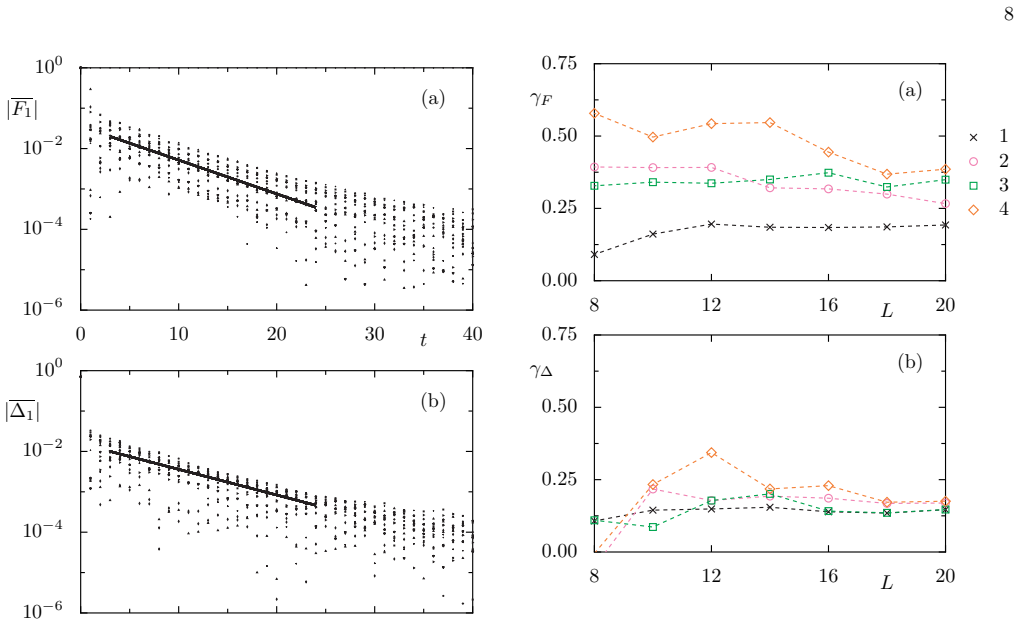
75 (b) L γ∆ FIG. 4. Thermalization rate of (a) full thermalizationγ F and (b) deep thermalizationγ ∆ obtained by median regression over results of all non-trivial Gell-Mann matrices forL A = 2 withR= 150 spin chain realizations. Data is shown fork= 1,2,3,4. malization all thermalization rates approximately coin- cides, except a small even odd effect which...
-
[5]
00 1 2 3 4 5 6 (a) L γF 8 12 16 20
-
[6]
00 (b) L γ∆ FIG. 5. Thermalization rates of (a) full thermalizationγ F and (b) deep thermalizationγ ∆. Similar to Fig. 4 but here forL A = 1, i.e. Pauli matrices, forL= 8, . . . ,18 (150 spin chain realizations) andL= 20 (100 realizations). Data is shown fork= 1,2,3,4,5,6. sizeL= 12, but saturated towards the largest accessible system sizes except for the...
-
[7]
00 LA = 2 LA = 1 (a) k γ F 1 2 3 4 5 6
-
[8]
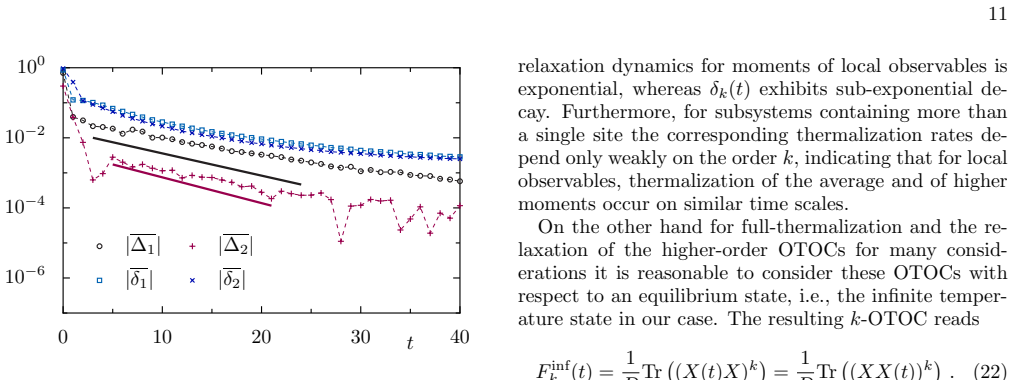
00 LA = 2, t ∈ [2, 7] (b) k γ ∆ FIG. 6. Thermalization rates of (a) full thermalizationγ F and (b) deep thermalizationγ ∆ for Gell-Mann matrices with LA = 2 (red plus) and Pauli matricesL A = 1 (blue cross). For the case of deep thermalization we also show for evenk andL A = 2 results of mean regression in early time interval t∈[2,7] (pink square). Fork= ...
-
[9]
Similarly we assume that the eigenba- sis of their productX(t)Xhas generic orientation with respect to any fixed basis and in particular to our ini- tial state|ψ 0⟩
Full thermalization Our estimates are based on the observation that chaotic time evolution, e.g., by the kicked Ising chain or by a Haar random unitary rotates the eigenbasis ofX(t) into generic orientation with respect to the eigenbasis of X(t= 0) =X. Similarly we assume that the eigenba- sis of their productX(t)Xhas generic orientation with respect to a...
-
[10]
In this case one expects the time evolved state|ψ(t)⟩to resemble a Haar random state on the full Hilbert space
Deep thermalization We now turn to an estimate for the scaling of the fi- nite size plateau at late times for deep thermalization. In this case one expects the time evolved state|ψ(t)⟩to resemble a Haar random state on the full Hilbert space. Replacing the time evolved state by such a Haar random state|ϕ⟩and determining the variance gives a rough es- tima...
-
[11]
J. M. Deutsch,Quantum statistical mechanics in a closed system, Phys. Rev. A43, 2046 (1991)
2046
-
[12]
Srednicki,Chaos and quantum thermalization, Phys
M. Srednicki,Chaos and quantum thermalization, Phys. Rev. E50, 888 (1994)
1994
-
[13]
D’Alessio, Y
L. D’Alessio, Y. Kafri, A. Polkovnikov, and M. Rigol, From quantum chaos and eigenstate thermalization to statistical mechanics and thermodynamics, Adv. Phys. 65, 239 (2016)
2016
-
[14]
J. M. Deutsch,Eigenstate thermalization hypothesis, Rep. Prog. Phys.81, 082001 (2018)
2018
-
[15]
A. Chan, A. De Luca, and J. T. Chalker,Eigen- state correlations, thermalization, and the butterfly effect, Phys. Rev. Lett.122, 220601 (2019)
2019
-
[16]
Foini and J
L. Foini and J. Kurchan,Eigenstate thermalization and rotational invariance in ergodic quantum systems, Phys. Rev. Lett.123, 260601 (2019)
2019
-
[17]
D. L. Jafferis, D. K. Kolchmeyer, B. Mukhametzhanov, and J. Sonner,Matrix models for eigenstate thermaliza- tion, Phys. Rev. X13, 031033 (2023)
2023
-
[18]
D. Hahn, D. J. Luitz, and J. T. Chalker,Eigenstate cor- relations, the eigenstate thermalization hypothesis, and quantum information dynamics in chaotic many-body quantum systems, Phys. Rev. X14, 031029 (2024)
2024
-
[19]
Pappalardi, F
S. Pappalardi, F. Fritzsch, and T. Prosen,Full eigenstate thermalization via free cumulants in quantum lattice sys- tems, Phys. Rev. Lett.134, 140404 (2025)
2025
-
[20]
Fritzsch, T
F. Fritzsch, T. Prosen, and S. Pappalardi,Microcanoni- cal free cumulants in lattice systems, Phys. Rev. B111, 054303 (2025)
2025
-
[21]
G. O. Alves, F. Fritzsch, and P. W. Claeys,Probes of full eigenstate thermalization in ergodicity-breaking quantum circuits, Quantum9, 1949 (2025)
1949
-
[22]
F. Fritzsch, G. O. Alves, M. A. Rampp, and P. W. Claeys,Free cumulants and full eigenstate thermalization from boundary scrambling, arXiv:2509.08060 [quant-ph] (2025)
-
[23]
E. Vallini, L. Foini, and S. Pappalardi,Refinements of the eigenstate thermalization hypothesis under local ro- tational invariance via free probability, arXiv:2511.23217 [cond-mat.stat-mech] (2025)
-
[24]
T. Pathak,Full eigenstate thermalization in integrable spin systems, arXiv:2510.05887 [cond-mat.stat-mech] (2025)
-
[25]
Scaling of free cumulants in closed system-bath setups
M. F¨ ullgraf, J. Gemmer, and J. Wang,Scaling of free cumulants in closed system-bath setups, arXiv:2511.11333 [cond-mat.stat-mech] (2025)
work page internal anchor Pith review arXiv 2025
-
[26]
Y. Zhang and P. Zhang,Finite-size scaling of the full eigenstate thermalization in quantum spin chains, arXiv:2602.01809 [quant-ph] (2026)
- [27]
-
[28]
Maldacena, S
J. Maldacena, S. H. Shenker, and D. Stanford,A bound on chaos, J. High Energy Phys.08, 106 (2016)
2016
-
[29]
Hosur, X.-L
P. Hosur, X.-L. Qi, D. A. Roberts, and B. Yoshida, Chaos in quantum channels, J. High Energy Phys.02, 004 (2016)
2016
-
[30]
Garc´ ıa-Mata, M
I. Garc´ ıa-Mata, M. Saraceno, R. A. Jalabert, A. J. Roncaglia, and D. A. Wisniacki,Chaos signatures in the short and long time behavior of the out-of-time ordered correlator, Phys. Rev. Lett.121, 210601 (2018). 16
2018
-
[31]
D. A. Roberts and B. Yoshida,Chaos and complexity by design, J. High Energy Phys.04, 121 (2017)
2017
-
[32]
Swingle,Unscrambling the physics of out-of-time- order correlators, Nat
B. Swingle,Unscrambling the physics of out-of-time- order correlators, Nat. Phys.14, 988 (2018)
2018
-
[33]
P. W. Claeys and A. Lamacraft,Maximum velocity quan- tum circuits, Phys. Rev. Res.2, 033032 (2020)
2020
-
[34]
M. A. Rampp, R. Moessner, and P. W. Claeys,From dual unitarity to generic quantum operator spreading, Phys. Rev. Lett.130, 130402 (2023)
2023
-
[35]
Xu and B
S. Xu and B. Swingle,Scrambling dynamics and out-of- time-ordered correlators in quantum many-body systems, PRX Quantum5, 010201 (2024)
2024
-
[36]
Garc´ ıa-Mata, R
I. Garc´ ıa-Mata, R. A. Jalabert, and D. A. Wisniacki, Out-of-time-order correlators and quantum chaos, Schol- arpedia18, 55237 (2023)
2023
-
[37]
Dowling, P
N. Dowling, P. Kos, and K. Modi,Scrambling is necessary but not sufficient for chaos, Phys. Rev. Lett.131, 180403 (2023)
2023
-
[38]
Yoshimura, S
T. Yoshimura, S. J. Garratt, and J. T. Chalker,Operator dynamics in Floquet many-body systems, Phys. Rev. B 111, 094316 (2025)
2025
-
[39]
Jonay, C
C. Jonay, C. Li, and T. Zhou,Two-stage relaxation of operators through domain wall and magnon dynamics, Phys. Rev. B111, 224304 (2025)
2025
- [40]
- [41]
-
[42]
Pappalardi, L
S. Pappalardi, L. Foini, and J. Kurchan,Eigen- state thermalization hypothesis and free probability, Phys. Rev. Lett.129, 170603 (2022)
2022
-
[43]
Quantum probability & related topics
D. Voiculescu,Free noncommutative random variables, random matrices and theII 1 factors of free groups, in “Quantum probability & related topics”, volume VI of QP-PQ, 473, World Sci. Publ., River Edge, NJ (1991)
1991
-
[44]
Asymp- totic Combinatorics with Applications to Mathematical Physics: A European Mathematical Summer School Held at the Euler Institute, St. Petersburg, Russia July 9–20, 2001
R. Speicher,Free probability theory and random matrices, in A. M. Vershik and Y. Yakubovich (editors) “Asymp- totic Combinatorics with Applications to Mathematical Physics: A European Mathematical Summer School Held at the Euler Institute, St. Petersburg, Russia July 9–20, 2001”, 53, Springer, Berlin, Heidelberg (2003)
2001
-
[45]
J. A. Mingo and R. Speicher,Free Probability and Ran- dom Matrices, volume 35 ofFields Institute Monographs, Springer, New York, NY (2017)
2017
-
[46]
Nica and R
A. Nica and R. Speicher,Lectures on the combinatorics of free probability, Cambridge University Press, Cambridge (2006)
2006
-
[47]
M. Fava, J. Kurchan, and S. Pappalardi,Designs via free probability, Phys. Rev. X15, 011031 (2025)
2025
-
[48]
H. J. Chen and J. Kudler-Flam,Free independence and the noncrossing partition lattice in dual-unitary quantum circuits, Phys. Rev. B111, 014311 (2025)
2025
- [49]
-
[50]
Jahnke, P
V. Jahnke, P. Nandy, K. Pal, H. A. Camargo, and K.- Y. Kim,Free probability approach to spectral and oper- ator statistics in Rosenzweig-Porter random matrix en- sembles, J. High Energy Phys.2025, 2 (2025)
2025
-
[51]
F. Fritzsch and P. W. Claeys,Free probability in a mini- mal quantum circuit model, arXiv:2506.11197 [quant-ph] (2025)
-
[52]
S. Vardhan and J. Wang,Free mutual information and higher-point otocs, arXiv:2509.13406 [quant-ph] (2025)
-
[53]
E. Vallini and S. Pappalardi,Long-time freeness in the kicked top, arXiv:2411.12050 [cond-mat.stat-mech] (2025)
work page internal anchor Pith review arXiv 2025
-
[54]
N. Dowling, J. D. Nardis, M. Heinrich, X. Turkeshi, and S. Pappalardi,Free independence and unitary design from random matrix product unitaries, arXiv:2508.00051 [quant-ph] (2025)
-
[55]
Prosen,Ruelle resonances in quantum many-body dy- namics, J
T. Prosen,Ruelle resonances in quantum many-body dy- namics, J. Phys. A35, L737 (2002)
2002
-
[56]
Prosen,Ruelle resonances in kicked quantum spin chain, Physica D187, 244 (2004)
T. Prosen,Ruelle resonances in kicked quantum spin chain, Physica D187, 244 (2004)
2004
-
[57]
ˇZnidariˇ c,Momentum-dependent quantum Ruelle- Pollicott resonances in translationally invariant many- body systems, Phys
M. ˇZnidariˇ c,Momentum-dependent quantum Ruelle- Pollicott resonances in translationally invariant many- body systems, Phys. Rev. E110, 054204 (2024)
2024
-
[58]
Mori,Liouvillian-gap analysis of open quantum many- body systems in the weak dissipation limit, Phys
T. Mori,Liouvillian-gap analysis of open quantum many- body systems in the weak dissipation limit, Phys. Rev. B 109, 064311 (2024)
2024
- [59]
-
[60]
J. A. Jacoby, D. A. Huse, and S. Gopalakrishnan,Spectral gaps of local quantum channels in the weak-dissipation limit, Phys. Rev. B111, 104303 (2025)
2025
-
[61]
Duh and M
U. Duh and M. ˇZnidariˇ c,Ruelle-Pollicott resonances of diffusiveU(1)-invariant qubit circuits, SciPost Phys.20, 061 (2026)
2026
-
[62]
Duarte, I
J. Duarte, I. Garc´ ıa-Mata, and D. A. Wisniacki,Ruelle- Pollicott decay of out-of-time-order correlators in many- body systems, Phys. Rev. E113, 024209 (2026)
2026
-
[63]
J. Choi, A. L. Shaw, I. S. Madjarov, X. Xie, R. Finkel- stein, J. P. Covey, J. S. Cotler, D. K. Mark, H.-Y. Huang, A. Kale, H. Pichler, F. G. S. L. Brand˜ ao, S. Choi, and M. Endres,Preparing random states and benchmarking with many-body quantum chaos, Nature613, 468 (2023)
2023
-
[64]
J. S. Cotler, D. K. Mark, H.-Y. Huang, F. Hern´ andez, J. Choi, A. L. Shaw, M. Endres, and S. Choi,Emergent quantum state designs from individual many-body wave functions, PRX Quantum4, 010311 (2023)
2023
-
[65]
Jozsa, D
R. Jozsa, D. Robb, and W. K. Wootters,Lower bound for accessible information in quantum mechanics, Phys. Rev. A49, 668 (1994)
1994
-
[66]
Goldstein, J
S. Goldstein, J. L. Lebowitz, R. Tumulka, and N. Zangh` ı, On the distribution of the wave function for systems in thermal equilibrium, J. Stat. Phys.125, 1193 (2006)
2006
-
[67]
Goldstein, J
S. Goldstein, J. L. Lebowitz, C. Mastrodonato, R. Tu- mulka, and N. Zangh` ı,Universal probability distribution for the wave function of a quantum system entangled with its environment, Commun. Math. Phys.342, 965 (2016)
2016
-
[68]
D. K. Mark, F. Surace, A. Elben, A. L. Shaw, J. Choi, G. Refael, M. Endres, and S. Choi,Maximum entropy principle in deep thermalization and in Hilbert-space er- godicity, Phys. Rev. X14, 041051 (2024)
2024
-
[69]
J. M. Renes, R. Blume-Kohout, A. J. Scott, and C. M. Caves,Symmetric informationally complete quantum measurements, J. Math. Phys.45, 2171 (2004)
2004
-
[70]
Kuperberg,Numerical cubature using error-correcting codes, SIAM J
G. Kuperberg,Numerical cubature using error-correcting codes, SIAM J. Numer. Anal.44, 897 (2006)
2006
-
[71]
Twenty-Second Annual IEEE Conference on Computational Complexity (CCC’07)
A. Ambainis and J. Emerson,Quantumt-designs:t-wise independence in the quantum world, in “Twenty-Second Annual IEEE Conference on Computational Complexity (CCC’07)”, 129, San Diego, CA, USA (2007). 17
2007
-
[72]
W. W. Ho and S. Choi,Exact emergent quantum state designs from quantum chaotic dynamics, Phys. Rev. Lett. 128, 060601 (2022)
2022
-
[73]
P. W. Claeys and A. Lamacraft,Emergent quantum state designs and biunitarity in dual-unitary circuit dynamics, Quantum6, 738 (2022)
2022
-
[74]
Ippoliti and W
M. Ippoliti and W. W. Ho,Dynamical purification and the emergence of quantum state designs from the pro- jected ensemble, PRX Quantum4, 030322 (2023)
2023
-
[75]
Ippoliti and W
M. Ippoliti and W. W. Ho,Solvable model of deep ther- malization with distinct design times, Quantum6, 886 (2022)
2022
-
[76]
H. Wilming and I. Roth,High-temperature thermaliza- tion implies the emergence of quantum state designs, arXiv:2202.01669 [quant-ph] (2022)
-
[77]
Bhore, J.-Y
T. Bhore, J.-Y. Desaules, and Z. Papi´ c,Deep thermaliza- tion in constrained quantum systems, Phys. Rev. B108, 104317 (2023)
2023
-
[78]
C. Liu, Q. C. Huang, and W. W. Ho,Deep thermaliza- tion in Gaussian continuous-variable quantum systems, Phys. Rev. Lett.133, 260401 (2024)
2024
-
[79]
Chang, H
R.-A. Chang, H. Shrotriya, W. W. Ho, and M. Ippoliti, Deep thermalization under charge-conserving quantum dynamics, PRX Quantum6, 020343 (2025)
2025
-
[80]
Lucas, L
M. Lucas, L. Piroli, J. De Nardis, and A. De Luca, Generalized deep thermalization for free Fermions, Phys. Rev. A107, 032215 (2023)
2023
discussion (0)
Sign in with ORCID, Apple, or X to comment. Anyone can read and Pith papers without signing in.