Recognition: unknown
On Linear and Non-Linear Mechanics of Cyanobacterial Colonies
Pith reviewed 2026-05-07 06:04 UTC · model grok-4.3
The pith
Cyanobacterial colonies resist fragmentation by lake mixing and strengthen under low phosphorus conditions.
A machine-rendered reading of the paper's core claim, the machinery that carries it, and where it could break.
Core claim
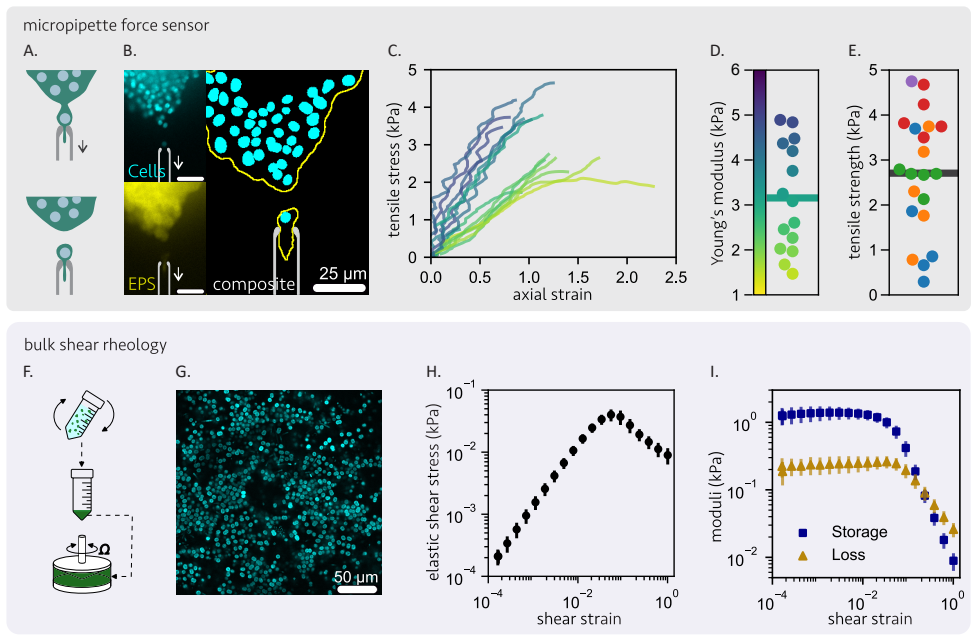
Micropipette force sensors quantify the linear and non-linear mechanical properties of individual Microcystis colonies at single-cell resolution, complemented by bulk shear rheology for macroscopic properties. The measured tensile strength and yield stress are broadly comparable to those of bacterial biofilms and far greater than the hydrodynamic stresses typically found in wind-mixed lakes. This implies that cyanobacterial colonies are highly resistant to fragmentation by natural mixing processes. Low nutrient availability, particularly low phosphorus, produced stronger colonies, suggesting structural changes in the EPS.
What carries the argument
The extracellular polymeric substances (EPS) matrix binding cells into colonies, measured via micropipette aspiration for local tensile response and bulk shear rheology for yield behavior.
Load-bearing premise
Measurements on laboratory-grown colonies accurately reflect the mechanical behavior of colonies in natural lakes without artifacts from sample preparation, handling, or differences in growth conditions.
What would settle it
In-situ mechanical tests or fragmentation observations on colonies sampled directly from wind-mixed lakes during peak mixing events, compared against the reported yield stresses and tensile strengths.
Figures


read the original abstract
Toxic cyanobacterial blooms are a growing environmental concern that affects freshwater ecosystems, drinking water supplies, and public health. The cyanobacterium Microcystis is among the most important bloom forming species. It often grows in large colonies, which enhances its flotation, reduces grazing, and improves nutrient regulation. Microcystis cells are held together by a matrix of extracellular polymeric substances (EPS), making colony mechanics crucial for bloom formation. However, an analysis of the biomechanical properties of cyanobacterial colonies, and how these properties relate to environmental conditions like nutrient availability, remains largely missing. Here, we use micropipette force sensors to quantify the linear and non-linear mechanical properties of individual colonies at single-cell resolution. Bulk shear rheology complements these measurements by probing macroscopic properties. The measured tensile strength and yield stress are broadly comparable to those of bacterial biofilms and are far greater than the hydrodynamic stresses typically found in wind-mixed lakes. This implies that cyanobacterial colonies are highly resistant to fragmentation by natural mixing processes. We also show that low nutrient availability, particularly low phosphorus, produced stronger colonies, suggesting structural changes in the EPS. Overall, our results establish mechanical testing as a tool for a more complete and physically grounded understanding of cyanobacterial colony formation.
Editorial analysis
A structured set of objections, weighed in public.
Referee Report
Summary. The paper measures the linear and non-linear mechanical properties of Microcystis cyanobacterial colonies using micropipette aspiration at single-cell resolution and complementary bulk shear rheology. It reports tensile strengths and yield stresses comparable to bacterial biofilms and substantially larger than typical hydrodynamic stresses in wind-mixed lakes, implying resistance to natural fragmentation. Colonies grown under low-nutrient conditions (especially low phosphorus) are stronger, which the authors interpret as evidence for nutrient-driven structural changes in the EPS matrix.
Significance. If the quantitative measurements and controls hold, the work supplies the first direct mechanical characterization of intact cyanobacterial colonies under controlled nutrient regimes. This supplies a physically grounded link between environmental conditions and colony stability that is relevant to bloom persistence, flotation, and resistance to mixing. The dual-technique approach (micropipette plus rheology) is a strength, and the environmental-stress comparison offers a concrete test of ecological relevance.
major comments (3)
- [Methods] Methods section: No sample sizes (n), error bars, statistical tests, calibration protocols for the micropipette force sensors, or exclusion criteria are reported. These details are load-bearing for the central quantitative claims (tensile strength, yield stress, and nutrient comparisons) and must be supplied before the data can be evaluated.
- [Results (nutrient experiments)] Results, nutrient-availability experiments: The claim that low phosphorus produces stronger colonies 'suggesting structural changes in the EPS' is presented without normalization by cell packing density, colony-size distribution, or paired EPS biochemical assays. Cell-density or growth-phase differences could independently increase measured yield stress and tensile strength; the current data therefore support mechanical robustness but not the proposed mechanistic link to EPS structure.
- [Discussion] Discussion: The assertion that measured strengths are 'far greater' than hydrodynamic stresses in wind-mixed lakes lacks explicit numerical comparison to literature values (e.g., specific shear-stress magnitudes under typical wind speeds and lake depths) or any sensitivity analysis on flow assumptions. This comparison is central to the fragmentation-resistance conclusion and requires quantitative grounding.
minor comments (3)
- [Figures] Figure legends and captions should explicitly state the number of colonies or replicates per condition and the statistical test used for any reported differences.
- [Abstract and Introduction] The abstract and introduction could add one sentence on the specific range of colony sizes tested and the growth conditions used to produce the lab colonies.
- [References] A few recent references on EPS mechanics in other cyanobacteria or biofilms appear to be missing; adding them would strengthen the comparative context.
Simulated Author's Rebuttal
We appreciate the referee's detailed and constructive feedback on our manuscript. We have carefully considered each major comment and provide point-by-point responses below. Where appropriate, we will revise the manuscript to address the concerns raised.
read point-by-point responses
-
Referee: [Methods] Methods section: No sample sizes (n), error bars, statistical tests, calibration protocols for the micropipette force sensors, or exclusion criteria are reported. These details are load-bearing for the central quantitative claims (tensile strength, yield stress, and nutrient comparisons) and must be supplied before the data can be evaluated.
Authors: We agree that these methodological details are essential for reproducibility and evaluation of the quantitative claims. In the revised manuscript, we will include the following: sample sizes for each experimental condition (e.g., n = 20-50 colonies per nutrient regime), error bars representing standard error of the mean or standard deviation as appropriate, results of statistical tests (such as ANOVA or t-tests with p-values for nutrient comparisons), detailed calibration protocols for the micropipette force sensors (including force constant determination via known weights or deflection methods), and explicit exclusion criteria (e.g., exclusion of colonies showing visible damage or irregular shapes during aspiration). These additions will strengthen the transparency of our methods. revision: yes
-
Referee: [Results (nutrient experiments)] Results, nutrient-availability experiments: The claim that low phosphorus produces stronger colonies 'suggesting structural changes in the EPS' is presented without normalization by cell packing density, colony-size distribution, or paired EPS biochemical assays. Cell-density or growth-phase differences could independently increase measured yield stress and tensile strength; the current data therefore support mechanical robustness but not the proposed mechanistic link to EPS structure.
Authors: We acknowledge the validity of this critique. Our data demonstrate that colonies grown under low-phosphorus conditions exhibit higher tensile strength and yield stress. However, without normalization for cell packing density or colony size distribution, and in the absence of direct EPS biochemical assays, we cannot conclusively attribute this to structural changes in the EPS matrix. In the revision, we will modify the interpretation to state that low nutrient availability, particularly low phosphorus, results in mechanically stronger colonies, and we will discuss potential contributing factors including possible EPS modifications while noting that cell density variations or growth phase differences could also play a role. If cell density data from imaging is available, we will perform normalization and include it. We cannot add new paired EPS assays as they were not part of the original experimental design, but we will tone down the mechanistic claim accordingly. revision: partial
-
Referee: [Discussion] Discussion: The assertion that measured strengths are 'far greater' than hydrodynamic stresses in wind-mixed lakes lacks explicit numerical comparison to literature values (e.g., specific shear-stress magnitudes under typical wind speeds and lake depths) or any sensitivity analysis on flow assumptions. This comparison is central to the fragmentation-resistance conclusion and requires quantitative grounding.
Authors: We agree that a more quantitative comparison is needed. In the revised discussion, we will provide explicit numerical comparisons, citing literature values for hydrodynamic stresses in lakes (e.g., shear stresses ranging from 0.001 to 0.1 Pa depending on wind speed and depth, based on studies such as those by MacIntyre et al. or similar). Our measured yield stresses are approximately 10-100 Pa, which are indeed 100-1000 times larger. We will also include a brief sensitivity analysis discussing how variations in assumed flow conditions (e.g., different wind speeds or lake depths) affect the comparison, reinforcing the conclusion that colonies are resistant to fragmentation under typical conditions. revision: yes
- Providing paired EPS biochemical assays to directly support the mechanistic link to EPS structural changes, as these experiments were not conducted in the original study.
Circularity Check
No circularity: purely experimental measurements with no derivations or self-referential reductions
full rationale
The paper is an experimental study that reports direct measurements of tensile strength, yield stress, and other mechanical properties of cyanobacterial colonies using micropipette aspiration at single-cell resolution and complementary bulk shear rheology. No equations, models, or fitted parameters are presented that define or predict these quantities in terms of themselves or the same dataset. Comparative observations on nutrient effects (e.g., low phosphorus yielding stronger colonies) are based on separate experimental conditions and do not involve any self-definitional loops, fitted inputs renamed as predictions, or load-bearing self-citations that reduce claims to unverified priors. The reported values are independent empirical outputs, not constructions that presuppose the results by definition.
Axiom & Free-Parameter Ledger
axioms (1)
- domain assumption Colonies can be treated as homogeneous viscoelastic materials for the purpose of force-displacement analysis
Reference graph
Works this paper leans on
-
[1]
A review of the global ecology, genomics, and biogeography of the toxic cyanobacterium,Microcystisspp
M. J. Harke, M. M. Steffen, C. J. Gobler, T. G. Otten, S. W. Wilhelm, S. A. Wood, and H. W. Paerl, “A review of the global ecology, genomics, and biogeography of the toxic cyanobacterium,Microcystisspp.”, Harmful algae54, 4–20 (2016)
2016
-
[2]
Cyanobacterial blooms
J. Huisman, G. A. Codd, H. W. Paerl, B. W. Ibelings, J. M. H. Verspagen, and P. M. Visser, “Cyanobacterial blooms”, Nature Reviews Microbiology16, 471–483 (2018)
2018
-
[3]
Harmful algal blooms: A climate change co-stressor in marine and freshwater ecosystems
A. W. Griffith and C. J. Gobler, “Harmful algal blooms: A climate change co-stressor in marine and freshwater ecosystems”, Harmful Algae91, 101590 (2020)
2020
-
[4]
Chorus and M
I. Chorus and M. Welker,Toxic Cyanobacteria in Water: A Guide to Their Public Health Consequences, Monitoring and Management(CRC Press, 2021)
2021
-
[5]
Colony formation in the cyanobacteriumMicrocystis
M. Xiao, M. Li, and C. S. Reynolds, “Colony formation in the cyanobacteriumMicrocystis”, Biological Reviews93, 1399– 1420 (2018)
2018
-
[6]
Changes in turbulent mixing shift competition for light between phytoplankton species
J. Huisman, J. Sharples, J. M. Stroom, P. M. Visser, W. E. A. Kardinaal, J. M. H. Verspagen, and B. Sommeijer, “Changes in turbulent mixing shift competition for light between phytoplankton species”, Ecology85, 2960–2970 (2004)
2004
-
[7]
Biophysics of biofilm infection
P. S. Stewart, “Biophysics of biofilm infection”, Pathogens and Disease70, 212–218 (2014)
2014
-
[8]
Fragmentation and aggregation of cyanobacterial colonies
Y. Z. Sinzato, R. Uittenbogaard, P. M. Visser, J. Huisman, and M. Jalaal, “Fragmentation and aggregation of cyanobacterial colonies”, eLife14, RP103503 (2026)
2026
-
[9]
Microcystiscolony formation: Extracellular polymeric sub- stance, associated microorganisms, and its application
V. V. Le, A. Srivastava, S.-R. Ko, C.-Y. Ahn, and H.-M. Oh, “Microcystiscolony formation: Extracellular polymeric sub- stance, associated microorganisms, and its application”, Bioresource Technology360, 127610 (2022)
2022
-
[10]
Investigation on extracellular polymeric substances from mucilaginous cyanobacterial blooms in eutrophic freshwater lakes
H. Xu, G. Yu, and H. Jiang, “Investigation on extracellular polymeric substances from mucilaginous cyanobacterial blooms in eutrophic freshwater lakes”, Chemosphere93, 75–81 (2013)
2013
-
[11]
Comparative studies on physiological responses to phosphorus in two phenotypes of bloom-forming Microcystis
H. Shen and L. Song, “Comparative studies on physiological responses to phosphorus in two phenotypes of bloom-forming Microcystis”, Hydrobiologia592, 475–486 (2007)
2007
-
[12]
Colony formation in twoMicrocystismorphotypes: Effects of temperature and nutrient availability
Z. Duan, X. Tan, K. Parajuli, S. Upadhyay, D. Zhang, X. Shu, and Q. Liu, “Colony formation in twoMicrocystismorphotypes: Effects of temperature and nutrient availability”, Harmful Algae72, 14–24 (2018)
2018
-
[13]
Ecological stoichiometry of functional traits in a colonial harmful cyanobacterium
Z. Duan, X. Tan, H. W. Paerl, and D. B. Van de Waal, “Ecological stoichiometry of functional traits in a colonial harmful cyanobacterium”, Limnology and Oceanography66, 2051–2062 (2021)
2051
-
[14]
The effect of nitrogen concentration and its interaction with light intensity on population dynamics and polysaccharide content ofMicrocystis aeruginosa
W. Wang, Y. Liu, L. Geng, Z. Yang, and Y. Chen, “The effect of nitrogen concentration and its interaction with light intensity on population dynamics and polysaccharide content ofMicrocystis aeruginosa”, Journal of Freshwater Ecology26, 241–248 (2011)
2011
-
[15]
The role of morphological changes inMicrocystisadaptation to nutrient availability at the colonial level
G. Feng, W. Zhu, Z. Duan, and Y. Zhang, “The role of morphological changes inMicrocystisadaptation to nutrient availability at the colonial level”, Harmful Algae115, 102235 (2022)
2022
-
[16]
Nutrient limitation dynamics examined on a multi-annual scale in Lake Taihu, China: implications for controlling eutrophication and harmful algal blooms
H. W. Paerl, H. Xu, N. S. Hall, K. L. Rossignol, A. R. Joyner, G. Zhu, and B. Qin, “Nutrient limitation dynamics examined on a multi-annual scale in Lake Taihu, China: implications for controlling eutrophication and harmful algal blooms”, Journal of Freshwater Ecology30, 5–24 (2015)
2015
-
[17]
Variability in the provision and function of mucilage in phytoplankton: facultative responses to the envi- ronment
C. S. Reynolds, “Variability in the provision and function of mucilage in phytoplankton: facultative responses to the envi- ronment”, Hydrobiologia578, 37–45 (2007)
2007
-
[18]
Effect of fluid motion on colony formation inMicrocystis aeruginosa
L. Li, W. Zhu, T.-t. Wang, Y.-g. Luo, F.-l. Chen, and X. Tan, “Effect of fluid motion on colony formation inMicrocystis aeruginosa”, Water Science and Engineering6, 106–116 (2013)
2013
-
[19]
Disaggregation ofMicrocystis aeruginosacolonies under turbulent mixing: laboratory experiments in a grid-stirred tank
K. R. O’Brien, D. L. Meyer, A. M. Waite, G. N. Ivey, and D. P. Hamilton, “Disaggregation ofMicrocystis aeruginosacolonies under turbulent mixing: laboratory experiments in a grid-stirred tank”, Hydrobiologia519, 143–152 (2004)
2004
-
[20]
Structural Variations Increase the Upper Limit of Colony Size ofMicrocystis: Implications from Laboratory Cultures and Field Investigations
G. Feng, W. Zhu, Z. Xue, S. Hu, R. Wang, S. Zhao, and H. Chen, “Structural Variations Increase the Upper Limit of Colony Size ofMicrocystis: Implications from Laboratory Cultures and Field Investigations”, Journal of Phycology56, 1676–1686 (2020)
2020
-
[21]
Not by Sieving Alone: Observations of Suspension Feeding inDaphnia
J. Gerritsen, K. G. Porter, and J. R. Strickler, “Not by Sieving Alone: Observations of Suspension Feeding inDaphnia”, Bulletin of Marine Science43, 366–376 (1988)
1988
-
[22]
Strong effects of amoebae grazing on the biomass and genetic structure of aMicrocystisbloom (Cyanobac- teria)
J. Van Wichelen, I. Van Gremberghe, P. Vanormelingen, A.-E. Debeer, B. Leporcq, D. Menzel, G. A. Codd, J.-P. Descy, and W. Vyverman, “Strong effects of amoebae grazing on the biomass and genetic structure of aMicrocystisbloom (Cyanobac- teria)”, Environmental Microbiology12, 2797–2813 (2010)
2010
-
[23]
Grazing on colonial and filamentous, toxic and non-toxic cyanobacteria by the zebra musselDreissena polymorpha
L. M. Dionisio Pires, B. M. Bontes, E. Van Donk, and B. W. Ibelings, “Grazing on colonial and filamentous, toxic and non-toxic cyanobacteria by the zebra musselDreissena polymorpha”, Journal of Plankton Research27, 331–339 (2005). 9
2005
-
[24]
Quantifying the tensile strength of microbial mats grown over noncohesive sediments
E. Vignaga, H. Haynes, and W. Sloan, “Quantifying the tensile strength of microbial mats grown over noncohesive sediments”, Biotechnology and Bioengineering109, 1155–1164 (2012)
2012
-
[25]
Biofilms and mechanics: a review of experimental techniques and findings
V. D. Gordon, M. Davis-Fields, K. Kovach, and C. A. Rodesney, “Biofilms and mechanics: a review of experimental techniques and findings”, Journal of Physics D: Applied Physics50, 223002 (2017)
2017
-
[26]
Towards standardized mechanical characterization of microbial biofilms: analysis and critical review
H. Boudarel, J.-D. Mathias, B. Blaysat, and M. Gr´ ediac, “Towards standardized mechanical characterization of microbial biofilms: analysis and critical review”, npj Biofilms and Microbiomes4, 17 (2018)
2018
-
[27]
Micropipette force sensors for in vivo force measurements on single cells and multicellular microorganisms
M. Backholm and O. B¨ aumchen, “Micropipette force sensors for in vivo force measurements on single cells and multicellular microorganisms”, Nature Protocols14, 594–615 (2019)
2019
-
[28]
Effects of Temperature on the Morphological, Polymeric, and Mechanical Properties ofStaphylococcus epidermidisBacterial Biofilms
L. Pavlovsky, R. A. Sturtevant, J. G. Younger, and M. J. Solomon, “Effects of Temperature on the Morphological, Polymeric, and Mechanical Properties ofStaphylococcus epidermidisBacterial Biofilms”, Langmuir31, 2036–2042 (2015)
2036
-
[29]
Micro-cantilever method for measuring the tensile strength of biofilms and microbial flocs
E. H. Poppele and R. M. Hozalski, “Micro-cantilever method for measuring the tensile strength of biofilms and microbial flocs”, Journal of Microbiological Methods55, 607–615 (2003)
2003
-
[30]
Development and testing of a novel microcantilever technique for measuring the cohesive strength of intact biofilms
S. Aggarwal, E. H. Poppele, and R. M. Hozalski, “Development and testing of a novel microcantilever technique for measuring the cohesive strength of intact biofilms”, Biotechnology and Bioengineering105, 924–934 (2010)
2010
-
[31]
Strong alone, weak together: biofilm tensile strength in kangaroo rat burrows
D. Aydin, I. D. Akin, D. R. Call, and H. Beyenal, “Strong alone, weak together: biofilm tensile strength in kangaroo rat burrows”, Enzyme and Microbial Technology192, 110752 (2026)
2026
-
[32]
Soft matter mechanics of immune cell aggregates
S. Askari, G. Saldo Rubio, A. Datar, H. Harjunp¨ a¨ a, S. C. Fagerholm, and M. Backholm, “Soft matter mechanics of immune cell aggregates”, Journal of The Royal Society Interface22, 20250231 (2025)
2025
-
[33]
The EPS-I exopolysaccharide transformsRalstoniawilt pathogen biofilms into viscoelastic fluids for rapid dissemination in planta
M. L. Cope-Arguello, J. Li, Z. Konkel, N. Aoun, T. Cowell, N. Wagner, A. L. H. Chan, L. T. Chu, S. Wang, M. D. Carter, C. Allen, L. J. Caverly, L. Bui, K. M. DeAngelis, M. J. Wargo, T. M. Tran, J. M. Jacobs, H. Manikantan, and T. M. Lowe-Power, “The EPS-I exopolysaccharide transformsRalstoniawilt pathogen biofilms into viscoelastic fluids for rapid dissem...
2026
-
[34]
Community stoichiometry in a changing world: combined effects of warming and eutrophication on phytoplankton dynamics
L. N. De Senerpont Domis, D. B. Van de Waal, N. R. Helmsing, E. Van Donk, and W. M. Mooij, “Community stoichiometry in a changing world: combined effects of warming and eutrophication on phytoplankton dynamics”, Ecology95, 1485–1495 (2014)
2014
-
[35]
Phytoplankton growth and stoichiometric responses to warming, nutrient addition and grazing depend on lake productivity and cell size
M. A. Schulhof, J. B. Shurin, S. A. J. Declerck, and D. B. Van de Waal, “Phytoplankton growth and stoichiometric responses to warming, nutrient addition and grazing depend on lake productivity and cell size”, Global Change Biology25, 2751–2762 (2019)
2019
-
[36]
A comparative study on the elastic modulus of polyvinyl alcohol sponge using different stress-strain definitions
A. Karimi, M. Navidbakhsh, M. Alizadeh, and R. Razaghi, “A comparative study on the elastic modulus of polyvinyl alcohol sponge using different stress-strain definitions”, Biomedical Engineering / Biomedizinische Technik59, 439–446 (2014)
2014
-
[37]
Concentration Dependence of Tensile Behavior in Agarose Gel Using Digital Image Correlation
G. Subhash, Q. Liu, D. F. Moore, P. G. Ifju, and M. A. Haile, “Concentration Dependence of Tensile Behavior in Agarose Gel Using Digital Image Correlation”, Experimental Mechanics51, 255–262 (2011)
2011
-
[38]
Insights into the relationship between colony formation and extracellular polymeric substances (EPS) composition of the cyanobacteriumMicrocystisspp
M. Xiao, M. Li, P. Duan, Z. Qu, and H. Wu, “Insights into the relationship between colony formation and extracellular polymeric substances (EPS) composition of the cyanobacteriumMicrocystisspp”, Harmful Algae83, 34–41 (2019)
2019
-
[39]
Excitation-emission matrix fluorescence and parallel factor analyses of the effects of N and P nutrients on the extracellular polymeric substances ofMicrocystis aeruginosa
L. Liu, Q. Huang, Y. Zhang, B. Qin, and G. Zhu, “Excitation-emission matrix fluorescence and parallel factor analyses of the effects of N and P nutrients on the extracellular polymeric substances ofMicrocystis aeruginosa”, Limnologica63, 18–26 (2017)
2017
-
[40]
In Vivo Microrheology Reveals Local Elastic and Plastic Responses Inside 3D Bacterial Biofilms
T. Ohmura, D. J. Skinner, K. Neuhaus, G. P. T. Choi, J. Dunkel, and K. Drescher, “In Vivo Microrheology Reveals Local Elastic and Plastic Responses Inside 3D Bacterial Biofilms”, Advanced Materials36, 2314059 (2024)
2024
-
[41]
Stress-hardening behaviour of biofilm streamers
G. Savorana, T. Redaelli, D. Truzzolillo, L. Cipelletti, and E. Secchi, “Stress-hardening behaviour of biofilm streamers”, Nature Communications16, 9497 (2025)
2025
-
[42]
A novel method for evaluation of biofilm tensile strength resisting erosion
A. Ohashi, T. Koyama, K. Syutsubo, and H. Harada, “A novel method for evaluation of biofilm tensile strength resisting erosion”, Water Science and Technology39, 261–268 (1999)
1999
-
[43]
Strengthening Biofilms with Selective Metal Ions
K. J. Croland and R. K. Bay, “Strengthening Biofilms with Selective Metal Ions”, Soft Matter (2026)
2026
-
[44]
Viscoelastic Properties of a Mixed Culture Biofilm from Rheometer Creep Analysis
B. W. Towler, C. J. Rupp, A. B. Cunningham, and P. Stoodley, “Viscoelastic Properties of a Mixed Culture Biofilm from Rheometer Creep Analysis”, Biofouling19, 279–285 (2003)
2003
-
[45]
Field observations of turbulent dissipation rate profiles immediately below the air-water interface
B. Wang and Q. Liao, “Field observations of turbulent dissipation rate profiles immediately below the air-water interface”, Journal of Geophysical Research: Oceans121, 4377–4391 (2016)
2016
-
[46]
Artificial mixing to control cyanobacterial blooms: a review
P. M. Visser, B. W. Ibelings, M. Bormans, and J. Huisman, “Artificial mixing to control cyanobacterial blooms: a review”, Aquatic Ecology50, 423–441 (2016)
2016
-
[47]
The turbulent kinetic energy budget in a bubble plume
C. C. K. Lai and S. A. Socolofsky, “The turbulent kinetic energy budget in a bubble plume”, Journal of Fluid Mechanics 865, 993–1041 (2019)
2019
-
[48]
Morphological Response ofMicrocystis aeruginosato Grazing by Different Sorts of Zooplankton
Z. Yang, F. Kong, X. Shi, and H. Cao, “Morphological Response ofMicrocystis aeruginosato Grazing by Different Sorts of Zooplankton”, Hydrobiologia563, 225–230 (2006)
2006
-
[49]
De novoorigins of multicellularity in response to predation
M. D. Herron, J. M. Borin, J. C. Boswell, J. Walker, I.-C. K. Chen, C. A. Knox, M. Boyd, F. Rosenzweig, and W. C. Ratcliff, “De novoorigins of multicellularity in response to predation”, Scientific Reports9, 2328 (2019)
2019
-
[50]
The importance of morphological versus chemical defences for the bloom-forming cyanobacteriumMicrocystisagainst amoebae grazing
J. Van Wichelen, I. van Gremberghe, P. Vanormelingen, and W. Vyverman, “The importance of morphological versus chemical defences for the bloom-forming cyanobacteriumMicrocystisagainst amoebae grazing”, Aquatic Ecology46, 73–84 (2012)
2012
-
[51]
Cell Detection with Star-Convex Polygons
U. Schmidt, M. Weigert, C. Broaddus, and G. Myers, “Cell Detection with Star-Convex Polygons”, in Medical Image Com- puting and Computer Assisted Intervention – MICCAI 2018, edited by A. F. Frangi, J. A. Schnabel, C. Davatzikos, C. Alberola-L´ opez, and G. Fichtinger (2018), pp. 265–273. 10 SUPPORTING INFORMATION FOR Title:On Linear and non-Linear Mechani...
2018
discussion (0)
Sign in with ORCID, Apple, or X to comment. Anyone can read and Pith papers without signing in.