Recognition: unknown
Hybrid Anomaly Detection for Bullion Coin Authentication Leveraging Acoustic Signature Analysis
Pith reviewed 2026-05-07 07:04 UTC · model grok-4.3
The pith
Acoustic analysis with a dual neural model separates authentic bullion coins from high-quality counterfeits.
A machine-rendered reading of the paper's core claim, the machinery that carries it, and where it could break.
Core claim
The integrated dual-model system achieves high precision in distinguishing authentic bullion coins from high-quality counterfeits by treating the acoustic frequency signature, fixed by material composition, mass, and geometry, as a stable physical identifier. An autoencoder reconstructs the spectrum to flag anomalies, while the companion classifier identifies coin type; the combination remains reliable across different recording devices and noisy environments.
What carries the argument
Synergistic dual-model architecture consisting of an autoencoder that reconstructs the acoustic spectrum for anomaly detection together with a deep learning classifier for coin-type identification.
If this is right
- The same acoustic-plus-neural framework can be applied to non-destructive safety checks on critical metal components in automotive and aerospace systems.
- Stability across recording devices and conditions supports deployment outside controlled laboratory settings.
- Data augmentation and dynamic anomaly thresholds allow the method to function with modest numbers of authentic samples.
- The approach provides an independent physical check that does not require chemical assay or destructive sampling.
Where Pith is reading between the lines
- Dealers could implement the method with ordinary smartphone microphones for rapid field authentication.
- Combining the acoustic channel with existing visual or weight sensors would create a low-cost multi-modal verification station.
- The underlying principle of using excitation response as a geometry-and-material fingerprint may extend to other uniform metallic objects such as industrial fasteners or jewelry.
Load-bearing premise
The acoustic frequency signature set by material composition, mass, and geometry stays sufficiently unique and stable to separate authentic coins from high-quality counterfeits even when recordings contain environmental noise and training data are limited.
What would settle it
A collection of high-quality counterfeits that produce acoustic spectra statistically indistinguishable from those of authentic coins under several different recording devices and noise levels would falsify the claim of reliable separation.
Figures





read the original abstract
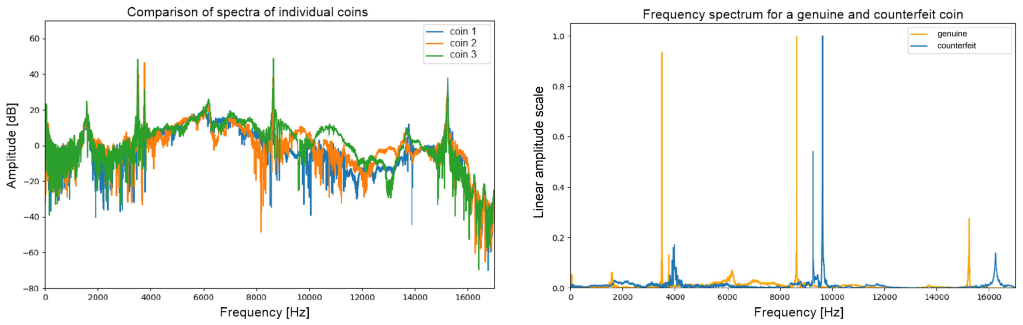
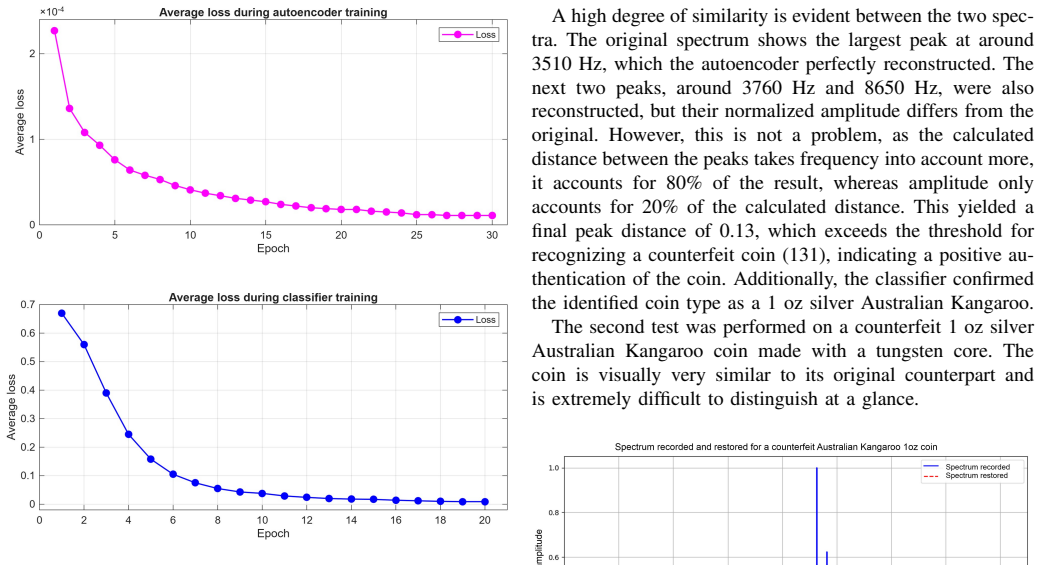
The verification of bullion coin authenticity is essential for maintaining integrity within the precious metals market; however, the increasing sophistication of counterfeits has rendered traditional inspection methods insufficient. This paper proposes a non-destructive verification framework based on acoustic frequency analysis and deep neural networks. The methodology leverages the unique acoustic fingerprint of a coin, a physical signature determined by its material composition, mass, and geometry, captured through mechanical excitation. We implement a synergistic dual-model architecture consisting of an autoencoder that reconstructs the spectrum for anomaly detection and a deep learning classifier for coin type identification. To address the challenges of environmental noise and limited dataset diversity, a dynamically calculated anomaly threshold and data augmentation techniques were employed. Experimental results demonstrate that the integrated system achieves high precision in distinguishing authentic specimens from high-quality counterfeits, maintaining stability across varying recording conditions and devices. Beyond bullion authentication, the study highlights the scalability of the proposed non-destructive testing method for assessing the safety of critical components in the automotive and aerospace industries.
Editorial analysis
A structured set of objections, weighed in public.
Referee Report
Summary. The paper proposes a non-destructive bullion coin authentication framework that captures acoustic frequency signatures via mechanical excitation and processes them with a hybrid deep learning architecture: an autoencoder for spectrum reconstruction-based anomaly detection combined with a classifier for coin-type identification. Data augmentation and a dynamically calculated anomaly threshold are introduced to mitigate environmental noise and limited training diversity. The central claim is that the integrated system achieves high precision in separating authentic specimens from high-quality counterfeits while remaining stable across recording conditions and devices, with suggested extensions to non-destructive testing in automotive and aerospace applications.
Significance. If the performance claims are substantiated with rigorous quantitative validation and the acoustic distinctions are shown to arise from the stated physical parameters rather than unmeasured factors, the work could supply a practical, portable verification tool for the precious-metals market. The hybrid autoencoder-plus-classifier design is a technically coherent choice for anomaly detection under data scarcity. Broader applicability to safety-critical components is noted but remains speculative without transfer experiments.
major comments (2)
- [Abstract] Abstract: the assertion that the system 'achieves high precision' and 'maintains stability' is unsupported by any numerical results, dataset sizes, precision/recall values, error bars, or ablation studies. Without these metrics it is impossible to determine whether the reported separation is robust or an artifact of post-hoc threshold selection and augmentation choices.
- [Abstract] Abstract: the acoustic fingerprint is explicitly attributed to 'material composition, mass, and geometry,' yet no quantitative comparison (e.g., weight, diameter, alloy composition, or density measurements) is supplied between the authentic and counterfeit samples used in the experiments. High-quality counterfeits routinely replicate these parameters within manufacturing tolerances; absent such data, any observed acoustic differences cannot be confidently ascribed to the claimed physical signature and may reflect unstated secondary factors such as microstructure or voids.
minor comments (2)
- [Abstract] Abstract: the specific neural-network architectures (layer counts, input representation of the spectrum, loss functions) are not described, making it difficult to assess reproducibility or compare against standard baselines.
- [Abstract] Abstract: the claim of cross-device stability would benefit from an explicit statement of the devices, sampling rates, and environmental conditions tested.
Simulated Author's Rebuttal
We are grateful to the referee for the insightful comments that help improve the clarity and rigor of our work. We respond to each major comment below and commit to revising the manuscript to incorporate the suggested improvements, particularly by enhancing the abstract with quantitative details and providing additional substantiation for the physical basis of the acoustic signatures.
read point-by-point responses
-
Referee: [Abstract] Abstract: the assertion that the system 'achieves high precision' and 'maintains stability' is unsupported by any numerical results, dataset sizes, precision/recall values, error bars, or ablation studies. Without these metrics it is impossible to determine whether the reported separation is robust or an artifact of post-hoc threshold selection and augmentation choices.
Authors: We thank the referee for highlighting this issue. The abstract summarizes the key findings, but we agree it should be more self-contained with numerical evidence. The manuscript's experimental section provides the supporting data, including dataset sizes, precision and recall values from the hybrid model, error bars from cross-validation, and ablation studies comparing the autoencoder, classifier, and integrated system. We will revise the abstract to explicitly state these metrics and reference the relevant sections, ensuring the claims of high precision and stability are directly supported by the reported results rather than appearing unsubstantiated. revision: yes
-
Referee: [Abstract] Abstract: the acoustic fingerprint is explicitly attributed to 'material composition, mass, and geometry,' yet no quantitative comparison (e.g., weight, diameter, alloy composition, or density measurements) is supplied between the authentic and counterfeit samples used in the experiments. High-quality counterfeits routinely replicate these parameters within manufacturing tolerances; absent such data, any observed acoustic differences cannot be confidently ascribed to the claimed physical signature and may reflect unstated secondary factors such as microstructure or voids.
Authors: We appreciate the referee's point regarding the need for quantitative physical comparisons. The acoustic fingerprint is indeed primarily determined by material composition, mass, and geometry, as per fundamental principles of vibration analysis. However, the current manuscript does not include direct measurements of these parameters for the tested samples. In the revision, we will include a table listing the nominal specifications and any available measured values (weight, diameter, alloy composition) for the authentic and counterfeit coins used. We will also elaborate on how the method can detect deviations even when macro-parameters are closely matched, due to factors like internal defects, and discuss the limitations if exact measurements are not feasible for all items. This will strengthen the attribution of observed acoustic differences to the claimed physical signatures. revision: yes
Circularity Check
No derivation chain present; experimental ML results rest on data rather than self-referential definitions or predictions
full rationale
The paper presents a hybrid anomaly detection framework using an autoencoder for spectrum reconstruction and a classifier for coin identification, trained on acoustic data with data augmentation and a dynamically calculated threshold. No equations, first-principles derivations, or mathematical predictions are described that could reduce to fitted parameters by construction. The acoustic signature is stated as physically determined by material composition, mass, and geometry—a standard external principle, not derived or fitted within the paper. Claims of high precision and cross-device stability are supported by experimental results, not by any self-citation chain or renaming of known results. No load-bearing steps match the enumerated circularity patterns; the work is self-contained against external benchmarks via reported experiments.
Axiom & Free-Parameter Ledger
axioms (2)
- domain assumption Acoustic frequency spectrum constitutes a unique physical signature determined by material composition, mass, and geometry
- domain assumption Environmental noise and limited dataset diversity can be adequately mitigated by dynamic threshold calculation and data augmentation
Reference graph
Works this paper leans on
-
[1]
O. K. Aksentian and T. N. Selezneva. Determination of frequencies of natural vibrations of circular plates.Journal of Applied Mathematics and Mechanics, 1976
1976
-
[2]
A. V . Banerjee and E. S. Maskin. A walrasian theory of money and barter.The Quarterly Journal of Economics, 1996
1996
-
[3]
Boashash.Time-Frequency Signal Analysis and Processing: A Comprehensive Reference
B. Boashash.Time-Frequency Signal Analysis and Processing: A Comprehensive Reference. Academic Press, 2 edition, 2016
2016
-
[4]
A survey of one-class classification methods.ACM Computing Surveys, 54(3):1–40, 2021
Sravani Bulusu, Bhavya Kailkhura, Bo Li, and Pramod Varshney. A survey of one-class classification methods.ACM Computing Surveys, 54(3):1–40, 2021
2021
-
[5]
Charteris and V
A. Charteris and V . Kallinterakis. Feedback trading in retail-dominated assets: Evidence from the gold bullion coin market.International Review of Financial Analysis, 2021
2021
-
[6]
COMSOL AB, Stockholm, Sweden, 2023
COMSOL AB.COMSOL Multiphysics Reference Manual, Version 6.2. COMSOL AB, Stockholm, Sweden, 2023
2023
-
[7]
Davies.A History of Money: From Ancient Times to the Present Day
G. Davies.A History of Money: From Ancient Times to the Present Day. University of Wales Press, Cardiff, 1994
1994
-
[8]
D. M. Dimitrov, J. P. Krasteva, and G. Georgiev. Possibilities to use the eigenfrequencies to identify coins.Eastern Academic Journal, 2:68–74, 2016
2016
-
[9]
Greenacre, P
M. Greenacre, P. J. Groenen, T. Hastie, A. I. d’Enza, A. Markos, and E. Tuzhilina. Principal component analysis.Nature Reviews Methods Primers, 2(1):100, 2022
2022
-
[10]
Reducing the dimen- sionality of data with neural networks.Science, 313(5786):504–507, 2006
Geoffrey E Hinton and Ruslan R Salakhutdinov. Reducing the dimen- sionality of data with neural networks.Science, 313(5786):504–507, 2006
2006
-
[11]
S. W. Hughes. Measuring liquid density using archimedes’ principle. Physics Education, 2006
2006
-
[12]
Vienna Philharmonic 1 oz, 2026
M ¨unze ¨Osterreich. Vienna Philharmonic 1 oz, 2026
2026
-
[13]
Athenian Owl 1 oz, 2026
New Zealand Mint. Athenian Owl 1 oz, 2026
2026
-
[14]
A. V . Oppenheim and R. W. Schafer.Discrete-Time Signal Processing. Prentice Hall, 2 edition, 1997
1997
-
[15]
G. Pang, C. Shen, L. Cao, and A. V . D. Hengel. Deep learning for anomaly detection: A review.ACM Computing Surveys (CSUR), 54(2):1–38, 2021
2021
-
[16]
Ranganathan, Y
R. Ranganathan, Y . Shi, and P. Keblinski. Frequency-dependent me- chanical damping in alloys.Phys. Rev. B, 95(214112), 2017
2017
-
[17]
Recanatesi, M
S. Recanatesi, M. Farrell, G. Lajoie, S. Deneve, M. Rigotti, and E. Shea- Brown. Predictive learning as a network mechanism for extracting low-dimensional latent space representations.Nature Communications, 12(1):1417, 2021
2021
-
[18]
Deep one-class classification
Lukas Ruff, Nico G ¨ornitz, Lucas Deecke, Shoaib Ahmed Siddiqui, Robert Vandermeulen, Alexander Binder, Emmanuel M¨uller, and Marius Kloft. Deep one-class classification. InInternational Conference on Machine Learning (ICML), pages 4390–4399, 2018
2018
-
[19]
Anomaly detection using autoen- coders with nonlinear dimensionality reduction
Mayu Sakurada and Takehisa Yairi. Anomaly detection using autoen- coders with nonlinear dimensionality reduction. InProceedings of the MLSDA Workshop, 2014
2014
-
[20]
Estimating the support of a high-dimensional distribution.Neural Computation, 13(7):1443–1471, 2001
Bernhard Sch ¨olkopf, John C Platt, John Shawe-Taylor, Alex J Smola, and Robert C Williamson. Estimating the support of a high-dimensional distribution.Neural Computation, 13(7):1443–1471, 2001
2001
-
[21]
Shorten and T
C. Shorten and T. M. Khoshgoftaar. A survey on image data augmen- tation for deep learning.Journal of Big Data, 6(1):1–48, 2019
2019
-
[22]
M. Suzuki. Development of a simple and non-destructive examination for counterfeit coins using acoustic characteristics.Forensic Science International, 2008
2008
-
[23]
Australian Silver Kangaroo 1 oz, 2026
The Perth Mint. Australian Silver Kangaroo 1 oz, 2026
2026
-
[24]
Tschannen, O
M. Tschannen, O. Bachem, and M. Lucic. Recent advances in autoencoder-based representation learning, 2018
2018
-
[25]
Vahdat and J
A. Vahdat and J. Kautz. Nvae: A deep hierarchical variational au- toencoder. InAdvances in Neural Information Processing Systems, volume 33, pages 19667–19679, 2020
2020
-
[26]
Stacked denoising autoencoders: Learning useful representations in a deep network with a local denoising criterion
Pascal Vincent, Hugo Larochelle, Isabelle Lajoie, Yoshua Bengio, and Pierre-Antoine Manzagol. Stacked denoising autoencoders: Learning useful representations in a deep network with a local denoising criterion. Journal of Machine Learning Research, 11:3371–3408, 2010
2010
-
[27]
Weiss, T
K. Weiss, T. M. Khoshgoftaar, and D. Wang. A survey of transfer learning.Journal of Big Data, 3(1):9, 2016
2016
discussion (0)
Sign in with ORCID, Apple, or X to comment. Anyone can read and Pith papers without signing in.