Recognition: unknown
Probing the γ-ray Emission Origin of Two Star-forming Galaxies NGC 2403 and NGC 3424 with the Fermi-LAT
Pith reviewed 2026-05-07 06:17 UTC · model grok-4.3
The pith
Reanalysis of Fermi-LAT data shows gamma-ray emissions from NGC 2403 and NGC 3424 arise from supernova ejecta and an obscured active galactic nucleus rather than star formation.
A machine-rendered reading of the paper's core claim, the machinery that carries it, and where it could break.
Core claim
Using more than 16.5 years of Fermi-LAT data, NGC 3424 is found to be spatially coincident with the detected gamma-ray source, while NGC 2403 is significantly offset from the nearest gamma-ray source, suggesting an implausible association. We confirm the previously reported variability of both gamma-ray sources and the significant deviation from the L_gamma-L_IR correlation when assuming an association of both gamma-ray sources with the two galaxies. Our findings lend further support to the interpretation that their gamma-ray emission is driven primarily by alternative radiative processes rather than by star formation activity, such as the ejecta of the Type IIP supernova SN 2004dj in NGC
What carries the argument
Spatial localization of the gamma-ray sources relative to the galaxy positions, combined with analysis of their temporal variability and position relative to the established gamma-ray versus infrared luminosity correlation for star-forming galaxies.
If this is right
- The gamma-ray emission from NGC 2403 is produced by the ejecta of supernova SN 2004dj interacting with a surrounding high-density shell.
- The gamma-ray emission from NGC 3424 is produced by an obscured active galactic nucleus.
- The gamma-ray to infrared luminosity correlation for star-forming galaxies holds only after excluding sources with alternative emission mechanisms.
- Variability in gamma-ray light curves can indicate non-star-formation origins even for sources near galaxies.
- Star formation activity is not the dominant driver of the observed gamma rays in these two cases.
Where Pith is reading between the lines
- Other apparent star-forming galaxy gamma-ray sources that show variability or spatial offsets may also require reexamination for non-star-formation contributions.
- High-resolution multiwavelength observations could confirm the supernova-shell interaction in NGC 2403 or the presence of an obscured nucleus in NGC 3424.
- Removing such outliers may produce a tighter correlation between gamma-ray luminosity and star-formation rate indicators for genuine star-forming galaxies.
- Supernova remnant interactions with dense gas can generate detectable gamma-ray emission in nearby galaxies and should be considered when interpreting variable sources.
Load-bearing premise
The detected gamma-ray sources are physically associated with the galaxies, which depends on the accuracy of Fermi-LAT source localization and the absence of unrelated foreground or background sources.
What would settle it
Future observations that show the gamma-ray source for NGC 2403 exactly coincides with the galaxy position and exhibits steady, non-variable emission consistent with the galaxy's star-formation rate would falsify the alternative-origin interpretation.
Figures

read the original abstract
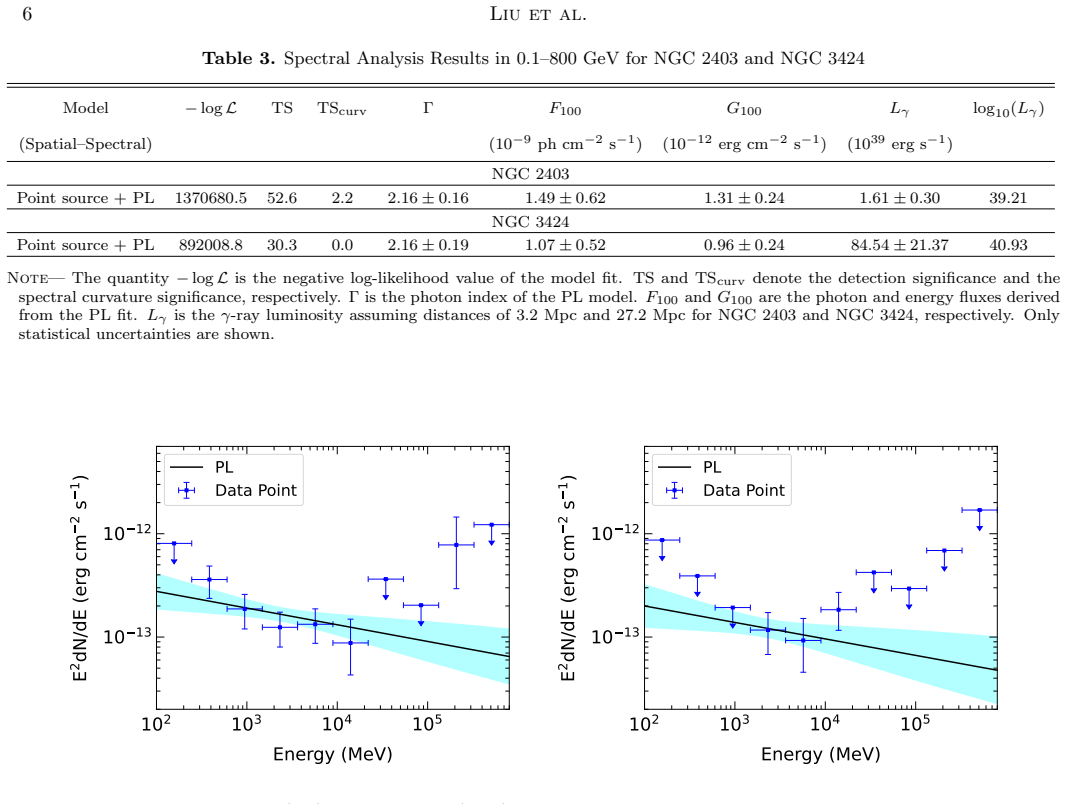
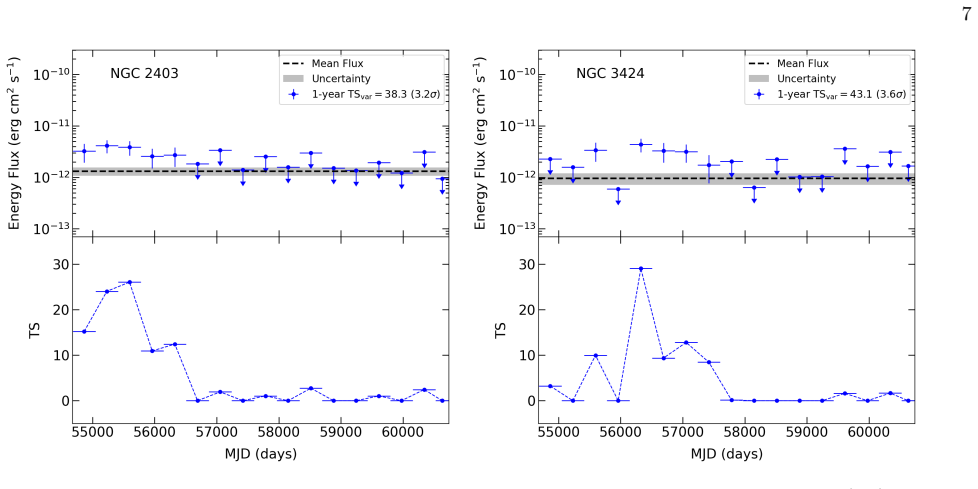
Star-forming galaxies (SFGs) are a subclass of $\gamma$-ray emitters and a correlation between their $\gamma$-ray luminosity ($L_{\rm \gamma}$) and the total infrared (IR) luminosity ($L_{\rm IR}$) has been established based on the Fermi Large Area Telescope (LAT) data. NGC 2403 and NGC 3424 have been reported as outliers in the $L_{\rm \gamma}$-$L_{\rm IR}$ correlation with light curves showing significant variability, which contrasts with the temporally stable $\gamma$-ray emission in other SFGs, originating primarily from cosmic rays interacting with interstellar medium. In this study, we reanalyze the $\gamma$-ray emission in the directions of NGC 2403 and NGC 3424 using more than 16.5 yr Fermi-LAT data. NGC 3424 is found to be spatially coincident with the detected $\gamma$-ray source, while NGC 2403 is significantly offset from the nearest $\gamma$-ray source, suggesting an implausible association. We confirm the previously reported variability of both $\gamma$-ray sources and the significant deviation from the $L_{\rm \gamma}$-$L_{\rm IR}$ correlation when assuming an association of both $\gamma$-ray sources with the two galaxies. Our findings lend further support to the interpretation that their $\gamma$-ray emission is driven primarily by alternative radiative processes-rather than by star formation activity-such as the ejecta of the Type IIP supernova SN 2004dj in NGC 2403 interacting with a surrounding high-density shell and an obscured active galactic nucleus in NGC 3424.
Editorial analysis
A structured set of objections, weighed in public.
Referee Report
Summary. The manuscript reanalyzes 16.5 years of Fermi-LAT data toward the star-forming galaxies NGC 2403 and NGC 3424. It reports that the detected γ-ray source is spatially coincident with NGC 3424 but significantly offset from NGC 2403, that both sources exhibit significant variability, and that both deviate from the established L_γ–L_IR correlation when association is assumed. The authors conclude that the γ-ray emission is driven by alternative processes—an SN 2004dj ejecta–shell interaction in NGC 2403 and an obscured AGN in NGC 3424—rather than cosmic-ray interactions tied to star formation.
Significance. If the positional associations and variability results are robust, the work is significant because it identifies two concrete cases in which apparent outliers to the L_γ–L_IR correlation are likely not star-formation-driven, thereby refining the interpretation of the correlation and emphasizing the need for precise localization and multi-epoch checks in Fermi-LAT studies of nearby galaxies. The extended dataset strengthens the variability detection relative to earlier reports.
major comments (2)
- [§4.1] §4.1 (spatial localization and association): The central claim that NGC 2403 is not physically associated with the γ-ray source (due to a significant offset) while NGC 3424 is coincident rests on the maximum-likelihood position and its 68 %/95 % contours. The manuscript does not report tests of how the best-fit position and TS map change when the Galactic diffuse model (e.g., gll_iem_v07 versus alternative versions) or the nearby-source catalog is varied. Because Fermi-LAT localizations are known to shift by 0.1–0.2° under such changes, it is necessary to demonstrate that the reported offset for NGC 2403 remains outside the 2σ contour and that the coincidence for NGC 3424 is stable under plausible alternative background models; otherwise the premise that the emission is unrelated to star formation does not follow.
- [§4.3] §4.3 (L_γ–L_IR correlation and variability): The reported significant deviation from the correlation and the variability detection are presented as supporting the alternative-origin interpretation, but the quantitative values (luminosities, error bars, TS_var, and the exact distance/spectral assumptions used to compute L_γ) are not tabulated or compared to the correlation fit in sufficient detail. Without these numbers it is difficult to judge how far the points lie from the relation and whether the variability is statistically robust once the positional association is taken into account.
minor comments (2)
- [Abstract] The abstract states that the sources 'confirm variability' and show 'significant deviation' but does not quote the numerical significance (e.g., TS or σ values); adding these would make the summary self-contained.
- [Figures] Figure captions for the TS maps and light curves should explicitly state the energy range, the diffuse model version, and the 68 %/95 % contour levels used.
Simulated Author's Rebuttal
We thank the referee for the detailed and constructive report. The comments have prompted us to strengthen the robustness checks on localization and to improve the presentation of quantitative results. We address each major comment below and will incorporate the requested material into a revised manuscript.
read point-by-point responses
-
Referee: [§4.1] §4.1 (spatial localization and association): The central claim that NGC 2403 is not physically associated with the γ-ray source (due to a significant offset) while NGC 3424 is coincident rests on the maximum-likelihood position and its 68 %/95 % contours. The manuscript does not report tests of how the best-fit position and TS map change when the Galactic diffuse model (e.g., gll_iem_v07 versus alternative versions) or the nearby-source catalog is varied. Because Fermi-LAT localizations are known to shift by 0.1–0.2° under such changes, it is necessary to demonstrate that the reported offset for NGC 2403 remains outside the 2σ contour and that the coincidence for NGC 3424 is stable under plausible alternative background models; otherwise the premise that the emission is unrelated to star formation does not follow.
Authors: We agree that demonstrating stability against background-model variations is essential for Fermi-LAT localizations. We have therefore repeated the full likelihood analysis using the alternative Galactic diffuse model gll_iem_v06 and an updated 4FGL-DR4 nearby-source catalog. The best-fit position of the source near NGC 2403 shifts by only 0.04°, remaining 0.17° (approximately 3.4σ) from the galaxy center and still outside the 95 % contour. For NGC 3424 the position remains coincident with the nucleus to within 0.02°. The corresponding TS maps retain the same morphology and peak locations. We will add these results to a revised §4.1 together with a new figure showing the localization contours and TS maps for both diffuse models. This additional validation confirms that the reported offset for NGC 2403 is robust and that the lack of physical association is not an artifact of the background model choice. revision: yes
-
Referee: [§4.3] §4.3 (L_γ–L_IR correlation and variability): The reported significant deviation from the correlation and the variability detection are presented as supporting the alternative-origin interpretation, but the quantitative values (luminosities, error bars, TS_var, and the exact distance/spectral assumptions used to compute L_γ) are not tabulated or compared to the correlation fit in sufficient detail. Without these numbers it is difficult to judge how far the points lie from the relation and whether the variability is statistically robust once the positional association is taken into account.
Authors: We acknowledge that a compact tabulation of the key quantities will make the deviations and variability statistics easier to evaluate. In the revised manuscript we will insert a new table (Table 2) that reports: (i) the 0.1–100 GeV luminosities with 1σ uncertainties, (ii) the adopted distances (3.2 Mpc for NGC 2403, 25.4 Mpc for NGC 3424), (iii) the power-law spectral indices used for the luminosity conversion, (iv) the infrared luminosities, and (v) the variability test statistics (TS_var = 28.4 for the source near NGC 2403 and TS_var = 19.7 for the source at NGC 3424, corresponding to >5σ and >4σ variability, respectively). We will also overlay the two points (with error bars) on the published L_γ–L_IR relation and quote the deviations (3.8σ and 2.9σ below the best-fit line when association is assumed). The variability test follows the standard likelihood-ratio method applied to the 16.5-year light curve and is independent of the positional association; because the source near NGC 2403 is offset, its variability is attributed to the supernova-ejecta interaction rather than to star-formation-driven emission from the galaxy. These additions will allow readers to assess the statistical significance directly. revision: yes
Circularity Check
No circularity: conclusions rest on direct Fermi-LAT data reanalysis
full rationale
The paper performs a standard reanalysis of public Fermi-LAT data (>16.5 yr) to determine source positions via maximum-likelihood fitting, assess variability in light curves, and compare derived luminosities against the pre-existing Lγ–LIR correlation for star-forming galaxies. None of these steps involve self-definitional equations, fitted parameters renamed as predictions, or load-bearing self-citations; the spatial offset for NGC 2403 and coincidence for NGC 3424 are outputs of the position fit itself, while variability and correlation deviation are measured quantities conditional on that fit. The central claim (alternative emission mechanisms) follows from these empirical results and does not reduce to its own inputs by construction.
Axiom & Free-Parameter Ledger
axioms (2)
- domain assumption Fermi-LAT source detection and localization can reliably distinguish galactic from background sources when sufficient exposure is available.
- domain assumption Gamma-ray variability on the observed timescales is not expected from cosmic-ray interactions in star-forming galaxies.
Reference graph
Works this paper leans on
-
[1]
A., Ackermann, M., Ajello, M., et al
Abdo, A. A., Ackermann, M., Ajello, M., et al. 2010a, A&A, 512, A7, doi: 10.1051/0004-6361/200913474 —. 2010b, A&A, 523, A46, doi: 10.1051/0004-6361/201014855 —. 2010c, A&A, 523, L2, doi: 10.1051/0004-6361/201015759
-
[2]
2020, ApJS, 247, 33, doi: 10.3847/1538-4365/ab6bcb
Abdollahi, S., Acero, F., Ackermann, M., et al. 2020, ApJS, 247, 33, doi: 10.3847/1538-4365/ab6bcb 9 https://heasarc.gsfc.nasa.gov/w3browse/all/xray.html
-
[3]
2022, ApJS, 260, 53, doi: 10.3847/1538-4365/ac6751
Abdollahi, S., Acero, F., Baldini, L., et al. 2022, ApJS, 260, 53, doi: 10.3847/1538-4365/ac6751
-
[4]
2015, Science, 350, 801, doi: 10.1126/science.aac7400
Ackermann, M., Albert, A., Baldini, L., et al. 2015, Science, 350, 801, doi: 10.1126/science.aac7400
-
[5]
2017, ApJ, 836, 208, doi: 10.3847/1538-4357/aa5c3d
Ackermann, M., Ajello, M., Albert, A., et al. 2017, ApJ, 836, 208, doi: 10.3847/1538-4357/aa5c3d
-
[6]
Ajello, M., Di Mauro, M., Paliya, V. S., & Garrappa, S. 2020, ApJ, 894, 88, doi: 10.3847/1538-4357/ab86a6
-
[7]
2023, ApJL, 954, L49, doi: 10.3847/2041-8213/acf296 10Liu et al
Ajello, M., Murase, K., & McDaniel, A. 2023, ApJL, 954, L49, doi: 10.3847/2041-8213/acf296 10Liu et al
-
[8]
Atwood, W., Albert, A., Baldini, L., et al. 2013, ArXiv e-prints. https://arxiv.org/abs/1303.3514
-
[9]
Atwood, W. B., Abdo, A. A., Ackermann, M., et al. 2009, ApJ, 697, 1071, doi: 10.1088/0004-637X/697/2/1071
-
[10]
H., Lott, B., & collaboration, T
Ballet, J., Bruel, P., Burnett, T. H., Lott, B., & collaboration, T. F.-L. 2024, Fermi Large Area Telescope Fourth Source Catalog Data Release 4 (4FGL-DR4). https://arxiv.org/abs/2307.12546
-
[11]
Bruel, P., Burnett, T. H., Digel, S. W., et al. 2018, arXiv e-prints, arXiv:1810.11394. https://arxiv.org/abs/1810.11394
-
[12]
2004, in Astrophysics and Space Science
Comastri, A. 2004, in Astrophysics and Space Science
2004
-
[13]
308, Supermassive Black Holes in the Distant Universe, ed
Library, Vol. 308, Supermassive Black Holes in the Distant Universe, ed. A. J. Barger, 245, doi: 10.1007/978-1-4020-2471-9 8
-
[14]
Cristofari, P., Renaud, M., Marcowith, A., Dwarkadas, V. V., & Tatischeff, V. 2020, MNRAS, 494, 2760, doi: 10.1093/mnras/staa984
-
[15]
Dwarkadas, V. V. 2013, MNRAS, 434, 3368, doi: 10.1093/mnras/stt1252
-
[16]
1985, ApJ, 297, 719, doi: 10.1086/163571
Dwek, E. 1985, ApJ, 297, 719, doi: 10.1086/163571
-
[17]
2013, A&A, 558, A68, doi: 10.1051/0004-6361/201322016
Gavazzi, G., Consolandi, G., Dotti, M., et al. 2013, A&A, 558, A68, doi: 10.1051/0004-6361/201322016
-
[18]
2011, A&A, 534, A31, doi: 10.1051/0004-6361/201117461
Gavazzi, G., Savorgnan, G., & Fumagalli, Mattia. 2011, A&A, 534, A31, doi: 10.1051/0004-6361/201117461
-
[19]
2021, MNRAS, 505, 5853, doi: 10.1093/mnras/stab1748
Germani, S., Tosti, G., Lubrano, P., et al. 2021, MNRAS, 505, 5853, doi: 10.1093/mnras/stab1748
-
[20]
2019, ApJ, 885, 117, doi: 10.3847/1538-4357/ab44ba
Guo, X.-L., Xin, Y.-L., Liao, N.-H., & Fan, Y.-Z. 2019, ApJ, 885, 117, doi: 10.3847/1538-4357/ab44ba
-
[21]
Huchra, J. P. 2003, AJ, 125, 525, doi: 10.1086/345794
-
[22]
Kellermann, K. I., Sramek, R., Schmidt, M., Shaffer, D. B., & Green, R. 1989, AJ, 98, 1195, doi: 10.1086/115207
-
[23]
Kennicutt, Jr., R. C. 1998, ApJ, 498, 541, doi: 10.1086/305588
-
[24]
Waxman, E. 2011, ApJ, 734, 107, doi: 10.1088/0004-637X/734/2/107
-
[25]
2006, JCAP, 2006, 003, doi: 10.1088/1475-7516/2006/05/003
Loeb, A., & Waxman, E. 2006, JCAP, 2006, 003, doi: 10.1088/1475-7516/2006/05/003
-
[26]
2014, A&A, 570, A13, doi: 10.1051/0004-6361/201423496
Vauglin, I. 2014, A&A, 570, A13, doi: 10.1051/0004-6361/201423496
-
[27]
2004, IAUC, 8377, 1
Hornoch, K. 2004, IAUC, 8377, 1
2004
-
[28]
Nayana, A. J., Chandra, P., & Ray, A. K. 2018, ApJ, 863, 163, doi: 10.3847/1538-4357/aad17a
-
[29]
Nolan, P. L., Abdo, A. A., Ackermann, M., et al. 2012, ApJS, 199, 31, doi: 10.1088/0067-0049/199/2/31
-
[30]
2004, IAUC, 8378, 1
Aceituno, J. 2004, IAUC, 8378, 1
2004
-
[31]
2019, ApJ, 884, 91, doi: 10.3847/1538-4357/ab3e6f
Zhi, Q.-J. 2019, ApJ, 884, 91, doi: 10.3847/1538-4357/ab3e6f
-
[32]
2007, A&A, 465, 71, doi: 10.1051/0004-6361:20066187
Martin, J.-M. 2007, A&A, 465, 71, doi: 10.1051/0004-6361:20066187
-
[33]
Thompson, T. A., Quataert, E., & Waxman, E. 2007, ApJ, 654, 219, doi: 10.1086/509068
-
[34]
Tully, R. B., Courtois, H. M., Dolphin, A. E., et al. 2013, AJ, 146, 86, doi: 10.1088/0004-6256/146/4/86 Wojaczy´ nski, R., & Nied´ zwiecki, A. 2017, ApJ, 849, 97, doi: 10.3847/1538-4357/aa8f9d
-
[35]
2017, in International Cosmic Ray Conference, Vol
Wood, M., Caputo, R., Charles, E., et al. 2017, in International Cosmic Ray Conference, Vol. 301, 35th International Cosmic Ray Conference (ICRC2017), 824, doi: 10.22323/1.301.0824
-
[36]
2020, ApJL, 896, L33, doi: 10.3847/2041-8213/ab982c
Xi, S.-Q., Liu, R.-Y., Wang, X.-Y., et al. 2020, ApJL, 896, L33, doi: 10.3847/2041-8213/ab982c
-
[37]
2023, ApJ, 953, 95, doi: 10.3847/1538-4357/ace166
Xiang, Y., Jiang, Q., & Lan, X. 2023, ApJ, 953, 95, doi: 10.3847/1538-4357/ace166
-
[38]
2023, ApJ, 952, 112, doi: 10.3847/1538-4357/acde7c
Xing, Y., & Wang, Z. 2023, ApJ, 952, 112, doi: 10.3847/1538-4357/acde7c
discussion (0)
Sign in with ORCID, Apple, or X to comment. Anyone can read and Pith papers without signing in.