Recognition: unknown
On Agentic Behavioral Modeling
Pith reviewed 2026-05-07 05:11 UTC · model grok-4.3
The pith
Agentic behavioral modeling equates Rescorla-Wagner learning with Bayesian inference in symmetric bandits.
A machine-rendered reading of the paper's core claim, the machinery that carries it, and where it could break.
Core claim
The framework of agentic behavioral modeling treats artificial agents as latent generative hypotheses about cognitive mechanisms and evaluates them by their statistical adequacy in explaining human behavior. For a binary perceptual contrast-discrimination task and a symmetric two-armed bandit learning task, the approach constructs joint probability models, derives explicit conditional log-likelihoods, validates variants through recovery simulations, and produces an agent-centric interpretation of the psychometric function, optimal policies for both tasks, and the equivalence between Rescorla-Wagner learning and Bayesian inference under symmetry.
What carries the argument
Agentic behavioral modeling (ABM), the construction of joint task-agent-data probability models that enable derivation of conditional log-likelihoods and evaluation of agents as cognitive hypotheses.
If this is right
- Optimal policies for the perceptual discrimination and bandit tasks follow directly from the agent models.
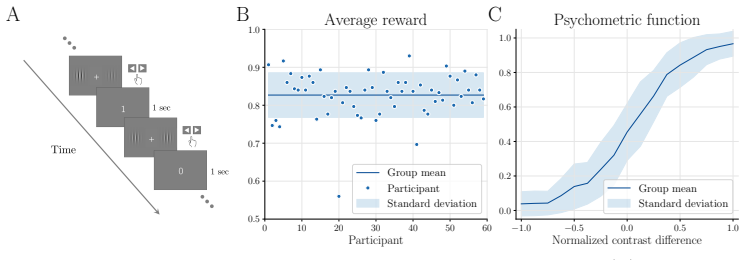
- The psychometric function arises as the marginal choice probability under the agent's decision policy in the perceptual task.
- Model variants for both tasks are distinguishable and recoverable in simulation before data application.
- Rescorla-Wagner and Bayesian agents coincide exactly in symmetric stationary bandit environments.
Where Pith is reading between the lines
- The same joint-model structure could be used to test whether other learning rules diverge from optimality once symmetry is broken.
- Formalizing existing cognitive models inside ABM would allow direct statistical comparison of their generative adequacy on shared datasets.
- Synthetic data generated by the optimal agents could serve as a benchmark for detecting when human behavior deviates from the derived policies.
- The framework supplies a route to embed reinforcement-learning agents from neuroscience into the same inference pipeline used for behavioral data.
Load-bearing premise
Artificial agents can be treated as valid latent, generative hypotheses about underlying cognitive mechanisms that are statistically adequate for explaining human behavior.
What would settle it
Human choice data from the symmetric two-armed bandit task in which the fitted Rescorla-Wagner and Bayesian agents produce statistically different likelihoods or systematic posterior predictive deviations from observed learning curves.
Figures





read the original abstract
Integrating theoretical neuroscience, decision theory, and probabilistic inference offers a promising route to understanding human cognition, yet concrete methodological bridges between agentic AI models and behavioral data analysis remain formally underdeveloped. We advance this synthesis under the framework of agentic behavioral modeling (ABM), which treats artificial agents as latent, generative hypotheses about cognitive mechanisms and evaluates them by their statistical adequacy in explaining human behavior. After outlining its conceptual foundations, we apply the framework to two minimal laboratory paradigms: a binary perceptual contrast-discrimination task and a symmetric two-armed bandit learning task. We formalize each task-agent-data system as a joint probability model, derive explicit conditional log-likelihoods for behavioral inference, validate different model variants using model and parameter recovery simulations, and evaluate them in light of empirical data. Using these minimal examples, we provide an agent-centric interpretation of the psychometric function, derive optimal policies for both tasks, and show the equivalence between Rescorla-Wagner learning and Bayesian inference in symmetric bandits. More broadly, this work may serve as a conceptual and practical foundation for applying ABM to cognitive behavioral science.
Editorial analysis
A structured set of objections, weighed in public.
Referee Report
Summary. The paper introduces the Agentic Behavioral Modeling (ABM) framework, which treats artificial agents as latent generative hypotheses about cognitive mechanisms and evaluates them via statistical adequacy in explaining human behavior. It applies the framework to a binary perceptual contrast-discrimination task and a symmetric two-armed bandit task by formalizing each task-agent-data system as a joint probability model, deriving explicit conditional log-likelihoods, validating model variants through model and parameter recovery simulations, and evaluating against empirical data. Key results include an agent-centric interpretation of the psychometric function, optimal policies for both tasks, and the equivalence between Rescorla-Wagner learning and Bayesian inference in symmetric bandits.
Significance. If the derivations hold, this provides a concrete methodological bridge between agentic AI models and behavioral data analysis, advancing integration of theoretical neuroscience, decision theory, and probabilistic inference. The explicit joint-model construction and likelihood derivation supply verifiable machinery for the equivalence claim, while the recovery simulations and empirical evaluation add practical credibility. The framework's emphasis on artificial agents as generative hypotheses offers a foundation that could extend to other paradigms, with the symmetry-based equivalence serving as a clear, falsifiable example.
minor comments (3)
- [Abstract] Abstract: the description of ABM as treating agents as 'latent, generative hypotheses' is repeated in the broader contribution statement; a single, concise definition early in the abstract would reduce redundancy.
- [Simulations section] Model and parameter recovery simulations: the abstract states that different model variants are validated, but does not specify the exact recovery metrics (e.g., bias, coverage, or confusion matrices); adding these quantitative details would strengthen the validation claim.
- [Empirical evaluation] Empirical evaluation: the abstract mentions evaluation 'in light of empirical data' without naming the dataset or the specific adequacy measures (e.g., posterior predictive checks or out-of-sample log-likelihood); including these would make the empirical support more transparent.
Simulated Author's Rebuttal
We thank the referee for their positive and accurate summary of our manuscript on Agentic Behavioral Modeling (ABM). The report correctly identifies the framework's core elements: treating artificial agents as latent generative hypotheses, formalizing task-agent-data systems as joint probability models, deriving conditional log-likelihoods, validating via recovery simulations, and demonstrating results such as the agent-centric psychometric function, optimal policies, and the Rescorla-Wagner/Bayesian equivalence in symmetric bandits. We appreciate the recommendation for minor revision and the recognition of the work's potential to bridge agentic AI, theoretical neuroscience, and behavioral data analysis.
Circularity Check
No significant circularity; derivation is self-contained
full rationale
The paper formalizes each task-agent-data system as an explicit joint probability model, derives conditional log-likelihoods for inference, performs model/parameter recovery simulations, and evaluates against data. The central equivalence between Rescorla-Wagner learning and Bayesian inference is obtained directly from the symmetry condition within this joint model construction; it is an internal mathematical property of the two agent specifications once the model is fixed, not a reduction to fitted parameters, self-definitions, or load-bearing self-citations. The broader ABM premise is presented as the methodological framing rather than an unexamined input required for the equivalence result. No quoted step reduces by construction to its own inputs, and the workflow supplies independent verification machinery (likelihoods, simulations, empirical checks). This aligns with a score of 0 as the most common honest finding for self-contained derivations.
Axiom & Free-Parameter Ledger
axioms (1)
- domain assumption Artificial agents can serve as latent, generative hypotheses about cognitive mechanisms that are statistically adequate for explaining human behavior
invented entities (1)
-
Agentic Behavioral Modeling (ABM) framework
no independent evidence
Reference graph
Works this paper leans on
-
[1]
Cambridge, Mass: Belknap Press of Harvard University Press. Summerfield, C., & Tsetsos, K. (2012). Building Bridges between Perceptual and Economic Decision-Making: Neural and Computational Mechanisms.Frontiers in Neuroscience,6, , https://doi.org/10.3389/fnins.2012.00070 Sutton, R.S., & Barto, A.G. (1981). Toward a modern theory of adaptive networks: Exp...
-
[2]
Stimuli withc∈[−κ, κ] forκ= 1 2 in steps of 0.01 were thus created by setting γl :=µ− 1 2 candγ r :=c+γ l (S.11) as implemented inabm stimuli.py. 4 −1.0 −0.5 0.0 0.5 1.0 0.0 0.2 0.4 0.6 0.8 1.0 P1 A2 ˆσ: 0.25, ˆη: -0.10, ˆτ: 0.00 −1.0 −0.5 0.0 0.5 1.0 0.0 0.2 0.4 0.6 0.8 1.0 P2 A2 ˆσ: 0.47, ˆη: -0.16, ˆτ: 0.05 −1.0 −0.5 0.0 0.5 1.0 0.0 0.2 0.4 0.6 0.8 1.0...
2016
discussion (0)
Sign in with ORCID, Apple, or X to comment. Anyone can read and Pith papers without signing in.