Recognition: unknown
Scale-freeness under node removal: a finite-size scaling perspective
Pith reviewed 2026-05-07 07:39 UTC · model grok-4.3
The pith
Under hub-preferential node removal, networks can match a scale-free degree distribution yet fail to show scale-invariant organization across different sizes.
A machine-rendered reading of the paper's core claim, the machinery that carries it, and where it could break.
Core claim
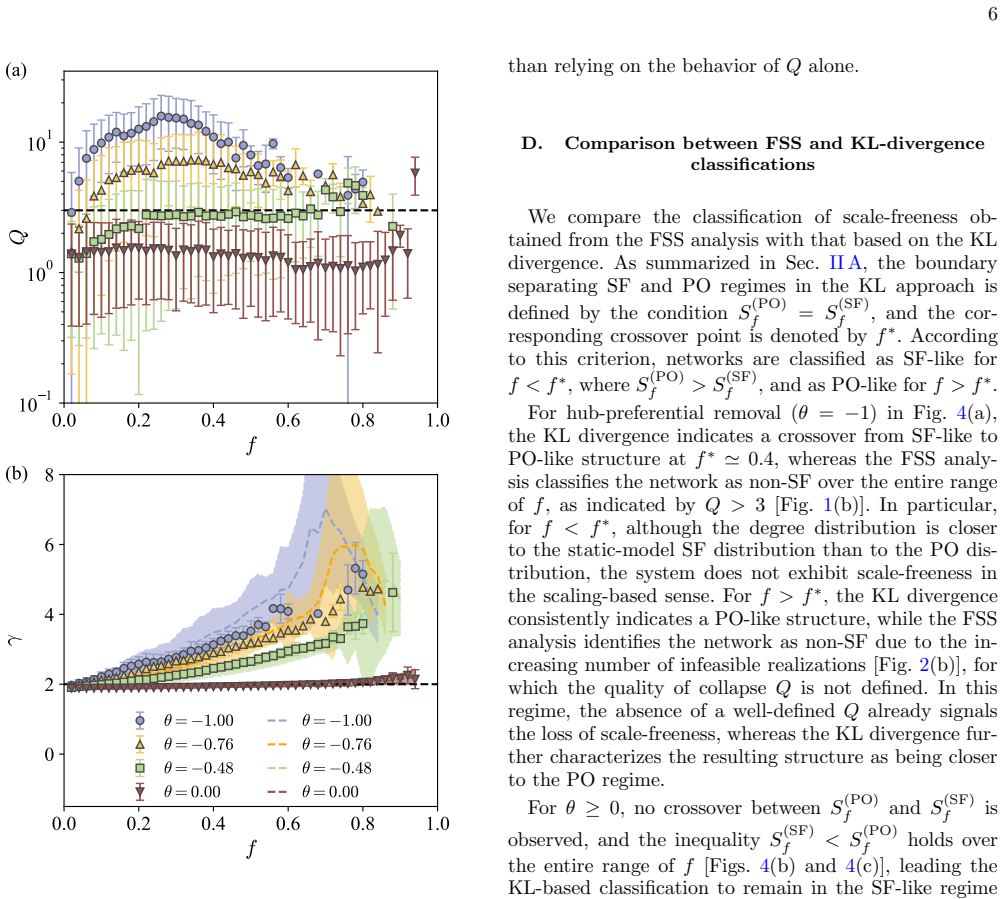
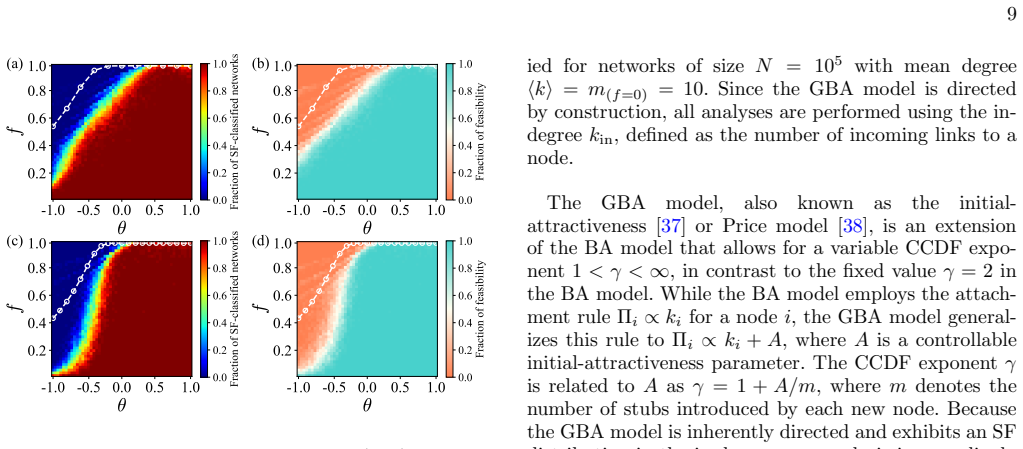
Starting from scale-free networks, the application of degree-dependent node removal with varying hub-protection strength θ shows that under hub-preferential removal (θ < 0) the networks satisfy the Kullback-Leibler criterion for scale-freeness but do not exhibit the data collapse required by finite-size scaling analysis. This reveals that resemblance to a reference degree distribution does not ensure the persistence of scale-invariant organization across system sizes. Consequently, the two diagnostic methods capture complementary aspects of network structure and should be used together for a fuller understanding of structural degradation under node removal.
What carries the argument
The finite-size scaling (FSS) analysis applied to the degree distributions or related quantities of node-removed networks, contrasted with Kullback-Leibler divergence from a reference scale-free distribution, under a removal process where node removal probability depends on degree raised to power θ.
If this is right
- For random removal and hub-protecting removal, the KL and FSS criteria agree on whether the network remains scale-free.
- The discrepancy under hub-preferential removal shows that matching a static degree distribution does not guarantee scale-invariance across sizes.
- Structural stability assessments in networks should incorporate finite-size scaling tests in addition to distribution comparisons.
- The joint use of both diagnostics offers a more complete picture of how scale-free organization degrades.
Where Pith is reading between the lines
- In applications to real-world networks subject to targeted attacks on hubs, one should verify scale-freeness with FSS rather than relying solely on KL divergence.
- This discrepancy might explain why some networks appear robust by degree stats but still show collapse when system sizes vary in simulations.
- Future models could incorporate FSS directly into robustness metrics for predicting systemic stability under different removal regimes.
- Testing on empirical networks from ecology or social systems could reveal whether observed scale-free traits survive removal processes in practice.
Load-bearing premise
The finite-size scaling procedure accurately detects the absence of scale-invariant organization without being affected by the details of how the networks are generated or nodes removed, and that the starting networks are genuinely scale-free.
What would settle it
If networks generated or modified under hub-preferential removal (θ < 0) exhibit successful data collapse in the finite-size scaling analysis across multiple system sizes while still passing the KL criterion, this would contradict the reported discrepancy between the two diagnostics.
Figures




read the original abstract
In heterogeneous network systems such as ecological and social networks, structural stability depends on how connectivity changes under node removal, as different removal sequences can trigger distinct modes of systemic collapse. While robustness to random failures and targeted attacks has been extensively studied, most analyses have focused on connectivity loss or degree distribution, rather than on how scale-invariant organization emerges and evolves with system size. Here we examine how scale-free structure evolves under progressive degree-dependent node removal, systematically varying the hub-protection strength $\theta$. Starting from scale-free networks, we apply the recently developed finite-size scaling (FSS) analysis to node-removed networks and compare the results with those from Kullback-Leibler (KL) divergence-based classification. We find that under random ($\theta=0$) and hub-protecting removal ($\theta>0$), the two criteria largely agree, whereas under hub-preferential removal ($\theta<0$), networks may appear scale-free according to the KL criterion while failing the FSS test of scaling collapse. This discrepancy indicates that similarity to a reference degree distribution does not guarantee the persistence of scale-invariant organization across system sizes. The two diagnostics thus probe complementary aspects of network structure, and their joint use provides a more complete characterization of structural degradation.
Editorial analysis
A structured set of objections, weighed in public.
Referee Report
Summary. The manuscript examines how scale-free organization in networks evolves under degree-dependent node removal, parameterized by a hub-protection strength θ. Starting from scale-free networks, the authors apply finite-size scaling (FSS) analysis to test for data collapse of the degree distribution P(k) across remaining system sizes after removal, and compare this to classification by Kullback-Leibler (KL) divergence to a reference power-law distribution. They report agreement between the two diagnostics for random (θ=0) and hub-protecting (θ>0) removal, but a discrepancy for hub-preferential removal (θ<0), where networks can satisfy the KL criterion while failing FSS scaling collapse. The central conclusion is that KL similarity to a reference distribution does not guarantee persistence of scale-invariant structure across sizes, so the two diagnostics are complementary for characterizing structural degradation.
Significance. If the reported discrepancy is robust, the result would be significant for network robustness studies in social, ecological, and infrastructure systems, as it shows that static distributional similarity (KL) can be insufficient to confirm scale-freeness under perturbation, while FSS provides a stricter test of scale-invariance across sizes. The joint use of two independent diagnostics is a clear strength, moving beyond single-metric analyses common in the field. The simulation-driven approach with tunable θ allows systematic exploration, but the absence of detailed methodological parameters limits generalizability.
major comments (2)
- [Methods] Methods section: The text provides no quantitative details on initial network sizes N, the algorithm used to generate the starting scale-free networks (e.g., Barabási–Albert parameters or configuration-model exponents), the exact functional form of the removal probability p(k) ∝ k^θ, the number of independent realizations per θ value, or any statistical measures (error bars, p-values) for the KL/FSS agreement or discrepancy. These omissions are load-bearing for the central claim, because without them it cannot be verified that the FSS collapse failure under θ<0 is not an artifact of the specific generation or removal implementation, as raised in the stress-test note.
- [Results] Results section (FSS analysis): The scaling-collapse procedure is described only at a high level; the manuscript does not specify the assumed scaling ansatz (e.g., P(k) = k^{-α} f(k/N^β) or alternative form), the range of post-removal system sizes used for collapse, or the quantitative criterion for declaring 'failure' of collapse versus visual inspection. This is critical because the discrepancy claim for θ<0 rests on FSS correctly diagnosing loss of scale-invariance rather than a mismatch between the removal-induced correlations and the FSS assumptions.
minor comments (2)
- [Abstract] Abstract: The phrase 'the recently developed finite-size scaling (FSS) analysis' is used without a citation; adding the reference would allow readers to locate the precise method being applied.
- [Figures] Figure captions (throughout): Captions should explicitly state the values of θ, N, and number of realizations shown, as well as the metric used to assess collapse quality, to make the visual evidence self-contained.
Simulated Author's Rebuttal
We thank the referee for their careful reading and constructive comments on our manuscript. We have revised the manuscript to address the concerns regarding insufficient methodological details and the high-level description of the finite-size scaling procedure. Our point-by-point responses to the major comments follow.
read point-by-point responses
-
Referee: [Methods] Methods section: The text provides no quantitative details on initial network sizes N, the algorithm used to generate the starting scale-free networks (e.g., Barabási–Albert parameters or configuration-model exponents), the exact functional form of the removal probability p(k) ∝ k^θ, the number of independent realizations per θ value, or any statistical measures (error bars, p-values) for the KL/FSS agreement or discrepancy. These omissions are load-bearing for the central claim, because without them it cannot be verified that the FSS collapse failure under θ<0 is not an artifact of the specific generation or removal implementation, as raised in the stress-test note.
Authors: We agree that the original Methods section omitted several quantitative parameters essential for reproducibility and independent verification. In the revised manuscript we have expanded the Methods section to specify the initial network sizes N, the algorithm and parameters used to generate the starting scale-free networks, the exact functional form of the removal probability p(k) ∝ k^θ (including normalization), the number of independent realizations per θ value, and the statistical measures (error bars and p-values) employed for the KL and FSS comparisons. These additions allow readers to confirm that the reported discrepancy for θ < 0 is not an artifact of the particular implementation. revision: yes
-
Referee: [Results] Results section (FSS analysis): The scaling-collapse procedure is described only at a high level; the manuscript does not specify the assumed scaling ansatz (e.g., P(k) = k^{-α} f(k/N^β) or alternative form), the range of post-removal system sizes used for collapse, or the quantitative criterion for declaring 'failure' of collapse versus visual inspection. This is critical because the discrepancy claim for θ<0 rests on FSS correctly diagnosing loss of scale-invariance rather than a mismatch between the removal-induced correlations and the FSS assumptions.
Authors: We acknowledge that the original description of the finite-size scaling analysis was presented at a high level. In the revised manuscript we have added a detailed subsection that explicitly states the scaling ansatz employed, the specific range of post-removal system sizes used for the collapse, and the quantitative criterion (combining visual assessment with a measure of curve variance) used to determine success or failure of collapse. This clarification supports the conclusion that the lack of collapse for θ < 0 reflects a genuine loss of scale-invariance rather than a mismatch with the assumed scaling form. revision: yes
Circularity Check
No circularity: simulation-based comparison of two independent diagnostics
full rationale
The paper generates scale-free networks, applies degree-dependent node removal parameterized by θ, and then applies two separate, externally defined diagnostics (KL divergence to a reference P(k) and finite-size scaling collapse test for scale-freeness). The reported discrepancy for θ<0 is an empirical observation from these simulations rather than a mathematical reduction. No equation or derivation equates the FSS outcome to the KL outcome or to any fitted input by construction. The FSS method is invoked as a pre-existing tool (cited as 'recently developed'), but its application here does not make the central claim tautological; the result remains falsifiable by the simulation data itself. This matches the default expectation for a simulation-driven study with no self-definitional or fitted-input circularity.
Axiom & Free-Parameter Ledger
free parameters (1)
- θ (hub-protection strength)
axioms (2)
- domain assumption Initial networks follow a power-law degree distribution and are scale-free
- domain assumption Finite-size scaling collapse is a valid test for persistence of scale-invariant organization
Reference graph
Works this paper leans on
-
[1]
Barab´ asi and R
A.-L. Barab´ asi and R. Albert, Emergence of scaling in random networks, Science286, 509 (1999)
1999
-
[2]
Pastor-Satorras and A
R. Pastor-Satorras and A. Vespignani, Epidemic spread- ing in scale-free networks, Phys. Rev. Lett.86, 3200 (2001)
2001
-
[3]
M. J. Lee and D.-S. Lee, Understanding the temporal pattern of spreading in heterogeneous networks: Theory of the mean infection time, Phys. Rev. E99, 032309 (2019)
2019
-
[4]
Clauset, C
A. Clauset, C. R. Shalizi, and M. E. Newman, Power- law distributions in empirical data, SIAM Rev.51, 661 (2009)
2009
-
[5]
A. D. Broido and A. Clauset, Scale-free networks are rare, Nat. Commun.10, 1017 (2019)
2019
-
[6]
Voitalov, P
I. Voitalov, P. Van Der Hoorn, R. Van Der Hofstad, and D. Krioukov, Scale-free networks well done, Phys. Rev. Res.1, 033034 (2019)
2019
-
[7]
Albert, H
R. Albert, H. Jeong, and A.-L. Barab´ asi, Error and at- tack tolerance of complex networks, Nature406, 378 (2000)
2000
-
[8]
Cohen, K
R. Cohen, K. Erez, D. Ben-Avraham, and S. Havlin, Re- silience of the internet to random breakdowns, Phys. Rev. Lett.85, 4626 (2000)
2000
-
[9]
M. P. H. Stumpf, C. Wiuf, and R. M. May, Subnets of scale-free networks are not scale-free: Sampling proper- ties of networks, Proc. Nati. Acad. Sci. USA102, 4221 (2005)
2005
-
[11]
S.-W. Son, C. Christensen, G. Bizhani, D. V. Foster, P. Grassberger, and M. Paczuski, Sampling properties of directed networks, Phys. Rev. E86, 046104 (2012). 10
2012
-
[12]
M. J. Lee, J.-H. Kim, K.-I. Goh, S. H. Lee, S.-W. Son, and D.-S. Lee, Degree distributions under general node re- moval: Power-law or Poisson?, Phys. Rev. E106, 064309 (2022)
2022
-
[13]
Kullback and R
S. Kullback and R. A. Leibler, On Information and Suf- ficiency, Ann. Math. Stat.22, 79 (1951)
1951
-
[14]
Tishby, O
I. Tishby, O. Biham, and E. Katzav, Convergence to- wards an erd˝ os-r´ enyi graph structure in network contrac- tion processes, Phys. Rev. E100, 032314 (2019)
2019
-
[15]
Tishby, O
I. Tishby, O. Biham, and E. Katzav, Analysis of the con- vergence of the degree distribution of contracting random networks towards a poisson distribution using the relative entropy, Phys. Rev. E101, 062308 (2020)
2020
-
[16]
Budnick, O
B. Budnick, O. Biham, and E. Katzav, Structure of net- works that evolve under a combination of growth and contraction, Phys. Rev. E106, 044305 (2022)
2022
-
[17]
Serafino, G
M. Serafino, G. Cimini, A. Maritan, A. Rinaldo, S. Suweis, J. R. Banavar, and G. Caldarelli, True scale- free networks hidden by finite size effects, Proc. Natl. Acad. Sci.118, e2013825118 (2021)
2021
-
[18]
Privman,Finite Size Scaling and Numerical Simula- tion of Statistical Systems(World Scientific, New Jersey, 1990)
V. Privman,Finite Size Scaling and Numerical Simula- tion of Statistical Systems(World Scientific, New Jersey, 1990)
1990
-
[19]
S. N. Dorogovtsev, A. V. Goltsev, and J. F. Mendes, Crit- ical phenomena in complex networks, Rev. Mod. Phys. 80, 1275 (2008)
2008
-
[20]
P´ osfai and A.-L
M. P´ osfai and A.-L. Barab´ asi,Network Science, Vol. 3 (Cambridge University Press Cambridge, UK, 2016)
2016
-
[21]
K.-I. Goh, B. Kahng, and D. Kim, Universal behavior of load distribution in scale-free networks, Phys. Rev. Lett. 87, 278701 (2001)
2001
-
[22]
Erd˝ os and A
P. Erd˝ os and A. R´ enyi, On random graphs i, Publ. Math. Debrecen6, 18 (1959)
1959
-
[23]
Hollander, D
M. Hollander, D. A. Wolfe, and E. Chicken,Nonparamet- ric Statistical Methods(John Wiley & Sons, Hoboken, New Jersey, USA, 2014)
2014
-
[24]
J. A. Nelder and R. Mead, A simplex method for function minimization, Comput. J.7, 308 (1965)
1965
-
[25]
O. Melchert, autoscale.py-a program for automatic finite- size scaling analyses: A user’s guide, arXiv:0910.5403 10.48550/arXiv.0910.5403 (2009)
-
[26]
M. E. J. Newman, The structure and function of complex networks, SIAM Rev.45, 167 (2003)
2003
-
[27]
Fortunato, Community detection in graphs, Phys
S. Fortunato, Community detection in graphs, Phys. Rep. 486, 75 (2010)
2010
-
[28]
S. P. Borgatti and M. G. Everett, Models of core/periphery structures, Social Networks21, 375 (2000)
2000
-
[29]
S. H. Lee, P.-J. Kim, and H. Jeong, Statistical properties of sampled networks, Phys. Rev. E73, 016102 (2006)
2006
-
[30]
S. N. Dorogovtsev and J. F. F. Mendes, Evolution of networks, Adv. Phys.51, 1079 (2002)
2002
-
[31]
V. M. Eguiluz and K. Klemm, Epidemic threshold in structured scale-free networks, Phys. Rev. Lett.89, 108701 (2002)
2002
-
[32]
Y. Wang, D. Chakrabarti, C. Wang, and C. Faloutsos, Epidemic spreading in real networks: An eigenvalue view- point, in22nd International Symposium on Reliable Dis- tributed Systems, 2003. Proceedings.(IEEE, 2003) pp. 25–34
2003
-
[33]
G´ omez-Gardenes, Y
J. G´ omez-Gardenes, Y. Moreno, and A. Arenas, Paths to synchronization on complex networks, Phys. Rev. Lett. 98, 034101 (2007)
2007
-
[34]
Gross, C
T. Gross, C. J. D. D’Lima, and B. Blasius, Epidemic dynamics on an adaptive network, Phys. Rev. Lett.96, 208701 (2006)
2006
-
[35]
Alstott, M
J. Alstott, M. Breakspear, P. Hagmann, L. Cammoun, and O. Sporns, Modeling the impact of lesions in the human brain, PLoS Comput. Biol.5, e1000408 (2009)
2009
-
[36]
Caeyenberghs, A
K. Caeyenberghs, A. Leemans, I. Leunissen, J. Gooijers, K. Michiels, S. Sunaert, and S. P. Swinnen, Altered struc- tural networks and executive deficits in traumatic brain injury patients, Brain Struct. Funct.219, 193 (2014)
2014
-
[37]
S. N. Dorogovtsev, J. F. F. Mendes, and A. N. Samukhin, Structure of growing networks with preferential linking, Phys. Rev. Lett.85, 4633 (2000)
2000
-
[38]
D. D. S. Price, A general theory of bibliometric and other cumulative advantage processes, J. Am. Soc. Inf. Sci.27, 292 (1976)
1976
discussion (0)
Sign in with ORCID, Apple, or X to comment. Anyone can read and Pith papers without signing in.