Recognition: unknown
Synthetic Biological Intelligence: System-Level Abstractions and Adaptive Bio-Digital Interaction
Pith reviewed 2026-05-07 06:50 UTC · model grok-4.3
The pith
Synthetic Biological Intelligence can be treated as a bio-digital interaction system governed by a single protocol for encoding, decoding, engineering, and benchmarking.
A machine-rendered reading of the paper's core claim, the machinery that carries it, and where it could break.
Core claim
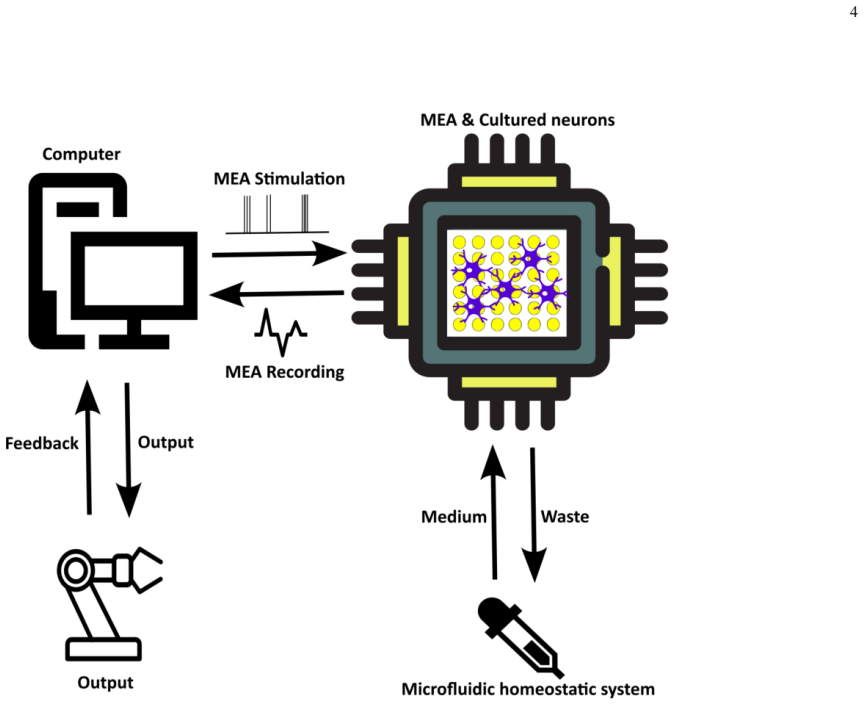
The paper states that Synthetic Biological Intelligence consists of engineered systems in which living Biological Neural Networks are interfaced with hardware and software to perform task-oriented information processing in a closed loop. It summarizes the enabling innovations and early testbed interfaces, then reframes SBI as a bio-digital interaction system and introduces a unified protocol spanning encoding, decoding, system engineering, and benchmarking to improve accessibility and support further development.
What carries the argument
The unified protocol for encoding, decoding, system engineering, and benchmarking, which standardizes the interfaces that allow living biological neural networks to interact with digital hardware and software in closed-loop SBI systems.
If this is right
- Standardized, cloud-integrated biological neural networks will lower the cost and technical barriers to building SBI testbeds.
- The unified protocol will make SBI systems more reproducible across different laboratories and application domains.
- Applications in robotics, biomedicine, signal processing, and neuroscience will become practical once the encoding-decoding and benchmarking layers are shared.
- SBI will achieve highly efficient performance in both computing speed and energy use compared with conventional silicon-only approaches.
Where Pith is reading between the lines
- A shared protocol could allow SBI testbeds to be offered as a service, similar to how cloud machine-learning platforms accelerated neural-network research.
- Hybrid bio-digital systems might reveal new computational primitives that neither pure biological nor pure silicon systems currently exhibit.
- Open implementations of the protocol could be tested by measuring how quickly new research groups publish closed-loop experiments after the protocol is released.
- Energy-efficiency gains claimed for SBI would become quantifiable only after standardized benchmarks are applied across multiple biological and digital configurations.
Load-bearing premise
The main thing holding back Synthetic Biological Intelligence is the lack of commercially available standardized platforms, and a unified protocol will meaningfully increase accessibility and speed further progress.
What would settle it
Whether laboratories that adopt the proposed unified protocol produce measurable increases in the number of reproducible SBI experiments or in the rate at which commercial testbed platforms appear within two to three years.
Figures



read the original abstract
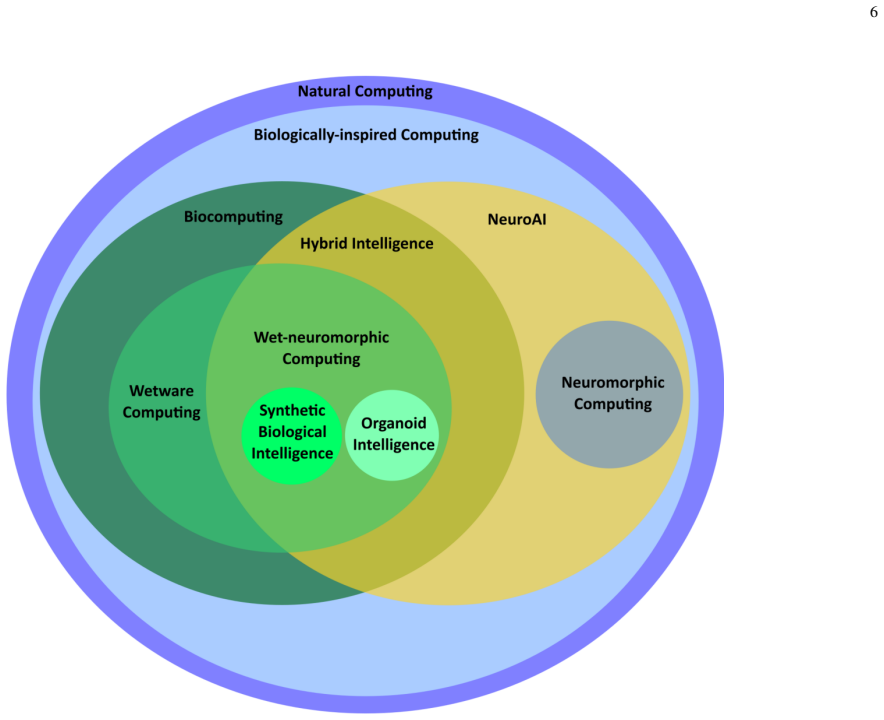
Concurrent advances across fields such as organoid technology, Microelectrode Arrays (MEAs), neuromorphic computing, and machine learning have given rise to a groundbreaking research paradigm: Synthetic Biological Intelligence (SBI). SBI refers to engineered systems in which living Biological Neural Networks (BNNs) are interfaced with hardware and software to perform task-oriented information processing in a closed loop. This cutting-edge technology, while still in its infancy, has the potential to deliver highly efficient performance across both computing capabilities and energy consumption. The early stage of this field underscores the need for reliable multi-scale and cross-domain interaction interfaces to support applications in robotics, biomedicine, signal processing, and neuroscience research. The hitherto lack of commercially available SBI platforms has slowed the development, as the conditions to produce a testbed are expensive and cumbersome. The introduction of standardized, platform- and cloud-integrated BNNs has been a crucial catalyst for the scientific community, improving the accessibility of SBI and leading the way to further developments. In this survey, we summarize the innovations that contributed to the emergence of SBI and the first testbed interfaces that enabled its embodiment. This work reframes SBI as a bio-digital interaction system and introduces a unified protocol across encoding, decoding, system engineering, and benchmarking.
Editorial analysis
A structured set of objections, weighed in public.
Referee Report
Summary. The paper surveys advances in organoid technology, MEAs, neuromorphic computing, and machine learning that enable Synthetic Biological Intelligence (SBI), where biological neural networks (BNNs) interface with digital systems for closed-loop information processing. It reframes SBI as a bio-digital interaction system and proposes a unified protocol for encoding, decoding, system engineering, and benchmarking to standardize development and improve accessibility.
Significance. This survey offers a conceptual reframing and high-level protocol that could organize research in the emerging SBI field. If implemented, the unified protocol may accelerate progress by providing a common framework for bio-digital interfaces, though its value depends on community adoption and empirical validation of the standardization benefits.
minor comments (2)
- [Abstract] The statement that the lack of commercially available SBI platforms has slowed development would be strengthened by including specific references or data on costs and accessibility barriers in the main text.
- [Protocol Outline] Provide more detailed steps or examples for the encoding and decoding components of the unified protocol to make the framework more actionable.
Simulated Author's Rebuttal
We thank the referee for their positive assessment of our manuscript, including the recognition of its conceptual reframing of SBI as a bio-digital interaction system and the proposed unified protocol. The recommendation for minor revision is noted. As the report contains no specific major comments, our responses below address the overall feedback at a high level. We have revised the manuscript to improve clarity on the protocol's intended role as an initial framework rather than a fully validated standard.
Circularity Check
No significant circularity in conceptual survey and framework proposal
full rationale
The paper is a literature survey that summarizes prior advances in organoid technology, MEAs, neuromorphic computing, and machine learning to reframe SBI as a bio-digital interaction system and to outline a high-level unified protocol for encoding, decoding, system engineering, and benchmarking. No mathematical derivations, equations, predictions, fitted parameters, or formal proofs are present. The central claims are organizational and conceptual rather than empirical results or derivations that could reduce to self-referential inputs, self-citation chains, or ansatzes smuggled via prior work. The standardization hypothesis is offered as a field-level perspective, not a load-bearing premise derived from the paper's own content, leaving the argument self-contained against external benchmarks.
Axiom & Free-Parameter Ledger
axioms (1)
- domain assumption Concurrent advances in organoid technology, MEAs, neuromorphic computing, and machine learning have given rise to the SBI paradigm
Reference graph
Works this paper leans on
-
[1]
Energy and AI – Analysis,
“Energy and AI – Analysis,” Apr. 2025. [Online]. Available: https://www.iea.org/reports/energy-and-ai 22
2025
-
[2]
Development and Applications of Biomimetic Neuronal Networks Toward BrainMorphic Artificial Intelligence,
T. Levi, T. Nanami, A. Tange, K. Aihara, and T. Kohno, “Development and Applications of Biomimetic Neuronal Networks Toward BrainMorphic Artificial Intelligence,”IEEE Transactions on Circuits and Systems II: Express Briefs, vol. 65, no. 5, pp. 577–581, May 2018
2018
-
[3]
On Biological and Artificial Consciousness: A Case for Biological Computationalism,
B. Milinkovic and J. Aru, “On Biological and Artificial Consciousness: A Case for Biological Computationalism,”Neuroscience & Biobehavioral Reviews, vol. 181, Feb. 2026, Art. no. 106524
2026
-
[4]
Hewlett Packard Enterprise Delivers World’s Fastest Direct Liquid-Cooled Exascale Supercomputer, “El Capitan
“Hewlett Packard Enterprise Delivers World’s Fastest Direct Liquid-Cooled Exascale Supercomputer, “El Capitan”, for Lawrence Livermore National Laboratory.” [Online]. Available: https://www.hpe.com/us/en/newsroom/press-release/2024/11/hewlett-packard-e nterprise-delivers-worlds-fastest-direct-liquid-cooled-exascale-supercomputer-el-capitan-for-lawrence-li...
2024
-
[5]
Organoid Intelligence (OI): The New Frontier in Biocomputing and Intelligence-in-a-Dish,
L. Smirnova, B. S. Caffo, D. H. Gracias, Q. Huang, I. E. Morales Pantoja, B. Tang, D. J. Zack, C. A. Berlinicke, J. L. Boyd, T. D. Harris, E. C. Johnson, B. J. Kagan, J. Kahn, A. R. Muotri, B. L. Paulhamus, J. C. Schwamborn, J. Plotkin, A. S. Szalay, J. T. V ogelstein, P. F. Worley, and T. Hartung, “Organoid Intelligence (OI): The New Frontier in Biocompu...
2023
-
[6]
Limitations of Deep Learning for Inverse Problems on Digital Hardware,
H. Boche, A. Fono, and G. Kutyniok, “Limitations of Deep Learning for Inverse Problems on Digital Hardware,”IEEE Transactions on Information Theory, vol. 69, no. 12, pp. 7887–7908, Dec. 2023
2023
-
[7]
Beyond von Neumann Architecture: Brain-Inspired Artificial Neuromorphic Devices and Integrated Computing,
H. Seok, D. Lee, S. Son, H. Choi, G. Kim, and T. Kim, “Beyond von Neumann Architecture: Brain-Inspired Artificial Neuromorphic Devices and Integrated Computing,”Advanced Electronic Materials, vol. 10, no. 8, Aug. 2024, Art. no. 2300839
2024
-
[8]
Brain-Inspired Learning in Artificial Neural Networks: A Review,
S. Schmidgall, R. Ziaei, J. Achterberg, L. Kirsch, S. P. Hajiseyedrazi, and J. Eshraghian, “Brain-Inspired Learning in Artificial Neural Networks: A Review,”APL Machine Learning, vol. 2, no. 2, May 2024, Art. no. 021501
2024
-
[9]
Bridging Biological and Artificial Neural Networks with Emerging Neuromorphic Devices: Fundamentals, Progress, and Challenges,
J. Tang, F. Yuan, X. Shen, Z. Wang, M. Rao, Y . He, Y . Sun, X. Li, W. Zhang, Y . Li, B. Gao, H. Qian, G. Bi, S. Song, J. J. Yang, and H. Wu, “Bridging Biological and Artificial Neural Networks with Emerging Neuromorphic Devices: Fundamentals, Progress, and Challenges,”Advanced Materials, vol. 31, no. 49, Sep. 2019
2019
-
[10]
Brain-Inspired Computing Needs a Master Plan,
A. Mehonic and A. J. Kenyon, “Brain-Inspired Computing Needs a Master Plan,”Nature, vol. 604, no. 7905, pp. 255–260, Apr. 2022
2022
-
[11]
SpiNNaker2: A Large-Scale Neuromorphic System for Event-Based and Asynchronous Machine Learning,
H. A. Gonzalez, J. Huang, F. Kelber, K. K. Nazeer, T. Langer, C. Liu, M. Lohrmann, A. Rostami, M. Sch ¨one, B. V ogginger, T. C. Wunderlich, Y . Yan, M. Akl, and C. Mayr, “SpiNNaker2: A Large-Scale Neuromorphic System for Event-Based and Asynchronous Machine Learning,”arXiv, Jan. 2024, Workshop on Machine Learning with New Compute Paradigms - NeurIPS 2023...
2024
-
[12]
Third-Order Nanocircuit Elements for Neuromorphic Engineering,
S. Kumar, R. S. Williams, and Z. Wang, “Third-Order Nanocircuit Elements for Neuromorphic Engineering,”Nature, vol. 585, no. 7826, pp. 518–523, Sep. 2020
2020
-
[13]
Neuromorphic Learning, Working Memory, and Metaplasticity in Nanowire Networks,
A. Loeffler, A. Diaz Alvarez, R. Zhu, N. Ganesh, J. Shine, T. Nakayama, and Z. Kuncic, “Neuromorphic Learning, Working Memory, and Metaplasticity in Nanowire Networks,”Science Advances, vol. 9, no. 16, Apr. 2023
2023
-
[14]
Self-Organising Memristive Networks as Physical Learning Systems,
F. Caravelli, G. Milano, A. Z. Stieg, C. Ricciardi, S. A. Brown, and Z. Kuncic, “Self-Organising Memristive Networks as Physical Learning Systems,”arXiv, Aug. 2025
2025
-
[15]
A Spiking Artificial Neuron Based on One Diffusive Memristor, One Transistor and One Resistor,
R. Zhao, T. Wang, T. Moon, Y . Xu, J. Zhao, P. Sud, S. J. Kim, H.-T. Liao, Y . Zhuo, R. Midya, S. Asapu, D. Gao, Z. Rong, Q. Qiu, C. Bowers, K. Mahalingam, S. Ganguli, A. K. Roy, Q. Wu, J.-W. Han, R. S. Williams, Y . Chen, and J. J. Yang, “A Spiking Artificial Neuron Based on One Diffusive Memristor, One Transistor and One Resistor,”Nature Electronics, vo...
2025
-
[16]
In Vitro Neurons Learn and Exhibit Sentience When Embodied in a Simulated Game-World,
B. J. Kagan, A. C. Kitchen, N. T. Tran, F. Habibollahi, M. Khajehnejad, B. J. Parker, A. Bhat, B. Rollo, A. Razi, and K. J. Friston, “In Vitro Neurons Learn and Exhibit Sentience When Embodied in a Simulated Game-World,”Neuron, vol. 110, no. 23, pp. 3952–3969, Dec. 2022
2022
-
[17]
Why AI Progress Will Necessitate Harnessing Synthetic Biology to Leverage the Ground Truth of Intelligence,
B. J. Kagan and A. C. Kitchen, “Why AI Progress Will Necessitate Harnessing Synthetic Biology to Leverage the Ground Truth of Intelligence,” inScience for a Better Tomorrow, U. A. K. Betz, Ed. Cham: Springer Nature Switzerland, Aug. 2025, pp. 195–213
2025
-
[18]
Brain Organoid Computing – An Overview,
Y . Talavera and B. Ulmann, “Brain Organoid Computing – An Overview,”arXiv, Nov. 2025
2025
-
[19]
Closed-Loop Neuro-Robotic Experiments to Test Computational Properties of Neuronal Networks,
J. Tessadori and M. Chiappalone, “Closed-Loop Neuro-Robotic Experiments to Test Computational Properties of Neuronal Networks,” Journal of Visualized Experiments, no. 97, Mar. 2015
2015
-
[20]
Biocomputation: Moving Beyond Turing with Living Cellular Computers,
A. Go ˜ni-Moreno, “Biocomputation: Moving Beyond Turing with Living Cellular Computers,”Communications of the ACM, vol. 67, no. 6, p. 70–77, May 2024
2024
-
[21]
Biocomputing — Tools, Aims, Perspectives,
E. Katz, “Biocomputing — Tools, Aims, Perspectives,”Current Opinion in Biotechnology, vol. 34, pp. 202–208, Aug. 2015
2015
-
[22]
Natural Computation and Non-Turing Models of Computation,
B. J. MacLennan, “Natural Computation and Non-Turing Models of Computation,”Theoretical Computer Science, vol. 317, no. 1, pp. 115–145, Jun. 2004
2004
-
[23]
On a Theory of Computation Over the Real Numbers; NP Completeness, Recursive Functions and Universal Machines,
L. Blum, M. Shub, and S. Smale, “On a Theory of Computation Over the Real Numbers; NP Completeness, Recursive Functions and Universal Machines,” inProc. 29th Annual Symposium on Foundations of Computer Science, Oct. 1988, pp. 387–397
1988
-
[24]
Analog Computation,
H. T. Siegelmann, “Analog Computation,” inNeural Networks and Analog Computation: Beyond the Turing Limit, H. T. Siegelmann, Ed. Boston, MA: Birkh ¨auser, 1999, pp. 147–152
1999
-
[25]
Toward a Formal Theory for Computing Machines Made Out of Whatever Physics Offers,
H. Jaeger, B. Noheda, and W. G. van der Wiel, “Toward a Formal Theory for Computing Machines Made Out of Whatever Physics Offers,”Nature Communications, vol. 14, no. 1, Aug. 2023, Art. no. 4911
2023
-
[26]
Brain Organoids: Tiny Mirrors of Human Neurodevelopment and Neurological Disorders,
A. Yadav, B. Seth, and R. K. Chaturvedi, “Brain Organoids: Tiny Mirrors of Human Neurodevelopment and Neurological Disorders,” The Neuroscientist, vol. 27, no. 4, pp. 388–426, Aug. 2021
2021
-
[27]
Brain Organoids and Assembloids—From Disease Modeling to Drug Discovery,
A. O. Ajongbolo and S. A. Langhans, “Brain Organoids and Assembloids—From Disease Modeling to Drug Discovery,”Cells, vol. 14, no. 11, Jun. 2025, Art. no. 842
2025
-
[28]
Connecting Brains to Robots: An Artificial Body for Studying the Computational Properties of Neural Tissues,
B. D. Reger, K. M. Fleming, V . Sanguineti, S. Alford, and F. A. Mussa-Ivaldi, “Connecting Brains to Robots: An Artificial Body for Studying the Computational Properties of Neural Tissues,”Artificial Life, vol. 6, no. 4, pp. 307–324, Oct. 2000
2000
-
[29]
The Neurally Controlled Animat: Biological Brains Acting with Simulated Bodies,
T. B. DeMarse, D. A. Wagenaar, A. W. Blau, and S. M. Potter, “The Neurally Controlled Animat: Biological Brains Acting with Simulated Bodies,”Autonomous Robots, vol. 11, no. 3, pp. 305–310, Nov. 2001
2001
-
[30]
Connecting Neurons to a Mobile Robot: An In Vitro Bidirectional Neural Interface,
A. Novellino, P. D’Angelo, L. Cozzi, M. Chiappalone, V . Sanguineti, and S. Martinoia, “Connecting Neurons to a Mobile Robot: An In Vitro Bidirectional Neural Interface,”Computational Intelligence and Neuroscience, vol. 2007, pp. 1–13, Jul. 2007. 23
2007
-
[31]
Modular Neuronal Assemblies Embodied in a Closed-Loop Environment: Toward Future Integration of Brains and Machines,
J. Tessadori, M. Bisio, S. Martinoia, and M. Chiappalone, “Modular Neuronal Assemblies Embodied in a Closed-Loop Environment: Toward Future Integration of Brains and Machines,”Frontiers in Neural Circuits, vol. 6, Dec. 2012
2012
-
[32]
The CL1 as a Platform Technology to Leverage Biological Neural System Functions,
B. J. Kagan, “The CL1 as a Platform Technology to Leverage Biological Neural System Functions,”Nature Reviews Bioengineering, vol. 3, no. 9, pp. 724–725, Sep. 2025
2025
-
[33]
Open and Remotely Accessible Neuroplatform for Research in Wetware Computing,
F. D. Jordan, M. Kutter, J.-M. Comby, F. Brozzi, and E. Kurtys, “Open and Remotely Accessible Neuroplatform for Research in Wetware Computing,”Frontiers in Artificial Intelligence, vol. 7, May 2024
2024
-
[34]
An Overview of In Vitro Biological Neural Networks for Robot Intelligence,
Z. Chen, Q. Liang, Z. Wei, X. Chen, Q. Shi, Z. Yu, and T. Sun, “An Overview of In Vitro Biological Neural Networks for Robot Intelligence,”Cyborg and Bionic Systems, vol. 4, Jan. 2023, Art. no. 0001
2023
-
[35]
The Technology, Opportunities, and Challenges of Synthetic Biological Intelligence,
B. J. Kagan, C. Gyngell, T. Lysaght, V . M. Cole, T. Sawai, and J. Savulescu, “The Technology, Opportunities, and Challenges of Synthetic Biological Intelligence,”Biotechnology Advances, vol. 68, Nov. 2023
2023
-
[36]
Moral Dimensions of Synthetic Biological Intelligence: Unravelling the Ethics of Neural Integration,
K. Mansanori, C. Gyngell, J. Savulescu, and S. Tsutomi, “Moral Dimensions of Synthetic Biological Intelligence: Unravelling the Ethics of Neural Integration,” inDevelopments in Neuroethics and Bioethics. Academic Press, Jan. 2024, vol. 7, pp. 205–219
2024
-
[37]
A Cybernetic Framework for Synthetic Biological Intelligence in the Era of Neural Tissue Engineering,
E. P. Sellar and N. Rouleau, “A Cybernetic Framework for Synthetic Biological Intelligence in the Era of Neural Tissue Engineering,” PsyArXiv, Dec. 2025
2025
-
[38]
Starting a Synthetic Biological Intelligence Lab from Scratch,
M. S. Tanveer, D. Patel, H. E. Schweiger, K. D. Abu-Bonsrah, B. Watmuff, A. Azadi, S. Pryshchep, K. Narayanan, C. Puleo, K. Natarajan, M. A. Mostajo-Radji, B. J. Kagan, and G. Wang, “Starting a Synthetic Biological Intelligence Lab from Scratch,” Patterns, vol. 6, no. 5, May 2025, Art. no. 101232
2025
-
[39]
A Computational Perspective on NeuroAI and Synthetic Biological Intelligence,
D. Patel, M. S. Tanveer, J. Gonzalez-Ferrer, A. Loeffler, B. J. Kagan, M. A. Mostajo-Radji, and G. Wang, “A Computational Perspective on NeuroAI and Synthetic Biological Intelligence,”arXiv, Oct. 2025
2025
-
[40]
Organoid Intelligence: Bridging Artificial Intelligence for Biological Computing and Neurological Insights,
S. Ballav, A. Ranjan, S. Sur, and S. Basu, “Organoid Intelligence: Bridging Artificial Intelligence for Biological Computing and Neurological Insights,” inBiochemistry, S. Basu, A. Ranjan, and S. Sur, Eds. IntechOpen, Jun. 2024, vol. 54
2024
-
[41]
Organoid Computing: Leveraging Organoid Neural Networks for Artificial Intelligence,
K. Li, L. Gu, H. Cai, and F. Guo, “Organoid Computing: Leveraging Organoid Neural Networks for Artificial Intelligence,” inHuman Brain Organoids, I. Hyun and J. E. Lunshof, Eds. Cham: Springer Nature Switzerland, 2024, vol. 4, pp. 165–182
2024
-
[42]
Advanced Brain-on-a-Chip for Wetware Computing: A Review,
S. Li, Y . Liu, S. Hua, Y . Wang, S. Sun, L. Jiang, C. Lu, J. Liu, H. Shi, P. Wu, X. Cai, and J. Luo, “Advanced Brain-on-a-Chip for Wetware Computing: A Review,”Advanced Science, vol. 12, no. 33, Sep. 2025
2025
-
[43]
Opportunities and Challenges of Brain-on-a-Chip Interfaces,
W. Shao, W. Meng, J. Zuo, X. Li, and D. Ming, “Opportunities and Challenges of Brain-on-a-Chip Interfaces,”Cyborg and Bionic Systems, vol. 6, Jun. 2025
2025
-
[44]
Bio Inspired Computing – A Review of Algorithms and Scope of Applications,
A. K. Kar, “Bio Inspired Computing – A Review of Algorithms and Scope of Applications,”Expert Systems with Applications, vol. 59, pp. 20–32, Oct. 2016
2016
-
[45]
Enzyme-Based Logic Systems for Information Processing,
E. Katz and V . Privman, “Enzyme-Based Logic Systems for Information Processing,”Chemical Society Reviews, vol. 39, no. 5, 2010, Art. no. 1835
2010
-
[46]
Wet-Neuromorphic Computing: A New Paradigm for Biological Artificial Intelligence,
J. Perera, S. Balasubramaniam, S. Somathilaka, Q. Wen, X. Li, D. Kasthurirathna, A. Roohi, and M. T. Nelson, “Wet-Neuromorphic Computing: A New Paradigm for Biological Artificial Intelligence,”IEEE Intelligent Systems, vol. 40, no. 3, pp. 39–48, May 2025
2025
-
[47]
Editorial: Intersection Between the Biological and Digital: Synthetic Biological Intelligence and Organoid Intelligence,
M. T. Barros, B. J. Kagan, T. Hartung, and L. Smirnova, “Editorial: Intersection Between the Biological and Digital: Synthetic Biological Intelligence and Organoid Intelligence,”Frontiers in Cellular Neuroscience, vol. 18, Jan. 2025
2025
-
[48]
Toward Controlling a Cyber-Physical System using Synthetic Biological Intelligence,
P. Hofmann, A. Loeffler, C. Desouza, R. Zheng, P. Zhou, J. A. Cabrera, F. H. P. Fitzek, and B. J. Kagan, “Toward Controlling a Cyber-Physical System using Synthetic Biological Intelligence,” inProc. 12th Annual ACM International Conference on Nanoscale Computing and Communication, Oct. 2025, pp. 157–158
2025
-
[49]
Harnessing Intelligence from Brain Cells In Vitro,
B. J. Kagan, F. Habibollahi, B. Watmuff, A. Azadi, F. Doensen, A. Loeffler, S. H. Byun, B. Servais, C. Desouza, K. D. Abu-Bonsrah, and N. Kerlero de Rosbo, “Harnessing Intelligence from Brain Cells In Vitro,”The Neuroscientist, vol. 31, no. 5, pp. 536–555, Oct. 2025
2025
-
[50]
Neural vs Neuromorphic Interfaces: Where Are We Standing?
D. Rana, N. Babushkina, M. Gini, A. Flores C ´aceres, H. Li, V . Maybeck, V . Criscuolo, D. Mayer, M. Ienca, S. Musall, V . Rincon Montes, A. Offenh ¨ausser, and F. Santoro, “Neural vs Neuromorphic Interfaces: Where Are We Standing?”Chemical Reviews, vol. 125, no. 19, pp. 9092–9139, Oct. 2025
2025
-
[51]
Learning in Networks of Cortical Neurons,
G. Shahaf and S. Marom, “Learning in Networks of Cortical Neurons,”The Journal of Neuroscience, vol. 21, no. 22, pp. 8782–8788, Nov. 2001
2001
-
[52]
Controlling a Mobile Robot with a Biological Brain,
K. Warwick, D. Xydas, S. Nasuto, V . Becerra, M. Hammond, J. Downes, S. Marshall, and B. Whalley, “Controlling a Mobile Robot with a Biological Brain,”Defence Science Journal, vol. 60, no. 1, pp. 5–14, Jan. 2010
2010
-
[53]
Control of a Robot Arm with Artificial and Biological Neural Networks
Shultz, A., Lee, S., Shea, T. B. and Yanco, H. A., “Control of a Robot Arm with Artificial and Biological Neural Networks.” inAI and Robotics: Proc. AAAI-14 Workshop, Jul. 2014
2014
-
[54]
D. Ito, J. Tessadori, S. Buccelli, and M. Chiappalone,Changes in Network Activity in a Neuro-Robotic Environment. Springer Singapore, Jun. 2017, p. 442–445
2017
-
[55]
Adaptive Flight Control with Living Neuronal Networks on Microelectrode Arrays,
T. DeMarse and K. Dockendorf, “Adaptive Flight Control with Living Neuronal Networks on Microelectrode Arrays,” inProc. IEEE International Joint Conference on Neural Networks, vol. 3, Aug. 2005, pp. 1548–1551
2005
-
[56]
Toward the Neurocomputer: Image Processing and Pattern Recognition With Neuronal Cultures,
M. Ruaro, P. Bonifazi, and V . Torre, “Toward the Neurocomputer: Image Processing and Pattern Recognition With Neuronal Cultures,” IEEE Transactions on Biomedical Engineering, vol. 52, no. 3, pp. 371–383, Mar. 2005
2005
-
[57]
Spatio-Temporal Electrical Stimuli Shape Behavior of an Embodied Cortical Network in a Goal-Directed Learning Task,
D. J. Bakkum, Z. C. Chao, and S. M. Potter, “Spatio-Temporal Electrical Stimuli Shape Behavior of an Embodied Cortical Network in a Goal-Directed Learning Task,”Journal of Neural Engineering, vol. 5, no. 3, pp. 310–323, Sep. 2008
2008
-
[58]
Modular Microstructure Design to Build Neuronal Networks of Defined Functional Connectivity,
C. Forr ´o, G. Thompson-Steckel, S. Weaver, S. Weydert, S. Ihle, H. Dermutz, M. J. Aebersold, R. Pilz, L. Demk ´o, and J. V ¨or¨os, “Modular Microstructure Design to Build Neuronal Networks of Defined Functional Connectivity,”Biosensors & Bioelectronics, vol. 122, pp. 75–87, Dec. 2018
2018
-
[59]
Generation of Functional Human 3D Cortico-Motor Assembloids,
J. Andersen, O. Revah, Y . Miura, N. Thom, N. D. Amin, K. W. Kelley, M. Singh, X. Chen, M. V . Thete, E. M. Walczak, H. V ogel, H. C. Fan, and S. P. Pas ¸ca, “Generation of Functional Human 3D Cortico-Motor Assembloids,”Cell, vol. 183, no. 7, pp. 1913–1929, Dec. 2020
1913
-
[60]
In Vitro Studies of Neuronal Networks and Synaptic Plasticity in Invertebrates and in Mammals Using Multielectrode Arrays,
P. Massobrio, J. Tessadori, M. Chiappalone, and M. Ghirardi, “In Vitro Studies of Neuronal Networks and Synaptic Plasticity in Invertebrates and in Mammals Using Multielectrode Arrays,”Neural Plasticity, vol. 2015, no. 1, Mar. 2015. 24
2015
-
[61]
Investigating Brain Functional Evolution and Plasticity Using Microelectrode Array Technology,
A. Napoli and I. Obeid, “Investigating Brain Functional Evolution and Plasticity Using Microelectrode Array Technology,”Brain Research Bulletin, vol. 119, pp. 127–135, Oct. 2015
2015
-
[62]
Investigating the Reliability of the Evoked Response in Human iPSCs-Derived Neuronal Networks Coupled to Micro-Electrode Arrays,
G. Zanini, G. Parodi, M. Chiappalone, and S. Martinoia, “Investigating the Reliability of the Evoked Response in Human iPSCs-Derived Neuronal Networks Coupled to Micro-Electrode Arrays,”APL Bioengineering, vol. 7, no. 4, Dec. 2023
2023
-
[63]
Closed-Loop Systems and In Vitro Neuronal Cultures: Overview and Applications,
M. Bisio, A. Pimashkin, S. Buccelli, J. Tessadori, M. Semprini, T. Levi, I. Colombi, A. Gladkov, I. Mukhina, A. Averna, V . Kazantsev, V . Pasquale, and M. Chiappalone, “Closed-Loop Systems and In Vitro Neuronal Cultures: Overview and Applications,” inIn Vitro Neuronal Networks. Cham: Springer International Publishing, 2019, vol. 22, pp. 351–387
2019
-
[64]
Plasticity and Adaptation in Neuromorphic Biohybrid Systems,
R. George, M. Chiappalone, M. Giugliano, T. Levi, S. Vassanelli, J. Partzsch, and C. Mayr, “Plasticity and Adaptation in Neuromorphic Biohybrid Systems,”iScience, vol. 23, no. 10, Oct. 2020
2020
-
[65]
Organoid Intelligence and Biocomputing Advances: Current Steps and Future Directions,
A.-H. S. Wadan, “Organoid Intelligence and Biocomputing Advances: Current Steps and Future Directions,”Brain Organoid and Systems Neuroscience Journal, vol. 3, pp. 8–14, Dec. 2025
2025
-
[66]
Microelectrode Arrays Cultured with in Vitro Neural Networks for Motion Control Tasks: Encoding and Decoding Progress and Advances,
S. Hua, Y . Liu, J. Luo, S. Li, L. Jiang, P. Wu, S. Sun, L. Shang, C. Lu, K. Zhang, J. Liu, M. Wang, H. Shi, and X. Cai, “Microelectrode Arrays Cultured with in Vitro Neural Networks for Motion Control Tasks: Encoding and Decoding Progress and Advances,”Microsystems & Nanoengineering, vol. 11, no. 1, Nov. 2025, Art. no. 233
2025
-
[67]
Dissociated Neuronal Cultures as Model Systems for Self-Organized Prediction,
A. Yaron, Z. Zhang, D. Akita, T. I. Shiramatsu, Z. C. Chao, and H. Takahashi, “Dissociated Neuronal Cultures as Model Systems for Self-Organized Prediction,”Frontiers in Neural Circuits, vol. 19, Jun. 2025
2025
-
[68]
Electrophysiological Characteristics of Chick Embryo Sympathetic Neurons in Dissociated Cell Culture,
A. Chalazonitis, L. A. Greene, and M. Nirenberg, “Electrophysiological Characteristics of Chick Embryo Sympathetic Neurons in Dissociated Cell Culture,”Brain Research, vol. 68, no. 2, pp. 235–252, Mar. 1974
1974
-
[69]
Recording Action Potentials from Cultured Neurons with Extracellular Microcircuit Electrodes,
J. Pine, “Recording Action Potentials from Cultured Neurons with Extracellular Microcircuit Electrodes,”Journal of Neuroscience Methods, vol. 2, no. 1, pp. 19–31, Feb. 1980
1980
-
[70]
A New Approach to Neural Cell Culture for Long-Term Studies,
S. M. Potter and T. B. DeMarse, “A New Approach to Neural Cell Culture for Long-Term Studies,”Journal of Neuroscience Methods, vol. 110, no. 1, pp. 17–24, Sep. 2001
2001
-
[71]
How to Culture, Record and Stimulate Neuronal Networks on Micro-electrode Arrays (MEAs),
C. M. Hales, J. D. Rolston, and S. M. Potter, “How to Culture, Record and Stimulate Neuronal Networks on Micro-electrode Arrays (MEAs),”Journal of Visualized Experiments, no. 39, May 2010, Art. no. 2056
2010
-
[72]
Behaviors from an Electrically Stimulated Spinal Cord Neuronal Network Cultured on Microelectrode Arrays,
A. Novellino, M. Chiappalone, A. Vato, M. Bove, M. B. Tedesco, and S. Martionia, “Behaviors from an Electrically Stimulated Spinal Cord Neuronal Network Cultured on Microelectrode Arrays,”Neurocomputing, vol. 52-54, pp. 661–669, Jun. 2003
2003
-
[73]
Induction of Pluripotent Stem Cells from Adult Human Fibroblasts by Defined Factors,
K. Takahashi, K. Tanabe, M. Ohnuki, M. Narita, T. Ichisaka, K. Tomoda, and S. Yamanaka, “Induction of Pluripotent Stem Cells from Adult Human Fibroblasts by Defined Factors,”Cell, vol. 131, no. 5, pp. 861–872, Nov. 2007
2007
-
[74]
Brain Organoids: Advances, Applications and Challenges,
X. Qian, H. Song, and G.-l. Ming, “Brain Organoids: Advances, Applications and Challenges,”Development, vol. 146, no. 8, Apr. 2019
2019
-
[75]
Comparative Analysis of Human and Rodent Brain Primary Neuronal Culture Spontaneous Activity Using Micro-Electrode Array Technology,
A. Napoli and I. Obeid, “Comparative Analysis of Human and Rodent Brain Primary Neuronal Culture Spontaneous Activity Using Micro-Electrode Array Technology,”Journal of Cellular Biochemistry, vol. 117, no. 3, pp. 559–565, Mar. 2016
2016
-
[76]
Cortical Neurons Form a Functional Neuronal Network in a 3D Printed Reinforced Matrix,
D. Janzen, E. Bakirci, A. Wieland, C. Martin, P. D. Dalton, and C. Villmann, “Cortical Neurons Form a Functional Neuronal Network in a 3D Printed Reinforced Matrix,”Advanced Healthcare Materials, vol. 9, no. 9, Mar. 2020, Art. no. 1901630
2020
-
[77]
Removing Some ‘A’ from AI: Embodied Cultured Networks,
D. J. Bakkum, A. C. Shkolnik, G. Ben-Ary, P. Gamblen, T. B. DeMarse, and e. al, “Removing Some ‘A’ from AI: Embodied Cultured Networks,” inEmbodied Artificial Intelligence: International Seminar. Berlin, Heidelberg: Springer, Jul. 2004, pp. 130–145
2004
-
[78]
Human-Derived Cortical Neurospheroids Coupled to Passive, High-Density and 3D MEAs: A Valid Platform for Functional Tests,
L. Muzzi, D. D. Lisa, M. Falappa, S. Pepe, A. Maccione, L. Pastorino, S. Martinoia, and M. Frega, “Human-Derived Cortical Neurospheroids Coupled to Passive, High-Density and 3D MEAs: A Valid Platform for Functional Tests,”Bioengineering, vol. 10, no. 4, Apr. 2023
2023
-
[79]
Revealing Neuronal Function Through Microelectrode Array Recordings,
M. E. J. Obien, K. Deligkaris, T. Bullmann, D. J. Bakkum, and U. Frey, “Revealing Neuronal Function Through Microelectrode Array Recordings,”Frontiers in Neuroscience, vol. 8, Jan. 2015
2015
-
[80]
Fabrication and Training of 3D Conductive Polymer Networks for Neuromorphic Wetware,
N. Hagiwara, T. Asai, K. Ando, and M. Akai-Kasaya, “Fabrication and Training of 3D Conductive Polymer Networks for Neuromorphic Wetware,”Advanced Functional Materials, vol. 33, no. 42, Oct. 2023
2023
discussion (0)
Sign in with ORCID, Apple, or X to comment. Anyone can read and Pith papers without signing in.