Stationary Distribution of Brownian Motion in the Half-Plane with Two-sided Reflections
Pith reviewed 2026-05-07 05:48 UTC · model grok-4.3
The pith
An explicit Laplace transform is derived for the stationary distribution of reflecting Brownian motion in the half-plane with constant two-sided reflections.
A machine-rendered reading of the paper's core claim, the machinery that carries it, and where it could break.
Core claim
The unique stationary measure of a positive recurrent reflecting Brownian motion in the upper half-plane with constant reflection directions on each half-axis is characterized by a functional equation for its Laplace transform. This equation is resolved by solving a discontinuous Riemann boundary value problem, and the Sokhotski-Plemelj formulas then yield an explicit expression for the Laplace transform. The local behavior of the stationary density at the origin and its asymptotics along the boundary axes are established using Tauberian theorems and asymptotic analysis.
What carries the argument
The functional equation for the Laplace transform of the stationary measure, reduced to and solved as a discontinuous Riemann boundary value problem via the Sokhotski-Plemelj formulas.
If this is right
- The local behavior of the stationary density at the origin is characterized in detail.
- Asymptotic rates for the stationary density along each boundary axis are obtained explicitly.
- Moments and other functionals of the stationary measure become accessible from the explicit Laplace transform.
- The density can be recovered, at least locally, by Tauberian inversion of the given expression.
Where Pith is reading between the lines
- The reduction to a Riemann boundary value problem may extend to oblique or state-dependent reflections if an analogous functional equation can still be written down.
- Numerical Laplace inversion of the explicit formula supplies a practical route to approximate the full stationary density for concrete parameter values.
- The closed form may connect to exact stationary solutions known for certain queueing or storage models that admit diffusion approximations with reflecting boundaries.
Load-bearing premise
The reflecting Brownian motion is positive recurrent, which is taken as given under the constant reflection directions on each half-axis.
What would settle it
For concrete drift and reflection-angle values, numerically invert the claimed explicit Laplace transform and compare the resulting density against the empirical occupation measure obtained from long direct simulations of the reflected process.
Figures

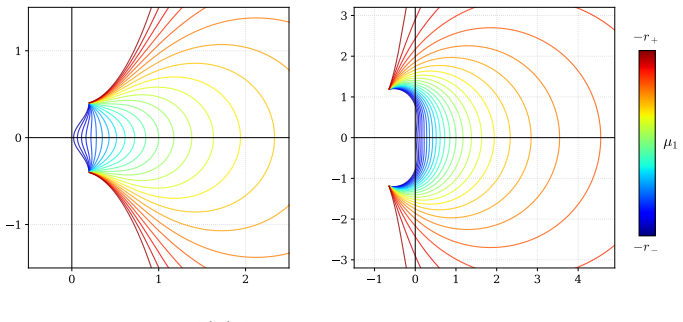


read the original abstract
We investigate the unique stationary measure of a positive recurrent reflecting Brownian motion in the upper half-plane, where the direction of reflection is constant on each half-axis. The Laplace transform of the stationary distribution is characterized by a functional equation, whose resolution is reduced to solving a discontinuous Riemann boundary value problem. By applying the Sokhotski-Plemelj formulas, we derive an explicit expression for the Laplace transform. Finally, we establish the local behavior of the stationary density at the origin and its asymptotics along the boundary axes using Tauberian theorems and asymptotic analysis.
Editorial analysis
A structured set of objections, weighed in public.
Referee Report
Summary. The manuscript derives an explicit expression for the Laplace transform of the stationary distribution of a positive recurrent reflecting Brownian motion in the upper half-plane with constant reflection directions on each half-axis. The Laplace transform is shown to satisfy a functional equation obtained from the infinitesimal generator; this equation is recast as a discontinuous Riemann boundary-value problem, solved via the Sokhotski-Plemelj formulas, and the resulting closed-form expression is then used to extract the local behavior of the density at the origin together with its asymptotic decay along the boundary axes by means of Tauberian theorems and asymptotic analysis.
Significance. If the derivation holds, the work supplies a rare explicit Laplace transform for the stationary measure of a two-dimensional reflected diffusion with oblique reflections, a setting in which closed-form results are uncommon. The reduction of the generator equation to a Riemann problem and the subsequent application of classical complex-analysis identities constitute a technically clean approach, while the Tauberian extraction of local and boundary asymptotics adds concrete analytic value. The result could serve as a benchmark for numerical schemes or as a starting point for further study of reflected processes in wedges or half-planes.
major comments (1)
- [§2 (Model and assumptions)] §2 (Model and assumptions): The central claim presupposes that the reflected Brownian motion is positive recurrent, thereby guaranteeing a unique stationary probability measure whose Laplace transform is derived. However, the manuscript does not supply explicit inequalities on the drift vector and the angles of the two constant reflection directions (relative to the inward normal) that ensure positive recurrence rather than null recurrence or transience. Without these conditions the formal solution of the functional equation may exist but need not be the Laplace transform of a probability measure; this assumption is therefore load-bearing for the interpretation of the explicit expression.
minor comments (1)
- [Notation and figures] The notation for the reflection vectors and the domains of the Laplace transform could be accompanied by a single diagram that labels the angles and the half-axes explicitly; this would improve readability without altering the technical content.
Simulated Author's Rebuttal
We thank the referee for the careful reading of our manuscript and the positive overall assessment. We address the single major comment below and will revise the manuscript to incorporate the requested clarification on the conditions for positive recurrence.
read point-by-point responses
-
Referee: §2 (Model and assumptions): The central claim presupposes that the reflected Brownian motion is positive recurrent, thereby guaranteeing a unique stationary probability measure whose Laplace transform is derived. However, the manuscript does not supply explicit inequalities on the drift vector and the angles of the two constant reflection directions (relative to the inward normal) that ensure positive recurrence rather than null recurrence or transience. Without these conditions the formal solution of the functional equation may exist but need not be the Laplace transform of a probability measure; this assumption is therefore load-bearing for the interpretation of the explicit expression.
Authors: We agree with the referee that explicit conditions for positive recurrence are necessary to ensure the derived Laplace transform corresponds to a stationary probability measure. The manuscript assumes positive recurrence (as stated in the abstract and §1) but does not detail the parameter regime in §2. In the revised manuscript we will add to §2 a clear statement of the inequalities on the drift vector and the two reflection angles (relative to the inward normal) that guarantee positive recurrence rather than null recurrence or transience. These conditions will be drawn from the standard theory of reflected Brownian motion in half-planes and wedges, thereby delineating the precise domain of validity of our explicit expression. revision: yes
Circularity Check
Derivation applies standard complex-analysis tools to generator-derived functional equation; fully self-contained with no reductions to inputs by construction.
full rationale
The paper obtains a functional equation for the Laplace transform directly from the infinitesimal generator of the reflected Brownian motion (standard Itô-Tanaka or Dynkin formula application for reflected processes). It then reformulates this equation as a discontinuous Riemann boundary-value problem and invokes the classical Sokhotski-Plemelj formulas to produce an explicit expression. Both the generator step and the boundary-value solution rely on external, well-established results in stochastic processes and complex analysis; neither step defines its output in terms of itself nor renames a fitted quantity as a prediction. The positive-recurrence assumption is an explicit modeling hypothesis that selects the stationary measure to be studied, not a quantity derived from the final expression. No self-citations are load-bearing, no ansatz is smuggled, and no uniqueness theorem from prior author work is invoked to close the argument. The derivation chain therefore remains independent of its own outputs.
Axiom & Free-Parameter Ledger
axioms (2)
- domain assumption The reflecting Brownian motion is positive recurrent
- domain assumption Existence and uniqueness of the stationary measure
Reference graph
Works this paper leans on
- [1]
- [2]
-
[3]
M. Bousquet-M´ elou, A. Elvey Price, S. Franceschi, C. Hardouin, and K. Raschel,On the stationary distribution of reflected Brownian motion in a wedge: Differential properties, Electron. J. Probab.30(2025), 1–68. MR MR4847230
work page 2025
-
[4]
M. Costabel and M. Dauge,Construction of corner singularities for Agmon-Douglis-Nirenberg elliptic systems, Mathematische Nachrichten 162(1993), no. 1, 209–237
work page 1993
-
[5]
J. G. Dai and M. Miyazawa,Reflecting Brownian motion in two dimen- sions: Exact asymptotics for the stationary distribution, Stochastic Systems 1(2011), no. 1, 146–208
work page 2011
-
[6]
M. Dauge,Elliptic boundary value problems on corner domains: Smooth- ness and asymptotics of solutions, Springer, 1988
work page 1988
-
[7]
G. Doetsch,Introduction to the theory and application of the Laplace trans- formation, Springer-Verlag, 2013
work page 2013
-
[8]
T. Dreyfus, J. Flin, and S. Franceschi,Degenerate systems of three brownian particles with asymmetric collisions: invariant measure of gaps, 2025
work page 2025
-
[9]
G. Fayolle, S. Franceschi, and K. Raschel,On the stationary distribution of reflected brownian motion in a non-convex wedge, Markov Processes and Related Fields (2022), 737–772
work page 2022
-
[10]
,Stationary Brownian motion in a 3/4-plane: Reduction to a Rie- mann–Hilbert problem via Fourier transforms, Indagationes Mathematicae 34(2023), no. 5, 874–890
work page 2023
-
[11]
G. Fayolle, R. Iasnogorodski, and V. Malyshev,Random walks in the quarter-plane: Algebraic methods, boundary value problems and applica- tions, Springer Berlin Heidelberg, 1999
work page 1999
-
[12]
S. Franceschi and K. Raschel,Integral expression for the stationary distri- bution of reflected brownian motion in a wedge, Bernoulli25(2019), no. 4B
work page 2019
-
[13]
F. D. Gakhov,Boundary value problems, Dover, 1990. 22
work page 1990
-
[14]
P. Grisvard,Elliptic problems in nonsmooth domains, Society for Industrial and Applied Mathematics, 2011
work page 2011
-
[15]
J. M. Harrison,The diffusion approximation for tandem queues in heavy traffic, Advances in Applied Probability10(1978), no. 4, 886–905
work page 1978
-
[16]
J. M. Harrison and M. I. Reiman,On the distribution of multidimen- sional reflected brownian motion, SIAM Journal on Applied Mathematics 41(1981), no. 2, 345–361
work page 1981
-
[17]
J. M. Harrison and R. J. Williams,Brownian models of open queueing networks with homogeneous customer populations, Stochastics22(1987), no. 2, 77–115
work page 1987
-
[18]
D. G. Hobson and L. C. Rogers,Recurrence and transience of reflecting Brownian motion in the quadrant, Mathematical Proceedings of the Cam- bridge Philosophical Society113(1993), no. 2, 387–399
work page 1993
-
[19]
V. A. Kondratiev,Boundary value problems for elliptic equations in do- mains with conical or angular points, Transactions of the Moscow Mathe- matical Society16(1967), 227–313
work page 1967
-
[20]
Lu,Boundary value problems for analytic functions, World Scientific Publishing Company, 1994
J.-K. Lu,Boundary value problems for analytic functions, World Scientific Publishing Company, 1994
work page 1994
-
[21]
M. I. Reiman,Open queueing networks in heavy traffic, Mathematics of Operations Research9(1984), no. 3, 441–458
work page 1984
-
[22]
S. R. Varadhan and R. J. Williams,Brownian Motion in a wedge with oblique reflection, Communications on Pure and Applied Mathematics38 (1985), no. 4, 405–443
work page 1985
-
[23]
V. S. Vladimirov, Drozhzhinov, and B. I. Zavialov,Tauberian theorems for generalized functions, Kluwer Academic Publishers, 1988
work page 1988
-
[24]
R. J. Williams,Recurrence classification and invariant measure for reflected Brownian motion in a wedge, The Annals of Probability13(1985), no. 3, 758–778
work page 1985
-
[25]
,Reflected Brownian motion in a wedge: Semimartingale prop- erty, Zeitschrift f¨ ur Wahrscheinlichkeitstheorie und Verwandte Gebiete69 (1985), no. 2, 161–176. 23
work page 1985
discussion (0)
Sign in with ORCID, Apple, or X to comment. Anyone can read and Pith papers without signing in.