Recognition: unknown
International Optical Clock Comparison Using the European Optical Fiber Network
Pith reviewed 2026-05-07 05:42 UTC · model grok-4.3
The pith
Four European labs used an optical fiber network to compare seven optical clocks, with two ytterbium clocks agreeing to within 7.7×10^{-18}.
A machine-rendered reading of the paper's core claim, the machinery that carries it, and where it could break.
Core claim
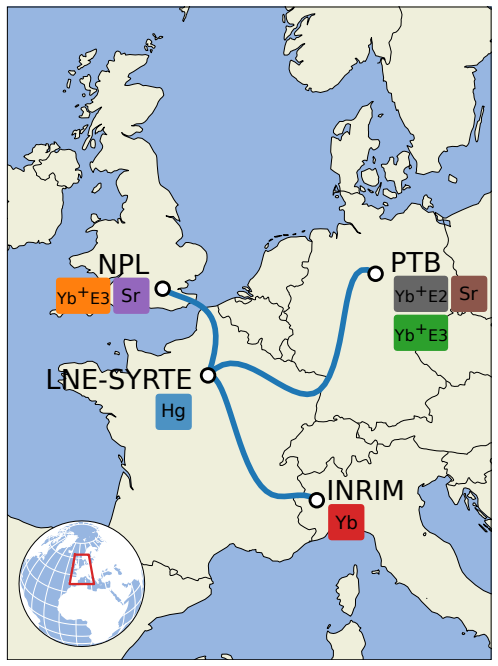
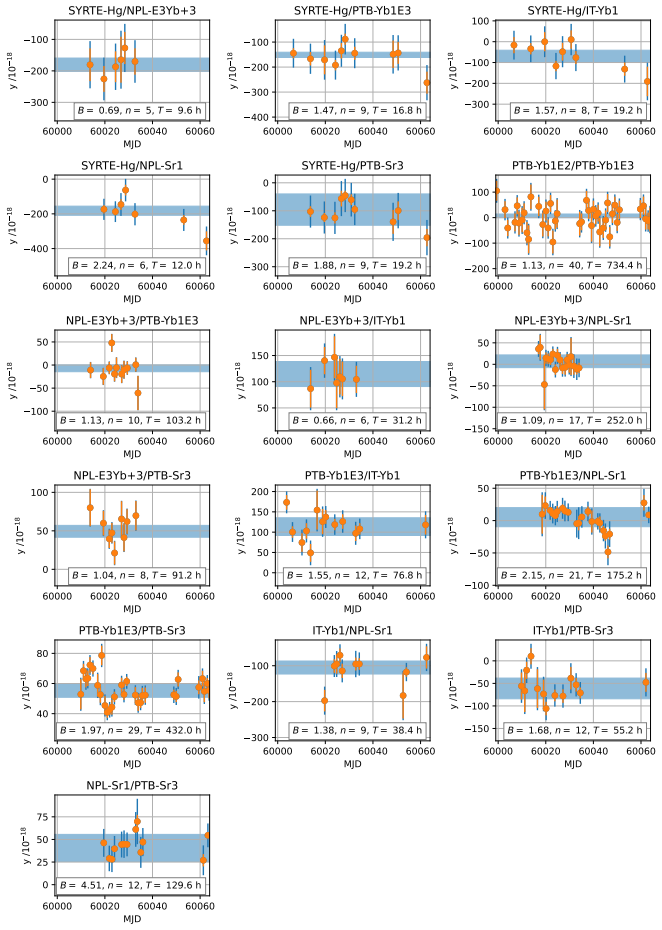
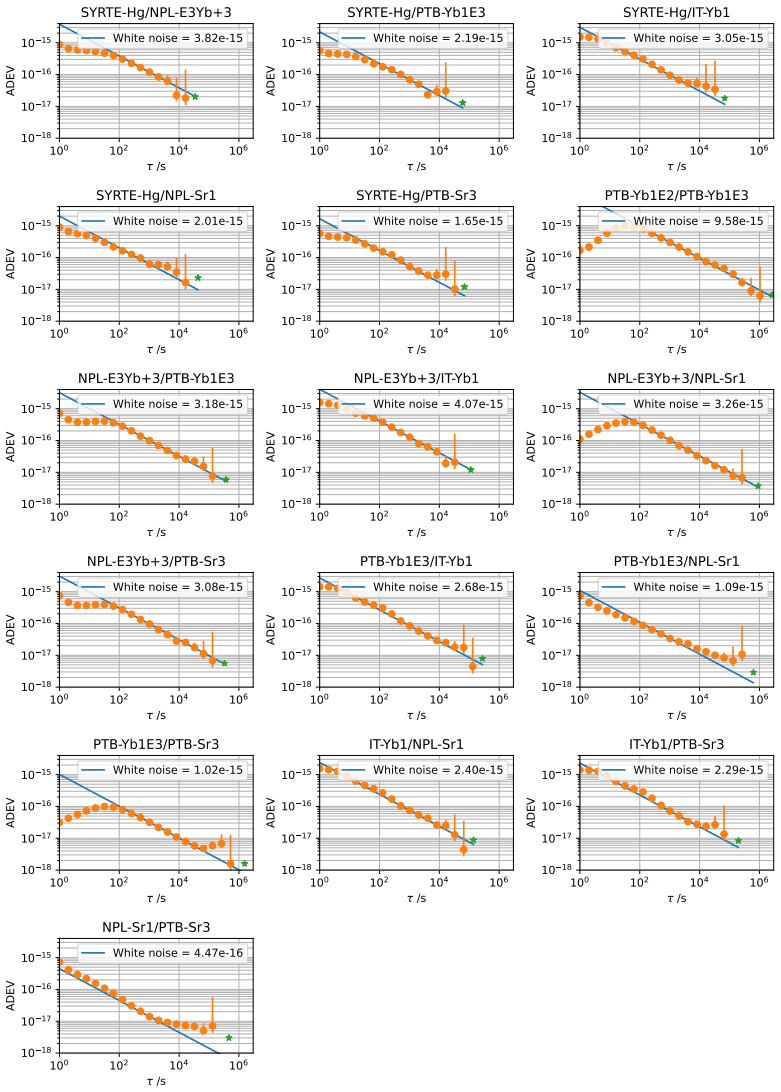
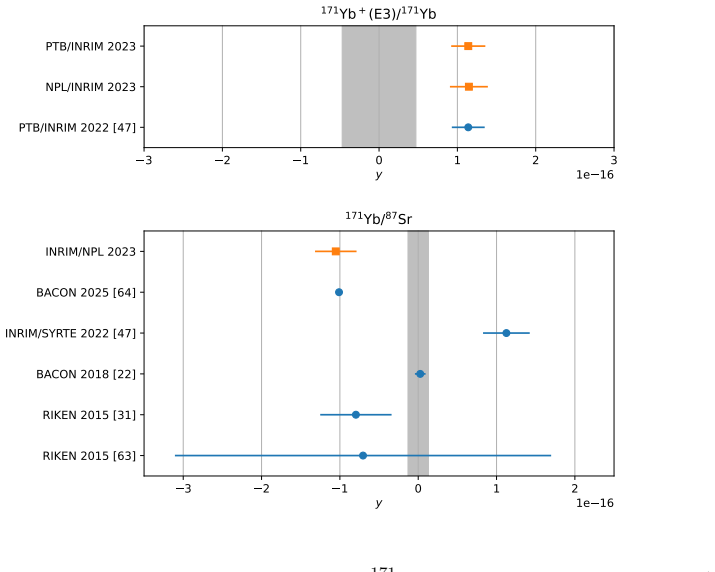
The ^{171}Yb^+ (E3) clocks at NPL and PTB demonstrated agreement within an uncertainty of 7.7×10^{-18}, marking the first international verification of two independently developed optical clocks below one part in 10^{17}. The campaign connected clocks at INRIM, LNE-OP, NPL, and PTB via the European optical fiber network over two months and produced optical frequency ratios with uncertainties ranging from 7.7×10^{-18} to 6.1×10^{-17}.
What carries the argument
The European optical fiber network that transmits stable optical frequency signals between national metrology institutes, enabling remote comparison of clock frequencies without physical transport of the devices.
If this is right
- The measured ratios supply concrete data for the evaluation of candidate transitions in the redefinition of the SI second.
- Fiber links remove the need to transport clocks, making regular international comparisons practical.
- Improved ratios for the ^{199}Hg clock tighten constraints on possible variations of fundamental constants.
- Clock networks enable differential measurements of gravitational potential for geodesy applications.
Where Pith is reading between the lines
- If such networks are extended across continents, persistent discrepancies could signal either new physics or underestimated systematics.
- Continuous operation of the links could support real-time monitoring of clock stability for navigation or earth-science applications.
- The same infrastructure could be used to test whether the same optical transitions remain identical when viewed from different gravitational potentials.
Load-bearing premise
All systematic effects in the individual clocks and in the fiber links have been correctly identified and quantified so that the reported uncertainties fully capture the true error budget.
What would settle it
A later independent comparison of the same NPL and PTB ^{171}Yb^+ clocks that finds a frequency difference larger than the combined 7.7×10^{-18} uncertainty.
Figures



read the original abstract
Optical clocks have achieved remarkable estimated fractional frequency uncertainties reaching the $10^{-18}$ level and below, enabling applications in fundamental physics, general relativity, and geodesy. However, the challenge of verifying the international consistency of optical clocks remains critical as efforts intensify toward redefining the SI second based on an optical transition or transitions. We report on a two-month international clock comparison campaign involving seven optical clocks in four national metrology institutes (INRIM, LNE-OP, NPL, and PTB) connected via the optical fiber network established in Europe. The campaign resulted in optical frequency ratios with uncertainties ranging from $7.7\times10^{-18}$ to $6.1\times10^{-17}$. Among the results, the $^{171}$Yb$^+$(E3) clocks at NPL and PTB demonstrated agreement within an uncertainty of $7.7\times10^{-18}$, marking the first international verification of two independently developed optical clocks below one part in $10^{17}$. The operation of the $^{199}$Hg clock at LNE-OP (formerly LNE-SYRTE) resulted in frequency ratios with improved uncertainties with $^{171}$Yb$^+$(E3), $^{171}$Yb, and $^{87}$Sr optical clocks. These results provide input for the redefinition of the second and underscore how fiber-linked clock networks can advance metrology and scientific applications.
Editorial analysis
A structured set of objections, weighed in public.
Referee Report
Summary. The manuscript reports results from a two-month international optical clock comparison campaign using the European optical fiber network. Seven optical clocks from four national metrology institutes (INRIM, LNE-OP, NPL, and PTB) were compared, yielding frequency ratios with uncertainties ranging from 7.7×10^{-18} to 6.1×10^{-17}. The standout result is the agreement between the ^{171}Yb^+ (E3) clocks at NPL and PTB within an uncertainty of 7.7×10^{-18}, representing the first international verification of two independently developed optical clocks below 10^{-17}. Improved frequency ratios involving the ^{199}Hg clock at LNE-OP are also presented.
Significance. If the uncertainty budgets are complete and correctly evaluated, this work is significant for the redefinition of the SI second. It provides the first direct international verification of optical clock consistency at the 10^{-18} level, supporting the reliability of optical frequency standards. The fiber-linked network approach is shown to be effective for metrology, fundamental physics, and geodesy applications. The multi-institute collaboration and experimental scale are strengths.
major comments (2)
- [§4.2, Table 2] §4.2, Table 2: The combined uncertainty of 7.7×10^{-18} for the NPL-PTB ^{171}Yb^+ (E3) ratio is load-bearing for the central claim, but the breakdown does not explicitly quantify time-varying environmental effects on the fiber link (e.g., dispersion or temperature-induced phase noise) over the full two-month campaign; this leaves open whether the quoted uncertainty fully captures all link systematics.
- [§5.1] §5.1: The individual clock systematic evaluations (Stark, Zeeman, BBR shifts) for the two ^{171}Yb^+ (E3) systems are presented separately but lack a direct side-by-side comparison of evaluation methods and residual uncertainties; any unaccounted differential bias would undermine the agreement result.
minor comments (2)
- [Abstract] The abstract states 'improved uncertainties' for the ^{199}Hg ratios but does not quantify the improvement relative to prior values; this should be stated explicitly for clarity.
- [Figure 3] Figure 3 caption: The error bars on the frequency ratio plot are difficult to discern at the 10^{-18} scale; increasing line thickness or using a log scale inset would improve readability.
Simulated Author's Rebuttal
We are grateful to the referee for their positive evaluation of our manuscript and for identifying areas where additional clarity can be provided. We have carefully considered the comments and revised the manuscript to address them fully. Our responses to the major comments are as follows.
read point-by-point responses
-
Referee: [§4.2, Table 2] §4.2, Table 2: The combined uncertainty of 7.7×10^{-18} for the NPL-PTB ^{171}Yb^+ (E3) ratio is load-bearing for the central claim, but the breakdown does not explicitly quantify time-varying environmental effects on the fiber link (e.g., dispersion or temperature-induced phase noise) over the full two-month campaign; this leaves open whether the quoted uncertainty fully captures all link systematics.
Authors: The fiber link uncertainty is based on the observed stability and repeatability over the entire campaign duration, which inherently includes the effects of time-varying environmental factors like temperature fluctuations and dispersion. We have revised §4.2 to provide a more explicit description of this evaluation process, including how the phase noise measurements account for these variations across the two-month period. revision: yes
-
Referee: [§5.1] §5.1: The individual clock systematic evaluations (Stark, Zeeman, BBR shifts) for the two ^{171}Yb^+ (E3) systems are presented separately but lack a direct side-by-side comparison of evaluation methods and residual uncertainties; any unaccounted differential bias would undermine the agreement result.
Authors: We acknowledge that a side-by-side comparison would facilitate easier verification of consistency between the two independent evaluations. In the revised manuscript, we have included a new comparative table in §5.1 that lists the evaluation methods and residual uncertainties for each shift (Stark, Zeeman, BBR) for both the NPL and PTB clocks. This addition demonstrates that the methods are compatible and that any potential differential biases are well within the combined uncertainties, thereby reinforcing the validity of the agreement. revision: yes
Circularity Check
No significant circularity: direct experimental frequency ratios from clock comparisons
full rationale
The paper is an experimental measurement campaign reporting observed frequency ratios between optical clocks connected by fiber links, with uncertainties from evaluated systematic budgets. No derivation chain exists in which a claimed prediction or first-principles result reduces by construction to fitted inputs, self-definitions, or load-bearing self-citations. The central result (NPL-PTB Yb+(E3) agreement at 7.7e-18) is a measured difference, not a quantity forced by prior parameters or ansatzes. Self-citations, if present for prior clock characterizations, are not load-bearing for any mathematical reduction here; the result stands as independent data against external benchmarks. Concerns about completeness of uncertainty budgets address potential unaccounted systematics (correctness), not circularity.
Axiom & Free-Parameter Ledger
Reference graph
Works this paper leans on
-
[1]
Investissements d’Avenir
The operation of the 199Hg clock at LNE-OP (formerly LNE-SYRTE) resulted in frequency ratios with improved uncertainties with 171Yb+(E3), 171Yb, and 87Sr optical clocks. These results provide input for the redefinition of the second and underscore how fiber-linked clock networks can advance metrology and scientific applications. I. INTRODUCTION Optical cl...
2023
-
[2]
W. F. McGrew, X. Zhang, R. J. Fasano, S. A. Sch¨ affer, K. Beloy, D. Nicolodi, R. C. Brown, N. Hinkley, G. Milani, M. Schioppo, T. H. Yoon, and A. D. Ludlow, Atomic clock performance enabling geodesy below the centimetre level, Nature564, 87 (2018)
2018
-
[3]
Sanner, N
C. Sanner, N. Huntemann, R. Lange, C. Tamm, E. Peik, M. S. Safronova, and S. G. Porsev, Optical clock comparison for Lorentz symmetry testing, Nature567, 204 (2019)
2019
-
[4]
Huang, B
Y. Huang, B. Zhang, M. Zeng, Y. Hao, Z. Ma, H. Zhang, H. Guan, Z. Chen, M. Wang, and K. Gao, Liquid-nitrogen-cooled Ca + optical clock with systematic uncertainty of 3×10 −18, Phys. Rev. Appl.17, 034041 (2022)
2022
-
[5]
Aeppli, K
A. Aeppli, K. Kim, W. Warfield, M. S. Safronova, and J. Ye, Clock with 8×10 −19 systematic uncertainty, Phys. Rev. Lett.133, 023401 (2024). 17
2024
-
[6]
Z. Y. Ma, K. Deng, Z. Y. Wang, W. Z. Wei, P. Hao, H. X. Zhang, L. R. Pang, B. Wang, F. F. Wu, H. L. Liu, W. H. Yuan, J. L. Chang, J. X. Zhang, Q. Y. Wu, J. Zhang, and Z. H. Lu, Quantum-logic-based 25Mg+-27Al+ optical frequency standard for the redefinition of the SI second, Phys. Rev. Appl.21, 044017 (2024)
2024
-
[7]
Tofful, C
A. Tofful, C. F. A. Baynham, E. A. Curtis, A. O. Parsons, B. I. Robertson, M. Schioppo, J. Tunesi, H. S. Margolis, R. J. Hendricks, J. Whale, R. C. Thompson, and R. M. Godun, 171Yb+ optical clock with 2.2×10 −18 systematic uncertainty and absolute frequency mea- surements, Metrologia61, 045001 (2024)
2024
-
[8]
H. N. Hausser, J. Keller, T. Nordmann, N. M. Bhatt, J. Kiethe, H. Liu, I. M. Richter, M. von Boehn, J. Rahm, S. Weyers, E. Benkler, B. Lipphardt, S. D¨ orscher, K. Stahl, J. Klose, C. Lisdat, M. Filzinger, N. Huntemann, E. Peik, and T. E. Mehlst¨ aubler, 115In+ − 172Yb+ Coulomb crystal clock with 2.5×10 −18 systematic uncertainty, Phys. Rev. Lett.134, 023...
2025
-
[9]
M. C. Marshall, D. A. R. Castillo, W. J. Arthur-Dworschack, A. Aeppli, K. Kim, D. Lee, W. Warfield, J. Hinrichs, N. V. Nardelli, T. M. Fortier, J. Ye, D. R. Leibrandt, and D. B. Hume, High-stability single-ion clock with 5.5×10 −19 systematic uncertainty, Phys. Rev. Lett. 135, 033201 (2025)
2025
-
[10]
Lindvall, T
T. Lindvall, T. Fordell, K. J. Hanhij¨ arvi, M. Doleˇ zal, J. Rahm, S. Weyers, and A. E. Wallin, 88sr+ optical clock with 7.9×10 −19 systematic uncertainty and measurement of its absolute frequency with 9.8×10 −17 uncertainty, Phys. Rev. Appl.24, 044082 (2025)
2025
-
[11]
Oelker, R
E. Oelker, R. B. Hutson, C. J. Kennedy, L. Sonderhouse, T. Bothwell, A. Goban, D. Kedar, C. Sanner, J. M. Robinson, G. E. Marti, D. G. Matei, T. Legero, M. Giunta, R. Holzwarth, F. Riehle, U. Sterr, and J. Ye, Demonstration of 4.8×10 −17 stability at 1 s for two independent optical clocks, Nature Photonics13, 714 (2019)
2019
-
[12]
Schioppo, R
M. Schioppo, R. C. Brown, W. F. McGrew, N. Hinkley, R. J. Fasano, K. Beloy, T. H. Yoon, G. Milani, D. Nicolodi, J. A. Sherman, N. B. Phillips, C. W. Oates, and A. D. Ludlow, Ultrastable optical clock with two cold-atom ensembles, Nature Photonics11, 48 (2017)
2017
-
[13]
Lange, N
R. Lange, N. Huntemann, J. M. Rahm, C. Sanner, H. Shao, B. Lipphardt, C. Tamm, S. Weyers, and E. Peik, Improved limits for violations of local position invariance from atomic clock comparisons, Phys. Rev. Lett.126, 011102 (2021). 18
2021
-
[14]
Sherrill, A
N. Sherrill, A. O. Parsons, C. F. A. Baynham, W. Bowden, E. Anne Curtis, R. Hendricks, I. R. Hill, R. Hobson, H. S. Margolis, B. I. Robertson, M. Schioppo, K. Szymaniec, A. Tofful, J. Tunesi, R. M. Godun, and X. Calmet, Analysis of atomic-clock data to constrain variations of fundamental constants, New Journal of Physics25, 093012 (2023)
2023
-
[15]
Takamoto, I
M. Takamoto, I. Ushijima, N. Ohmae, T. Yahagi, K. Kokado, H. Shinkai, and H. Katori, Test of general relativity by a pair of transportable optical lattice clocks, Nature Photonics14, 411 (2020)
2020
-
[16]
Delva, J
P. Delva, J. Lodewyck, S. Bilicki, E. Bookjans, G. Vallet, R. Le Targat, P.-E. Pottie, C. Guer- lin, F. Meynadier, C. Le Poncin-Lafitte, O. Lopez, A. Amy-Klein, W.-K. Lee, N. Quintin, C. Lisdat, A. Al-Masoudi, S. D¨ orscher, C. Grebing, G. Grosche, A. Kuhl, S. Raupach, U. Sterr, I. R. Hill, R. Hobson, W. Bowden, J. Kronj¨ ager, G. Marra, A. Rolland, F. N....
2017
-
[17]
T. E. Mehlst¨ aubler, G. Grosche, C. Lisdat, P. O. Schmidt, and H. Denker, Atomic clocks for geodesy, Reports on Progress in Physics81, 064401 (2018)
2018
-
[18]
Grotti, S
J. Grotti, S. Koller, S. Vogt, S. H¨ afner, U. Sterr, C. Lisdat, H. Denker, C. Voigt, L. Timmen, A. Rolland, F. N. Baynes, H. S. Margolis, M. Zampaolo, P. Thoumany, M. Pizzocaro, B. Rauf, F. Bregolin, A. Tampellini, P. Barbieri, M. Zucco, G. A. Costanzo, C. Clivati, F. Levi, and D. Calonico, Geodesy and metrology with a transportable optical clock, Nature...
2018
-
[19]
Filzinger, A
M. Filzinger, A. R. Caddell, D. Jani, M. Steinel, L. Giani, N. Huntemann, and B. M. Roberts, Ultralight dark matter search with space-time separated atomic clocks and cavities, Phys. Rev. Lett.134, 031001 (2025)
2025
-
[20]
Filzinger, S
M. Filzinger, S. D¨ orscher, R. Lange, J. Klose, M. Steinel, E. Benkler, E. Peik, C. Lisdat, and N. Huntemann, Improved limits on the coupling of ultralight bosonic dark matter to photons from optical atomic clock comparisons, Phys. Rev. Lett.130, 253001 (2023)
2023
-
[21]
Kobayashi, A
T. Kobayashi, A. Takamizawa, D. Akamatsu, A. Kawasaki, A. Nishiyama, K. Hosaka, Y. Hisai, M. Wada, H. Inaba, T. Tanabe, and M. Yasuda, Search for ultralight dark matter from long- term frequency comparisons of optical and microwave atomic clocks, Phys. Rev. Lett.129, 241301 (2022). 19
2022
-
[22]
B. M. Roberts, P. Delva, A. Al-Masoudi, A. Amy-Klein, C. Bærentsen, C. F. A. Baynham, E. Benkler, S. Bilicki, S. Bize, W. Bowden, J. Calvert, V. Cambier, E. Cantin, E. A. Curtis, S. D¨ orscher, M. Favier, F. Frank, P. Gill, R. M. Godun, G. Grosche, C. Guo, A. Hees, I. R. Hill, R. Hobson, N. Huntemann, J. Kronj¨ ager, S. Koke, A. Kuhl, R. Lange, T. Legero,...
2020
-
[23]
Beloy, M
K. Beloy, M. I. Bodine, T. Bothwell, S. M. Brewer, S. L. Bromley, J.-S. Chen, J.-D. De- schˆ enes, S. A. Diddams, R. J. Fasano, T. M. Fortier, Y. S. Hassan, D. B. Hume, D. Kedar, C. J. Kennedy, I. Khader, A. Koepke, D. R. Leibrandt, H. Leopardi, A. D. Ludlow, W. F. McGrew, W. R. Milner, N. R. Newbury, D. Nicolodi, E. Oelker, T. E. Parker, J. M. Robinson, ...
2021
-
[24]
Formichella, G
V. Formichella, G. Signorile, T. T. Thai, L. Galleani, M. Pizzocaro, I. Goti, S. Condio, C. Cli- vati, M. Risaro, F. Levi, D. Calonico, and I. Sesia, Year-long optical time scale with sub- nanosecond capabilities, Optica11, 523 (2024)
2024
-
[25]
J. Yao, J. A. Sherman, T. Fortier, H. Leopardi, T. Parker, W. McGrew, X. Zhang, D. Nicolodi, R. Fasano, S. Sch¨ affer, K. Beloy, J. Savory, S. Romisch, C. Oates, S. Diddams, A. Ludlow, and J. Levine, Optical-clock-based time scale, Phys. Rev. Applied12, 044069 (2019)
2019
-
[26]
Hachisu, F
H. Hachisu, F. Nakagawa, Y. Hanado, and T. Ido, Months-long real-time generation of a time scale based on an optical clock, Scientific Reports8, 4243 (2018)
2018
-
[27]
Ushijima, M
I. Ushijima, M. Takamoto, M. Das, T. Ohkubo, and H. Katori, Cryogenic optical lattice clocks, Nature Photonics9, 185 (2015)
2015
-
[28]
Zhiqiang, K
Z. Zhiqiang, K. J. Arnold, R. Kaewuam, and M. D. Barrett, 176Lu+ clock comparison at the 1×10 −18 level via correlation spectroscopy, Science Advances9, eadg1971 (2023)
2023
-
[29]
D¨ orscher, N
S. D¨ orscher, N. Huntemann, R. Schwarz, R. Lange, E. Benkler, B. Lipphardt, U. Sterr, E. Peik, and C. Lisdat, Optical frequency ratio of a 171Yb+ single-ion clock and a 87Sr lattice clock, Metrologia58, 015005 (2021). 20
2021
-
[30]
Ohmae, F
N. Ohmae, F. Bregolin, N. Nemitz, and H. Katori, Direct measurement of the frequency ratio for Hg and Yb optical lattice clocks and closure of the Hg/Yb/Sr loop, Opt. Express28, 15112 (2020)
2020
-
[31]
Ohtsubo, Y
N. Ohtsubo, Y. Li, N. Nemitz, H. Hachisu, K. Matsubara, T. Ido, and K. Hayasaka, Frequency ratio of an 115In+ ion clock and a 87Sr optical lattice clock, Opt. Lett.45, 5950 (2020)
2020
-
[32]
Nemitz, T
N. Nemitz, T. Ohkubo, M. Takamoto, I. Ushijima, M. Das, N. Ohmae, and H. Katori, Fre- quency ratio of Yb and Sr clocks with 5×10 −17 uncertainty at 150 seconds averaging time, Nature Photonics10, 258 (2016)
2016
-
[33]
Rosenband, D
T. Rosenband, D. B. Hume, P. O. Schmidt, C. W. Chou, A. Brusch, L. Lorini, W. H. Oskay, R. E. Drullinger, T. M. Fortier, J. E. Stalnaker, S. A. Diddams, W. C. Swann, N. R. Newbury, W. M. Itano, D. J. Wineland, and J. C. Bergquist, Frequency ratio of Al + and Hg+ single-ion optical clocks; metrology at the 17th decimal place, Science319, 1808 (2008)
2008
-
[34]
Clivati, M
C. Clivati, M. Pizzocaro, E. K. Bertacco, S. Condio, G. A. Costanzo, S. Donadello, I. Goti, M. Gozzelino, F. Levi, A. Mura, M. Risaro, D. Calonico, M. Tønnes, B. Pointard, M. Mazouth- Laurol, R. Le Targat, M. Abgrall, M. Lours, H. Le Goff, L. Lorini, P.-E. Pottie, E. Cantin, O. Lopez, C. Chardonnet, and A. Amy-Klein, Coherent optical-fiber link across Ita...
2022
-
[35]
Riedel, A
F. Riedel, A. Al-Masoudi, E. Benkler, S. D¨ orscher, V. Gerginov, C. Grebing, S. H¨ afner, N. Huntemann, B. Lipphardt, C. Lisdat, E. Peik, D. Piester, C. Sanner, C. Tamm, S. Weyers, H. Denker, L. Timmen, C. Voigt, D. Calonico, G. Cerretto, G. A. Costanzo, F. Levi, I. Sesia, J. Achkar, J. Gu´ ena, M. Abgrall, D. Rovera, B. Chupin, C. Shi, S. Bilicki, E. Bo...
2020
-
[36]
Fujieda, S
M. Fujieda, S. Yang, T. Gotoh, S. Hwang, H. Hachisu, H. Kim, Y. K. Lee, R. Tabuchi, T. Ido, W. Lee, M. Heo, C. Y. Park, D. Yu, and G. Petit, Advanced satellite-based frequency transfer at the 10 −16 level, IEEE Transactions on Ultrasonics, Ferroelectrics, and Frequency Control 65, 973 (2018). 21
2018
-
[37]
Hachisu, M
H. Hachisu, M. Fujieda, S. Nagano, T. Gotoh, A. Nogami, T. Ido, S. Falke, N. Huntemann, C. Grebing, B. Lipphardt, C. Lisdat, and D. Piester, Direct comparison of optical lattice clocks with an intercontinental baseline of 9000 km, Optics Letters39, 4072 (2014)
2014
-
[38]
Pizzocaro, M
M. Pizzocaro, M. Sekido, K. Takefuji, H. Ujihara, H. Hachisu, N. Nemitz, M. Tsutsumi, T. Kondo, E. Kawai, R. Ichikawa, K. Namba, Y. Okamoto, R. Takahashi, J. Komuro, C. Cli- vati, F. Bregolin, P. Barbieri, A. Mura, E. Cantoni, G. Cerretto, F. Levi, G. Maccaferri, M. Roma, C. Bortolotti, M. Negusini, R. Ricci, G. Zacchiroli, J. Roda, J. Leute, G. Pe- tit, ...
2021
-
[39]
Negusini, M.-S
M. Negusini, M.-S. Heo, C. Clivati, S. Xu, R. Ricci, T. Jung, B. Cho, M. Stagni, C. Bor- tolotti, G. Maccaferri, F. Perini, M. Roma, D.-Y. Byun, D.-H. Je, M. Pizzocaro, D. Calonico, E. Cantoni, G. Cerretto, S. Condio, G. A. Costanzo, S. Donadello, I. Goti, M. Gozzelino, A. Mura, F. Levi, M. Risaro, H. Kim, W.-K. Lee, C. Y. Park, D.-H. Yu, Y. K. Lee, J. H....
2026
-
[40]
Pizzocaro, F
M. Pizzocaro, F. Bregolin, P. Barbieri, B. Rauf, F. Levi, and D. Calonico, Absolute frequency measurement of the 1S0 – 3P0 transition of 171Yb with a link to international atomic time, Metrologia57, 035007 (2020)
2020
-
[41]
W. F. McGrew, X. Zhang, H. Leopardi, R. J. Fasano, D. Nicolodi, K. Beloy, J. Yao, J. A. Sherman, S. A. Sch¨ affer, J. Savory, R. C. Brown, S. R¨ omisch, C. W. Oates, T. E. Parker, T. M. Fortier, and A. D. Ludlow, Towards the optical second: verifying optical clocks at the SI limit, Optica6, 448 (2019)
2019
-
[42]
Dimarcq, M
N. Dimarcq, M. Gertsvolf, G. Mileti, S. Bize, C. W. Oates, E. Peik, D. Calonico, T. Ido, P. Tavella, F. Meynadier, G. Petit, G. Panfilo, J. Bartholomew, P. Defraigne, E. A. Donley, P. O. Hedekvist, I. Sesia, M. Wouters, P. Dub´ e, F. Fang, F. Levi, J. Lodewyck, H. S. Margolis, D. Newell, S. Slyusarev, S. Weyers, J.-P. Uzan, M. Yasuda, D.-H. Yu, C. Rieck, ...
2024
-
[43]
Lodewyck, R
J. Lodewyck, R. Le Targat, P.-E. Pottie, E. Benkler, S. Koke, and J. Kronj¨ ager, Universal formalism for data sharing and processing in clock comparison networks, Phys. Rev. Res.2, 22 043269 (2020)
2020
-
[44]
Therefore, the clocks and comparison campaigns conducted at LNE-OP are labeled with the “SYRTE” prefix
We refer to the clock as it was designated at the time of the measurements to remain consistent with the nomenclature used in our lab and in other collaborations. Therefore, the clocks and comparison campaigns conducted at LNE-OP are labeled with the “SYRTE” prefix
-
[45]
Schioppo, J
M. Schioppo, J. Kronj¨ ager, A. Silva, R. Ilieva, J. W. Paterson, C. F. A. Baynham, W. Bow- den, I. R. Hill, R. Hobson, A. Vianello, M. Dovale- ´Alvarez, R. A. Williams, G. Marra, H. S. Margolis, A. Amy-Klein, O. Lopez, E. Cantin, H. ´Alvarez Mart´ ınez, R. Le Targat, P. E. Pottie, N. Quintin, T. Legero, S. H¨ afner, U. Sterr, R. Schwarz, S. D¨ orscher, C...
2022
-
[46]
Cantin, M
E. Cantin, M. Tønnes, R. Le Targat, A. Amy-Klein, O. Lopez, and P.-E. Pottie, An accurate and robust metrological network for coherent optical frequency dissemination, New Journal of Physics23, 053027 (2021)
2021
-
[47]
Lisdat, G
C. Lisdat, G. Grosche, N. Quintin, C. Shi, S. Raupach, C. Grebing, D. Nicolodi, F. Stefani, A. Al-Masoudi, S. D¨ orscher, S. H¨ afner, J.-L. Robyr, N. Chiodo, S. Bilicki, E. Bookjans, A. Koczwara, S. Koke, A. Kuhl, F. Wiotte, F. Meynadier, E. Camisard, M. Abgrall, M. Lours, T. Legero, H. Schnatz, U. Sterr, H. Denker, C. Chardonnet, Y. Le Coq, G. Santarell...
2016
-
[48]
Lindvall, M
T. Lindvall, M. Pizzocaro, R. M. Godun, M. Abgrall, D. Akamatsu, A. Amy-Klein, E. Ben- kler, N. M. Bhatt, D. Calonico, E. Cantin, E. Cantoni, G. Cerretto, C. Chardonnet, M. A. C. Marin, C. Clivati, S. Condio, E. A. Curtis, H. Denker, S. Donadello, S. D¨ orscher, C.-H. Feng, M. Filzinger, T. Fordell, I. Goti, K. Hanhij¨ arvi, H. N. Hausser, I. R. Hill, K. ...
2025
-
[49]
International Clock and Oscillator Networking and Collaboration, A. Amy-Klein, E. Benkler, P. Blond´ e, K. Bongs, E. Cantin, C. Chardonnet, H. Denker, S. D¨ orscher, C.-H. Feng, J.-O. Gaudron, P. Gill, I. R. Hill, W. Huang, M. Y. H. Johnson, Y. B. Kale, H. Katori, J. Klose, J. Kronj¨ ager, A. Kuhl, R. L. Targat, C. Lisdat, O. Lopez, T. L¨ ucke, M. Mazouth...
-
[50]
Nosske, C
I. Nosske, C. Vishwakarma, T. L¨ ucke, J. Rahm, N. Poudel, S. Weyers, E. Benkler, S. D¨ orscher, and C. Lisdat, Transportable strontium lattice clock with 4×10 −19 blackbody radiation shift uncertainty, Quantum Sci. Technol.10, 045076 (2025)
2025
-
[51]
Ohmae, M
N. Ohmae, M. Takamoto, Y. Takahashi, M. Kokubun, K. Araki, A. Hinton, I. Ushijima, T. Muramatsu, T. Furumiya, Y. Sakai, N. Moriya, N. Kamiya, K. Fujii, R. Muramatsu, T. Shiimado, and H. Katori, Transportable strontium optical lattice clocks operated outside laboratory at the level of 10 −18 uncertainty, Adv. Quantum Technol.4, 2100015 (2021)
2021
-
[52]
Klose, K
J. Klose, K. Stahl, R. Schwarz, J. Rahm, N. Poudel, S. Weyers, E. Benkler, S. D¨ orscher, and C. Lisdat, in preparation
-
[53]
Tyumenev, M
R. Tyumenev, M. Favier, S. Bilicki, E. Bookjans, R. L. Targat, J. Lodewyck, D. Nicolodi, Y. L. Coq, M. Abgrall, J. Gu´ ena, L. D. Sarlo, and S. Bize, Comparing a mercury optical lattice clock with microwave and optical frequency standards, New Journal of Physics18, 113002 (2016)
2016
-
[54]
I. Goti, S. Condio, C. Clivati, M. Risaro, M. Gozzelino, G. A. Costanzo, F. Levi, D. Calonico, and M. Pizzocaro, Absolute frequency measurement of a Yb optical clock at the limit of the Cs fountain, Metrologia60, 035002 (2023)
2023
-
[55]
Hobson, W
R. Hobson, W. Bowden, A. Vianello, A. Silva, C. F. A. Baynham, H. S. Margolis, P. E. G. Baird, P. Gill, and I. R. Hill, A strontium optical lattice clock with 1×10 −17 uncertainty and measurement of its absolute frequency, Metrologia57, 065026 (2020)
2020
-
[56]
Schwarz,A cryogenic strontium lattice clock, Ph.D
R. Schwarz,A cryogenic strontium lattice clock, Ph.D. thesis, Gottfried Wilhelm Leibniz Uni- versit¨ at Hannover (2022)
2022
-
[57]
Denker, L
H. Denker, L. Timmen, C. Voigt, S. Weyers, E. Peik, H. S. Margolis, P. Delva, P. Wolf, and G. Petit, Geodetic methods to determine the relativistic redshift at the level of 10 −18 in the 24 context of international timescales: a review and practical results, Journal of Geodesy92, 487 (2018)
2018
-
[58]
H. S. Margolis, G. Panfilo, G. Petit, C. Oates, T. Ido, and S. Bize, The CIPM list ‘Recom- mended values of standard frequencies’: 2021 update, Metrologia61, 035005 (2024)
2021
-
[59]
H. S. Margolis and M. Pizzocaro, Guidelines on the evaluation and reporting of correlation coefficients between frequency ratio measurements (2020)
2020
-
[60]
Tiesinga, P
E. Tiesinga, P. J. Mohr, D. B. Newell, and B. N. Taylor, Codata recommended values of the fundamental physical constants: 2018*, J. Phys. Chem. Ref. Data50, 033105 (2021)
2018
-
[61]
A new least-square adjustment has been carried out in 2025 [71, 72]
2025
-
[62]
Yamanaka, N
K. Yamanaka, N. Ohmae, I. Ushijima, M. Takamoto, and H. Katori, Frequency ratio of 199Hg and 87Sr optical lattice clocks beyond the SI limit, Phys. Rev. Lett.114, 230801 (2015)
2015
-
[63]
Zyskind,An optical lattice clock with a bosonic isotope of mercury, Ph.D
C. Zyskind,An optical lattice clock with a bosonic isotope of mercury, Ph.D. thesis, Sorbonne Universit´ e (2024)
2024
-
[64]
Takamoto, I
M. Takamoto, I. Ushijima, M. Das, N. Nemitz, T. Ohkubo, K. Yamanaka, N. Ohmae, T. Takano, T. Akatsuka, A. Yamaguchi, and H. Katori, Frequency ratios of Sr, Yb, and Hg based optical lattice clocks and their applications, Comptes Rendus Physique16, 489 (2015)
2015
-
[65]
A. Aeppli, W. J. Arthur-Dworschack, K. Beloy, C. M. Berry, T. Bothwell, A. Folz, T. M. Fortier, T. Grogan, Y. S. Hassan, Z. Z. Hu, D. B. Hume, B. D. Hunt, K. Kim, A. Koepke, D. Lee, D. R. Leibrandt, B. Lewis, A. D. Ludlow, M. C. Marshall, N. V. Nardelli, H. Ran- ganath, D. A. R. Castillo, J. A. Sherman, J. L. Siegel, S. Thornton, W. Warfield, and J. Ye, A...
-
[66]
Bondarescu, A
R. Bondarescu, A. Sch¨ arer, A. Lundgren, G. Het´ enyi, N. Houli´ e, P. Jetzer, and M. Bondarescu, Ground-based optical atomic clocks as a tool to monitor vertical surface motion, Geophysical Journal International202, 1770 (2015)
2015
-
[67]
G. Lion, I. Panet, P. Wolf, C. Guerlin, S. Bize, and P. Delva, Determination of a high spatial resolution geopotential model using atomic clock comparisons, Journal of Geodesy91, 597 (2017)
2017
-
[68]
M¨ uller, D
J. M¨ uller, D. Dirkx, S. M. Kopeikin, G. Lion, I. Panet, G. Petit, and P. N. A. M. Visser, High performance clocks and gravity field determination, Space Science Reviews214, 5 (2017). 25
2017
-
[69]
Clivati, A
C. Clivati, A. Meda, S. Donadello, S. Virz` ı, M. Genovese, F. Levi, A. Mura, M. Pittaluga, Z. Yuan, A. J. Shields, M. Lucamarini, I. P. Degiovanni, and D. Calonico, Coherent phase transfer for real-world twin-field quantum key distribution, Nature Communications13, 157 (2022)
2022
-
[70]
Clivati, R
C. Clivati, R. Aiello, G. Bianco, C. Bortolotti, P. De Natale, V. Di Sarno, P. Maddaloni, G. Maccaferri, A. Mura, M. Negusini, F. Levi, F. Perini, R. Ricci, M. Roma, L. Santa- maria Amato, M. Siciliani de Cumis, M. Stagni, A. Tuozzi, and D. Calonico, Common-clock very long baseline interferometry using a coherent optical fiber link, Optica7, 1031 (2020)
2020
-
[71]
Pizzocaro and et al., DOI reserved on Zenodo doi:10.5281/zenodo.16539534 (2025)
M. Pizzocaro and et al., DOI reserved on Zenodo doi:10.5281/zenodo.16539534 (2025)
-
[72]
Consultative Committee for Time and Frequency (CCTF), Recommendation CCTF 24-2 (2025) updates to the CIPM list of standard frequencies (2026)
2025
-
[73]
Recommended values of standard frequencies for applications including the practical realiza- tion of the metre and secondary representations of the definition of the second. 26
discussion (0)
Sign in with ORCID, Apple, or X to comment. Anyone can read and Pith papers without signing in.