Recognition: unknown
A nanoionic diode: Equilibrium rectifying junction enabling large and stable resistance variations
Pith reviewed 2026-05-07 07:57 UTC · model grok-4.3
The pith
A nanoionic diode maintains full equilibrium to deliver stable high-ratio rectification at the nanoscale.
A machine-rendered reading of the paper's core claim, the machinery that carries it, and where it could break.
Core claim
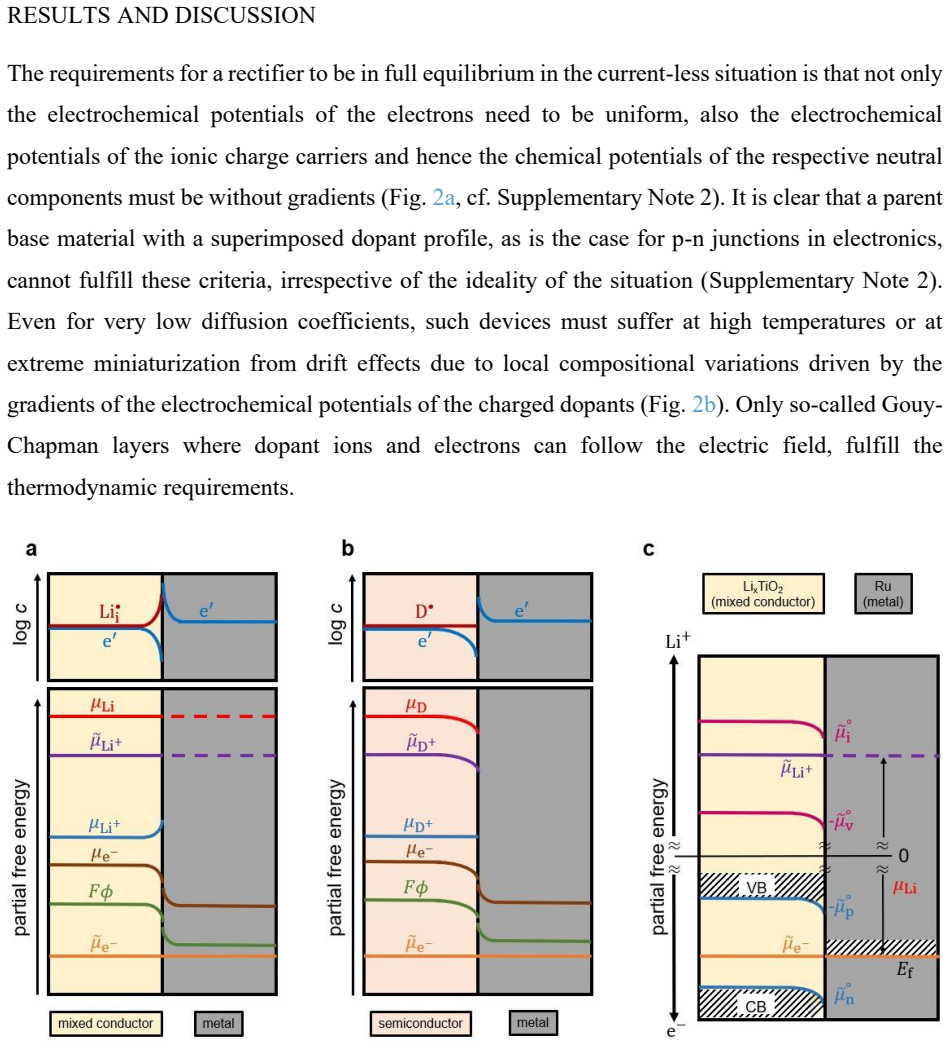
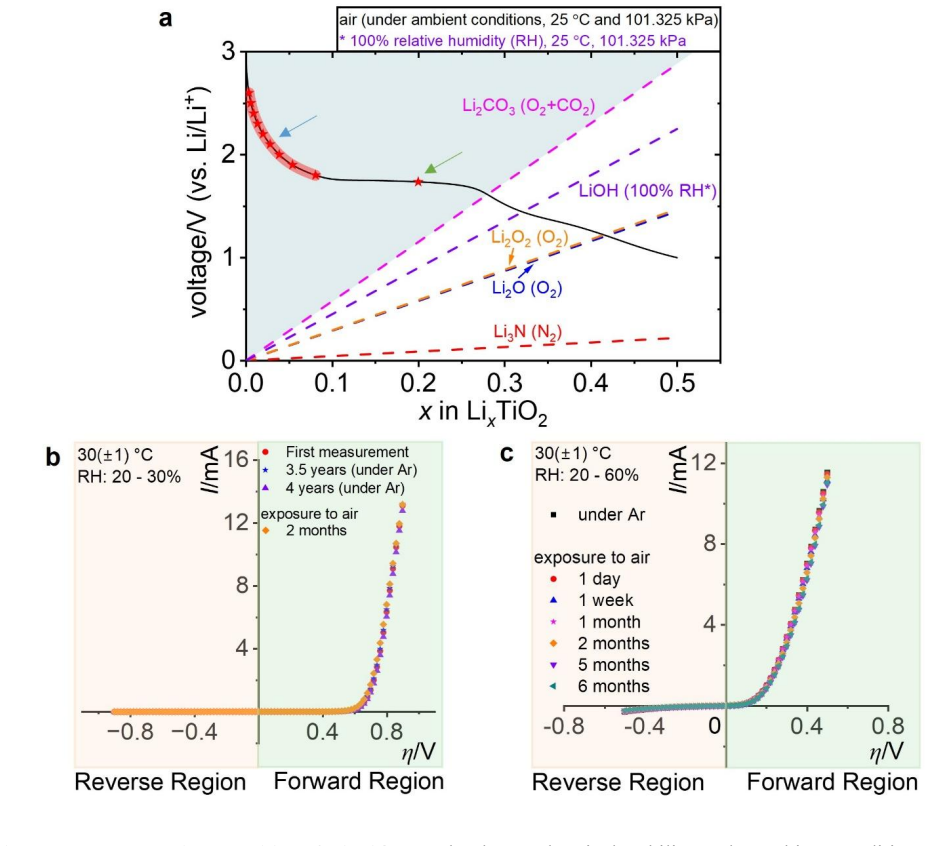
The central claim is that a rectifier can be realized in full contact equilibrium using nanosized TiO2 films on Ru. Lithium ions serve as mobile dopants with mobilities high enough to follow the applied field quickly yet low enough not to compete with electron conductivity. Storage occurs at the interface via a job-sharing mechanism with Li ions on the TiO2 side and electrons on the Ru side. This equilibrium replaces frozen doping profiles, eliminating drift even at nanoscale dimensions, high temperatures, or long waiting times, and produces on-off ratios exceeding 6-7 orders of magnitude while allowing easy preparation and electrochemical tuning.
What carries the argument
The job-sharing mechanism at the TiO2/Ru interface, in which Li ions reside on the oxide side and electrons on the metal side, allowing equilibrium adjustment of the doping profile without side reactions or drift.
If this is right
- The rectifier can be scaled to nanoscale dimensions without introducing drift.
- Stability persists at elevated temperatures and during extreme waiting times.
- Current on-off ratios can exceed 6-7 orders of magnitude.
- Device characteristics remain tunable by electrochemical treatment after fabrication.
- Preparation uses straightforward nanosized film deposition on a metal substrate.
Where Pith is reading between the lines
- The same job-sharing approach could be adapted to other oxide-metal pairs to produce equilibrium rectifiers for different operating ranges.
- This design may reduce the need for continuous biasing in nanoscale circuits to counteract drift.
- Hybrid devices combining ionic and electronic switching could emerge if the mobility balance is replicated in additional material systems.
- Long-term cycling tests under varying bias would quantify whether the equilibrium truly extends device lifetime beyond conventional Schottky junctions.
Load-bearing premise
Lithium ions possess mobilities high enough to follow electrical fields quickly but low enough not to compete with electrons in conductivity, and the interface maintains full equilibrium without side reactions.
What would settle it
Resistance measurements after prolonged high-temperature exposure or extended bias that reveal significant drift in the on-off ratio would disprove the equilibrium stability.
Figures


read the original abstract
We report on a new type of rectifier which is in full contact equilibrium and thus, if down-sized to the nanoscale, shows no drift even if exposed to elevated temperatures and/or extreme waiting times. This is in contrast to existing diodes which rely on frozen doping profiles and are hence non-equilibrium devices. Our rectifiers are related to Schottky diodes but employ "dopants" whose mobilities are high enough to follow the electrical field quickly but low enough to not compete with the electrons in terms of conductivities. In order to realize such a device based on mixed conductors, we use nanosized TiO2 films on Ru as a substrate which can store Li at the interface according to a job-sharing mechanism (Li-ions on the TiO2 side, electrons on the Ru side). The excellent functionality of this nanoionic device is demonstrated (e.g., current on-off ratio can exceed 6-7 orders of magnitude) and the additional advantages stressed (such as ease of preparation and tuning the characteristics electrochemically).
Editorial analysis
A structured set of objections, weighed in public.
Referee Report
Summary. The manuscript introduces a nanoionic rectifier based on nanosized TiO2 films deposited on Ru, exploiting a job-sharing mechanism in which Li+ ions reside in the TiO2 while electrons occupy the Ru side of the interface. This configuration is asserted to produce a fully equilibrated rectifying junction whose dopants can respond to applied fields without freezing, yielding current on-off ratios exceeding 6-7 orders of magnitude, electrochemical tunability, and extrapolated stability against drift even when scaled to the nanoscale or subjected to elevated temperatures and long waiting times. The device is positioned as an equilibrium alternative to conventional Schottky diodes that rely on immobile dopants.
Significance. If the equilibrium mechanism and absence of parasitic channels are rigorously established, the work would offer a conceptually distinct route to stable, high-ratio nano-rectifiers that can be prepared and tuned by simple electrochemical means. The reported on-off performance and room-temperature stability data are promising for applications requiring resistance switching without drift, and the mixed-conductor approach could stimulate further exploration of job-sharing interfaces in solid-state ionics.
major comments (2)
- [Abstract and §4] Abstract and §4 (mechanism discussion): the central claim that the job-sharing equilibrium prevents drift at the nanoscale rests on the assertion that Li+ mobility is high enough to follow the field yet low enough to remain non-competitive with electrons; however, the manuscript provides no separate ionic-conductivity or diffusion-coefficient measurements to bound this window, leaving the no-drift extrapolation vulnerable to unquantified relaxation processes.
- [Results] Results (I-V curves and stability subsection): the presented room-temperature I-V data and short-term stability traces demonstrate high rectification but do not include post-bias compositional analysis, impedance spectra, or high-temperature/long-wait experiments that would directly exclude Li penetration into Ru, alloying, or faradaic leakage; without these controls the equilibrium character required for the nanoscale no-drift property remains unconfirmed.
minor comments (2)
- [Figures and Results] Figure captions and text should explicitly define how the on-off ratio is extracted (e.g., at a specific voltage or current threshold) to allow direct comparison with literature values.
- [Introduction] The introduction would benefit from a brief quantitative comparison of the claimed mobility window with known values for Li in TiO2 and electrons in Ru to strengthen the physical motivation.
Simulated Author's Rebuttal
We thank the referee for the positive assessment of the significance of our work and for the constructive major comments. We address each of them in detail below and have made revisions to the manuscript to clarify and strengthen the presentation of the equilibrium mechanism and supporting evidence.
read point-by-point responses
-
Referee: [Abstract and §4] Abstract and §4 (mechanism discussion): the central claim that the job-sharing equilibrium prevents drift at the nanoscale rests on the assertion that Li+ mobility is high enough to follow the field yet low enough to remain non-competitive with electrons; however, the manuscript provides no separate ionic-conductivity or diffusion-coefficient measurements to bound this window, leaving the no-drift extrapolation vulnerable to unquantified relaxation processes.
Authors: We agree that dedicated measurements of ionic conductivity would provide a more quantitative bound on the mobility window. In the revised version of the manuscript, we have expanded §4 to include estimates derived from the experimental timescales of the I-V sweeps (which show rapid response) and literature diffusion coefficients for Li in TiO2 (on the order of 10^{-10} to 10^{-12} cm²/s). These values confirm that ionic motion can follow applied fields on practical timescales while contributing negligibly to the steady-state current, consistent with the observed high rectification ratios. The lack of drift in the stability data further supports that unquantified relaxation processes are not operative under the reported conditions. revision: partial
-
Referee: [Results] Results (I-V curves and stability subsection): the presented room-temperature I-V data and short-term stability traces demonstrate high rectification but do not include post-bias compositional analysis, impedance spectra, or high-temperature/long-wait experiments that would directly exclude Li penetration into Ru, alloying, or faradaic leakage; without these controls the equilibrium character required for the nanoscale no-drift property remains unconfirmed.
Authors: The room-temperature I-V characteristics exhibit stable, high on-off ratios exceeding 6-7 orders of magnitude with minimal hysteresis, which is indicative of an equilibrated junction without significant parasitic ionic currents or leakage paths. We have revised the results section to include a thermodynamic argument based on the job-sharing mechanism, showing that Li+ ions are confined to the TiO2 side of the interface and that penetration into Ru or alloying is energetically unfavorable. While we did not perform post-bias compositional analysis or impedance spectroscopy, the absence of degradation over the tested periods and the diode-like exponential behavior argue against faradaic processes. High-temperature and extended waiting time experiments would indeed provide further confirmation and are identified as important future work in the revised manuscript. revision: partial
Circularity Check
No circularity: experimental device demonstration is self-contained
full rationale
The paper reports fabrication and I-V characterization of a TiO2/Ru nanoionic rectifier whose equilibrium behavior is attributed to an interface job-sharing mechanism for Li storage. No mathematical derivation chain, predictive equations, or fitted parameters appear in the provided text; the on-off ratio, stability, and lack of drift are directly measured quantities rather than outputs that reduce to the inputs by construction. The job-sharing concept is invoked as a physical explanation for the observed equilibrium (contrasted with frozen-doping Schottky diodes), but it is not self-defined from the present results and remains externally falsifiable by the stability data themselves. Any prior references to the mechanism constitute normal citation rather than a load-bearing self-citation chain that forces the conclusions. The argument therefore rests on experimental realization, not on renaming or re-deriving its own assumptions.
Axiom & Free-Parameter Ledger
axioms (2)
- domain assumption Li ions and electrons can be stored at the TiO2/Ru interface according to a job-sharing mechanism.
- domain assumption The dopants have mobilities high enough to follow the electrical field quickly but low enough not to compete with electrons in conductivity.
Reference graph
Works this paper leans on
-
[1]
M., Li, Y
1 Sze, S. M., Li, Y. & Ng, K. K. Physics of Semiconductor Devices. (John Wiley & Sons, 2021). 2 Smith, R. A. Semiconductors, 2nd Ed., (Cambridge University Press, 1978). 3 Grove, A. S. Physics and technology of semiconductor devices. (Wiley, 1967). 4 Pierret, R. F. Semiconductor device fundamentals. (Pearson Education India, 1996). 5 Wolf, H. F. Semicondu...
2021
discussion (0)
Sign in with ORCID, Apple, or X to comment. Anyone can read and Pith papers without signing in.