Recognition: unknown
Semi-analytic bounds on axion-like-particle supernovae emission
Pith reviewed 2026-05-07 06:04 UTC · model grok-4.3
The pith
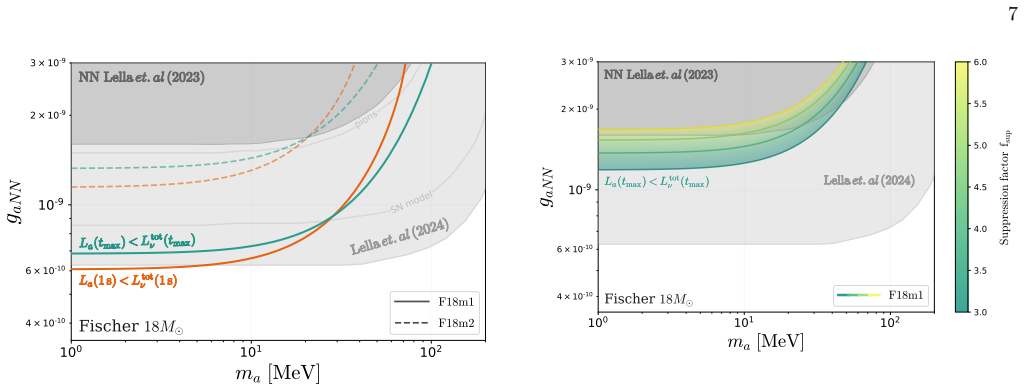
A semi-analytic model using six proto-neutron star parameters yields axion-like particle bounds from supernovae that match numerical simulations.
A machine-rendered reading of the paper's core claim, the machinery that carries it, and where it could break.
Core claim
By expressing proto-neutron star observables in terms of six global parameters and including finite mass effects for axion-like particles, the authors obtain bounds on the axion-nucleon coupling versus mass from the requirement that ALP emission does not over-cool the supernova. These bounds are shown to be in good agreement with those from full numerical simulations, demonstrating the robustness of the reduced description.
What carries the argument
The semi-analytic framework that expresses proto-neutron star observables through six global parameters and calculates finite-mass ALP emission rates to derive cooling constraints.
Load-bearing premise
The six global proto-neutron star parameters together with the selected nuclear effects and cooling exclusion criteria are sufficient to describe the dominant processes of ALP production and escape during the supernova cooling phase.
What would settle it
A full numerical supernova simulation that incorporates the exact same six-parameter calibration but yields ALP bounds differing by more than the reported agreement margin would falsify the robustness claim.
Figures


read the original abstract
Core-collapse supernovae provide natural laboratories for the production of new light particles. In particular, axion-like particles (ALPs) can be constrained via SN1987A cooling arguments. However, significant astrophysical and nuclear uncertainties imply that such bounds may vary strongly depending on modeling choices, even when expensive simulations are employed. In this context, semi-analytic methods offer a simple and fast alternative for deriving new-physics constraints. Building on a previous semi-analytic framework, in which proto-neutron star (PNS) observables are expressed in terms of six global PNS parameters, we include a finite ALP mass in the calculation and derive bounds in the axion-nucleon coupling versus mass plane. The obtained bounds are in good agreement with previous results from numerical simulations, demonstrating the robustness of the method. We also illustrate the sensitivity of the bounds to different PNS parameter calibrations, nuclear effects and cooling exclusion criteria.
Editorial analysis
A structured set of objections, weighed in public.
Referee Report
Summary. The manuscript extends a prior semi-analytic framework for proto-neutron star (PNS) observables, now incorporating finite axion-like particle (ALP) mass into nucleon bremsstrahlung production and escape probability calculations. Using a PNS model reduced to six global parameters (mass, radius, core and surface temperatures, density scale, etc.), it derives bounds on the ALP-nucleon coupling g_aN versus ALP mass m_a from SN1987A cooling arguments. The central result is that these bounds agree with those obtained from full numerical simulations, with additional exploration of sensitivity to PNS parameter choices, nuclear effects, and cooling exclusion criteria.
Significance. If the agreement with numerical simulations holds under detailed scrutiny, the work provides a computationally efficient and transparent alternative to expensive simulations for placing ALP constraints from supernovae. This enables rapid sensitivity studies to astrophysical and nuclear uncertainties, which is valuable in a field where such modeling choices can significantly affect bounds. The approach builds on an established six-parameter reduction and demonstrates its utility for finite-mass cases, potentially aiding future explorations of new-physics scenarios in core-collapse supernovae.
major comments (2)
- [Results section] Results section: The central claim that the semi-analytic bounds are in good agreement with previous numerical simulations (and thus demonstrate robustness) requires stronger substantiation for m_a > 0. The manuscript reports sensitivity to the six global PNS parameters but does not present a direct side-by-side comparison of ALP luminosity or derived g_aN bounds computed from the analytic profiles versus integration over full numerical radial T(r) and ρ(r) profiles for any finite-mass point. Since both the production rate and the optical depth τ(r) for massive ALPs depend on local conditions in the decoupling region, profile deviations at the 10-20% level could shift the bounds comparably to the quoted agreement.
- [Method section] Method section: The reduction of the PNS to six global parameters (with assumed analytic profiles such as isothermal core plus exponential atmosphere) is load-bearing for the finite-mass calculation. While the paper illustrates sensitivity to parameter calibrations, it should quantify the fidelity of these profiles against specific simulation outputs in the regions controlling ALP trapping and emission, e.g., by reporting the fractional difference in integrated luminosity for benchmark m_a values.
minor comments (2)
- [Abstract] The abstract refers to 'six global PNS parameters' without enumerating them; adding a short list (e.g., mass, radius, core temperature, surface temperature, density scale, and one additional) would improve immediate clarity for readers.
- [Methods] Ensure that the cooling exclusion criteria are defined with an explicit equation or threshold value in the methods, as their impact on the bounds is highlighted in the sensitivity analysis.
Simulated Author's Rebuttal
We thank the referee for their careful reading of the manuscript and for the constructive comments, which help clarify the presentation of our semi-analytic approach. We address each major comment below and describe the revisions we will make to strengthen the substantiation of our results.
read point-by-point responses
-
Referee: [Results section] Results section: The central claim that the semi-analytic bounds are in good agreement with previous numerical simulations (and thus demonstrate robustness) requires stronger substantiation for m_a > 0. The manuscript reports sensitivity to the six global PNS parameters but does not present a direct side-by-side comparison of ALP luminosity or derived g_aN bounds computed from the analytic profiles versus integration over full numerical radial T(r) and ρ(r) profiles for any finite-mass point. Since both the production rate and the optical depth τ(r) for massive ALPs depend on local conditions in the decoupling region, profile deviations at the 10-20% level could shift the bounds comparably to the quoted agreement.
Authors: We agree that a direct side-by-side comparison of the ALP luminosity (and resulting optical depth) for finite m_a would provide stronger substantiation of the agreement with numerical simulations. The current manuscript demonstrates agreement at the level of the final derived bounds on g_aN versus m_a (see Figure 5 and associated discussion), which already incorporate the integrated production and escape probabilities. However, to address the referee's concern explicitly, we will add a new panel or appendix figure in the revised manuscript that shows the fractional difference in computed ALP luminosity for benchmark finite-mass values (e.g., m_a = 10 MeV and m_a = 100 MeV) when evaluated with the six-parameter analytic profiles versus direct integration over the radial T(r) and ρ(r) profiles from the reference numerical simulation. This will quantify any profile-induced discrepancies in the decoupling region and confirm that they remain smaller than the overall uncertainty band on the bounds. revision: yes
-
Referee: [Method section] Method section: The reduction of the PNS to six global parameters (with assumed analytic profiles such as isothermal core plus exponential atmosphere) is load-bearing for the finite-mass calculation. While the paper illustrates sensitivity to parameter calibrations, it should quantify the fidelity of these profiles against specific simulation outputs in the regions controlling ALP trapping and emission, e.g., by reporting the fractional difference in integrated luminosity for benchmark m_a values.
Authors: We acknowledge that the six-parameter reduction with analytic profiles is central to the finite-mass extension, and its fidelity in the trapping and emission regions must be quantified for full transparency. The parameters are calibrated to reproduce global PNS observables (total energy loss, neutrino luminosities, and average temperatures) from the reference numerical simulations, as established in our prior work. To directly address the request, we will include in the revised Methods section (or a dedicated subsection) the fractional difference in integrated ALP luminosity for the same benchmark m_a values, computed using the analytic profiles versus the specific simulation radial profiles in the density range 10^13–10^14 g/cm^3 and temperature range 10–30 MeV that dominate the decoupling. This will be presented alongside the existing sensitivity studies to PNS parameters. revision: yes
Circularity Check
Finite-mass ALP bounds derived from prior PNS parameterization but validated externally against simulations
full rationale
The derivation extends an existing semi-analytic PNS model (six global parameters) by incorporating finite ALP mass into production and escape integrals, then computes new g_aN bounds. These bounds are compared to independent numerical simulations for validation rather than being forced by the inputs. The prior framework supplies the base profiles and calibration, but the mass-dependent optical depth and luminosity integrals introduce new content not reducible to the calibration by construction. No self-citation chain or fitted-input renaming carries the central result; the agreement with simulations serves as an external check on the approximation.
Axiom & Free-Parameter Ledger
free parameters (1)
- six global PNS parameters
axioms (2)
- domain assumption ALP emission can be treated as an additional cooling channel whose rate depends on the axion-nucleon coupling and ALP mass.
- domain assumption The six-parameter description adequately captures the essential thermodynamics and neutrino/ALP transport in the PNS.
Reference graph
Works this paper leans on
-
[1]
G. G. Raffelt,Stars as laboratories for fundamental physics: The astrophysics of neutrinos, axions, and other weakly interacting particles(1996)
1996
-
[2]
Hirataet al.(Kamiokande-II), Phys
K. Hirataet al.(Kamiokande-II), Phys. Rev. Lett.58, 1490 (1987)
1987
-
[3]
R. M. Biontaet al., Phys. Rev. Lett.58, 1494 (1987)
1987
-
[4]
R. D. Peccei and H. R. Quinn, Phys. Rev. Lett.38, 1440 (1977)
1977
-
[5]
Weinberg, Phys
S. Weinberg, Phys. Rev. Lett.40, 223 (1978)
1978
-
[6]
Wilczek, Phys
F. Wilczek, Phys. Rev. Lett.40, 279 (1978)
1978
-
[7]
Chikashige, R
Y. Chikashige, R. N. Mohapatra, and R. D. Peccei, Phys. Lett. B98, 265 (1981)
1981
-
[8]
G. B. Gelmini and M. Roncadelli, Phys. Lett. B99, 411 (1981)
1981
- [9]
- [10]
-
[11]
Wilczek, Phys
F. Wilczek, Phys. Rev. Lett.49, 1549 (1982)
1982
-
[12]
Sikivie, Phys
P. Sikivie, Phys. Rev. Lett.51, 1415 (1983)
1983
-
[13]
L. Di Luzio, M. Giannotti, E. Nardi, and L. Visinelli, Phys. Rept.870, 1 (2020), arXiv:2003.01100 [hep-ph]
- [14]
-
[15]
A. Bharucha, F. Br¨ ummer, N. Desai, and S. Mutzel, JHEP02, 141 (2023), arXiv:2209.03932 [hep-ph]
-
[16]
G. Armando, P. Panci, J. Weiss, and R. Ziegler, Phys. Rev. D109, 055029 (2024), arXiv:2310.05827 [hep-ph]
-
[17]
W. Beenakker, D. Mikkers, A. V. Phan, and S. Westhoff, (2025), arXiv:2511.19619 [hep-ph]
- [18]
- [19]
-
[20]
M. S. Turner, Phys. Rev. Lett.60, 1797 (1988)
1988
-
[21]
P. Carenza, T. Fischer, M. Giannotti, G. Guo, G. Mart´ ınez-Pinedo, and A. Mirizzi, JCAP10, 016 (2019), [Erratum: JCAP 05, E01 (2020)], arXiv:1906.11844 [hep-ph]
- [22]
- [23]
- [24]
- [25]
-
[26]
G. Lucente, P. Carenza, T. Fischer, M. Giannotti, and A. Mirizzi, JCAP12, 008 (2020), arXiv:2008.04918 [hep- ph]
- [27]
- [28]
-
[29]
Weinberg,Gravitation and Cosmology: Principles and Applications of the General Theory of Relativity(John Wiley and Sons, New York, 1972)
S. Weinberg,Gravitation and Cosmology: Principles and Applications of the General Theory of Relativity(John Wiley and Sons, New York, 1972)
1972
-
[30]
Raffelt and L
G. Raffelt and L. Stodolsky, Phys. Rev. D37, 1237 (1988)
1988
-
[31]
S. Chakraborty, A. Gupta, and M. Vanvlasselaer, Phys. Rev. D110, 063032 (2024), arXiv:2403.12169 [hep-ph]
-
[32]
Carena and R
M. Carena and R. D. Peccei, Phys. Rev. D40, 652 (1989)
1989
-
[33]
Hadronic axion window and the big-bang nucleosynthesis
S. Chang and K. Choi, Phys. Lett. B316, 51 (1993), arXiv:hep-ph/9306216
work page Pith review arXiv 1993
-
[34]
R. P. Brinkmann and M. S. Turner, Phys. Rev. D38, 2338 (1988)
1988
-
[35]
M. S. Turner, H. S. Kang, and G. Steigman,Axions, SN 1987A, and one pion exchange, Tech. Rep. (Chicago Univ., IL (USA), 1988)
1988
-
[36]
Y. Suwa, Publ. Astron. Soc. Jap.66, L1 (2014), arXiv:1311.7249 [astro-ph.HE]
-
[37]
H. Dembinski and P. O. et al., (2020), 10.5281/zen- odo.3949207. 9
-
[38]
T. Fischer, S. Chakraborty, M. Giannotti, A. Mirizzi, A. Payez, and A. Ringwald, Phys. Rev. D94, 085012 (2016), arXiv:1605.08780 [astro-ph.HE]
-
[39]
Burrows, M
A. Burrows, M. T. Ressell, and M. S. Turner, Phys. Rev. D42, 3297 (1990)
1990
-
[40]
Raffelt and D
G. Raffelt and D. Seckel, Phys. Rev. Lett.60, 1793 (1988)
1988
- [41]
-
[42]
A. Betranhandy and E. O’Connor, Phys. Rev. D106, 063019 (2022), arXiv:2204.00503 [astro-ph.HE]
-
[43]
D. Alonso-Gonz´ alez, D. Cerde˜ no, M. Cerme˜ no, and A. D. Perez, Phys. Rev. D111, 083029 (2025), arXiv:2412.19890 [hep-ph]
discussion (0)
Sign in with ORCID, Apple, or X to comment. Anyone can read and Pith papers without signing in.