Recognition: unknown
Continuous-tone Simple Points: An ell₀-Norm of Cyclic Gradient for Topology-Preserving Data-Driven Image Segmentation
Pith reviewed 2026-05-07 07:43 UTC · model grok-4.3
The pith
An ℓ₀-norm of the cyclic gradient detects simple points directly on continuous-valued images.
A machine-rendered reading of the paper's core claim, the machinery that carries it, and where it could break.
Core claim
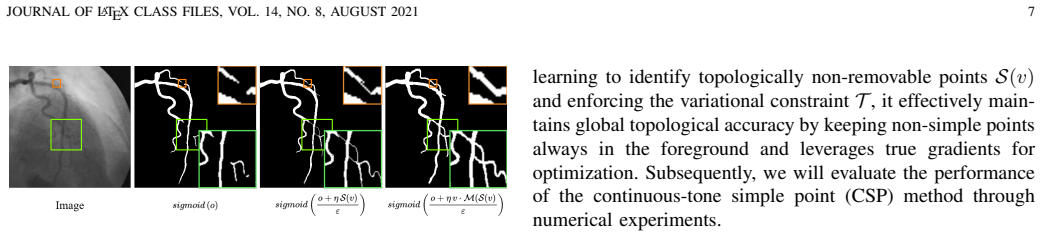
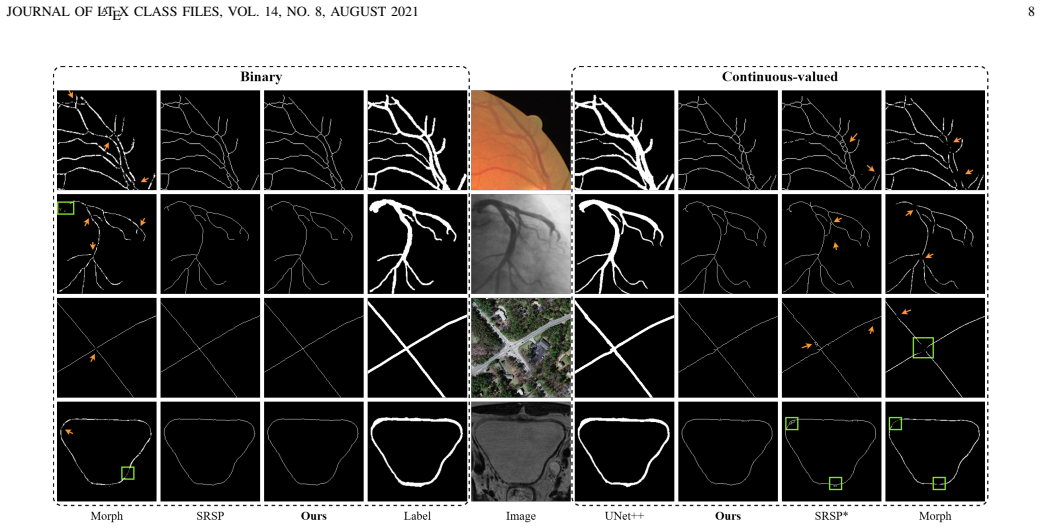
We propose a novel method that directly computes simple points on continuous-valued images by means of the ℓ₀-norm of the cyclic gradient, enabling differentiable topological inference. This leads to an efficient skeleton extraction algorithm that preserves topological structures in both binary and continuous-valued images. Furthermore, we design a variational model that enforces topological constraints by preserving topologically non-removable points, which integrates seamlessly into deep neural network segmentation models with softmax or sigmoid outputs.
What carries the argument
The ℓ₀-norm of the cyclic gradient operator, which identifies topologically non-removable (non-simple) points in continuous images and allows gradient flow for topology preservation.
If this is right
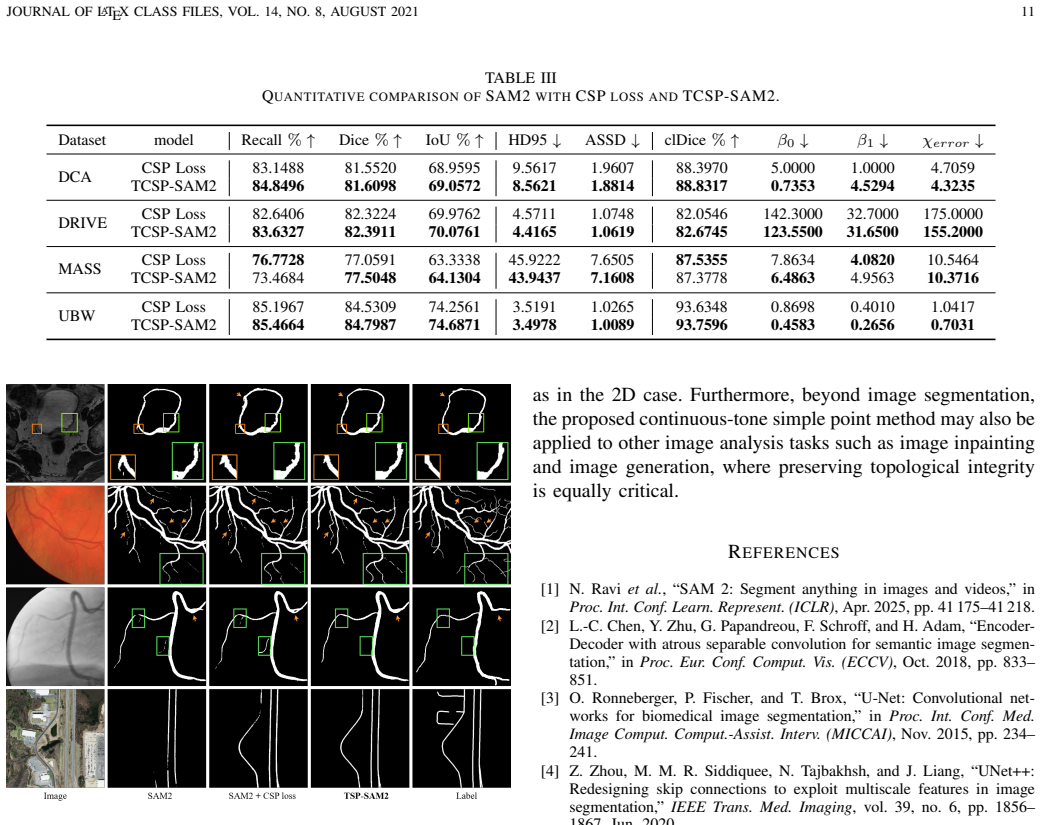
- Any deep neural network for segmentation with softmax or sigmoid outputs can incorporate topological constraints during training.
- The approach yields segmentations with improved topological integrity and structural accuracy on benchmarks.
- Skeleton extraction becomes possible for continuous-valued images while maintaining topology.
- Topology preservation no longer requires separate binary post-processing steps.
Where Pith is reading between the lines
- Similar cyclic gradient norms might apply to other topological features beyond simple points in image processing.
- This differentiable formulation could support end-to-end training for tasks like medical image analysis where topology is critical.
- Verification on synthetic images with controlled topology changes would confirm equivalence to discrete simple point criteria.
Load-bearing premise
That the ℓ₀-norm of the cyclic gradient on continuous images correctly identifies non-simple points in a way equivalent to discrete binary simple point theorems.
What would settle it
An experiment on an image with a known hole or loop where the trained segmentation network using this model produces an output with altered topology, such as a missing connection.
Figures



read the original abstract
Topological features play an essential role in ensuring geometric plausibility and structural consistency in image analysis tasks such as segmentation and skeletonization. However, integrating topology-preserving learning based on simple points into deep learning tasks remains challenging, as existing simple point detection methods are confined to binary images and are non-differentiable, rendering them incompatible with gradient-based optimization in modern deep learning. Moreover, morphological and purely data-driven approaches often fail to guaranty topological consistency. To address these limitations, we propose a novel method that directly computes simple points on continuous-valued images, enabling differentiable topological inference. Building on this theory, we develop an efficient skeleton extraction algorithm that preserves topological structures in binary and continuous-valued images. Furthermore, we design a variational model that enforces topological constraints by preserving topologically non-removable (i.e., non-simple) points, which can be seamlessly integrated into any deep neural network segmentation with softmax or sigmoid outputs. Experimental results demonstrate that the proposed approach effectively improves topological integrity and structural accuracy across multiple benchmarks. The codes are available in https://github.com/levnsio/CSP.
Editorial analysis
A structured set of objections, weighed in public.
Referee Report
Summary. The paper claims to introduce continuous-tone simple points defined as the ℓ₀-norm of the cyclic gradient on continuous-valued images. This allows for a differentiable way to detect simple points, leading to a skeleton extraction algorithm that preserves topology and a variational model that can be integrated into deep learning segmentation networks to enforce topological constraints by preserving non-simple points. Experiments on benchmarks show improved topological integrity and structural accuracy.
Significance. Should the equivalence to discrete simple points hold and the model enforce topology correctly, this would be significant for enabling topology-preserving deep learning in image segmentation, a common need in fields like medical imaging. The provision of code enhances the potential impact by allowing reproduction and extension. It bridges discrete topology with continuous differentiable models.
major comments (2)
- [§3 (Method - Continuous-tone Simple Points)] The definition of continuous-tone simple points via the ℓ₀-norm of the cyclic gradient is presented without a formal proof that it coincides with the discrete binary simple point definition for arbitrary intensity values. This is a load-bearing issue for the central claim, as the variational model in the subsequent section relies on this to guarantee topology preservation equivalent to classical methods. A theorem or at least exhaustive verification on synthetic neighborhoods would be necessary.
- [§4 (Variational Model)] The variational model enforces constraints by preserving non-simple points, but it is not clear from the formulation how this local constraint ensures global topological properties (such as correct Betti numbers) are maintained throughout the optimization. An analysis or additional experiments demonstrating no introduction of new topological artifacts would address this.
minor comments (2)
- [Abstract] The abstract is clear but could mention the specific benchmarks used for experiments to give readers a better sense of the scope.
- [Notation] The cyclic gradient is introduced but its exact mathematical definition (e.g., how the cycle is defined in 2D/3D) should be clarified earlier in the method section for better readability.
Simulated Author's Rebuttal
We thank the referee for the constructive and insightful comments, which help strengthen the theoretical and empirical aspects of our work. We address each major comment below and will incorporate revisions to provide additional proofs, clarifications, and experiments in the revised manuscript.
read point-by-point responses
-
Referee: [§3 (Method - Continuous-tone Simple Points)] The definition of continuous-tone simple points via the ℓ₀-norm of the cyclic gradient is presented without a formal proof that it coincides with the discrete binary simple point definition for arbitrary intensity values. This is a load-bearing issue for the central claim, as the variational model in the subsequent section relies on this to guarantee topology preservation equivalent to classical methods. A theorem or at least exhaustive verification on synthetic neighborhoods would be necessary.
Authors: We agree that a formal equivalence result for the binary case would strengthen the central claim. The continuous-tone definition is constructed so that the ℓ₀-norm of the cyclic gradient vanishes precisely when a point satisfies the classical discrete simple-point conditions (no change in local topology). In the current manuscript we demonstrate this via the motivating discrete case and selected examples, but we did not include an exhaustive verification or theorem statement. In the revision we will add (i) a theorem proving that, when the input is strictly binary, the proposed ℓ₀-norm is zero if and only if the point is simple in the sense of Bertrand (or equivalent discrete definitions), and (ii) an exhaustive table/figure checking all 256 possible 3×3 binary configurations (and the analogous 3-D case if space permits). For non-binary intensities the definition is intentionally a continuous relaxation; we will explicitly state that equivalence is claimed only in the binary limit and provide a short continuity argument showing that small perturbations around 0/1 values preserve the simple/non-simple classification. revision: yes
-
Referee: [§4 (Variational Model)] The variational model enforces constraints by preserving non-simple points, but it is not clear from the formulation how this local constraint ensures global topological properties (such as correct Betti numbers) are maintained throughout the optimization. An analysis or additional experiments demonstrating no introduction of new topological artifacts would address this.
Authors: The local constraint is grounded in the classical digital-topology result that a point is simple if and only if its removal (or addition) does not alter the local homotopy type; when only simple points are modified, the global Betti numbers are therefore preserved. Our variational term penalizes the removal of non-simple points, thereby restricting the optimizer to topologically safe updates at every iteration. To make this connection explicit we will insert a short paragraph in §4 that recalls the relevant theorem from digital topology and explains why the soft constraint inherits the global invariance. In addition, we will add a new experiment on synthetic images whose ground-truth Betti numbers are known a priori; we will report the evolution of Betti numbers (β₀, β₁, β₂) during optimization and show that no spurious components, holes, or tunnels are created. These results will be summarized in a new table and a supplementary figure. revision: yes
Circularity Check
No circularity: novel continuous operator proposed as independent construction
full rationale
The derivation introduces an ℓ₀-norm of cyclic gradient as a new continuous-valued detector for simple points, then builds a variational model that preserves non-simple points inside differentiable losses for segmentation networks. This operator is presented as a direct proposal rather than derived from or fitted to the classical discrete binary simple-point test; the paper does not reduce the continuous definition to the discrete one by construction, nor rename a known result, nor invoke self-citations for a uniqueness theorem that would force the choice. The skeleton extraction and topology-enforcing loss follow directly from the new operator without statistical forcing or self-referential closure. The chain is therefore self-contained as an original ansatz with external experimental checks, yielding no load-bearing circular step.
Axiom & Free-Parameter Ledger
axioms (1)
- domain assumption The ℓ₀-norm of the cyclic gradient on continuous images identifies topologically simple points equivalently to the discrete binary definition.
invented entities (1)
-
Continuous-tone simple points
no independent evidence
Reference graph
Works this paper leans on
-
[1]
SAM 2: Segment anything in images and videos,
N. Raviet al., “SAM 2: Segment anything in images and videos,” in Proc. Int. Conf. Learn. Represent. (ICLR), Apr. 2025, pp. 41 175–41 218
2025
-
[2]
Encoder- Decoder with atrous separable convolution for semantic image segmen- tation,
L.-C. Chen, Y . Zhu, G. Papandreou, F. Schroff, and H. Adam, “Encoder- Decoder with atrous separable convolution for semantic image segmen- tation,” inProc. Eur. Conf. Comput. Vis. (ECCV), Oct. 2018, pp. 833– 851
2018
-
[3]
U-Net: Convolutional net- works for biomedical image segmentation,
O. Ronneberger, P. Fischer, and T. Brox, “U-Net: Convolutional net- works for biomedical image segmentation,” inProc. Int. Conf. Med. Image Comput. Comput.-Assist. Interv. (MICCAI), Nov. 2015, pp. 234– 241
2015
-
[4]
UNet++: Redesigning skip connections to exploit multiscale features in image segmentation,
Z. Zhou, M. M. R. Siddiquee, N. Tajbakhsh, and J. Liang, “UNet++: Redesigning skip connections to exploit multiscale features in image segmentation,”IEEE Trans. Med. Imaging, vol. 39, no. 6, pp. 1856– 1867, Jun. 2020
2020
-
[5]
SegFormer: Simple and efficient design for semantic segmentation with transformers,
E. Xie, W. Wang, Z. Yu, A. Anandkumar, J. M. Alvarez, and P. Luo, “SegFormer: Simple and efficient design for semantic segmentation with transformers,” inProc. Adv. Neural Inf. Process. Syst. (NeurIPS), vol. 34, Dec. 2021, pp. 12 077–12 090
2021
-
[6]
Segment anything,
A. Kirillovet al., “Segment anything,” inProc. IEEE/CVF Int. Conf. Comput. Vis. (ICCV), Oct. 2023, pp. 3992–4003
2023
-
[7]
Dynamic snake convo- lution based on topological geometric constraints for tubular structure segmentation,
Y . Qi, Y . He, X. Qi, Y . Zhang, and G. Yang, “Dynamic snake convo- lution based on topological geometric constraints for tubular structure segmentation,” inProc. IEEE/CVF Int. Conf. Comput. Vis. (ICCV), Oct. 2023, pp. 6047–6056
2023
-
[8]
Represent- ing topological self-similarity using fractal feature maps for accurate segmentation of tubular structures,
J. Huang, Y . Zhou, Y . Luo, G. Liu, H. Guo, and G. Yang, “Represent- ing topological self-similarity using fractal feature maps for accurate segmentation of tubular structures,” inProc. Eur. Conf. Comput. Vis. (ECCV), Oct. 2024, pp. 143–160
2024
-
[9]
Topology optimization in medical image segmentation with fastχeuler characteristic,
L. Li, Q. Ma, C. Ouyang, J. C. Paetzold, D. Rueckert, and B. Kainz, “Topology optimization in medical image segmentation with fastχeuler characteristic,”IEEE Trans. Med. Imaging, vol. 44, no. 12, pp. 5221– 5232, Jul. 2025
2025
-
[10]
Topology-aware uncertainty for image segmentation,
S. Gupta, Y . Zhang, X. Hu, P. Prasanna, and C. Chen, “Topology-aware uncertainty for image segmentation,” inProc. Adv. Neural Inf. Process. Syst. (NeurIPS), vol. 36, Nov. 2023, pp. 8186–8207
2023
-
[11]
Topology-aware segmentation using discrete Morse theory,
X. Hu, Y . Wang, L. Fuxin, D. Samaras, and C. Chen, “Topology-aware segmentation using discrete Morse theory,” inProc. Int. Conf. Learn. Represent. (ICLR), May 2021, pp. 2101–2119
2021
-
[12]
Beyond the pixel-wise loss for topology-aware delineation,
A. Mosinska, P. Marquez-Neila, M. Kozinski, and P. Fua, “Beyond the pixel-wise loss for topology-aware delineation,” inProc. IEEE/CVF Conf. Comput. Vis. Pattern Recognit. (CVPR), Jun. 2018, pp. 3136–3145
2018
-
[13]
Optimized vessel segmentation: A structure-agnostic approach with small vessel enhancement and morphological correction,
D. Song, W. Huang, J. Liu, M. J. Islam, H. Yang, S. Wang, H. Zheng, and S. Wang, “Optimized vessel segmentation: A structure-agnostic approach with small vessel enhancement and morphological correction,” IEEE Trans. Image Process., vol. 34, pp. 7168–7179, Oct. 2025
2025
-
[14]
clDice - a novel topology-preserving loss function for tubular structure segmentation,
S. Shitet al., “clDice - a novel topology-preserving loss function for tubular structure segmentation,” inProc. IEEE/CVF Conf. Comput. Vis. Pattern Recognit. (CVPR), Jun. 2021, pp. 16 555–16 564. JOURNAL OF LATEX CLASS FILES, VOL. 14, NO. 8, AUGUST 2021 12
2021
-
[15]
Slender object scene segmentation in remote sensing image based on learnable morphological skeleton with segment anything model,
J. Xie, W. Li, F. Wang, L. Zhang, Z. Hou, and J. Liu, “Slender object scene segmentation in remote sensing image based on learnable morphological skeleton with segment anything model,”IEEE Trans. Geosci. Remote Sens., vol. 63, pp. 1–13, Jun. 2025
2025
-
[16]
The centerline- cross entropy loss for vessel-like structure segmentation: Better topology consistency without sacrificing accuracy,
C. Acebes, A. H. Moustafa, O. Camara, and A. Galdran, “The centerline- cross entropy loss for vessel-like structure segmentation: Better topology consistency without sacrificing accuracy,” inProc. Int. Conf. Med. Image Comput. Comput.-Assist. Interv. (MICCAI), Oct. 2024, pp. 710–720
2024
-
[17]
BiconNet: An edge- preserved connectivity-based approach for salient object detection,
Z. Yang, S. Soltanian-Zadeh, and S. Farsiu, “BiconNet: An edge- preserved connectivity-based approach for salient object detection,” Pattern Recogn., vol. 121, p. 108231, Jan. 2022
2022
-
[18]
RoadNet: Learning to comprehensively analyze road networks in complex urban scenes from high-resolution remotely sensed images,
Y . Liu, J. Yao, X. Lu, M. Xia, X. Wang, and Y . Liu, “RoadNet: Learning to comprehensively analyze road networks in complex urban scenes from high-resolution remotely sensed images,”IEEE Trans. Geosci. Remote Sens., vol. 57, no. 4, pp. 2043–2056, Oct. 2019
2043
-
[19]
Directional connectivity-based segmentation of medical images,
Z. Yang and S. Farsiu, “Directional connectivity-based segmentation of medical images,” inProc. IEEE/CVF Conf. Comput. Vis. Pattern Recognit. (CVPR), Jun, 2023, pp. 11 525–11 535
2023
-
[20]
Promoting connectivity of network-like structures by enforcing region separation,
D. Oner, M. Kozi ´nski, L. Citraro, N. C. Dadap, A. G. Konings, and P. Fua, “Promoting connectivity of network-like structures by enforcing region separation,”IEEE Trans. Pattern Anal. Mach. Intell., vol. 44, no. 9, pp. 5401–5413, Apr. 2022
2022
-
[21]
Topology-preserving image segmentation by Beltrami representation of shapes,
H.-L. Chan, S. Yan, L. M. Lui, and X.-C. Tai, “Topology-preserving image segmentation by Beltrami representation of shapes,”J. Math. Imaging Vis., vol. 60, no. 3, pp. 401–421, Mar. 2018
2018
-
[22]
Topology- and convexity- preserving image segmentation based on image registration,
D. Zhang, X. cheng Tai, and L. M. Lui, “Topology- and convexity- preserving image segmentation based on image registration,”Appl. Math. Model., vol. 100, pp. 218–239, Dec. 2021
2021
-
[23]
Topology-preserving 3D image segmentation based on hyperelastic regularization,
D. Zhang and L. M. Lui, “Topology-preserving 3D image segmentation based on hyperelastic regularization,”J. Sci. Comput., vol. 87, no. 3, p. 74, Apr. 2021
2021
-
[24]
A learning-based framework for topology- preserving segmentation using quasiconformal mappings,
H. Zhang and L. M. Lui, “A learning-based framework for topology- preserving segmentation using quasiconformal mappings,”Neurocom- puting, vol. 600, p. 128124, Oct. 2024
2024
-
[25]
Anatomically plausible segmentations: Explicitly preserving topology through prior deformations,
M. K. Wyburd, N. K. Dinsdale, M. Jenkinson, and A. I. Namburete, “Anatomically plausible segmentations: Explicitly preserving topology through prior deformations,”Med. Image Anal., vol. 97, p. 103222, Oct. 2024
2024
-
[26]
A fast diffeomorphic image registration algorithm,
J. Ashburner, “A fast diffeomorphic image registration algorithm,” NeuroImage, vol. 38, no. 1, pp. 95–113, Oct. 2007
2007
-
[27]
Topology-preserving deep image segmentation,
X. Hu, F. Li, D. Samaras, and C. Chen, “Topology-preserving deep image segmentation,” inProc. Adv. Neural Inf. Process. Syst. (NeurIPS), vol. 32, Nov. 2019, pp. 5657–5668
2019
-
[28]
A topological loss function for deep-learning based image segmentation using persistent homology,
J. R. Clough, N. Byrne, I. Oksuz, V . A. Zimmer, J. A. Schnabel, and A. P. King, “A topological loss function for deep-learning based image segmentation using persistent homology,”IEEE Trans. Pattern Anal. Mach. Intell., vol. 44, no. 12, pp. 8766–8778, Sep. 2022
2022
-
[29]
Explicit topological priors for deep-learning based image segmentation using persistent homology,
J. R. Clough, I. Oksuz, N. Byrne, J. A. Schnabel, and A. P. King, “Explicit topological priors for deep-learning based image segmentation using persistent homology,” inProc. Inf. Process. Med. Imaging (IPMI), May 2019, pp. 16–28
2019
-
[30]
Topology-guaranteed image segmentation: Enforcing connectivity, genus, and width constraints,
W. Li, X.-C. Tai, and J. Liu, “Topology-guaranteed image segmentation: Enforcing connectivity, genus, and width constraints,” 2026. [Online]. Available: https://arxiv.org/abs/2601.11409
-
[31]
TopoCellGen: Generating histopathology cell topology with a diffusion model,
M. Xuet al., “TopoCellGen: Generating histopathology cell topology with a diffusion model,” inProc. IEEE/CVF Conf. Comput. Vis. Pattern Recognit. (CVPR), Jun. 2025, pp. 20 979–20 989
2025
-
[32]
An introduction to topological data analysis: Fundamental and practical aspects for data scientists,
F. Chazal and B. Michel, “An introduction to topological data analysis: Fundamental and practical aspects for data scientists,”Front. Artif. Intell., vol. 4, Sep. 2021
2021
-
[33]
A topology preserving level set method for geometric deformable models,
X. Han, C. Xu, and J. Prince, “A topology preserving level set method for geometric deformable models,”IEEE Trans. Pattern Anal. Mach. Intell., vol. 25, no. 6, pp. 755–768, Jun. 2003
2003
-
[34]
Toposegnet: Scalable topology preser- vation in image segmentation via critical points,
M. Ahmadkhani and E. Shook, “Toposegnet: Scalable topology preser- vation in image segmentation via critical points,”Comput. Vis. Image Underst., vol. 262, p. 104564, Dec. 2025
2025
-
[35]
Connected-component pre- serving image segmentation using the iterative convolution-thresholding method,
L. Deng, L. Liu, D. Wang, and X.-P. Wang, “Connected-component pre- serving image segmentation using the iterative convolution-thresholding method,”SIAM J. Imaging Sci., vol. 18, no. 3, pp. 1904–1928, Jul. 2025
1904
-
[36]
Deep closing: Enhancing topological connectivity in medical tubular segmentation,
Q. Wu, Y . Chen, W. Liu, X. Yue, and X. Zhuang, “Deep closing: Enhancing topological connectivity in medical tubular segmentation,” IEEE Trans. Med. Imaging, vol. 43, no. 11, pp. 3990–4003, May 2024
2024
-
[37]
A skeletonization algorithm for gradient-based optimization,
M. J. Mentenet al., “A skeletonization algorithm for gradient-based optimization,” inProc. IEEE/CVF Int. Conf. Comput. Vis. (ICCV), Oct. 2023, pp. 21 337–21 346
2023
-
[38]
Simple points, topological numbers and geodesic neigh- borhoods in cubic grids,
G. Bertrand, “Simple points, topological numbers and geodesic neigh- borhoods in cubic grids,”Pattern Recogn. Lett., vol. 15, no. 10, pp. 1003–1011, Oct. 1994
1994
-
[39]
A fully parallel 3d thinning algorithm and its applications,
C. Ma and M. Sonka, “A fully parallel 3d thinning algorithm and its applications,”Comput. Vis. Image Underst., vol. 64, no. 3, pp. 420–433, Nov. 1996
1996
-
[40]
Muitiscale medial analysis of medical images,
B. S. Morse, S. M. Pizer, and A. Liu, “Muitiscale medial analysis of medical images,”Image Vis. Comput., vol. 12, no. 6, pp. 327–338, Aug. 1994
1994
-
[41]
Preprocessing and postprocessing for skeleton- based fingerprint minutiae extraction,
F. Zhao and X. Tang, “Preprocessing and postprocessing for skeleton- based fingerprint minutiae extraction,”Pattern Recogn., vol. 40, no. 4, pp. 1270–1281, Apr. 2007
2007
-
[42]
Terrain reconstruction from contours by skeleton construction,
D. Thibault and C. M. Gold, “Terrain reconstruction from contours by skeleton construction,”GeoInformatica, vol. 4, no. 4, pp. 349–373, Dec. 2000
2000
-
[43]
Powerful parallel and symmetric 3d thinning schemes based on critical kernels,
G. Bertrand and M. Couprie, “Powerful parallel and symmetric 3d thinning schemes based on critical kernels,”J. Math. Imaging Vis., vol. 48, no. 1, pp. 134–148, Jan. 2014
2014
-
[44]
A fast parallel algorithm for thinning digital patterns,
T. Y . Zhang and C. Y . Suen, “A fast parallel algorithm for thinning digital patterns,”Commun. ACM, vol. 27, no. 3, p. 236–239, Mar. 1984
1984
-
[45]
Efficient skeletonization of volumetric objects,
Y . Zhou and A. Toga, “Efficient skeletonization of volumetric objects,” IEEE Trans. Vis. Comput. Graph., vol. 5, no. 3, pp. 196–209, Sep. 1999
1999
-
[46]
A new shape preserving parallel thinning algorithm for 3D digital images,
P. Saha, B. Chaudhuri, and D. Dutta Majumder, “A new shape preserving parallel thinning algorithm for 3D digital images,”Pattern Recogn., vol. 30, no. 12, pp. 1939–1955, Dec. 1997
1939
-
[47]
Three-dimensional topology preserving reduction on the 4-subfields,
C.-M. Ma, S.-Y . Wan, and J.-D. Lee, “Three-dimensional topology preserving reduction on the 4-subfields,”IEEE Trans. Pattern Anal. Mach. Intell., vol. 24, no. 12, pp. 1594–1605, Dec. 2002
2002
-
[48]
Automatic correction of Ma and Sonka’s thinning algorithm using p-simple points,
C. Lohou and J. Dehos, “Automatic correction of Ma and Sonka’s thinning algorithm using p-simple points,”IEEE Trans. Pattern Anal. Mach. Intell., vol. 32, no. 6, pp. 1148–1152, Jan. 2010
2010
-
[49]
A survey on skeletonization algorithms and their applications,
P. K. Saha, G. Borgefors, and G. Sanniti di Baja, “A survey on skeletonization algorithms and their applications,”Pattern Recogn. Lett., vol. 76, pp. 3–12, Jun. 2016
2016
-
[50]
DeepSkele- ton: Learning multi-task scale-associated deep side outputs for object skeleton extraction in natural images,
W. Shen, K. Zhao, Y . Jiang, Y . Wang, X. Bai, and A. Yuille, “DeepSkele- ton: Learning multi-task scale-associated deep side outputs for object skeleton extraction in natural images,”IEEE Trans. Image Process., vol. 26, no. 11, pp. 5298–5311, Aug. 2017
2017
-
[51]
Object co-skeletonization with co-segmentation,
K. R. Jerripothula, J. Cai, J. Lu, and J. Yuan, “Object co-skeletonization with co-segmentation,” inProc. IEEE Conf. Comput. Vis. Pattern Recog- nit. (CVPR), Jul. 2017, pp. 3881–3889
2017
-
[52]
Dynamic feature integration for simultaneous detection of salient object, edge, and skeleton,
J.-J. Liu, Q. Hou, and M.-M. Cheng, “Dynamic feature integration for simultaneous detection of salient object, edge, and skeleton,”IEEE Trans. Image Process., vol. 29, pp. 8652–8667, Aug. 2020
2020
-
[53]
Categorical reparameterization with gumbel-softmax,
E. Jang, S. Gu, and B. Poole, “Categorical reparameterization with gumbel-softmax,” inProc. Int. Conf. Learn. Represent. (ICLR), Apr. 2017, pp. 1920–1931
2017
-
[54]
Estimating or propagating gradients through stochastic neurons for conditional computation,
Y . Bengio, N. L ´eonard, and A. Courville, “Estimating or propagating gradients through stochastic neurons for conditional computation,”
-
[55]
Estimating or Propagating Gradients Through Stochastic Neurons for Conditional Computation
[Online]. Available: https://arxiv.org/abs/1308.3432
work page internal anchor Pith review arXiv
-
[56]
Three-dimensional skeletonization: Principle and algorithm,
S. Lobregt, P. W. Verbeek, and F. C. A. Groen, “Three-dimensional skeletonization: Principle and algorithm,”IEEE Trans. Pattern Anal. Mach. Intell., vol. PAMI-2, no. 1, pp. 75–77, Jan. 1980
1980
-
[57]
A boolean characterization of three-dimensional simple points,
G. Bertrand, “A boolean characterization of three-dimensional simple points,”Pattern Recogn. Lett., vol. 17, no. 2, pp. 115–124, Feb. 1996
1996
-
[58]
Three-dimensional thinning algorithm using subfields,
G. Bertrand and Z. Aktouf, “Three-dimensional thinning algorithm using subfields,” inVis. Geom. III, R. A. Melter and A. Y . Wu, Eds., vol. 2356, Jan. 1995, pp. 113 – 124
1995
-
[59]
Deep convolutional neural networks with spatial regularization, volume and star-shape priors for image segmentation,
J. Liu, X. Wang, and X.-C. Tai, “Deep convolutional neural networks with spatial regularization, volume and star-shape priors for image segmentation,”J. Math. Imaging Vis., vol. 64, no. 6, pp. 625–645, jul. 2022
2022
-
[60]
Ridge-based vessel segmentation in color images of the retina,
J. Staal, M. Abramoff, M. Niemeijer, M. Viergever, and B. van Gin- neken, “Ridge-based vessel segmentation in color images of the retina,” IEEE Trans. Med. Imaging, vol. 23, no. 4, pp. 501–509, Apr. 2004
2004
-
[61]
Automatic segmentation of coronary arteries in X-ray angiograms using multiscale analysis and artificial neural networks,
F. Cervantes-Sanchez, I. Cruz-Aceves, A. Hernandez-Aguirre, M. A. Hernandez-Gonzalez, and S. E. Solorio-Meza, “Automatic segmentation of coronary arteries in X-ray angiograms using multiscale analysis and artificial neural networks,”Appl. Sci., vol. 9, no. 24, Dec. 2019
2019
-
[62]
Machine learning for aerial image labeling,
V . Mnih, “Machine learning for aerial image labeling,” Ph.D. disserta- tion, University of Toronto, CAN., 2013, aAINR96184. [62]Proceedings of the Third International Symposium on Image Computing and Digital Medicine. New York, NY , USA: Association for Computing Machinery, Aug. 2019
2013
-
[63]
Metrics for evaluating 3d medical image segmentation: analysis, selection, and tool,
A. A. Taha and A. Hanbury, “Metrics for evaluating 3d medical image segmentation: analysis, selection, and tool,”BMC Med. Imaging, vol. 15, no. 1, p. 29, Aug. 2015. JOURNAL OF LATEX CLASS FILES, VOL. 14, NO. 8, AUGUST 2021 13
2015
-
[64]
Comparison and evaluation of methods for liver segmentation from CT datasets,
T. Heimannet al., “Comparison and evaluation of methods for liver segmentation from CT datasets,”IEEE Trans. Med. Imaging, vol. 28, no. 8, pp. 1251–1265, Feb. 2009
2009
-
[65]
scikit-image: image processing in python,
S. van der Waltet al., “scikit-image: image processing in python,”PeerJ, vol. 2, p. e453, Jun. 2014
2014
-
[66]
Decoupled weight decay regularization,
I. Loshchilov and F. Hutter, “Decoupled weight decay regularization,” in Proc. Int. Conf. Learn. Represent. (ICLR), May. 2019, pp. 4061–4078
2019
discussion (0)
Sign in with ORCID, Apple, or X to comment. Anyone can read and Pith papers without signing in.