Recognition: unknown
Enhancement of superconducting stiffness in hybrid superconducting-metallic bilayers
Pith reviewed 2026-05-07 06:12 UTC · model grok-4.3
The pith
Doping hybrid bilayers away from half-filling enables superconducting near-long-range order despite small charge gaps
A machine-rendered reading of the paper's core claim, the machinery that carries it, and where it could break.
Core claim
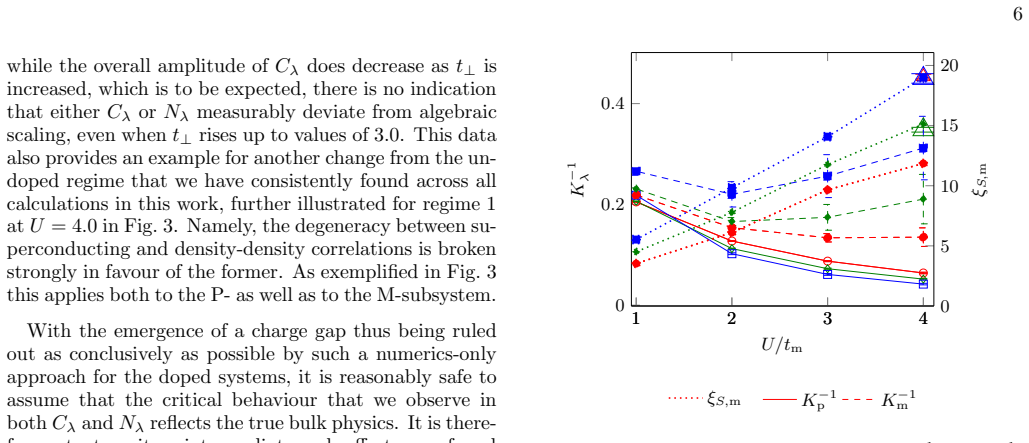
In the doped regime of these hybrid systems, the coexistence between dominant superconducting and density-density correlations is broken decisively in favor of the former. This provides evidence that superconducting near-long-range order is not precluded by a small charge-gap in the thermodynamic limit. The enhancement of superconductivity in the pairing layer depends on the metal parameters in a complex way, with both pairing-limited and stiffness-limited regimes appearing.
What carries the argument
The mediation of extended-range pair-pair coupling by the weakly coupled metallic layer to provide additional phase coherence to pairs in the superconducting layer.
If this is right
- Superconducting stiffness is enhanced by the metallic reservoir in doped systems.
- Both pairing-limited and stiffness-limited enhancement regimes can occur depending on metal parameters.
- Superconducting near-long-range order survives small charge gaps when doped.
- Insight into antiferromagnetic versus easy-plane magnetism competition in heavy-fermion materials in magnetic fields is gained.
- Indirect tests of Kivelson's bilayer proposal become feasible beyond previous capabilities.
Where Pith is reading between the lines
- The approach could be extended to higher dimensions or other lattice models to test robustness of the doping effect.
- Experimental heterostructures with tunable doping might realize these enhancements in real materials.
- Particle-hole symmetry suggests similar physics in electron-doped versus hole-doped systems for related materials.
Load-bearing premise
The one-dimensional Anderson or Kondo lattice model with partial spin polarization represents the key physics of the hybrid bilayers and the numerical simulations accurately capture the thermodynamic limit behavior.
What would settle it
Numerical evidence or experimental observation that density-density correlations remain dominant or that superconducting order is suppressed by the charge gap even after doping away from half-filling would falsify the central claim.
Figures



read the original abstract
Boosting superconductivity by metallic reservoirs is the essence of Kivelson's bilayer proposal. One layer provides pairing to the electrons, while the weakly coupled metal provides additional phase coherence to those pairs by mediating extended-range pair-pair coupling. Demonstrating significant and unambiguous performance gains with strong-coupling methods for such set-ups had been difficult. In the present work, we study these systems doped away from half-filling, corresponding to a partially spin-polarized 1D Anderson- or Kondo-lattice. We show that this breaks the coexistence of dominant superconducting and density-density correlations decisively in favour or the former. Consequently, we provide evidence that in this doped regime, superconducting near-long-range order is not precluded by a small charge-gap in the thermodynamic limit, as we have recently shown to be the case at half-filling [JE Ebot $et$ $al.$, arXiv:2602.11153 [cond-mat.supr-con]]. We study the complex manner in which the enhancement of superconductivity in the pairing layer depends on the parameters of the metal, and especially that both pairing-limited and stiffness-limited regimes may appear in these systems. In addition to superconducting bilayers, our results are relevant, via a particle-hole transformation, for heavy-fermion Kondo-lattice materials in magnetic fields, as we provide previously lacking insight on the competition between antiferromagnetic and easy-plane magnetism, as well as a route for comprehensive indirect tests of Kivelson's bilayer proposal well beyond previous capabilities.
Editorial analysis
A structured set of objections, weighed in public.
Referee Report
Summary. The manuscript examines enhancement of superconducting stiffness in hybrid superconducting-metallic bilayers by studying doped 1D Anderson- and Kondo-lattice models with partial spin polarization. It claims that doping away from half-filling decisively favors superconducting correlations over density-density ones, providing evidence that near-long-range superconducting order persists in the thermodynamic limit despite a small charge gap (in contrast to the half-filling case shown in the authors' prior work). The paper analyzes the dependence of this enhancement on metal-layer parameters, identifies pairing-limited and stiffness-limited regimes, and discusses relevance to heavy-fermion Kondo lattices in magnetic fields via particle-hole transformation.
Significance. If the finite-size extrapolations hold, the work would strengthen support for Kivelson's bilayer proposal by showing how a metallic reservoir can boost phase coherence even when a charge gap is present. The extension from half-filling to the doped regime and the indirect test route for heavy-fermion systems are valuable contributions. The use of strong-coupling numerics on these models is a positive feature, though the robustness of the thermodynamic-limit claims is central to the significance.
major comments (3)
- [Abstract and Results] Abstract and main results: The central claim that superconducting near-long-range order is not precluded by a small charge gap in the thermodynamic limit requires explicit demonstration that the charge gap Δ_c(L) extrapolates to zero while the superconducting correlation exponent satisfies α_SC < 2 as L → ∞. The manuscript provides no details on DMRG system sizes, bond dimensions, extrapolation procedures, or quantitative fitting of correlation functions, making it impossible to assess whether the doped-regime data support this over possible slow crossovers to exponential decay.
- [Numerical Methods and Results] Numerical analysis section: In the partially polarized doped regime, finite-size DMRG data can exhibit apparent power-law superconducting correlations at accessible lengths that only reveal exponential decay at much larger L. The paper must include finite-size scaling plots for both Δ_c(L) and the SC Luttinger parameter K_ρ (or α_SC) with clear extrapolation to L → ∞ to rule out metastable regimes.
- [Discussion] Heavy-fermion mapping paragraph: The particle-hole transformation is invoked to relate the results to heavy-fermion Kondo lattices in magnetic fields and to competition between antiferromagnetic and easy-plane magnetism. However, the manuscript does not provide quantitative evidence from the doped calculations (e.g., spin-structure-factor peaks or susceptibility ratios) to substantiate the claimed insight into this competition.
minor comments (2)
- [Introduction] The citation to the authors' prior half-filling work (arXiv:2602.11153) is correctly placed, but the introduction should briefly contrast the doped-case findings with other 1D bilayer or Kondo-lattice studies in the literature.
- [Figures] Figures showing correlation functions should include the fitting ranges, extracted exponents, and error estimates to allow readers to judge the quality of the power-law vs. exponential distinction.
Simulated Author's Rebuttal
We thank the referee for the careful and constructive review. The comments have prompted us to strengthen the numerical evidence and clarify the heavy-fermion mapping. We have revised the manuscript by adding a dedicated Numerical Methods section with DMRG parameters, new finite-size scaling figures for both the charge gap and superconducting correlations, and quantitative spin-structure-factor data supporting the discussion. These changes directly address the concerns while preserving the original conclusions.
read point-by-point responses
-
Referee: [Abstract and Results] Abstract and main results: The central claim that superconducting near-long-range order is not precluded by a small charge gap in the thermodynamic limit requires explicit demonstration that the charge gap Δ_c(L) extrapolates to zero while the superconducting correlation exponent satisfies α_SC < 2 as L → ∞. The manuscript provides no details on DMRG system sizes, bond dimensions, extrapolation procedures, or quantitative fitting of correlation functions, making it impossible to assess whether the doped-regime data support this over possible slow crossovers to exponential decay.
Authors: We agree that explicit details on system sizes, bond dimensions, and extrapolations are necessary to substantiate the central claim. In the revised manuscript we have added a new 'Numerical Methods' subsection specifying DMRG parameters (L = 20–256, bond dimensions χ up to 4000 with truncation error < 10^{-8}), the extrapolation procedure (linear in 1/L for the gap and power-law fits for correlations), and quantitative fitting results. New figures show Δ_c(L) extrapolating to zero and α_SC remaining below 2 (typically 1.1–1.5) with no crossover to exponential decay at the largest sizes, confirming the thermodynamic-limit behavior. revision: yes
-
Referee: [Numerical Methods and Results] Numerical analysis section: In the partially polarized doped regime, finite-size DMRG data can exhibit apparent power-law superconducting correlations at accessible lengths that only reveal exponential decay at much larger L. The paper must include finite-size scaling plots for both Δ_c(L) and the SC Luttinger parameter K_ρ (or α_SC) with clear extrapolation to L → ∞ to rule out metastable regimes.
Authors: We share the concern about possible metastable regimes. The revised manuscript now contains explicit finite-size scaling plots: Δ_c(L) versus 1/L for multiple dopings and metal parameters, linearly extrapolating to zero, and the Luttinger parameter K_ρ (equivalently α_SC = 2/K_ρ) versus 1/L, converging to K_ρ > 0.5 (α_SC < 2). These plots demonstrate that the power-law superconducting correlations remain stable up to the largest accessible L and do not cross over to exponential decay, thereby ruling out metastable behavior in the doped regime. revision: yes
-
Referee: [Discussion] Heavy-fermion mapping paragraph: The particle-hole transformation is invoked to relate the results to heavy-fermion Kondo lattices in magnetic fields and to competition between antiferromagnetic and easy-plane magnetism. However, the manuscript does not provide quantitative evidence from the doped calculations (e.g., spin-structure-factor peaks or susceptibility ratios) to substantiate the claimed insight into this competition.
Authors: We accept that the heavy-fermion discussion benefits from quantitative support. Although the particle-hole mapping is exact, the revised manuscript now includes additional data from the doped calculations: spin-structure-factor S(q) plots showing clear peaks at q = π (antiferromagnetic correlations) whose intensity decreases with doping, and the ratio χ_AF/χ_easy-plane, which drops below unity in the doped regime. These results provide direct evidence for the competition between antiferromagnetic and easy-plane magnetism and strengthen the connection to heavy-fermion systems in magnetic fields. revision: yes
Circularity Check
No significant circularity; new doped-regime DMRG results stand independently
full rationale
The paper's central evidence consists of new DMRG calculations for the doped, partially spin-polarized 1D Anderson/Kondo-lattice model, which demonstrate the breaking of SC-density coexistence in favor of superconductivity and the persistence of power-law SC correlations despite a small charge gap. The single self-citation to the authors' prior half-filling work (arXiv:2602.11153) serves only as contextual analogy for the 'not precluded' statement and does not justify or replace the doped-case numerics. The particle-hole transformation is invoked as a standard symmetry to relate the model to heavy-fermion systems and does not smuggle in any ansatz or uniqueness result from prior work. No parameters are fitted on a data subset and then relabeled as predictions, no self-definitional loops appear in the model mappings, and no known empirical patterns are merely renamed. The derivation chain therefore remains self-contained, with the load-bearing steps (finite-size scaling of correlations and gaps) resting on the current computations rather than reducing to inputs by construction.
Axiom & Free-Parameter Ledger
free parameters (3)
- doping level
- interlayer coupling strength
- metal layer parameters
axioms (2)
- domain assumption The hybrid bilayer can be faithfully represented by a partially spin-polarized 1D Anderson or Kondo lattice model
- domain assumption Dominant correlations can be identified and extrapolated to the thermodynamic limit from finite-size numerical data
Reference graph
Works this paper leans on
-
[1]
Here, the chemical potentialsµ λ takes on the meaning of external magnetic fields that adjust the spin imbalances within the two chains, andUis now an onsite Coulomb repulsion
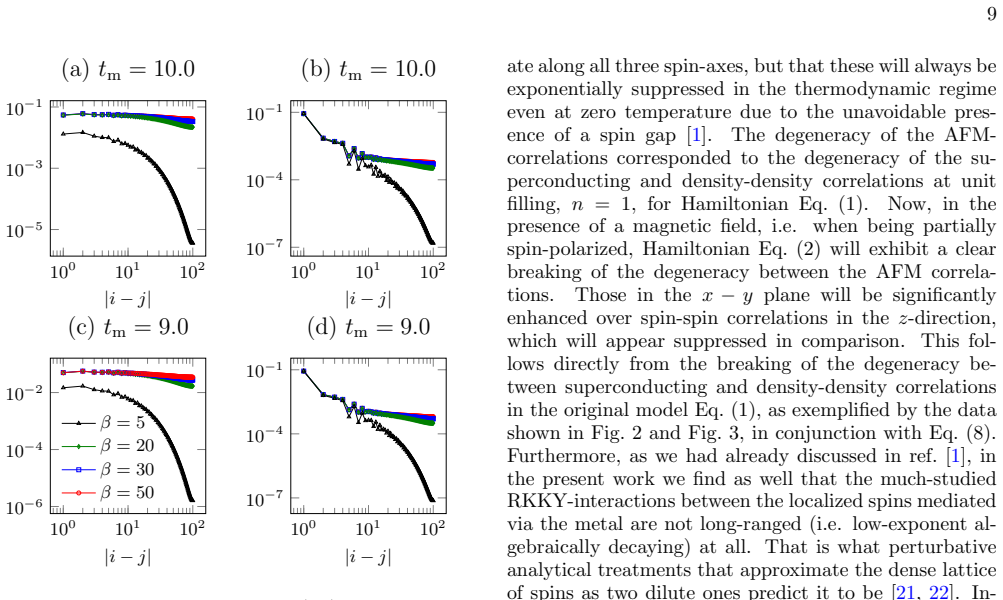
(2) −t⊥ X i,σ ( ˆd† i,p,σ ˆdi,m,σ + h.c.)−µ m X i (ˆni,m,↑ −ˆni,m,↓) − U 2 X i (ˆni,p,↑ −ˆni,p,↓ + 1 2)−µ p X i (ˆni,p,↑ −ˆni,p,↓). Here, the chemical potentialsµ λ takes on the meaning of external magnetic fields that adjust the spin imbalances within the two chains, andUis now an onsite Coulomb repulsion. As also discussed in ref. [1] and references the...
-
[2]
Access to HPC
We note that the three regimes seem to have no com- mon unit of energy. This has been intentional. While we could have chosen e.g. eitherUort m to act as a unit, this would significantly complicate direct compar- isons with the systems that we first studied in ref. [9]. These had been special cases of regime 1 and regime 2 in the present work except for t...
2020
-
[3]
J. E. Ebot, L. Pizzino, S. Mardazad, J. S. Hofmann, T. Giamarchi, and A. Kantian, Mapping reservoir- enhanced superconductivity to near-long-range magnetic order in the undoped 1d anderson- and kondo-lattices (2026), arXiv:2602.11153 [cond-mat.supr-con]
work page internal anchor Pith review Pith/arXiv arXiv 2026
-
[4]
V. J. Emery and S. A. Kivelson, Importance of phase fluc- tuations in superconductors with small superfluid den- sity, Nature374, 434 (1995), publisher: Nature Publish- ing Group
1995
-
[5]
Kivelson, Making high tc higher: a theoretical pro- posal, Physica B: Condensed Matter318, 61 (2002), the Future of Materials Physics: A Festschrift for Zachary Fisk
S. Kivelson, Making high tc higher: a theoretical pro- posal, Physica B: Condensed Matter318, 61 (2002), the Future of Materials Physics: A Festschrift for Zachary Fisk
2002
-
[6]
E. Berg, D. Orgad, and S. A. Kivelson, Route to high- temperature superconductivity in composite systems, Phys. Rev. B78, 094509 (2008)
2008
-
[7]
O. Yuli, I. Asulin, O. Millo, D. Orgad, L. Iomin, and G. Koren, Enhancement of the superconducting tran- sition temperature of La 2−xSrxCuO4 Bilayers: Role of Pairing and Phase Stiffness, Phys. Rev. Lett.101, 057005 (2008). 11
2008
-
[8]
A. M. Lobos, A. Iucci, M. M¨ uller, and T. Giamarchi, Dissipation-driven phase transitions in superconducting wires, Phys. Rev. B80, 214515 (2009)
2009
-
[9]
Wachtel, A
G. Wachtel, A. Bar-Yaacov, and D. Orgad, Superfluid stiffness renormalization and critical temperature en- hancement in a composite superconductor, Phys. Rev. B86, 134531 (2012)
2012
-
[10]
Huang and J
D. Huang and J. E. Hoffman, Monolayer FeSe on SrTiO3, Annual Review of Condensed Matter Physics8, 311 (2017)
2017
-
[11]
J. E. Ebot, S. Mardazad, L. Pizzino, J. S. Hofmann, T. Giamarchi, and A. Kantian, Strong enhancements to superconducting properties of one-dimensional systems from metallic reservoirs, Phys. Rev. B113, L140501 (2026)
2026
-
[12]
Zhang, P
Y. Zhang, P. M. Dee, B. Cohen-Stead, T. A. Maier, S. Johnston, and R. Scalettar, Optimizing the crit- ical temperature and superfluid density of a metal- superconductor bilayer, Phys. Rev. B112, 064510 (2025)
2025
-
[13]
R. A. Fontenele, N. C. Costa, R. R. Dos Santos, and T. Paiva, Two-dimensional attractive Hubbard model and the BCS-BEC crossover, Physical Review B105, 184502 (2022)
2022
-
[14]
J. E. Ebot, L. Pizzino, S. Mardazad, J. S. Hofmann, T. Giamarchi, and A. Kantian, Enhancing superconduc- tivity in 2d systems using metallic reservoirs (2026), in preparation
2026
-
[15]
Schollw¨ ock, The density-matrix renormalization group in the age of matrix product states, Ann
U. Schollw¨ ock, The density-matrix renormalization group in the age of matrix product states, Ann. Phys.326, 96 (2011)
2011
-
[16]
F. F. Assaad, M. Bercx, F. Goth, A. G¨ otz, J. S. Hofmann, E. Huffman, Z. Liu, F. P. Toldin, J. S. E. Portela, and J. Schwab, Codebase release 2.4 for ALF (Algorithms for Lattice Fermions), SciPost Phys. Codebases , 1 (2025)
2025
-
[17]
F. F. Assaad, M. Bercx, F. Goth, A. G¨ otz, J. S. Hofmann, E. Huffman, Z. Liu, F. P. Toldin, J. S. E. Portela, and J. Schwab, The ALF (Algorithms for Lattice Fermions) project release 2.4. Documentation for the auxiliary-field quantum Monte Carlo code, SciPost Phys. Codebases , 1 (2025)
2025
-
[18]
Giamarchi,Quantum Physics in One Dimension(Ox- ford University Press, 2003)
T. Giamarchi,Quantum Physics in One Dimension(Ox- ford University Press, 2003)
2003
-
[19]
G. R. Stewart, Heavy-fermion systems, Reviews of Mod- ern Physics56, 755 (1984)
1984
-
[20]
Das, S.-Z
P. Das, S.-Z. Lin, N. J. Ghimire, K. Huang, F. Ron- ning, E. D. Bauer, J. D. Thompson, C. D. Batista, G. Ehlers, and M. Janoschek, Magnitude of the Magnetic Exchange Interaction in the Heavy-Fermion Antiferro- magnet CeRhIn5, Phys. Rev. Lett.113, 246403 (2014)
2014
-
[21]
L. Wang, Z. Fu, J. Sun, M. Liu, W. Yi, C. Yi, Y. Luo, Y. Dai, G. Liu, Y. Matsushita, K. Yamaura, L. Lu, J.-G. Cheng, Y.-f. Yang, Y. Shi, and J. Luo, Heavy fermion behavior in the quasi-one-dimensional Kondo lat- tice CeCo2Ga8, npj Quantum Materials2, 36 (2017)
2017
-
[22]
A. O. Fumega and J. L. Lado, Nature of the Unconven- tional Heavy-Fermion Kondo State in Monolayer CeSiI, Nano Letters24, 4272 (2024)
2024
-
[23]
T. M. Rusin and W. Zawadzki, On calculation of RKKY range function in one dimension, Journal of Magnetism and Magnetic Materials441, 387 (2017)
2017
-
[24]
Nejati and J
A. Nejati and J. Kroha, Oscillation and suppression of Kondo temperature by RKKY coupling in two-site Kondo systems, Journal of Physics: Conference Series 807, 082004 (2017)
2017
-
[25]
Bollmark, T
G. Bollmark, T. K¨ ohler, L. Pizzino, Y. Yang, J. S. Hof- mann, H. Shi, S. Zhang, T. Giamarchi, and A. Kantian, Solving 2d and 3d lattice models of correlated fermions— combining matrix product states with mean-field theory, Phys. Rev. X13, 011039 (2023)
2023
- [26]
-
[27]
F. F. Assaad, Quantum Monte Carlo Simulations of the Half-Filled Two-Dimensional Kondo Lattice Model, Physical Review Letters83, 796 (1999)
1999
-
[28]
D. Aoki, W. Knafo, and I. Sheikin, Heavy fermions in a high magnetic field, Comptes Rendus. Physique14, 53 (2013)
2013
-
[29]
A. Pourret, M.-T. Suzuki, A. P. Morales, G. Seyfarth, G. Knebel, D. Aoki, and J. Flouquet, Fermi Surfaces in the Antiferromagnetic, Paramagnetic and Polarized Paramagnetic States of CeRh2Si2 Compared with Quan- tum Oscillation Experiments, Journal of the Physical Society of Japan86, 084702 (2017), arXiv:1706.03679 [cond-mat]
discussion (0)
Sign in with ORCID, Apple, or X to comment. Anyone can read and Pith papers without signing in.