Recognition: unknown
Locality versus Fock-space structure in East-type models
Pith reviewed 2026-05-09 20:21 UTC · model grok-4.3
The pith
Randomizing Fock-space connections in the quantum East model while preserving magnetization sectors still yields a delocalized-to-localized transition.
A machine-rendered reading of the paper's core claim, the machinery that carries it, and where it could break.
Core claim
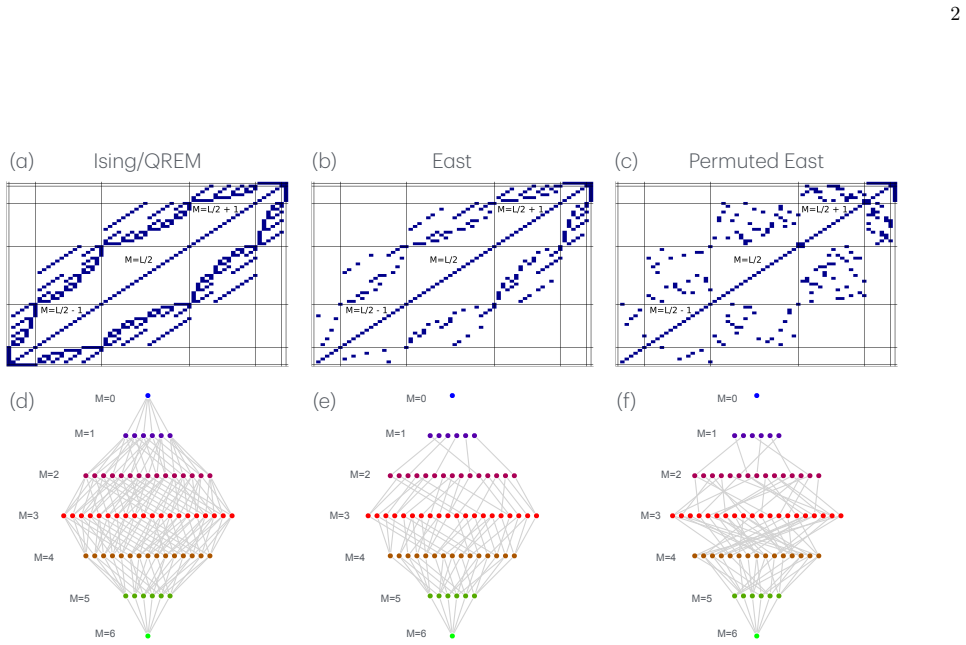
By randomizing the connectivity in Fock space while preserving its organisation into neighbouring magnetisation sectors, the modified East model still exhibits a transition between two distinct phases, one delocalised and the other localised. The authors conclude that, for East-type constrained models, the essential ingredient is the structure of the graph in Fock space rather than geometric locality of spin flips.
What carries the argument
The randomized Fock-space connectivity graph that preserves neighboring magnetization sectors, which carries the argument by decoupling real-space locality from the constraint-induced phase transition.
If this is right
- Localization transitions in other East-type models arise primarily from the global Fock-space graph rather than local flip rules.
- Slow relaxation in constrained quantum systems can be analyzed through random-matrix properties of the effective Hilbert-space graph.
- Models without geometric locality can still host many-body localization if their Fock-space connectivity matches the sector-organized pattern.
Where Pith is reading between the lines
- This approach could extend to other kinetically constrained models to test whether Fock-space structure universally overrides spatial details.
- Analytic random-matrix predictions might now be applied directly to the randomized version to locate the transition point without spatial geometry.
Load-bearing premise
The randomization of connections preserves a meaningful comparison to the original East model without introducing artifacts that create the observed transition.
What would settle it
Numerical evidence that the delocalized-localized transition disappears when the randomization is altered to break the neighboring magnetization sector structure while keeping the same overall connectivity density.
Figures




read the original abstract
Local kinetic constraints in quantum many-body systems can generate slow dynamics or complete many-body localisation. Here we focus on a modification of the quantum East model: Inspired by random matrix theory, we randomise the connectivity in Fock space (rendering it nonlocal in real space) while preserving its organisation into neighbouring magnetisation sectors. We find that there is still a transition between two distinct phases, one delocalised and the other localised. We conclude that, for East-type constrained models, the essential ingredient is the structure of the graph in Fock space rather than geometric locality of spin flips.
Editorial analysis
A structured set of objections, weighed in public.
Referee Report
Summary. The paper modifies the quantum East model by randomizing Fock-space connectivity (inspired by random matrix theory) while preserving organization into neighboring magnetization sectors. Numerical observations indicate that a delocalized-to-localized transition persists in this nonlocal version, leading to the conclusion that the essential ingredient for East-type dynamics is the structure of the graph in Fock space rather than geometric locality of the spin flips.
Significance. If the result holds, the work offers a valuable test of whether real-space locality or abstract Fock-space organization drives the slow dynamics and localization in kinetically constrained models. The randomization approach provides a concrete way to isolate these factors, with potential implications for many-body localization theory and the design of constrained quantum systems. The idea is conceptually clean and could stimulate further graph-theoretic analyses of Hilbert-space dynamics.
major comments (2)
- [Model definition and randomization procedure] The randomization procedure (model section) reassigns allowed flips between neighboring magnetization sectors but does not report controls ensuring preservation of the original degree distribution, one-way facilitation bias, or hierarchical constraint structure of the East model. Without these invariants, changes in average connectivity or directionality could produce a delocalized phase for reasons unrelated to Fock-space organization, weakening the claim that locality is inessential.
- [Numerical results] The results section reports that a transition is still observed but supplies no details on system sizes, numerical methods (e.g., exact diagonalization or time evolution), localization diagnostics (participation ratio, level statistics, or entanglement), or error analysis. This absence prevents assessment of whether the phases are robustly identified and directly comparable to the original East model.
minor comments (1)
- [Abstract] The abstract would benefit from a brief mention of the specific observable or diagnostic used to detect the transition.
Simulated Author's Rebuttal
We thank the referee for their positive evaluation of the significance of our work and for the constructive comments. We address each major point below and have revised the manuscript to provide the requested clarifications and details.
read point-by-point responses
-
Referee: [Model definition and randomization procedure] The randomization procedure (model section) reassigns allowed flips between neighboring magnetization sectors but does not report controls ensuring preservation of the original degree distribution, one-way facilitation bias, or hierarchical constraint structure of the East model. Without these invariants, changes in average connectivity or directionality could produce a delocalized phase for reasons unrelated to Fock-space organization, weakening the claim that locality is inessential.
Authors: We appreciate the referee drawing attention to this aspect of the procedure. The randomization reassigns connections exclusively within the same pairs of neighboring magnetization sectors while exactly preserving the number of allowed flips outgoing from each Fock-space state; this construction maintains the original degree distribution, the unidirectional facilitation bias (flips remain possible only in the direction permitted by the East constraint), and the overall hierarchical sector organization. These invariants were verified during model construction but were not explicitly documented. In the revised manuscript we have added a dedicated paragraph in the model section describing the randomization algorithm step by step together with supplementary verification plots confirming that the degree distribution and bias are identical to those of the original quantum East model. We believe these additions remove any ambiguity and reinforce that the persistence of the transition arises from the retained Fock-space graph structure. revision: yes
-
Referee: [Numerical results] The results section reports that a transition is still observed but supplies no details on system sizes, numerical methods (e.g., exact diagonalization or time evolution), localization diagnostics (participation ratio, level statistics, or entanglement), or error analysis. This absence prevents assessment of whether the phases are robustly identified and directly comparable to the original East model.
Authors: We agree that the numerical implementation was described too briefly. The revised manuscript now contains an expanded 'Numerical Methods' subsection that specifies the system sizes employed, the use of exact diagonalization to obtain eigenstates, the localization diagnostics (inverse participation ratio and adjacent-gap ratio for level statistics), and the error analysis obtained by averaging over multiple independent realizations of the randomized connectivity. A direct side-by-side comparison of the critical point and diagnostic values with the standard quantum East model has also been included. These additions enable a clear assessment of robustness and comparability. revision: yes
Circularity Check
No circularity: conclusion follows from explicit model randomization and observed transition
full rationale
The paper constructs a randomized Fock-space graph that preserves only magnetization-sector adjacency, simulates the dynamics, and reports a delocalized-to-localized transition. The claim that Fock-space structure (rather than real-space locality) is essential is a direct inference from this controlled modification and its phenomenology. No equation reduces to a fitted parameter defined from the target result, no self-citation supplies a uniqueness theorem, and no ansatz is smuggled in. The derivation chain is self-contained and externally falsifiable via the randomization procedure itself.
Axiom & Free-Parameter Ledger
Reference graph
Works this paper leans on
-
[1]
Equilibrium states of generic quantum systems subject to periodic driving,
A. Lazarides, A. Das, and R. Moessner, “Equilibrium states of generic quantum systems subject to periodic driving,” Phys. Rev. E90, 12110 (2014)
2014
-
[2]
Phase Structure of Driven Quantum Systems,
V. Khemani, A. Lazarides, R. Moessner, and S. L. Sondhi, “Phase Structure of Driven Quantum Systems,” Phys. Rev. Lett.116, 250401 (2016)
2016
-
[3]
Localization of inter- acting fermions at high temperature,
V. Oganesyan and D. A. Huse, “Localization of inter- acting fermions at high temperature,” Phys. Rev. B75, 155111 (2007)
2007
-
[4]
Many body localiza- tion and thermalization in quantum statistical mechan- ics,
R. Nandkishore and D. A. Huse, “Many body localiza- tion and thermalization in quantum statistical mechan- ics,” Annu. Rev. Condens. Matter Phys. , 1404.0686v2 (2014)
-
[5]
Inter- acting electrons in disordered wires: Anderson localiza- tion and low-ttransport,
I. V. Gornyi, A. D. Mirlin, and D. G. Polyakov, “Inter- acting electrons in disordered wires: Anderson localiza- tion and low-ttransport,” Phys. Rev. Lett.95, 206603 (2005)
2005
-
[6]
Metal– insulatortransitioninaweaklyinteractingmany-electron system with localized single-particle states,
D. M. Basko, I. L. Aleiner, and B. L. Altshuler, “Metal– insulatortransitioninaweaklyinteractingmany-electron system with localized single-particle states,” Ann. Phys. 321, 1126–1205 (2006)
2006
-
[7]
Loc- alization and glassy dynamics of many-body quantum systems,
G. Carleo, F. Becca, M. Schiró, and M. Fabrizio, “Loc- alization and glassy dynamics of many-body quantum systems,” Sci. Rep.2, 243 (2012)
2012
-
[8]
Scenario for delocaliz- ation in translation-invariant systems,
W. De Roeck and F. Huveneers, “Scenario for delocaliz- ation in translation-invariant systems,” Phys. Rev. B90, 165137 (2014)
2014
-
[9]
Quantum disentangled liquids,
T. Grover and M. P. A. Fisher, “Quantum disentangled liquids,” J. Stat. Mech.2014, P10010 (2014)
2014
-
[10]
Dynamics in many-body localized quantum systems without dis- order,
M. Schiulaz, A. Silva, and M. Müller, “Dynamics in many-body localized quantum systems without dis- order,” Phys. Rev. B91, 184202 (2015)
2015
-
[11]
Many- body localization in disorder-free systems: The import- ance of finite-size constraints,
Z. Papić, E. M. Stoudenmire, and D. A. Abanin, “Many- body localization in disorder-free systems: The import- ance of finite-size constraints,” Ann. Phys.362, 714–726 (2015)
2015
-
[12]
Out- of-equilibrium states and quasi-many-body localization in polar lattice gases,
L. Barbiero, C. Menotti, A. Recati, and L. Santos, “Out- of-equilibrium states and quasi-many-body localization in polar lattice gases,” Phys. Rev. B92, 180406 (2015)
2015
-
[13]
Quasi-many-body localization in translation-invariant systems,
N. Y. Yao, C. R. Laumann, J. I. Cirac, M. D. Lukin, and J. E. Moore, “Quasi-many-body localization in translation-invariant systems,” Phys. Rev. Lett.117, 240601 (2016)
2016
-
[14]
Disorder-freelocalization,
A. Smith, J. Knolle, D. L. Kovrizhin, and R. Moessner, “Disorder-freelocalization,” Phys.Rev.Lett.118,266601 (2017)
2017
-
[15]
Many-body localization in a translation-invariant system,
R. Mondaini and Z. Cai, “Many-body localization in a translation-invariant system,” Phys. Rev. B96, 035153 (2017)
2017
-
[16]
Quasi-many-body localization in a translationally invariant model,
H. Yarloo, A. Langari, and A. Vaezi, “Quasi-many-body localization in a translationally invariant model,” Phys. Rev. B97, 054304 (2018)
2018
-
[17]
Stark many-body localization,
M. Schulz, C. A. Hooley, R. Moessner, and F. Pollmann, “Stark many-body localization,” Phys. Rev. Lett.122, 040606 (2019)
2019
-
[18]
Dynam- ics of many-body localization in a translation-invariant quantum glass model,
M. van Horssen, E. Levi, and J. P. Garrahan, “Dynam- ics of many-body localization in a translation-invariant quantum glass model,” Phys. Rev. B92, 100305 (2015)
2015
-
[19]
Signatures of many-body localisation in a system without disorder,
J.M.Hickey, S.Genway, andJ.P.Garrahan,“Signatures of many-body localisation in a system without disorder,” J. Stat. Mech.2016, 054047 (2016)
2016
-
[20]
Systematic construction of counterexamples to the eigenstate thermalization hypo- thesis,
N. Shiraishi and T. Mori, “Systematic construction of counterexamples to the eigenstate thermalization hypo- thesis,” Phys. Rev. Lett.119, 030601 (2017)
2017
-
[21]
Quantum slow relaxation and metastability due 9 to dynamical constraints,
Z. Lan, M. van Horssen, S. Powell, and J. P. Gar- rahan, “Quantum slow relaxation and metastability due 9 to dynamical constraints,” Phys. Rev. Lett.121, 040603 (2018)
2018
-
[22]
Emergent glassy dynamics in a quantum dimer model,
J. Feldmeier, F. Pollmann, and M. Knap, “Emergent glassy dynamics in a quantum dimer model,” Phys. Rev. Lett.123, 040601 (2019)
2019
-
[23]
From bloch oscillations to many-body localization in clean interacting systems,
E. P. L. van Nieuwenburg, Y. Baum, and G. Refael, “From bloch oscillations to many-body localization in clean interacting systems,” Proc. Natl. Acad. Sci. USA 116, 9269–9274 (2019)
2019
-
[24]
Slow dynamics in stark many-body localization,
G. Zisling, A. Karahalios, Z. Papić, and F. Pollmann, “Slow dynamics in stark many-body localization,” Phys. Rev. Lett.129, 037201 (2022)
2022
-
[25]
Slow many-body delocalization beyond one dimension,
E. V. H. Doggen, I. V. Gornyi, A. D. Mirlin, and D. G. Polyakov, “Slow many-body delocalization beyond one dimension,” Phys. Rev. B103, 174203 (2021)
2021
-
[26]
Absence of many-body localization in interacting stark systems,
B. Kloss, J. C. Halimeh, A. Lazarides, and Y. Bar Lev, “Absence of many-body localization in interacting stark systems,” Nat. Commun.14, 3778 (2023)
2023
-
[27]
Glassy quantum dynamics in translation invariant fracton mod- els,
A. Prem, J. Haah, and R. Nandkishore, “Glassy quantum dynamics in translation invariant fracton mod- els,” Phys. Rev. B95, 155133 (2017)
2017
- [28]
-
[29]
Fracton phases of matter,
M. Pretko, X. Chen, and Y. You, “Fracton phases of matter,” Int. J. Mod. Phys. A35, 2030003 (2020)
2020
-
[30]
Quantum glassiness in strongly correlated clean systems: An example of topological overprotec- tion,
C. Chamon, “Quantum glassiness in strongly correlated clean systems: An example of topological overprotec- tion,” Phys. Rev. Lett.94, 040402 (2005)
2005
-
[31]
Local stabilizer codes in three dimensions without string logical operators,
J. Haah, “Local stabilizer codes in three dimensions without string logical operators,” Phys. Rev. A83, 042330 (2011)
2011
-
[32]
Exotic topological order in fractal spin li- quids,
B. Yoshida, “Exotic topological order in fractal spin li- quids,” Phys. Rev. B88, 125122 (2013)
2013
-
[33]
A new kind of topolo- gical quantum order: A dimensional hierarchy of quasi- particles built from stationary excitations,
S. Vijay, J. Haah, and L. Fu, “A new kind of topolo- gical quantum order: A dimensional hierarchy of quasi- particles built from stationary excitations,” Phys. Rev. B 92, 235136 (2015)
2015
-
[34]
Fracton topological order, generalized lattice gauge theory, and duality,
S. Vijay, J. Haah, and L. Fu, “Fracton topological order, generalized lattice gauge theory, and duality,” Phys. Rev. B94, 235157 (2016)
2016
-
[35]
Fracton-elasticity dual- ity,
M. Pretko and L. Radzihovsky, “Fracton-elasticity dual- ity,” Phys. Rev. Lett.120, 195301 (2018)
2018
-
[36]
Subdimensional particle structure of higher- rank u(1) spin liquids,
M. Pretko, “Subdimensional particle structure of higher- rank u(1) spin liquids,” Phys. Rev. B95, 115139 (2017)
2017
-
[37]
The fracton gauge principle,
M. Pretko, “The fracton gauge principle,” Phys. Rev. B 98, 115134 (2018)
2018
-
[38]
Higher-spin witten effect and two- dimensional fracton phases,
M. Pretko, “Higher-spin witten effect and two- dimensional fracton phases,” Phys. Rev. B96, 125151 (2017)
2017
-
[39]
Fractonic mat- ter in symmetry-enriched u(1) gauge theory,
D. J. Williamson, Z. Bi, and M. Cheng, “Fractonic mat- ter in symmetry-enriched u(1) gauge theory,” Phys. Rev. B100, 125150 (2019)
2019
-
[40]
Ergodicity breaking arising from hilbert space fragmentation in dipole-conserving hamiltonians,
P. Sala, T. Rakovszky, R. Verresen, M. Knap, and F. Pollmann, “Ergodicity breaking arising from hilbert space fragmentation in dipole-conserving hamiltonians,” Phys. Rev. X10, 011047 (2020)
2020
-
[41]
Loc- alization from hilbert space shattering: From theory to physical realizations,
V. Khemani, M. Hermele, and R. Nandkishore, “Loc- alization from hilbert space shattering: From theory to physical realizations,” Phys. Rev. B101, 174204 (2020)
2020
-
[42]
Statistical localization: From strong frag- mentation to strong edge modes,
T. Rakovszky, P. Sala, R. Verresen, M. Knap, and F. Pollmann, “Statistical localization: From strong frag- mentation to strong edge modes,” Phys. Rev. B101, 125126 (2020)
2020
-
[43]
Observing non-ergodicity due to kinetic constraints in tilted fermi- hubbard chains,
S. Scherg, T. Kohlert, P. Sala, F. Pollmann, H. M. Bharath, I. Bloch, and M. Aidelsburger, “Observing non-ergodicity due to kinetic constraints in tilted fermi- hubbard chains,” Nat. Commun.12, 4490 (2021)
2021
-
[44]
Anomalous diffusion in dipole-and higher- moment-conserving systems,
J. Feldmeier, P. Sala, G. De Tomasi, F. Pollmann, and M. Knap, “Anomalous diffusion in dipole-and higher- moment-conserving systems,” Phys. Rev. Lett.125, 245303 (2020)
2020
-
[45]
Kinetic- ally constrained freezing transition in a dipole-conserving system,
A. Morningstar, V. Khemani, and D. A. Huse, “Kinetic- ally constrained freezing transition in a dipole-conserving system,” Phys. Rev. B101, 214205 (2020)
2020
-
[46]
Weak ergodicity breaking from quantum many-body scars,
C. J. Turner, A. A. Michailidis, D. A. Abanin, M. Serbyn, and Z. Papić, “Weak ergodicity breaking from quantum many-body scars,” Nat. Phys.14, 745–749 (2018)
2018
-
[47]
Weak ergodicity breaking through the lens of quantum entanglement,
Z. Papić, “Weak ergodicity breaking through the lens of quantum entanglement,” inEntanglement in Spin Chains: From Theory to Quantum Technology Applic- ations, edited by Abolfazl Bayat, Sougato Bose, and Henrik Johannesson (Springer International Publishing, Cham, 2022) pp. 341–395
2022
-
[48]
Weakbreakingofergodicityinquantummany- body systems from quantum scars,
M. Serbyn, A. A. Michailidis, D. A. Abanin, and Z.Papić,“Weakbreakingofergodicityinquantummany- body systems from quantum scars,” Nat. Phys.17, 675– 685 (2021)
2021
-
[49]
Periodic orbits, entanglement, and quantum many-body scars in constrained models,
W. W. Ho, S. Choi, M. D. Lukin, and D. A. Abanin, “Periodic orbits, entanglement, and quantum many-body scars in constrained models,” Phys. Rev. Lett.122, 040603 (2019)
2019
-
[50]
Exact quantum many- body scar states in the rydberg-blockaded atom chain,
C.-J. Lin and O. I. Motrunich, “Exact quantum many- body scar states in the rydberg-blockaded atom chain,” Phys. Rev. Lett.122, 173401 (2019)
2019
-
[51]
Quantum east model: Localization, non- thermal eigenstates, and slow dynamics,
N. Pancotti, G. Giudice, J. I. Cirac, J. P. Garrahan, and M. C. Bañuls, “Quantum east model: Localization, non- thermal eigenstates, and slow dynamics,” Phys. Rev. X 10, 021051 (2020)
2020
-
[52]
Graph theory and tunable slow dynamics in quantum east hamiltonians,
H. G. Menzler, M. C. Bañuls, and F. Heidrich-Meisner, “Graph theory and tunable slow dynamics in quantum east hamiltonians,” Phys. Rev. B112, 115141 (2025)
2025
-
[53]
Ground state and persist- ent oscillations in the quantum East model,
A. K. Das and A. Lazarides, “Ground state and persist- ent oscillations in the quantum East model,” (2026), arXiv:2602.23422 [quant-ph]
-
[54]
Characteristic vectors of bordered matrices with infinite dimensions,
E. P. Wigner, “Characteristic vectors of bordered matrices with infinite dimensions,” Ann. Math.62, 548– 564 (1955)
1955
-
[55]
Characteristic vectors of bordered matrices with infinite dimensions ii,
E. P. Wigner, “Characteristic vectors of bordered matrices with infinite dimensions ii,” Ann. Math.65, 203–207 (1957)
1957
-
[56]
On the distribution of the roots of certain symmetric matrices,
E. P. Wigner, “On the distribution of the roots of certain symmetric matrices,” Ann. Math.67, 325–327 (1958)
1958
-
[57]
From quantum chaos and eigenstate thermalization to statistical mechanics and thermodynamics,
L. D’Alessio, Y. Kafri, A. Polkovnikov, and M. Rigol, “From quantum chaos and eigenstate thermalization to statistical mechanics and thermodynamics,” Adv. Phys. 65, 239–362 (2016), arXiv:1509.06411 [cond-mat.stat- mech]
-
[58]
Analyticalexpres- sions for the evolution of many-body quantum systems quenched far from equilibrium,
L.F.SantosandE.J.Torres-Herrera,“Analyticalexpres- sions for the evolution of many-body quantum systems quenched far from equilibrium,” AIP Conf. Proc.1912, 020015 (2017)
1912
-
[59]
E. J. Torres-Herrera, “Generic dynamical features of quenched interacting quantum systems: Survival prob- ability, density imbalance, and out-of-time-ordered correlator,” Phys. Rev. B97(2018), 10.1103/Phys- RevB.97.060303
-
[60]
Validity of Random 10 Matrix Theories for Many-Particle Systems,
J. B. French and S. S. M. Wong, “Validity of Random 10 Matrix Theories for Many-Particle Systems,” Phys. Lett. B33B, 449 (1970)
1970
-
[61]
Two-body Random Hamilto- nians and Level Density,
O. Bohigas and J. Flores, “Two-body Random Hamilto- nians and Level Density,” Phys. Lett. B34, 261 (1971)
1971
-
[62]
Embedded random matrix ensembles for com- plexity and chaos in finite interacting particle systems,
V. Kota, “Embedded random matrix ensembles for com- plexity and chaos in finite interacting particle systems,” Phys. Rep.347, 223–288 (2001)
2001
-
[63]
Random matrix en- sembles for many-body quantum systems,
M. Vyas and T. H. Seligman, “Random matrix en- sembles for many-body quantum systems,” AIP Conf. Proc.1950, 030009 (2018)
1950
-
[64]
Transition from localized to ex- tended eigenstates in the ensemble of power-law random banded matrices,
A. D. Mirlin, Y. V. Fyodorov, F.-M. Dittes, J. Quezada, and T. H. Seligman, “Transition from localized to ex- tended eigenstates in the ensemble of power-law random banded matrices,” Phys. Rev. E54, 3221 (1996)
1996
-
[65]
Eigenfunction Entropy and Spectral Compressibility for Critical Random Matrix Ensembles,
E. Bogomolny and O. Giraud, “Eigenfunction Entropy and Spectral Compressibility for Critical Random Matrix Ensembles,” Phys. Rev. Lett.106, 044101 (2011), pub- lisher: American Physical Society
2011
-
[66]
Power- law banded random matrix ensemble as a model for quantum many-body hamiltonians,
W.Buijsman, M.Haque, andI.M.Khaymovich,“Power- law banded random matrix ensemble as a model for quantum many-body hamiltonians,” Phys. Rev. E113, 034116 (2026)
2026
-
[67]
Strong ergodicity breaking due to local constraints in a quantum system,
S. Roy and A. Lazarides, “Strong ergodicity breaking due to local constraints in a quantum system,” Phys. Rev. Res.2, 023159 (2020)
2020
-
[68]
Fock-space correlations and the origins of many-body localization,
S. Roy and D. E. Logan, “Fock-space correlations and the origins of many-body localization,” Phys. Rev. B101 (2020), 10.1103/physrevb.101.134202
-
[69]
Many-Body Mobility Edge in a Mean-Field Quantum Spin Glass,
C.R.Laumann, A.Pal, andA.Scardicchio,“Many-Body Mobility Edge in a Mean-Field Quantum Spin Glass,” Phys. Rev. Lett.113, 200405 (2014)
2014
-
[70]
We useFock statesto refer to computational basis states: product states of eigenstates of theσz Pauli operator on each site
-
[71]
Fate of Many- Body Localization Under Periodic Driving,
A. Lazarides, A. Das, and R. Moessner, “Fate of Many- Body Localization Under Periodic Driving,” Phys. Rev. Lett.115, 30402–30405 (2015)
2015
-
[72]
The many-body localized phase of the quantum random energy model,
C. L. Baldwin, C. R. Laumann, A. Pal, and A. Scardic- chio, “The many-body localized phase of the quantum random energy model,” Phys. Rev. B93, 024202 (2016)
2016
-
[73]
Anderson transitions,
F. Evers and A. D. Mirlin, “Anderson transitions,” Rev. Mod. Phys.80, 1355–1417 (2008), publisher: American Physical Society
2008
-
[74]
Ergodicity breaking in a modelshowingmany-bodylocalization,
A. De Luca and A. Scardicchio, “Ergodicity breaking in a modelshowingmany-bodylocalization,” EPL101,37003 (2013)
2013
-
[75]
Multifractal Scalings Across the Many-Body Localization Transition,
N. Macé, F. Alet, and N. Laflorencie, “Multifractal Scalings Across the Many-Body Localization Transition,” Phys. Rev. Lett.123, 180601 (2019), publisher: Amer- ican Physical Society
2019
-
[76]
Foundation of Statistical Mechanics under Experimentally Realistic Conditions,
P. Reimann, “Foundation of Statistical Mechanics under Experimentally Realistic Conditions,” Phys. Rev. Lett. 101, 190403 (2008)
2008
-
[77]
Many-body localization edge in the random-field Heisenberg chain,
D. J. Luitz, N. Laflorencie, and F. Alet, “Many-body localization edge in the random-field Heisenberg chain,” Phys. Rev. B91, 81103 (2015)
2015
-
[78]
W. Beugeling, R. Moessner, and M. Haque, “Global characteristics of all eigenstates of local many-body hamiltonians: Participation ratio and entanglement en- tropy,” Phys. Rev. E89, 042112 (2014), arXiv:1403.5234 [cond-mat.stat-mech]
-
[79]
The approach to thermal equilibrium in quantized chaotic systems,
M. Srednicki, “The approach to thermal equilibrium in quantized chaotic systems,” J. Phys. A. Math. Gen.32, 1163–1175 (1999)
1999
-
[80]
Many-body localization characterized from a one-particle perspective,
S. Bera, H. Schomerus, F. Heidrich-Meisner, and J. H. Bardarson, “Many-body localization characterized from a one-particle perspective,” Phys. Rev. Lett.115, 046603 (2015), arXiv:1504.07149 [cond-mat.dis-nn]
discussion (0)
Sign in with ORCID, Apple, or X to comment. Anyone can read and Pith papers without signing in.