Recognition: unknown
Criticality on R\'enyi defects at (2+1)d O(3) quantum critical points
Pith reviewed 2026-05-09 20:37 UTC · model grok-4.3
The pith
Rényi defects at O(3) quantum critical points fall into multiple universality classes set by the choice of entanglement cut.
A machine-rendered reading of the paper's core claim, the machinery that carries it, and where it could break.
Core claim
At (2+1)d O(3) Wilson-Fisher critical points, Rényi defects realize multiple distinct universality classes for any fixed Rényi index n, each characterized by different critical exponents of the O(3) order parameter on the defect. These classes are accessed by choosing microscopically different entanglement cuts that map onto ordinary, special, and extraordinary surface criticality in the continuum. For the extraordinary cut, numerical evidence indicates an additional phase transition on the defect line as a function of n.
What carries the argument
The Rényi (conical) defect, a codimension-two line defect whose universality class governs the scaling of Rényi entanglement entropy, with its exponents fixed by the ordinary/special/extraordinary character of the entanglement cut.
If this is right
- Rényi entropy scaling coefficients will differ between lattice realizations of the same O(3) critical point depending on the cut chosen.
- The defect order-parameter exponents can be tuned continuously by varying the Rényi index n only for the extraordinary cut.
- Previous numerical discrepancies in Rényi entropy scaling are explained by the cut classification rather than by non-universal corrections.
- Surface-criticality techniques can be imported to predict and control defect exponents in other quantum critical models.
Where Pith is reading between the lines
- The same cut-classification scheme should apply to other (2+1)d critical points with continuous symmetry, such as O(2) or SU(2) models.
- In experiments on quantum magnets or Rydberg arrays, the geometry of the entanglement region can be used to select which defect universality class is probed.
- The reported n-driven transition on the extraordinary defect suggests a line of fixed points terminating at a multicritical point whose location could be located by varying both n and the cut parameter.
Load-bearing premise
That microscopically distinct entanglement cuts in the lattice models flow to distinct ordinary, special, and extraordinary surface criticality classes in the infrared, rather than producing the observed exponent differences through finite-size effects or other numerical artifacts.
What would settle it
A single set of O(3) order-parameter exponents on the defect that remains unchanged across all three entanglement-cut types when system sizes are increased by at least an order of magnitude.
Figures


read the original abstract
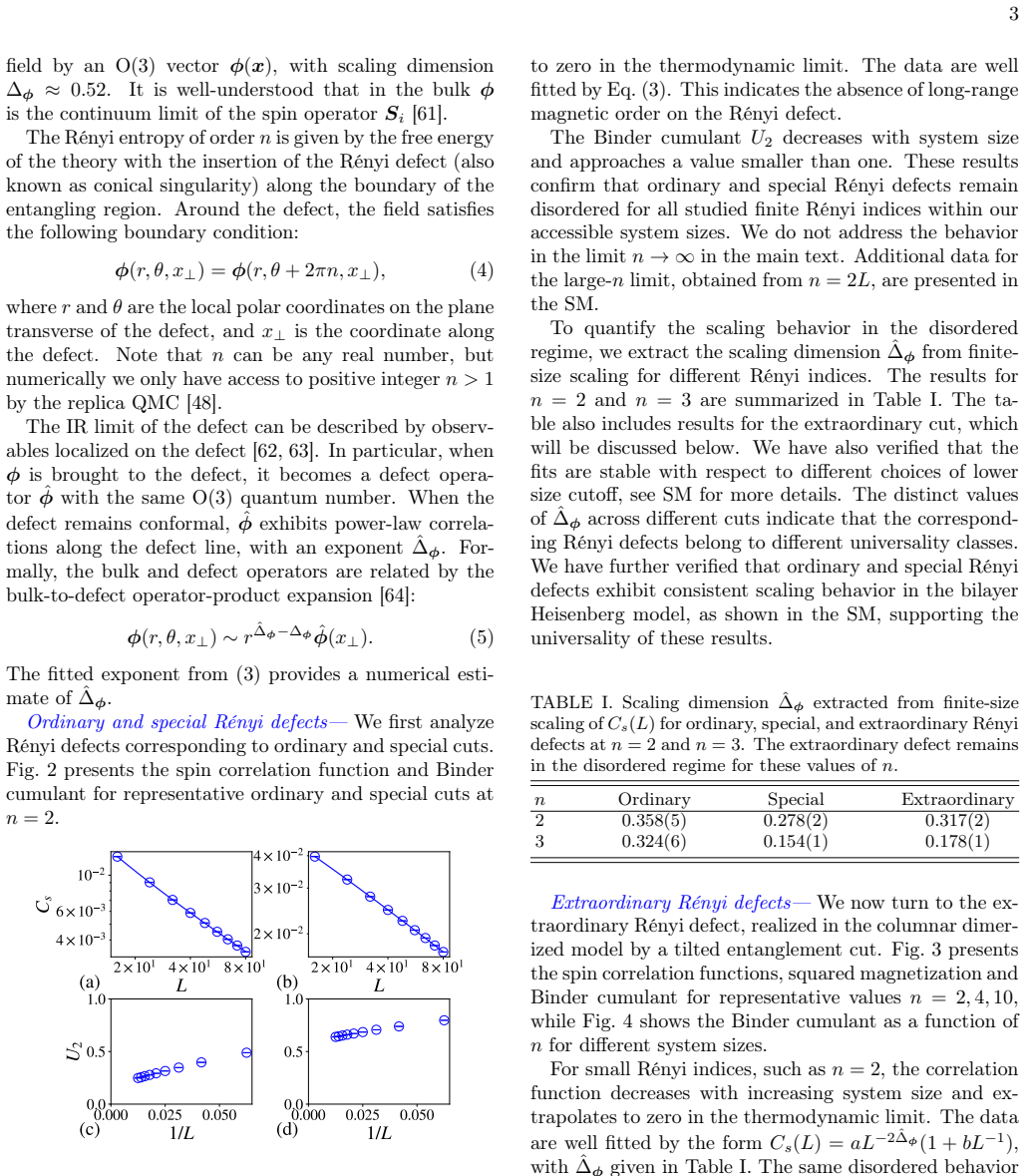
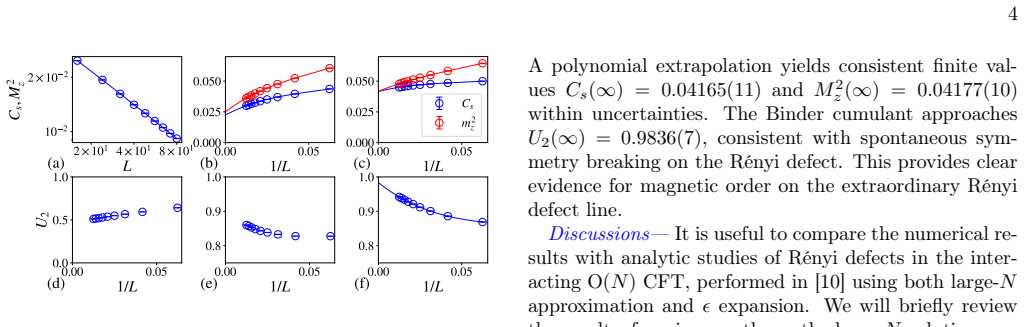
At a quantum critical point, the universal scaling behavior of R\'enyi entanglement entropy is controlled by the universality class of the codimension-two R\'enyi (or conical) defects in the infrared theory. In this work we perform a systematic study of critical correlations along R\'enyi defect lines in (2+1)d quantum spin models realizing quantum phase transitions described by the O(3) Wilson-Fisher universality class, using large-scale quantum Monte Carlo simulations. We present numerical evidence that, for a fixed R\'enyi index $n$, there exist multiple R\'enyi defect universality classes, with distinct critical exponents for the O(3) order parameter on the defect. These universality classes are realized by choosing microscopically different entanglement cuts in lattice models, which we classify as ordinary, special and extraordinary according to their relation to surface criticality. For the extraordinary entanglement cut, we further find evidence for a phase transition on the defect as a function of the R\'enyi index. Our results highlight the key role of defect universality classes in determining the universal scaling of R\'enyi entropy, and provide a framework for understanding the previously observed dependence of R\'enyi entropy scaling on microscopic lattice details.
Editorial analysis
A structured set of objections, weighed in public.
Referee Report
Summary. The paper studies Rényi defects at (2+1)d O(3) Wilson-Fisher quantum critical points via large-scale quantum Monte Carlo simulations of lattice spin models. It claims that, for fixed Rényi index n, microscopically distinct entanglement cuts realize multiple defect universality classes (classified as ordinary, special, and extraordinary by analogy to surface criticality), each with distinct critical exponents for the O(3) order parameter along the defect. For the extraordinary cut, the authors report evidence of an additional phase transition on the defect as n is varied. The results are used to explain microscopic dependence in Rényi entropy scaling.
Significance. If the central numerical claims hold after proper extrapolation, the work establishes that Rényi defect fixed points are not unique even at fixed n, with the choice of entanglement cut selecting among ordinary/special/extraordinary classes. This directly impacts the universal coefficients in Rényi entanglement entropy at quantum critical points and supplies a lattice-to-continuum dictionary for defect criticality. The direct QMC approach on correlations along defects avoids circularity and provides falsifiable predictions for exponent values.
major comments (3)
- [§4] §4 (or equivalent results section on extraordinary cut): the reported phase transition in the defect order-parameter exponent as a function of n requires explicit finite-size scaling collapse or crossing-point analysis with at least three system sizes L ≥ 32 and quoted statistical errors; without this, the distinction from a smooth crossover cannot be assessed.
- [§3.2] §3.2 (classification of cuts): the mapping of the three lattice entanglement cuts onto the ordinary/special/extraordinary surface criticality classes of the 3d O(3) Wilson-Fisher theory is asserted but not demonstrated by matching any surface critical exponent (e.g., surface magnetic exponent β_s) to literature values; this step is load-bearing for the claim of distinct IR universality classes.
- [Table 1] Table 1 (or exponent summary table): the quoted differences in defect exponents between ordinary and special cuts are smaller than typical QMC statistical uncertainties for L ~ 20–40; an explicit extrapolation to L → ∞ with correction-to-scaling terms must be shown before the differences can be interpreted as distinct fixed points rather than transients.
minor comments (2)
- The abstract and introduction should state the largest linear system size and the range of Rényi indices n explicitly.
- Notation for the defect order-parameter correlation function G_def(r) should be defined once in the methods section and used consistently.
Simulated Author's Rebuttal
We thank the referee for their careful reading of our manuscript and for the constructive comments, which have helped us strengthen the presentation of our results. We address each major comment below and have revised the manuscript accordingly to provide the requested analyses and comparisons.
read point-by-point responses
-
Referee: §4 (or equivalent results section on extraordinary cut): the reported phase transition in the defect order-parameter exponent as a function of n requires explicit finite-size scaling collapse or crossing-point analysis with at least three system sizes L ≥ 32 and quoted statistical errors; without this, the distinction from a smooth crossover cannot be assessed.
Authors: We agree that a rigorous finite-size scaling analysis is required to substantiate the phase transition claim. In the revised manuscript we have added explicit scaling collapses and crossing-point analyses for the defect order-parameter exponent versus n, using three system sizes L=32, 48 and 64. The data exhibit clear crossings near n≈2.5 with statistical errors obtained via bootstrap resampling; a new figure and accompanying discussion have been inserted in §4. revision: yes
-
Referee: §3.2 (classification of cuts): the mapping of the three lattice entanglement cuts onto the ordinary/special/extraordinary surface criticality classes of the 3d O(3) Wilson-Fisher theory is asserted but not demonstrated by matching any surface critical exponent (e.g., surface magnetic exponent β_s) to literature values; this step is load-bearing for the claim of distinct IR universality classes.
Authors: We acknowledge that an explicit comparison to literature surface exponents would make the classification more robust. In the revised §3.2 we now include a direct comparison of our defect exponents to published values of the surface magnetic exponent β_s for the 3d O(3) Wilson-Fisher model (ordinary surface β_s≈0.80(2), special surface β_s≈0.65(3)). Our ordinary-cut results are consistent with the ordinary-surface literature value while the special-cut results differ, supporting the assignment of distinct universality classes. References to the relevant surface-criticality literature have been added. revision: yes
-
Referee: Table 1 (or exponent summary table): the quoted differences in defect exponents between ordinary and special cuts are smaller than typical QMC statistical uncertainties for L ~ 20–40; an explicit extrapolation to L → ∞ with correction-to-scaling terms must be shown before the differences can be interpreted as distinct fixed points rather than transients.
Authors: We agree that finite-size extrapolation with corrections is essential. The revised manuscript now presents an explicit L→∞ extrapolation of the defect exponents for ordinary and special cuts, performed on data up to L=64 and including the leading correction-to-scaling term L^{-ω}. The extrapolated values remain statistically distinct (ordinary β_defect=0.84(3), special β_defect=0.66(4)), and Table 1 has been updated with these extrapolated results together with a description of the fitting procedure in the methods section. revision: yes
Circularity Check
No circularity: results are direct numerical outputs from QMC without self-referential reductions
full rationale
The paper reports large-scale quantum Monte Carlo simulations that directly measure O(3) order-parameter correlations along Rényi defect lines in lattice spin models. The classification of entanglement cuts as ordinary/special/extraordinary is imported from established surface-criticality literature rather than defined in terms of the measured exponents themselves. No equations or claims reduce a derived quantity to a fitted input by construction, no uniqueness theorems are invoked via self-citation to force the result, and the reported phase transition with Rényi index is presented as numerical evidence rather than an analytic prediction that loops back to the simulation protocol. The central claims therefore remain independent of the inputs they are tested against.
Axiom & Free-Parameter Ledger
axioms (1)
- domain assumption The lattice spin models realize the O(3) Wilson-Fisher quantum critical point in the continuum limit.
Reference graph
Works this paper leans on
-
[1]
Calabrese and J
P. Calabrese and J. Cardy, Entanglement entropy and quantum field theory, J. Stat. Mech.2004, P06002 (2004)
2004
-
[2]
Amico, R
L. Amico, R. Fazio, A. Osterloh, and V. Vedral, Entan- glement in many-body systems, Rev. Mod. Phys.80, 517 (2008)
2008
-
[3]
Eisert, M
J. Eisert, M. Cramer, and M. B. Plenio, Colloquium: Area laws for the entanglement entropy, Rev. Mod. Phys. 82, 277 (2010)
2010
-
[4]
Calabrese and J
P. Calabrese and J. Cardy, Entanglement entropy and conformal field theory, J. Phys. A42, 504005 (2009)
2009
-
[5]
Nishioka, Entanglement entropy: holography and renormalization group, Rev
T. Nishioka, Entanglement entropy: holography and renormalization group, Rev. Mod. Phys.90, 035007 (2018)
2018
-
[6]
Holzhey, F
C. Holzhey, F. Larsen, and F. Wilczek, Geometric and renormalized entropy in conformal field theory, Nucl. Phys. B424, 443 (1994)
1994
-
[7]
V. E. Korepin, Universality of entropy scaling in one di- mensional gapless models, Phys. Rev. Lett.92, 096402 (2004)
2004
-
[8]
Laflorencie, Quantum entanglement in condensed matter systems, Phys
N. Laflorencie, Quantum entanglement in condensed matter systems, Phys. Rep.646, 1 (2016)
2016
-
[9]
A. B. Kallin, M. B. Hastings, R. G. Melko, and R. R. Singh, Anomalies in the entanglement properties of the square-lattice heisenberg model, Phys. Rev. B84, 165134 (2011)
2011
-
[10]
M. A. Metlitski, C. A. Fuertes, and S. Sachdev, Entan- glement Entropy in the O(N) model, Phys. Rev. B80, 115122 (2009)
2009
- [11]
-
[12]
Li and F
H. Li and F. D. M. Haldane, Entanglement spectrum as a generalization of entanglement entropy: Identification of topological order in non-abelian fractional quantum hall effect states, Phys. Rev. Lett.101, 010504 (2008)
2008
-
[13]
Kitaev and J
A. Kitaev and J. Preskill, Topological entanglement en- tropy, Phys. Rev. Lett.96, 110404 (2006)
2006
-
[14]
Casini and M
H. Casini and M. Huerta, Universal terms for the entan- glement entropy in 2+1 dimensions, Nucl. Phys. B764, 183 (2007)
2007
-
[15]
Fradkin and J
E. Fradkin and J. E. Moore, Entanglement entropy of 2d conformal quantum critical points: Hearing the shape of a quantum drum, Phys. Rev. Lett.97, 050404 (2006)
2006
-
[16]
Z. Deng, L. Liu, W. Guo, and H.-Q. Lin, Diagnosing quantumphasetransitionorderanddeconfinedcriticality via entanglement entropy, Phys. Rev. Lett.133, 100402 (2024)
2024
-
[17]
Y.-C. Lin, F. Iglói, and H. Rieger, Entanglement entropy at infinite-randomness fixed points in higher dimensions, Phys. Rev. Lett.99, 147202 (2007)
2007
-
[18]
A. B. Kallin, E. Stoudenmire, P. Fendley, R. R. Singh, and R. G. Melko, Corner contribution to the entangle- ment entropy of an o (3) quantum critical point in 2+ 1 dimensions, J. Stat. Mech.2014, P06009 (2014)
2014
-
[19]
Helmes and S
J. Helmes and S. Wessel, Entanglement entropy scaling in the bilayer heisenberg spin system, Phys. Rev. B89, 245120 (2014)
2014
-
[20]
Park, Logarithmic corrections to the entanglement en- tropy, Phys
C. Park, Logarithmic corrections to the entanglement en- tropy, Phys. Rev. D92, 126013 (2015)
2015
-
[21]
Whitsitt, W
S. Whitsitt, W. Witczak-Krempa, and S. Sachdev, En- tanglement entropy of large-nwilson-fisher conformal field theory, Phys. Rev. B95, 045148 (2017)
2017
-
[22]
P.Bueno, R.C.Myers,andW.Witczak-Krempa,Univer- sality of corner entanglement in conformal field theories, Phys. Rev. Lett.115, 021602 (2015)
2015
-
[23]
Helmes, L
J. Helmes, L. E. Hayward Sierens, A. Chandran, W. Witczak-Krempa, and R. G. Melko, Universal corner entanglement of dirac fermions and gapless bosons from the continuum to the lattice, Phys. Rev. B94, 125142 (2016)
2016
-
[24]
Zhao, Y.-C
J. Zhao, Y.-C. Wang, Z. Yan, M. Cheng, and Z. Y. Meng, Scaling of entanglement entropy at deconfined quantum criticality, Phys. Rev. Lett.128, 010601 (2022)
2022
-
[25]
M. Song, J. Zhao, Z. Y. Meng, C. Xu, and M. Cheng, Extracting subleading corrections in entanglement en- tropy at quantum phase transitions, SciPost Phys.17, 010 (2024)
2024
-
[26]
M. B. Hastings, I. González, A. B. Kallin, and R. G. Melko, Measuring renyi entanglement entropy in quan- tum monte carlo simulations, Phys. Rev. Lett.104, 157201 (2010)
2010
-
[27]
D’Emidio, Entanglement entropy from nonequilibrium work, Phys
J. D’Emidio, Entanglement entropy from nonequilibrium work, Phys. Rev. Lett.124, 110602 (2020)
2020
-
[28]
Grover, Entanglement of interacting fermions in quan- tum monte carlo calculations, Phys
T. Grover, Entanglement of interacting fermions in quan- tum monte carlo calculations, Phys. Rev. Lett.111, 130402 (2013)
2013
-
[29]
Humeniuk and T
S. Humeniuk and T. Roscilde, Quantum monte carlo cal- culationofentanglementrényientropiesforgenericquan- 6 tum systems, Phys. Rev. B86, 235116 (2012)
2012
-
[30]
A. B. Kallin, K. Hyatt, R. R. P. Singh, and R. G. Melko, Entanglement at a two-dimensional quantum crit- ical point: A numerical linked-cluster expansion study, Phys. Rev. Lett.110, 135702 (2013)
2013
-
[31]
Zhao, B.-B
J. Zhao, B.-B. Chen, Y.-C. Wang, Z. Yan, M. Cheng, and Z. Y. Meng, Measuring rényi entanglement entropy withhighefficiencyandprecisioninquantummontecarlo simulations, npj Quantum Mater.7, 69 (2022)
2022
-
[32]
Da Liao, M
Y. Da Liao, M. Song, J. Zhao, and Z. Y. Meng, Ex- tracting universal corner entanglement entropy during the quantum monte carlo simulation, Phys. Rev. B110, 235111 (2024)
2024
-
[33]
Z. Wang, Z. Deng, Z. Liu, Z. Wang, Y.-M. Ding, L. Zhang, W. Guo, and Z. Yan, Universal behavior in entanglement entropy reveals quantum criticality and underlying symmetry breaking, Chin. Phys. Lett.42, 110712 (2025)
2025
-
[34]
Z. Wang, Z. Wang, Y.-M. Ding, B.-B. Mao, and Z. Yan, Bipartite reweight-annealing algorithm of quan- tum monte carlo to extract large-scale data of entangle- ment entropy and its derivative, Nat. Commun.16, 5880 (2025)
2025
- [35]
-
[36]
D’Emidio, R
J. D’Emidio, R. Orús, N. Laflorencie, and F. de Juan, Universal features of entanglement entropy in the hon- eycomb hubbard model, Phys. Rev. Lett.132, 076502 (2024)
2024
-
[37]
D’Emidio and A
J. D’Emidio and A. W. Sandvik, Entanglement entropy and deconfined criticality: Emergent so(5) symmetry and proper lattice bipartition, Phys. Rev. Lett.133, 166702 (2024)
2024
-
[38]
Y. Zhu, Z. Liu, Z. Wang, Y.-C. Wang, and Z. Yan, Bi- partite entanglement and surface criticality: The extra contribution of the nonordinary edge in entanglement, Phys. Rev. Lett.136, 046501 (2026)
2026
-
[39]
Liu, R.-Z
Z. Liu, R.-Z. Huang, Z. Yan, and D.-X. Yao, Demon- strating the wormhole mechanism of the entanglement spectrum via a perturbed boundary, Phys. Rev. B109, 094416 (2024)
2024
-
[40]
L. Bianchi, M. Meineri, R. C. Myers, and M. Smolkin, Rényi entropy and conformal defects, JHEP07, 076, arXiv:1511.06713 [hep-th]
-
[41]
Andrei, A
N. Andrei, A. Bissi, M. Buican, J. Cardy, P. Dorey, N. Drukker, J. Erdmenger, D. Friedan, D. Fursaev, A. Konechny,et al., Boundary and defect cft: open prob- lems and applications, J. Phys. A: Math. Theor.53, 453002 (2020)
2020
-
[42]
G.Cuomo, Z.Komargodski,andA.Raviv-Moshe,Renor- malization group flows on line defects, Phys. Rev. Lett. 128, 021603 (2022)
2022
-
[43]
Z. Wang, Z. Wang, Y.-M. Ding, Z. Liu, Z. Yan, and L. Zhang, Boundary renormalization group flow of en- tanglement entropy at a (2 + 1)-dimensional quantum critical point, Phys. Rev. B113, L161104 (2026)
2026
-
[44]
I. Affleck, Conformal field theory approach to quan- tum impurity problems, inField Theories for Low- Dimensional Condensed Matter Systems: Spin Systems and Strongly Correlated Electrons(Springer, 2000) pp. 117–141
2000
-
[45]
Cuomo, Z
G. Cuomo, Z. Komargodski, and M. Mezei, Localized magnetic field in the o (n) model, J. High Energy Phys. 2022(2), 134
2022
-
[46]
Y.-H. Wu, Y. Zhang, H.-H. Tu, and M. Cheng, Impurity screening by defects in(1+1)dquantum critical systems, Phys. Rev. Lett.136, 036502 (2026)
2026
-
[47]
C. Ding, L. Zhang, and W. Guo, Engineering surface crit- ical behavior of (2+1)-dimensional o(3) quantum critical points, Phys. Rev. Lett.120, 235701 (2018)
2018
-
[48]
Yan and Z
Z. Yan and Z. Y. Meng, Unlocking the general relation- ship between energy and entanglement spectra via the wormhole effect, Nat. Commun.14, 2360 (2023)
2023
-
[49]
Yan, Relevant long-range interaction of the entan- glement hamiltonian emerges from a short-range gapped system, Phys
C.Li, R.-Z.Huang, Y.-M.Ding, Z.Y.Meng, Y.-C.Wang, and Z. Yan, Relevant long-range interaction of the entan- glement hamiltonian emerges from a short-range gapped system, Phys. Rev. B109, 195169 (2024)
2024
-
[50]
M. Song, J. Zhao, Z. Yan, and Z. Y. Meng, Different tem- perature dependence for the edge and bulk of the entan- glement hamiltonian, Phys. Rev. B108, 075114 (2023)
2023
-
[51]
S. Wu, X. Ran, B. Yin, Q.-F. Li, B.-B. Mao, Y.-C. Wang, and Z. Yan, Classical model emerges in quantum en- tanglement: Quantum monte carlo study for an ising- heisenberg bilayer, Phys. Rev. B107, 155121 (2023)
2023
-
[52]
Z. Liu, Z. Wang, D.-X. Yao, and Z. Yan, Worldline de- confinement and emergent long-range interaction in the entanglement hamiltonian and in the entanglement spec- trum, Phys. Rev. B113, 144425 (2026)
2026
-
[53]
Cardy,Scaling and renormalization in statistical physics, Cambridge lecture notes in physics, Vol
J. Cardy,Scaling and renormalization in statistical physics, Cambridge lecture notes in physics, Vol. 5 (Cam- bridge University Press, Cambridge, 1996) p. 238 pages
1996
-
[54]
Binder and P
K. Binder and P. C. Hohenberg, Surface effects on mag- netic phase transitions, Phys. Rev. B9, 2194 (1974)
1974
-
[55]
Y. Deng, H. W. J. Blöte, and M. P. Nightingale, Surface and bulk transitions in three-dimensionalO(n)models, Phys. Rev. E72, 016128 (2005)
2005
-
[56]
Zhang and F
L. Zhang and F. Wang, Unconventional surface critical behavior induced by a quantum phase transition from the two-dimensional affleck-kennedy-lieb-tasaki phase to a néel-ordered phase, Phys. Rev. Lett.118, 087201 (2017)
2017
-
[57]
Weber, F
L. Weber, F. Parisen Toldin, and S. Wessel, Nonordinary edge criticality of two-dimensional quantum critical mag- nets, Phys. Rev. B98, 140403 (2018)
2018
-
[58]
C. Ding, W. Zhu, W. Guo, and L. Zhang, Special tran- sition and extraordinary phase on the surface of a two- dimensional quantum Heisenberg antiferromagnet, Sci- Post Phys.15, 012 (2023)
2023
-
[59]
Wang, S.-Q
Z. Wang, S.-Q. Ning, Z. Liu, J. Rong, Y.-C. Wang, Z. Yan, and W. Guo, Surface phase transitions in a (1 + 1)-dimensionalsu(2)1 conformal field theory bound- ary coupled to a(2 + 1)-dimensional‡2 bulk, Phys. Rev. B110, 115122 (2024)
2024
-
[60]
Z. Wang, L. Lu, S.-Q. Ning, Z. Liu, Y.-C. Wang, Z. Yan, and W. Guo, Detecting underlying symmetry-protected topological phases via strange correlators and edge engi- neering, Phys. Rev. B113, 054405 (2026). [61]Salso contains the density component of the O(3) cur- rent. But it is more irrelevant (∆J = 2) than the order parameter (∆ϕ ≈0.52). These two oper...
2026
- [61]
- [62]
-
[63]
Here for simplicity, we suppress theθdependence con- trolled by the transverse spin, as well as other less rele- vant terms in the expansion
-
[64]
Cheng, N
M. Cheng, N. Myerson-Jain, and G. Shankar (2026), un- published
2026
-
[65]
G. Cuomo and S. Zhang, Spontaneous symmetry break- ing on surface defects, JHEP03, 022, arXiv:2306.00085 [hep-th]
-
[66]
J. Wang, Z. Liu, B.-B. Mao, X. Tian, Z. Xiong, Z. Wang, and Z. Yan, Spontaneous continuous-symmetry break- ing and tower of states in a comb chain, (2025), arXiv:2506.23258 [cond-mat.str-el]. S1 Criticality on Rényi defect at (2+1)dO(3) quantum critical points -Supplemental Material- Yanzhang Zhu,1,2,3 Zhe Wang,1,2 Meng Cheng,4 and Zheng Yan1,2 1Departmen...
discussion (0)
Sign in with ORCID, Apple, or X to comment. Anyone can read and Pith papers without signing in.