Recognition: unknown
High temporal resolution THz streaking of high brightness relativistic electron beams
Pith reviewed 2026-05-09 20:21 UTC · model grok-4.3
The pith
Horn-coupled THz waveguide structures establish general design principles and performance limits for high-resolution streaking of relativistic electron beams.
A machine-rendered reading of the paper's core claim, the machinery that carries it, and where it could break.
Core claim
The central claim is that horn-coupled waveguide geometries enable comparative characterization of THz streaking performance, with analytical models and simulations showing the dependence of streaking power on waveguide dimensions and frequency, and experiments on RF photoinjector beams across varied field strengths, energies, and durations establishing general design principles and performance limits for ultrafast beam diagnostics.
What carries the argument
Horn-coupled waveguide geometries that couple THz fields to produce streaking in relativistic electron beams.
If this is right
- Waveguide dimensions can be chosen to optimize streaking power at a target THz frequency.
- Dispersion and transmission losses set practical upper bounds on temporal resolution.
- The structures remain effective across a documented range of beam energies and bunch lengths.
- Comparative testing of geometries identifies trade-offs between streaking strength and signal fidelity.
Where Pith is reading between the lines
- The same design rules could guide adaptation of the structures to beam parameters not yet tested in the lab.
- Higher temporal resolution from these structures might improve synchronization precision in accelerator-based experiments that combine electron beams with other probes.
- Extending the models to predict performance at shorter bunch durations or stronger fields would indicate how far the current limits can be pushed.
Load-bearing premise
The tested range of THz field strengths, beam energies, and bunch durations is representative of operating conditions in future facilities.
What would settle it
A measurement of streaking strength and temporal resolution on an electron beam with parameters well outside the tested ranges that deviates from the predictions of the analytical models and simulations.
Figures






read the original abstract
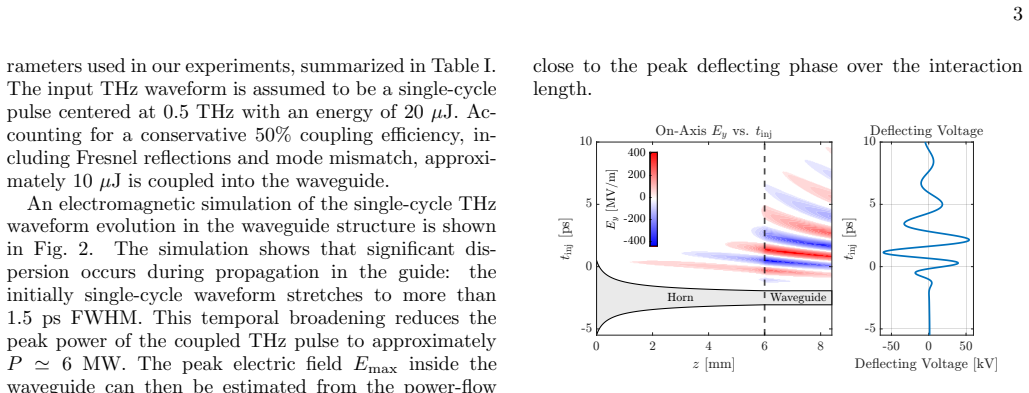
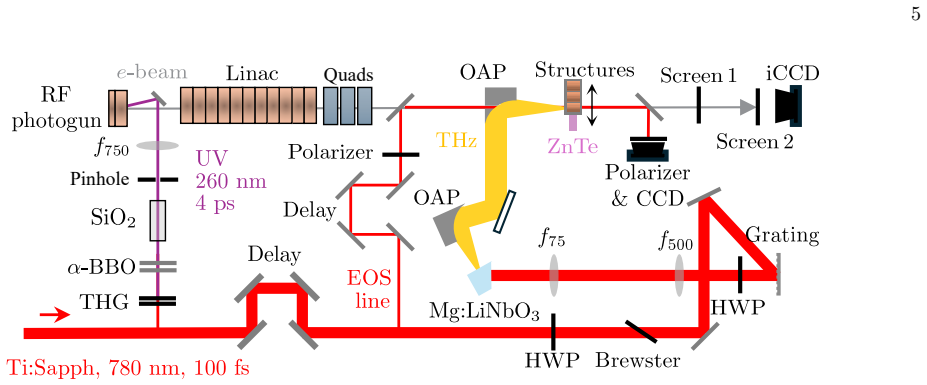
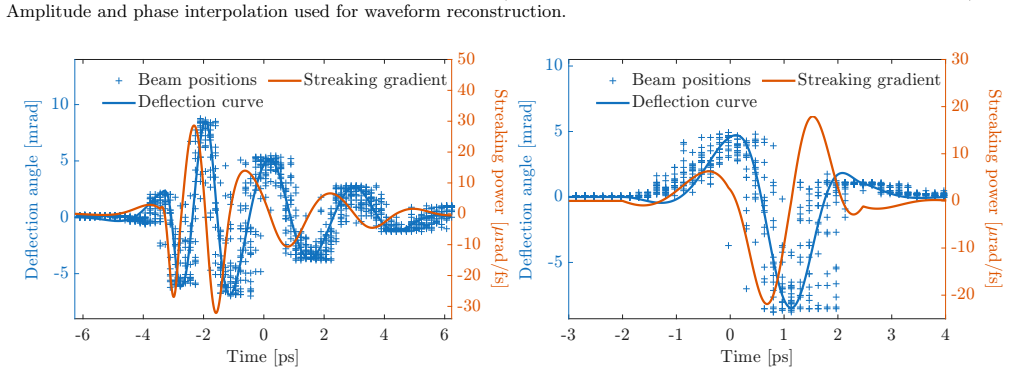
We report a systematic experimental study of terahertz (THz) streaking structures for ultrafast characterization of relativistic, high-brightness electron beams. Horn-coupled waveguide geometries are investigated, enabling a comparative characterization of streaking strength, dispersion, transmission, and temporal fidelity. Analytical models and electromagnetic simulations are used to describe the dependence of streaking power on the waveguide dimensions and the drive frequency. Experimentally, the structures are characterized using compressed electron beam from an RF photoinjector over a range of THz field strengths, beam energies, and bunch durations. These results establish general design principles and performance limits for THz streaking structures applicable to ultrafast electron beam diagnostics.
Editorial analysis
A structured set of objections, weighed in public.
Referee Report
Summary. The paper reports a systematic experimental study of terahertz (THz) streaking structures for ultrafast characterization of relativistic high-brightness electron beams. It compares horn-coupled waveguide geometries through analytical models and electromagnetic simulations describing streaking power dependence on waveguide dimensions and drive frequency. Experiments characterize streaking strength, dispersion, transmission, and temporal fidelity using compressed beams from an RF photoinjector over a range of THz field strengths, beam energies, and bunch durations, concluding that the results establish general design principles and performance limits for THz streaking in ultrafast electron beam diagnostics.
Significance. If the results hold, the work contributes to accelerator diagnostics by providing experimental benchmarks and design guidelines for high-temporal-resolution THz streaking, which is relevant for characterizing short electron bunches. The combination of analytical models, simulations, and multi-parameter experiments is a strength, offering comparative data on waveguide performance that could inform practical implementations if the tested conditions support broader applicability.
major comments (1)
- [Abstract] Abstract (final sentence): The claim that 'These results establish general design principles and performance limits for THz streaking structures applicable to ultrafast electron beam diagnostics' is load-bearing for the central contribution. The manuscript describes characterization 'over a range' of THz field strengths, beam energies, and bunch durations from the RF photoinjector but provides no explicit mapping, extrapolation, or discussion of how these ranges relate to untested regimes (e.g., GeV-scale linacs, bunches <50 fs, or higher field strengths where space-charge effects, nonlinear dispersion, or transmission losses may dominate). This leaves the generality of the design principles unsupported by the presented evidence.
minor comments (2)
- The abstract refers to 'a range' of parameters without numerical bounds; adding specific values for beam energies, bunch durations, and THz field strengths would improve clarity and allow immediate assessment of applicability.
- Ensure experimental figures include error bars, sample sizes, and any exclusion criteria for data points to support the claimed performance limits.
Simulated Author's Rebuttal
We thank the referee for the constructive review and the opportunity to clarify the scope and presentation of our claims. We address the major comment point by point below.
read point-by-point responses
-
Referee: [Abstract] Abstract (final sentence): The claim that 'These results establish general design principles and performance limits for THz streaking structures applicable to ultrafast electron beam diagnostics' is load-bearing for the central contribution. The manuscript describes characterization 'over a range' of THz field strengths, beam energies, and bunch durations from the RF photoinjector but provides no explicit mapping, extrapolation, or discussion of how these ranges relate to untested regimes (e.g., GeV-scale linacs, bunches <50 fs, or higher field strengths where space-charge effects, nonlinear dispersion, or transmission losses may dominate). This leaves the generality of the design principles unsupported by the presented evidence.
Authors: We agree that the abstract claim would be strengthened by explicit qualification of the tested parameter space and clearer linkage to the underlying models. The analytical models and electromagnetic simulations in the manuscript derive general scaling relations for streaking strength, dispersion, and transmission that depend only on waveguide geometry and drive frequency; these relations are independent of the specific beam parameters used in experiment. The multi-parameter experiments then validate the models within the accessible range of the RF photoinjector. To address the concern directly, we will revise the final sentence of the abstract to read: 'These results provide experimental validation of design principles and performance limits for THz streaking structures, with analytical models supporting applicability to ultrafast electron beam diagnostics.' We will also insert a new paragraph in the discussion section that (i) tabulates the tested ranges, (ii) shows how the validated scaling laws extrapolate to GeV-scale energies and sub-50 fs bunches, and (iii) identifies the regimes where space-charge, nonlinear dispersion, or increased transmission losses would require additional corrections. This revision will make the generality of the principles explicit and evidence-based without overstating the experimental coverage. revision: yes
Circularity Check
No circularity: experimental measurements and independent models
full rationale
The paper reports direct experimental characterization of THz streaking structures over tested ranges of field strengths, beam energies, and bunch durations, using compressed beams from an RF photoinjector. Analytical models and electromagnetic simulations describe dependence on waveguide dimensions and drive frequency without reducing to fitted parameters from the same dataset by construction. Self-citations to prior THz work exist but are not load-bearing for the performance metrics or design principles, which follow from the current measurements and simulations. The chain is self-contained, with results falsifiable against external benchmarks rather than equivalent to inputs by definition.
Axiom & Free-Parameter Ledger
Reference graph
Works this paper leans on
-
[1]
Filippetto, P
D. Filippetto, P. Musumeci, R. Li, B. J. Siwick, M. Otto, M. Centurion, and J. Nunes, Reviews of modern physics 94, 045004 (2022)
2022
-
[2]
Weathersby, G
S. Weathersby, G. Brown, M. Centurion, T. Chase, R. Coffee, J. Corbett, J. Eichner, J. Frisch, A. Fry, M. G¨ uhr,et al., Review of Scientific Instruments86 (2015)
2015
-
[3]
F. Qi, Z. Ma, L. Zhao, Y. Cheng, W. Jiang, C. Lu, T. Jiang, D. Qian, Z. Wang, W. Zhang,et al., Physi- cal review letters124, 134803 (2020)
2020
-
[4]
P. Emma, R. Akre, J. Arthur, R. Bionta, C. Bostedt, J. Bozek, A. Brachmann, P. Bucksbaum, R. Coffee, F.-J. Decker,et al., nature photonics4, 641 (2010)
2010
-
[5]
Duris, S
J. Duris, S. Li, T. Driver, E. G. Champenois, J. P. MacArthur, A. A. Lutman, Z. Zhang, P. Rosenberger, J. W. Aldrich, R. Coffee,et al., Nature Photonics14, 30 (2020)
2020
-
[6]
Hartemann, W
F. Hartemann, W. Brown, D. Gibson, S. Anderson, A. Tremaine, P. Springer, A. Wootton, . f. E. Har- touni, and C. Barty, Physical Review Special Top- ics—Accelerators and Beams8, 100702 (2005)
2005
-
[7]
Graves, J
W. Graves, J. Bessuille, P. Brown, S. Carbajo, V. Dol- gashev, K.-H. Hong, E. Ihloff, B. Khaykovich, H. Lin, K. Murari,et al., Physical Review Special Topics- Accelerators and Beams17, 120701 (2014)
2014
-
[8]
P. Piot, C. Behrens, C. Gerth, M. Dohlus, F. Lemery, D. Mihalcea, P. Stoltz, and M. Vogt, Physical Review Letters108, 034801 (2012). 11
2012
-
[9]
Alesini, G
D. Alesini, G. Di Pirro, L. Ficcadenti, A. Mostacci, L. Palumbo, J. Rosenzweig, and C. Vaccarezza, Nuclear Instruments and Methods in Physics Research Section A: Accelerators, Spectrometers, Detectors and Associated Equipment568, 488 (2006)
2006
-
[10]
Maxson, D
J. Maxson, D. Cesar, G. Calmasini, A. Ody, P. Musumeci, and D. Alesini, Physical review letters 118, 154802 (2017)
2017
-
[11]
R. Akre, D. Dowell, P. Emma, J. Frisch, S. Gile- vich, G. Hays, P. Hering, R. Iverson, C. Limborg- Deprey, H. Loos,et al., Physical Review Special Top- ics—Accelerators and Beams11, 030703 (2008)
2008
-
[12]
Behrens, F.-J
C. Behrens, F.-J. Decker, Y. Ding, V. A. Dolgashev, J. Frisch, Z. Huang, P. Krejcik, H. Loos, A. Lutman, T. Maxwell,et al., Nature communications5, 3762 (2014)
2014
-
[14]
Kealhoferet al., Science352, 429 (2016)
C. Kealhoferet al., Science352, 429 (2016)
2016
-
[15]
R. Li, M. Hoffmann, E. Nanni, S. Glenzer, M. Koz- ina, A. Lindenberg, B. Ofori-Okai, A. Reid, X. Shen, S. Weathersby,et al., Physical Review Accelerators and Beams22, 012803 (2019)
2019
-
[16]
L. Zhao, Z. Wang, C. Lu, R. Wang, C. Hu, P. Wang, J. Qi, T. Jiang, S. Liu, Z. Ma,et al., Physical Review X 8, 021061 (2018)
2018
-
[17]
M. A. Othman, A. E. Gabriel, E. C. Snively, M. E. Koz- ina, X. Shen, F. Ji, S. Lewis, S. Weathersby, P. Vasireddy, D. Luo,et al., Applied Physics Letters122(2023)
2023
-
[18]
Snively, M
E. Snively, M. Othman, M. Kozina, B. Ofori-Okai, S. Weathersby, S. Park, X. Shen, X. Wang, M. Hoffmann, R. Li,et al., Physical review letters124, 054801 (2020)
2020
-
[19]
E. A. Nanni, W. R. Huang, K.-H. Hong, K. Ravi, A. Fal- lahi, G. Moriena, R. Dwayne Miller, and F. X. K¨ artner, Nature communications6, 8486 (2015)
2015
-
[20]
Zhang, A
D. Zhang, A. Fallahi, M. Hemmer, X. Wu, M. Fakhari, Y. Hua, H. Cankaya, A.-L. Calendron, L. E. Zapata, N. H. Matlis,et al., Nature photonics12, 336 (2018)
2018
-
[21]
M. T. Hibberd, A. L. Healy, D. S. Lake, V. Georgiadis, E. J. Smith, O. J. Finlay, T. H. Pacey, J. K. Jones, Y. Saveliev, D. A. Walsh,et al., Nature Photonics14, 755 (2020)
2020
-
[22]
Zhang, M
D. Zhang, M. Fakhari, H. Cankaya, A.-L. Calendron, N. H. Matlis, and F. X. K¨ artner, Physical Review X 10, 011067 (2020)
2020
-
[23]
Fabia´ nska, G
J. Fabia´ nska, G. Kassier, and T. Feurer, Scientific re- ports4, 5645 (2014)
2014
-
[24]
Volkov, E
M. Volkov, E. Ramachandran, M. Mattes, A. B. Swain, M. Tsarev, and P. Baum, ACS Photonics9, 3225 (2022)
2022
-
[25]
I. H. Baek, H. W. Kim, H. S. Bark, K.-H. Jang, S. Park, J. Shin, Y. C. Kim, M. Kim, K. Y. Oang, K. Lee,et al., Nature communications12, 6851 (2021)
2021
- [26]
-
[27]
Alesini, A
D. Alesini, A. Battisti, M. Ferrario, L. Foggetta, V. Lollo, L. Ficcadenti, V. Pettinacci, S. Custodio, E. Pirez, P. Musumeci,et al., Physical Review Special Top- ics—Accelerators and Beams18, 092001 (2015)
2015
-
[28]
Zangwill,Modern electrodynamics(Cambridge Uni- versity Press, 2013)
A. Zangwill,Modern electrodynamics(Cambridge Uni- versity Press, 2013)
2013
-
[29]
W. L. Stutzman and G. A. Thiele,Antenna theory and design(John Wiley & Sons, 2012)
2012
-
[30]
X. Wu, D. Kong, S. Hao, Y. Zeng, X. Yu, B. Zhang, M. Dai, S. Liu, J. Wang, Z. Ren,et al., Advanced Mate- rials35, 2208947 (2023)
2023
-
[31]
T. Kroh, T. Rohwer, D. Zhang, U. Demirbas, H. Cankaya, M. Hemmer, Y. Hua, L. E. Zapata, M. Pergament, F. X. K¨ artner,et al., Optics Express30, 24186 (2022)
2022
-
[32]
Hebling, A
J. Hebling, A. Stepanov, G. Alm´ asi, B. Bartal, and J. Kuhl, Applied Physics B78, 593 (2004)
2004
-
[33]
Hebling, G
J. Hebling, G. Almasi, I. Z. Kozma, and J. Kuhl, Optics express10, 1161 (2002)
2002
-
[34]
Gayer, Z
O. Gayer, Z. Sacks, E. Galun, and A. Arie, Applied Physics B91, 343 (2008)
2008
-
[35]
P´ alfalvi, J
L. P´ alfalvi, J. Hebling, J. Kuhl, A. Peter, and K. Polg´ ar, Journal of applied physics97(2005)
2005
-
[36]
Nakamura, S
M. Nakamura, S. Higuchi, S. Takekawa, K. Terabe, Y. Furukawa, and K. Kitamura, Japanese journal of ap- plied physics41, L49 (2002)
2002
-
[37]
Buz´ ady, R
A. Buz´ ady, R. G´ alos, G. Makkai, X. Wu, G. T´ oth, L. Kov´ acs, G. Alm´ asi, J. Hebling, and L. P´ alfalvi, Op- tical Materials Express10, 998 (2020)
2020
-
[38]
Kreier and P
D. Kreier and P. Baum, Optics letters37, 2373 (2012)
2012
-
[39]
Lenz and P
M. Lenz and P. Musumeci, Instruments7, 39 (2023)
2023
-
[40]
Tokodi, J
L. Tokodi, J. Hebling, and L. P´ alfalvi, Journal of In- frared, Millimeter, and Terahertz Waves38, 22 (2017)
2017
-
[41]
Guiramand, J
L. Guiramand, J. Nkeck, X. Ropagnol, T. Ozaki, and F. Blanchard, Photonics Research10, 340 (2022)
2022
-
[42]
A. E. Gabriel, M. A. Othman, P. L. Kramer, H. Miura, M. C. Hoffmann, and E. A. Nanni, Optics Express33, 37084 (2025)
2025
-
[43]
E. Prat, Z. Geng, C. Kittel, A. Malyzhenkov, F. Mar- cellini, S. Reiche, T. Schietinger, and P. Craievich, Ad- vanced Photonics7, 026002 (2025)
2025
-
[44]
Wiener,Extrapolation, interpolation, and smoothing of stationary time series: with engineering applications (The MIT press, 1949)
N. Wiener,Extrapolation, interpolation, and smoothing of stationary time series: with engineering applications (The MIT press, 1949)
1949
-
[45]
Introduction to fourier optics,
J. W. Goodman and M. E. Cox, “Introduction to fourier optics,” (1969)
1969
discussion (0)
Sign in with ORCID, Apple, or X to comment. Anyone can read and Pith papers without signing in.