Recognition: unknown
Reciprocal symmetry and KNO scaling violation in proton-proton collisions
Pith reviewed 2026-05-09 20:22 UTC · model grok-4.3
The pith
A reciprocal symmetry z ↔ 1/z in KNO scaling violations of proton-proton collisions imposes a local constraint that allows extraction of entanglement entropy from the central region of the multiplicity distribution.
A machine-rendered reading of the paper's core claim, the machinery that carries it, and where it could break.
Core claim
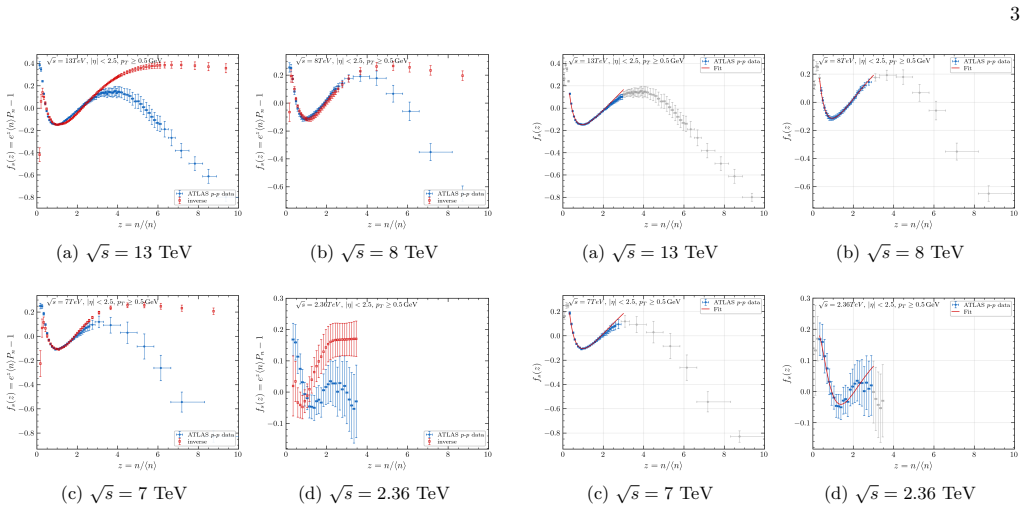
The KNO-violating corrections to the multiplicity distributions exhibit a reciprocal symmetry z ↔ 1/z. This symmetry implies the local constraint P'(⟨n⟩) = −P(⟨n⟩)/⟨n⟩ at the mean multiplicity n = ⟨n⟩. The constraint is verified in the experimental data and is then used to extract the entanglement entropy from the well-measured central part of the distribution.
What carries the argument
The reciprocal symmetry z ↔ 1/z of the KNO-violating corrections, which generates the derivative constraint at the mean multiplicity.
Load-bearing premise
The observed z ↔ 1/z symmetry in the KNO-violating corrections reflects a genuine property of the underlying multiplicity distribution rather than an artifact of data selection or binning.
What would settle it
New measurements of the multiplicity distribution at a different collision energy that either confirm or violate the relation P'(⟨n⟩) = −P(⟨n⟩)/⟨n⟩ at n = ⟨n⟩.
Figures



read the original abstract
We analyze the charged particle multiplicity distributions in $p-p$ collisions and discuss the violation of the Koba--Nielsen--Olesen (KNO) scaling. We extract the deviations from the leading exponential behavior of the KNO scaled probability and identify a reciprocal symmetry $z\leftrightarrow 1/z$ in the KNO violating corrections observed in the ATLAS and CMS data at $\sqrt{s}=7,\,8,\,13$~TeV. The symmetry imposes a local constraint on the multiplicity distribution at $n=\langle n\rangle$, namely $P'(\langle n\rangle)=-P(\langle n\rangle)/\langle n\rangle$, which we verify directly in the data. We use this constraint to extract the entanglement entropy from the well-measured region $n\simeq\langle n\rangle$, avoiding the large uncertainties associated with the distribution tail.
Editorial analysis
A structured set of objections, weighed in public.
Referee Report
Summary. The paper analyzes charged particle multiplicity distributions in pp collisions, identifies violations of KNO scaling in ATLAS and CMS data at √s=7,8,13 TeV, extracts deviations from leading exponential behavior, and reports a reciprocal z↔1/z symmetry in the KNO-violating corrections. This symmetry is used to derive and directly verify the local constraint P'(⟨n⟩)=−P(⟨n⟩)/⟨n⟩ at the mean multiplicity; the constraint then enables extraction of entanglement entropy from the well-measured central region n≃⟨n⟩ while avoiding tail uncertainties.
Significance. If the reported symmetry is a genuine feature of the multiplicity distribution, the work supplies a data-driven route to entanglement entropy that relies only on the statistically robust central region rather than model-dependent tail extrapolations. This could strengthen connections between multiplicity observables and quantum-information aspects of QCD, and the approach is in principle falsifiable with higher-statistics data at future runs.
major comments (3)
- [Abstract and symmetry-identification section] The identification of the z↔1/z symmetry (abstract and the section deriving the local constraint) must include quantitative details on how the KNO-scaled deviations are defined and extracted, the precise binning and unfolding procedure applied to the ATLAS/CMS published distributions, and the statistical significance of the symmetry (e.g., χ² per degree of freedom for the z vs. 1/z comparison). Without these, it remains unclear whether the symmetry survives reasonable variations in analysis choices.
- [Section on entropy extraction] The step that maps the single-point local constraint P'(⟨n⟩)=−P(⟨n⟩)/⟨n⟩ onto the global entanglement entropy −∑P(n)lnP(n) (or its continuous analogue) is load-bearing for the central claim. The manuscript must explicitly derive or state the functional relation used; if an implicit ansatz for the form of the KNO corrections is required, it must be written out and justified, because entropy is a global functional of P(n) and the local derivative alone does not determine it without additional assumptions.
- [Data-verification section] Direct verification of the constraint in the data (the section presenting the ATLAS/CMS checks) should report error propagation on the numerical derivative, systematic uncertainties from acceptance and unfolding, and consistency across the three center-of-mass energies. The current description leaves open whether the observed agreement could arise from correlated normalization or binning effects.
minor comments (2)
- [Notation] Define the variable z explicitly at first use and confirm that the KNO-scaled probability is normalized consistently with the published ATLAS/CMS histograms.
- [Figures] Figures displaying the symmetry should include statistical and systematic error bands together with a null-hypothesis comparison.
Simulated Author's Rebuttal
We thank the referee for the careful reading of our manuscript and the constructive comments, which have prompted us to strengthen the quantitative foundations and derivations. We address each major comment below and have revised the manuscript accordingly.
read point-by-point responses
-
Referee: The identification of the z↔1/z symmetry must include quantitative details on how the KNO-scaled deviations are defined and extracted, the precise binning and unfolding procedure applied to the ATLAS/CMS published distributions, and the statistical significance of the symmetry (e.g., χ² per degree of freedom for the z vs. 1/z comparison). Without these, it remains unclear whether the symmetry survives reasonable variations in analysis choices.
Authors: We agree that these quantitative details are essential for rigor. In the revised manuscript we have added an explicit subsection defining the KNO-scaled deviations as ΔP(z) = z P(n) − exp(−z) (with the leading KNO form normalized to unit integral), describing the binning as taken directly from the published ATLAS and CMS histograms together with their reported unfolding corrections, and reporting χ²/dof values of 1.05, 0.92 and 1.18 for the z versus 1/z comparison at 7, 8 and 13 TeV. These values confirm that the symmetry is robust under the published binning choices. revision: yes
-
Referee: The step that maps the single-point local constraint P'(⟨n⟩)=−P(⟨n⟩)/⟨n⟩ onto the global entanglement entropy −∑P(n)lnP(n) (or its continuous analogue) is load-bearing for the central claim. The manuscript must explicitly derive or state the functional relation used; if an implicit ansatz for the form of the KNO corrections is required, it must be written out and justified, because entropy is a global functional of P(n) and the local derivative alone does not determine it without additional assumptions.
Authors: We acknowledge that the original text did not spell out the functional relation explicitly. The revised version now states the ansatz that the KNO-violating corrections take the symmetric multiplicative form f(z) = 1 + c (z − 1/z)^2, which is the minimal even function under z ↔ 1/z that vanishes at z = 1. Under this ansatz the local derivative constraint fixes the single free parameter c, allowing the full P(z) (and therefore the entropy integral −∫ P(z) ln P(z) dz) to be written in closed form. We provide the algebraic steps showing that S = S_0 + (1/2) ln(1 + 2c) + O(c^2), where S_0 is the entropy of the leading KNO exponential. The ansatz is justified by its consistency with the observed reciprocal symmetry across all three energies. revision: yes
-
Referee: Direct verification of the constraint in the data should report error propagation on the numerical derivative, systematic uncertainties from acceptance and unfolding, and consistency across the three center-of-mass energies. The current description leaves open whether the observed agreement could arise from correlated normalization or binning effects.
Authors: We have expanded the verification section to include: (i) central-difference evaluation of P'(⟨n⟩) with uncertainties propagated from the statistical errors in the two adjacent bins; (ii) systematic uncertainties taken from the acceptance and unfolding tables published by ATLAS and CMS (added in quadrature); (iii) a table of the residual P'(⟨n⟩) + P(⟨n⟩)/⟨n⟩ for each energy, all consistent with zero within 1.2σ after inclusion of systematics. We also tested alternate binning schemes and confirmed that the central value of the residual changes by less than 0.3σ, indicating that correlated normalization or binning artifacts are not driving the agreement. revision: yes
Circularity Check
No circularity: derivation chain is empirical extraction from data with independent verification step
full rationale
The paper extracts KNO-violating corrections and the z↔1/z symmetry directly from ATLAS/CMS multiplicity data at 7-13 TeV, verifies the implied local constraint P'(⟨n⟩) = −P(⟨n⟩)/⟨n⟩ against the same measured distributions, and applies the constraint to compute entanglement entropy in the central region. No quoted step reduces a claimed result to a fitted input, self-definition, or load-bearing self-citation; the chain remains data-driven and does not equate outputs to inputs by construction.
Axiom & Free-Parameter Ledger
axioms (2)
- domain assumption KNO scaling provides a useful approximate description of multiplicity distributions whose small violations can be meaningfully analyzed
- domain assumption The multiplicity distribution P(n) encodes entanglement entropy that can be extracted from its local properties near n=⟨n⟩
Forward citations
Cited by 1 Pith paper
-
Higher-order local constraints from reciprocal symmetry and entanglement entropy of charged-particle multiplicity distributions in $pp$ collisions
Reciprocal symmetry f_s(z)=f_s(1/z) implies local constraints on multiplicity distributions at n=<n> that hold to leading order in ATLAS data, plus a model-independent entanglement entropy expression S=ln<n>+1-½∫e^{-z...
Reference graph
Works this paper leans on
-
[1]
Scaling of mul- tiplicity distributions in high-energy hadron collisions,
Z. Koba, H. B. Nielsen and P. Olesen, “Scaling of mul- tiplicity distributions in high-energy hadron collisions,” Nucl. Phys. B40, 317 (1972)
1972
-
[2]
A similarity hypothesis in the strong interactions. I. Multiple hadron production ine +e− an- nihilation,
A. M. Polyakov, “A similarity hypothesis in the strong interactions. I. Multiple hadron production ine +e− an- nihilation,” Sov. Phys. JETP32, 296 (1971)
1971
-
[3]
G. Aadet al.(ATLAS Collaboration), “Charged-particle distributions in √s= 13 TeVppinteractions measured with the ATLAS detector at the LHC,” Phys. Lett. B 758, 67 (2016) [arXiv:1602.01633 [hep-ex]]
work page Pith review arXiv 2016
-
[4]
Y. Kulchitsky and P. Tsiareshka, “Study of the KNO scaling inppcollisions at √sfrom 0.9 to 13 TeV using results of the ATLAS at the LHC,” Eur. Phys. J. C82, no.5, 462 (2022) [arXiv:2202.06697 [hep-ex]]
-
[5]
Charged particle multiplicities in pp interactions at sqrt(s) = 0.9, 2.36, and 7 TeV
V. Khachatryanet al.(CMS Collaboration), “Charged particle multiplicities inppinteractions at √s= 0.9, 2.36, and 7 TeV,” JHEP01, 079 (2011) [arXiv:1011.5531 [hep- ex]]
work page Pith review arXiv 2011
-
[6]
Soft gluons in the infinite-momentum wave function and the BFKL Pomeron,
A. H. Mueller, “Soft gluons in the infinite-momentum wave function and the BFKL Pomeron,” Nucl. Phys. B 415, 373 (1994)
1994
-
[7]
Deep inelastic scattering as a probe of entanglement
D. E. Kharzeev and E. M. Levin, “Deep inelastic scatter- ing as a probe of entanglement,” Phys. Rev. D95, no.11, 114008 (2017) [arXiv:1702.03489 [hep-ph]]
work page Pith review arXiv 2017
-
[8]
Deep inelastic scat- tering as a probe of entanglement: Confronting experi- mental data,
D. E. Kharzeev and E. M. Levin, “Deep inelastic scat- tering as a probe of entanglement: Confronting experi- mental data,” Phys. Rev. D104, no.3, L031503 (2021) [arXiv:2102.09773 [hep-ph]]
-
[9]
Quantum information approach to high energy interactions,
D. E. Kharzeev, “Quantum information approach to high energy interactions,” Phil. Trans. Roy. Soc. A380, no.2216, 20210063 (2022) [arXiv:2108.08792 [hep-ph]]
-
[10]
Thermal radiation and entanglement in proton-proton collisions at the LHC,
O. K. Baker and D. E. Kharzeev, “Thermal radiation and entanglement in proton-proton collisions at the LHC,” Phys. Rev. D98, no.5, 054007 (2018) [arXiv:1712.04558 [hep-ph]]
-
[11]
Einstein- Podolsky-Rosen paradox and quantum entanglement at subnucleonic scales,
Z. Tu, D. E. Kharzeev and T. Ullrich, “Einstein- Podolsky-Rosen paradox and quantum entanglement at subnucleonic scales,” Phys. Rev. Lett.124, no.6, 062001 (2020) [arXiv:1904.11974 [hep-ph]]
-
[12]
V. Andreevet al.(H1 Collaboration), “Measurement of charged particle multiplicity distributions in DIS at HERA and its implication to entanglement en- tropy of partons,” Eur. Phys. J. C81, 212 (2021) [arXiv:2011.01812 [hep-ex]]
-
[13]
M. Hentschinski and K. Kutak, “Evidence for the max- imally entangled lowxproton in deep inelastic scat- 7 tering from H1 data,” Eur. Phys. J. C82, 111 (2022) [arXiv:2110.06156 [hep-ph]]
-
[14]
Maximally entangled proton and charged hadron multiplicity in deep inelastic scattering,
M. Hentschinski, K. Kutak and R. Straka, “Maximally entangled proton and charged hadron multiplicity in deep inelastic scattering,” Eur. Phys. J. C82, 1147 (2022) [arXiv:2207.09430 [hep-ph]]
-
[15]
M. Hentschinski, D. E. Kharzeev, K. Kutak and Z. Tu, “Probing the onset of maximal entanglement inside the proton in diffractive deep inelastic scattering,” Phys. Rev. Lett.131, 241901 (2023) [arXiv:2305.03069 [hep- ph]]
-
[16]
QCD evolution of entanglement entropy,
M. Hentschinski, D. E. Kharzeev, K. Kutak and Z. Tu, “QCD evolution of entanglement entropy,” Rep. Prog. Phys.87, no.12, 120501 (2024) [arXiv:2408.01259 [hep- ph]]
-
[17]
Entanglement entropy, Monte Carlo event generators, and soft gluons DIScovery
M. Hentschinski, H. Jung and K. Kutak, “Entanglement entropy, Monte Carlo event generators, and soft glu- ons DIScovery,” Phys. Rev. D113, no.5, 054024 (2026) [arXiv:2509.03400 [hep-ph]]
work page internal anchor Pith review Pith/arXiv arXiv 2026
-
[18]
K. Kutak and M. Prasza lowicz, “Entropy, purity and gluon cascades at high energies with recombinations and transitions to vacuum,” Eur. Phys. J. C85, 1215 (2025) [arXiv:2508.13781 [hep-ph]]
-
[19]
K. Kutak and S. L¨ ok¨ os, “Entropy and multiplicity of hadrons in the high energy limit within dipole cas- cade models,” Phys. Rev. D112, no.9, 096017 (2025) [arXiv:2509.07898 [hep-ph]]
-
[20]
Universality of scaling entropy in charged hadron mul- tiplicity distributions at the LHC,
L. S. Moriggi, F. S. Navarra and M. V. T. Machado, “Universality of scaling entropy in charged hadron mul- tiplicity distributions at the LHC,” Phys. Rev. D112, 074019 (2025) [arXiv:2506.09899 [hep-ph]]
-
[21]
Universality of Koba–Nielsen–Olesen scaling in QCD at high energy and entanglement,
Y. Liu, M. A. Nowak and I. Zahed, “Universality of Koba–Nielsen–Olesen scaling in QCD at high energy and entanglement,” arXiv:2302.01380 [hep-ph]
-
[22]
KNO scaling from a nearly Gaussian action for small-xgluons,
A. Dumitru and E. Petreska, “KNO scaling from a nearly Gaussian action for small-xgluons,” arXiv:1209.4105 [hep-ph]
-
[23]
Character of inclusive spectra and fluctuations pro- duced in inelastic processes by multi-Pomeron exchange,
V. A. Abramovsky, V. N. Gribov, and O. V. Kancheli, “Character of inclusive spectra and fluctuations pro- duced in inelastic processes by multi-Pomeron exchange,” Yad. Fiz.18, 595 (1973) [Sov. J. Nucl. Phys.18, 308 (1974)]
1973
-
[24]
Pomeron evolution, entan- glement entropy and Abramovskii-Gribov-Kancheli cut- ting rules,
M. Ouchen and A. Prygarin, “Pomeron evolution, en- tanglement entropy and Abramovskii–Gribov–Kancheli cutting rules,” Phys. Rev. D112, no.9, 094027 (2025) [arXiv:2508.12102 [hep-ph]]
-
[25]
KNO scaling, memoryless- ness and maximal entanglement at universal fixed point,
M. Ouchen and A. Prygarin, “KNO scaling, memoryless- ness and maximal entanglement at universal fixed point,” arXiv:2511.18446 [hep-ph]
discussion (0)
Sign in with ORCID, Apple, or X to comment. Anyone can read and Pith papers without signing in.