Recognition: 2 theorem links
· Lean TheoremHigher-order local constraints from reciprocal symmetry and entanglement entropy of charged-particle multiplicity distributions in pp collisions
Pith reviewed 2026-05-12 01:40 UTC · model grok-4.3
The pith
Reciprocal symmetry of the scaling function implies local algebraic constraints on multiplicity distributions at the mean.
A machine-rendered reading of the paper's core claim, the machinery that carries it, and where it could break.
Core claim
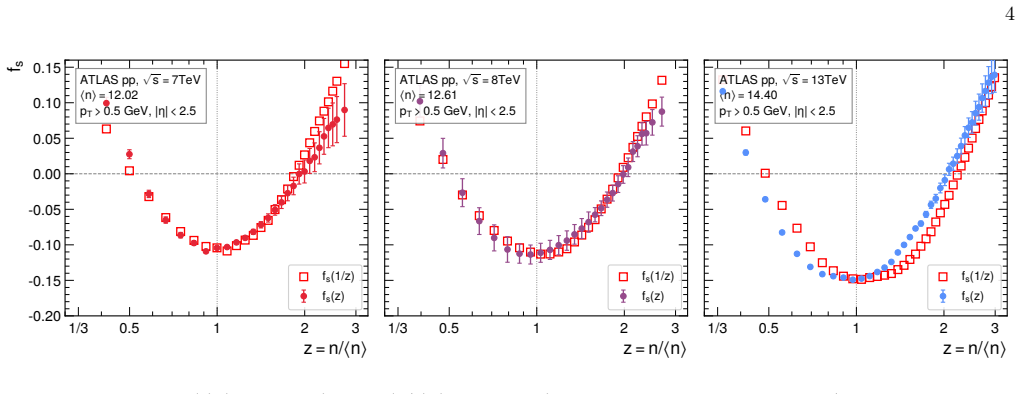
The reciprocal symmetry f_s(z)=f_s(1/z) of the KNO-violating term implies that h(u)≡f_s(e^u) is even in u=ln z. Each odd derivative of h at u=0 therefore supplies a local algebraic constraint on the multiplicity distribution at n=<n>. The k=1 constraint is <n>^3 P'''(<n>)+6<n>^2 P''(<n>)=5 P(<n>), which is equivalent to the unconditional residual δ_3=1-2ρ_0+ρ_1=0. In ATLAS 13 TeV data with the largest fit window, δ_3=-0.02±0.11, consistent with the symmetric value. A χ² test rejects global symmetry at 13 TeV but the local picture near z=1 holds at the first two non-trivial orders. The entanglement entropy is given by the model-independent expression S=ln<n>+1−(1/2)∫ e^{-z} f_s²(z) dz + O(f_s
What carries the argument
The even function h(u)=f_s(e^u) obtained from the reciprocal symmetry f_s(z)=f_s(1/z), whose vanishing odd derivatives at u=0 produce algebraic constraints on the derivatives of P at the mean multiplicity.
Load-bearing premise
That the reciprocal symmetry is sufficiently accurate near z=1 for the Taylor expansion of h(u) to produce local constraints that are borne out by the data, despite the global symmetry being rejected at 13 TeV.
What would settle it
A measurement with smaller uncertainties showing that δ_3 differs from zero by several standard deviations, or that the combination <n>^3 P'''(<n>)+6<n>^2 P''(<n>)-5 P(<n>) is nonzero near the mean, would falsify the local constraint derived from the symmetry.
Figures


read the original abstract
The reciprocal symmetry $f_s(z)=f_s(1/z)$ of the KNO-violating term in proton--proton charged-multiplicity distributions, observed at $\sqrt{s}=7$, $8$ and $13$ TeV, implies that the function $h(u)\equiv f_s(e^u)$ is even in $u=\ln z$. Each odd derivative of $h$ at $u=0$ then provides a local algebraic constraint on the multiplicity distribution at $n=\langle n\rangle$. The $k=0$ constraint $P'(\langle n\rangle)=-P(\langle n\rangle)/\langle n\rangle$ has been verified previously. We derive the $k=1$ constraint, $\langle n\rangle^3 P'''(\langle n\rangle)+6\langle n\rangle^2 P''(\langle n\rangle)=5\,P(\langle n\rangle)$, equivalent to the unconditional residual $\delta_3\equiv 1-2\rho_0+\rho_1=0$, and test it in the ATLAS data: at $13$~TeV with the largest fit window we find $\delta_3=-0.02\pm 0.11$, consistent with the leading-order symmetric value, while the $7$ and $8$~TeV results are inconclusive at the available precision. A $\chi^2$ test of the global symmetry across the window $1/3<z<3$ is consistent with the symmetry at $7$ and $8$~TeV but rejects it decisively at $13$~TeV, where the smaller experimental uncertainties expose a residual departure from $z\to 1/z$ invariance away from $z=1$. The overall picture is therefore that the symmetry holds at the leading two non-trivial orders near $z=1$ but breaks down globally at the precision afforded by the $13$~TeV data, suggesting that $f_s(z)=f_s(1/z)$ is at best an approximate symmetry. We derive a model-independent expression for the entanglement entropy $S=\ln\langle n\rangle+1-\tfrac{1}{2}\int_0^\infty e^{-z}f_s^2(z)\,dz+\mathcal{O}(f_s^3)$, in which the linear term in $f_s$ cancels by virtue of normalisation and the constraint $\langle z\rangle=1$, and evaluate it numerically on the ATLAS data.
Editorial analysis
A structured set of objections, weighed in public.
Referee Report
Summary. The paper reports that the reciprocal symmetry f_s(z)=f_s(1/z) observed in the KNO-violating component of charged-particle multiplicity distributions in pp collisions at LHC energies implies that h(u)≡f_s(e^u) is even, yielding local algebraic constraints on P(n) at n=⟨n⟩ via Taylor expansion. It derives the k=1 constraint ⟨n⟩³P'''(⟨n⟩)+6⟨n⟩²P''(⟨n⟩)=5P(⟨n⟩) (or δ₃=0), tests it on ATLAS data (finding δ₃=-0.02±0.11 at 13 TeV consistent with zero), notes that global χ² rejects the symmetry at 13 TeV while local consistency holds near z=1, and derives the model-independent entanglement entropy S=ln⟨n⟩+1−½∫e^{-z}f_s²(z)dz+O(f_s³).
Significance. If the local symmetry near z=1 is robust, the work supplies parameter-free higher-order constraints on multiplicity distributions and a compact, model-independent expression for entanglement entropy that cancels the linear term in f_s by normalization and ⟨z⟩=1. This could constrain phenomenological models of particle production and link multiplicity statistics to information-theoretic quantities in high-energy collisions. The explicit data tests and derivation of the entropy formula are strengths.
major comments (1)
- [Abstract and data-analysis section] Abstract and data-analysis section: The central claim that 'the symmetry holds at the leading two non-trivial orders near z=1' rests on δ₃ consistency at 13 TeV, yet the same data set yields a decisive χ² rejection of global reciprocity over 1/3<z<3. No auxiliary figure or table quantifies the scale |ln z| at which |f_s(z)−f_s(1/z)| first exceeds the local statistical uncertainty, leaving open whether asymmetry already contaminates the Taylor truncation used to extract the k=1 constraint at the reported ±0.11 precision.
minor comments (1)
- [Entropy derivation] The numerical evaluation of the integral in the entropy expression is stated to be performed on ATLAS data, but the binning, interpolation, or cutoff procedure used for f_s(z) is not specified, which affects reproducibility of the quoted S values.
Simulated Author's Rebuttal
We thank the referee for the careful reading and for identifying the need to better quantify the range of validity of the local reciprocal symmetry. We agree that an auxiliary figure or table would strengthen the distinction between local consistency near z=1 and global deviations, and we will incorporate this in the revision.
read point-by-point responses
-
Referee: [Abstract and data-analysis section] Abstract and data-analysis section: The central claim that 'the symmetry holds at the leading two non-trivial orders near z=1' rests on δ₃ consistency at 13 TeV, yet the same data set yields a decisive χ² rejection of global reciprocity over 1/3<z<3. No auxiliary figure or table quantifies the scale |ln z| at which |f_s(z)−f_s(1/z)| first exceeds the local statistical uncertainty, leaving open whether asymmetry already contaminates the Taylor truncation used to extract the k=1 constraint at the reported ±0.11 precision.
Authors: We agree that an explicit quantification of the |ln z| scale is needed to confirm that the local Taylor truncation remains uncontaminated. The δ₃ constraint is obtained from a local fit to P(n) in a window around n=⟨n⟩ (i.e., z near 1), while the global χ² integrates over 1/3<z<3. In the revised manuscript we will add a new figure displaying |f_s(z)−f_s(1/z)|/σ(z) versus |ln z|, where σ(z) is the point-wise uncertainty propagated from the ATLAS data. This will show that the normalized deviation remains consistent with zero (within 1σ) for |ln z| ≲ 0.1, which covers the fit window used for δ₃, while statistically significant departures appear only at larger |ln z| that drive the global χ² rejection. We will also update the abstract and discussion to state more precisely that the leading two orders hold locally near z=1, with the global symmetry breaking exposed only by the higher-precision 13 TeV data at larger |ln z|. revision: yes
Circularity Check
No significant circularity; derivation is self-contained from observed symmetry and normalization
full rationale
The paper observes reciprocal symmetry f_s(z)=f_s(1/z) in data at multiple energies, defines h(u)≡f_s(e^u) as even, and derives the k=1 algebraic constraint on P(n) at n=<n> via Taylor expansion of the even function (odd derivatives vanish at u=0). This is a direct mathematical consequence, not a fit or self-definition. The entropy expression follows from an expansion where the linear f_s term cancels explicitly by normalization and <z>=1, independent of the symmetry. The χ² global rejection at 13 TeV is reported separately and does not enter the local derivation or entropy formula. No self-citations, ansatze smuggled via citation, or renaming of known results occur; the central claims reduce to the input symmetry assumption plus standard normalization, with data tests serving as external checks rather than tautological outputs.
Axiom & Free-Parameter Ledger
axioms (2)
- domain assumption The function h(u) = f_s(e^u) is even, so all odd derivatives vanish at u=0.
- standard math Normalization ∫ P(n) dn = 1 and <z> = 1 hold exactly.
Lean theorems connected to this paper
-
IndisputableMonolith/Cost/FunctionalEquation.leanwashburn_uniqueness_aczel echoesThe reciprocal symmetry f_s(z)=f_s(1/z) ... implies that the function h(u)≡f_s(e^u) is even in u=ln z. Each odd derivative of h at u=0 then provides a local algebraic constraint
Reference graph
Works this paper leans on
-
[1]
Reciprocal symmetry and KNO scaling violation in proton-proton collisions
M. Ouchen and A. Prygarin, “Reciprocal symmetry and KNO scaling violation in proton-proton collisions,” arXiv:2605.00128 [hep-ph] (2026)
work page internal anchor Pith review Pith/arXiv arXiv 2026
-
[2]
KNO scaling, memoryless- ness and maximal entanglement at universal fixed point,
M. Ouchen and A. Prygarin, “KNO scaling, memoryless- ness and maximal entanglement at universal fixed point,” arXiv:2511.18446 [hep-ph] (2025)
-
[3]
Soft gluons in the infinite-momentum wave function and the BFKL Pomeron,
A. H. Mueller, “Soft gluons in the infinite-momentum wave function and the BFKL Pomeron,” Nucl. Phys. B 415, 373 (1994)
work page 1994
-
[4]
Deep inelastic scattering as a probe of entanglement
D. E. Kharzeev and E. M. Levin, “Deep inelastic scatter- ing as a probe of entanglement,” Phys. Rev. D95, no. 11, 114008 (2017) [arXiv:1702.03489 [hep-ph]]. 9
work page Pith review arXiv 2017
-
[5]
Deep inelastic scat- tering as a probe of entanglement: Confronting experi- mental data,
D. E. Kharzeev and E. M. Levin, “Deep inelastic scat- tering as a probe of entanglement: Confronting experi- mental data,” Phys. Rev. D104, no. 3, L031503 (2021) [arXiv:2102.09773 [hep-ph]]
-
[6]
Quantum information approach to high energy interactions,
D. E. Kharzeev, “Quantum information approach to high energy interactions,” Phil. Trans. Roy. Soc. A380, no. 2216, 20210063 (2022) [arXiv:2108.08792 [hep-ph]]
-
[7]
Einstein- Podolsky-Rosen paradox and quantum entanglement at subnucleonic scales,
Z. Tu, D. E. Kharzeev and T. Ullrich, “Einstein- Podolsky-Rosen paradox and quantum entanglement at subnucleonic scales,” Phys. Rev. Lett.124, no. 6, 062001 (2020) [arXiv:1904.11974 [hep-ph]]
-
[8]
V. Andreevet al.[H1 Collaboration], “Measurement of charged particle multiplicity distributions in DIS at HERA and its implication to entanglement en- tropy of partons,” Eur. Phys. J. C81, 212 (2021) [arXiv:2011.01812 [hep-ex]]
-
[9]
M. Hentschinski and K. Kutak, “Evidence for the max- imally entangled low x proton in deep inelastic scat- tering from H1 data,” Eur. Phys. J. C82, 111 (2022) [arXiv:2110.06156 [hep-ph]]
-
[10]
Maximally entangled proton and charged hadron multiplicity in deep inelastic scattering,
M. Hentschinski, K. Kutak and R. Straka, “Maximally entangled proton and charged hadron multiplicity in deep inelastic scattering,” Eur. Phys. J. C82, 1147 (2022) [arXiv:2207.09430 [hep-ph]]
-
[11]
M. Hentschinski, D. E. Kharzeev, K. Kutak and Z. Tu, “Probing the onset of maximal entanglement inside the proton in diffractive deep inelastic scattering,” Phys. Rev. Lett.131, 241901 (2023) [arXiv:2305.03069 [hep- ph]]
-
[12]
QCD evolution of entanglement entropy,
M. Hentschinski, D. E. Kharzeev, K. Kutak and Z. Tu, “QCD evolution of entanglement entropy,” Rep. Prog. Phys.87, no. 12, 120501 (2024) [arXiv:2408.01259 [hep- ph]]
-
[13]
Entanglement entropy, Monte Carlo event generators, and soft gluons DIScovery
M. Hentschinski, H. Jung and K. Kutak, “Entanglement entropy, Monte Carlo event generators, and soft gluons DIScovery,” Phys. Rev. D113, no. 5, 054024 (2026) [arXiv:2509.03400 [hep-ph]]
work page internal anchor Pith review Pith/arXiv arXiv 2026
-
[14]
K. Kutak and M. Praszalowicz, “Entropy, purity and gluon cascades at high energies with recombinations and transitions to vacuum,” Eur. Phys. J. C85, 1215 (2025) [arXiv:2508.13781 [hep-ph]]
-
[15]
K. Kutak and S. L¨ ok¨ os, “Entropy and multiplicity of hadrons in the high energy limit within dipole cas- cade models,” Phys. Rev. D112, no. 9, 096017 (2025) [arXiv:2509.07898 [hep-ph]]
-
[16]
Universality of scaling entropy in charged hadron mul- tiplicity distributions at the LHC,
L. S. Moriggi, F. S. Navarra and M. V. T. Machado, “Universality of scaling entropy in charged hadron mul- tiplicity distributions at the LHC,” Phys. Rev. D112, 074019 (2025) [arXiv:2506.09899 [hep-ph]]
-
[17]
Charged-particle multiplicities in pp interactions measured with the ATLAS detector at the LHC
G. Aadet al.[ATLAS Collaboration], “Charged-particle multiplicities inppinteractions measured with the AT- LAS detector at the LHC,” New J. Phys.13, 053033 (2011) [arXiv:1012.5104 [hep-ex]]
work page Pith review arXiv 2011
-
[18]
G. Aadet al.[ATLAS Collaboration], “Charged-particle distributions in √s= 8 TeVppinteractions at the LHC,” Eur. Phys. J. C76, no. 7, 403 (2016) [arXiv:1603.02439 [hep-ex]]
work page Pith review arXiv 2016
-
[19]
G. Aadet al.[ATLAS Collaboration], “Charged-particle distributions in √s= 13 TeVppinteractions measured with the ATLAS detector at the LHC,” Phys. Lett. B 758, 67 (2016) [arXiv:1602.01633 [hep-ex]]
work page Pith review arXiv 2016
-
[20]
Y. Kulchitsky and P. Tsiareshka, “Study of the KNO scaling inppcollisions at √sfrom 0.9 to 13 TeV using results of the ATLAS at the LHC,” Eur. Phys. J. C82, no. 5, 462 (2022) [arXiv:2202.06697 [hep-ex]]
-
[21]
Charged particle multiplicities in pp interactions at sqrt(s) = 0.9, 2.36, and 7 TeV
V. Khachatryanet al.[CMS Collaboration], “Charged particle multiplicities inppinteractions at √s= 0.9, 2.36, and 7 TeV,” JHEP01, 079 (2011) [arXiv:1011.5531 [hep- ex]]
work page Pith review arXiv 2011
-
[22]
Pomeron evolution, entan- glement entropy and Abramovskii-Gribov-Kancheli cut- ting rules,
M. Ouchen and A. Prygarin, “Pomeron evolution, entan- glement entropy and Abramovskii-Gribov-Kancheli cut- ting rules,” Phys. Rev. D112, no. 9, 094027 (2025) [arXiv:2508.12102 [hep-ph]]
-
[23]
The bare pomeron in quantum chromo- dynamics,
L. N. Lipatov, “The bare pomeron in quantum chromo- dynamics,” Sov. Phys. JETP63, 904 (1986)
work page 1986
-
[24]
High-energy asymptotics of multicolor QCD and two-dimensional conformal field theories,
L. N. Lipatov, “High-energy asymptotics of multicolor QCD and two-dimensional conformal field theories,” Phys. Lett. B309, 394 (1993)
work page 1993
-
[25]
Spin-spin entanglement in diffractive heavy-quark production,
M. Fucilla and Y. Hatta, “Spin-spin entanglement in diffractive heavy-quark production,” Phys. Rev. D113, no. 3, L031504 (2026) [arXiv:2509.05267 [hep-ph]]
-
[26]
Probing quantum en- tanglement with Generalized Parton Distributions at the Electron-Ion Collider,
Y. Hatta and J. Schoenleber, “Probing quantum en- tanglement with Generalized Parton Distributions at the Electron-Ion Collider,” arXiv:2511.04537 [hep-ph] (2025)
-
[27]
M. Fucilla, Y. Hatta, and B.-W. Xiao, “Quantum entan- glement in electron-nucleus collisions: Role of the linearly polarized gluon distribution,” arXiv:2604.11697 [hep-ph] (2026)
work page internal anchor Pith review Pith/arXiv arXiv 2026
discussion (0)
Sign in with ORCID, Apple, or X to comment. Anyone can read and Pith papers without signing in.