Recognition: unknown
Compatible k-Relaxations of Fairness and Non-Wastefulness Under Hereditary Constraints
Pith reviewed 2026-05-09 20:17 UTC · model grok-4.3
The pith
Relaxed fairness and non-wastefulness are always compatible under hereditary constraints in matching markets.
A machine-rendered reading of the paper's core claim, the machinery that carries it, and where it could break.
Core claim
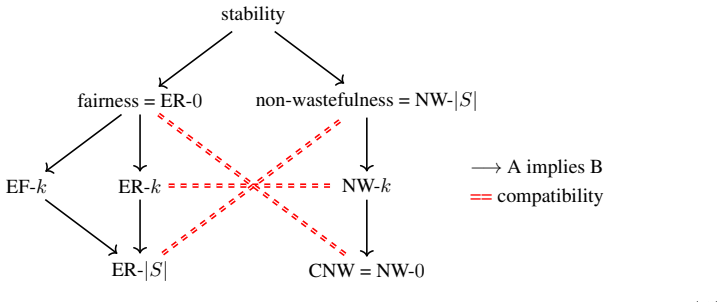
For any fixed positive integer k and any two-sided matching instance whose feasibility constraints are hereditary, there always exists a matching that is both envy-received up to k and non-wasteful up to k. Such a matching can be found in polynomial time by a k-admissible cutoff algorithm or by a k-admissible variant of the college-proposing deferred acceptance procedure.
What carries the argument
The pair of k-relaxations ER-k and NW-k, whose joint feasibility is ensured by the hereditary property of the constraint sets, together with the two equivalent polynomial-time algorithms that locate a matching satisfying both.
Load-bearing premise
The feasibility constraints must be hereditary, so that every subset of a feasible set is itself feasible.
What would settle it
An explicit matching market with hereditary constraints together with a small k for which no matching satisfies both ER-k and NW-k, or for which one of the stated algorithms returns a matching violating one of the two relaxed properties.
Figures
read the original abstract
We study two-sided matching markets under hereditary constraints, which extend beyond simple capacity limits and arise in applications such as diversity requirements and refugee resettlement. In these settings, fairness and non-wastefulness are often incompatible, and existing approaches typically address this tension by prioritizing one property at the expense of the other. We take a different approach by relaxing both properties simultaneously in a controlled and symmetric manner. We introduce two notions indexed by an integer $k$: envy-received up to $k$ peers (ER-$k$) and non-wastefulness up to $k$ objections (NW-$k$). Our main theoretical result shows that ER-$k$ and NW-$k$ are always compatible under hereditary constraints for any fixed $k$. We provide two equivalent polynomial-time algorithms to compute such matchings: a $k$-admissible cutoff algorithm and a $k$-admissible college-proposing deferred acceptance mechanism. Finally, experimental results demonstrate that even small relaxations achieve a favorable balance between fairness and non-wastefulness.
Editorial analysis
A structured set of objections, weighed in public.
Referee Report
Summary. The manuscript studies two-sided matching markets with hereditary constraints (extending beyond capacities, e.g., diversity or resettlement rules). It defines symmetric k-relaxations: ER-k (envy-received up to k peers) and NW-k (non-wastefulness up to k objections). The central claim is that ER-k and NW-k are always compatible for any fixed k under hereditary constraints, supported by two equivalent polynomial-time algorithms (a k-admissible cutoff algorithm and a k-admissible college-proposing deferred acceptance mechanism). Experiments illustrate that small k values achieve a practical balance between the relaxed properties.
Significance. If the results hold, the work supplies a controlled, symmetric relaxation framework for the well-known incompatibility of strict fairness and non-wastefulness in constrained matching. The hereditary assumption is appropriately highlighted as necessary, the dual algorithmic constructions (with claimed equivalence) provide independent verification, and the polynomial-time guarantees for fixed k enhance applicability. This could inform implementations in diversity-constrained or refugee-matching systems where exact stability is unattainable.
major comments (2)
- [§4, Theorem 4.1] §4, Theorem 4.1 (compatibility): the existence argument invokes hereditary closure to guarantee a matching satisfying both ER-k and NW-k simultaneously, but the step showing that the output of either algorithm meets the 'up to k' thresholds for all agents simultaneously is only sketched; an explicit inductive argument on the number of proposals or cutoffs would strengthen the load-bearing claim.
- [§5.2] §5.2 (algorithm equivalence): the proof that the cutoff algorithm and the modified DA produce identical matchings relies on the hereditary property to preserve admissibility after rejections, yet the handling of ties or equal-rank peers in the k-count is not fully detailed; this could affect both correctness and the claimed polynomial runtime for fixed k.
minor comments (3)
- [Abstract] Abstract: the claim that the two algorithms are 'equivalent' is stated without noting that equivalence is proven later; a parenthetical reference to the relevant theorem would improve readability.
- [Experiments] Experimental section: the description of how hereditary constraint families are sampled (e.g., for diversity quotas) is brief; adding a short paragraph or pseudocode would aid reproducibility.
- [§3] Notation: the definition of 'peers' in ER-k and 'objections' in NW-k uses similar but not identical indexing; a unified table comparing the two notions side-by-side would reduce reader confusion.
Simulated Author's Rebuttal
We thank the referee for the careful reading, positive assessment, and constructive suggestions. We address each major comment below and will revise the manuscript accordingly.
read point-by-point responses
-
Referee: [§4, Theorem 4.1] §4, Theorem 4.1 (compatibility): the existence argument invokes hereditary closure to guarantee a matching satisfying both ER-k and NW-k simultaneously, but the step showing that the output of either algorithm meets the 'up to k' thresholds for all agents simultaneously is only sketched; an explicit inductive argument on the number of proposals or cutoffs would strengthen the load-bearing claim.
Authors: We agree that the proof of Theorem 4.1 would benefit from greater explicitness. In the revised version we will insert a detailed inductive argument (on the number of proposals for the DA variant and on the number of cutoffs for the cutoff algorithm) establishing that the final output simultaneously satisfies the ER-k and NW-k thresholds for every agent. The induction will rely on the hereditary closure property at each step and will not alter the statement or complexity of the result. revision: yes
-
Referee: [§5.2] §5.2 (algorithm equivalence): the proof that the cutoff algorithm and the modified DA produce identical matchings relies on the hereditary property to preserve admissibility after rejections, yet the handling of ties or equal-rank peers in the k-count is not fully detailed; this could affect both correctness and the claimed polynomial runtime for fixed k.
Authors: We thank the referee for highlighting this point. The current manuscript assumes a fixed but arbitrary tie-breaking rule and counts a peer toward the k-limit whenever the peer has equal or higher rank. In the revision we will explicitly state the tie-breaking convention, redefine the k-count to treat equal-rank peers unambiguously, and verify that this convention is preserved by the hereditary property. The added paragraph will confirm that the equivalence proof and the O(n^{k+1}) runtime bound for fixed k remain valid. revision: yes
Circularity Check
No significant circularity identified
full rationale
The paper defines ER-k and NW-k relaxations directly from the hereditary constraint family and proves their compatibility via two equivalent polynomial-time algorithms (k-admissible cutoff and college-proposing DA). The central claim follows from the downward-closed property of the constraints and the new definitions, without any reduction to fitted parameters, self-referential quantities, or load-bearing self-citations. The derivation is self-contained against the stated assumptions, with the equivalence of the algorithms providing independent verification of the result.
Axiom & Free-Parameter Ledger
axioms (1)
- domain assumption The constraint family is hereditary
Reference graph
Works this paper leans on
-
[1]
Ahmadi and F
S. Ahmadi and F. Ahmed and J. P. Dickerson and M. Fuge and S. Khuller , booktitle =. An Algorithm for Multi-Attribute Diverse Matching , year =
-
[2]
Ashlagi and M
I. Ashlagi and M. Braverman and A. Hassidim , title =. Operation Research , volume =
-
[3]
K. C. Integer programming methods for special college admissions problems , volume =. Journal of Combinatorial Optimization , number =
-
[4]
D. J. Abraham and A. Blum and T. Sandholm , booktitle =. Clearing algorithms for barter exchange markets: Enabling nationwide kidney exchanges , year =
-
[5]
Mathematical Programming , volume=
Cutoff stability under distributional constraints with an application to summer internship matching , author=. Mathematical Programming , volume=. 2024 , publisher=
2024
-
[6]
Aziz and P
H. Aziz and P. Bir. Thirty-Sixth
-
[7]
Aziz and J
H. Aziz and J. Chen and S. Gaspers and Z. Sun , booktitle =. Stability and Pareto Optimality in Refugee Allocation Matchings , year =
-
[8]
D. J. Abraham and K. Cechl. Pareto Optimality in House Allocation Problems , volume =
-
[9]
Ahmed and J
F. Ahmed and J. P. Dickerson and M. Fuge , booktitle =. Diverse weighted bipartite b-matching , year =
-
[10]
Aziz and S
H. Aziz and S. Gaspers and Z. Sun , Title =
-
[11]
Aziz and S
H. Aziz and S. Gaspers and Z. Sun , booktitle =. Mechanism Design for School Choice with Soft Diversity Constraints , year =
-
[12]
Aziz and S
H. Aziz and S. Gaspers and Z. Sun and T. Walsh , booktitle =. From Matching with Diversity Constraints to Matching with Regional Quotas , year =
-
[13]
Aziz and S
H. Aziz and S. Gaspers and Z. Sun and M. Yokoo , booktitle =. Multiple Levels of Importance in Matching with Distributional Constraints , year =
-
[14]
R. K. Ahuja and T. L. Magnanti and J. B.Orlin , publisher =. Network Flows: Theory, Algorithms, and Applications , year =
-
[15]
Abdulkadiro
A. Abdulkadiro. The New York City High School Match , volume =. American Economic Review , number =
-
[16]
Abdulkadiro
A. Abdulkadiro. The Boston Public School Match , volume =. American Economic Review , number =
-
[17]
Abdulkadiro
A. Abdulkadiro. School Choice: A Mechanism Design Approach , volume =. American Economic Review , number =
-
[18]
Abdulkadiro
A. Abdulkadiro. College admissions with affirmative action , volume =. International Journal of Game Theory , number =
-
[19]
Andersson and L
T. Andersson and L. Ehlers , institution =
-
[20]
O. Ayg. College admission with multidimensional privileges: The. 2021 , journal =
2021
-
[21]
O. Ayg. Matching with contracts: Comment , volume =. American Economic Review , number =
-
[22]
O. Ayg. Dynamic reserves in matching markets: Theory and applications , year =
-
[23]
O. Ayg. American Economic Review , number =
-
[24]
O. Ayg. Journal of Economic Theory , title =
-
[25]
Aygun and B
O. Aygun and B. Turhan , institution =
-
[26]
How to De-reserve Reserves: Admissions to Technical Colleges in India , booktitle =
Orhan Ayg. How to De-reserve Reserves: Admissions to Technical Colleges in India , booktitle =
-
[27]
How to De-Reserve Reserves: Admissions to Technical Colleges in India , journal =
Orhan Ayg. How to De-Reserve Reserves: Admissions to Technical Colleges in India , journal =
-
[28]
Aziz and F
H. Aziz and F. Brandl , booktitle =. Efficient, Fair, and Incentive-Compatible Healthcare Rationing , year =
-
[29]
Games Econ
Haris Aziz and Florian Brandl , title =. Games Econ. Behav. , volume =
-
[30]
Journal of Artificial Intelligence Research , volume=
Efficient and Fair Healthcare Rationing , author=. Journal of Artificial Intelligence Research , volume=
-
[31]
Aziz and Z
H. Aziz and Z. Sun , booktitle =. Multi-rank Smart Reserves , year =
-
[32]
Aziz and Z
H. Aziz and Z. Sun , booktitle =. School Choice with Flexible Diversity Goals and Specialized Seats , year =
-
[33]
Aziz and Z
H. Aziz and Z. Sun , title =. Artif. Intell. , volume =
-
[34]
Aziz , journal =
H. Aziz , journal =. A Rule for Committee Selection with Soft Diversity Constraints , year =
-
[35]
Baswana and P
S. Baswana and P. P. Chakrabarti and S. Chandran and Y. Kanoria and U. Patange , booktitle =. Centralized Admissions for Engineering Colleges in
-
[36]
Baswana and P
S. Baswana and P. P. Chakrabarti and S. Chandran and Y. Kanoria and U. Patange , title =. 2019 , url =
2019
-
[37]
Benabbou and M
N. Benabbou and M. Chakraborty and X. Ho and J. Sliwinski and Y. Zick , booktitle =. Diversity constraints in public housing allocation , year =
-
[38]
Bansak and J
K. Bansak and J. Ferwerda and J. Hainmueller and A. Dillon and D. Hangartner and D. Lawrence and J. Weinstein , journal =. Improving Refugee Integration Through Data-driven Algorithmic Assignment , volume =
-
[39]
P. Bir. Matching couples with. Annals of Mathematics and Artificial Intelligence , volume=. 2016 , publisher=
2016
-
[40]
P. Bir. The College Admissions problem with lower and common quotas , volume =. Theoretical Computer Science , keywords =
-
[41]
Bredereck and P
R. Bredereck and P. Faliszewski and A. Igarashi and M. Lackner and P. Skowron , booktitle =. Multiwinner elections with diversity constraints , year =
-
[42]
P. Bir. Stable matching with couples: an empirical study , volume =. Journal of Experimental Algorithmics (JEA) , pages =
-
[43]
Berman and M
P. Berman and M. Karpinski and A. D. Scott , journal =. Approximation Hardness of Short Symmetric Instances of
-
[44]
P. Bir. The hospitals/residents problem with couples: Complexity and integer programming models , year =. International Symposium on Experimental Algorithms , organization =
-
[45]
Basu and K
S. Basu and K. A. Sankararaman and A. Sankararaman , title =. Proceedings of the 38th International Conference on Machine Learning,
-
[46]
Balinski and T
M. Balinski and T. S. A tale of two mechanisms: student placement , volume =. Journal of Economic theory , number =
-
[47]
Berge , journal =
C. Berge , journal =. Two theorems in graph theory , volume =
-
[48]
P. Bir. Three-Sided Stable Matchings with Cyclic Preferences , volume =. Algorithmica , month =
-
[49]
P. Bir. Matching with sizes (or scheduling with processing set restrictions) , volume =. Discrete Applied Mathematics , pages =
-
[50]
Brilliantova and H
A. Brilliantova and H. Hosseini , title =. Proceedings of the 21st International Conference on Autonomous Agents and Multiagent Systems,
-
[51]
J. R. Correa and R. Epstein and J. Escobar and I. Rios and B. Bahamondes and C. Bonet and N. Epstein and N. Aramayo and M. Castillo and A. Cristi and B. Epstein , booktitle =
-
[52]
Correa and N
J. Correa and N. Epstein and R. Epstein and J. Escobar and I. Rios and N. Aramayo and B. Bahamondes and C. Bonet and M. Castillo and A. Cristi and B. Epstein and F. Subiabre , journal =. School choice in Chile , volume =
-
[53]
and Freeman, R
Conitzer, V. and Freeman, R. and Shah, N. and Vaughan, J. W. , title =. the 28th AAAI Conference on Artificial Intelligence (AAAI) , pages =
-
[54]
Economics Letters , volume=
Impossibility of weakly stable and strategy-proof mechanism , author=. Economics Letters , volume=. 2022 , publisher=
2022
-
[55]
Cho and K
S. Cho and K. Kimura and K. Liu and K. Liu and Z. Liu and Z. Sun and K. Yahiro and M. Yokoo , title =. Proceedings of the 23rd International Conference on Autonomous Agents and Multiagent Systems,
-
[56]
Conry and Y
D. Conry and Y. Koren and N. Ramakrishnan , booktitle =. Recommender systems for the conference paper assignment problem , year =
-
[57]
G. Cs. Couples Can Be Tractable: New Algorithms and Hardness Results for the Hospitals/Residents Problem with Couples , booktitle =
-
[58]
S. Cho and T. Todo and M. Yokoo , booktitle =. Two-Sided Matching over Social Networks , year =. doi:10.24963/ijcai.2022/27 , editor =
-
[59]
Dean and M
B. Dean and M. Goemans and N. Immorlica , booktitle =. The unsplittable stable marriage problem , year =
-
[60]
Journal of Political Economy , volume=
Reserve Design: Unintended Consequences and the Demise of Boston’s Walk Zones , author=. Journal of Political Economy , volume=
-
[61]
American Economic Review , volume=
Matching Mechanisms for Refugee Settlement , author=. American Economic Review , volume=
-
[62]
Dur and T
U. Dur and T. Morrill and W. Phan , journal =. Family Ties: School Assignment with Siblings , volume =
-
[63]
Dur and P
U. Dur and P. A. Pathak and T. S. Explicit vs. statistical targeting in affirmative action: Theory and evidence from Chicago's exam schools , journal =
-
[64]
J. P. Dickerson and K. A. Sankararaman and A. Srinivasan and P. Xu , booktitle =. Balancing relevance and diversity in online bipartite matching via submodularity , volume =
-
[65]
Das and E
S. Das and E. Kamenica , title =. Proceedings of the Nineteenth International Joint Conference on Artificial Intelligence, Edinburgh, Scotland, UK, July 30 - August 5, 2005 , pages =
2005
-
[66]
Drummond and A
J. Drummond and A. Perrault and F. Bacchus , title =. Proceedings of the Twenty-Fourth International Joint Conference on Artificial Intelligence,
-
[67]
Ehlers and I
L. Ehlers and I. E. Hafalir and M. B. Yenmez and M. A. Yildirim , journal =. School choice with controlled choice constraints: Hard bounds versus soft bounds , volume =
-
[68]
Ergin and T
H. Ergin and T. S. Dual-Donor Organ Exchange , volume =. Econometrica , number =
-
[69]
and Yenmez, M
Echenique, F. and Yenmez, M. B. , journal =. How to Control Controlled School Choice , volume =
-
[70]
Goto and A
M. Goto and A. Iwasaki and Y. Kawasaki and R. Kurata and Y. Yasuda and M. Yokoo , journal =. Strategyproof matching with regional minimum and maximum quotas , volume =
-
[71]
A. H. Geitle and. Kindergarten allocation in Norway: An integer programming approach , volume =. Journal of the Operational Research Society , number =
-
[72]
Goto and R
M. Goto and R. Kurata and N. Hamada and A. Iwasaki and M. Yokoo , booktitle =. Improving fairness in nonwasteful matching with hierarchical regional minimum quotas , year =
-
[73]
Y. A. Gonczarowski and L. Kovalio and N. Nisan and A. Romm , booktitle =. Matching for the
-
[74]
Y. A. Gonczarowski and N. Nisan and L. Kovalio and A. Romm , booktitle =. Matching for the
-
[75]
M. R. Garey and D. S. Johnson , year=. Computers and Intractability: A Guide to the Theory of
-
[76]
Gale and L
D. Gale and L. S. Shapley , journal =. College admissions and the stability of marriage , volume =
-
[77]
Galanter , title =
M. Galanter , title =
-
[78]
Goto and F
M. Goto and F. Kojima and R. Kurata and A. Tamura and M. Yokoo , title =. Proceedings of the Sixteenth
-
[79]
American Economic Journal: Microeconomics , volume=
Designing Matching Mechanisms under General Distributional Constraints , author =. American Economic Journal: Microeconomics , volume=. 2017 , publisher=
2017
-
[80]
P. G. CoRR , title =. 2018 , bdsk-url-1 =
2018
discussion (0)
Sign in with ORCID, Apple, or X to comment. Anyone can read and Pith papers without signing in.