Recognition: unknown
Critical parameters of an oval billiard with an elliptical component
Pith reviewed 2026-05-09 20:10 UTC · model grok-4.3
The pith
Adding an elliptical component to an oval billiard lowers the critical deformation for global chaos.
A machine-rendered reading of the paper's core claim, the machinery that carries it, and where it could break.
Core claim
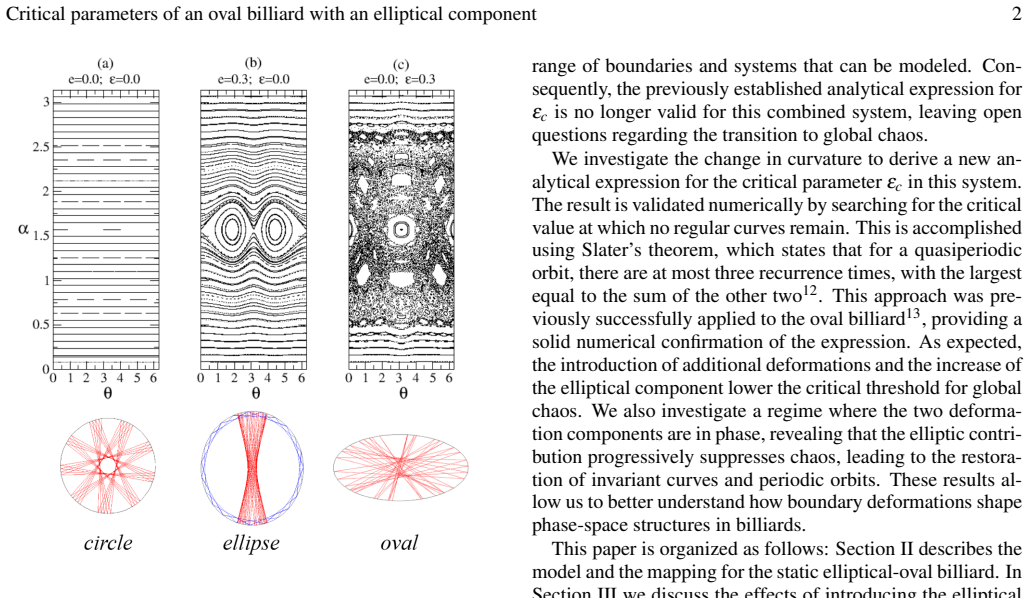
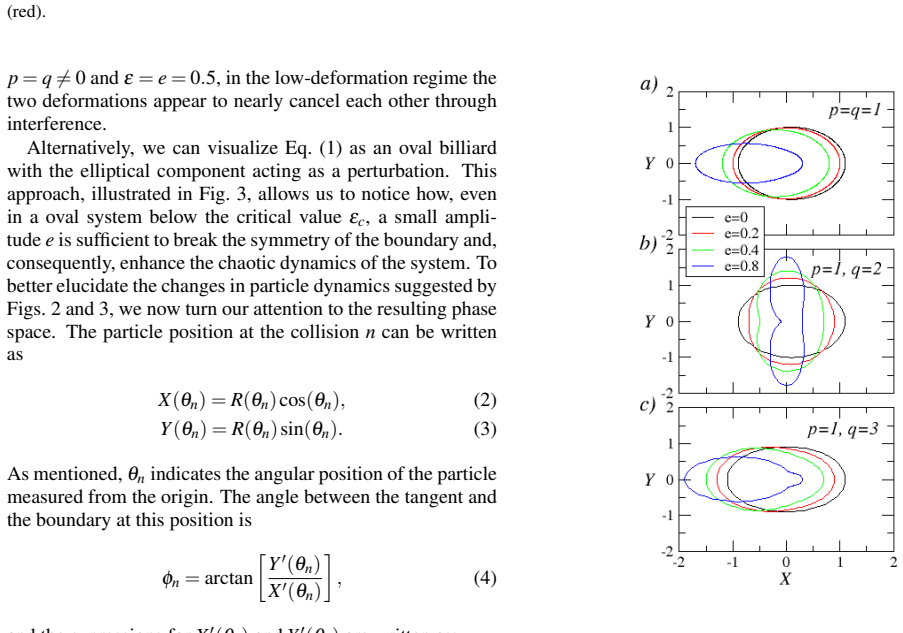
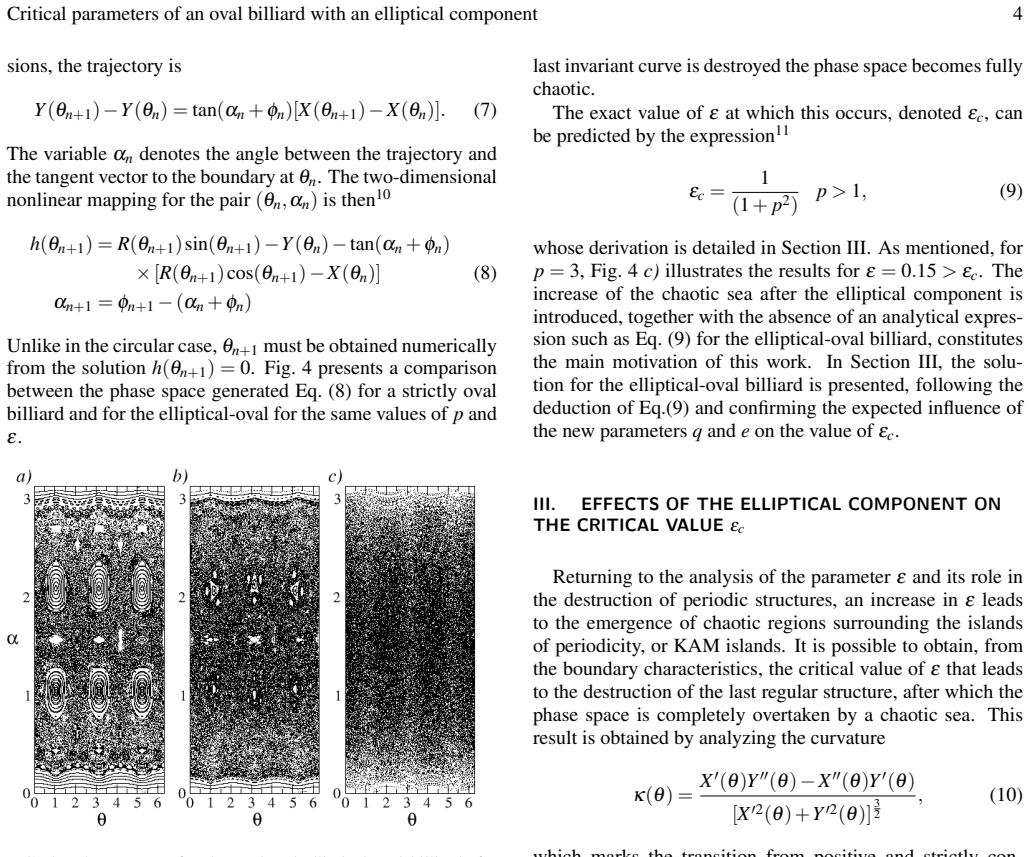
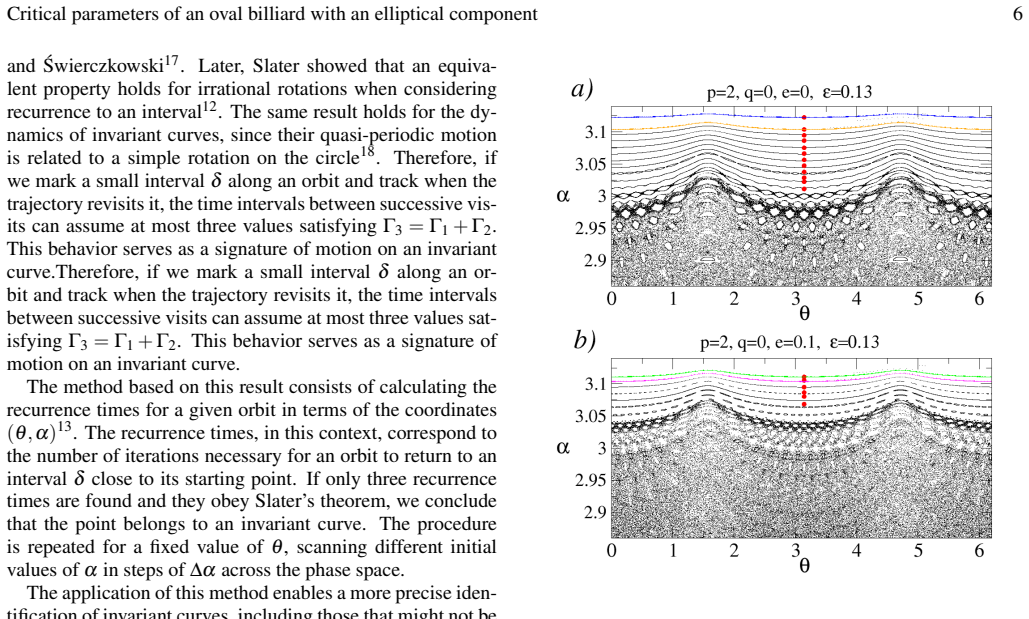
In billiards with a boundary formed by combining elliptical and oval deformations, an analytical formula for the critical parameter is obtained via a first-order approximation; this parameter decreases with increasing elliptical deformation strength, and phase-synchronized deformations allow the elliptical component to suppress chaos and restore regular orbits.
What carries the argument
The effective critical parameter for the combined elliptical-oval deformation, derived from a first-order analytical approximation of the boundary.
If this is right
- Increasing the elliptical deformation lowers the threshold value at which global chaos sets in.
- When the deformations are in phase, the system can regain invariant curves and periodic orbits as the elliptical strength grows.
- The first-order approximation accurately predicts the location of the transition for moderate deformations.
- Numerical confirmation via Slater's theorem matches the analytical critical values.
Where Pith is reading between the lines
- The interplay between different deformation types could be exploited to design billiards with tunable levels of chaos.
- Similar combined perturbations might be studied in other classical Hamiltonian systems to control integrability breaking.
- Testing the approximation at larger deformation values would reveal where higher-order terms become important.
Load-bearing premise
The mixed elliptical and oval boundary deformation admits a single effective critical parameter that can be calculated accurately from a first-order approximation alone.
What would settle it
Numerical simulation locating the last invariant curve at a deformation strength that differs from the value predicted by the analytical formula for a chosen pair of elliptical and oval parameters.
Figures





read the original abstract
We explore the critical parameters responsible for the transition from integrability to chaos in a family of billiards combining elliptical and oval deformations. Unlike standard oval billiards, where a known critical parameter governs the destruction of the last invariant curve, the introduction of an integrable elliptic component yields a second deformation axis. We derive an analytical expression for the critical parameter in this combined system and validate it numerically using Slater's theorem, showing that increasing the elliptical component lowers the critical threshold for global chaos. Moreover, we uncover a previously unexplored regime: when the two deformation components are in phase, the elliptic contribution progressively suppresses chaos, leading to the restoration of invariant curves and periodic orbits. A first-order analytical approximation confirms this behavior, supported by numerical validation. Our results reveal how the interplay between distinct boundary deformations enriches phase-space organization and offers enhanced controllability of chaotic dynamics in billiard systems.
Editorial analysis
A structured set of objections, weighed in public.
Referee Report
Summary. The paper explores the critical parameters for the transition to chaos in a family of billiards that combine elliptical and oval deformations. It derives an analytical expression for the critical parameter in this combined system using a first-order approximation and validates it numerically using Slater's theorem. The results indicate that increasing the elliptical component lowers the critical threshold for global chaos, and when the two deformation components are in phase, the elliptic contribution suppresses chaos, restoring invariant curves and periodic orbits.
Significance. If the first-order approximation holds without significant higher-order corrections, this work provides valuable analytical and numerical insights into how different types of boundary deformations interact to influence the onset of chaos in billiards. It extends previous work on oval billiards and offers a mechanism for controlling chaotic behavior through phase alignment of deformations, which could have implications for understanding phase-space structures in non-integrable systems. The use of Slater's theorem for validation is a positive aspect.
major comments (2)
- [Analytical derivation section] The derivation of the analytical expression for the critical parameter relies on a first-order boundary perturbation. The manuscript should explicitly address whether higher-order terms in the deformation amplitudes shift the critical parameter or alter the suppression of chaos in the in-phase case, as this is central to the claim that the elliptic component progressively suppresses chaos (see the section presenting the analytical derivation and the in-phase regime results).
- [Numerical validation section] It is not clear if the numerical validation with Slater's theorem uses the exact combined boundary or the linearized approximation. A direct comparison or sensitivity analysis to the approximation order would be necessary to confirm the approximation's validity for the combined system, particularly since the central claim requires the leading term to remain accurate.
minor comments (1)
- [Abstract] Clarify the specific form of the derived analytical expression and the range of parameters for which the first-order approximation is claimed to hold.
Simulated Author's Rebuttal
We thank the referee for the careful reading of our manuscript and the constructive comments. We address each major comment below.
read point-by-point responses
-
Referee: [Analytical derivation section] The derivation of the analytical expression for the critical parameter relies on a first-order boundary perturbation. The manuscript should explicitly address whether higher-order terms in the deformation amplitudes shift the critical parameter or alter the suppression of chaos in the in-phase case, as this is central to the claim that the elliptic component progressively suppresses chaos (see the section presenting the analytical derivation and the in-phase regime results).
Authors: The analytical derivation is performed to first order in the deformation amplitudes, as stated in the manuscript. Higher-order terms are not included in the analytical expression. The numerical validation with Slater's theorem is applied to the exact combined boundary (not the linearized approximation), and the agreement with the first-order prediction indicates that higher-order corrections do not significantly shift the critical parameter or reverse the suppression effect within the studied regime. In the in-phase case, both the analytical result and the exact numerical simulations show progressive restoration of invariant curves. We will add an explicit paragraph in the analytical derivation section acknowledging the first-order limitation and the supporting evidence from the exact numerics. revision: yes
-
Referee: [Numerical validation section] It is not clear if the numerical validation with Slater's theorem uses the exact combined boundary or the linearized approximation. A direct comparison or sensitivity analysis to the approximation order would be necessary to confirm the approximation's validity for the combined system, particularly since the central claim requires the leading term to remain accurate.
Authors: The numerical validation applies Slater's theorem directly to the exact combined boundary, which incorporates the full nonlinear elliptical and oval deformations. The analytical critical parameter is the first-order approximation. This distinction will be stated explicitly in the revised numerical validation section. A full sensitivity analysis to higher approximation orders would require deriving second-order perturbative corrections, which lies beyond the first-order scope of the present work; however, the close quantitative match between the first-order analytical expression and the exact numerical results already confirms that the leading term remains accurate for the parameters considered. revision: yes
Circularity Check
No significant circularity; derivation remains independent of inputs
full rationale
The paper derives an analytical first-order expression for the critical parameter of the combined elliptical-oval billiard and validates it separately via Slater's theorem on the exact boundary. No quoted step reduces the claimed critical parameter to a fit, self-definition, or prior self-citation whose content is itself unverified; the numerical search for the last invariant curve is presented as an external check rather than a re-expression of the approximation. The central claim therefore retains independent content beyond its inputs.
Axiom & Free-Parameter Ledger
Reference graph
Works this paper leans on
-
[1]
First Experimental Evidence for Chaos-Assisted Tunneling in a Microwave Annular Billiard , author =. Phys. Rev. Lett. , volume =. 2000 , month =. doi:10.1103/PhysRevLett.84.867 , url =
-
[2]
Light: Science and Applications , volume =
Direct observation of chaotic resonances in optical microcavities , author =. Light: Science and Applications , volume =. 2021 , month =
2021
-
[3]
Philos Trans A Math Phys Eng Sci , volume =
Viana RL and da Silva EC and Kroetz T and Caldas IL and Roberto M and Sanjuán MA , title =. Philos Trans A Math Phys Eng Sci , volume =. 2011 , month =
2011
-
[4]
Barutello, Vivina L and De Blasi, Irene and Terracini, Susanna , title =. 2023 , month =. doi:10.1088/1361-6544/acdec2 , url =
-
[5]
Miao and S
F. Miao and S. Wijeratne and Y. Zhang and U. C. Coskun and W. Bao and C. N. Lau , title =. Science , volume =. 2007 , doi =
2007
-
[6]
A Brief History of Chaos
Predrag Cvitanovic. A Brief History of Chaos. 1989
1989
-
[7]
, title =
Arnold, Vladimir I. , title =. 1989 , edition =
1989
-
[8]
Regular and Chaotic Dynamics
Lichtenberg, AJ and Lieberman, MA. Regular and Chaotic Dynamics. 1992
1992
-
[9]
Chaotic Billiards
Chernov, Nikolai and Markarian, Roberto. Chaotic Billiards. 2006
2006
-
[10]
Leonel, Edson Denis. Time Dependent Billiards. Scaling Laws in Dynamical Systems. 2021. doi:10.1007/978-981-16-3544-1_13
-
[11]
Dynamical chaos: systems of classical mechanics , author =. 2007 , month =. doi:10.1070/PU2007V050N09ABEH006341 , issue =
-
[12]
Berry, MV. Regularity and chaos in classical mechanics, illustrated by three deformations of a circular 'billiard'. European Journal of Physics. 1981. doi:10.1088/0143-0807/2/2/006
-
[13]
Dynamical systems with elastic reflections
Yakov Sinai. Dynamical systems with elastic reflections. Ergodic properties of dispersing billiards. Russian Mathematical Survey. 1970. doi:10.1070/rm1970v025n02abeh003794
-
[14]
Oliveira and Marko Robnik and Edson D
Diego F.M. Oliveira and Marko Robnik and Edson D. Leonel , keywords =. Statistical properties of a dissipative kicked system: Critical exponents and scaling invariance , journal =. 2012 , doi =
2012
-
[15]
Global ballistic acceleration in a bouncing-ball model , author =. Phys. Rev. E , volume =. 2015 , month =. doi:10.1103/PhysRevE.92.012905 , url =
-
[16]
Nonlinear Dynamics and Chaos: With Applications to Physics, Biology, Chemistry, and Engineering
Strogatz, S.H. Nonlinear Dynamics and Chaos: With Applications to Physics, Biology, Chemistry, and Engineering. 2015
2015
-
[17]
Oliveira and Mario R
Diego F.M. Oliveira and Mario R. Silva and Edson D. Leonel , keywords =. A symmetry break in energy distribution and a biased random walk behavior causing unlimited diffusion in a two dimensional mapping , journal =. 2015 , doi =
2015
-
[18]
On the ergodic properties of nowhere dispersing billiards
Bunimovich, LA. On the ergodic properties of nowhere dispersing billiards. Communications in Mathematical Physics. 1979. doi:10.1007/BF01197884
-
[19]
Oliveira and Edson D
Diego F.M. Oliveira and Edson D. Leonel. On the dynamical properties of an elliptical–oval billiard with static boundary. Commun Nonlinear Sci Numer Simulat. 2010
2010
-
[20]
2010 , doi =
Suppressing Fermi acceleration in a two-dimensional non-integrable time-dependent oval-shaped billiard with inelastic collisions , journal =. 2010 , doi =
2010
-
[21]
2025 , doi =
Analysis of invariant spanning curves in oval billiards: A numerical approach based on Slater’s theorem , journal =. 2025 , doi =
2025
-
[22]
Mathematical Proceedings of the Cambridge Philosophical Society , author=
Gaps and steps for the sequence n \ 1 , volume=. Mathematical Proceedings of the Cambridge Philosophical Society , author=. 1967 , pages=. doi:10.1017/S0305004100042195 , number=
-
[23]
On Slater’s criterion for the breakup of invariant curves , journal =. 2015 , issn =. doi:https://doi.org/10.1016/j.physd.2015.06.005 , url =
-
[24]
van Ravenstein , title =
T. van Ravenstein , title =. Journal of the Australian Mathematical Society Series A , volume =
-
[25]
, title =
Slater, Noel B. , title =. Proceedings of the Cambridge Philosophical Society , volume =. 1950 , doi =
1950
-
[26]
On the distribution mod 1 of the sequence n , journal =
S. On the distribution mod 1 of the sequence n , journal =
-
[27]
Annales Universitatis Scientiarum Budapestinensis de Rolando E
Sur. Annales Universitatis Scientiarum Budapestinensis de Rolando E
-
[28]
On successive settings of an arc on the circumference of a circle , journal =
discussion (0)
Sign in with ORCID, Apple, or X to comment. Anyone can read and Pith papers without signing in.