Recognition: unknown
Confirmation of Fe I on MASCARA-5 b's Dayside Observed With EXPRES
Pith reviewed 2026-05-09 20:23 UTC · model grok-4.3
The pith
New EXPRES observations confirm Fe I emission lines from the dayside of ultra-hot Jupiter MASCARA-5 b and an inverted thermal profile.
A machine-rendered reading of the paper's core claim, the machinery that carries it, and where it could break.
Core claim
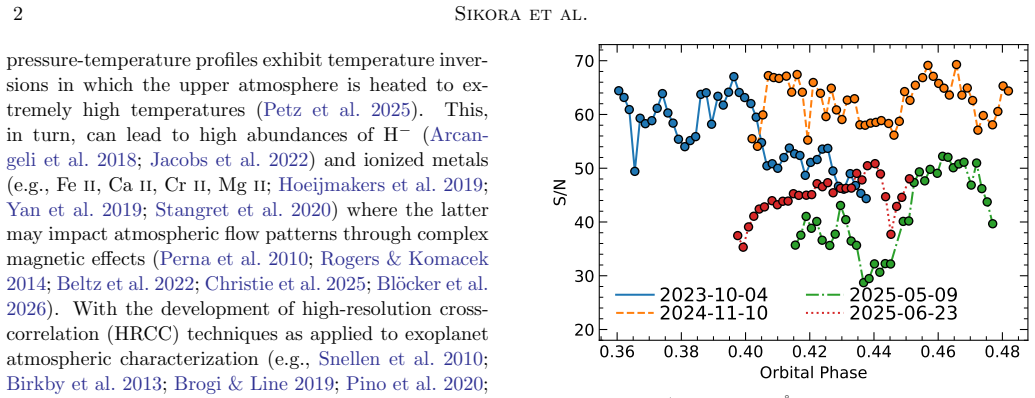
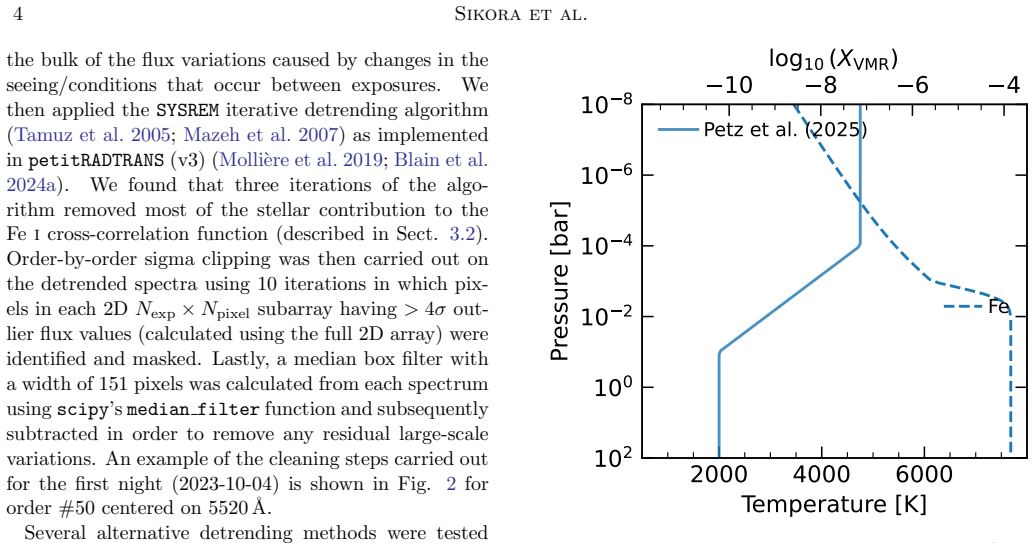
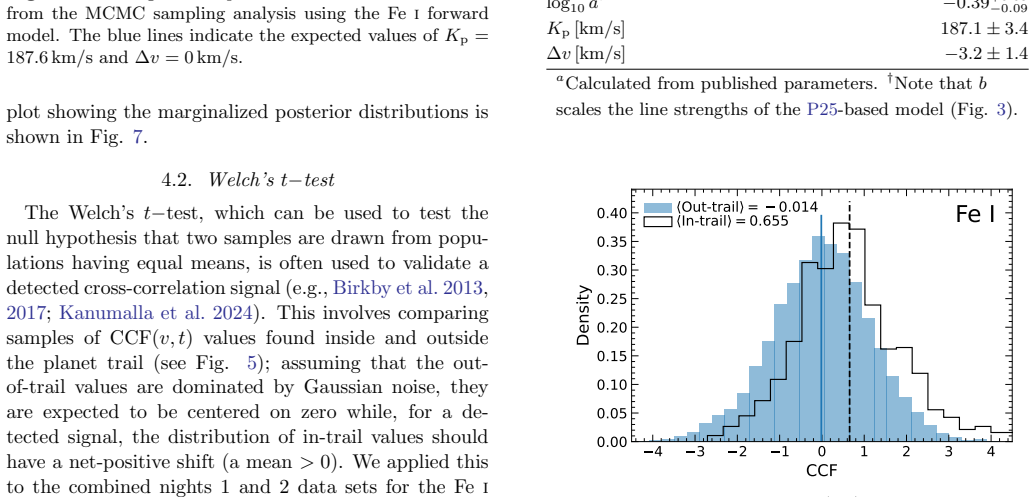
Pre-eclipse observations with EXPRES confirm the previous detection of gas-phase Fe I on MASCARA-5 b's dayside at 5.5 sigma significance from two nights and show that the thermal profile is inverted, with lower temperatures around 2000 K and upper temperatures around 4500 K. Searches for Fe II and Cr I yield no plausible detections. The pre-eclipse signal exhibits a non-negligible blueshift of -3.2 plus or minus 1.4 km/s that may be caused by winds.
What carries the argument
High-resolution emission spectroscopy that isolates atomic line emission from the planet during pre-eclipse phases to probe atmospheric composition and temperature structure.
If this is right
- The inverted temperature profile is robust across independent instruments and multiple nights of data.
- Atmospheric winds are suggested by the consistent blueshift in the pre-eclipse signal.
- Gas-phase iron is present while ionized iron and chromium remain undetected in the observed wavelength range and phases.
- High-resolution dayside spectroscopy can be extended to additional orbital phases to map chemistry and dynamics.
Where Pith is reading between the lines
- Similar observations of other ultra-hot Jupiters could test whether thermal inversions correlate with specific stellar or planetary properties.
- The blueshift measurement provides a starting point for modeling global wind patterns if full-orbit coverage becomes available.
- Absence of Fe II may indicate limited ionization at the probed atmospheric depths, which could be checked with broader wavelength coverage.
Load-bearing premise
The observed emission lines come from the planet's atmosphere rather than stellar activity, telluric lines, or instrumental effects, and a simple two-layer temperature model fully describes the thermal structure.
What would settle it
Repeated observations in which the Fe I lines appear at orbital phases or velocities inconsistent with the planet's known orbit, or match patterns of stellar variability instead, would undermine the planetary-atmosphere origin.
Figures






read the original abstract
MASCARA-5~b/TOI-1431~b is an ultra-hot Jupiter \citep[$P_{\rm orb}=2.650237\pm0.000003\,{\rm d}$, $T_{\rm eq}=2370\pm70\,{\rm K}$, $M_{\rm p}=3.12\pm0.18\,M_{\rm Jup}$, $R_{\rm p}=1.49\pm0.05\,R_{\rm Jup}$;][]{addison2021} orbiting a bright Am star ($V=8.0\,{\rm mag}$). Recent time-series observations obtained with PEPSI@LBT during the planet's post-eclipse phases have revealed Fe~{\sc i} emission lines indicative of a thermally inverted atmosphere. These observations demonstrate that MASCARA-5~b is well-suited to atmospheric characterization via emission spectroscopy, thereby motivating further follow-up observations covering additional orbital phases to constrain the planet's atmospheric chemistry, thermal structure, and dynamics. Here we present pre-eclipse time-series observations obtained with the high-resolution optical spectrograph EXPRES@LDT. Our analysis confirms the previous detection of gas-phase Fe~{\sc i} on MASCARA-5~b's dayside (with a $5.5\sigma$ significance obtained from two nights of observations) and the fact that the thermal profile is inverted with lower and upper temperatures $\sim2000\,{\rm K}$ and $\sim4500\,{\rm K}$, respectively. A search for Fe~{\sc ii} and Cr~{\sc i} did not yield any plausible detections. We also find that the pre-eclipse signal exhibits a non-negligible blueshift of $-3.2\pm1.4\,{\rm km/s}$ potentially caused by winds.
Editorial analysis
A structured set of objections, weighed in public.
Referee Report
Summary. The manuscript presents pre-eclipse time-series observations of the ultra-hot Jupiter MASCARA-5 b obtained with the EXPRES spectrograph on two nights. It confirms the prior detection of Fe I emission lines on the dayside at 5.5σ significance using high-resolution cross-correlation, infers an inverted thermal profile via a simple two-temperature model (lower ~2000 K, upper ~4500 K), reports a blueshift of -3.2 ± 1.4 km/s, and finds no plausible signals from Fe II or Cr I.
Significance. If the detection and modeling hold, this provides an independent confirmation using a different instrument and orbital phases, strengthening evidence for thermal inversions in ultra-hot Jupiters and the value of high-resolution emission spectroscopy. The standard cross-correlation approach and negative results for other species are positive aspects; the minimal two-temperature parameterization is presented only as a demonstration of inversion rather than a full retrieval.
major comments (2)
- [§3] §3 (Data Reduction and Analysis): The 5.5σ significance is reported from the cross-correlation function peak at the expected planetary velocity, but the text does not explicitly state whether this value incorporates corrections for the number of independent velocity trials, template parameter variations, or the two-night combination procedure. This detail is load-bearing for the confirmation claim and should be quantified (e.g., via bootstrap or injection-recovery tests).
- [§4.2] §4.2 (Thermal Profile): The two-temperature model is used to demonstrate inversion, but the manuscript does not show the impact of adding a third temperature layer or additional opacity sources (e.g., TiO or H-) on the fit quality or the derived temperatures. Given that the temperatures are free parameters fitted to the data, a brief sensitivity test would strengthen the claim that the profile is robustly inverted.
minor comments (3)
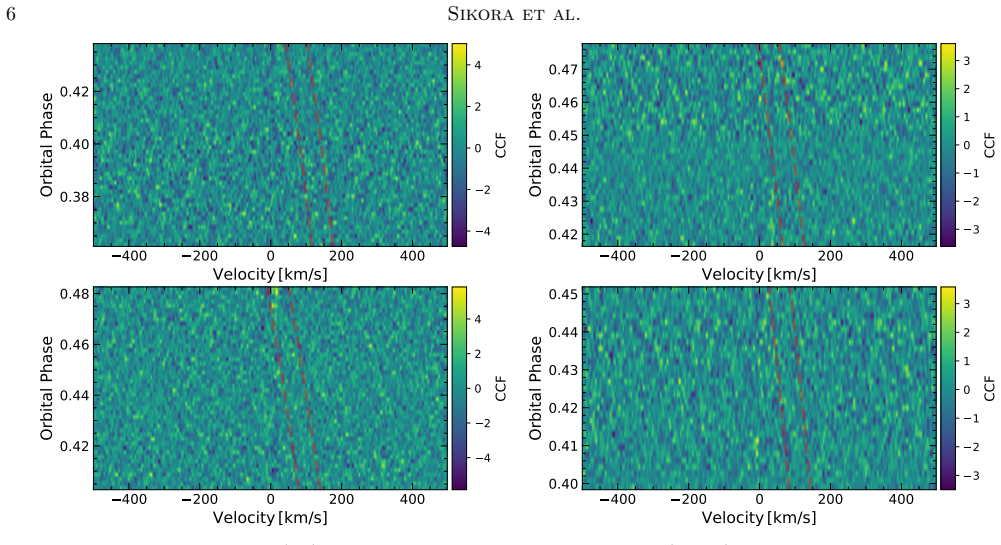
- [Figure 3] Figure 3: The CCF maps and K_p-v_sys plots would benefit from explicit labeling of the expected planetary velocity and the location of the 5.5σ peak to aid visual assessment.
- [Abstract] Abstract and §1: The quoted planetary parameters (P_orb, T_eq, etc.) are cited to Addison et al. (2021) but the uncertainties are not carried through to the discussion of the blueshift or temperature values.
- [§2] §2: The description of the EXPRES data reduction pipeline is brief; a short statement on the handling of telluric correction and stellar activity removal would improve reproducibility.
Simulated Author's Rebuttal
We thank the referee for their positive assessment and recommendation for minor revision. We address each major comment below and have updated the manuscript accordingly.
read point-by-point responses
-
Referee: [§3] §3 (Data Reduction and Analysis): The 5.5σ significance is reported from the cross-correlation function peak at the expected planetary velocity, but the text does not explicitly state whether this value incorporates corrections for the number of independent velocity trials, template parameter variations, or the two-night combination procedure. This detail is load-bearing for the confirmation claim and should be quantified (e.g., via bootstrap or injection-recovery tests).
Authors: We thank the referee for this important clarification request. The reported 5.5σ was derived from the peak amplitude in the two-night combined CCF divided by the empirical standard deviation measured in velocity bins distant from the expected planetary signal. To explicitly address multiple trials (~200 independent velocities), template variations, and the combination procedure, we have performed bootstrap resampling of the time-series spectra and injection-recovery tests across a range of template parameters. These confirm the detection significance remains above 5σ after corrections. We will revise §3 to describe the procedure and report the test results. revision: yes
-
Referee: [§4.2] §4.2 (Thermal Profile): The two-temperature model is used to demonstrate inversion, but the manuscript does not show the impact of adding a third temperature layer or additional opacity sources (e.g., TiO or H-) on the fit quality or the derived temperatures. Given that the temperatures are free parameters fitted to the data, a brief sensitivity test would strengthen the claim that the profile is robustly inverted.
Authors: We agree that a sensitivity test would be beneficial. The two-temperature parameterization is presented strictly as a minimal demonstration of inversion, not a full retrieval, which limits the utility of more complex models given the data. We will add a brief sensitivity analysis to the revised §4.2, testing a three-layer model and the inclusion of H- opacity. The results show that the requirement for an inversion persists with temperatures consistent within uncertainties, while additional parameters remain poorly constrained. This addition will strengthen the robustness statement without altering the paper's scope. revision: yes
Circularity Check
No significant circularity in the derivation chain
full rationale
The paper's central claims rest on new pre-eclipse EXPRES observations from two nights, analyzed via standard high-resolution cross-correlation to recover a 5.5σ Fe I emission signal at the expected planetary velocity (with measured blueshift). The inverted thermal profile is demonstrated by fitting a minimal two-temperature parameterization directly to the observed line strengths, yielding approximate values of ~2000 K and ~4500 K. No step reduces by construction to a prior fit or self-citation; the detection significance and model parameters are outputs of the new data reduction rather than inputs. Self-citations (e.g., to planet parameters) are peripheral and non-load-bearing. The derivation chain is therefore data-driven and externally falsifiable against the raw spectra.
Axiom & Free-Parameter Ledger
free parameters (2)
- lower atmospheric temperature =
~2000 K
- upper atmospheric temperature =
~4500 K
axioms (2)
- domain assumption Observed spectral features are planetary emission lines from Fe I rather than stellar or telluric contamination
- standard math Planetary and stellar parameters from Addison et al. 2021 are accurate inputs for phase and velocity calculations
Reference graph
Works this paper leans on
-
[1]
C., Knudstrup, E., Wong, I., et al
Addison, B. C., Knudstrup, E., Wong, I., et al. 2021, AJ, 162, 292, doi: 10.3847/1538-3881/ac224e
-
[2]
The Astrophysical Journal , author =
Arcangeli, J., D´ esert, J.-M., Line, M. R., et al. 2018, ApJ, 855, L30, doi: 10.3847/2041-8213/aab272 14Sikora et al. Astropy Collaboration, Robitaille, T. P., Tollerud, E. J., et al. 2013, ˚ ap, 558, A33, doi: 10.1051/0004-6361/201322068 Astropy Collaboration, Price-Whelan, A. M., Sip\Hocz, B. M., et al. 2018,\aj, 156, 123, doi: 10.3847/1538-3881/aabc4f...
-
[3]
Beltz, H., & Rauscher, E. 2024, Comparative Planetology of Magnetic Effects in Ultrahot Jupiters: Trends in High Resolution Spectroscopy, arXiv. https://arxiv.org/abs/2409.13840
-
[4]
Beltz, H., Rauscher, E., Brogi, M., & Kempton, E. M.-R. 2020, AJ, 161, 1, doi: 10.3847/1538-3881/abb67b
-
[5]
Beltz, H., Rauscher, E., Kempton, E. M.-R., et al. 2022, AJ, 164, 140, doi: 10.3847/1538-3881/ac897b
- [6]
-
[7]
Birkby, J. L., De Kok, R. J., Brogi, M., et al. 2013, Monthly Notices of the Royal Astronomical Society: Letters, 436, L35, doi: 10.1093/mnrasl/slt107
-
[8]
Snellen, I. A. G. 2017, AJ, 153, 138, doi: 10.3847/1538-3881/aa5c87
-
[9]
Jurgenson, C. A. 2017, ApJ, 837, 18, doi: 10.3847/1538-4357/aa5ead
-
[10]
Blackman, R. T., Fischer, D. A., Jurgenson, C. A., et al. 2020, AJ, 159, 238, doi: 10.3847/1538-3881/ab811d
-
[11]
2024a, JOSS, 9, 7028, doi: 10.21105/joss.07028
Blain, D., Molli` ere, P., & Nasedkin, E. 2024a, JOSS, 9, 7028, doi: 10.21105/joss.07028
-
[12]
2024b, AJ, 167, 179, doi: 10.3847/1538-3881/ad2c8b Bl¨ ocker, A., Carone, L., & Helling, C
Blain, D., S´ anchez-L´ opez, A., & Molli` ere, P. 2024b, AJ, 167, 179, doi: 10.3847/1538-3881/ad2c8b Bl¨ ocker, A., Carone, L., & Helling, C. 2026, Inhomogeneous Magnetic Coupling in Exoplanets: The Stop & Go of WASP-18 b’s Atmospheric Flows, arXiv, doi: 10.48550/arXiv.2602.18101
-
[13]
Brogi, M., de Kok, R. J., Albrecht, S., et al. 2016, ApJ, 817, 106, doi: 10.3847/0004-637X/817/2/106
-
[14]
Snellen, I. A. G. 2014, A&A, 565, A124, doi: 10.1051/0004-6361/201423537
-
[15]
2017, ApJ, 839, L2, doi: 10.3847/2041-8213/aa6933
Brogi, M., Line, M., Bean, J., D´ esert, J.-M., & Schwarz, H. 2017, ApJ, 839, L2, doi: 10.3847/2041-8213/aa6933
-
[16]
Brogi, M., & Line, M. R. 2019, AJ, 157, 114, doi: 10.3847/1538-3881/aaffd3
-
[17]
Brogi, M., Emeka-Okafor, V., Line, M. R., et al. 2023, AJ, 165, 91, doi: 10.3847/1538-3881/acaf5c
-
[18]
2019, Monthly Notices of the Royal Astronomical Society, 482, 4422, doi: 10.1093/mnras/sty2994
Gandhi, S. 2019, Monthly Notices of the Royal Astronomical Society, 482, 4422, doi: 10.1093/mnras/sty2994
-
[19]
Kohary, K. 2025, Monthly Notices of the Royal Astronomical Society, 541, 2773, doi: 10.1093/mnras/staf1146 Costa Silva, A., Demangeon, O. D. S., Santos, N. C., et al. 2024, A&A, 689, A8, doi: 10.1051/0004-6361/202449935
-
[20]
Flowers, E., Brogi, M., Rauscher, E., Kempton, E. M.-R., & Chiavassa, A. 2019, AJ, 157, 209, doi: 10.3847/1538-3881/ab164c
-
[21]
Publications of the Astronomical Society of the Pacific , author =
Foreman-Mackey, D., Hogg, D. W., Lang, D., & Goodman, J. 2013, Publications of the Astronomical Society of the Pacific, 125, 306, doi: 10.1086/670067
-
[22]
The Journal of Open Source Software , keywords =
Foreman-Mackey, D., Farr, W. M., Sinha, M., et al. 2019, JOSS, 4, 1864, doi: 10.21105/joss.01864
-
[23]
2023, AJ, 165, 242, doi: 10.3847/1538-3881/accd65
Gandhi, S., Kesseli, A., Zhang, Y., et al. 2023, AJ, 165, 242, doi: 10.3847/1538-3881/accd65
-
[24]
Gelman, A., & Rubin, D. B. 1992, Statistical Science, 7, 457, doi: 10.1214/ss/1177011136
-
[25]
P., Nugroho, S
Gibson, N. P., Nugroho, S. K., Lothringer, J., Maguire, C., & Sing, D. K. 2022, 21
2022
-
[26]
Gibson, N. P., Merritt, S., Nugroho, S. K., et al. 2020, Monthly Notices of the Royal Astronomical Society, 493, 2215, doi: 10.1093/mnras/staa228
-
[27]
arXiv , author =:1006.4702 , journal =
Guillot, T. 2010, A&A, 520, A27, doi: 10.1051/0004-6361/200913396
-
[28]
Harris, C. R., Millman, K. J., van der Walt, S. J., et al. 2020, Nature, 585, 357, doi: 10.1038/s41586-020-2649-2
-
[29]
2018, ApJ, 863, L11, doi: 10.3847/2041-8213/aac49d
Gandhi, S. 2018, ApJ, 863, L11, doi: 10.3847/2041-8213/aac49d
-
[30]
Hoeijmakers, H. J., Ehrenreich, D., Heng, K., et al. 2018, Nature, 560, 453, doi: 10.1038/s41586-018-0401-y
-
[31]
Hoeijmakers, H. J., Ehrenreich, D., Kitzmann, D., et al. 2019, A&A, 627, A165, doi: 10.1051/0004-6361/201935089
-
[32]
Hoeijmakers, H. J., Cabot, S. H. C., Zhao, L., et al. 2020, A&A, 641, A120, doi: 10.1051/0004-6361/202037437
-
[33]
Hunter, J. D. 2007, Computing in Science & Engineering, 9, 90, doi: 10.1109/MCSE.2007.55
-
[34]
2022, A&A, 668, L1, doi: 10.1051/0004-6361/202244533
Jacobs, B., D´ esert, J.-M., Pino, L., et al. 2022, A&A, 668, L1, doi: 10.1051/0004-6361/202244533
-
[35]
Ground-based and Airborne Instrumentation for Astronomy VI , year = 2016, editor =
Jurgenson, C., Fischer, D., McCracken, T., et al. 2016, in SPIE Astronomical Telescopes + Instrumentation, ed. C. J. Evans, L. Simard, & H. Takami, Edinburgh, United Kingdom, 99086T, doi: 10.1117/12.2233002 EXPRES Detection of Fe i on MASCARA-5 b15
-
[36]
R., Weiner Mansfield, M., et al
Kanumalla, K., Line, M. R., Weiner Mansfield, M., et al. 2024, AJ, 168, 201, doi: 10.3847/1538-3881/ad72f3
-
[37]
Kasper, D., Bean, J. L., Line, M. R., et al. 2021, ApJL, 921, L18, doi: 10.3847/2041-8213/ac30e1
-
[38]
Kesseli, A. Y., Snellen, I. A. G., Casasayas-Barris, N., Molli` ere, P., & S´ anchez-L´ opez, A. 2022, AJ, 163, 107, doi: 10.3847/1538-3881/ac4336
-
[39]
2026, ApJS, 283, 5, doi: 10.3847/1538-4365/ae3238
Kokori, A., Tsiaras, A., Pantelidou, G., et al. 2026, ApJS, 283, 5, doi: 10.3847/1538-4365/ae3238
-
[40]
Leet, C., Fischer, D. A., & Valenti, J. A. 2019, AJ, 157, 187, doi: 10.3847/1538-3881/ab0d86
-
[41]
Levine, S. E., Bida, T. A., Chylek, T., et al. 2012, in Society of Photo-Optical Instrumentation Engineers (SPIE) Conference Series, Vol. 8444, Ground-Based and Airborne Telescopes IV, ed. L. M. Stepp, R. Gilmozzi, & H. J. Hall, 844419, doi: 10.1117/12.926415
-
[42]
Line, M. R., Brogi, M., Bean, J. L., et al. 2021, Nature, 598, 580, doi: 10.1038/s41586-021-03912-6
-
[43]
Malsky, I., Rauscher, E., Kempton, E. M.-R., et al. 2021, ApJ, 923, 62, doi: 10.3847/1538-4357/ac2a2a
-
[44]
2007, in Astronomical Society of the Pacific Conference Series, Vol
Mazeh, T., Tamuz, O., & Zucker, S. 2007, in Astronomical Society of the Pacific Conference Series, Vol. 366, Transiting Extrapolar Planets Workshop, ed. C. Afonso, D. Weldrake, & Th. Henning, 119, doi: 10.48550/arXiv.astro-ph/0612418 Molli` ere, P., Wardenier, J. P., van Boekel, R., et al. 2019, A&A, 627, A67, doi: 10.1051/0004-6361/201935470
-
[45]
2023, Nature, 619, 491, doi: 10.1038/s41586-023-06134-0
Pelletier, S., Benneke, B., Ali-Dib, M., et al. 2023, Nature, doi: 10.1038/s41586-023-06134-0
-
[46]
2010, ApJ, 719, 1421, doi: 10.1088/0004-637x/719/2/1421
Perna, R., Menou, K., & Rauscher, E. 2010, ApJ, 719, 1421, doi: 10.1088/0004-637x/719/2/1421
-
[47]
Petersburg, R. R., Joel Ong, J. M., Zhao, L. L., et al. 2020, AJ, 159, 187, doi: 10.3847/1538-3881/ab7e31
-
[48]
Petz, S., Johnson, M. C., Asnodkar, A. P., et al. 2025, AJ, 169, 267, doi: 10.3847/1538-3881/adc411
-
[49]
Pino, L., D´ esert, J. M., Brogi, M., et al. 2020, ApJ, 894, L27, doi: 10.3847/2041-8213/ab8c44
-
[50]
Pino, L., Brogi, M., D´ esert, J. M., et al. 2022, A&A, 668, A176, doi: 10.1051/0004-6361/202244593
-
[51]
Renson, P., Gerbaldi, M., & Catalano, F. A. 1991, 89, 429
1991
-
[52]
Rogers, T. M., & Komacek, T. D. 2014, ApJ, 794, 132, doi: 10.1088/0004-637X/794/2/132
-
[53]
Smith, P. C. B., Sanchez, J. A., Line, M. R., et al. 2024, AJ, 168, 293, doi: 10.3847/1538-3881/ad8574
-
[54]
Snellen, I. A. G., Brandl, B. R., De Kok, R. J., et al. 2014, Nature, 509, 63, doi: 10.1038/nature13253
-
[55]
Albrecht, S. 2010, Nature, 465, 1049, doi: 10.1038/nature09111
-
[56]
2020, A&A, 638, A26, doi: 10.1051/0004-6361/202037541
Stangret, M., Casasayas-Barris, N., Pall´ e, E., et al. 2020, A&A, 638, A26, doi: 10.1051/0004-6361/202037541
-
[57]
2021, A&A, 654, A73, doi: 10.1051/0004-6361/202040100
Stangret, M., Pall´ e, E., Casasayas-Barris, N., et al. 2021, A&A, 654, A73, doi: 10.1051/0004-6361/202040100
-
[58]
Stock, J. W., Kitzmann, D., Patzer, A. B. C., & Sedlmayr, E. 2018, Monthly Notices of the Royal Astronomical Society, doi: 10.1093/mnras/sty1531
-
[59]
Monthly Notices of the Royal Astronomical Society , author =
Tamuz, O., Mazeh, T., & Zucker, S. 2005, Monthly Notices of the Royal Astronomical Society, 356, 1466, doi: 10.1111/j.1365-2966.2004.08585.x van Sluijs, L., Birkby, J. L., Lothringer, J., et al. 2023, Monthly Notices of the Royal Astronomical Society, 522, 2145, doi: 10.1093/mnras/stad1103
-
[60]
Virtanen, P., Gommers, R., Oliphant, T. E., et al. 2020, Nature Methods, 17, 261, doi: 10.1038/s41592-019-0686-2
-
[61]
Wardenier, J. P., Parmentier, V., Lee, E. K. H., & Line, M. R. 2025, ApJ, 986, 63, doi: 10.3847/1538-4357/add341
-
[62]
2019, arXiv:1911.00380 [astro-ph]
Yan, F., Casasayas-Barris, N., Molaverdikhani, K., et al. 2019, arXiv:1911.00380 [astro-ph]. https://arxiv.org/abs/1911.00380
-
[63]
2020, A&A, 640, L5, doi: 10.1051/0004-6361/202038294
Yan, F., Pall´ e, E., Reiners, A., et al. 2020, A&A, 640, L5, doi: 10.1051/0004-6361/202038294
-
[64]
Yan, F., Nortmann, L., Reiners, A., et al. 2023, CRIRES+ Detection of CO Emissions Lines and Temperature Inversions on the Dayside of WASP-18b and WASP-76b, arXiv. https://arxiv.org/abs/2302.08736
-
[65]
2014, A&A, 561, A59, doi: 10.1051/0004-6361/201322746
Zechmeister, M., Anglada-Escud´ e, G., & Reiners, A. 2014, A&A, 561, A59, doi: 10.1051/0004-6361/201322746
-
[66]
Zhang, J., Kempton, E. M.-R., & Rauscher, E. 2017, ApJ, 851, 84, doi: 10.3847/1538-4357/aa9891
discussion (0)
Sign in with ORCID, Apple, or X to comment. Anyone can read and Pith papers without signing in.