Recognition: unknown
Development of Ultra High Power Compact X-Band Pulse Compressor
Pith reviewed 2026-05-09 19:43 UTC · model grok-4.3
The pith
A compact X-band pulse compressor using spherical cavities with TE modes reaches 317 MW peak power in 27 ns pulses.
A machine-rendered reading of the paper's core claim, the machinery that carries it, and where it could break.
Core claim
The authors constructed and tested at SLAC a compact pulse compressor made of two spherical cavities supporting axially symmetric TE modes together with a waveguide hybrid, all using TE01 circular waveguide ports. High-power experiments compressed 52 MW input pulses lasting 1 microsecond into a peak power of 317 MW with a full-width at half-maximum of 27 ns, confirming the low surface-field design.
What carries the argument
Spherical cavities supporting axially symmetric TE modes, paired with a waveguide hybrid, which minimize surface electric fields while performing pulse compression.
If this is right
- The compressor supplies the short-pulse high peak power needed to drive high-gradient X-band photoinjectors.
- It offers a route to higher peak powers for RF deflectors and other short-pulse applications in free-electron lasers.
- The approach demonstrates a compact geometry that can be integrated with existing klystrons to reach the high-gradient short-pulse regime.
Where Pith is reading between the lines
- The same low-surface-field spherical-cavity approach could be scaled or adapted to other frequencies where compact high-power handling is needed.
- If the no-breakdown behavior holds over long operation, the design may reduce maintenance and increase uptime in accelerator facilities.
Load-bearing premise
The cavities keep surface electric fields low enough to avoid breakdown when operating at the demonstrated power levels.
What would settle it
A high-power test run at or above 317 MW peak power that shows electrical breakdown inside the spherical cavities or measured fields higher than expected from the TE mode design.
Figures


read the original abstract
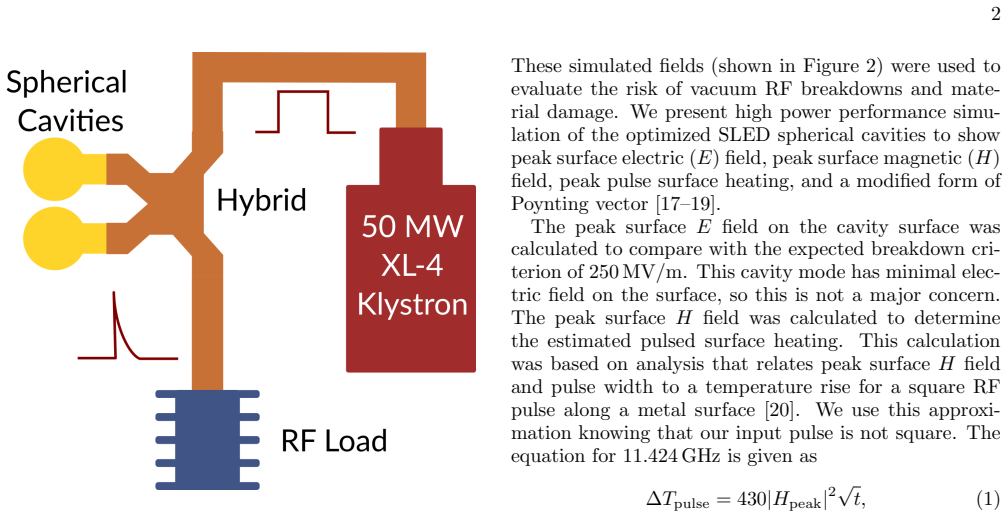
We demonstrate a new 11.424 GHz SLED-type RF pulse compressor for powering high-gradient X-band photoinjectors with pulse lengths around 20 ns. RF pulse compression provides a practical path to higher peak power at the cost of pulse length for various applications such as RF deflectors for electron beam diagnostics on free electron lasers. Our new compact pulse compressor uses spherical cavities supporting axially symmetric TE modes which have minimal electric fields on the cavity surfaces, intended to improve high-power robustness as compared to existing compact spherical SLEDs which use a TE dipole mode. We present the design of this pulse compressor composed of two spherical cavities and a waveguide hybrid. The two cavities and hybrid have TE01 circular waveguide ports. This pulse compressor was built and high power tested at SLAC. These tests demonstrated a peak power of 317 MW by compressing 52 MW, 1 {\mu}s pulses generated by a SLAC XL-4 klystron. The full-width at half-maximum of this compressed pulse was 27 ns. We conjecture that this development demonstrates a viable route to reaching the high-gradient, short pulse regime for accelerating structures and RF photoinjectors.
Editorial analysis
A structured set of objections, weighed in public.
Referee Report
Summary. The manuscript presents the design, fabrication, and high-power testing of a compact 11.424 GHz SLED-type RF pulse compressor consisting of two spherical cavities supporting axially symmetric TE modes plus a waveguide hybrid, all with TE01 ports. It reports successful compression of 52 MW, 1 μs input pulses from a SLAC XL-4 klystron to 317 MW peak power with 27 ns FWHM without breakdown, and conjectures that the geometry offers a viable path to the high-gradient short-pulse regime for photoinjectors and accelerators.
Significance. If the reported performance holds, this work provides a concrete experimental demonstration of ultra-high-power compact pulse compression with reduced surface electric fields, directly addressing robustness challenges in X-band high-gradient applications. The SLAC test data (317 MW peak, 27 ns width) supplies a measurable benchmark and supports the design choice of axially symmetric TE modes over dipole alternatives. This strengthens the case for practical short-pulse RF sources in FEL diagnostics and photoinjectors.
major comments (1)
- [High-power test results] High-power test results section: The central claim of 317 MW peak power from 52 MW input is presented as a direct measurement, but the manuscript provides no description of the power calibration procedure, diagnostic setup, or uncertainty quantification. This detail is load-bearing for validating the exact compression ratio and pulse width metrics.
minor comments (3)
- [Design section] The rationale for selecting axially symmetric TE modes is stated qualitatively as minimizing surface fields, but a table or calculation comparing peak surface E-fields to prior TE dipole compact SLED designs would clarify the improvement.
- [Conclusion] The concluding conjecture on viability for the high-gradient regime would benefit from a short discussion of potential limitations, such as long-term reliability or scaling to higher repetition rates, even if preliminary.
- [Abstract and figures] Figure captions and the abstract use 'ultra high power' without a brief comparison to existing X-band compressor performance levels for context.
Simulated Author's Rebuttal
We thank the referee for the positive assessment of our work and the recommendation for minor revision. The single major comment is addressed below with a revision to the manuscript.
read point-by-point responses
-
Referee: [High-power test results] High-power test results section: The central claim of 317 MW peak power from 52 MW input is presented as a direct measurement, but the manuscript provides no description of the power calibration procedure, diagnostic setup, or uncertainty quantification. This detail is load-bearing for validating the exact compression ratio and pulse width metrics.
Authors: We agree that additional detail on the power diagnostics is necessary to substantiate the reported compression performance. In the revised manuscript we have inserted a new paragraph in the high-power test results section that describes the measurement chain: input and output powers were monitored with calibrated 40 dB directional couplers whose coupling factors were verified with a vector network analyzer prior to installation; the coupled signals were detected by crystal detectors whose response was linearized and calibrated against a known low-power reference; the compressed pulse envelope was recorded on a 20 GS/s real-time oscilloscope. Uncertainty is quantified as ±5 % on peak power, arising from coupler directivity (±1 dB) and detector calibration accuracy (±3 %). These additions directly support the stated 317 MW / 52 MW ratio and 27 ns FWHM without altering any numerical results. revision: yes
Circularity Check
No significant circularity; experimental result stands alone
full rationale
The paper's central claim is an experimental measurement: a fabricated device using two spherical cavities and a waveguide hybrid compressed 52 MW, 1 μs input pulses from an external XL-4 klystron to a measured 317 MW peak with 27 ns FWHM. No derivation chain, prediction, or uniqueness theorem is invoked that reduces by construction to fitted parameters, self-citations, or ansatzes within the paper. Design choices (axially symmetric TE modes for minimal surface fields) are motivated by physical reasoning and validated by high-power testing at SLAC without breakdown; the result does not rely on renaming known patterns or importing load-bearing premises from prior self-work. The derivation is therefore self-contained against external benchmarks.
Axiom & Free-Parameter Ledger
axioms (2)
- standard math Standard Maxwell-equation solutions for TE modes in spherical cavities yield low surface electric fields when the mode is axially symmetric.
- domain assumption Pulse compression via resonant cavities can increase peak power at the expense of pulse length without introducing new loss mechanisms beyond those in conventional SLED systems.
Reference graph
Works this paper leans on
-
[1]
B. E. Carlsten, R. L. Sheffield, and B. D. McVey, Photo- electric injector designs at los alamos national laboratory (1989)
1989
-
[2]
V. A. Dolgashev, Applied Sciences13, 10.3390/app131910849 (2023)
-
[3]
W. H. Tan, S. Antipov, D. S. Doran, G. Ha, C. Jing, E. Knight, S. Kuzikov, W. Liu, X. Lu, P. Piot, J. G. Power, J. Shao, C. Whiteford, and E. E. Wisniewski, Phys. Rev. Accel. Beams25, 083402 (2022)
2022
- [4]
-
[5]
F. Wang, C. Adolphsen, and C. Nantista, AIP Conf. Proc.1299, 280 (2010)
2010
-
[6]
Farkas, Microwave developments at slac (2018)
Z. Farkas, Microwave developments at slac (2018)
2018
-
[7]
S. G. Tantawi, C. D. Nantista, V. A. Dolgashev, C. Pear- son, J. Nelson, K. Jobe, J. Chan, K. Fant, J. Frisch, and D. Atkinson, Phys. Rev. ST Accel. Beams8, 042002 (2005)
2005
-
[8]
Franzi, J
M. Franzi, J. Wang, V. Dolgashev, and S. Tantawi, Phys. Rev. Accel. Beams19, 062002 (2016)
2016
-
[9]
J. W. Wang, S. G. Tantawi, C. Xu, M. Franzi, P. Krej- cik, G. Bowden, S. Condamoor, Y. Ding, V. Dolgashev, J. Eichner, A. Haase, J. R. Lewandowski, and L. Xiao, Phys. Rev. Accel. Beams20, 110401 (2017)
2017
-
[10]
Dolgashev, H
V. Dolgashev, H. Bassan, S. Condamoor, A. Haase, P. Krejcik, T. Maxwell, and J. Wang, JACoW IBIC2021, WEPP18 (2021)
2021
-
[11]
X. Lin, H. Zha, J. Shi, Y. Jiang, F. Hu, W. Gu, Q. Gao, and H. Chen, Phys. Rev. Accel. Beams25, 120401 (2022)
2022
-
[12]
Jiang, J
Y. Jiang, J. Shi, P. Wang, H. Zha, X. Lin, F. Liu, C. Cheng, and H. Chen, IEEE Transactions on Mi- crowave Theory and Techniques69, 4533 (2021)
2021
-
[13]
Caryotakis, The x-band klystron program at slac (1996)
G. Caryotakis, The x-band klystron program at slac (1996)
1996
-
[14]
C. D. Nantista, AIP Conf. Proc.691, 263 (2003)
2003
-
[15]
Yeddulla, S
M. Yeddulla, S. Tantawi, J. Guo, and V. Dolgashev, IEEE Transactions on Microwave Theory and Techniques 57, 1516 (2009)
2009
-
[16]
Ansys, Ansys hfss,https://www.ansys.com/(2023)
2023
-
[17]
Nantista, S
C. Nantista, S. Tantawi, and V. Dolgashev, Phys. Rev. ST Accel. Beams7, 072001 (2004)
2004
-
[18]
K. N. Sjobak, A. Grudiev, and E. Adli, in27th In- ternational Linear Accelerator Conference(2014) p. MOPP028
2014
-
[19]
Grudiev, S
A. Grudiev, S. Calatroni, and W. Wuensch, Physical Re- view Special Topics-Accelerators and Beams12, 102001 (2009)
2009
-
[20]
D. P. Pritzkau and R. H. Siemann, Phys. Rev. ST Accel. Beams5, 112002 (2002)
2002
-
[21]
Laurent, S
L. Laurent, S. Tantawi, V. Dolgashev, C. Nantista, Y. Hi- gashi, M. Aicheler, S. Heikkinen, and W. Wuensch, Phys. Rev. ST Accel. Beams14, 041001 (2011)
2011
-
[22]
J. C. Slater, Rev. Mod. Phys.18, 441 (1946)
1946
-
[23]
National Instruments,LabVIEW, National Instruments Corporation, Austin, TX (2024), system Design Soft- ware
2024
-
[24]
W. H. Tan, R. Robles, J. Hernandez, E. A. Nanni, and A. Dhar, Nanosecond radio-frequency pulse driven photogun for very hard x-ray free-electron laser (2025), arXiv:2511.07592 [physics.acc-ph]
work page internal anchor Pith review Pith/arXiv arXiv 2025
discussion (0)
Sign in with ORCID, Apple, or X to comment. Anyone can read and Pith papers without signing in.