Recognition: unknown
FieryGS: In-the-Wild Fire Synthesis with Physics-Integrated Gaussian Splatting
Pith reviewed 2026-05-09 19:48 UTC · model grok-4.3
The pith
FieryGS integrates combustion physics into 3D Gaussian Splatting to generate realistic, controllable fire directly in reconstructed real-world scenes.
A machine-rendered reading of the paper's core claim, the machinery that carries it, and where it could break.
Core claim
By coupling a multimodal large-language-model module that reasons about material combustibility with an efficient volumetric combustion simulator and a renderer that operates jointly on both fire and scene Gaussians, the framework automatically produces flame propagation, smoke dispersion, and surface carbonization that remain consistent with the reconstructed geometry and inferred material properties.
What carries the argument
The three-module pipeline that links language-model material reasoning, volumetric combustion simulation, and unified rendering inside the 3D Gaussian Splatting representation.
If this is right
- Fire effects can be added to any 3D Gaussian Splatting reconstruction without manual geometry creation or parameter tuning.
- Complex combustion phenomena such as flame spread, smoke movement, and surface charring arise automatically from the simulation.
- Users retain precise control over parameters including fire intensity, ignition location, and airflow while the results stay physically grounded.
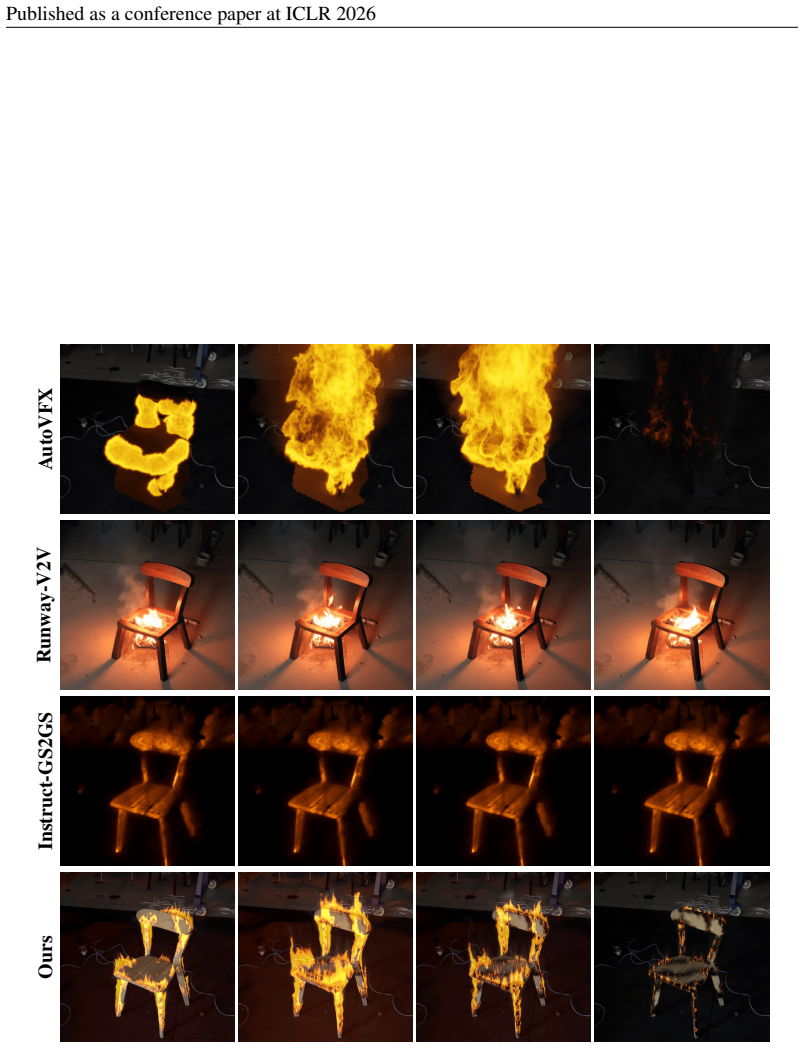
- The method produces higher visual realism and physical fidelity than prior separate reconstruction and simulation pipelines on diverse indoor and outdoor scenes.
Where Pith is reading between the lines
- The same coupling of inference, simulation, and rendering could be applied to other dynamic effects such as fluid flow or material degradation within the same scene representations.
- If the material-reasoning step generalizes, the framework could support predictive uses such as safety planning or virtual training where fire outcomes must be consistent with real geometry.
- A direct comparison against scenes with known ground-truth material properties would test how sensitive the overall fire output is to small errors in the language-model inference.
Load-bearing premise
The language model correctly infers combustion-relevant material properties from scene images so that simulation errors do not accumulate.
What would settle it
A controlled test in which independently measured material properties of a real scene are compared against the model's inferences, followed by side-by-side visual and quantitative comparison of the simulated fire behavior against recorded footage from the same scene.
Figures





read the original abstract
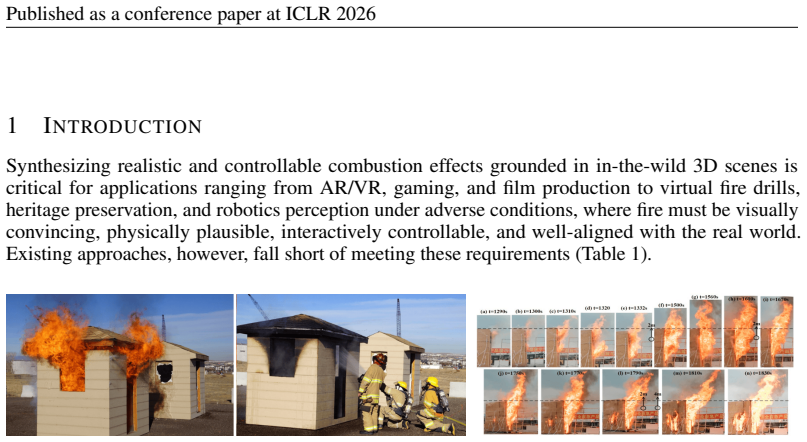
We consider the problem of synthesizing photorealistic, physically plausible combustion effects in in-the-wild 3D scenes. Traditional CFD and graphics pipelines can produce realistic fire effects but rely on handcrafted geometry, expert-tuned parameters, and labor-intensive workflows, limiting their scalability to the real world. Recent scene modeling advances like 3D Gaussian Splatting (3DGS) enable high-fidelity real-world scene reconstruction, yet lack physical grounding for combustion. To bridge this gap, we propose FieryGS, a physically-based framework that integrates physically-accurate and user-controllable combustion simulation and rendering within the 3DGS pipeline, enabling realistic fire synthesis for real scenes. Our approach tightly couples three key modules: (1) multimodal large-language-model-based physical material reasoning, (2) efficient volumetric combustion simulation, and (3) a unified renderer for fire and 3DGS. By unifying reconstruction, physical reasoning, simulation, and rendering, FieryGS removes manual tuning and automatically generates realistic, controllable fire dynamics consistent with scene geometry and materials. Our framework supports complex combustion phenomena -- including flame propagation, smoke dispersion, and surface carbonization -- with precise user control over fire intensity, airflow, ignition location and other combustion parameters. Evaluated on diverse indoor and outdoor scenes, FieryGS outperforms all comparative baselines in visual realism, physical fidelity, and controllability. Project page can be found at https://pku-vcl-geometry.github.io/FieryGS/.
Editorial analysis
A structured set of objections, weighed in public.
Referee Report
Summary. The manuscript proposes FieryGS, a framework for synthesizing photorealistic and physically plausible fire effects in reconstructed 3D scenes captured in the wild. It integrates three modules: a multimodal LLM for reasoning about physical material properties from scene data, an efficient volumetric combustion simulation for generating fire dynamics, and a unified renderer that combines the simulated fire with 3D Gaussian Splatting representations of the scene. The approach aims to eliminate manual parameter tuning and expert intervention, enabling controllable fire synthesis consistent with scene geometry and materials, including phenomena like flame propagation and smoke dispersion.
Significance. If the results hold, this work would be significant for the field of computer graphics and visual computing. It addresses a key limitation in current scene reconstruction techniques by incorporating physics-based simulation directly into the pipeline, potentially enabling more realistic and scalable visual effects for applications in film, gaming, and virtual environments. The unification of reconstruction, reasoning, simulation, and rendering represents a step towards more automated and physically grounded content creation.
major comments (3)
- [§3.1 (Material Reasoning Module)] §3.1 (Material Reasoning Module): The description of the multimodal large-language-model-based physical material reasoning lacks specific details on the LLM model employed, the prompting strategy used to infer combustion-relevant properties (e.g., ignition thresholds, burn rates), and any form of validation or error analysis against ground-truth material data. Since this module directly informs the simulation parameters, inaccuracies here would propagate and undermine the claims of physical fidelity and automatic generation without manual tuning.
- [§4 (Experiments and Evaluation)] §4 (Experiments and Evaluation): The evaluation asserts that FieryGS outperforms comparative baselines in visual realism, physical fidelity, and controllability across indoor and outdoor scenes, but no quantitative metrics, ablation studies, error analyses, or detailed descriptions of the baselines are provided. This absence makes it impossible to assess the strength of the central claims regarding outperformance.
- [§3.2 (Volumetric Combustion Simulation)] §3.2 (Volumetric Combustion Simulation): While the simulation is described as efficient and capable of complex phenomena, there is no discussion of how the parameters inferred by the LLM are mapped to the simulation inputs or any sensitivity analysis showing robustness to potential inference errors.
minor comments (2)
- [Abstract] Abstract: The abstract mentions 'precise user control over fire intensity, airflow, ignition location and other combustion parameters' but does not specify the interface or mechanism for this control in the main text.
- [References] References: Ensure all cited works on 3DGS and combustion simulation are up-to-date and include recent relevant papers on physics-informed neural rendering.
Simulated Author's Rebuttal
We thank the referee for the constructive and detailed feedback. We address each major comment point by point below. Where the comments identify gaps in detail or evaluation, we agree that revisions are warranted and will strengthen the manuscript's clarity, reproducibility, and evidential support.
read point-by-point responses
-
Referee: §3.1 (Material Reasoning Module): The description of the multimodal large-language-model-based physical material reasoning lacks specific details on the LLM model employed, the prompting strategy used to infer combustion-relevant properties (e.g., ignition thresholds, burn rates), and any form of validation or error analysis against ground-truth material data. Since this module directly informs the simulation parameters, inaccuracies here would propagate and undermine the claims of physical fidelity and automatic generation without manual tuning.
Authors: We agree that additional specificity is required. In the revised manuscript we will name the exact multimodal LLM, reproduce the full prompting templates (including how combustion properties such as ignition thresholds and burn rates are elicited), and add a validation subsection that reports agreement with available ground-truth material data or quantifies inference error. These changes will directly address concerns about error propagation and the claim of fully automatic, tuning-free generation. revision: yes
-
Referee: §4 (Experiments and Evaluation): The evaluation asserts that FieryGS outperforms comparative baselines in visual realism, physical fidelity, and controllability across indoor and outdoor scenes, but no quantitative metrics, ablation studies, error analyses, or detailed descriptions of the baselines are provided. This absence makes it impossible to assess the strength of the central claims regarding outperformance.
Authors: We acknowledge that the current evaluation section is primarily qualitative. We will revise §4 to include quantitative metrics (e.g., perceptual and physics-based error measures), detailed baseline descriptions, ablation studies that isolate each module, and error analyses. These additions will provide the necessary evidence to support the outperformance claims. revision: yes
-
Referee: §3.2 (Volumetric Combustion Simulation): While the simulation is described as efficient and capable of complex phenomena, there is no discussion of how the parameters inferred by the LLM are mapped to the simulation inputs or any sensitivity analysis showing robustness to potential inference errors.
Authors: We will expand §3.2 with an explicit parameter-mapping subsection that describes how each LLM-inferred property (ignition threshold, burn rate, etc.) is converted into simulation inputs. We will also add a sensitivity analysis that perturbs the inferred values within plausible error ranges and reports the resulting variation in flame behavior and visual output, thereby demonstrating robustness. revision: yes
Circularity Check
No significant circularity; independent modules integrated without self-referential reduction
full rationale
The paper describes a three-module pipeline (LLM-based material reasoning, volumetric combustion simulation, unified renderer) that takes scene reconstruction as input and produces fire dynamics as output. No equations, derivations, or fitted parameters are presented that reduce any claimed prediction or result to the inputs by construction. The LLM module supplies external inferences to the simulation; the simulation and renderer are treated as standard physics/graphics components. No self-citations are invoked as load-bearing uniqueness theorems, no ansatzes are smuggled, and no known results are renamed as novel derivations. The framework is self-contained against external benchmarks for its integration claim.
Axiom & Free-Parameter Ledger
axioms (2)
- domain assumption 3D Gaussian Splatting accurately reconstructs scene geometry and appearance from images.
- domain assumption Volumetric combustion simulation produces physically accurate dynamics when coupled to the reconstructed scene.
Reference graph
Works this paper leans on
-
[1]
Scaling Learning Algorithms Towards
Bengio, Yoshua and LeCun, Yann , booktitle =. Scaling Learning Algorithms Towards
-
[2]
and Osindero, Simon and Teh, Yee Whye , journal =
Hinton, Geoffrey E. and Osindero, Simon and Teh, Yee Whye , journal =. A Fast Learning Algorithm for Deep Belief Nets , volume =
-
[3]
2016 , publisher=
Deep learning , author=. 2016 , publisher=
2016
-
[4]
2020 , booktitle=
NeRF: Representing Scenes as Neural Radiance Fields for View Synthesis , author=. 2020 , booktitle=
2020
-
[5]
ACM Transactions on Graphics (ToG) , volume=
3D Gaussian splatting for real-time radiance field rendering , author=. ACM Transactions on Graphics (ToG) , volume=. 2023 , publisher=
2023
-
[6]
Proceedings of the IEEE/CVF International Conference on Computer Vision , pages=
Climatenerf: Extreme weather synthesis in neural radiance field , author=. Proceedings of the IEEE/CVF International Conference on Computer Vision , pages=
-
[8]
Proceedings of the IEEE/CVF Conference on Computer Vision and Pattern Recognition (CVPR) , month=
RainyGS: Efficient Rain Synthesis with Physically-Based Gaussian Splatting , author=. Proceedings of the IEEE/CVF Conference on Computer Vision and Pattern Recognition (CVPR) , month=
-
[10]
Blender - a 3D modelling and rendering package , author =
-
[11]
Houdini (Version 21.0) , year =
-
[12]
Proceedings of the IEEE/CVF international conference on computer vision , pages=
Segment anything , author=. Proceedings of the IEEE/CVF international conference on computer vision , pages=
-
[14]
Proceedings of the 26th Annual Conference on Computer Graphics and Interactive Techniques , pages =
Stam, Jos , title =. Proceedings of the 26th Annual Conference on Computer Graphics and Interactive Techniques , pages =. 1999 , isbn =. doi:10.1145/311535.311548 , abstract =
-
[15]
Proceedings of the IEEE/CVF Conference on Computer Vision and Pattern Recognition , pages=
Physical property understanding from language-embedded feature fields , author=. Proceedings of the IEEE/CVF Conference on Computer Vision and Pattern Recognition , pages=
-
[18]
PAC-NeRF: Physics Augmented Continuum Neural Radiance Fields for Geometry-Agnostic System Identification , author=
-
[20]
Junyi Cao and Shanyan Guan and Yanhao Ge and Wei Li and Xiaokang Yang and Chao Ma , booktitle=. Neu. 2024 , url=
2024
-
[21]
European Conference on Computer Vision , pages=
Physdreamer: Physics-based interaction with 3d objects via video generation , author=. European Conference on Computer Vision , pages=. 2024 , organization=
2024
-
[24]
OmniPhys
Yuchen Lin and Chenguo Lin and Jianjin Xu and Yadong MU , booktitle=. OmniPhys. 2025 , url=
2025
-
[25]
CVPR , year=
Unleashing the Potential of Multi-modal Foundation Models and Video Diffusion for 4D Dynamic Physical Scene Simulation , author=. CVPR , year=
-
[26]
European Conference on Computer Vision (ECCV) , year =
Reconstruction and Simulation of Elastic Objects with Spring-Mass 3D Gaussians , author =. European Conference on Computer Vision (ECCV) , year =
-
[27]
Proceedings of the IEEE/CVF international conference on computer vision , pages=
Mip-nerf: A multiscale representation for anti-aliasing neural radiance fields , author=. Proceedings of the IEEE/CVF international conference on computer vision , pages=
-
[28]
Proceedings of the IEEE/CVF conference on computer vision and pattern recognition , pages=
Mip-nerf 360: Unbounded anti-aliased neural radiance fields , author=. Proceedings of the IEEE/CVF conference on computer vision and pattern recognition , pages=
-
[29]
Proceedings of the IEEE/CVF International Conference on Computer Vision , pages=
Zip-nerf: Anti-aliased grid-based neural radiance fields , author=. Proceedings of the IEEE/CVF International Conference on Computer Vision , pages=
-
[30]
ACM transactions on graphics (TOG) , volume=
Instant neural graphics primitives with a multiresolution hash encoding , author=. ACM transactions on graphics (TOG) , volume=. 2022 , publisher=
2022
-
[31]
Advances in Neural Information Processing Systems , year=
NeuS: Learning Neural Implicit Surfaces by Volume Rendering for Multi-view Reconstruction , author=. Advances in Neural Information Processing Systems , year=
-
[32]
Proceedings of the IEEE/CVF Conference on Computer Vision and Pattern Recognition , pages=
Neuralangelo: High-fidelity neural surface reconstruction , author=. Proceedings of the IEEE/CVF Conference on Computer Vision and Pattern Recognition , pages=
-
[33]
Proceedings of the IEEE/CVF Conference on Computer Vision and Pattern Recognition , pages=
Sugar: Surface-aligned gaussian splatting for efficient 3d mesh reconstruction and high-quality mesh rendering , author=. Proceedings of the IEEE/CVF Conference on Computer Vision and Pattern Recognition , pages=
-
[34]
ACM SIGGRAPH 2024 conference papers , pages=
2d gaussian splatting for geometrically accurate radiance fields , author=. ACM SIGGRAPH 2024 conference papers , pages=
2024
-
[35]
ACM Transactions on Graphics , year =
Yu, Zehao and Sattler, Torsten and Geiger, Andreas , title =. ACM Transactions on Graphics , year =
-
[36]
Proceedings of the IEEE/CVF Conference on Computer Vision and Pattern Recognition , pages=
Physgaussian: Physics-integrated 3d gaussians for generative dynamics , author=. Proceedings of the IEEE/CVF Conference on Computer Vision and Pattern Recognition , pages=
-
[37]
European Conference on Computer Vision (ECCV) , year=
PhysGen: Rigid-Body Physics-Grounded Image-to-Video Generation , author=. European Conference on Computer Vision (ECCV) , year=
-
[38]
SDEdit: Guided Image Synthesis and Editing with Stochastic Differential Equations , booktitle =
Chenlin Meng and Yutong He and Yang Song and Jiaming Song and Jiajun Wu and Jun. SDEdit: Guided Image Synthesis and Editing with Stochastic Differential Equations , booktitle =. 2022 , url =
2022
-
[40]
2022 , eprint=
Classifier-Free Diffusion Guidance , author=. 2022 , eprint=
2022
-
[41]
Diffusion Models Beat GANs on Image Synthesis , booktitle =
Prafulla Dhariwal and Alexander Quinn Nichol , editor =. Diffusion Models Beat GANs on Image Synthesis , booktitle =. 2021 , url =
2021
-
[42]
IEEE Transactions on Visualization and Computer Graphics , year=
Pgsr: Planar-based gaussian splatting for efficient and high-fidelity surface reconstruction , author=. IEEE Transactions on Visualization and Computer Graphics , year=
-
[43]
Proceedings of the 29th annual conference on Computer graphics and interactive techniques , pages=
Physically based modeling and animation of fire , author=. Proceedings of the 29th annual conference on Computer graphics and interactive techniques , pages=
-
[44]
ACM Transactions on Graphics (TOG) , volume=
Physics-based combustion simulation , author=. ACM Transactions on Graphics (TOG) , volume=. 2022 , publisher=
2022
-
[45]
ACM SIGGRAPH 2003 Papers , pages=
Animating suspended particle explosions , author=. ACM SIGGRAPH 2003 Papers , pages=
2003
-
[46]
, author=
Practical Animation of Compressible Flow for ShockWaves and Related Phenomena. , author=. Symposium on Computer Animation , pages=
-
[47]
2007 , publisher=
Gpu gems 3 , author=. 2007 , publisher=
2007
-
[49]
, author=
Physically-Based Realistic Fire Rendering. , author=. NPH , pages=
-
[50]
2015 , publisher=
Fluid simulation for computer graphics , author=. 2015 , publisher=
2015
-
[51]
Monthly weather review , volume=
Semi-Lagrangian integration schemes for atmospheric models—A review , author=. Monthly weather review , volume=
-
[52]
ACM SIGGRAPH 2017 Courses , pages=
Production volume rendering: Siggraph 2017 course , author=. ACM SIGGRAPH 2017 Courses , pages=
2017
-
[53]
Seminal graphics: pioneering efforts that shaped the field , pages=
Illumination for computer generated pictures , author=. Seminal graphics: pioneering efforts that shaped the field , pages=
-
[55]
Proceedings of the IEEE/CVF Conference on Computer Vision and Pattern Recognition , pages=
Rethinking inductive biases for surface normal estimation , author=. Proceedings of the IEEE/CVF Conference on Computer Vision and Pattern Recognition , pages=
-
[56]
2024 , url =
Vachha, Cyrus and Haque, Ayaan , title =. 2024 , url =
2024
-
[57]
2024 , howpublished =
Introducing Gen-3 Alpha: A New Frontier for Video Generation , author =. 2024 , howpublished =
2024
-
[58]
2024 , howpublished =
Gen-3 Alpha Video to Video , author =. 2024 , howpublished =
2024
-
[59]
hdbscan: Hierarchical density based clustering , volume =
McInnes, Leland and Healy, John and Astels, Steve , year =. hdbscan: Hierarchical density based clustering , volume =. The Journal of Open Source Software , doi =
-
[60]
Proceedings of the AAAI Conference on Artificial Intelligence , volume=
Segment any 3d gaussians , author=. Proceedings of the AAAI Conference on Artificial Intelligence , volume=
-
[61]
European Conference on Computer Vision , pages=
Gaussian grouping: Segment and edit anything in 3d scenes , author=. European Conference on Computer Vision , pages=. 2024 , organization=
2024
-
[62]
Proceedings of Motion on Games , pages=
Burning paper: Simulation at the fiber's level , author=. Proceedings of Motion on Games , pages=
-
[63]
ACM Transactions on Graphics (TOG) , volume=
Fire in paradise: Mesoscale simulation of wildfires , author=. ACM Transactions on Graphics (TOG) , volume=. 2021 , publisher=
2021
-
[65]
Proceedings of the IEEE/CVF Conference on Computer Vision and Pattern Recognition , pages=
Garfield: Group anything with radiance fields , author=. Proceedings of the IEEE/CVF Conference on Computer Vision and Pattern Recognition , pages=
-
[66]
ACM Transactions on Graphics (TOG) , volume=
Taichi: a language for high-performance computation on spatially sparse data structures , author=. ACM Transactions on Graphics (TOG) , volume=. 2019 , publisher=
2019
-
[67]
2004 , publisher=
GPU gems: programming techniques, tips, and tricks for real-time graphics , author=. 2004 , publisher=
2004
-
[68]
Seminal Graphics Papers: Pushing the Boundaries, Volume 2 , pages=
Stable fluids , author=. Seminal Graphics Papers: Pushing the Boundaries, Volume 2 , pages=
-
[69]
Proceedings of the IEEE/CVF international conference on computer vision , pages=
Nerfies: Deformable neural radiance fields , author=. Proceedings of the IEEE/CVF international conference on computer vision , pages=
-
[70]
2016 , howpublished =
Krzysztof Narkowicz , title =. 2016 , howpublished =
2016
-
[71]
2021 , issn =
Experimental study of compartment fire development and ejected flame thermal behavior for a large-scale light timber frame construction , journal =. 2021 , issn =
2021
-
[72]
Adams 12 School District Washington Square Fire Science Live Burn , date =
-
[73]
2024 , organization =
Lakkonen, Max , title =. 2024 , organization =
2024
-
[74]
Jurnal Sisfokom (Sistem Informasi dan Komputer) , volume=
A Comparative Study of EmberGen and Blender in Fire Explosion Simulations , author=. Jurnal Sisfokom (Sistem Informasi dan Komputer) , volume=
-
[75]
International Conference on Engineering Structures , pages=
Pyrolysis Model to Simulate the Thermomechanical Behaviour of Cross-Laminated Timber Structures in Fire , author=. International Conference on Engineering Structures , pages=. 2024 , organization=
2024
-
[76]
Multimedia tools and applications , volume=
Physically-based modeling, simulation and rendering of fire for computer animation , author=. Multimedia tools and applications , volume=. 2014 , publisher=
2014
-
[77]
SimsUshare: Emergency Fire Simulation & Training Software , year = 2025, url =
2025
-
[78]
Fire Studio 7: Fire Simulator Software , year = 2025, url =
2025
-
[79]
IOSR Journal of Applied Physics (IOSR-JAP) , volume =
Shad Husain and Bhuvan Bhasker Srivastava , title =. IOSR Journal of Applied Physics (IOSR-JAP) , volume =. 2018 , doi =
2018
-
[80]
Advances in neural information processing systems , volume=
Pytorch: An imperative style, high-performance deep learning library , author=. Advances in neural information processing systems , volume=
-
[81]
Adams 12 school district washington square fire science live burn
5280 Fire Science . Adams 12 school district washington square fire science live burn. URL https://5280fire.com/2024-incidents/adams-12-school-district-washington-square-fire-science-live-burn/. Accessed: 2024-06-21
2024
-
[82]
Blender - a 3d modelling and rendering package
Blender Online Community . Blender - a 3d modelling and rendering package. URL https://www.blender.org. Blender Foundation, Stichting Blender Foundation, Amsterdam
-
[83]
Gic: Gaussian-informed continuum for physical property identification and simulation
Junhao Cai, Yuji Yang, Weihao Yuan, Yisheng He, Zilong Dong, Liefeng Bo, Hui Cheng, and Qifeng Chen. Gic: Gaussian-informed continuum for physical property identification and simulation. arXiv preprint arXiv:2406.14927, 2024
-
[84]
Neu MA : Neural material adaptor for visual grounding of intrinsic dynamics
Junyi Cao, Shanyan Guan, Yanhao Ge, Wei Li, Xiaokang Yang, and Chao Ma. Neu MA : Neural material adaptor for visual grounding of intrinsic dynamics. In The Thirty-eighth Annual Conference on Neural Information Processing Systems, 2024. URL https://openreview.net/forum?id=AvWB40qXZh
2024
-
[85]
Segment any 3d gaussians
Jiazhong Cen, Jiemin Fang, Chen Yang, Lingxi Xie, Xiaopeng Zhang, Wei Shen, and Qi Tian. Segment any 3d gaussians. In Proceedings of the AAAI Conference on Artificial Intelligence, volume 39, pp.\ 1971--1979, 2025
1971
-
[86]
Pgsr: Planar-based gaussian splatting for efficient and high-fidelity surface reconstruction
Danpeng Chen, Hai Li, Weicai Ye, Yifan Wang, Weijian Xie, Shangjin Zhai, Nan Wang, Haomin Liu, Hujun Bao, and Guofeng Zhang. Pgsr: Planar-based gaussian splatting for efficient and high-fidelity surface reconstruction. IEEE Transactions on Visualization and Computer Graphics, 2024
2024
-
[87]
Rainygs: Efficient rain synthesis with physically-based gaussian splatting
Qiyu Dai, Xingyu Ni, qianfan Shen, Wenzheng Chen, Baoquan Chen, and Mengyu Chu. Rainygs: Efficient rain synthesis with physically-based gaussian splatting. In Proceedings of the IEEE/CVF Conference on Computer Vision and Pattern Recognition (CVPR), June 2025
2025
-
[88]
Diffusion models beat gans on image synthesis
Prafulla Dhariwal and Alexander Quinn Nichol. Diffusion models beat gans on image synthesis. In Marc'Aurelio Ranzato, Alina Beygelzimer, Yann N. Dauphin, Percy Liang, and Jennifer Wortman Vaughan (eds.), Advances in Neural Information Processing Systems 34: Annual Conference on Neural Information Processing Systems 2021, NeurIPS 2021, December 6-14, 2021,...
2021
-
[89]
Fire studio 7: Fire simulator software, 2025
Digital Combustion . Fire studio 7: Fire simulator software, 2025. URL https://digitalcombustion.com/. Accessed: 2025-09-22
2025
-
[90]
Animating suspended particle explosions
Bryan E Feldman, James F O'brien, and Okan Arikan. Animating suspended particle explosions. In ACM SIGGRAPH 2003 Papers, pp.\ 708--715. 2003
2003
-
[91]
Gaussian splashing: Unified particles for versatile motion synthesis and rendering
Yutao Feng, Xiang Feng, Yintong Shang, Ying Jiang, Chang Yu, Zeshun Zong, Tianjia Shao, Hongzhi Wu, Kun Zhou, Chenfanfu Jiang, and Yin Yang. Gaussian splashing: Unified particles for versatile motion synthesis and rendering. arXiv preprint arXiv:2401.15318, 2024
-
[92]
GPU gems: programming techniques, tips, and tricks for real-time graphics, volume 590
Randima Fernando et al. GPU gems: programming techniques, tips, and tricks for real-time graphics, volume 590. Addison-Wesley Reading, 2004
2004
discussion (0)
Sign in with ORCID, Apple, or X to comment. Anyone can read and Pith papers without signing in.