Recognition: unknown
A Detailed View of the Large-Scale Sloshing Cold Front in RXJ2014.8-2430
Pith reviewed 2026-05-09 20:22 UTC · model grok-4.3
The pith
Deep Chandra observations of RXJ2014.8-2430 show that the widths of its three sloshing cold fronts are consistent with or below the Coulomb mean free path, indicating suppressed diffusion across the fronts.
A machine-rendered reading of the paper's core claim, the machinery that carries it, and where it could break.
Core claim
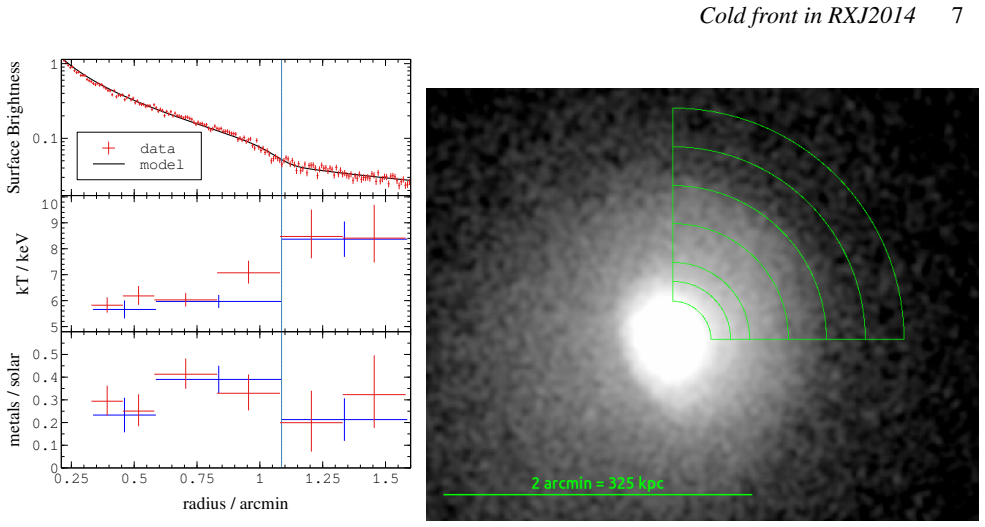
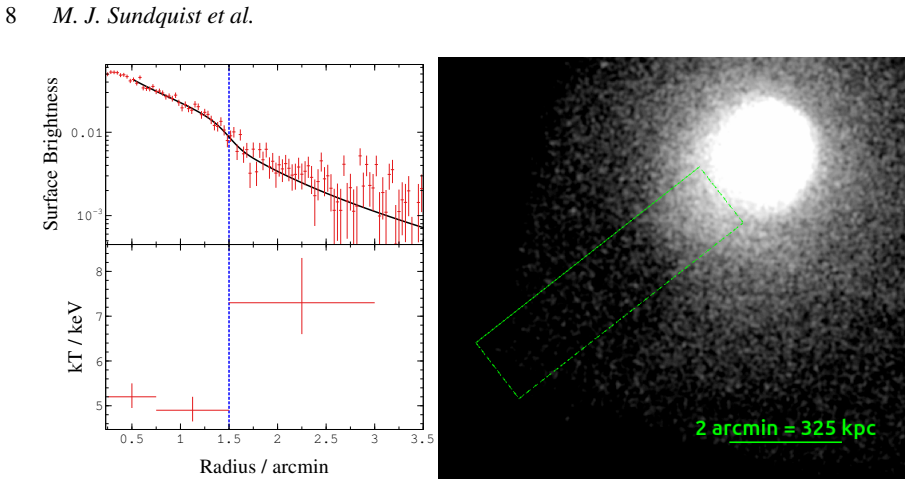
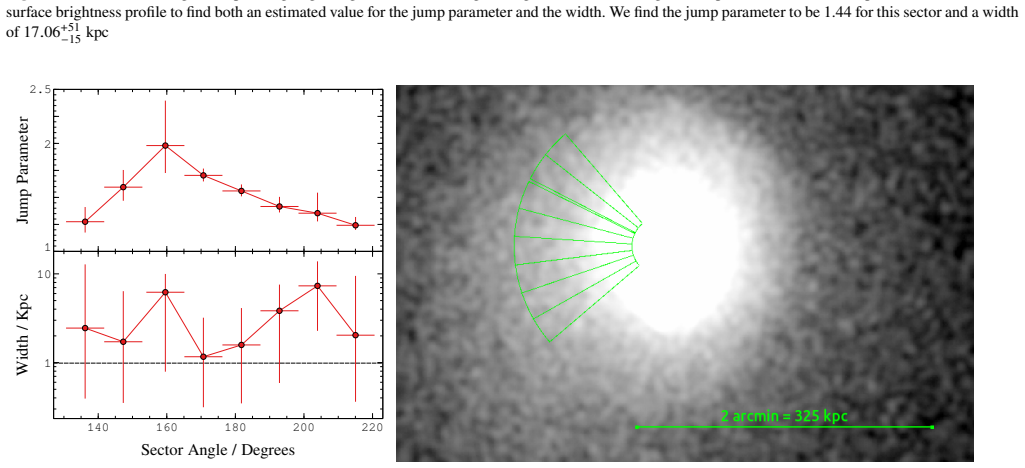
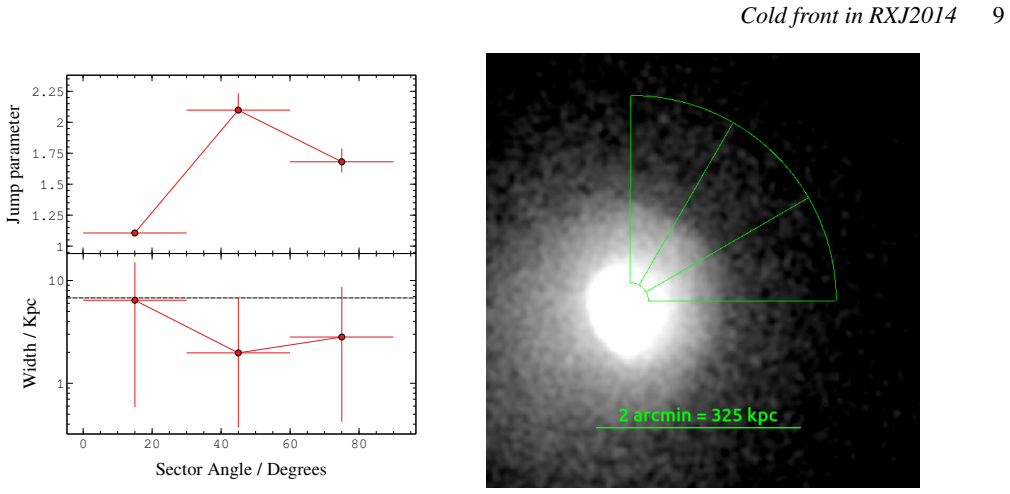
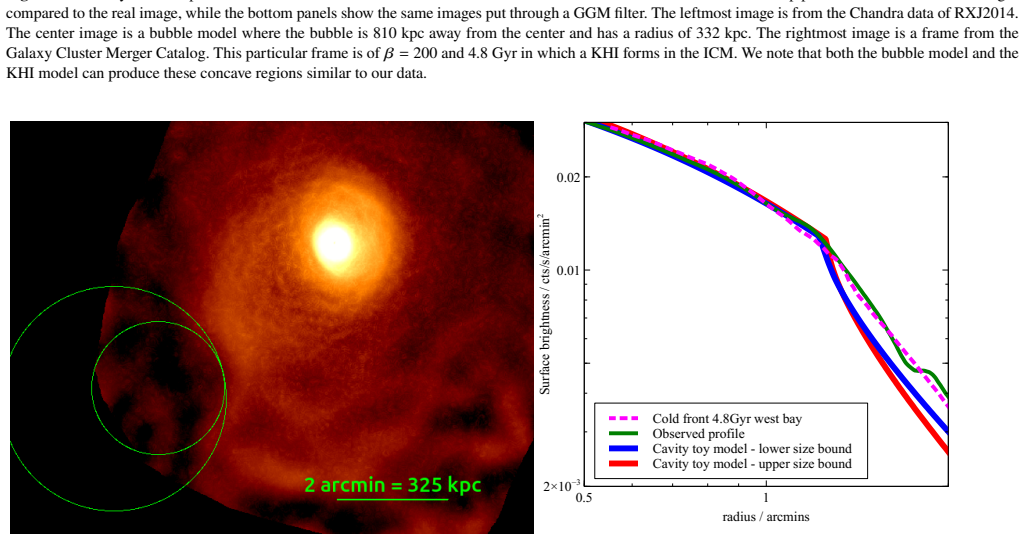
Using deep Chandra data, we confirm the locations of three sloshing cold fronts in RXJ2014.8-2430 and measure their widths to be consistent with or lower than the Coulomb mean free paths within error, signifying that diffusion is suppressed across the cold fronts. We also discover a large concave structure southeast of the core near the outermost front, which could be a Kelvin-Helmholtz instability or the inner rim of an AGN cavity. If the concave feature is the inner rim of a cavity, it has a radius in the range 200-330 kpc and PV values in the range of 5.7 times 10 to the 60 to 2.7 times 10 to the 61 erg, making it consistent with some of the most powerful bubbles observed.
What carries the argument
The comparison of measured cold front widths to the Coulomb mean free path lengths, derived from beta model subtraction and Gaussian Gradient Magnitude filtering of the X-ray images.
If this is right
- Diffusion of heat and particles is suppressed across the cold fronts in this cluster.
- The cluster shows evidence of ongoing sloshing that has produced multiple generations of cold fronts.
- If the concave feature is an AGN cavity, it represents one of the largest and most energetic bubbles known, with total energy in the range 5.7e60 to 2.7e61 erg.
- The outer cold front lies approximately 800 kpc from the core and traces large-scale gas motions in the cluster.
Where Pith is reading between the lines
- Suppressed diffusion across cold fronts may be a general property of sloshing galaxy clusters and should be tested in additional systems.
- The possible giant cavity implies AGN feedback can inject enough energy to affect gas dynamics on scales of hundreds of kiloparsecs.
- Similar concave features in other clusters could be re-examined to distinguish between instabilities and hidden AGN activity.
- Magnetohydrodynamic simulations of sloshing clusters could be compared directly to these width measurements to identify the physical mechanism responsible for the suppression.
Load-bearing premise
The measured cold front widths accurately reflect intrinsic widths without dominant projection effects or unresolved substructure, and the concave southeast structure is either a Kelvin-Helmholtz instability or the rim of an AGN cavity.
What would settle it
High-resolution follow-up imaging or tailored simulations that demonstrate the cold front widths exceed the Coulomb mean free path after full correction for projection and substructure, or that prove the concave feature is neither an instability nor a cavity.
Figures





read the original abstract
We analyze our new 144 ks deep Chandra observation of the sloshing cold front cluster RXJ2014.8-2430. Previous observations of RXJ2014.8-2430 with XMM-Newton shows evidence of a large scale, sloshing cold front around 800 kpc away from the cluster core. Previous shallow Chandra data also shows evidence of two younger cold fronts closer to the core. Our new deeper Chandra data allow us to analyze the fine, small scale structure of these three cold fronts. Using both beta model subtraction and Gaussian Gradient Magnitude filtering, we confirm the locations of the three cold fronts, as well as discover a large concave structure southeast of the cluster core near the outermost cold front, which could be a large Kelvin-Helmholtz instability or a gas cavity from AGN activity. Analyzing the three cold fronts, we measure the widths of the cold fronts and find them to be consistent with or lower than the Coulomb mean free paths within error, signifying that diffusion is suppressed across the cold fronts. If the concave feature is the inner rim of a cavity, we find that it has a radius in the range 200-330kpc, and would have $PV$ values in the range of $5.7 \times 10^{60}$ - $2.7 \times 10^{61}$ erg. These values would make it consistent with the some of the most powerful bubbles observed.
Editorial analysis
A structured set of objections, weighed in public.
Referee Report
Summary. The manuscript analyzes a new 144 ks Chandra observation of the sloshing cold front cluster RXJ2014.8-2430. Using beta-model subtraction and Gaussian Gradient Magnitude filtering, the authors confirm three cold fronts (one large-scale at ~800 kpc and two younger ones closer to the core), measure their widths, and conclude that these widths are consistent with or lower than the Coulomb mean free path within errors, implying suppressed diffusion across the fronts. They also identify a large concave southeast structure, which they suggest may be a Kelvin-Helmholtz instability or the inner rim of an AGN cavity with radius 200-330 kpc and PV energy 5.7e60-2.7e61 erg.
Significance. If the width measurements prove robust, the work would add concrete observational support for suppressed thermal conduction or diffusion at cold fronts in the ICM, with implications for transport physics and cluster thermodynamics. The possible large cavity would rank among the most energetic AGN bubbles reported, aiding studies of feedback energetics.
major comments (2)
- [Cold-front width measurement and comparison section] The headline result that the three cold-front widths are 'consistent with or lower than the Coulomb mean free paths within error' (thereby signifying suppressed diffusion) is load-bearing. The manuscript reports no quantitative width values, error budgets, or explicit tests for projection broadening or unresolved line-of-sight substructure. If the fronts are inclined or contain KH ripples, the projected surface-brightness transition widths will exceed the intrinsic interface width, weakening the suppression claim. A deprojection exercise or inclination modeling is required to substantiate the comparison.
- [Discussion of concave southeast structure] The concave southeast feature is interpreted as either a KHI or AGN-cavity rim, with the cavity case used to derive the reported radius range (200-330 kpc) and PV energy (5.7e60-2.7e61 erg). The manuscript must specify the geometric assumptions, pressure profile, and volume used in the PV calculation, as these directly determine whether the structure qualifies as one of the most powerful bubbles observed.
minor comments (3)
- [Abstract] The abstract states the width result 'within error' but supplies neither the measured widths nor the error values; these quantitative results should be stated explicitly.
- [Data analysis methods] The beta-model parameters and the exact GGM filter scales employed should be tabulated or stated in the methods to permit reproducibility of the front detections.
- [Figures and results] Surface-brightness profiles or GGM images used for width measurement should include the Coulomb mean-free-path value as a reference line for direct visual comparison.
Simulated Author's Rebuttal
We thank the referee for their constructive and positive review of our manuscript on the sloshing cold fronts in RXJ2014.8-2430. We have addressed each major comment below with revisions to the manuscript where needed, providing quantitative details and additional discussion to strengthen the analysis.
read point-by-point responses
-
Referee: [Cold-front width measurement and comparison section] The headline result that the three cold-front widths are 'consistent with or lower than the Coulomb mean free paths within error' (thereby signifying suppressed diffusion) is load-bearing. The manuscript reports no quantitative width values, error budgets, or explicit tests for projection broadening or unresolved line-of-sight substructure. If the fronts are inclined or contain KH ripples, the projected surface-brightness transition widths will exceed the intrinsic interface width, weakening the suppression claim. A deprojection exercise or inclination modeling is required to substantiate the comparison.
Authors: We agree that explicit quantitative values and error analysis are essential for the robustness of this result. The original manuscript stated the conclusion but did not tabulate the measured widths. We have added Table 2 reporting the three measured front widths (with 1σ statistical and systematic uncertainties from profile fitting and background modeling), the local Coulomb mean free paths, and the width-to-mfp ratios. We have also added a new subsection (3.3) discussing projection effects: based on the large-scale sloshing morphology and comparison to hydrodynamic simulations, the fronts are viewed close to edge-on, so any inclination would increase the apparent width and thus make the intrinsic widths smaller than reported, reinforcing the suppression conclusion. Unresolved KH ripples or line-of-sight substructure would similarly broaden the projected width. We acknowledge that a full 3D deprojection or inclination modeling would require assumptions not fully constrained by the current data and is beyond the scope of this paper; we have therefore added this limitation as an explicit caveat while noting that the reported widths already provide a conservative upper limit on the intrinsic interface thickness. revision: partial
-
Referee: [Discussion of concave southeast structure] The concave southeast feature is interpreted as either a KHI or AGN-cavity rim, with the cavity case used to derive the reported radius range (200-330 kpc) and PV energy (5.7e60-2.7e61 erg). The manuscript must specify the geometric assumptions, pressure profile, and volume used in the PV calculation, as these directly determine whether the structure qualifies as one of the most powerful bubbles observed.
Authors: We thank the referee for this clarification request. In the revised manuscript we have expanded the relevant paragraph in Section 4.2 to explicitly state the assumptions used for the cavity interpretation: the concave feature is modeled as the inner rim of a spherical bubble with radius 200–330 kpc (the range arising from the observed curvature and allowance for modest projection effects); the pressure is taken from the azimuthally averaged, deprojected X-ray pressure profile at the projected radius of the feature (∼1.5 × 10^{-10} erg cm^{-3}); and the volume is computed as (4/3)πr^3 for the spherical geometry. The PV energy range follows directly from these values. We also note that if the feature is instead a Kelvin-Helmholtz instability, no such energetic interpretation applies. These details are now provided so that readers can evaluate the cavity energetics and compare with other reported AGN bubbles. revision: yes
Circularity Check
No circularity: purely observational measurements and direct comparisons
full rationale
The paper's central results consist of direct measurements of cold-front surface-brightness transition widths from new Chandra data (via beta-model subtraction and GGM filtering) followed by comparison to Coulomb mean-free-path values computed from the same observed density and temperature profiles. No step reduces by construction to a fitted parameter or self-citation; the mean-free-path formula is a standard external expression, the width measurements are data-driven, and the diffusion-suppression conclusion is a straightforward inequality test that remains falsifiable by independent observations. The concave-feature interpretation is presented as secondary and does not underpin the width result. This is the expected outcome for an observational X-ray analysis without model fitting or uniqueness theorems.
Axiom & Free-Parameter Ledger
free parameters (1)
- beta-model parameters
axioms (1)
- domain assumption Beta model accurately represents the underlying smooth intracluster medium emission
invented entities (1)
-
Concave structure interpreted as AGN cavity or KHI
no independent evidence
Reference graph
Works this paper leans on
-
[1]
The Merger Dynamics of the X-Ray-Emitting Plasma in Clusters of Galaxies
ZuHone, John and Su, Yuanyuan. The Merger Dynamics of the X-Ray-Emitting Plasma in Clusters of Galaxies. Handbook of X-ray and Gamma-ray Astrophysics. 2022. doi:10.1007/978-981-16-4544-0_124-1
-
[2]
The XMM Cluster Outskirts Project (X-COP): Thermodynamic properties of the intracluster medium out to R _ 200 in Abell 2319. , keywords =. doi:10.1051/0004-6361/201731748 , archivePrefix =. 1708.02954 , primaryClass =
-
[4]
, year = 1997, month = dec, volume = 490, pages =
A Universal Density Profile from Hierarchical Clustering. , keywords =. doi:10.1086/304888 , archivePrefix =. astro-ph/9611107 , primaryClass =
-
[5]
Walker, Stephen A. and Lau, Erwin T. Cluster Outskirts and Their Connection to the Cosmic Web. Handbook of X-ray and Gamma-ray Astrophysics. 2022. doi:10.1007/978-981-16-4544-0_120-1
-
[6]
W., Jin, C., Blaes, O., & Ward, M
Gas sloshing, cold fronts, Kelvin-Helmholtz instabilities and the merger history of the cluster of galaxies Abell 496. , keywords =. doi:10.1111/j.1365-2966.2011.20287.x , archivePrefix =. 1112.1407 , primaryClass =
-
[7]
A Parameter Space Exploration of Galaxy Cluster Mergers. II. Effects of Magnetic Fields. , keywords =. doi:10.3847/1538-4357/ab3983 , archivePrefix =. 1904.10024 , primaryClass =
-
[8]
Radio footprints of a minor merger in the Shapley Supercluster: From supercluster down to galactic scales. , keywords =. doi:10.1051/0004-6361/202142048 , archivePrefix =. 2201.04887 , primaryClass =
-
[9]
, archivePrefix = "arXiv", eprint =
High-resolution XMM-Newton Spectroscopy of the Cooling Flow Cluster A3112. , keywords =. doi:10.1088/0004-637X/747/1/32 , archivePrefix =. 1110.4422 , primaryClass =
-
[10]
Shocks and cold fronts in merging and massive galaxy clusters: new detections with Chandra. , keywords =. doi:10.1093/mnras/sty598 , archivePrefix =. 1707.07038 , primaryClass =
-
[11]
A detailed study of the bridge of excess X-ray emission between the galaxy clusters Abell 2029 and Abell 2033. , keywords =. doi:10.1093/mnras/stab2979 , archivePrefix =. 2110.06224 , primaryClass =
-
[12]
Cold fronts in galaxy clusters. , keywords =. doi:10.1051/0004-6361/200912496 , archivePrefix =. 1003.1051 , primaryClass =
-
[13]
What is a cool-core cluster? a detailed analysis of the cores of the X-ray flux-limited HIFLUGCS cluster sample. , keywords =. doi:10.1051/0004-6361/200912377 , archivePrefix =. 0911.0409 , primaryClass =
-
[14]
A cluster in a crowded environment: XMM-Newton and Chandra observations of A3558. , keywords =. doi:10.1051/0004-6361:20054621 , archivePrefix =. astro-ph/0611056 , primaryClass =
-
[15]
Shapley supercluster survey: mapping the dark matter distribution. , keywords =. doi:10.1093/mnras/staa1766 , archivePrefix =. 2006.08130 , primaryClass =
-
[16]
Turbulent motions and shocks waves in galaxy clusters simulated with adaptive mesh refinement. , keywords =. doi:10.1051/0004-6361/200912535 , archivePrefix =. 0905.3169 , primaryClass =
-
[17]
doi:10.1093/mnras/stx640 , eprint =
Is there a giant Kelvin-Helmholtz instability in the sloshing cold front of the Perseus cluster?. , keywords =. doi:10.1093/mnras/stx640 , archivePrefix =. 1705.00011 , primaryClass =
-
[18]
The Megaparsec-scale Gas-sloshing Spiral in the Remnant Cool Core Cluster Abell 1763. , keywords =. doi:10.3847/1538-4357/aae9e7 , archivePrefix =. 1812.02645 , primaryClass =
-
[19]
Is There an Enormous Cold Front at the Virial Radius of the Perseus Cluster?. , keywords =. doi:10.3847/1538-4357/ac5894 , archivePrefix =. 2006.14043 , primaryClass =
-
[20]
The split in the ancient cold front in the Perseus cluster. Nature Astronomy , keywords =. doi:10.1038/s41550-018-0401-8 , archivePrefix =. 1803.00898 , primaryClass =
-
[21]
arXiv e-prints , keywords =
The NuSTAR and Chandra view of CL 0217+70 and Its Tell-Tale Radio Halo. arXiv e-prints , keywords =
-
[22]
arXiv e-prints , keywords =
NuSTAR low energy effective area correction due to thermal blanket tear. arXiv e-prints , keywords =
-
[23]
International Journal of Modern Physics D , keywords =
Magnetic Fields in Clusters of Galaxies. International Journal of Modern Physics D , keywords =. doi:10.1142/S0218271804005080 , archivePrefix =. astro-ph/0410182 , primaryClass =
-
[24]
The Halo and Magnetic Field of the Coma Cluster of Galaxies. , keywords =. doi:10.1086/168737 , adsurl =
-
[25]
The Coma cluster magnetic field from Faraday rotation measures. , keywords =. doi:10.1051/0004-6361/200913696 , archivePrefix =. 1002.0594 , primaryClass =
-
[26]
Vol.2: Stars, the galaxy and the interstellar medium
High energy astrophysics. Vol.2: Stars, the galaxy and the interstellar medium
-
[27]
Radiative processes in astrophysics
-
[28]
arXiv , author =:1401.7519 , journal =
Cosmic Rays in Galaxy Clusters and Their Nonthermal Emission. International Journal of Modern Physics D , keywords =. doi:10.1142/S0218271814300079 , archivePrefix =. 1401.7519 , primaryClass =
-
[29]
High- and Low-Energy Nonthermal X-Ray Emission from the Abell 2199 Cluster of Galaxies. , keywords =. doi:10.1086/312112 , archivePrefix =. astro-ph/9905209 , primaryClass =
-
[30]
The BEPPOSAX View of the Hot Cluster Abell 2319. , keywords =. doi:10.1086/312340 , archivePrefix =. astro-ph/9909228 , primaryClass =
-
[31]
Rossi X-Ray Timing Explorer Spectrum of A2319. , keywords =. doi:10.1086/324699 , adsurl =
-
[32]
Rossi X-Ray Timing Explorer Observations of A2256. , keywords =. doi:10.1086/377257 , adsurl =
-
[33]
Hard X-Ray Emission from the Galaxy Cluster A2256. , keywords =. doi:10.1086/312639 , archivePrefix =. astro-ph/0003141 , primaryClass =
-
[34]
Long RXTE Observations of A2163. , keywords =. doi:10.1086/506310 , archivePrefix =. astro-ph/0606097 , primaryClass =
-
[35]
Results from a Second Rossi X-Ray Timing Explorer Observation of the Coma Cluster. , keywords =. doi:10.1086/342796 , archivePrefix =. astro-ph/0207443 , primaryClass =
-
[36]
Confirmation of Nonthermal Hard X-Ray Excess in the Coma Cluster from Two Epoch Observations. , keywords =. doi:10.1086/382695 , archivePrefix =. astro-ph/0312625 , primaryClass =
-
[37]
A Suzaku Search for Nonthermal Emission at Hard X-Ray Energies in the Coma Cluster. , keywords =. doi:10.1088/0004-637X/696/2/1700 , archivePrefix =. 0902.3658 , primaryClass =
-
[38]
Hard X-ray and radio observations of Abell 754. , keywords =. doi:10.1051/0004-6361:20021639 , archivePrefix =. astro-ph/0212408 , primaryClass =
-
[39]
Hard X-Ray Emission from the Galaxy Cluster A3667. , keywords =. doi:10.1086/320340 , archivePrefix =. astro-ph/0105049 , primaryClass =
-
[40]
Spectral Analysis of Rossi X-Ray Timing Explorer Observations of A3667. , keywords =. doi:10.1086/383123 , archivePrefix =. astro-ph/0401312 , primaryClass =
-
[41]
Analysis and Interpretation of Hard X-Ray Emission from the Bullet Cluster (1ES 0657-558), the Most Distant Cluster of Galaxies Observed by RXTE. , keywords =. doi:10.1086/508564 , archivePrefix =. astro-ph/0608455 , primaryClass =
-
[42]
Planck 2015 results. XXVII. The second Planck catalogue of Sunyaev-Zeldovich sources. , keywords =. doi:10.1051/0004-6361/201525823 , archivePrefix =. 1502.01598 , primaryClass =
-
[43]
A Sunyaev-Zel'dovich-selected Sample of the Most Massive Galaxy Clusters in the 2500 deg ^ 2 South Pole Telescope Survey. , keywords =. doi:10.1088/0004-637X/738/2/139 , archivePrefix =. 1101.1290 , primaryClass =
-
[44]
Sunyaev-Zel'dovich Cluster Profiles Measured with the South Pole Telescope. , keywords =. doi:10.1088/0004-637X/716/2/1118 , archivePrefix =. 0911.2444 , primaryClass =
-
[45]
Baryon content in a sample of 91 galaxy clusters selected by the South Pole Telescope at 0.2 <z < 1.25. , keywords =. doi:10.1093/mnras/sty1284 , archivePrefix =. 1711.00917 , primaryClass =
-
[46]
Galaxy Clusters in the Swift/BAT Era. II. 10 More Clusters Detected Above 15 keV. , keywords =. doi:10.1088/0004-637X/725/2/1688 , archivePrefix =. 1009.4699 , primaryClass =
-
[47]
Investigating the hard X-ray emission from the hottest Abell cluster A2163 with Suzaku. , keywords =. doi:10.1051/0004-6361/201322878 , archivePrefix =. 1312.4120 , primaryClass =
-
[48]
The Swift Burst Alert Telescope Perspective on Non-thermal Emission in HIFLUGCS Galaxy Clusters. , keywords =. doi:10.1088/0004-637X/748/1/67 , archivePrefix =. 1207.0506 , primaryClass =
-
[49]
Galaxy Clusters in the Swift/Burst Alert Telescope Era: Hard X-rays in the Intracluster Medium. , keywords =. doi:10.1088/0004-637X/690/1/367 , archivePrefix =. 0809.0006 , primaryClass =
-
[50]
Hard X-Ray Radiation in the Coma Cluster Spectrum. , keywords =. doi:10.1086/311902 , archivePrefix =. astro-ph/9901018 , primaryClass =
-
[51]
Rossi X-Ray Timing Explorer Observations of the Coma Cluster. , keywords =. doi:10.1086/311828 , adsurl =
-
[52]
HEAO 1 Hard X-Ray Observations of Clusters of Galaxies and Intracluster Magnetic Fields. , keywords =. doi:10.1086/166729 , adsurl =
-
[53]
HEAO 1 Hard X-Ray Observations of Three Abell Clusters of Galaxies. , keywords =. doi:10.1086/165529 , adsurl =
-
[55]
Nonthermal Phenomena in Clusters of Galaxies. , keywords =. doi:10.1007/s11214-008-9314-7 , archivePrefix =. 0801.0982 , primaryClass =
-
[56]
Nonthermal Bremsstrahlung and Hard X-Ray Emission from Clusters of Galaxies. , keywords =. doi:10.1086/308649 , archivePrefix =. astro-ph/9911335 , primaryClass =
-
[57]
Relativistic electrons in the intracluster space of clusters of galaxies: the hard X-ray spectra and heating of the gas. , keywords =. doi:10.1086/156740 , adsurl =
-
[58]
arXiv , author =:1901.04496 , journal =
Diffuse Radio Emission from Galaxy Clusters. , keywords =. doi:10.1007/s11214-019-0584-z , archivePrefix =. 1901.04496 , primaryClass =
-
[59]
A joint XMM-NuSTAR observation of the galaxy cluster Abell 523: Constraints on inverse Compton emission. , keywords =. doi:10.1051/0004-6361/201834644 , archivePrefix =. 1906.07730 , primaryClass =
-
[60]
J., Groves, B., Kauffmann, G., & Heckman, T
Contour binning: a new technique for spatially resolved X-ray spectroscopy applied to Cassiopeia A. , keywords =. doi:10.1111/j.1365-2966.2006.10716.x , archivePrefix =. astro-ph/0606528 , primaryClass =
-
[61]
NuSTAR Observations of Abell 2163: Constraints on Non-thermal Emission. , keywords =. doi:10.3847/1538-4357/abcbf7 , archivePrefix =. 2012.00236 , primaryClass =
-
[62]
Diffuse radio emission in the galaxy cluster SPT-CL J2031-4037: a steep-spectrum intermediate radio halo?. , keywords =. doi:10.1093/mnrasl/slaa002 , archivePrefix =. 2001.02365 , primaryClass =
-
[63]
The Growth of Cool Cores and Evolution of Cooling Properties in a Sample of 83 Galaxy Clusters at 0.3 < z < 1.2 Selected from the SPT-SZ Survey. , keywords =. doi:10.1088/0004-637X/774/1/23 , archivePrefix =. 1305.2915 , primaryClass =
-
[64]
Testing for X-Ray-SZ Differences and Redshift Evolution in the X-Ray Morphology of Galaxy Clusters. , keywords =. doi:10.3847/1538-4357/aa6db4 , archivePrefix =. 1609.00375 , primaryClass =
-
[65]
NuSTAR Observations of the Bullet Cluster: Constraints on Inverse Compton Emission. , keywords =. doi:10.1088/0004-637X/792/1/48 , archivePrefix =. 1403.2722 , primaryClass =
-
[66]
A NuSTAR Observation of the Center of the Coma Cluster. , keywords =. doi:10.1088/0004-637X/800/2/139 , archivePrefix =. 1411.1573 , primaryClass =
-
[67]
The ROSAT-ESO Flux Limited X-ray (REFLEX) Galaxy cluster survey. V. The cluster catalogue. , keywords =. doi:10.1051/0004-6361:20034484 , archivePrefix =. astro-ph/0405546 , primaryClass =
-
[68]
Galaxy Clusters Discovered via the Sunyaev-Zel'dovich Effect in the 2500-Square-Degree SPT-SZ Survey. , keywords =. doi:10.1088/0067-0049/216/2/27 , archivePrefix =. 1409.0850 , primaryClass =
-
[69]
The X-ray Universe 2005 , year = 2006, editor =
Chandra Observation of the Most Interesting Cluster in the Universe. The X-ray Universe 2005 , year = 2006, editor =
2005
-
[70]
Bow Shock in Merging Cluster A520: The Edge of the Radio Halo and the Electron-Proton Equilibration Timescale. , keywords =. doi:10.3847/1538-4357/aab2aa , archivePrefix =. 1802.03402 , primaryClass =
-
[71]
A Strong Merger Shock in Abell 665. , keywords =. doi:10.3847/2041-8205/820/1/L20 , archivePrefix =. 1603.01271 , primaryClass =
-
[72]
Direct Constraints on the Dark Matter Self-Interaction Cross Section from the Merging Galaxy Cluster 1E 0657-56. , keywords =. doi:10.1086/383178 , archivePrefix =. astro-ph/0309303 , primaryClass =
-
[73]
Monthly Notices of the Royal Astronomical Society , volume =
Gas clumping in the outskirts of the Virgo cluster. , keywords =. doi:10.1093/mnras/stab1768 , archivePrefix =. 2106.09732 , primaryClass =
-
[74]
P., Werner, N., Clowe, D., et al
A filament of dark matter between two clusters of galaxies. , keywords =. doi:10.1038/nature11224 , archivePrefix =. 1207.0809 , primaryClass =
-
[75]
X-ray mapping the outer regions of galaxy clusters at z = 0.23 and 0.45. , keywords =. doi:10.1093/mnras/stu064 , archivePrefix =. 1401.6205 , primaryClass =
-
[76]
2003, The Astrophysical Journal, 591, 1220, doi: 10.1086/375492
Solar System Abundances and Condensation Temperatures of the Elements. , keywords =. doi:10.1086/375492 , adsurl =
-
[77]
On the Baryon Fractions in Clusters and Groups of Galaxies. , keywords =. doi:10.1088/0004-637X/719/1/119 , archivePrefix =. 0911.2230 , primaryClass =
-
[78]
Comprehensiveanalyticformulaeforstellarevolutionasafunctionofmassandmetallicity,
The intragroup medium in loose groups of galaxies. , keywords =. doi:10.1046/j.1365-8711.2000.03396.x , archivePrefix =. astro-ph/0002051 , primaryClass =
-
[79]
2010, ApJ, 717, 74, doi: 10.1088/0004-637X/717/1/74
Studying the WHIM Content of Large-scale Structures Along the Line of Sight to H 2356-309. , keywords =. doi:10.1088/0004-637X/717/1/74 , archivePrefix =. 1004.5359 , primaryClass =
-
[80]
2018, Nature, 558, 406, doi: 10.1038/s41586-018-0204-1
Observations of the missing baryons in the warm-hot intergalactic medium. , keywords =. doi:10.1038/s41586-018-0204-1 , archivePrefix =. 1806.08395 , primaryClass =
-
[81]
, year = 2005, month = feb, volume =
The mass of the missing baryons in the X-ray forest of the warm-hot intergalactic medium. , year = 2005, month = feb, volume =. doi:10.1038/nature03245 , adsurl =
-
[82]
An EAGLE view of the missing baryons. , keywords =. doi:10.1051/0004-6361/202039221 , archivePrefix =. 2012.09203 , primaryClass =
discussion (0)
Sign in with ORCID, Apple, or X to comment. Anyone can read and Pith papers without signing in.