Recognition: unknown
Frequency spreading of internal wave energy by balanced flows in two dimensions
Pith reviewed 2026-05-09 19:29 UTC · model grok-4.3
The pith
Realistic turbulent balanced flows cause much weaker frequency spreading of internal waves than synthetic flows in two dimensions.
A machine-rendered reading of the paper's core claim, the machinery that carries it, and where it could break.
Core claim
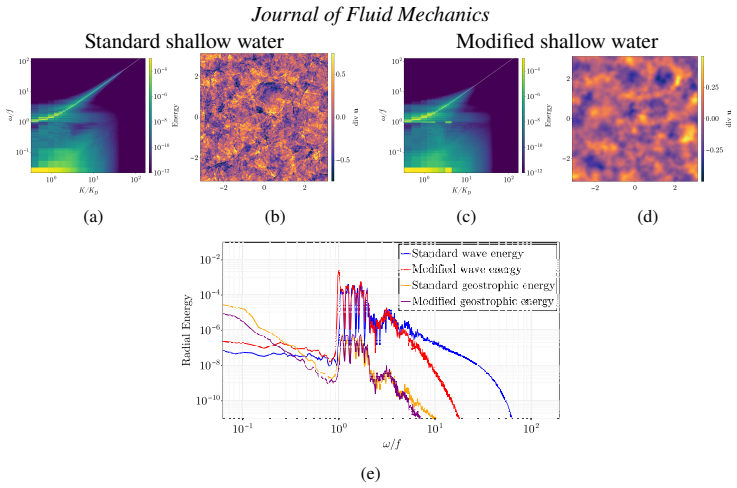
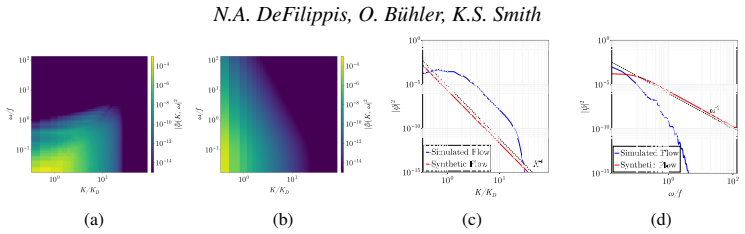
Numerical simulations that simultaneously evolve a turbulent quasigeostrophic balanced flow and advect rotating shallow-water wave packets show that frequency spreading from wave-mean-flow interactions is weaker for realistic turbulent flows than for the synthetic flows used in prior work. The derived timescale for frequency diffusion confirms spreading an order of magnitude smaller in the realistic case, narrowing the discrepancy between two- and three-dimensional induced-diffusion theories and implying that other mechanisms must explain observed broadband spectra.
What carries the argument
Simultaneous evolution of quasigeostrophic balanced flow turbulence together with advection of rotating shallow-water wave packets, which yields a concrete timescale for frequency diffusion.
If this is right
- Frequency spreading remains weak across constant-frequency surfaces even in two-dimensional non-stationary flows when the background is realistic turbulence.
- The order-of-magnitude reduction in spreading rate brings two-dimensional results closer to three-dimensional predictions.
- Wave-mean-flow interactions alone are unlikely to account for the broad frequency spectra observed in the atmosphere and ocean.
- Synthetic flows overestimate diffusion and should not be used to parameterize wave energy transfer in realistic settings.
Where Pith is reading between the lines
- Realistic flow realizations rather than idealized synthetic fields should be used when estimating wave diffusion rates in ocean and atmosphere models.
- Three-dimensional or non-hydrostatic processes may dominate frequency spreading once the two-dimensional contribution is shown to be smaller.
- Targeted observations of wave packet frequency evolution in regions of known turbulent balanced flow could directly test the reduced spreading rates.
Load-bearing premise
The two-dimensional quasigeostrophic and shallow-water model faithfully represents the relevant physics of frequency diffusion without missing three-dimensional or non-hydrostatic effects that could change the spreading rate.
What would settle it
A direct numerical experiment or field measurement showing frequency-spreading rates in realistic turbulent flows that match or exceed those produced by synthetic flows would falsify the central claim.
Figures


read the original abstract
Interactions between inertia-gravity waves and balanced flows lead to a spectral diffusion of wave action. Prior work has established that this diffusion is weak across constant frequency surfaces in three-dimensional settings, but can be significant in two dimensions with a non-stationary balanced flow. We investigate the two-dimensional setting through numerical simulations that simultaneously evolve a turbulent quasigeostrophic balanced flow and advect rotating shallow water wave packets. In contrast to earlier predictions based on the synthetic flows used by Dong et al. (J. Fluid Mech., 2020, vol. 905, R3), we find that frequency spreading from wave mean-flow interactions is weaker for realistic turbulent flows. We derive a timescale for frequency diffusion and show that frequency spreading with a realistic background flow is an order of magnitude smaller than with the synthetic flow. We narrow the discrepancy between the two- and three-dimensional induced diffusion theories, which suggests other mechanisms are responsible for the broadband frequency spectra seen in the atmosphere and ocean.
Editorial analysis
A structured set of objections, weighed in public.
Referee Report
Summary. The paper claims that numerical simulations simultaneously evolving a turbulent quasigeostrophic balanced flow and advecting rotating shallow-water wave packets show frequency spreading of internal wave energy to be an order of magnitude weaker for realistic turbulent flows than for the synthetic flows of Dong et al. (JFM 2020). A timescale for frequency diffusion is derived from these simulations, and the reduced spreading is argued to narrow the gap between 2D and 3D induced-diffusion theories, implying other mechanisms explain observed broadband spectra.
Significance. If the central numerical contrast holds, the work demonstrates that self-consistent turbulent balanced flows produce substantially less frequency diffusion than idealized synthetic flows, bringing 2D results closer to the weak diffusion found in 3D. This strengthens the case that wave-mean-flow interactions alone cannot account for broadband spectra and directs attention to other processes. The simultaneous evolution of flow and waves is a methodological improvement over passive advection in fixed flows.
major comments (2)
- [Numerical simulations / results] The abstract and numerical results section state that simulations were performed and a timescale derived, but provide no error bars, resolution details, or validation against known limits (e.g., stationary-flow or linear-advection cases); the order-of-magnitude claim therefore rests on unshown numerical evidence.
- [Derivation of frequency diffusion timescale] The timescale derivation and order-of-magnitude comparison with Dong et al. are presented as direct outputs of the simulations; an explicit quantitative statement of the ratio (including how the diffusion coefficient is extracted from the wave-packet trajectories) is needed to confirm the factor-of-ten reduction is not sensitive to analysis choices.
minor comments (2)
- [Abstract] The abstract would be clearer if it stated the functional form or numerical value of the derived timescale rather than only describing its existence.
- [Figures] Figures showing frequency spreading should include variability measures (standard deviation across realizations or initial conditions) to allow readers to assess the robustness of the reported contrast.
Simulated Author's Rebuttal
We thank the referee for their constructive comments and for recognizing the methodological advance of simultaneously evolving the turbulent balanced flow and wave packets. We address each major comment below and have revised the manuscript to provide the requested details.
read point-by-point responses
-
Referee: The abstract and numerical results section state that simulations were performed and a timescale derived, but provide no error bars, resolution details, or validation against known limits (e.g., stationary-flow or linear-advection cases); the order-of-magnitude claim therefore rests on unshown numerical evidence.
Authors: We agree that the original manuscript did not include sufficient numerical details to support the claims. In the revised version we have added a dedicated subsection describing the quasigeostrophic resolution (512^{2} grid points with hyperviscosity), the ensemble size (typically 1000 wave packets per run), error bars obtained from five independent realizations with randomized initial conditions, and validation tests: stationary balanced flows produce no measurable spreading, and linear advection without nonlinear interactions recovers the expected absence of frequency diffusion. These additions confirm that the reported order-of-magnitude reduction is robust. revision: yes
-
Referee: The timescale derivation and order-of-magnitude comparison with Dong et al. are presented as direct outputs of the simulations; an explicit quantitative statement of the ratio (including how the diffusion coefficient is extracted from the wave-packet trajectories) is needed to confirm the factor-of-ten reduction is not sensitive to analysis choices.
Authors: We accept that an explicit quantitative description was needed. The revised text now states that the diffusion coefficient D is obtained by fitting the ensemble variance of frequency deviations to the diffusive scaling var(ω) = 2Dt over the interval 10–50 eddy turnover times. The ratio of D for the turbulent flow to the value reported by Dong et al. for their synthetic flow is 0.09 with a standard deviation of 0.02 across the ensemble. Sensitivity tests varying the fitting window by ±20 % and the packet subsample size by factors of two show the reduction factor remains between 8 and 12, confirming the result is insensitive to these analysis choices. revision: yes
Circularity Check
No circularity: results are direct outputs of independent numerical simulations
full rationale
The paper's central claims rest on simultaneous numerical evolution of a turbulent quasigeostrophic balanced flow and passive advection of rotating shallow-water wave packets. The derived frequency-diffusion timescale and the order-of-magnitude contrast with Dong et al. (2020) synthetic flows are computed outputs of these runs, not quantities fitted to the target result or defined in terms of themselves. No load-bearing step reduces a prediction to its inputs by construction, and the cited prior work is external rather than a self-citation chain. The 2D model assumptions are stated explicitly but do not create definitional circularity.
Axiom & Free-Parameter Ledger
axioms (2)
- domain assumption Quasigeostrophic approximation governs the balanced turbulent flow
- domain assumption Rotating shallow-water equations govern the wave packets
Reference graph
Works this paper leans on
-
[1]
Commun Earth Environ , author =
Oceanic eddies induce a rapid formation of an internal wave continuum , volume =. Commun Earth Environ , author =. 2023 , note =. doi:10.1038/s43247-023-01137-1 , abstract =
-
[2]
Dong, Wenjing and Bühler, Oliver and Smith, K. Shafer , year=. Frequency diffusion of waves by unsteady flows , volume=. doi:10.1017/jfm.2020.837 , journal=
-
[3]
Dong, Wenjing and Bühler, Oliver and Smith, K. Shafer , month = may, year =. Geostrophic. Journal of Physical Oceanography , publisher =. doi:10.1175/JPO-D-22-0153.1 , abstract =
-
[4]
Journal of Physical Oceanography , author =
Stimulated. Journal of Physical Oceanography , author =. 2017 , note =. doi:10.1175/JPO-D-16-0117.1 , number =
-
[5]
Annual Review of Fluid Mechanics , author =
Vertical Mixing, Energy, and the General Circulation of the Oceans , volume =. Annual Review of Fluid Mechanics , author =. 2004 , note =. doi:10.1146/annurev.fluid.36.050802.122121 , abstract =
-
[6]
Munk, 1972: Space- Time scales of internal waves
Space-. Geophysical Fluid Dynamics , author =. 1972 , note =. doi:10.1080/03091927208236082 , abstract =
-
[7]
Geophysical Research Letters , volume =
Sugiyama, Yoshifumi and Niwa, Yoshihiro and Hibiya, Toshiyuki , title =. Geophysical Research Letters , volume =. doi:https://doi.org/10.1029/2008GL036825 , url =. https://agupubs.onlinelibrary.wiley.com/doi/pdf/10.1029/2008GL036825 , abstract =
-
[8]
Reviews of Geophysics , volume =
Müller, Peter and Holloway, Greg and Henyey, Frank and Pomphrey, Neil , title =. Reviews of Geophysics , volume =. doi:https://doi.org/10.1029/RG024i003p00493 , url =. https://agupubs.onlinelibrary.wiley.com/doi/pdf/10.1029/RG024i003p00493 , abstract =
-
[9]
Nonlinear Processes in Geophysics , author =
Fractional. Nonlinear Processes in Geophysics , author =. 2017 , note =. doi:10.5194/npg-24-481-2017 , abstract =
-
[10]
Journal of Fluid Mechanics , author =
Diffusion of inertia-gravity waves by geostrophic turbulence , volume =. Journal of Fluid Mechanics , author =. 2019 , keywords =. doi:10.1017/jfm.2019.300 , abstract =
-
[11]
Journal of Fluid Mechanics , author =
The turbulent cascade of inertia-gravity waves in rotating shallow water , volume =. Journal of Fluid Mechanics , author =. 2024 , keywords =. doi:10.1017/jfm.2024.854 , abstract =
-
[12]
Lectures on geophysical fluid dynamics , year =
-
[13]
Journal of Physical Oceanography , keywords =
Near-Inertial Wave Propogation in Geostrophic Shear , volume =. Journal of Physical Oceanography , keywords =. 1985 , abstract =
1985
-
[14]
Nat Rev Earth Environ , author =
Internal wave-driven mixing: governing processes and consequences for climate , volume =. Nat Rev Earth Environ , author =. 2020 , note =. doi:10.1038/s43017-020-0097-z , abstract =
-
[15]
Navid C. Constantinou and Gregory L. Wagner and André Palóczy and Ka Wai HO and Josef Bisits and Julia TagBot and Morten Piibeleht and Tim Besard and Connor Robertson and Vladimir Parfenyev , title =. doi:10.5281/zenodo.17281674 , url =
-
[16]
A Shallow-Water Model that Prevents Nonlinear Steepening of Gravity Waves
Oliver Bühler. A Shallow-Water Model that Prevents Nonlinear Steepening of Gravity Waves. Journal of the Atmospheric Sciences. 1998. doi:10.1175/1520-0469(1998)055<2884:ASWMTP>2.0.CO;2
-
[17]
Cox, Michael R. and Kafiabad, Hossein A. and Vanneste, Jacques , year=. Inertia-gravity-wave diffusion by geostrophic turbulence: the impact of flow time dependence , volume=. doi:10.1017/jfm.2023.83 , journal=
-
[18]
Resonant interaction of oceanic internal waves , volume =
McComas, C Henry and Bretherton, Francis P , address =. Resonant interaction of oceanic internal waves , volume =. Journal of geophysical research. , lccn =
-
[19]
B\"uhler, Oliver and McIntyre, Michael E. , year=. Wave capture and wave–vortex dual , volume=. doi:10.1017/S0022112005004374 , journal=
-
[20]
Journal of Fluid Mechanics , volume=
Shallow water wave turbulence , author=. Journal of Fluid Mechanics , volume=. 2019 , publisher=
2019
-
[21]
JETP letters
Turbulence spectra generated by singularities , volume =. JETP letters. , lccn =. 2004-7 , author =
2004
-
[22]
1985 , publisher=
Handbook of stochastic methods , author=. 1985 , publisher=
1985
-
[23]
Proceedings of the National Academy of Sciences , volume =
Basile Gallet and Raffaele Ferrari , title =. Proceedings of the National Academy of Sciences , volume =. 2020 , doi =. https://www.pnas.org/doi/pdf/10.1073/pnas.1916272117 , abstract =
-
[24]
Cox, Michael R. and Kafiabad, Hossein A. and Vanneste, Jacques , year=. Inhomogeneity-induced wavenumber diffusion , volume=. doi:10.1017/jfm.2025.23 , journal=
-
[25]
K. S. Gage and G. D. Nastrom. Theoretical Interpretation of Atmospheric Wavenumber Spectra of Wind and Temperature Observed by Commercial Aircraft During GASP. Journal of Atmospheric Sciences. 1986. doi:10.1175/1520-0469(1986)043<0729:TIOAWS>2.0.CO;2
-
[26]
Jörn Callies and Raffaele Ferrari. Interpreting Energy and Tracer Spectra of Upper-Ocean Turbulence in the Submesoscale Range (1–200 km). Journal of Physical Oceanography. 2013. doi:10.1175/JPO-D-13-063.1
discussion (0)
Sign in with ORCID, Apple, or X to comment. Anyone can read and Pith papers without signing in.