pith. machine review for the scientific record. sign in

arxiv: 2605.00263 · v1 · submitted 2026-04-30 · 🧮 math.GT

Recognition: unknown

Smoothing of singular intersections of ellipsoids: pyramitoid

Enrique Artal Bartolo, Mar\'ia Teresa Lozano Im\'izcoz, Santiago L\'opez de Medrano

Pith reviewed 2026-05-09 19:21 UTC · model grok-4.3

classification 🧮 math.GT
keywords n-pyramitoidn-pyramidCoxeter orbifoldsellipsoid intersectionsmanifold smoothingssingular 3-manifoldssmall covers
0
0 comments X

The pith

The n-pyramitoid generalizes the n-pyramid to smooth singular 3-manifolds from ellipsoid intersections.

A machine-rendered reading of the paper's core claim, the machinery that carries it, and where it could break.

This paper continues the study of smoothing singular 3-dimensional manifolds that arise as small covers of non-simple right-angle Coxeter polyhedral orbifolds. Such manifolds appear as coaxial intersections of ellipsoids. The authors introduce the n-pyramitoid as a generalization of the n-pyramid to address additional cases in this smoothing process. The new construction extends the range of singular intersections that can be smoothed in this geometric setting.

Core claim

The paper defines the n-pyramitoid to generalize the n-pyramid and applies it to the smoothing of singular 3-manifolds obtained from small covers of non-simple right-angle Coxeter orbifolds that arise in coaxial intersections of ellipsoids.

What carries the argument

The n-pyramitoid, a geometric construction that generalizes the n-pyramid to enable smoothing of singularities in the specified Coxeter orbifold covers.

If this is right

  • The n-pyramitoid allows smoothing for additional non-simple cases of right-angle Coxeter polyhedral orbifolds beyond those handled by the n-pyramid.
  • More singular intersections of ellipsoids become accessible for smoothing into regular 3-manifolds.
  • The study of small covers of such orbifolds gains a broader set of smooth examples through this generalization.

Where Pith is reading between the lines

These are editorial extensions of the paper, not claims the author makes directly.

  • This definition may support explicit constructions of new families of smooth 3-manifolds with controlled topology from ellipsoid data.
  • It could connect the smoothing problem to wider questions about polyhedral decompositions in 3-manifold topology.
  • Testing the n-pyramitoid on concrete low-dimensional Coxeter examples would clarify its range of applicability.

Load-bearing premise

That the newly defined n-pyramitoid meaningfully extends the smoothing techniques for these singular manifolds without further verification of its topological utility.

What would settle it

A specific non-simple right-angle Coxeter polyhedron for which the n-pyramitoid construction fails to produce a smooth manifold after the intended smoothing process.

Figures

Figures reproduced from arXiv: 2605.00263 by Enrique Artal Bartolo, Mar\'ia Teresa Lozano Im\'izcoz, Santiago L\'opez de Medrano.

Figure 1
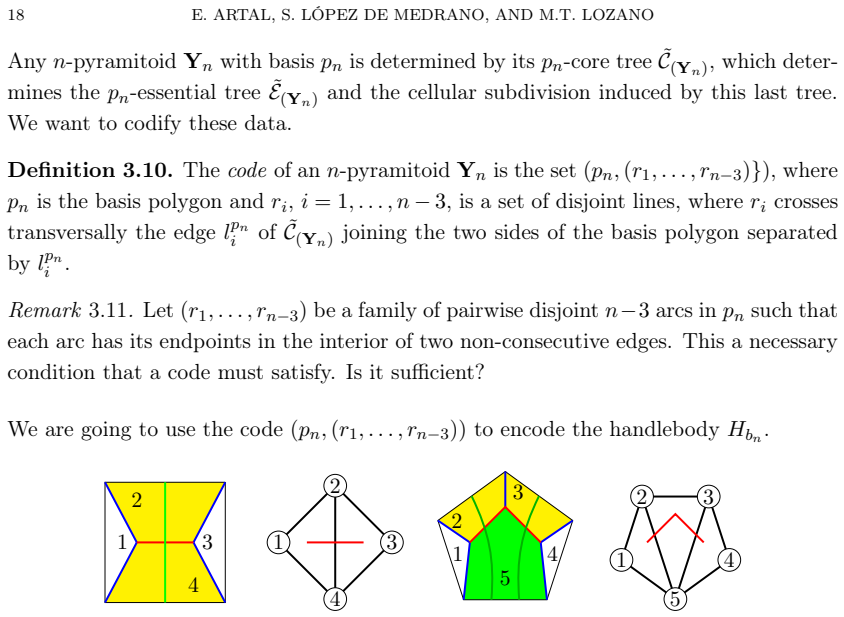
Figure 1. Figure 1: 2-dimensional orbifolds Xorb 1 , Xorb 2 for n = 5. Example 1.3. Let P be a combinatorial simple polyhedron in R 3 with n faces. We can associate a right-angled orbifold P orb structure where interior points in P are smooth points, interior points in each face are mirror points, points in the interior of each edge are corner reflector points and vertices are 3-singular points. The orbifold fundamental group… view at source ↗
Figure 2
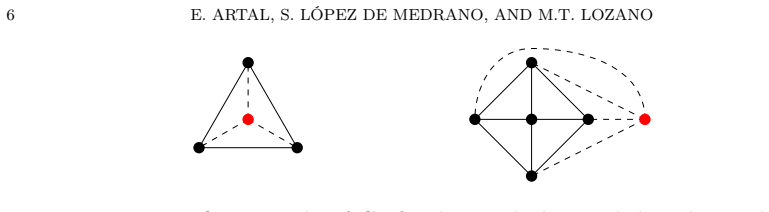
Figure 2. Figure 2: Defining graphs of GP for the tetrahedron and the cube. Red vertices and dashed edges stand for the edges and vertices to be eliminated when considering the defining graph for π orb 1 (P orb n ). edges (resp. vertices) of xn, the chart is given by R 2 × R≥0 and the group is acting by the reflection on x2 = 0 (resp. the reflections on x1 = 0 and x2 = 0). Remark 1.4. A simple 3-polytope P (with n faces) and … view at source ↗
Figure 3
Figure 3. Figure 3: Pyramitoids. The examples (a) and (b) are simple pyramitoids. [PITH_FULL_IMAGE:figures/full_fig_p008_3.png] view at source ↗
Figure 4
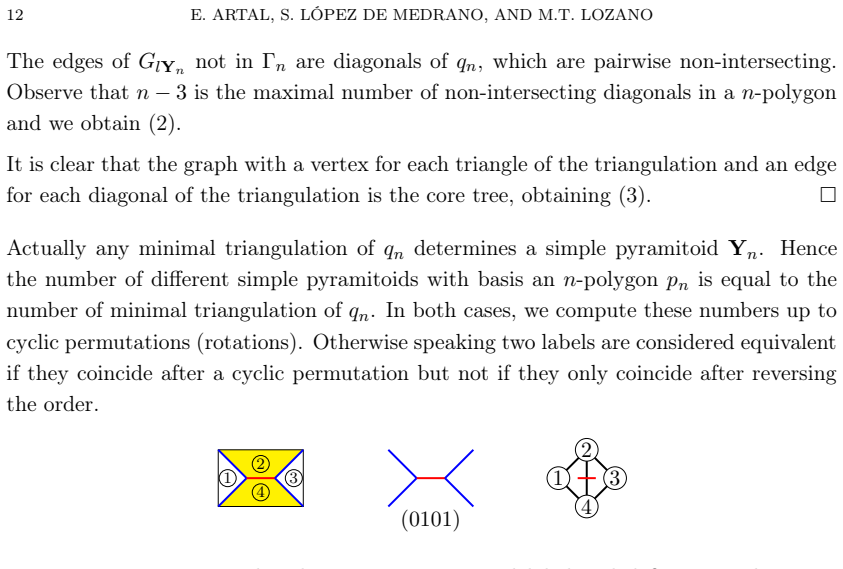
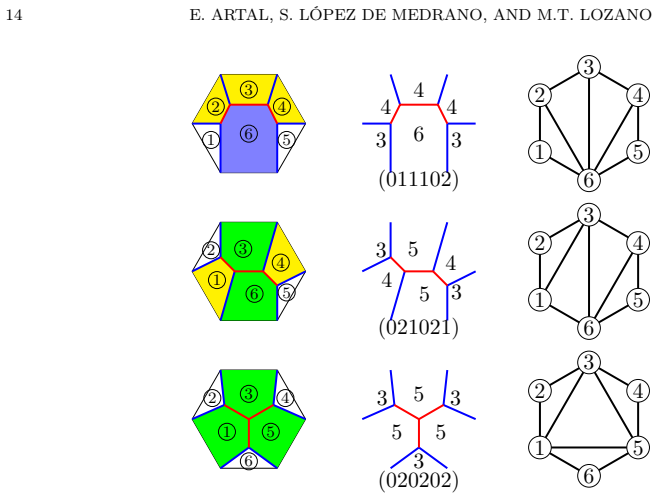
Figure 4. Figure 4: Essential and core trees, numerical label and defining graph [PITH_FULL_IMAGE:figures/full_fig_p012_4.png] view at source ↗
Figure 5
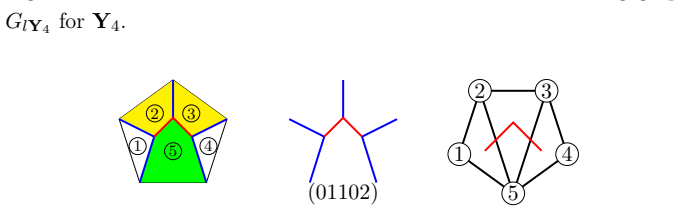
Figure 5. Figure 5: Essential and core trees, numerical label and defining graph [PITH_FULL_IMAGE:figures/full_fig_p012_5.png] view at source ↗
Figure 6
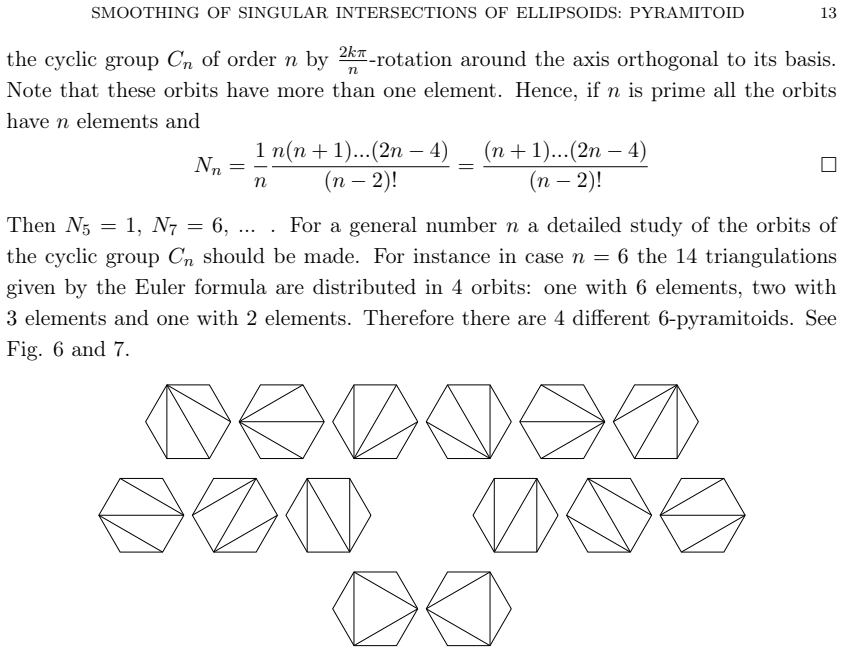
Figure 6. Figure 6: Triangulations in the hexagon. Each line represents an orbit [PITH_FULL_IMAGE:figures/full_fig_p013_6.png] view at source ↗
Figure 7
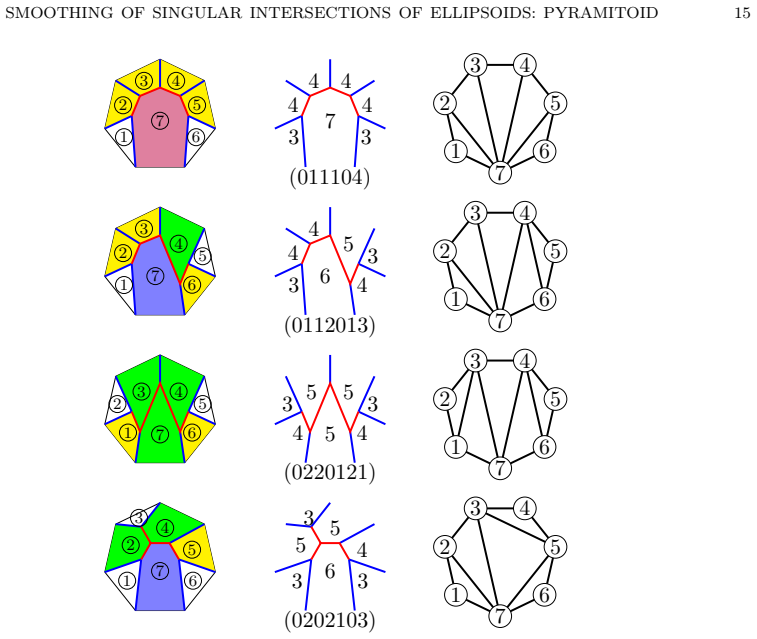
Figure 7. Figure 7: Essential and core trees, numerical label and defining graph [PITH_FULL_IMAGE:figures/full_fig_p014_7.png] view at source ↗
Figure 8
Figure 8. Figure 8: Essential and core trees and numerical label and defining graph [PITH_FULL_IMAGE:figures/full_fig_p015_8.png] view at source ↗
Figure 9
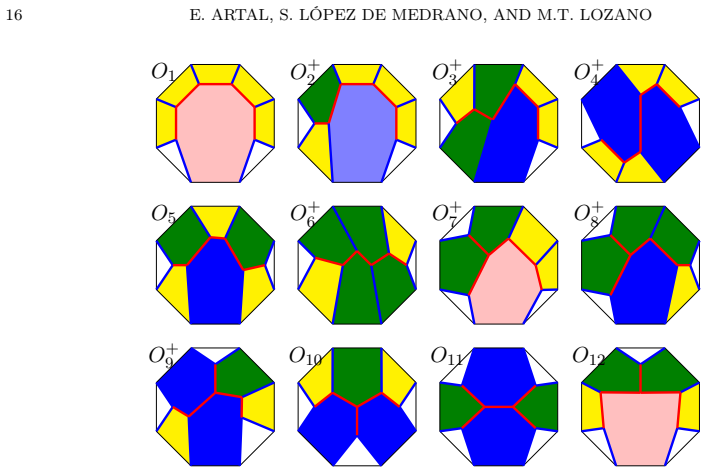
Figure 9. Figure 9: The 19 different simple 8-pyramitoids. We have to add the symmetric O − j for j = 2, 3, 4, 6, . . . , 9. Therefore, in the simple case Zn = 2 n−3 (n−4)+1 # i=1 (S 2 × S 1 )i , Note that bn = an−3 where {an} is the integer sequence A000337 in OEIS [OEI25], the integer sequence giving the genus of the n-cube ([BH65]). □ Because we are interested in the smoothing of an isolated n-singular vertex in a general … view at source ↗
Figure 10
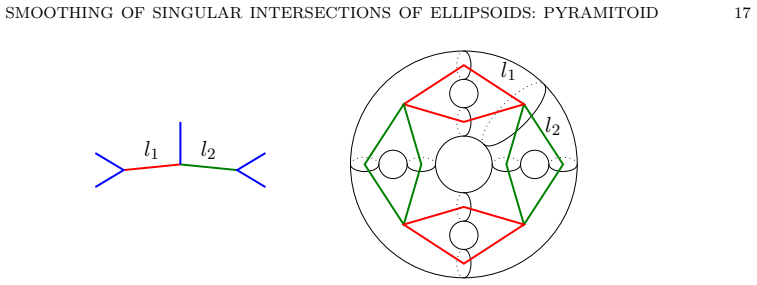
Figure 10. Figure 10: The core tree C(Y5) = l1 ∪ l2 and the core graph Gn in H5 = Z ∗ 5 ⊂ Z5. Definition 3.6. A core C of a handlebody Hn is any minimal deformation retract of Hn. If C is a graph, we say that C is a core graph of the handlebody. Theorem 3.7. The manifold Z ∗ n is a handlebody Hbn having π ∗ n −1 (C(Yn) ) as core graph. Proof. The manifold Z ∗ n is a neighborhood of the graph Gn := π ∗ n −1 (C(Yn) ), see [PITH… view at source ↗
Figure 11
Figure 11. Figure 11: The code (green lines) and triangulations in [PITH_FULL_IMAGE:figures/full_fig_p018_11.png] view at source ↗
Figure 12
Figure 12. Figure 12: The code (r1 and r2) and the core tree (l1 and l2) in Y5, and two partial covers with the preimages of the code and the core [PITH_FULL_IMAGE:figures/full_fig_p018_12.png] view at source ↗
Figure 13
Figure 13. Figure 13: Example of code of a Y7 with the associated cell decomposi￾tion. The code of a pyramitoid determines a cellular decomposition which are interesting. The proof of the following proposition is elementary and Figures 13 and 14 is a good illustration of the result. Proposition 3.13. The code (pn,(r1, . . . , rn−3)) of a pyramitoid Yn determines a cel￾lular decomposition of pn such that (a) The vertices of the… view at source ↗
Figure 14
Figure 14. Figure 14: The three possible cells, the corresponding subpyramitoids [PITH_FULL_IMAGE:figures/full_fig_p020_14.png] view at source ↗
Figure 15
Figure 15. Figure 15: Decomposition in balls for n = 4. Corollary 3.18. Let n > 4. The handlebody Hbn can be seen as the union of the (n − 2 − m1)2n−3 3-balls, where m1 is the 1-size of the code. The number of meridian disks is 2 n−3 (2n − 6 − m1). These balls come from the cells of types II and III and this decomposition is equivariant with respect to the action of the reflection group. Proof. Some of the circles defined by t… view at source ↗
Figure 16
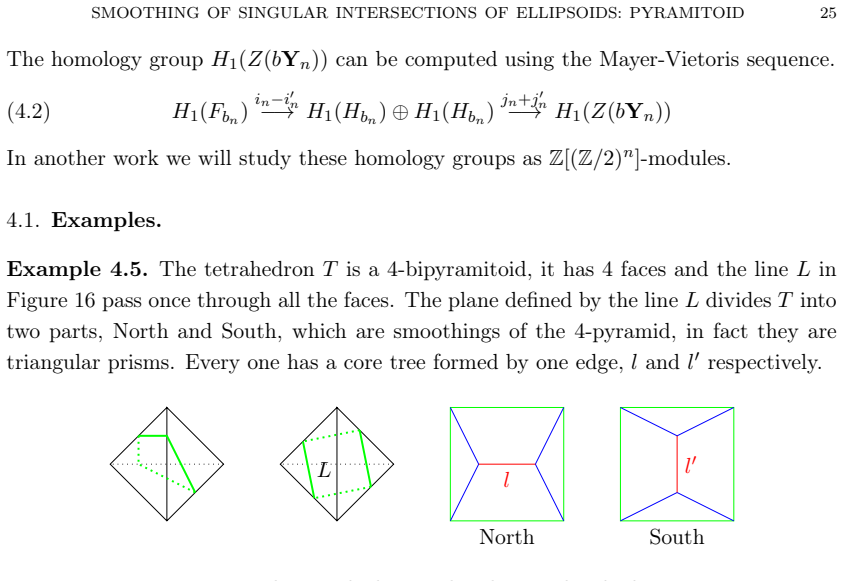
Figure 16. Figure 16: The tetrahedron and it division by the line [PITH_FULL_IMAGE:figures/full_fig_p025_16.png] view at source ↗
Figure 17
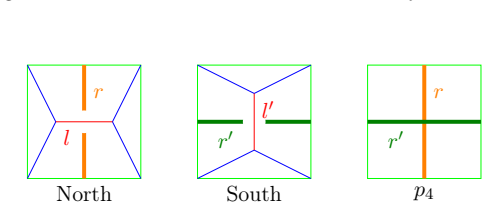
Figure 17. Figure 17: The code for north and south parts and in the polygon [PITH_FULL_IMAGE:figures/full_fig_p025_17.png] view at source ↗
Figure 18
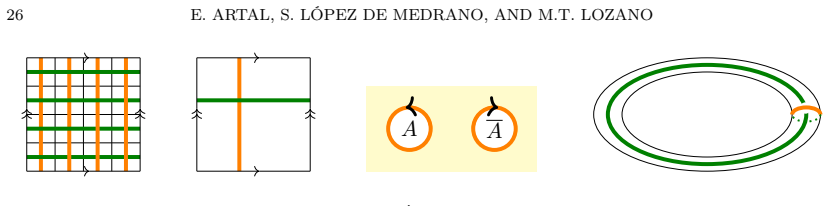
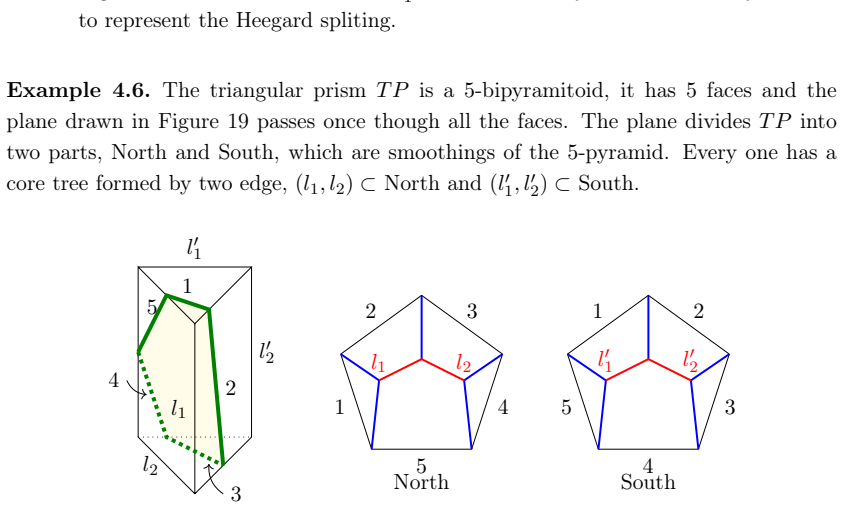
Figure 18. Figure 18: Meridians of H1 and H′ 1 in their boundary F1 and three ways to represent the Heegard spliting. Example 4.6. The triangular prism T P is a 5-bipyramitoid, it has 5 faces and the plane drawn in [PITH_FULL_IMAGE:figures/full_fig_p026_18.png] view at source ↗
Figure 19
Figure 19. Figure 19: The triangular prism and it division by a plane into two [PITH_FULL_IMAGE:figures/full_fig_p026_19.png] view at source ↗
Figure 20
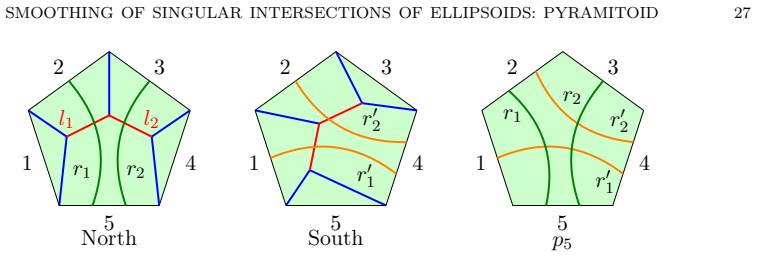
Figure 20. Figure 20: The code for North and South parts and in the polygon [PITH_FULL_IMAGE:figures/full_fig_p027_20.png] view at source ↗
Figure 21
Figure 21. Figure 21: Cube and it division by the line L. r1 r3 r2 r ′ 3 r ′ 2 r ′ 1 r ′ 3 r ′ 2 r ′ 1 r1 r3 r2 [PITH_FULL_IMAGE:figures/full_fig_p027_21.png] view at source ↗
Figure 22
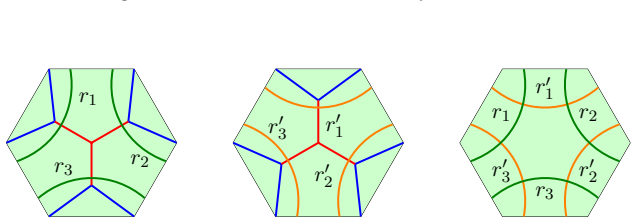
Figure 22. Figure 22: The code for north and south parts and in the polygon [PITH_FULL_IMAGE:figures/full_fig_p027_22.png] view at source ↗
Figure 23
Figure 23. Figure 23: The bipyramitoids gbY3 and gbY4 with the stereographic pro￾jection and a equatorial cut in red. Any smoothing of the bipyramitoid gbYn is obtained by pasting together two smoothings of a 2n-pyramitoid obtained by truncation of all the vertices in the basis of an n-pyramid. The gluing is done along the basis face in such a way that an edge in the basis bounds a triangular face in only one side. Note that a… view at source ↗
Figure 24
Figure 24. Figure 24: Stereographic projection of a 5-trapezohedron with the equa￾torial cut and the north-half part. pasting together 2 handlebodies Hb2n by a homeomorphism defined by the code associated to the smoothing of the two pyramids. Proof. It is a direct consequence of Theorem 4.2. Note that the two involved 2n￾pyramitoids have n triangular faces corresponding to alternating edges in the equatorial plane (the red lin… view at source ↗
Figure 25
Figure 25. Figure 25: The smoothing of the 4-trapezohedron gbY4 in [PITH_FULL_IMAGE:figures/full_fig_p029_25.png] view at source ↗
Figure 26
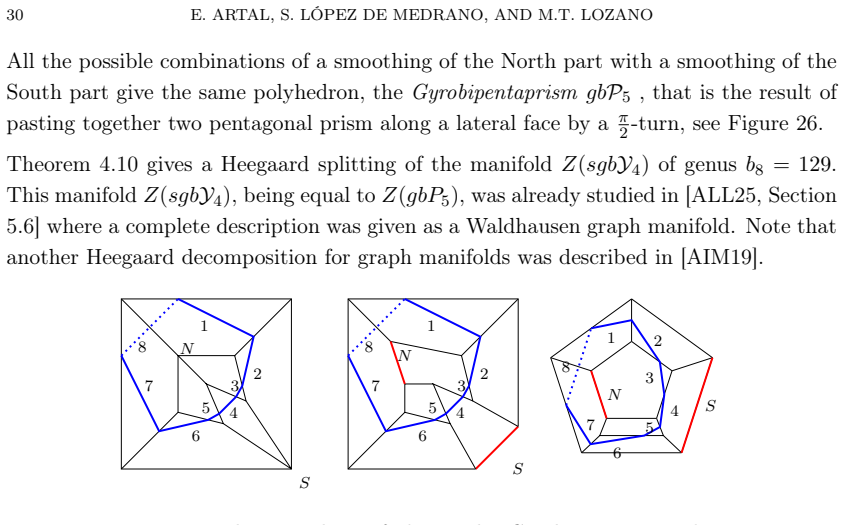
Figure 26. Figure 26: The smoothing of gbY4 is the Gyrobipentaprism gbP5. 5. General case Let Q be a polyhedron whith r faces associated to an intersection of ellipsoids Z(Q) such that a vertex v of Q has valence n ≥ 4. (5.1) π : Z(Q) −→ Q The vertex v corresponds to 2 r−n singular points in Z(Q). A neighborhood Uv of v in Q is a n-pyramid. Then π −1 (Q − Uv) has a boundary composed by 2 r−n surfaces (Fbn )i , i = 1, . . . , 2… view at source ↗
read the original abstract

The goal of this work is to continue the study the smoothings of 3-dimensional manifolds with singularities obtained as small covers of non simple right-angle Coxeter polyhedral orbifolds. They appear in the study of coaxial intersections of ellipsoids. In particular we introduce the concept of $n$-pyramitoid generalizing the $n$-pyramid.

Editorial analysis

A structured set of objections, weighed in public.

Desk editor's note, referee report, simulated authors' rebuttal, and a circularity audit. Tearing a paper down is the easy half of reading it; the pith above is the substance, this is the friction.

Referee Report

0 major / 2 minor

Summary. The manuscript continues the study of smoothings of singular 3-manifolds obtained as small covers of non-simple right-angled Coxeter polyhedral orbifolds arising from coaxial intersections of ellipsoids. Its central contribution is the introduction of the n-pyramitoid as a combinatorial generalization of the n-pyramid, defined explicitly via truncated pyramidal cells with controlled dihedral angles. The paper verifies that the n=3 case recovers the classical pyramid and demonstrates the concept through explicit constructions of smoothing resolutions, including computations of fundamental groups and homology groups.

Significance. If the constructions hold, the n-pyramitoid supplies a structured combinatorial tool that extends prior pyramid-based smoothing techniques to a broader class of Coxeter orbifolds. The explicit definition, the direct verification for n=3, and the concrete examples with computed topological invariants constitute a clear strength, providing reproducible constructions that can be checked and built upon in geometric topology.

minor comments (2)
  1. [Abstract] The abstract is extremely brief and omits any mention of the explicit combinatorial definition, the n=3 verification, or the fundamental-group/homology computations; a modest expansion would better communicate the paper's concrete contributions.
  2. [Definition of n-pyramitoid] In the section presenting the definition of the n-pyramitoid, the controlled dihedral angles are described combinatorially but would benefit from an accompanying table or diagram that lists the angle constraints for small n (e.g., n=3,4) to improve readability.

Simulated Author's Rebuttal

0 responses · 0 unresolved

We thank the referee for the positive summary of our manuscript and the recommendation for minor revision. The referee's description accurately reflects our introduction of the n-pyramitoid as a generalization of the n-pyramid for studying smoothings of singular 3-manifolds arising from small covers of Coxeter orbifolds in ellipsoid intersections. No specific major comments were provided in the report.

Circularity Check

0 steps flagged

No circularity: explicit new definition self-contained

full rationale

The paper introduces the n-pyramitoid via an explicit combinatorial definition (truncated pyramidal cells with controlled dihedral angles) that directly generalizes the n-pyramid, verifies the n=3 case recovers the classical pyramid, and carries the construction through to concrete smoothing resolutions of singular 3-manifolds from small covers of right-angled Coxeter orbifolds, including explicit fundamental-group and homology computations. No load-bearing step reduces by construction to fitted inputs, self-citations, or prior results; the contribution is a self-contained definitional extension with independent geometric content.

Axiom & Free-Parameter Ledger

0 free parameters · 0 axioms · 1 invented entities

The paper's main addition is the definition of a new geometric object; no free parameters, unstated axioms, or invented entities beyond the named concept are indicated in the abstract.

invented entities (1)
  • n-pyramitoid no independent evidence
    purpose: Generalizing the n-pyramid to study smoothings of singular 3-manifolds from Coxeter orbifolds and ellipsoid intersections
    Newly introduced concept presented as the key contribution.

pith-pipeline@v0.9.0 · 5356 in / 1178 out tokens · 43560 ms · 2026-05-09T19:21:12.869517+00:00 · methodology

discussion (0)

Sign in with ORCID, Apple, or X to comment. Anyone can read and Pith papers without signing in.

Reference graph

Works this paper leans on

15 extracted references

  1. [1]

    Artal, S

    E. Artal, S. Isaza, and M.\'A. Marco, Heegaard splittings of graph manifolds, Ann. Mat. Pura Appl. (4) 198 (2019), no. 3, 727--747

  2. [2]

    Artal, S

    E. Artal, S. L\'opez de Medrano , and M.T. Lozano, The dodecahedron: from intersections of quadrics to B orromean rings , A mathematical tribute to P rofessor J . M . M ontesinos A milibia, Dep. Geom. Topol. Fac. Cien. Mat. UCM, Madrid, 2016, pp. 85--103

  3. [3]

    , On generic singularities of intersections of ellipsoids: the octahedron, Bol. Soc. Mat. Mex. (3) 31 (2025), no. 2, Paper No. 51, 34

  4. [4]

    Bahri, M

    A. Bahri, M. Bendersky, F.R. Cohen, and S. Gitler, Decompositions of the polyhedral product functor with applications to moment-angle complexes and related spaces, Proc. Natl. Acad. Sci. USA 106 (2009), no. 30, 12241--12244

  5. [5]

    Beineke and F

    L.W. Beineke and F. Harary, The genus of the n -cube , Canadian J. Math. 17 (1965), 494--496

  6. [6]

    Bowman and A

    D. Bowman and A. Regev, Counting symmetry classes of dissections of a convex regular polygon, Adv. in Appl. Math. 56 (2014), 35--55

  7. [7]

    Davis, Groups generated by reflections and aspherical manifolds not covered by E uclidean space , Ann

    M.W. Davis, Groups generated by reflections and aspherical manifolds not covered by E uclidean space , Ann. of Math. (2) 117 (1983), no. 2, 293--324

  8. [8]

    Davis and T

    M.W. Davis and T. Januszkiewicz, Convex polytopes, C oxeter orbifolds and torus actions , Duke Math. J. 62 (1991), no. 2, 417--451

  9. [9]

    Dutch, Enumeration of polyhedra, https://stevedutch.net/symmetry/polynum0.htm

    S. Dutch, Enumeration of polyhedra, https://stevedutch.net/symmetry/polynum0.htm

  10. [10]

    Gitler and S

    S. Gitler and S. L\'opez de Medrano , Intersections of quadrics, moment-angle manifolds and connected sums, Geom. Topol. 17 (2013), no. 3, 1497--1534

  11. [11]

    Heegaard, Preliminary studies for a topological theory of the connectivity of algebraic surfaces., Kj \"o benhavn

    P. Heegaard, Preliminary studies for a topological theory of the connectivity of algebraic surfaces., Kj \"o benhavn. 104 S . \(8^ \) , 1898

  12. [12]

    Hempel, 3 - M anifolds , Annals of Mathematics Studies, vol

    J. Hempel, 3 - M anifolds , Annals of Mathematics Studies, vol. No. 86, Princeton University Press, Princeton, NJ; University of Tokyo Press, Tokyo, 1976

  13. [13]

    López de Medrano and G

    S. López de Medrano and G. de la Vega, Generalizing the M ay- L eonard system to any number of species , Progress and challenges in dynamical systems, Springer Proc. Math. Stat., vol. 54, Springer, Heidelberg, 2013, pp. 395--407

  14. [14]

    López de Medrano , From singularities to polyhedral products, Handbook of geometry and topology of singularities II , Springer, Cham, 2021, pp

    S. López de Medrano , From singularities to polyhedral products, Handbook of geometry and topology of singularities II , Springer, Cham, 2021, pp. 463--499

  15. [15]

    , The O n- L ine E ncyclopedia of I nteger S equences , 2025, Published electronically at http://oeis.org

    OEIS Foundation Inc. , The O n- L ine E ncyclopedia of I nteger S equences , 2025, Published electronically at http://oeis.org