Recognition: unknown
Programmable Integrated Magnonic Meshes
Pith reviewed 2026-05-09 19:13 UTC · model grok-4.3
The pith
Laser writing fabricates programmable magnonic meshes that route RF signals on a chip across seven cascaded stages without amplification.
A machine-rendered reading of the paper's core claim, the machinery that carries it, and where it could break.
Core claim
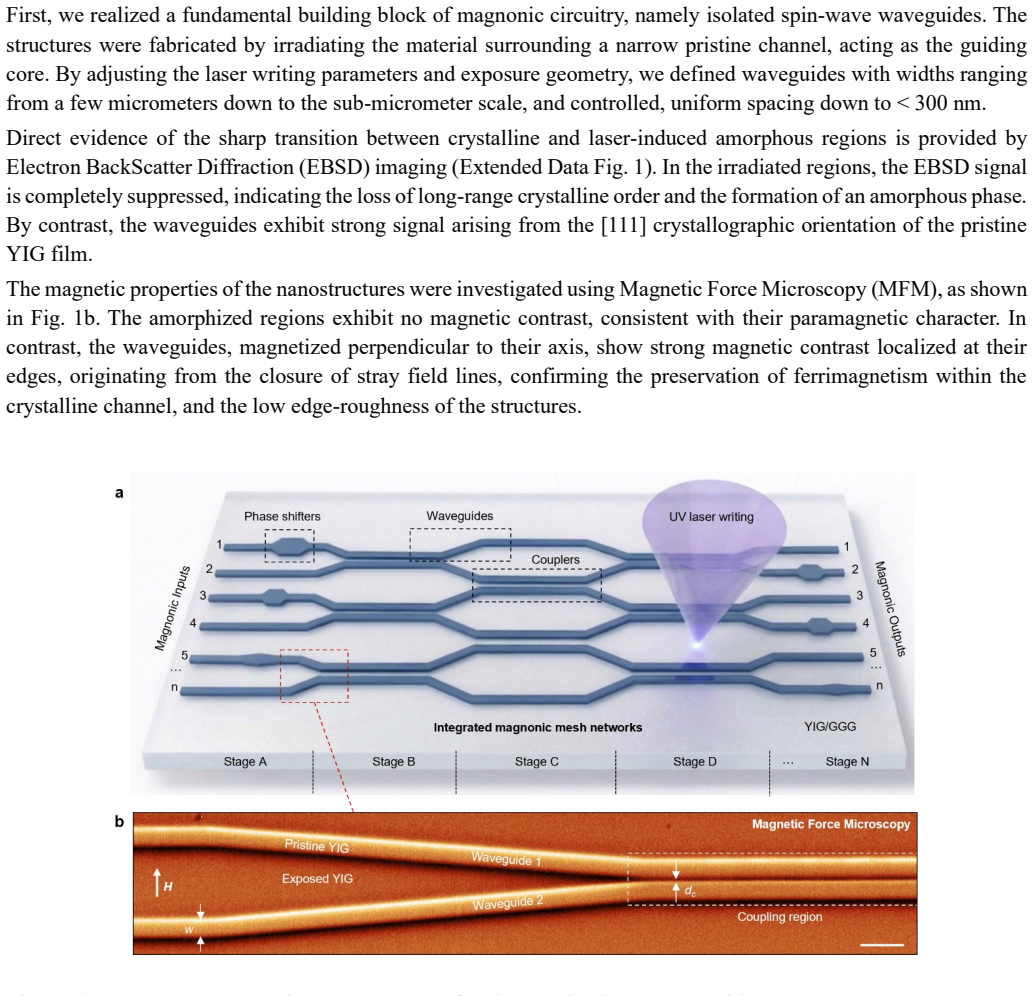
Using a single-step direct laser writing process in yttrium iron garnet, we fabricate and monolithically cascade magnonic waveguides, coupled waveguides that exhibit complete and periodic power transfer, and tunable phase shifters to realize programmable splitters, frequency demultiplexers, phase-controlled 2x2 routers, and interferometric meshes with up to six magnonic inputs and outputs across seven cascaded stages, all without intermediate amplification, while preserving efficient propagation and phase coherence over hundreds of wavelengths.
What carries the argument
Monolithically cascaded laser-written magnonic elements—waveguides, directional couplers, and external-field-tunable phase shifters—that together form programmable interferometric meshes for on-chip RF routing.
If this is right
- Programmable splitters and frequency demultiplexers can be built by cascading the basic waveguide, coupler, and phase-shifter elements.
- Phase-controlled 2x2 routers can be programmed on demand to set both output power distribution and relative phase using external magnetic fields.
- Interferometric meshes with six inputs and outputs become possible without any intermediate amplification between stages.
- These networks provide a direct path to large-scale magnonic architectures usable for classical microwave processing and quantum information tasks.
Where Pith is reading between the lines
- If the same coherence persists at still larger scales, magnonic meshes could support complex on-chip logic operations comparable to those in electronic integrated circuits.
- Hybrid integration of these meshes with superconducting or photonic elements could create low-power microwave processors that combine magnonic and other wave-based technologies.
- Testing the meshes at higher frequencies or in alternative magnetic films would reveal how far the laser-writing approach can extend before damping becomes limiting.
Load-bearing premise
The laser-written structures preserve low enough magnetic damping and uniformity for spin waves to keep their phase and amplitude across multiple cascaded stages and hundreds of wavelengths.
What would settle it
Clear loss of phase coherence or strong attenuation of the spin-wave signal after propagation through a seven-stage mesh spanning hundreds of wavelengths would show the damping assumption does not hold.
Figures

read the original abstract
Integrated circuits are a cornerstone of modern information technology, and analog wave-based architectures could enable fast and efficient processing beyond conventional charge electronics. In magnonics, spin waves provide a highly tunable, compact and energy-efficient medium for on-chip microwave signal transport and processing. However, progress has been limited to isolated elements or short devices, severely limiting the overall functional complexity and scalability. Here we realize the key elements of universal magnonic circuitry, using a single-step direct laser writing process in yttrium iron garnet, and monolithically cascade them in multi-stage programmable devices and networks. Using magneto-optical Kerr effect microscopy, we show efficient spin-wave propagation and preserved phase coherence in waveguide structures for hundreds of wavelengths. In coupled waveguides, we observe complete and periodic power transfer over several coupling lengths, and in phase shifters we achieve arbitrary, tunable phase delays. By cascading these elements, we realize programmable splitters, frequency demultiplexers, and phase-controlled 2x2 routers, where output power and relative phase can be programmed on demand via external fields. Finally, we realize programmable magnonic interferometric meshes for on-chip radio-frequency signal routing, with up to six magnonic inputs and outputs and seven cascaded stages, without the need for intermediate amplification. These direct-write cascaded networks bridge a long-standing gap in magnonic scalability, offering a viable pathway toward integrated, large-scale architectures for both classical and quantum processing.
Editorial analysis
A structured set of objections, weighed in public.
Referee Report
Summary. The manuscript reports a single-step direct laser writing process in yttrium iron garnet to monolithically fabricate and cascade magnonic waveguides, couplers, and phase shifters into programmable interferometric meshes. Using MOKE microscopy, it demonstrates spin-wave propagation with preserved phase coherence over hundreds of wavelengths in waveguides, complete periodic power transfer in coupled guides, arbitrary tunable phase delays, and functional devices including splitters, frequency demultiplexers, phase-controlled 2x2 routers, and meshes with up to six inputs/outputs and seven cascaded stages, all without intermediate amplification.
Significance. If the low-damping and uniformity claims hold, the work provides a viable route to scalable, monolithic magnonic integrated circuits for on-chip RF signal routing and processing, bridging the gap from isolated elements to complex multi-stage networks with potential implications for both classical and quantum magnonic architectures.
major comments (2)
- [Abstract] Abstract: the central scalability claim of seven cascaded stages 'without the need for intermediate amplification' is load-bearing but rests on qualitative statements of coherence preservation in single waveguides and complete power transfer in couplers; no quantitative decay lengths, insertion-loss values, transmission spectra, or error bars for the full multi-stage mesh are supplied to confirm that amplitude and phase survive the total propagation distance plus multiple junctions.
- [Description of the interferometric meshes] Description of the interferometric meshes: the assertion that laser-written structures maintain sufficiently low Gilbert damping and spatial uniformity for phase-coherent operation across hundreds of wavelengths and seven stages lacks supporting measurements (e.g., linewidths, propagation constants, or junction losses), leaving the no-amplification assertion incompletely substantiated by the presented data.
minor comments (2)
- The abstract and main text would benefit from explicit statements of the operating frequency, YIG film thickness, and laser-writing parameters to allow reproducibility assessment.
- Figure captions and methods summary should include scale bars, error analysis, and raw data examples for the MOKE observations to clarify the quantitative support for the claims.
Simulated Author's Rebuttal
We thank the referee for the positive overall assessment and for identifying areas where additional quantitative detail would strengthen the manuscript. We address the two major comments point by point below. In both cases we agree that the presentation can be improved by supplying explicit metrics and will revise the manuscript accordingly.
read point-by-point responses
-
Referee: [Abstract] Abstract: the central scalability claim of seven cascaded stages 'without the need for intermediate amplification' is load-bearing but rests on qualitative statements of coherence preservation in single waveguides and complete power transfer in couplers; no quantitative decay lengths, insertion-loss values, transmission spectra, or error bars for the full multi-stage mesh are supplied to confirm that amplitude and phase survive the total propagation distance plus multiple junctions.
Authors: We agree that the abstract claim would be more robust with explicit numbers. The MOKE images already show sustained amplitude and clear interference fringes across the entire seven-stage network, indicating that phase and amplitude are preserved. In the revised manuscript we will add (i) decay lengths extracted from intensity line profiles along the waveguides, (ii) insertion-loss estimates at each coupler and junction derived from the observed power-transfer ratios, (iii) representative transmission spectra for the cascaded devices, and (iv) error bars obtained from repeated measurements on multiple devices. These additions will place the “no intermediate amplification” statement on a quantitative footing. revision: yes
-
Referee: [Description of the interferometric meshes] Description of the interferometric meshes: the assertion that laser-written structures maintain sufficiently low Gilbert damping and spatial uniformity for phase-coherent operation across hundreds of wavelengths and seven stages lacks supporting measurements (e.g., linewidths, propagation constants, or junction losses), leaving the no-amplification assertion incompletely substantiated by the presented data.
Authors: The referee is correct that explicit damping and uniformity metrics are not reported. The long-distance propagation and periodic power transfer visible in the MOKE data already imply that the laser-written YIG waveguides retain low damping and sufficient uniformity. To address the comment directly, the revised version will include (i) spin-wave linewidths obtained from spatial Fourier analysis of the MOKE images or from frequency-dependent measurements, (ii) propagation constants extracted from the observed wave-vector patterns, and (iii) quantitative estimates of junction losses. These data will substantiate the claim of phase-coherent operation over the full mesh length. revision: yes
Circularity Check
No circularity: purely experimental demonstration with no derivations or equations
full rationale
The paper reports fabrication and magneto-optical characterization of laser-written YIG magnonic waveguides, couplers, phase shifters and cascaded meshes. No equations, fitted parameters, predictions, or theoretical derivations appear in the abstract or described content; all functional claims rest on direct experimental observations of spin-wave propagation, power transfer, and phase control. Because there is no derivation chain at all, none of the enumerated circularity patterns (self-definitional, fitted-input-as-prediction, self-citation load-bearing, etc.) can apply. The work is therefore self-contained against external benchmarks with a circularity score of 0.
Axiom & Free-Parameter Ledger
axioms (1)
- domain assumption Spin waves in laser-patterned YIG waveguides exhibit low damping and maintain phase coherence over distances of hundreds of wavelengths.
Reference graph
Works this paper leans on
-
[1]
Vansteenkiste, A. et al. The design and verification of MuMax3. AIP Advances 4, 107133 (2014)
2014
-
[2]
Wang, Q. et al. Reconfigurable nanoscale spin-wave directional coupler. Sci. Adv. 4, e1701517 (2018)
2018
-
[3]
Pettersson, L. A. A., Roman, L. S. & Inganäs, O. Modeling photocurrent action spectra of photovoltaic devices based on organic thin films. Journal of Applied Physics 86, 487–496 (1999)
1999
-
[4]
H., Blank, S
Wemple, S. H., Blank, S. L., Seman, J. A. & Biolsi, W. A. Optical properties of epitaxial iron garnet thin films. Phys. Rev. B 9, 2134–2144 (1974)
1974
-
[5]
Wood, D. L. & Nassau, K. Optical properties of gadolinium gallium garnet. Appl. Opt. 29, 3704 (1990)
1990
-
[6]
Castera, J. P. & Hartemann, P. Adjustable magnetostatic surface -wave multistrip directional coupler. Electron. Lett. (UK) 16, 195–196 (1980)
1980
discussion (0)
Sign in with ORCID, Apple, or X to comment. Anyone can read and Pith papers without signing in.