Recognition: unknown
Exploring RR Lyrae Variable Stars in the Vera C. Rubin Observatory Data Preview 1
Pith reviewed 2026-05-09 19:27 UTC · model grok-4.3
The pith
RR Lyrae distances from Rubin DP1 data agree with literature using PWZ relations but are systematically larger with PLZ relations.
A machine-rendered reading of the paper's core claim, the machinery that carries it, and where it could break.
Core claim
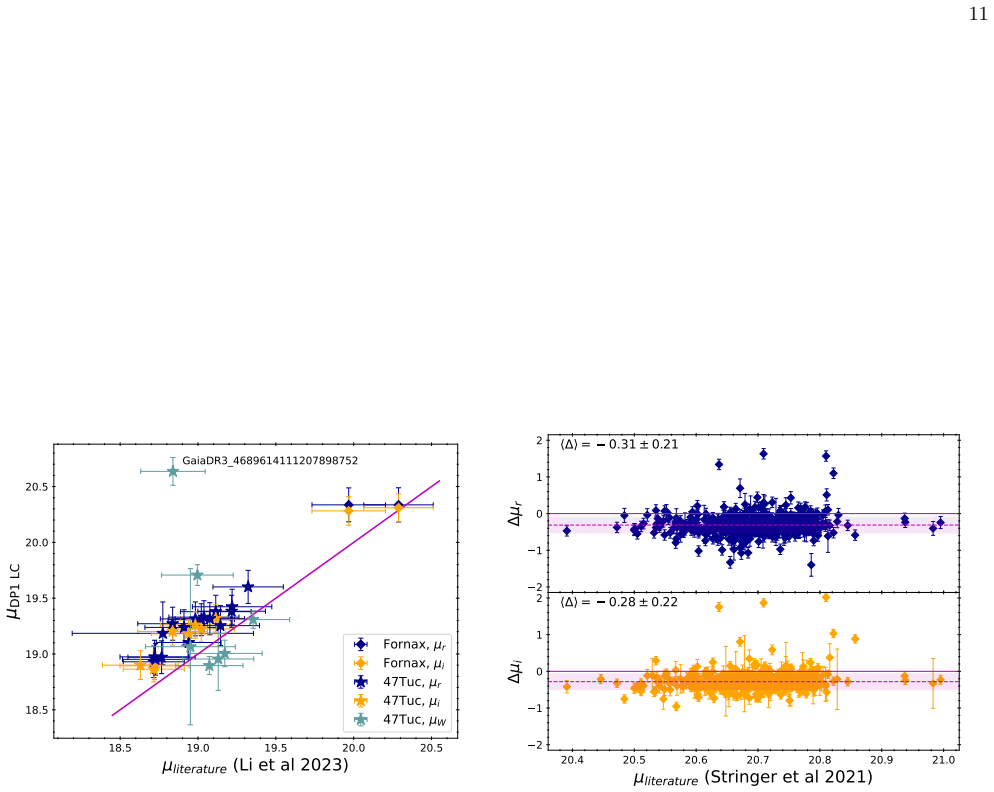
Distances to RR Lyrae stars in the DP1 fields based on the W_gr period-Wesenheit-metallicity relation match literature values with a mean offset of 0.01 plus or minus 0.36 mag, whereas PLZ-based distance moduli are systematically larger, possibly because of theoretical calibration uncertainties that include evolved horizontal branch models. Predicted period-amplitude relations from the evolved models are also inconsistent with amplitudes measured from the DP1 light curves.
What carries the argument
Theoretical period-luminosity-metallicity (PLZ) and period-Wesenheit-metallicity (PWZ) relations from stellar pulsation models tailored to LSST gri filters, applied after template fitting to derive metallicities and distances.
Load-bearing premise
The theoretical PLZ and PWZ relations calibrated on evolved horizontal branch models accurately represent RR Lyrae stars in the LSST gri filters and that template fitting yields reliable parameters even with sparse DP1 light curve sampling.
What would settle it
Future LSST data releases providing densely sampled light curves for the same stars would show whether PLZ distances continue to overestimate literature values or converge once sampling improves.
Figures


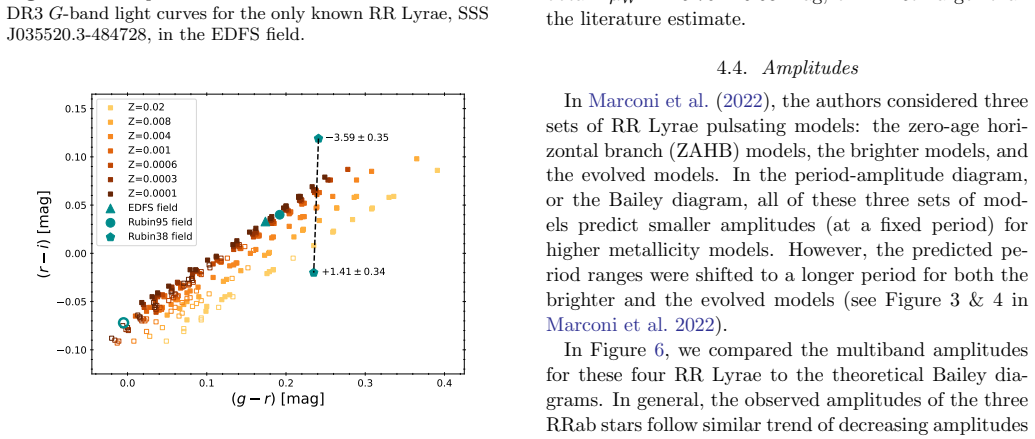
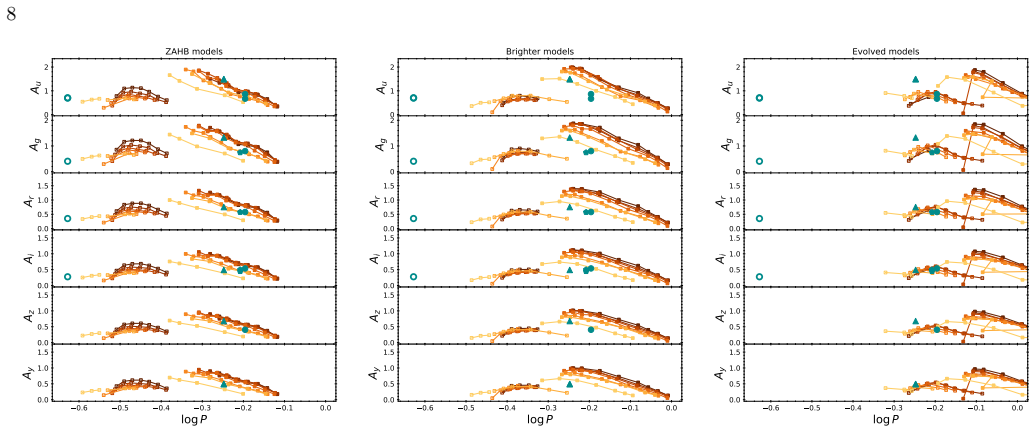

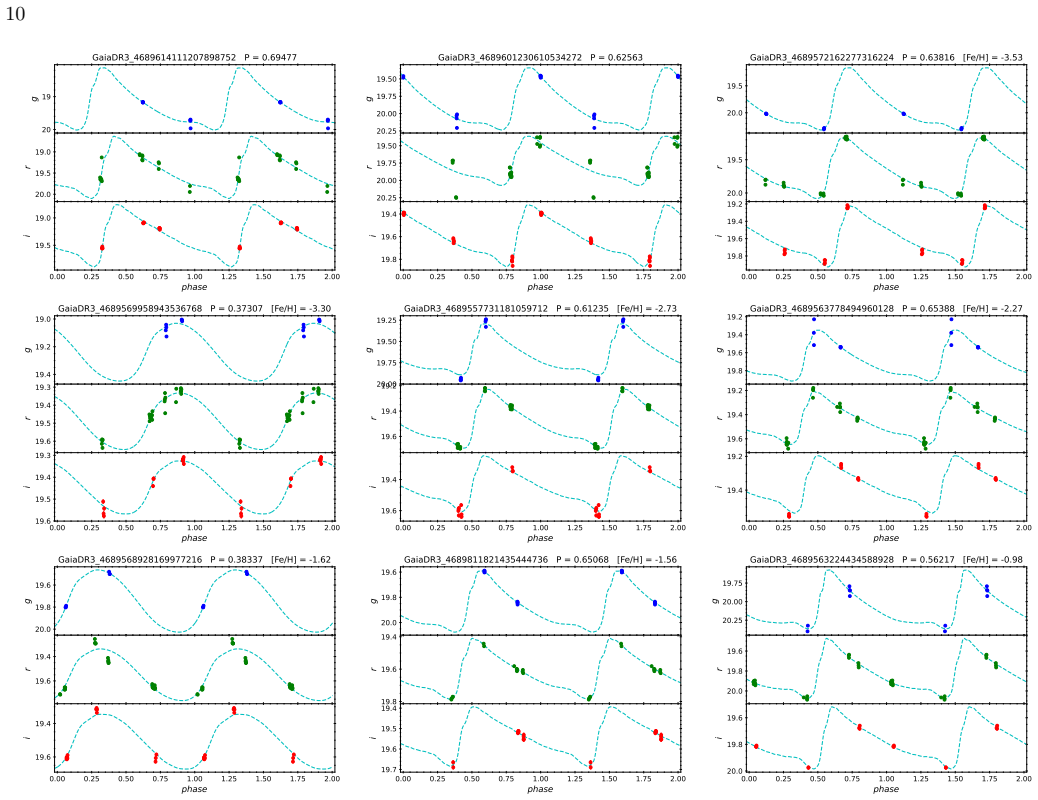
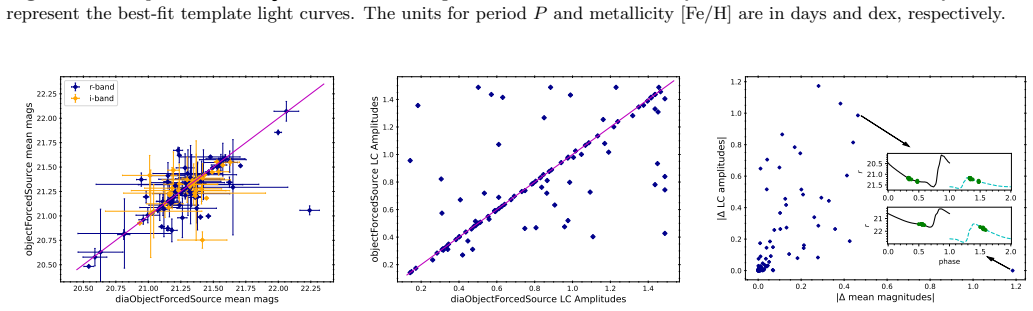

read the original abstract
We investigate the properties of known RR Lyrae in the Vera C. Rubin Observatory Data Preview 1 (DP1) fields and compare those with the predictions based on stellar pulsation models tailored to the Legacy Survey of Space and Time (LSST) filters. The cross-match of the DP1 data with two public variable star catalogs resulted in $\sim 600$ RR Lyrae with adequate light curve sampling in five (out of seven) DP1 fields. The majority of RR Lyrae are in the 47 Tucanae and Fornax fields. We estimated photometric metallicities for these RR Lyrae using the theoretical metallicity-color relation based on $gri$-band data, and find a good agreement with literature values where the light curve sampling is sufficient for fitting template light curves accurately. The distance modulus to all RR Lyrae in DP1 fields were determined using the theoretical period-luminosity-metallicity (PLZ) relations and the $W_{gr}$ period-Wesenheit-metallicity (PWZ) relation which has the smallest metallicity term. The distances based on PWZ relations are in good agreement with the literature values with a mean offset of $0.01\pm0.36$~mag. However, the PLZ-based distance moduli are systematically large which could be due to the theoretical calibration uncertainties that include evolved horizontal branch models. The predicted period-amplitude relations based on evolved models are also inconsistent with the amplitudes based on DP1 light curves. We conclude that the metallicity and distance estimates are sensitive to the template fitting to sparsely sampled light curves in DP1 data and future data release will significantly improve these determinations for RR Lyrae stars.
Editorial analysis
A structured set of objections, weighed in public.
Referee Report
Summary. The manuscript analyzes ~600 RR Lyrae stars identified in five Vera C. Rubin Observatory DP1 fields via cross-matching with public variable-star catalogs. Photometric metallicities are derived from theoretical gri-band metallicity-color relations, and distance moduli are computed using theoretical PLZ and PWZ relations (with the latter having the smallest metallicity coefficient). PWZ distances show a mean offset of 0.01±0.36 mag relative to literature values, while PLZ distances are systematically larger; period-amplitude predictions from evolved horizontal-branch models also mismatch the DP1 amplitudes. The authors conclude that both metallicity and distance estimates are sensitive to template fitting on the sparsely sampled DP1 light curves.
Significance. If the quantitative comparisons hold, the work supplies early empirical benchmarks for theoretical pulsation models calibrated to LSST gri filters against real preview photometry. The small PWZ offset and the explicit caveats on sampling limitations provide practical guidance for RR Lyrae science with the full LSST survey, where denser light-curve coverage will mitigate the reported sensitivities.
major comments (2)
- [Abstract and distance results] The central explanation that PLZ distances are systematically larger because of theoretical calibration uncertainties (including evolved horizontal-branch models) is load-bearing for the interpretation, yet the manuscript provides no quantitative comparison of the PLZ zero-point or slope shift between evolved and non-evolved model sets for the specific LSST gri passbands (see abstract and the distance-modulus results paragraph).
- [Methods and conclusions] The conclusion that metallicity and distance estimates are sensitive to template fitting on sparse DP1 light curves is well-motivated by the reported scatter, but the paper does not quantify the fitting uncertainties (e.g., via bootstrap or Monte-Carlo resampling of the template parameters) or show how the derived periods, amplitudes, and mean magnitudes change with different sampling thresholds.
minor comments (2)
- The abstract states that the majority of the ~600 stars lie in the 47 Tucanae and Fornax fields; adding the exact field-by-field counts and the two fields excluded for inadequate sampling would improve transparency.
- The reported mean offset of 0.01±0.36 mag for PWZ distances is quoted without specifying whether the uncertainty is the standard error of the mean or the rms scatter; clarifying this and showing the distribution of residuals would strengthen the claim of 'good agreement'.
Simulated Author's Rebuttal
We thank the referee for the careful review and the recommendation for minor revision. We address the major comments below and indicate the changes we will make to the manuscript.
read point-by-point responses
-
Referee: [Abstract and distance results] The central explanation that PLZ distances are systematically larger because of theoretical calibration uncertainties (including evolved horizontal-branch models) is load-bearing for the interpretation, yet the manuscript provides no quantitative comparison of the PLZ zero-point or slope shift between evolved and non-evolved model sets for the specific LSST gri passbands (see abstract and the distance-modulus results paragraph).
Authors: We agree that a direct quantitative comparison of the PLZ zero-point and slope between evolved and non-evolved model sets for the LSST gri passbands would strengthen the interpretation. The PLZ relations used here are taken from pulsation models that incorporate evolved horizontal-branch stars, and the observed systematic offset is presented only as a possible cause. In the revised manuscript we will qualify the relevant sentences in the abstract and distance-modulus paragraph to make this explicit, citing the model papers for the expected differences, rather than leaving the statement unqualified. revision: partial
-
Referee: [Methods and conclusions] The conclusion that metallicity and distance estimates are sensitive to template fitting on sparse DP1 light curves is well-motivated by the reported scatter, but the paper does not quantify the fitting uncertainties (e.g., via bootstrap or Monte-Carlo resampling of the template parameters) or show how the derived periods, amplitudes, and mean magnitudes change with different sampling thresholds.
Authors: We acknowledge that explicit quantification of the uncertainties would improve the robustness of the conclusion. The present analysis infers sensitivity from the scatter relative to literature values. In the revised version we will add a Monte-Carlo resampling of the template fits for a representative subset of stars and will include a brief analysis (text and/or table) showing how periods, amplitudes, and mean magnitudes vary with sampling quality thresholds. These additions will be placed in the methods and results sections. revision: yes
Circularity Check
No significant circularity; external theoretical relations applied to new data with independent comparisons
full rationale
The paper applies pre-existing theoretical PLZ, PWZ, and metallicity-color relations (calibrated on stellar pulsation models including evolved horizontal branch stars) to DP1 photometry for ~600 RR Lyrae stars. Metallicities and distance moduli are computed from these relations, then compared to independent literature values, yielding a PWZ offset of 0.01±0.36 mag while noting PLZ discrepancies and amplitude mismatches. No parameters of the relations are fitted to the DP1 data; the analysis instead flags sensitivity to sparse light-curve template fitting and attributes differences to model uncertainties. The derivation chain therefore remains self-contained against external benchmarks and does not reduce any claimed result to its own inputs by construction.
Axiom & Free-Parameter Ledger
axioms (2)
- domain assumption Theoretical metallicity-color relation based on gri-band data for RR Lyrae
- domain assumption Theoretical PLZ and PWZ relations calibrated including evolved horizontal branch models
Reference graph
Works this paper leans on
-
[1]
8 http://www.astropy.org Astropy Collaboration, Robitaille, T. P., Tollerud, E. J., et al. 2013, A&A, 558, A33, doi: 10.1051/0004-6361/201322068 Astropy Collaboration, Price-Whelan, A. M., Sip˝ ocz, B. M., et al. 2018, AJ, 156, 123, doi: 10.3847/1538-3881/aabc4f 14 Astropy Collaboration, Price-Whelan, A. M., Lim, P. L., et al. 2022, ApJ, 935, 167, doi: 10...
-
[2]
Beaton, R. L., Bono, G., Braga, V. F., et al. 2018, SSRv, 214, 113, doi: 10.1007/s11214-018-0542-1
-
[3]
Bersier, D., & Wood, P. R. 2002, AJ, 123, 840, doi: 10.1086/338315
-
[4]
2020, Journal of Astrophysics and Astronomy, 41, 23, doi: 10.1007/s12036-020-09640-z
Bhardwaj, A. 2020, Journal of Astrophysics and Astronomy, 41, 23, doi: 10.1007/s12036-020-09640-z
-
[5]
2024, AJ, 167, 247, doi: 10.3847/1538-3881/ad38b6
Bhardwaj, A., Rejkuba, M., Ngeow, C.-C., et al. 2024, AJ, 167, 247, doi: 10.3847/1538-3881/ad38b6
-
[6]
F., Monelli, M., Dall’Ora, M., et al
Braga, V. F., Monelli, M., Dall’Ora, M., et al. 2024, A&A, 689, A349, doi: 10.1051/0004-6361/202450971
-
[7]
F., Fiorentino, G., Bono, G., et al
Braga, V. F., Fiorentino, G., Bono, G., et al. 2022, MNRAS, 517, 5368, doi: 10.1093/mnras/stac2813
-
[8]
2025, arXiv e-prints, arXiv:2501.02103, doi: 10.48550/arXiv.2501.02103
Caplar, N., Beebe, W., Branton, D., et al. 2025, arXiv e-prints, arXiv:2501.02103, doi: 10.48550/arXiv.2501.02103
-
[9]
Cardelli, J. A., Clayton, G. C., & Mathis, J. S. 1989, ApJ, 345, 245, doi: 10.1086/167900
-
[10]
Choi, Y., Olsen, K. A. G., Carlin, J. L., et al. 2025, ApJ, 992, 47, doi: 10.3847/1538-4357/adfb70 Dark Energy Survey Collaboration, Abbott, T., Abdalla, F. B., et al. 2016, MNRAS, 460, 1270, doi: 10.1093/mnras/stw641 D´ ek´ any, I., & Grebel, E. K. 2022, ApJS, 261, 33, doi: 10.3847/1538-4365/ac74ba
-
[11]
Feng, Y., Guhathakurta, P., Peng, E. W., et al. 2024, ApJ, 966, 159, doi: 10.3847/1538-4357/ad2ae7
-
[12]
Fiorentino, G., Monelli, M., Stetson, P. B., et al. 2017, A&A, 599, A125, doi: 10.1051/0004-6361/201629501 Gaia Collaboration, Prusti, T., de Bruijne, J. H. J., et al. 2016, A&A, 595, A1, doi: 10.1051/0004-6361/201629272 Gaia Collaboration, Vallenari, A., Brown, A. G. A., et al. 2023, A&A, 674, A1, doi: 10.1051/0004-6361/202243940
-
[13]
Gordon, K. D., Clayton, G. C., Decleir, M., et al. 2023, ApJ, 950, 86, doi: 10.3847/1538-4357/accb59
-
[14]
Green, G. M. 2018, The Journal of Open Source Software, 3, 695, doi: 10.21105/joss.00695
-
[15]
Hambleton, K. M., Bianco, F. B., Street, R., et al. 2023, PASP, 135, 105002, doi: 10.1088/1538-3873/acdb9a
-
[16]
Hernitschek, N., Cohen, J. G., Rix, H.-W., et al. 2018, ApJ, 859, 31, doi: 10.3847/1538-4357/aabfbb Ivezi´ c,ˇZ., Kahn, S. M., Tyson, J. A., et al. 2019, ApJ, 873, 111, doi: 10.3847/1538-4357/ab042c
-
[17]
Li, X.-Y., Huang, Y., Liu, G.-C., Beers, T. C., & Zhang, H.-W. 2023, ApJ, 944, 88, doi: 10.3847/1538-4357/acadd5
-
[18]
2025, arXiv e-prints, arXiv:2506.23955, doi: 10.48550/arXiv.2506.23955
Malanchev, K., DeLucchi, M., Caplar, N., et al. 2025, arXiv e-prints, arXiv:2506.23955, doi: 10.48550/arXiv.2506.23955
-
[19]
2022, ApJ, 934, 29, doi: 10.3847/1538-4357/ac78ee
Marconi, M., Molinaro, R., Dall’Ora, M., et al. 2022, ApJ, 934, 29, doi: 10.3847/1538-4357/ac78ee
-
[20]
2022, Universe, 8, 191, doi: 10.3390/universe8030191
Monelli, M., & Fiorentino, G. 2022, Universe, 8, 191, doi: 10.3390/universe8030191
-
[21]
Nagarajan, P., Weisz, D. R., & El-Badry, K. 2022, ApJ, 932, 19, doi: 10.3847/1538-4357/ac69e6
-
[22]
2026, arXiv e-prints, arXiv:2603.24249, doi: 10.48550/arXiv.2603.24249 NSF-DOE Vera C
Ngeow, C.-C., Bhardwaj, A., Nishad, P., & Susmita, D. 2026, arXiv e-prints, arXiv:2603.24249, doi: 10.48550/arXiv.2603.24249 NSF-DOE Vera C. Rubin Observatory. 2025a, Legacy Survey of Space and Time Data Preview 1 [Data set], NSF-DOE Vera C. Rubin Observatory, doi: 10.71929/RUBIN/2570308. https://www.osti.gov//servlets/purl/2570308
-
[23]
Schlafly, E. F., & Finkbeiner, D. P. 2011, ApJ, 737, 103, doi: 10.1088/0004-637X/737/2/103
work page internal anchor Pith review doi:10.1088/0004-637x/737/2/103 2011
-
[24]
Schlegel, D. J., Finkbeiner, D. P., & Davis, M. 1998, ApJ, 500, 525, doi: 10.1086/305772 SLAC National Accelerator Laboratory, & NSF-DOE Vera C. Rubin Observatory. 2024, LSST Commissioning
-
[25]
https://www.osti.gov//servlets/purl/2561361
Camera, SLAC National Accelerator Laboratory (SLAC), Menlo Park, CA (United States), doi: 10.71929/RUBIN/2561361. https://www.osti.gov//servlets/purl/2561361
-
[26]
M., Drlica-Wagner, A., Macri, L., et al
Stringer, K. M., Drlica-Wagner, A., Macri, L., et al. 2021, ApJ, 911, 109, doi: 10.3847/1538-4357/abe873 Vera C Rubin Observatory Team, Acero Cuellar, T.,
-
[27]
2026, arXiv e-prints, arXiv:2603.23786
Acosta, E., et al. 2026, arXiv e-prints, arXiv:2603.23786. https://arxiv.org/abs/2603.23786
-
[28]
Wang, F., Zhang, H. W., Xue, X. X., et al. 2022, MNRAS, 513, 1958, doi: 10.1093/mnras/stac874
-
[29]
L., Henden, A
Watson, C. L., Henden, A. A., & Price, A. 2006, Society for Astronomical Sciences Annual Symposium, 25, 47
2006
discussion (0)
Sign in with ORCID, Apple, or X to comment. Anyone can read and Pith papers without signing in.