Recognition: unknown
Random Polarization Position Angle Behaviors across Bursts of Repeating Fast Radio Bursts
Pith reviewed 2026-05-09 19:18 UTC · model grok-4.3
The pith
Repeating fast radio bursts exhibit Gaussian-distributed polarization angles with no periodicity because the effective magnetic axis wanders stochastically within the neutron star magnetosphere.
A machine-rendered reading of the paper's core claim, the machinery that carries it, and where it could break.
Core claim
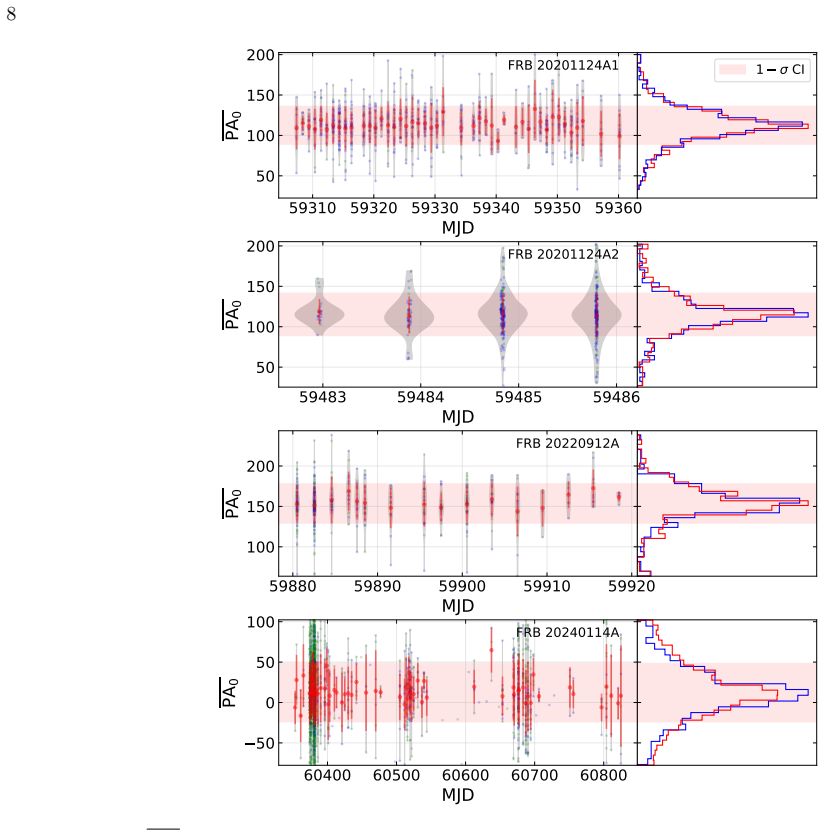
The intrinsic polarization position angles of repeating FRBs are approximately Gaussian distributed, and Lomb-Scargle analysis of their time series detects no credible periodic signal between 10 ms and 10^7 ms. These facts are interpreted by extending the rotating vector model to a dynamically evolving magnetosphere in which the effective magnetic axis varies from burst to burst due to stochastic perturbations. In this picture the PA distributions arise from geometric projection effects, while the absence of periodicity reflects random wandering of the axis inside a confined region, thereby offering a unified explanation for both repeating and apparently non-repeating FRBs.
What carries the argument
An extension of the rotating vector model that incorporates stochastic perturbations to the effective magnetic axis in a dynamically evolving neutron star magnetosphere.
If this is right
- Emission originates from a localized region inside the neutron star magnetosphere.
- Geometric projection of the wandering magnetic axis produces the observed PA distributions.
- Random confined wandering of the axis accounts for the lack of periodicity.
- The same mechanism explains both repeating and apparently non-repeating FRBs.
- PA statistical properties remain stable across separate observation sessions.
Where Pith is reading between the lines
- Magnetospheric perturbations may be a generic feature of neutron stars that produce FRBs and could appear in timing or spectral data at other wavelengths.
- Higher-cadence observations might reveal weak correlations in PA changes if the wandering is not completely random.
- The model predicts that sources with rarer perturbations would appear as one-off FRBs while frequent ones would repeat.
- Similar stochastic axis motion could be tested in other polarized neutron-star phenomena such as pulsar giant pulses.
Load-bearing premise
The measured polarization position angles are intrinsic to the source and their distribution is approximately Gaussian, so that the lack of periodicity signals stochastic rather than periodic evolution of the magnetic axis.
What would settle it
A statistically significant periodic signal in the PA time series at any timescale between 10 ms and 10^7 ms, or a clear deviation from a Gaussian PA distribution in a large sample of bursts from the same source.
Figures


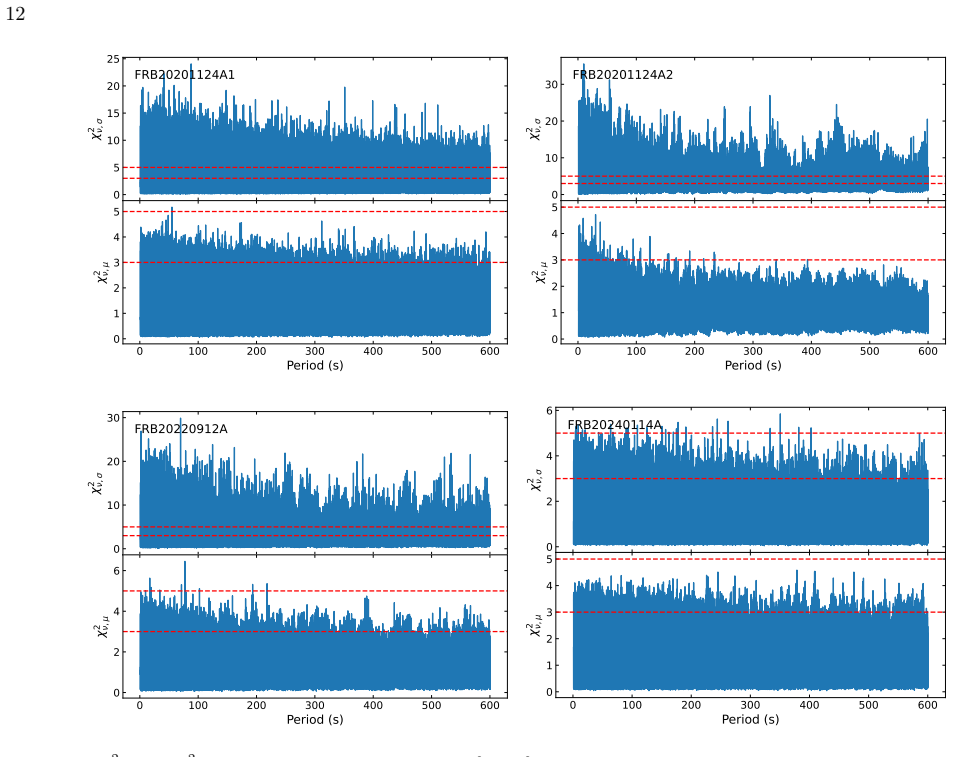
read the original abstract
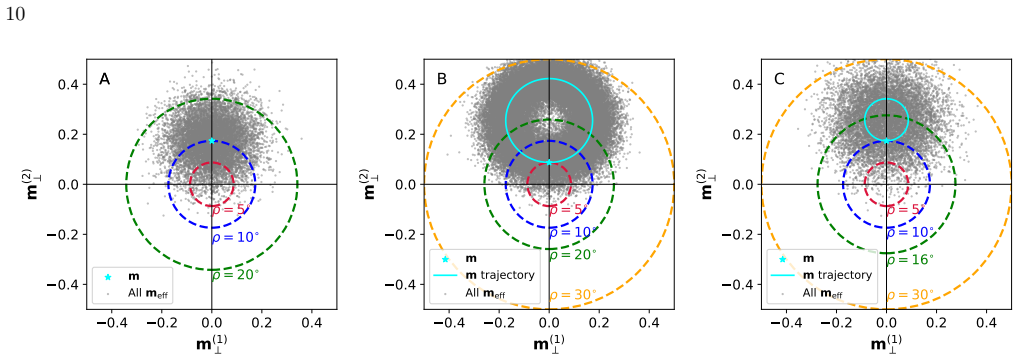
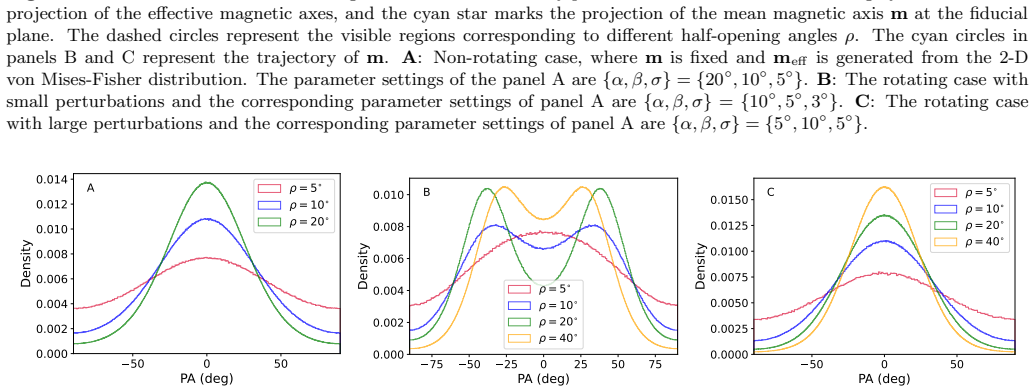
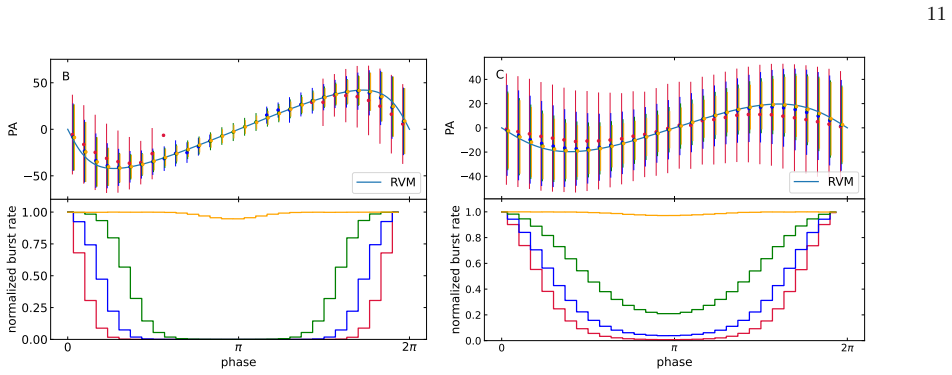
Fast radio bursts (FRBs), highly polarized, mostly have a nearly constant polarization position angle (PA) during each burst. Their PAs are observed to vary from burst to burst, with the statistical properties remaining stable across different observation sessions. We found that the intrinsic PAs of repeating FRBs are approximately Gaussian distributed, suggesting that the emission likely originates from a localized region within the neutron star's magnetosphere. A periodicity search of the PA time series using the Lomb-Scargle periodogram reveals no credible periodic signal in the period range from 10 ms to $10^7$ ms, and similar analyses of several active observations also yield null detections. We interpret these properties by extending the rotating vector model to include a dynamically evolving magnetosphere, in which the effective magnetic axis varies from burst to burst due to stochastic perturbations. In this framework, the observed PA distributions can naturally arise from geometric projection effects, and the absence of periodicity reflects the random wandering of the magnetic axis within a confined region. This scenario provides a natural explanation for both repeating and apparently non-repeating FRBs.
Editorial analysis
A structured set of objections, weighed in public.
Referee Report
Summary. The manuscript analyzes polarization position angles (PAs) across bursts of repeating fast radio bursts (FRBs). It reports that the intrinsic PAs are approximately Gaussian distributed, consistent with emission from a localized region in the neutron star magnetosphere. A Lomb-Scargle periodogram search finds no credible periodic signals in the PA time series over periods from 10 ms to 10^7 ms, including in multiple active observation sessions. The authors extend the rotating vector model to a dynamically evolving magnetosphere in which the effective magnetic axis undergoes stochastic perturbations from burst to burst; they argue that geometric projection effects then naturally produce the observed Gaussian PA distribution while the random wandering within a confined region explains the absence of periodicity. This scenario is proposed as a unified explanation for both repeating and apparently non-repeating FRBs.
Significance. If the central interpretation holds, the work supplies a geometric mechanism that accounts for the stable statistical properties of PA in repeating FRBs and links them to magnetospheric evolution, with potential implications for distinguishing emission physics between repeating and non-repeating sources. The multi-session null periodicity result is a concrete observational constraint. The paper's strength is its direct statistical characterization of PA data; however, the interpretive power is reduced by the absence of quantitative validation of the proposed projection effects.
major comments (2)
- [Interpretation section] Interpretation section (final paragraph of the discussion): the claim that the observed PA distributions 'can naturally arise from geometric projection effects' is presented without any analytic derivation, Monte Carlo realization, or quantitative comparison showing that stochastic wandering of the magnetic axis within a confined region, when mapped through the rotating-vector-model projection, reproduces an approximately Gaussian histogram whose width and shape match the data. This step is load-bearing for the central interpretive claim.
- [Analysis section] Analysis section describing the Gaussian characterization: the statement that intrinsic PAs are 'approximately Gaussian distributed' is used as the primary observational input to the model, yet the manuscript provides no details on the fitting procedure, treatment of measurement uncertainties on individual PA values, or how the intrinsic PA is extracted from the polarized burst emission. This affects the robustness of the distribution that the stochastic-magnetosphere model is required to reproduce.
minor comments (3)
- [Abstract and Methods] The abstract and methods should explicitly state the number of independent observation sessions analyzed for the periodicity search and list the specific sessions or bursts included, to allow direct reproducibility of the null Lomb-Scargle result.
- [Figures] Figure(s) displaying the PA histograms should report the best-fit Gaussian parameters (mean, width, and uncertainties) and overlay the fit on the data for immediate visual assessment.
- [Discussion] The discussion would benefit from a brief comparison to existing applications of the rotating vector model to pulsars and to any prior stochastic-magnetosphere ideas in the FRB or pulsar literature.
Simulated Author's Rebuttal
We thank the referee for their constructive and detailed comments, which have helped clarify several aspects of our analysis and interpretation. We address each major comment below and have revised the manuscript to incorporate additional quantitative support and methodological details.
read point-by-point responses
-
Referee: [Interpretation section] Interpretation section (final paragraph of the discussion): the claim that the observed PA distributions 'can naturally arise from geometric projection effects' is presented without any analytic derivation, Monte Carlo realization, or quantitative comparison showing that stochastic wandering of the magnetic axis within a confined region, when mapped through the rotating-vector-model projection, reproduces an approximately Gaussian histogram whose width and shape match the data. This step is load-bearing for the central interpretive claim.
Authors: We agree that the original presentation was qualitative and that a quantitative demonstration is warranted to support the central claim. In the revised manuscript we have added a Monte Carlo realization of the extended rotating-vector model. The magnetic axis is modeled as undergoing small stochastic angular perturbations drawn from a narrow distribution around a mean orientation; for each realization the projected PA is computed from the standard RVM formula. The resulting ensemble of PAs is approximately Gaussian, with a standard deviation that matches the observed widths for the repeating FRBs in our sample. A new figure and accompanying text in the Interpretation section now present the simulation setup, parameters, and direct comparison to the data histograms. revision: yes
-
Referee: [Analysis section] Analysis section describing the Gaussian characterization: the statement that intrinsic PAs are 'approximately Gaussian distributed' is used as the primary observational input to the model, yet the manuscript provides no details on the fitting procedure, treatment of measurement uncertainties on individual PA values, or how the intrinsic PA is extracted from the polarized burst emission. This affects the robustness of the distribution that the stochastic-magnetosphere model is required to reproduce.
Authors: We have expanded the Analysis section to include the requested methodological details. For each burst the intrinsic PA is obtained by integrating the Stokes Q and U parameters over the burst duration (after baseline subtraction and RFI excision) and computing the angle atan2(U,Q); the associated uncertainty is propagated from the polarized signal-to-noise ratio using the standard formula σ_PA ≈ 1/(2 × S/N_pol). The distribution of these PAs is then characterized by a maximum-likelihood Gaussian fit that incorporates the individual measurement uncertainties as weights. We now report the best-fit mean and dispersion together with their uncertainties, the reduced χ² of the fit, and the results of a Kolmogorov-Smirnov test against the Gaussian hypothesis. These additions make the input distribution to the stochastic-magnetosphere model fully reproducible. revision: yes
Circularity Check
No circularity: empirical PA statistics and qualitative model extension remain distinct
full rationale
The paper first reports direct observational results: PA values measured per burst, found to be approximately Gaussian distributed, and Lomb-Scargle periodograms on the PA time series yielding no significant periodic signals. These are data products independent of any model. The subsequent interpretation proposes extending the rotating vector model by adding stochastic perturbations to the magnetic axis, stating that the observed distributions 'can naturally arise from geometric projection effects' and that lack of periodicity 'reflects the random wandering of the magnetic axis within a confined region.' No equations, fitted parameters, or derivations are shown that reduce this extension back to the input data by construction; the framework is offered as a post-hoc narrative explanation rather than a predictive or self-defining calculation. No self-citations are invoked as load-bearing uniqueness theorems or ansatzes. The chain therefore contains no circular steps.
Axiom & Free-Parameter Ledger
free parameters (1)
- width of magnetic axis wandering region
axioms (2)
- standard math Rotating vector model describes polarization changes due to rotating magnetic field geometry
- domain assumption Observed PA variations are dominated by geometric projection rather than propagation or emission physics
invented entities (1)
-
dynamically evolving magnetosphere with stochastic perturbations
no independent evidence
Reference graph
Works this paper leans on
-
[1]
A second-scale periodicity in an active repeating fast radio burst source. arXiv e-prints , keywords =. doi:10.48550/arXiv.2503.12013 , archivePrefix =. 2503.12013 , primaryClass =
-
[2]
2025, ApJL, 994, L20, doi: 10.3847/2041-8213/ae1023
Magnetars in Binaries as the Engine of Actively Repeating Fast Radio Bursts. , keywords =. doi:10.3847/2041-8213/ae1023 , archivePrefix =. 2508.12119 , primaryClass =
-
[3]
Constraining the origin of the long-term periodicity of FRB 20180916B with polarization position angle. , keywords =. doi:10.1051/0004-6361/202556347 , archivePrefix =. 2507.07651 , primaryClass =
-
[4]
Behavior of the Position and Ellipticity Angles at Polarization Mode Transitions in Pulsar Radio Emission. , keywords =. doi:10.3847/1538-4357/ad6443 , archivePrefix =. 2408.09609 , primaryClass =
-
[5]
2025, ApJ, 988, 164, doi: 10.3847/1538-4357/ade1d2
Propagation-induced Frequency-dependent Polarization Properties of Fast Radio Burst. , keywords =. doi:10.3847/1538-4357/ade1d2 , archivePrefix =. 2502.02857 , primaryClass =
-
[6]
Magnetospheric Curvature Radiation by Bunches as Emission Mechanism for Repeating Fast Radio Bursts. , keywords =. doi:10.3847/1538-4357/ac4097 , archivePrefix =. 2111.11841 , primaryClass =
-
[7]
2025, ApJ, 988, 175, doi: 10.3847/1538-4357/ade689
Polarization Position Angle Swing and the Rotating Vector Model of Repeating Fast Radio Bursts. , keywords =. doi:10.3847/1538-4357/ade689 , archivePrefix =. 2504.00391 , primaryClass =
-
[8]
2025a, arXiv e-prints, arXiv:2507.14708, doi: 10.48550/arXiv.2507.14708
A comprehensive search for Long and Short Periodic Features from an Extremely Active Cycle of FRB 20240114A. arXiv e-prints , keywords =. doi:10.48550/arXiv.2507.14708 , archivePrefix =. 2507.14708 , primaryClass =
-
[9]
C., Cruces, M., Cassanelli, T., et al
Chromatic activity window of periodic FRBs: FRB 20121102A and FRB 20180916B. arXiv e-prints , keywords =. doi:10.48550/arXiv.2507.04609 , archivePrefix =. 2507.04609 , primaryClass =
-
[10]
2025, arXiv e-prints, arXiv:2505.06006, doi: 10.48550/arXiv.2505.06006
Periodic variation of magnetoionic environment of a fast radio burst source. arXiv e-prints , keywords =. doi:10.48550/arXiv.2505.06006 , archivePrefix =. 2505.06006 , primaryClass =
-
[11]
No Evidence for Second-Scale Periodicity in FRB 20201124A from FAST Observations. arXiv e-prints , keywords =. doi:10.48550/arXiv.2505.14219 , archivePrefix =. 2505.14219 , primaryClass =
-
[12]
A Possible Four Month Periodicity in the Activity of FRB 20240209A. , keywords =. doi:10.3847/2041-8213/adc386 , archivePrefix =. 2502.11215 , primaryClass =
-
[13]
Ninety percent circular polarization detected in a repeating fast radio burst. National Science Review , keywords =. doi:10.1093/nsr/nwae293 , archivePrefix =. 2408.03313 , primaryClass =
-
[14]
Sudden Polarization Angle Jumps of the Repeating Fast Radio Burst FRB 20201124A. , keywords =. doi:10.3847/2041-8213/ad7023 , archivePrefix =. 2407.10540 , primaryClass =
-
[15]
FAST Observations of an Extremely Active Episode of FRB 20201124A: I. Burst Morphology. Research in Astronomy and Astrophysics , keywords =. doi:10.1088/1674-4527/ac98f8 , archivePrefix =. 2210.03607 , primaryClass =
-
[16]
FAST Observations of an Extremely Active Episode of FRB 20201124A. II. Energy Distribution. Research in Astronomy and Astrophysics , keywords =. doi:10.1088/1674-4527/ac98f7 , archivePrefix =. 2210.03645 , primaryClass =
-
[17]
FAST Observations of an Extremely Active Episode of FRB 20201124A. III. Polarimetry. Research in Astronomy and Astrophysics , keywords =. doi:10.1088/1674-4527/ac98f6 , archivePrefix =. 2210.03609 , primaryClass =
-
[18]
FAST Observations of an Extremely Active Episode of FRB 20201124A. IV. Spin Period Search. Research in Astronomy and Astrophysics , keywords =. doi:10.1088/1674-4527/ac995d , archivePrefix =. 2210.03610 , primaryClass =
-
[19]
A fast radio burst source at a complex magnetized site in a barred galaxy. , keywords =. doi:10.1038/s41586-022-05071-8 , archivePrefix =. 2111.11764 , primaryClass =
-
[20]
A Bright Millisecond Radio Burst of Extragalactic Origin. Science , keywords =. doi:10.1126/science.1147532 , archivePrefix =. 0709.4301 , primaryClass =
-
[21]
A fast radio burst associated with a Galactic magnetar. , keywords =. doi:10.1038/s41586-020-2872-x , archivePrefix =. 2005.10828 , primaryClass =
-
[22]
C., Bandura, K., Bhardwaj, M., et al
A bright millisecond-duration radio burst from a Galactic magnetar. , keywords =. doi:10.1038/s41586-020-2863-y , archivePrefix =. 2005.10324 , primaryClass =
-
[23]
, year = 2025, month = jan, volume =
A pulsar-like polarization angle swing from a nearby fast radio burst. , year = 2025, month = jan, volume =. doi:10.1038/s41586-024-08184-4 , adsurl =
-
[24]
2025, arXiv e-prints, arXiv:2507.14707, doi: 10.48550/arXiv.2507.14707
The magnetar model's energy crisis for a prolific repeating fast radio burst source. arXiv e-prints , keywords =. doi:10.48550/arXiv.2507.14707 , archivePrefix =. 2507.14707 , primaryClass =
-
[25]
Bright Bursts with Submillisecond Structures of FRB 20230607A in a Highly Magnetized Environment. , keywords =. doi:10.3847/1538-4357/addfdb , archivePrefix =. 2504.11173 , primaryClass =
-
[26]
2023, ApJ, 955, 142, doi: 10.3847/1538-4357/aced0b
FAST Observations of FRB 20220912A: Burst Properties and Polarization Characteristics. , keywords =. doi:10.3847/1538-4357/aced0b , archivePrefix =. 2304.14665 , primaryClass =
-
[27]
, year = 1969, month = jan, volume =
Magnetic Poles and the Polarization Structure of Pulsar Radiation. , year = 1969, month = jan, volume =
1969
-
[28]
Are FRBs emitted from rotating magnetospheres? Searching for periodicity in polarized bursts. , keywords =. doi:10.1093/mnrasl/slaf065 , archivePrefix =. 2504.18176 , primaryClass =
-
[29]
The Role of Magnetic and Rotation Axis Alignment in Driving Fast Radio Burst Phenomenology. , keywords =. doi:10.3847/1538-4357/adb8e6 , archivePrefix =. 2410.19043 , primaryClass =
-
[30]
Fast Radio Bursts: An Extragalactic Enigma. , keywords =. doi:10.1146/annurev-astro-091918-104501 , archivePrefix =. 1906.05878 , primaryClass =
-
[31]
Fast Radio Burst Discovered in the Arecibo Pulsar ALFA Survey. , keywords =. doi:10.1088/0004-637X/790/2/101 , archivePrefix =. 1404.2934 , primaryClass =
-
[32]
The absence of periodicity in repeating FRB. , keywords =. doi:10.1093/mnras/stac1059 , archivePrefix =. 2201.02910 , primaryClass =
-
[33]
2021, Nature, 596, 505, doi: 10.1038/s41586-021-03724-8
Chromatic periodic activity down to 120 megahertz in a fast radio burst. , keywords =. doi:10.1038/s41586-021-03724-8 , archivePrefix =. 2012.08348 , primaryClass =
-
[34]
LOFAR Detection of 110-188 MHz Emission and Frequency-dependent Activity from FRB 20180916B. , keywords =. doi:10.3847/2041-8213/abec72 , archivePrefix =. 2012.08372 , primaryClass =
-
[35]
Expectations for fast radio bursts in neutron star-massive star binaries. , keywords =. doi:10.1051/0004-6361/202245468 , archivePrefix =. 2303.16770 , primaryClass =
-
[36]
Periodic Fast Radio Bursts with Neutron Star Free Precession. , keywords =. doi:10.3847/2041-8213/ab7cdd , archivePrefix =. 2002.05752 , primaryClass =
-
[37]
Orbit-induced Spin Precession as a Possible Origin for Periodicity in Periodically Repeating Fast Radio Bursts. , keywords =. doi:10.3847/2041-8213/ab800f , archivePrefix =. 2002.02553 , primaryClass =
-
[38]
2022, Monthly Notices of the Royal Astronomical Society, 515, 2020, doi: 10.1093/mnras/stac1910
Transparency of fast radio burst waves in magnetar magnetospheres. , keywords =. doi:10.1093/mnras/stac1910 , archivePrefix =. 2204.10953 , primaryClass =
-
[39]
2020, The Astrophysical Journal Letters, 898, L29, doi: 10.3847/2041-8213/aba2cf
INTEGRAL Discovery of a Burst with Associated Radio Emission from the Magnetar SGR 1935+2154. , keywords =. doi:10.3847/2041-8213/aba2cf , archivePrefix =. 2005.06335 , primaryClass =
-
[40]
HXMT identification of a non-thermal X-ray burst from SGR J1935+2154 and with FRB 200428. Nature Astronomy , keywords =. doi:10.1038/s41550-021-01302-6 , archivePrefix =. 2005.11071 , primaryClass =
-
[41]
The Role of Plasma Lensing in Fast Radio Bursts. arXiv e-prints , keywords =. doi:10.48550/arXiv.2601.11122 , archivePrefix =. 2601.11122 , primaryClass =
-
[42]
A Cosmic Comb Model of Fast Radio Bursts. , keywords =. doi:10.3847/2041-8213/aa5ded , archivePrefix =. 1701.04094 , primaryClass =
-
[43]
2018, ApJ, 868, 31, doi: 10.3847/1538-4357/aae685
Bunching Coherent Curvature Radiation in Three-dimensional Magnetic Field Geometry: Application to Pulsars and Fast Radio Bursts. , keywords =. doi:10.3847/1538-4357/aae685 , archivePrefix =. 1712.02702 , primaryClass =
-
[44]
Highest Frequency Detection of FRB 121102 at 4-8 GHz Using the Breakthrough Listen Digital Backend at the Green Bank Telescope. , keywords =. doi:10.3847/1538-4357/aad005 , archivePrefix =. 1804.04101 , primaryClass =
-
[45]
2020, Research in Astronomy and Astrophysics, 20, 064, doi: 10.1088/1674-4527/20/5/64
The fundamental performance of FAST with 19-beam receiver at L band. Research in Astronomy and Astrophysics , keywords =. doi:10.1088/1674-4527/20/5/64 , archivePrefix =. 2002.01786 , primaryClass =
-
[46]
Radio emission from a pulsar s magnetic pole revealed by general relativity. Science , keywords =. doi:10.1126/science.aav7272 , archivePrefix =. 1909.06212 , primaryClass =
-
[47]
2024, ApJ, 968, 50, doi: 10.3847/1538-4357/ad40aa
Polarization Properties of 128 Nonrepeating Fast Radio Bursts from the First CHIME/FRB Baseband Catalog. , keywords =. doi:10.3847/1538-4357/ad40aa , archivePrefix =. 2401.17378 , primaryClass =
-
[48]
A radio pulsar phase from SGR J1935+2154 provides clues to the magnetar FRB mechanism. Science Advances , keywords =. doi:10.1126/sciadv.adf6198 , archivePrefix =. 2307.16124 , primaryClass =
-
[49]
The time-averaged properties of the observed pulsar population
The Thousand Pulsar Array program on MeerKAT ─ IX. The time-averaged properties of the observed pulsar population. , keywords =. doi:10.1093/mnras/stac3383 , archivePrefix =. 2211.11849 , primaryClass =
-
[50]
FRB 20240619D: a study of the hyperactivity, rotation measure evolution, and searches for a persistent radio source. , keywords =. doi:10.1093/mnras/staf2222 , adsurl =
-
[51]
2017, MNRAS, 468, 2726, doi: 10.1093/mnras/stx665
Fast radio burst source properties and curvature radiation model. , keywords =. doi:10.1093/mnras/stx665 , archivePrefix =. 1703.06139 , primaryClass =
-
[52]
Blast Waves from Magnetar Flares and Fast Radio Bursts. , keywords =. doi:10.3847/1538-4357/ab83eb , archivePrefix =. 1908.07743 , primaryClass =
-
[53]
Fast radio bursts as synchrotron maser emission from decelerating relativistic blast waves. , keywords =. doi:10.1093/mnras/stz700 , archivePrefix =. 1902.01866 , primaryClass =
-
[54]
2024, The Astrophysical Journal, 974, 296, doi: 10.3847/1538-4357/ad7a64
An Extremely Active Repeating Fast Radio Burst Source in a Likely Nonmagneto-ionic Environment. , keywords =. doi:10.3847/1538-4357/ad7a64 , archivePrefix =. 2304.14671 , primaryClass =
-
[55]
Polarization Angle Orthogonal Jumps in Fast Radio Bursts. arXiv e-prints , keywords =. doi:10.48550/arXiv.2504.07449 , archivePrefix =. 2504.07449 , primaryClass =
-
[56]
Inferring the Intrinsic Energy Function of FRB 20220912A. arXiv e-prints , keywords =. doi:10.48550/arXiv.2512.16122 , archivePrefix =. 2512.16122 , primaryClass =
-
[57]
The Astropy Project: Sustaining and Growing a Community-oriented Open-source Project and the Latest Major Release (v5.0) of the Core Package. , keywords =. doi:10.3847/1538-4357/ac7c74 , archivePrefix =. 2206.14220 , primaryClass =
work page internal anchor Pith review Pith/arXiv arXiv doi:10.3847/1538-4357/ac7c74
-
[58]
Binary Comb Models for FRB 121102. , keywords =. doi:10.3847/1538-4357/ac127a , archivePrefix =. 2105.14480 , primaryClass =
-
[59]
FAST Pulsar Database. I. Polarization Profiles of 682 Pulsars. Research in Astronomy and Astrophysics , keywords =. doi:10.1088/1674-4527/acea1f , archivePrefix =. 2307.10340 , primaryClass =
-
[60]
Application of the rotating vector model
The Thousand-Pulsar-Array programme on MeerKAT ─ XI. Application of the rotating vector model. , keywords =. doi:10.1093/mnras/stac3636 , archivePrefix =. 2212.03988 , primaryClass =
-
[61]
Understanding the Lomb-Scargle Periodogram. , keywords =. doi:10.3847/1538-4365/aab766 , archivePrefix =. 1703.09824 , primaryClass =
work page internal anchor Pith review Pith/arXiv arXiv doi:10.3847/1538-4365/aab766
-
[62]
Periodicity in recurrent fast radio bursts and the origin of ultralong period magnetars. , keywords =. doi:10.1093/mnras/staa1783 , archivePrefix =. 2003.12509 , primaryClass =
-
[63]
Periodic activity from fast radio burst FRB180916 explained in the frame of the orbiting asteroid model. , keywords =. doi:10.1093/mnras/stab2622 , archivePrefix =. 2109.10577 , primaryClass =
-
[64]
On the geometry and environment of repeating FRBs. , keywords =. doi:10.1093/mnras/staa3527 , archivePrefix =. 2004.11223 , primaryClass =
-
[65]
Periodic Fast Radio Bursts as a Probe of Extragalactic Asteroid Belts. , keywords =. doi:10.3847/2041-8213/ab8f2d , archivePrefix =. 2003.04644 , primaryClass =
-
[66]
2020, Research in Astronomy and Astrophysics, 20, 142, doi: 10.1088/1674-4527/20/9/142
Periodicity in fast radio bursts due to forced precession by a fallback disk. Research in Astronomy and Astrophysics , keywords =. doi:10.1088/1674-4527/20/9/142 , archivePrefix =. 2002.10265 , primaryClass =
-
[67]
Periodic fast radio bursts from forcedly precessing neutron stars, anomalous torque, and internal magnetic field for FRB 180916.J0158+65 and FRB 121102. , keywords =. doi:10.1093/mnras/staa1976 , archivePrefix =. 2007.01616 , primaryClass =
-
[68]
Precessing Flaring Magnetar as a Source of Repeating FRB 180916.J0158+65. , keywords =. doi:10.3847/2041-8213/ab8c4c , archivePrefix =. 2002.04595 , primaryClass =
-
[69]
What binary systems are the most likely sources for periodically repeating FRBs?. , keywords =. doi:10.1093/mnrasl/slaa116 , archivePrefix =. 2006.10328 , primaryClass =
-
[70]
Periodic Fast Radio Bursts from Luminous X-ray Binaries. , keywords =. doi:10.3847/1538-4357/ac0140 , archivePrefix =. 2102.06138 , primaryClass =
-
[71]
2020, ApJL, 893, L26, doi: 10.3847/2041-8213/ab83fb
A Binary Comb Model for Periodic Fast Radio Bursts. , keywords =. doi:10.3847/2041-8213/ab83fb , archivePrefix =. 2002.08297 , primaryClass =
-
[72]
The FRB 20121102A November rain in 2018 observed with the Arecibo Telescope. , keywords =. doi:10.1093/mnras/stac3446 , archivePrefix =. 2202.05705 , primaryClass =
-
[73]
A Sample of Low-energy Bursts from FRB 121102. , keywords =. doi:10.3847/2041-8213/ab1f8a , archivePrefix =. 1903.02249 , primaryClass =
-
[74]
Simultaneous multi-telescope observations of FRB 121102. , keywords =. doi:10.1093/mnras/staa1791 , archivePrefix =. 2006.08662 , primaryClass =
-
[75]
A burst storm from the repeating FRB 20200120E in an M81 globular cluster. , keywords =. doi:10.1093/mnras/stad269 , archivePrefix =. 2206.03759 , primaryClass =
-
[76]
A Thorough Search for Short-timescale Periodicity in Four Active Repeating Fast Radio Bursts. , keywords =. doi:10.3847/1538-4357/ad8cd5 , archivePrefix =. 2310.08971 , primaryClass =
-
[77]
Repeating fast radio burst 20201124A originates from a magnetar/Be star binary. Nature Communications , keywords =. doi:10.1038/s41467-022-31923-y , archivePrefix =. 2204.08124 , primaryClass =
-
[78]
Repeating behaviour of FRB 121102: periodicity, waiting times, and energy distribution. , keywords =. doi:10.1093/mnras/staa3223 , archivePrefix =. 2008.03461 , primaryClass =
-
[79]
Arecibo observations of a burst storm from FRB 20121102A in 2016. , keywords =. doi:10.1093/mnras/stac1960 , archivePrefix =. 2111.11282 , primaryClass =
-
[80]
An extreme magneto-ionic environment associated with the fast radio burst source FRB 121102. , keywords =. doi:10.1038/nature25149 , archivePrefix =. 1801.03965 , primaryClass =
discussion (0)
Sign in with ORCID, Apple, or X to comment. Anyone can read and Pith papers without signing in.